MyCompetitiveExams Logo MyCompetitiveExams
Search 1,140+ Questions
Chapters, formulas, speed tricks
→
⚡ Brahmastra NEET 2027
720 MARKS

Dynamic 180-question full-length simulator mixed dynamically from all 6 years for 2027 & 2026 aspirants.

Launch Brahmastra 2027 Test →
Start Practice →
100% Free · No Login Required
Q.98 Botany ⭐ 360° Option Elimination Active
Vault ↗

NEET 2026 Botany Question 98 Solution

Topic: Cell: The Unit of Life · Official NTA Booklet Code 50
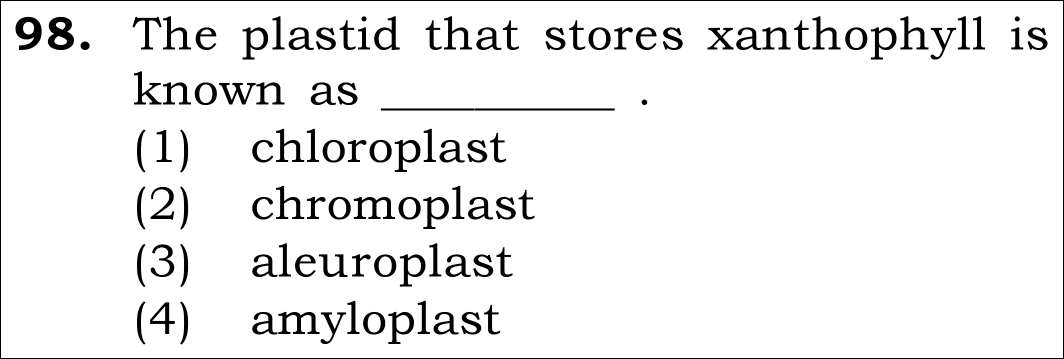
NEET 2026 Botany Question 98: Plastid Classification & Storage of Carotenoid Pigments (Chromoplasts)

Question

The plastid that stores xanthophyll is known as.

  1. (1)chloroplast
  2. (2)chromoplast
  3. (3)aleuroplast
  4. (4)amyloplast
✓
Verified Against NTA Final Answer Key
Option (2) : chromoplast
📚 Cell: The Unit of Life Easy
📋 Given Parameters & Problem Setup
Pigment Stored Xanthophyll (yellow fat-soluble carotenoid pigment)
Target Organelle Type of plastid that stores xanthophyll
⚡

The 30-Second Exam Hall Shortcut: ⚡ Chroma = Color (Yellow, Orange, Red)

⏱️ Save ~40 seconds

Chromoplasts store fat-soluble carotene & xanthophyll pigments to give flowers/fruits vibrant color!

1 Recall plastid classification based on pigments: Chloroplasts, Chromoplasts, and Leucoplasts.
2 Chloroplasts store chlorophyll (green).
3 Leucoplasts are colourless and store starch (amyloplast), oil (elaioplast), or protein (aleuroplast).
4 Chromoplasts store fat-soluble carotenoids: carotene and XANTHOPHYLL (yellow-orange-red).
5 Option (2) is Chromoplast! Pick Option (2) in 5 seconds!
🛡️
Why You Can 100% Trust This Shortcut: NCERT Cell Biology verbatim: In chromoplasts fat soluble carotenoid pigments like carotene, xanthophylls and others are present.
📐

Step-by-Step Rigorous Workflow & Mathematical Proof

Step 1

Classify Plastids Based on Pigment Content

Plastids are found in all plant cells and euglenoids. Based on the presence or absence of specific pigments, Schimper classified plastids into three types: 1. Chloroplasts: Contain chlorophyll and carotenoid pigments for photosynthesis. 2. Chromoplasts: Contain fat-soluble carotenoid pigments such as carotene and xanthophylls, imparting yellow, orange, or red color to petals, pericarp, and ripening fruits. 3. Leucoplasts: Colourless plastids of varied shapes and sizes that store nutrients.

Chromoplast≡Plastid containing Carotene and Xanthophyll\text{Chromoplast} \equiv \text{Plastid containing Carotene and Xanthophyll}
  • • Xanthophyll is an oxygenated carotenoid (yellow pigment).
Step 2

Evaluate the Sub-types of Leucoplasts

Leucoplasts store reserve foods and do NOT store pigments: - Amyloplasts: Store carbohydrates (starch, e.g., potato tuber). - Elaioplasts: Store oils and fats. - Aleuroplasts: Store proteins (aleurone grains).

Amyloplast: Starch;Aleuroplast: Protein;Elaioplast: Fat\text{Amyloplast: Starch}; \quad \text{Aleuroplast: Protein}; \quad \text{Elaioplast: Fat}
  • • Amyloplast and aleuroplast are non-pigmented nutrient storage plastids.
Step 3

Conclusion

The plastid that stores xanthophyll is known as chromoplast.

Matches Option (2)\text{Matches Option (2)}
  • • Matches Option (2).
⭐

360° Option Elimination Engine Key Feature

Diagnose every choice: Know exactly why the right option works and why distractors fail.

4-Option Deep Scan
1 A
✗ Incorrect
Verdict & Scientific Reason:

Incorrect. While chloroplasts have accessory carotenoids, the specialized plastid dedicated to storing high concentrations of xanthophylls and carotenes to color plant organs is the chromoplast.

⚠️
Student Fallacy (Why candidates pick this trap): Assuming all plant pigments are stored in chloroplasts.
2 B
✓ 100% Correct
Verdict & Scientific Reason:

Exact match with NCERT definition of chromoplasts as repositories for fat-soluble carotene and xanthophyll pigments.

💡
Why this is airtight: None; textbook precision.
3 C
✗ Incorrect
Verdict & Scientific Reason:

Incorrect. Aleuroplasts are colourless leucoplasts that store proteins.

⚠️
Student Fallacy (Why candidates pick this trap): Confusing protein-storing aleuroplast with pigment-bearing plastid.
4 D
✗ Incorrect
Verdict & Scientific Reason:

Incorrect. Amyloplasts store carbohydrates/starch.

⚠️
Student Fallacy (Why candidates pick this trap): Confusing starch storage with xanthophyll storage.
⚠️

NTA Trap Alert: Confusing Leucoplast Storage Types with Chromoplasts

Students frequently memorize amyloplast (starch), elaioplast (oil), and aleuroplast (protein), and panic when asked about xanthophyll. Xanthophyll is a PIGMENT, so it belongs to CHROMOPLAST (chromo = color)!

🛡️ How to avoid the -1 mark: Chromo means color. Xanthophyll is yellow pigment, so it resides in Chromoplast.
📖

Core NEET Syllabus Standard

NEET Biology Core Syllabus · Cell: The Unit of Life Standard Benchmark
Core Scientific Principle Tested:

"Chromoplasts contain fat-soluble carotenoids (carotene and xanthophylls) providing yellow, orange, and red pigmentation."

Syllabus Focus: Plastids - Chloroplasts, chromoplasts, and leucoplasts
✓ Core NEET UG Syllabus Anchor Syllabus & Academic Standards ↗
Chroma means Color (Yellow Xanthophyll); Amyl means Starch; Aleuro means Protein!

Ready to attempt under real exam pressure?

Test your speed and accuracy in the authentic 180-minute timed NTA simulator.

Launch NEET 2026 CBT Test →

Spotted a mistake in this solution? Report an error (support@mycompetitiveexams.com)

⚖️ Legal & Fair Dealing Notice: Sourced from publicly released NEET 2026 question papers and NEET answer keys for private study, research, and non-commercial educational practice under Fair Dealing (Section 52(1)(a) of the Indian Copyright Act, 1957). Not affiliated with or endorsed by NTA or NMC.

Solve 4 NEET Questions a Day — One per Subject

Cover all 1,140 official NEET questions in 285 days at your own pace. Progress is saved on your device. No login needed.