MyCompetitiveExams Logo MyCompetitiveExams
Search 1,140+ Questions
Chapters, formulas, speed tricks
→
⚡ Brahmastra NEET 2027
720 MARKS

Dynamic 180-question full-length simulator mixed dynamically from all 6 years for 2027 & 2026 aspirants.

Launch Brahmastra 2027 Test →
Start Practice →
100% Free · No Login Required
Q.179 Zoology ⭐ 360° Option Elimination Active
Vault ↗

NEET 2025 Zoology Question 179 Solution

Topic: Biotechnology: Principles and Processes · Official NTA Booklet Code 45
NEET 2025 Zoology Question 179: Principles of Blue-White Screening (Insertional Inactivation of lacZ)

Question

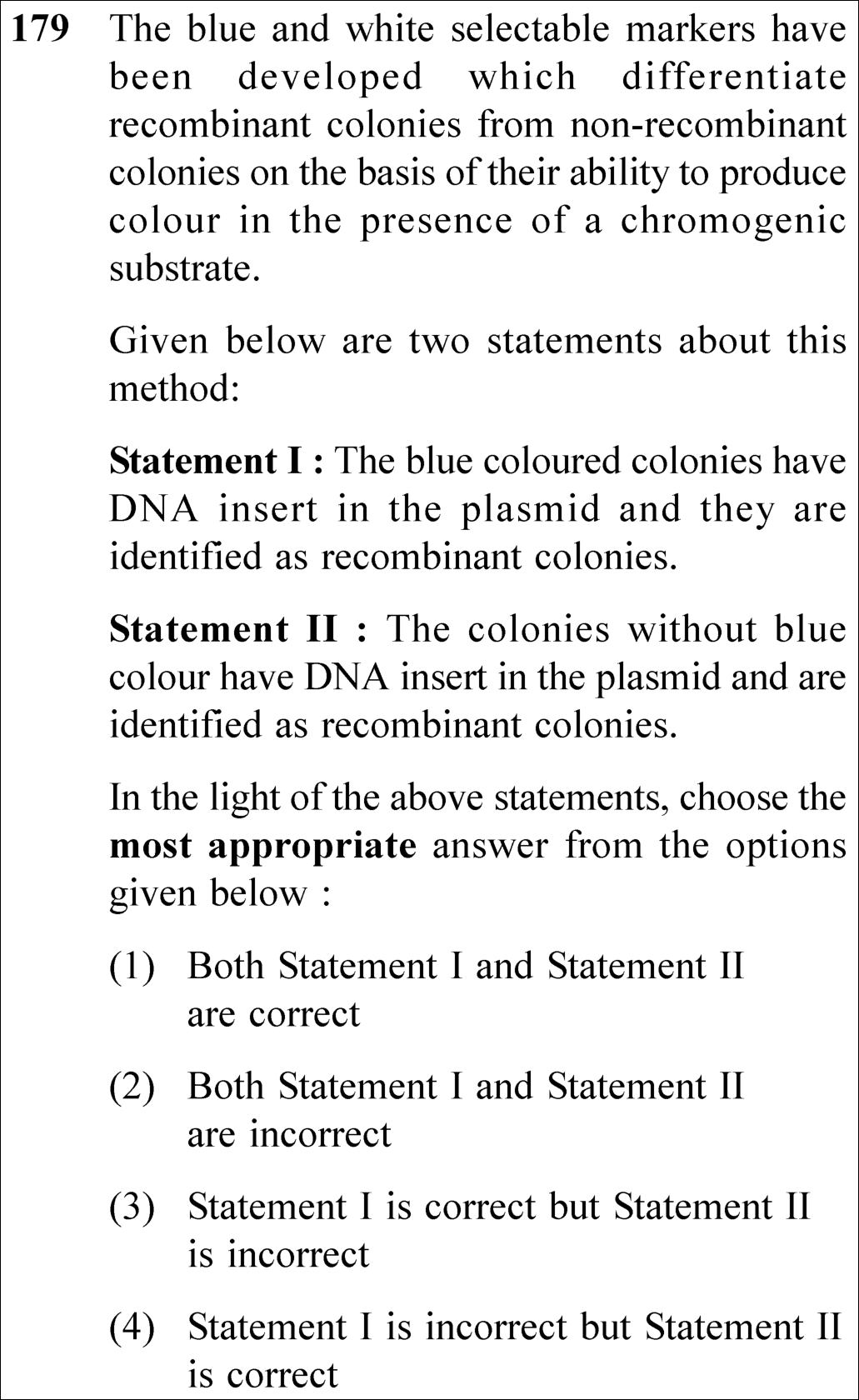
The blue and white selectable markers have been developed which differentiate recombinant colonies from non-recombinant colonies on the basis of their ability to produce colour in the presence of a chromogenic substrate. Given below are two statements about this method: Statement I: The blue coloured colonies have DNA insert in the plasmid and they are identified as recombinant colonies. Statement II: The colonies without blue colour have DNA insert in the plasmid and are identified as recombinant colonies. In the light of the above statements, choose the most appropriate answer from the options given below:

  1. (1)Both Statement I and Statement II are correct
  2. (2)Both Statement I and Statement II are incorrect
  3. (3)Statement I is correct but Statement II is incorrect
  4. (4)Statement I is incorrect but Statement II is correct
✓
Verified Against NTA Final Answer Key
Option (4) : Statement I is incorrect but Statement II is correct
📚 Biotechnology: Principles and Processes Easy
📋 Given Parameters & Problem Setup
Screening Method Blue-White screening using chromogenic substrate (X-gal)
Statement I The blue coloured colonies have DNA insert in the plasmid and they are identified as recombinant colonies.
Statement II The colonies without blue colour have DNA insert in the plasmid and are identified as recombinant colonies.
⚡

The 30-Second Exam Hall Shortcut: ⚡ Blue-White Colony Identification Fingerprint

⏱️ Save ~20 seconds

Insertional inactivation destroys the β-galactosidase gene -> NO enzyme -> Colonies CANNOT turn blue -> WHITE COLONIES (colonies without blue colour) are RECOMBINANTS! Blue colonies are NON-recombinants! Statement I is false, Statement II is true!

1 Recall NCERT Section 11.2.2 (Selection of Recombinants):
2 - "A recombinant DNA is inserted within the coding sequence of an enzyme, β\beta-galactosidase. This results into inactivation of the gene for synthesis of this enzyme, which is referred to as insertional inactivation."
3 - Non-recombinants: Gene is intact -> active β\beta-galactosidase -> forms BLUE colonies.
4 - Recombinants: Gene is disrupted by insert -> inactive enzyme -> colonies do NOT produce colour (WHITE colonies / colonies without blue colour).
5 Analyze statements:
6 - Statement I: Claims blue colonies have DNA insert -> INCORRECT!
7 - Statement II: Claims colonies without blue colour have DNA insert -> CORRECT!
8 Conclusion: Statement I is incorrect but Statement II is correct (Option 4)!
9 Select Option (4)!
🛡️
Why You Can 100% Trust This Shortcut: DNA Ligase & Phosphodiester Bond Synthesis (NCERT Biology · Biotechnology: Principles and Processes: Sealing recombinant constructs).
📐

Step-by-Step Rigorous Workflow & Mathematical Proof

Step 1

Molecular Principle of Blue-White Screening

Blue-white screening is an elegant single-step chromogenic method to identify bacterial transformants carrying recombinant plasmids:

  • • Cloning vectors (e.g. pUC19) contain a multiple cloning site (MCS) embedded inside the coding region of the *lacZ* gene, which codes for the β\beta-galactosidase enzyme.
  • • When foreign DNA is successfully ligated into this MCS, it interrupts the open reading frame of *lacZ*, abolishing functional enzyme production (insertional inactivation).
Step 2

Evaluating Phenotypic Outcomes on X-gal Media

Bacterial colonies grown in the presence of IPTG (inducer) and X-gal (chromogenic substrate):

  • • Non-recombinant colonies (no insert): The *lacZ* gene remains intact and expresses active β\beta-galactosidase. The enzyme hydrolyzes colorless X-gal into 5-bromo-4-chloro-indigo, giving rise to BLUE colonies.
  • • Recombinant colonies (with insert): Due to insertional inactivation, no active β\beta-galactosidase is produced. The substrate is not cleaved, so colonies appear WHITE (colonies without blue colour).
Step 3

Verdict on Statements I and II

Correlating with the test propositions:

  • • Statement I claims blue colonies have the DNA insert. This is completely FALSE because blue colonies lack inserts.
  • • Statement II claims colonies without blue colour (white colonies) have the DNA insert and are recombinants. This is completely TRUE.
  • • Thus, Statement I is incorrect but Statement II is correct.
Step 4

Conclusion

Statement I is incorrect but Statement II is correct, which corresponds to Option (4).

White (No Blue)=Insertional Inactivation (Recombinant)\text{White (No Blue)} = \text{Insertional Inactivation (Recombinant)}
⭐

360° Option Elimination Engine Key Feature

Diagnose every choice: Know exactly why the right option works and why distractors fail.

4-Option Deep Scan
1 A
✗ Incorrect
Verdict & Scientific Reason:

Incorrect. Statement I is false because blue colonies are non-recombinants without inserts.

⚠️
Student Fallacy (Why candidates pick this trap): Assuming color production implies recombinant success.
2 B
✗ Incorrect
Verdict & Scientific Reason:

Incorrect. Statement II is an accurate definition of recombinant identification.

⚠️
Student Fallacy (Why candidates pick this trap): Rejecting both statements.
3 C
✗ Incorrect
Verdict & Scientific Reason:

Incorrect. Exactly reverses the truth values of the two statements.

⚠️
Student Fallacy (Why candidates pick this trap): Flipping blue and white phenotypes.
4 D
✓ 100% Correct
Verdict & Scientific Reason:

100% correct. Accurately identifies that colonies lacking blue color harbor the insert due to insertional inactivation.

💡
Why this is airtight: None; pristine knowledge of recombinant selection.
⚠️

NTA Trap Alert: Blue vs White Recombinant Inversion

Do not associate "Blue" with "Success/Recombinant". In blue-white screening, SUCCESS means you BROKE the gene, so NO color can form. White = Recombinant; Blue = Non-recombinant!

🛡️ How to avoid the -1 mark: White = Recombinant (Gene destroyed); Blue = Non-recombinant (Gene alive).
📖

Core NEET Syllabus Standard

NEET Biology Core Syllabus · Biotechnology: Principles and Processes Standard Benchmark
Core Scientific Principle Tested:

"Insertional inactivation of β-galactosidase causes recombinant colonies to lack blue color in the presence of chromogenic substrate."

Syllabus Focus: Cloning Vectors · Selection of Recombinants (Blue-White Selection)
✓ Core NEET UG Syllabus Anchor Syllabus & Academic Standards ↗
WHITE = Winner (Recombinant with Insert); BLUE = Blank/Base plasmid!

Ready to attempt under real exam pressure?

Test your speed and accuracy in the authentic 180-minute timed NTA simulator.

Launch NEET 2025 CBT Test →

Spotted a mistake in this solution? Report an error (support@mycompetitiveexams.com)

⚖️ Legal & Fair Dealing Notice: Sourced from publicly released NEET 2025 question papers and NEET answer keys for private study, research, and non-commercial educational practice under Fair Dealing (Section 52(1)(a) of the Indian Copyright Act, 1957). Not affiliated with or endorsed by NTA or NMC.

Solve 4 NEET Questions a Day — One per Subject

Cover all 1,140 official NEET questions in 285 days at your own pace. Progress is saved on your device. No login needed.