MyCompetitiveExams Logo MyCompetitiveExams
Search 1,140+ Questions
Chapters, formulas, speed tricks
→
⚡ Brahmastra NEET 2027
720 MARKS

Dynamic 180-question full-length simulator mixed dynamically from all 6 years for 2027 & 2026 aspirants.

Launch Brahmastra 2027 Test →
Start Practice →
100% Free · No Login Required
Q.126 Botany ⭐ 360° Option Elimination Active
Vault ↗

NEET 2025 Botany Question 126 Solution

Topic: Biotechnology: Principles and Processes · Official NTA Booklet Code 45
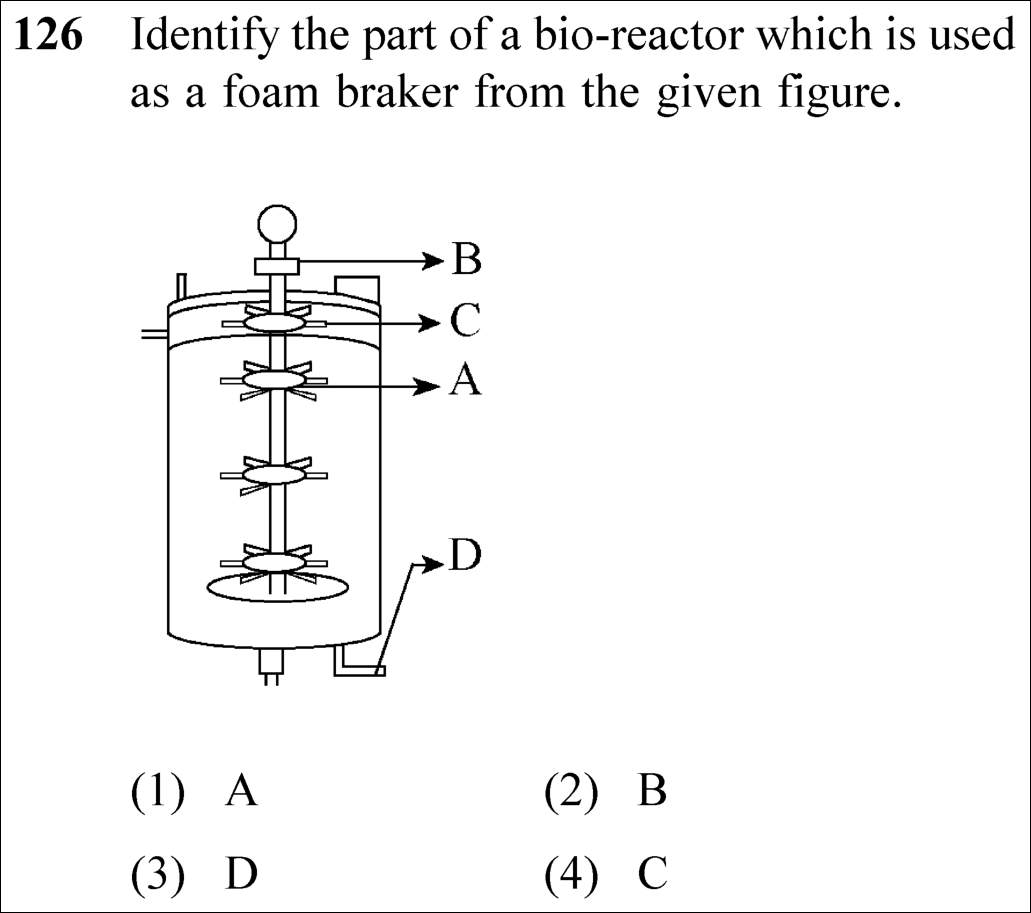
NEET 2025 Botany Question 126: Anatomy and Components of a Stirred-Tank Bioreactor (Foam Breaker)

Question

Identify the part of a bio-reactor which is used as a foam braker from the given figure.

✓
Verified Against NTA Final Answer Key
Option (4) : C
📚 Biotechnology: Principles and Processes Easy
📋 Given Parameters & Problem Setup
Device Simple stirred-tank bioreactor
Target Component Foam breaker (part used to break surface froth/foam)
⚡

The 30-Second Exam Hall Shortcut: ⚡ Bioreactor Parts Diagram Fingerprint

⏱️ Save ~20 seconds

In NCERT Fig 11.7 (a): B = Motor at top; C = Foam breaker at liquid-gas surface; A = Impeller blade (agitator); D = Sterile air sparger at bottom! Part C is the FOAM BREAKER!

1 Recall labels of the simple stirred-tank bioreactor from NCERT:
2 - Top motor driving shaft = B.
3 - Upper impeller located at head space/surface = C (Foam breaker).
4 - Submerged lower blades mixing culture = A (Flat bladed impeller / agitator).
5 - Bottom gas inlet line = D (Sterile air inlet / sparger).
6 The foam breaker is labeled C!
7 Select Option (4) C!
🛡️
Why You Can 100% Trust This Shortcut: Bioreactor Designs & Continuous Culture Systems (NCERT Biology · Biotechnology: Principles and Processes: Sparged vs Stirred-tank).
📐

Step-by-Step Rigorous Workflow & Mathematical Proof

Step 1

Design and Function of a Stirred-Tank Bioreactor

Bioreactors provide optimal conditions for achieving desired products (temperature, pH, substrate, salts, vitamins, oxygen). A simple stirred-tank bioreactor has specific essential subsystems:

  • • Agitator system: Includes an overhead motor (B) driving a central shaft with flat-bladed impellers (A) to ensure uniform mixing and oxygen availability throughout the vessel.
  • • Foam control system: Microbial fermentation with aeration creates violent bubbling and vigorous froth/foam at the liquid-air interface, which can clog exhaust filters and cause contamination. A rotating foam breaker (C) mounted near the liquid surface mechanically disintegrates this foam.
  • • Aeration system: Injects sterile air via a sparger (D) at the base of the vessel.
  • • Temperature, pH control systems, and sampling ports.
Step 2

Correlating the Letters to NCERT Figure 11.7 (a)

Matching the labels:

  • • B -> Motor.
  • • C -> Foam breaker.
  • • A -> Flat bladed impeller (agitator).
  • • D -> Sterile air sparger / line.
Step 3

Conclusion

Part C is explicitly identified as the foam breaker. This corresponds to Option (4).

Foam Breaker=C (Option 4)\text{Foam Breaker} = \text{C (Option 4)}
⭐

360° Option Elimination Engine Key Feature

Diagnose every choice: Know exactly why the right option works and why distractors fail.

4-Option Deep Scan
1 A
✗ Incorrect
Verdict & Scientific Reason:

Incorrect. Part A is the flat-bladed impeller (agitator system) submerged in the liquid broth.

⚠️
Student Fallacy (Why candidates pick this trap): Confusing agitator impeller with foam breaker.
2 B
✗ Incorrect
Verdict & Scientific Reason:

Incorrect. Part B is the electric motor mounted on the headplate.

⚠️
Student Fallacy (Why candidates pick this trap): Confusing the drive motor with the foam breaker blade.
3 C
✗ Incorrect
Verdict & Scientific Reason:

Incorrect. Part D is the sterile air sparger/inlet at the vessel bottom.

⚠️
Student Fallacy (Why candidates pick this trap): Confusing aeration inlet with surface foam control.
4 D
✓ 100% Correct
Verdict & Scientific Reason:

100% correct. Part C is the horizontal rotating foam-breaking blade positioned at the liquid-gas interface.

💡
Why this is airtight: None; flawless recall of NCERT diagram labels.
⚠️

NTA Trap Alert: Location of Foam Breaker vs Liquid Impellers

Foam only forms at the surface of the liquid broth. Therefore, the foam breaker must be the uppermost rotating set of blades located above/at the liquid level (C), while the impellers that mix the liquid are submerged deeper (A).

🛡️ How to avoid the -1 mark: Look at the height: top blade at the surface = Foam breaker (C).
📖

Core NEET Syllabus Standard

NEET Biology Core Syllabus · Biotechnology: Principles and Processes Standard Benchmark
Core Scientific Principle Tested:

"In a simple stirred-tank bioreactor, the upper rotating component at the broth surface is the foam breaker."

Syllabus Focus: Bioreactors · Stirred-Tank Bioreactor Components
✓ Core NEET UG Syllabus Anchor Syllabus & Academic Standards ↗
C is at the Ceiling of the liquid to Crush the foam!

Ready to attempt under real exam pressure?

Test your speed and accuracy in the authentic 180-minute timed NTA simulator.

Launch NEET 2025 CBT Test →

Spotted a mistake in this solution? Report an error (support@mycompetitiveexams.com)

⚖️ Legal & Fair Dealing Notice: Sourced from publicly released NEET 2025 question papers and NEET answer keys for private study, research, and non-commercial educational practice under Fair Dealing (Section 52(1)(a) of the Indian Copyright Act, 1957). Not affiliated with or endorsed by NTA or NMC.

Solve 4 NEET Questions a Day — One per Subject

Cover all 1,140 official NEET questions in 285 days at your own pace. Progress is saved on your device. No login needed.