MyCompetitiveExams Logo MyCompetitiveExams
Search 1,140+ Questions
Chapters, formulas, speed tricks
→
⚡ Brahmastra NEET 2027
720 MARKS

Dynamic 180-question full-length simulator mixed dynamically from all 6 years for 2027 & 2026 aspirants.

Launch Brahmastra 2027 Test →
Start Practice →
100% Free · No Login Required
Q.150 Botany ⭐ 360° Option Elimination Active
Vault ↗

NEET 2021 Botany Question 150 Solution

Topic: Biotechnology: Principles and Processes · Official NTA Booklet Code M1
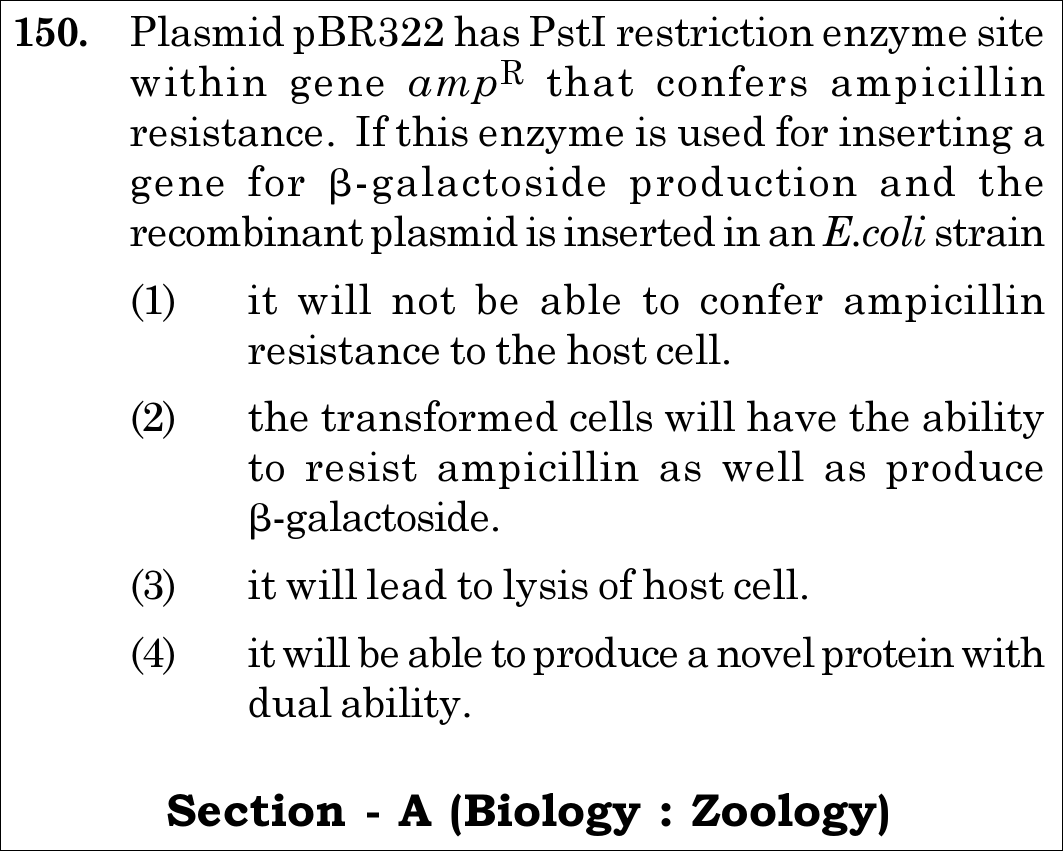
NEET 2021 Botany Question 150: Insertional Inactivation of Ampicillin Resistance in Plasmid pBR322

Question

Plasmid pBR322 has PstI restriction enzyme site within gene ampR that confers ampicillin resistance. If this enzyme is used for inserting a gene for β-galactoside production and the recombinant plasmid is inserted in an E.coli strain

  1. (1)it will not be able to confer ampicillin resistance to the host cell.
  2. (2)the transformed cells will have the ability to resist ampicillin as well as produce β-galactoside.
  3. (3)it will lead to lysis of host cell.
  4. (4)it will be able to produce a novel protein with dual ability. Section - A (Biology: Zoology)
✓
Verified Against NTA Final Answer Key
Option (1) : it will not be able to confer ampicillin resistance to the host cell.
📚 Biotechnology: Principles and Processes Easy
📋 Given Parameters & Problem Setup
Cloning Vector Plasmid pBR322
Cloning Site PstI restriction site within ampR gene
Inserted Gene Gene for β-galactoside production
Host Organism E. coli
⚡

The 30-Second Exam Hall Shortcut: ⚡ Insertion within ampR = Insertional Inactivation of Ampicillin Resistance!

⏱️ Save ~20 seconds

The PstI restriction site is located right inside the ampicillin resistance gene (ampRamp^R) of pBR322! Inserting a foreign gene at this site disrupts the reading frame of ampRamp^R (insertional inactivation), rendering the recombinant plasmid INCAPABLE of conferring ampicillin resistance to host E. coli cells! Match Option (1)!

1 Plasmid pBR322 contains two antibiotic resistance genes: ampRamp^R and tetRtet^R.
2 PstI and PvuI restriction sites lie within the ampRamp^R gene.
3 BamHI and SalI sites lie within the tetRtet^R gene.
4 Insertion of foreign DNA at PstI disrupts the ampRamp^R gene   ⟹  \implies Insertional inactivation.
5 Result: Transformed recombinant cells lose ampicillin resistance and become ampicillin-sensitive.
6 Match Option (1).
🛡️
Why You Can 100% Trust This Shortcut: Canonical NCERT Biotechnology Principles on Cloning Vectors and Insertional Inactivation.
📐

Step-by-Step Rigorous Workflow & Mathematical Proof

Step 1

Restriction Architecture of Plasmid pBR322

Plasmid pBR322pBR322 has distinct unique restriction endonuclease recognition sites within selectable marker genes:

ampR gene:Contains recognition sites for PstI and PvuItetR gene:Contains recognition sites for BamHI and SalI\begin{aligned} \mathbf{amp^R \text{ gene:}} & \quad \text{Contains recognition sites for } \mathbf{PstI} \text{ and } PvuI \\[4pt] \mathbf{tet^R \text{ gene:}} & \quad \text{Contains recognition sites for } BamHI \text{ and } SalI \end{aligned}
Step 2

Mechanism of Insertional Inactivation

When the foreign gene encoding β\beta-galactoside is ligated at the PstIPstI site, foreign DNA is inserted directly into the coding sequence of the ampRamp^R gene. This interruption destroys the integrity of the open reading frame, inactivating the production of functional β\beta-lactamase enzyme:

Step 3

Consequence to Host Cell

The host *E. coli* cells transformed with the recombinant plasmid will produce β\beta-galactoside, but will not be able to confer ampicillin resistance; they become sensitive to ampicillin and will fail to grow on medium containing ampicillin.

⭐

360° Option Elimination Engine Key Feature

Diagnose every choice: Know exactly why the right option works and why distractors fail.

4-Option Deep Scan
1 1
✓ 100% Correct
Verdict & Scientific Reason:

This statement is completely TRUE. Insertion at the PstI site inside ampR destroys ampicillin resistance due to insertional inactivation.

💡
Why this is airtight: None. Flawless application of insertional inactivation.
2 2
✗ Incorrect
Verdict & Scientific Reason:

Incorrect. The ampR gene has been disrupted and can no longer confer ampicillin resistance.

⚠️
Student Fallacy (Why candidates pick this trap): Assuming the host retains resistance while acquiring the new trait.
3 3
✗ Incorrect
Verdict & Scientific Reason:

The plasmid does not trigger a lytic cycle; lysis is characteristic of virulent bacteriophages, not non-lytic plasmids.

⚠️
Student Fallacy (Why candidates pick this trap): Confusing plasmid vectors with lytic bacteriophages.
4 4
✗ Incorrect
Verdict & Scientific Reason:

Insertional inactivation destroys the native protein product of the disrupted marker gene rather than forming a functional chimeric fusion protein.

⚠️
Student Fallacy (Why candidates pick this trap): Speculating that insertional disruption fuses the two protein functions.
⚠️

NTA Trap Alert: PstI / PvuI vs BamHI / SalI Restriction Sites on pBR322

Remember which enzyme cuts which marker: PstI & PvuI cut ampRamp^R; BamHI & SalI cut tetRtet^R.

🛡️ How to avoid the -1 mark: Mnemonic: "P = Penicillin/Ampicillin"   ⟹  \implies PstI cuts ampRamp^R.
📖

Core NEET Syllabus Standard

NEET / NCERT Biology · Biotechnology: Principles and Processes Standard Benchmark
Core Scientific Principle Tested:

"Ligation of alien DNA at a restriction site present in one of the antibiotic resistance genes inactivates that gene (insertional inactivation). Recombinant plasmids will lose resistance to that antibiotic."

Syllabus Focus: Cloning Vectors: Selectable Markers and Insertional Inactivation
✓ Core NEET UG Syllabus Anchor Syllabus & Academic Standards ↗

Ready to attempt under real exam pressure?

Test your speed and accuracy in the authentic 200-minute timed NTA simulator.

Launch NEET 2021 CBT Test →

Spotted a mistake in this solution? Report an error (support@mycompetitiveexams.com)

⚖️ Legal & Fair Dealing Notice: Sourced from publicly released NEET 2021 question papers and NEET answer keys for private study, research, and non-commercial educational practice under Fair Dealing (Section 52(1)(a) of the Indian Copyright Act, 1957). Not affiliated with or endorsed by NTA or NMC.

Solve 4 NEET Questions a Day — One per Subject

Cover all 1,140 official NEET questions in 285 days at your own pace. Progress is saved on your device. No login needed.