MyCompetitiveExams Logo MyCompetitiveExams
Search 1,140+ Questions
Chapters, formulas, speed tricks
→
⚡ Brahmastra NEET 2027
720 MARKS

Dynamic 180-question full-length simulator mixed dynamically from all 6 years for 2027 & 2026 aspirants.

Launch Brahmastra 2027 Test →
Start Practice →
100% Free · No Login Required
Q.168 Zoology ⭐ 360° Option Elimination Active
Vault ↗

NEET 2026 Zoology Question 168 Solution

Topic: Biotechnology: Principles and Processes · Official NTA Booklet Code 50
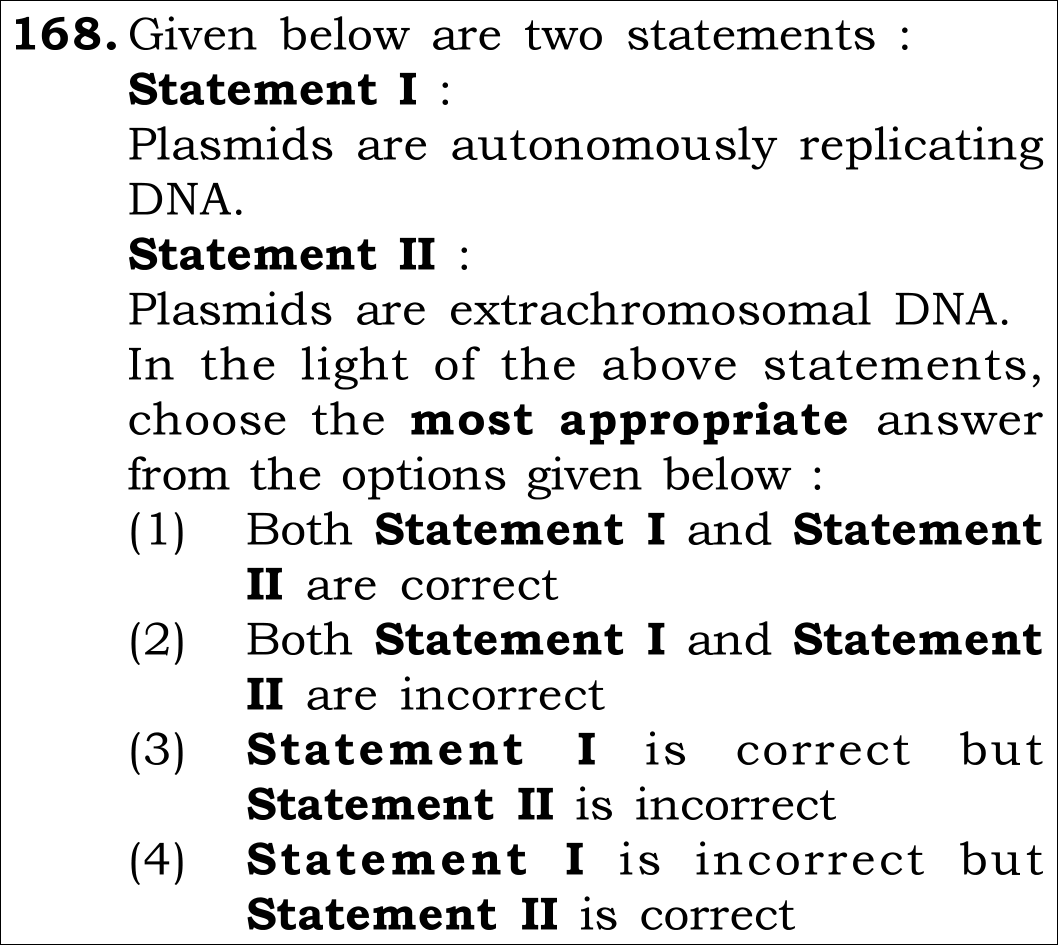
NEET 2026 Zoology Question 168: Plasmids: Nature and Function as Cloning Vectors

Question

Given below are two statements: Statement I: Plasmids are autonomously replicating DNA. Statement II: Plasmids are extrachromosomal DNA. In the light of the above statements, choose the most appropriate answer from the options given below:

  1. (1)Both Statement I and Statement II are correct
  2. (2)Both Statement I and Statement II are incorrect
  3. (3)Statement I is correct but Statement II is incorrect
  4. (4)Statement I is incorrect but Statement II is correct
✓
Verified Against NTA Final Answer Key
Option (1) : Both Statement I and Statement II are correct
📚 Biotechnology: Principles and Processes Easy
📋 Given Parameters & Problem Setup
Statement I Plasmids are autonomously replicating circular extrachromosomal DNA.
Statement II Plasmids are widely used as cloning vectors in recombinant DNA technology.
⚡

The 30-Second Exam Hall Shortcut: ⚡ Plasmid Definition Double-Check

⏱️ Save ~35 seconds

Plasmids = Autonomously replicating circular extrachromosomal DNA AND ubiquitous cloning vectors!

1 Read Statement I: "Plasmids are autonomously replicating circular extrachromosomal DNA." -> TRUE (NCERT verbatim definition).
2 Read Statement II: "Plasmids are widely used as cloning vectors in recombinant DNA technology." -> TRUE (e.g., pBR322, pUC19).
3 Both statements are flawless textbook truths.
4 Select Option (1): Both Statement I and Statement II are correct.
5 Confirm and move on in 10 seconds!
🛡️
Why You Can 100% Trust This Shortcut: NCERT Biology · Biotechnology: Principles and Processes (Recombinant DNA Tools: Restriction endonucleases produce sticky ends).
📐

Step-by-Step Rigorous Workflow & Mathematical Proof

Step 1

Biological Definition of Plasmids

Plasmids are naturally occurring, double-stranded, closed-circular, extrachromosomal DNA molecules found in bacteria and some yeasts that replicate autonomously independent of genomic DNA.

Plasmid≡Extrachromosomal, Circular, dsDNA with Autonomous Replication (ori)\text{Plasmid} \equiv \text{Extrachromosomal, Circular, dsDNA with Autonomous Replication (ori)}
  • • Statement I is completely correct.
Step 2

Use as Vectors in Recombinant DNA Technology

Plasmids have the ability to replicate within bacterial cells independent of chromosomal DNA control. Because they can carry foreign passenger DNA linked to their origin of replication and selectable markers (e.g., antibiotic resistance genes), they are the most widely used cloning vectors in genetic engineering.

Foreign DNA+Plasmid Vector→LigaseRecombinant DNA→TransformationHost Cell\text{Foreign DNA} + \text{Plasmid Vector} \xrightarrow{\text{Ligase}} \text{Recombinant DNA} \xrightarrow{\text{Transformation}} \text{Host Cell}
  • • Statement II is completely correct.
⭐

360° Option Elimination Engine Key Feature

Diagnose every choice: Know exactly why the right option works and why distractors fail.

4-Option Deep Scan
1 A
✓ 100% Correct
Verdict & Scientific Reason:

100% correct. Both Statement I (defining plasmid structure) and Statement II (defining plasmid application in rDNA technology) are canonical facts.

💡
Why this is airtight: None; perfect textbook alignment.
2 B
✗ Incorrect
Verdict & Scientific Reason:

Incorrect because both statements are undeniably true.

⚠️
Student Fallacy (Why candidates pick this trap): Second-guessing straightforward definitions.
3 C
✗ Incorrect
Verdict & Scientific Reason:

Incorrect because Statement II is undeniably correct.

⚠️
Student Fallacy (Why candidates pick this trap): Doubting plasmid use as cloning vectors.
4 D
✗ Incorrect
Verdict & Scientific Reason:

Incorrect because Statement I is the exact definition of a plasmid.

⚠️
Student Fallacy (Why candidates pick this trap): Failing to recognize the extrachromosomal nature of plasmids.
⚠️

NTA Trap Alert: Linear vs. Circular Vector Misconception

Bacterial genomic DNA is a large circular chromosome, while plasmids are smaller, separate circular molecules. Plasmids are not linear (unless cleaved by a restriction enzyme).

🛡️ How to avoid the -1 mark: Recall: Plasmids in vivo are always covalently closed circular extrachromosomal DNA.
📖

Core NEET Syllabus Standard

NEET Biology Core Syllabus · Biotechnology: Principles and Processes Standard Benchmark
Core Scientific Principle Tested:

"Plasmids are autonomously replicating circular extrachromosomal DNA widely used as cloning vectors."

Syllabus Focus: Cloning Vectors
✓ Core NEET UG Syllabus Anchor Syllabus & Academic Standards ↗
Plasmids are Perfect: Circular, Independent, and Premier Vectors!

Ready to attempt under real exam pressure?

Test your speed and accuracy in the authentic 180-minute timed NTA simulator.

Launch NEET 2026 CBT Test →

Spotted a mistake in this solution? Report an error (support@mycompetitiveexams.com)

⚖️ Legal & Fair Dealing Notice: Sourced from publicly released NEET 2026 question papers and NEET answer keys for private study, research, and non-commercial educational practice under Fair Dealing (Section 52(1)(a) of the Indian Copyright Act, 1957). Not affiliated with or endorsed by NTA or NMC.

Solve 4 NEET Questions a Day — One per Subject

Cover all 1,140 official NEET questions in 285 days at your own pace. Progress is saved on your device. No login needed.