MyCompetitiveExams Logo MyCompetitiveExams
Search 1,140+ Questions
Chapters, formulas, speed tricks
→
⚡ Brahmastra NEET 2027
720 MARKS

Dynamic 180-question full-length simulator mixed dynamically from all 6 years for 2027 & 2026 aspirants.

Launch Brahmastra 2027 Test →
Start Practice →
100% Free · No Login Required
Q.131 Botany ⭐ 360° Option Elimination Active
Vault ↗

NEET 2025 Botany Question 131 Solution

Topic: Biomolecules · Official NTA Booklet Code 45
NEET 2025 Botany Question 131: Prosthetic Groups of Enzymes: Haem in Catalase and Peroxidase

Question

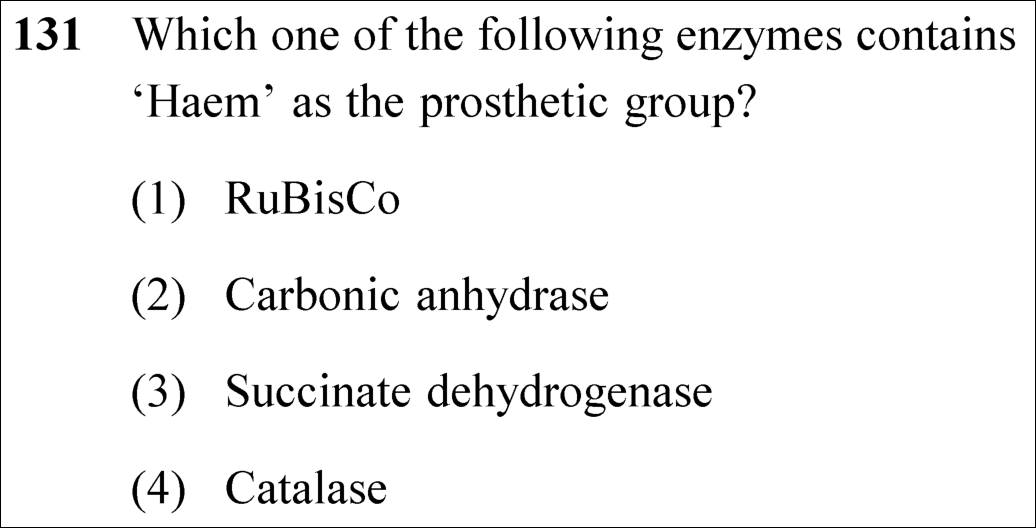
Which one of the following enzymes contains 'Haem' as the prosthetic group?

  1. (1)RuBisCo
  2. (2)Carbonic anhydrase
  3. (3)Succinate dehydrogenase
  4. (4)Catalase
✓
Verified Against NTA Final Answer Key
Option (4) : Catalase
📚 Biomolecules Easy
📋 Given Parameters & Problem Setup
Prosthetic Group Haem (iron-porphyrin complex)
Target Enzyme Enzyme containing haem as its prosthetic group
⚡

The 30-Second Exam Hall Shortcut: ⚡ Enzyme Prosthetic Group Fingerprint

⏱️ Save ~25 seconds

Haem is the tightly bound prosthetic group in PEROXIDASE and CATALASE (breaks down H₂O₂)! Carbonic anhydrase uses Zn²⁺! Catalase is the answer!

1 Recall NCERT Section "Co-factors" (Prosthetic groups) verbatim:
2 - "Prosthetic groups are organic compounds and are distinguished from other co-factors in that they are tightly bound to the apoenzyme."
3 - "For example, in peroxidase and catalase, which catalyze the breakdown of hydrogen peroxide to water and oxygen, haem is the prosthetic group and it is a part of the active site of the enzyme."
4 - RuBisCo: Magnesium (Mg²⁺) activator.
5 - Carbonic anhydrase: Zinc (Zn²⁺) co-factor.
6 - Catalase: HAEM prosthetic group!
7 Select Option (4) Catalase!
🛡️
Why You Can 100% Trust This Shortcut: Enzyme Cofactors & Coenzymes (NCERT Biology · Biomolecules: Prosthetic groups, NAD/NADP vitamins, Metal activators).
📐

Step-by-Step Rigorous Workflow & Mathematical Proof

Step 1

Definition of Prosthetic Groups

Enzymes can be simple proteins or conjugated holoenzymes consisting of a protein part (apoenzyme) and a non-protein part (co-factor):

  • • Co-factors are of three types: prosthetic groups, co-enzymes, and metal ions.
  • • Prosthetic groups are organic compounds characterized by being tightly or permanently bound to the apoenzyme.
Step 2

Haem as a Prosthetic Group in Catalase and Peroxidase

NCERT explicitly cites Catalase and Peroxidase as the prime examples:

  • • Catalase catalyzes the rapid decomposition of hydrogen peroxide into water and molecular oxygen: 2H2O2→Catalase2H2O+O22 H_2O_2 \xrightarrow{\text{Catalase}} 2 H_2O + O_2.
  • • Haem (an iron-protoporphyrin complex) is the prosthetic group tightly integrated into the catalytic active site of catalase.
  • • The central iron (Fe3+/Fe4+Fe^{3+}/Fe^{4+}) undergoes reversible redox changes during the catalytic cycle.
Step 3

Co-factor Analysis of the Other Options

Reviewing the other candidate enzymes:

  • • RuBisCo: Requires Mg2+Mg^{2+} as an essential divalent activator ion.
  • • Carbonic anhydrase: Contains a zinc (Zn2+Zn^{2+}) metal ion at its active site, not haem.
  • • Succinate dehydrogenase: Uses FAD (flavin adenine dinucleotide) and iron-sulfur clusters (Fe−SFe-S), but not haem as its prosthetic group.
Step 4

Conclusion

Catalase is the enzyme containing haem as its prosthetic group, matching Option (4).

2H2O2→Catalase (Haem)2H2O+O22 H_2O_2 \xrightarrow{\text{Catalase (Haem)}} 2 H_2O + O_2
⭐

360° Option Elimination Engine Key Feature

Diagnose every choice: Know exactly why the right option works and why distractors fail.

4-Option Deep Scan
1 A
✗ Incorrect
Verdict & Scientific Reason:

Incorrect. RuBisCo uses magnesium (Mg²⁺) as a metal co-factor, not haem.

⚠️
Student Fallacy (Why candidates pick this trap): Assuming the most abundant enzyme contains haem.
2 B
✗ Incorrect
Verdict & Scientific Reason:

Incorrect. Carbonic anhydrase is a classic metalloenzyme requiring zinc (Zn²⁺) as a co-factor.

⚠️
Student Fallacy (Why candidates pick this trap): Confusing zinc co-factor with haem.
3 C
✗ Incorrect
Verdict & Scientific Reason:

Incorrect. Succinate dehydrogenase utilizes FAD and iron-sulfur clusters, not haem.

⚠️
Student Fallacy (Why candidates pick this trap): Confusing Complex II ETS components.
4 D
✓ 100% Correct
Verdict & Scientific Reason:

100% correct. Direct NCERT textbook fact: haem is the prosthetic group of catalase and peroxidase.

💡
Why this is airtight: None; pristine knowledge of enzyme co-factors.
⚠️

NTA Trap Alert: Haem in Non-Blood Proteins

Many students believe "haem" is only found in hemoglobin and myoglobin. NCERT specifically highlights that CATALASE and PEROXIDASE are enzymes with haem as their prosthetic group!

🛡️ How to avoid the -1 mark: Memorize the NCERT co-factor duo: Peroxidase and Catalase have HAEM.
📖

Core NEET Syllabus Standard

NEET Biology Core Syllabus · Biomolecules Standard Benchmark
Core Scientific Principle Tested:

"In peroxidase and catalase, haem is the prosthetic group firmly bound to the active site."

Syllabus Focus: Enzymes · Co-factors (Prosthetic Groups)
✓ Core NEET UG Syllabus Anchor Syllabus & Academic Standards ↗
CATALASE = Cleans H₂O₂ with HAEM!

Ready to attempt under real exam pressure?

Test your speed and accuracy in the authentic 180-minute timed NTA simulator.

Launch NEET 2025 CBT Test →

Spotted a mistake in this solution? Report an error (support@mycompetitiveexams.com)

⚖️ Legal & Fair Dealing Notice: Sourced from publicly released NEET 2025 question papers and NEET answer keys for private study, research, and non-commercial educational practice under Fair Dealing (Section 52(1)(a) of the Indian Copyright Act, 1957). Not affiliated with or endorsed by NTA or NMC.

Solve 4 NEET Questions a Day — One per Subject

Cover all 1,140 official NEET questions in 285 days at your own pace. Progress is saved on your device. No login needed.