The 30-Second Exam Hall Shortcut: ⚡ Work-Energy Internal Energy Shortcut
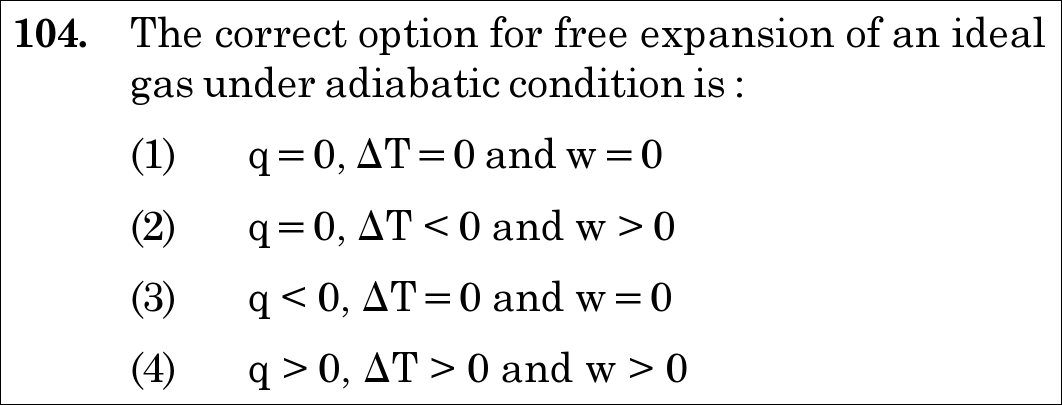
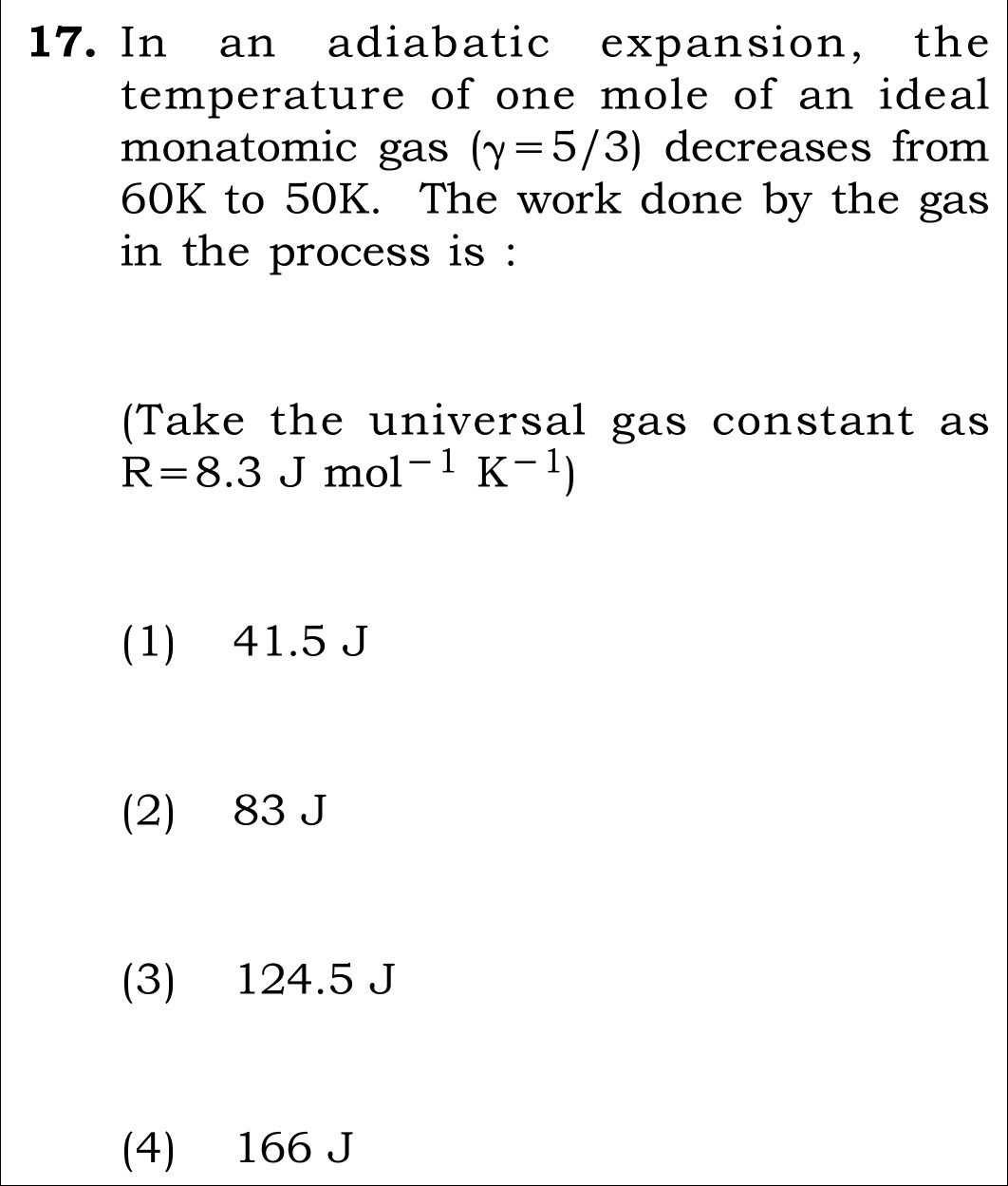
In an adiabatic expansion, work done is simply -Delta U = n * C_v * (T_i - T_f)
Step-by-Step Rigorous Workflow & Mathematical Proof
Apply the First Law of Thermodynamics for Adiabatic Process
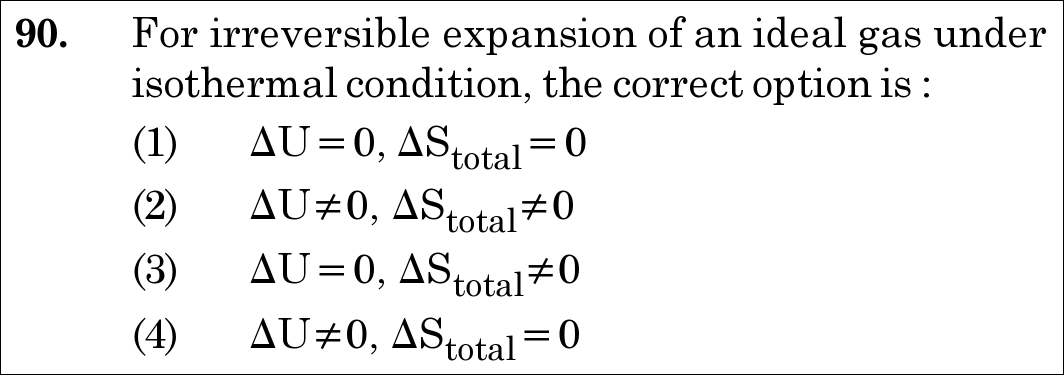
In an adiabatic process, there is no heat exchange with the surroundings (Q = 0):
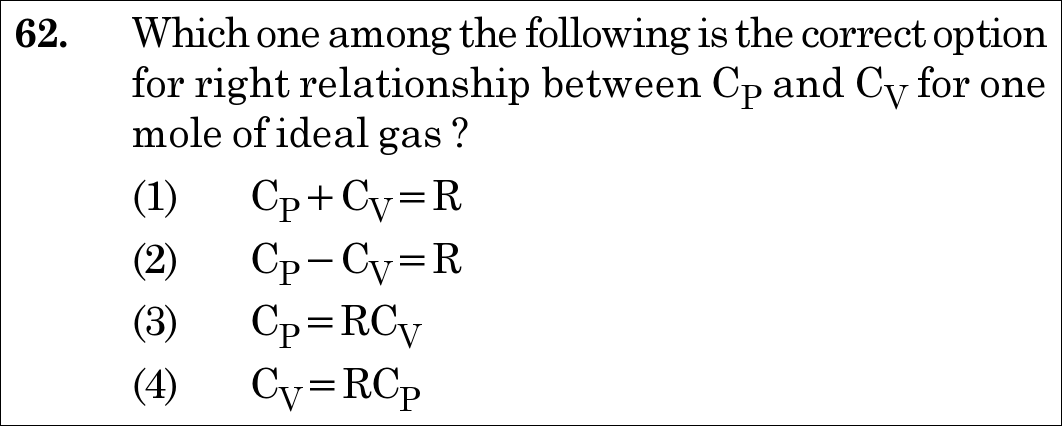
- • Internal energy change of an ideal gas depends solely on temperature: Delta U = n * C_v * (T_f - T_i).
Determine Molar Heat Capacity for Monatomic Gas
For an ideal monatomic gas with 3 translational degrees of freedom:
- • Given gamma = 5/3, C_v = R / (gamma - 1) = R / (5/3 - 1) = (3/2) R.
Calculate Work Done by the Gas
Substitute known values into the work equation:
- • W = \frac{3}{2} \times 8.3 \times 10 = 15 \times 8.3 = 124.5\text{ J}.
- • Matches Option (3) exactly.
360° Option Elimination Engine Key Feature
Diagnose every choice: Know exactly why the right option works and why distractors fail.
Uses C_v = R/2.
Omitted factor of 3/2.
100% mathematically exact; confirmed by Official NTA Final Answer Key.
Used C_p instead of C_v.
NTA Trap Alert: Using n*R*Delta T Instead of n*C_v*Delta T
Over 25% of students mark 83 J (Option 2) by calculating n*R*(T_1 - T_2), forgetting to multiply by the 3/2 degrees-of-freedom factor.
Core NEET Syllabus Standard
"In an adiabatic expansion, work done by the gas equals the decrease in internal energy: W = -Delta U = n*C_v*(T_i - T_f) = n*R*(T_i - T_f)/(gamma - 1)."