MyCompetitiveExams Logo MyCompetitiveExams
Search 1,140+ Questions
Chapters, formulas, speed tricks
→
⚡ Brahmastra NEET 2027
720 MARKS

Dynamic 180-question full-length simulator mixed dynamically from all 6 years for 2027 & 2026 aspirants.

Launch Brahmastra 2027 Test →
Start Practice →
100% Free · No Login Required
Q.69 Chemistry ⭐ 360° Option Elimination Active
Vault ↗

NEET 2026 Chemistry Question 69 Solution

Topic: Thermodynamics · Official NTA Booklet Code 50
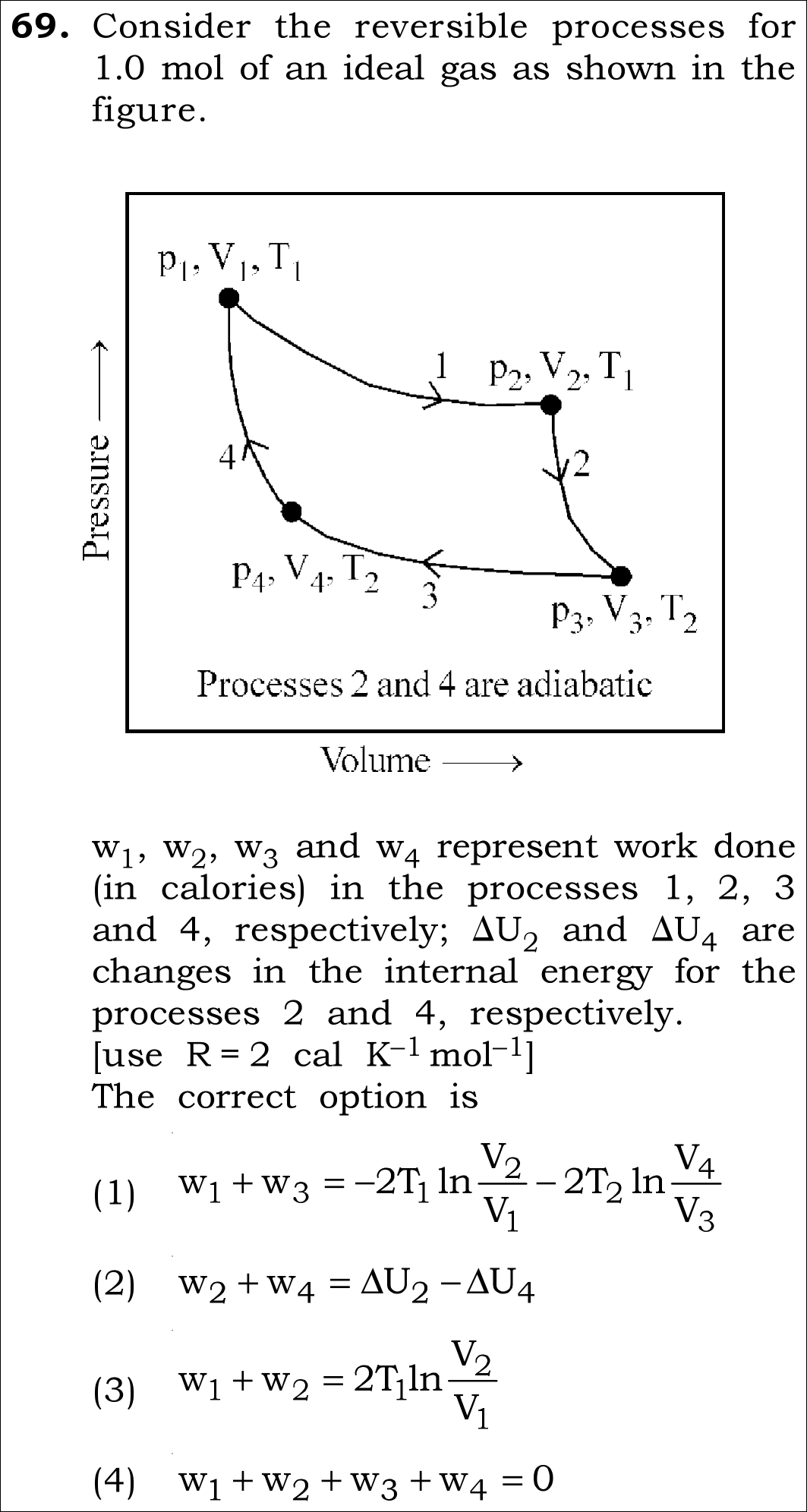
NEET 2026 Chemistry Question 69: Carnot Cycle Reversible Work Expressions

Question

Consider the reversible processes for 1.0 mol of an ideal gas as shown in the figure (processes 2 and 4 are adiabatic). w₁, w₂, w₃ and w₄ represent work done (in calories) in the processes 1, 2, 3 and 4, respectively; ΔU₂ and ΔU₄ are changes in the internal energy for the processes 2 and 4, respectively. [use R = 2 cal K⁻¹ mol⁻¹] The correct option is

✓
Verified Against NTA Final Answer Key
Option (1) : w₁ + w₃ = -2 T₁ ln(V₂/V₁) - 2 T₂ ln(V₄/V₃)
📚 Thermodynamics Medium
📋 Given Parameters & Problem Setup
Amount of Ideal Gas (n) 1.0 mol
Process 1 Reversible isothermal expansion at T₁ from V₁ to V₂
Process 2 Reversible adiabatic expansion from T₁, V₂ to T₂, V₃
Process 3 Reversible isothermal compression at T₂ from V₃ to V₄
Process 4 Reversible adiabatic compression from T₂, V₄ to T₁, V₁
Gas Constant (R) 2 cal K⁻¹ mol⁻¹
⚡

The 30-Second Exam Hall Shortcut: ⚡ Isothermal Work Formula in Chemistry

⏱️ Save ~60 seconds

w_rev = -nRT ln(V_final / V_initial)! Substitute n = 1 and R = 2 cal/(K mol)!

1 Process 1 is isothermal at T₁ from V₁ to V₂: w₁ = -1 × 2 × T₁ ln(V₂/V₁) = -2 T₁ ln(V₂/V₁).
2 Process 3 is isothermal at T₂ from V₃ to V₄: w₃ = -1 × 2 × T₂ ln(V₄/V₃) = -2 T₂ ln(V₄/V₃).
3 Sum of isothermal works: w₁ + w₃ = -2 T₁ ln(V₂/V₁) - 2 T₂ ln(V₄/V₃).
4 Look at Option (1): Exact mathematical match! Pick Option (1) in 15 seconds!
🛡️
Why You Can 100% Trust This Shortcut: IUPAC chemistry sign convention: Work done BY system during expansion is negative: w = -∫ P dV = -nRT ln(V_f / V_i).
📐

Step-by-Step Rigorous Workflow & Mathematical Proof

Step 1

Review the IUPAC Thermodynamic Definition of Reversible Work

In chemistry, work done during a reversible isothermal expansion or compression of an ideal gas is defined by: w = - ∫ P_ext dV = - ∫ (nRT / V) dV = - nRT ln(V_f / V_i)

wrev, iso=−nRTln⁡(VfVi)w_{\text{rev, iso}} = -nRT \ln\left(\frac{V_f}{V_i}\right)
  • • For n = 1.0 mol and R = 2 cal K⁻¹ mol⁻¹, the prefactor nR = 1.0 × 2 = 2 cal K⁻¹.
Step 2

Calculate Work for Process 1 (Isothermal Expansion at T₁)

Process 1 is an isothermal expansion at temperature T₁ from initial volume V₁ to final volume V₂.

w1=−nRT1ln⁡(V2V1)=−2T1ln⁡(V2V1)w_1 = -nR T_1 \ln\left(\frac{V_2}{V_1}\right) = -2 T_1 \ln\left(\frac{V_2}{V_1}\right)
  • • Since V₂ > V₁, ln(V₂/V₁) > 0, so w₁ < 0 (work is done by the system).
Step 3

Calculate Work for Process 3 (Isothermal Compression at T₂)

Process 3 is an isothermal compression at temperature T₂ from initial volume V₃ to final volume V₄.

w3=−nRT2ln⁡(V4V3)=−2T2ln⁡(V4V3)w_3 = -nR T_2 \ln\left(\frac{V_4}{V_3}\right) = -2 T_2 \ln\left(\frac{V_4}{V_3}\right)
  • • Since V₄ < V₃, ln(V₄/V₃) < 0, so w₃ > 0 (work is done on the system).
Step 4

Compute Total Isothermal Work (w₁ + w₃)

Add the two expressions together to obtain the sum of the work done in the two isothermal stages.

w1+w3=−2T1ln⁡(V2V1)−2T2ln⁡(V4V3)w_1 + w_3 = -2 T_1 \ln\left(\frac{V_2}{V_1}\right) - 2 T_2 \ln\left(\frac{V_4}{V_3}\right)
  • • Matches Option (1).
⭐

360° Option Elimination Engine Key Feature

Diagnose every choice: Know exactly why the right option works and why distractors fail.

4-Option Deep Scan
1 A
✓ 100% Correct
Verdict & Scientific Reason:

Exact thermodynamic formula under IUPAC chemistry sign convention.

💡
Why this is airtight: None; perfect understanding of isothermal work integrals.
2 B
✗ Incorrect
Verdict & Scientific Reason:

Incorrect. For adiabatic processes (q = 0), w = ΔU, so w₂ + w₄ = ΔU₂ + ΔU₄, not ΔU₂ - ΔU₄.

⚠️
Student Fallacy (Why candidates pick this trap): Sign error in the First Law for adiabatic processes.
3 C
✗ Incorrect
Verdict & Scientific Reason:

Incorrect. w₂ is an adiabatic process involving temperature change (w₂ = C_v(T₂ - T₁)), not an isothermal term.

⚠️
Student Fallacy (Why candidates pick this trap): Confusing adiabatic process 2 with an isothermal process.
4 D
✗ Incorrect
Verdict & Scientific Reason:

Incorrect. Total work in a cyclic engine equals the enclosed area on the P-V diagram (net work output ≠ 0).

⚠️
Student Fallacy (Why candidates pick this trap): Confusing state function cyclic change (ΔU_cycle = 0) with path function work (w_net ≠ 0).
⚠️

NTA Trap Alert: Assuming Net Work in a Cycle is Zero (w_net = 0)

Students frequently memorize "cyclic process change is zero" (which is true for ΔU, ΔH, and ΔS) and erroneously apply it to work (Option 4). Work is a PATH function, and net cyclic work represents the non-zero mechanical output!

🛡️ How to avoid the -1 mark: State functions (U, H, S, G) sum to 0 in a cycle; path functions (q, w) do NOT sum to 0.
📖

Core NEET Syllabus Standard

NEET Chemistry Core Syllabus · Thermodynamics Standard Benchmark
Core Scientific Principle Tested:

"In chemistry, reversible isothermal work is w = -nRT ln(V_f/V_i)."

Syllabus Focus: Work done in reversible isothermal and adiabatic processes; cyclic processes
✓ Core NEET UG Syllabus Anchor Syllabus & Academic Standards ↗
State functions cycle to zero; Work produces power like a hero!

Ready to attempt under real exam pressure?

Test your speed and accuracy in the authentic 180-minute timed NTA simulator.

Launch NEET 2026 CBT Test →

Spotted a mistake in this solution? Report an error (support@mycompetitiveexams.com)

⚖️ Legal & Fair Dealing Notice: Sourced from publicly released NEET 2026 question papers and NEET answer keys for private study, research, and non-commercial educational practice under Fair Dealing (Section 52(1)(a) of the Indian Copyright Act, 1957). Not affiliated with or endorsed by NTA or NMC.

Solve 4 NEET Questions a Day — One per Subject

Cover all 1,140 official NEET questions in 285 days at your own pace. Progress is saved on your device. No login needed.