The 30-Second Exam Hall Shortcut: ⚡ Transition Metal Binding Rule
More unpaired d-electrons + s-electrons = ultra-strong metallic lattice -> High melting point!
Step-by-Step Rigorous Workflow & Mathematical Proof
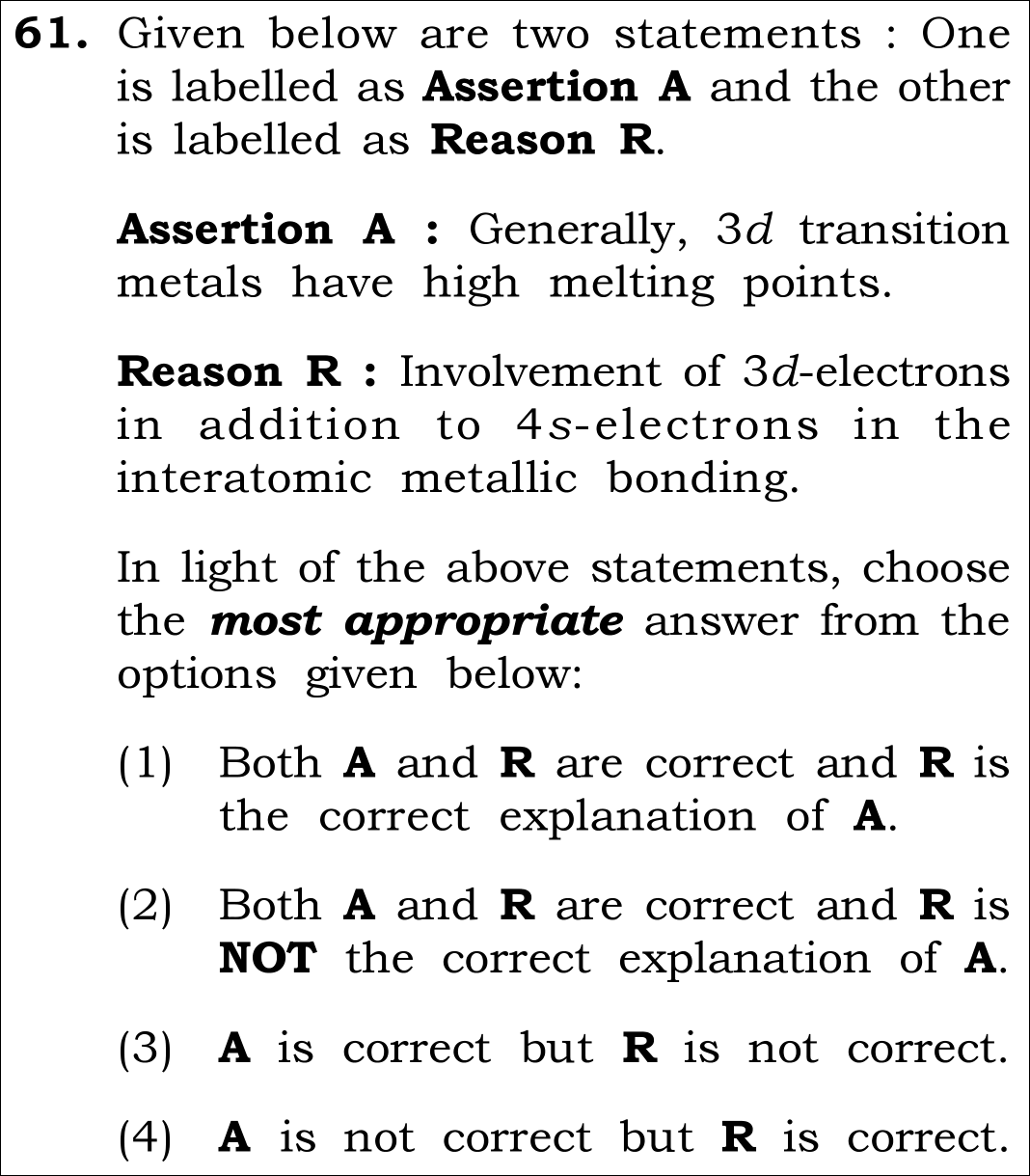
Evaluate Assertion A (Melting Points of 3d Metals)
Transition elements have exceptionally high melting and boiling points compared to s-block elements in the same period. For example, Vanadium melts at 1910 °C and Chromium at 1907 °C.
- • Assertion A is factually correct.
Evaluate Reason R (Role of 3d and 4s Electrons in Metallic Bonding)
Metallic bonding strength is directly proportional to the number of valence electrons per atom available for delocalization throughout the crystal lattice. In 3d transition metals, the energies of 3d and 4s subshells are very close, allowing both 4s and (n-1)d electrons (especially unpaired d-electrons) to participate in covalent interatomic bonding and metallic lattice cohesion.
- • Reason R is factually correct.
Determine Explanation Validity
Because the interatomic bonding is reinforced by the dual participation of (n-1)d and ns electrons, immense thermal energy is required to break the lattice bonds. Thus, Reason R is the precise, direct scientific explanation of Assertion A.
- • Matches Option (1).
360° Option Elimination Engine Key Feature
Diagnose every choice: Know exactly why the right option works and why distractors fail.
Scientifically flawless and aligns verbatim with NCERT d- and f-Block Chemistry.
Incorrect. R directly explains why the melting points are high.
Incorrect. Reason R is an established physical principle of transition metal chemistry.
Incorrect. 3d transition metals clearly possess high melting points.
NTA Trap Alert: Confusing Transition Metals Generally with Group 12 (Zn, Cd, Hg)
Students sometimes think of Zinc or Mercury (which have low melting points due to fully filled d¹⁰ configurations with no unpaired d-electrons) and doubt Assertion A. The assertion states "Generally", which is true for the 3d series.
Core NEET Syllabus Standard
"Participation of both (n-1)d and ns electrons maximizes metallic bond enthalpy and melting temperature."