MyCompetitiveExams Logo MyCompetitiveExams
Search 1,140+ Questions
Chapters, formulas, speed tricks
→
⚡ Brahmastra NEET 2027
720 MARKS

Dynamic 180-question full-length simulator mixed dynamically from all 6 years for 2027 & 2026 aspirants.

Launch Brahmastra 2027 Test →
Start Practice →
100% Free · No Login Required
Q.59 Chemistry ⭐ 360° Option Elimination Active
Vault ↗

NEET 2026 Chemistry Question 59 Solution

Topic: Thermodynamics · Official NTA Booklet Code 50
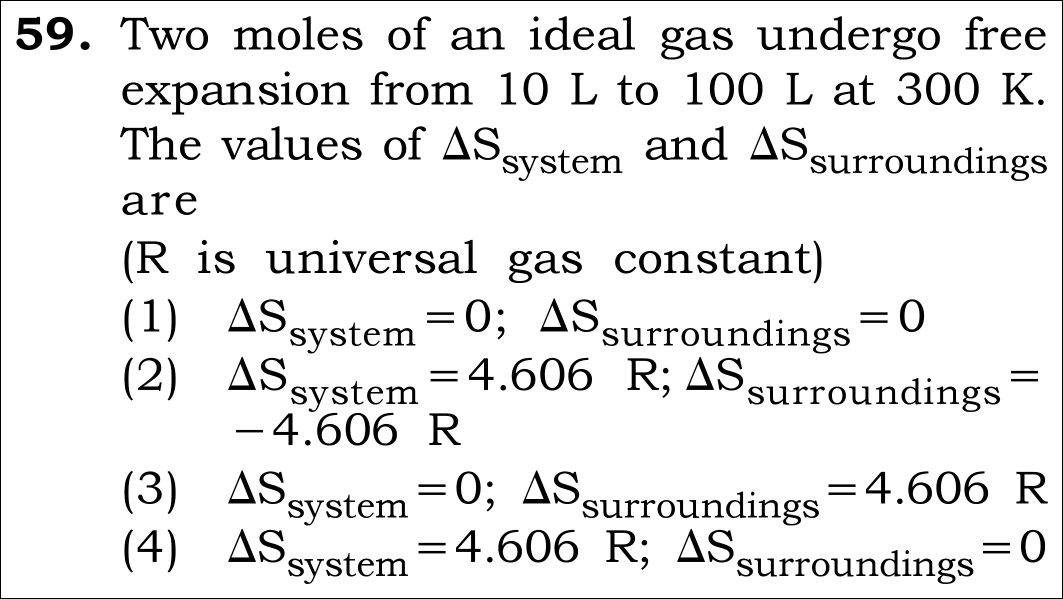
NEET 2026 Chemistry Question 59: Entropy Changes in Isothermal Free Expansion of an Ideal Gas

Question

Two moles of an ideal gas undergo free expansion from 10 L to 100 L at 300 K. The values of ΔS(system) and ΔS(surroundings) are (R is universal gas constant)

✓
Verified Against NTA Final Answer Key
Option (4) : ΔS_system = 4.606 R; ΔS_surroundings = 0
📚 Thermodynamics Medium
📋 Given Parameters & Problem Setup
Amount of Gas (n) 2.0 moles
Process Type Free expansion (expansion against vacuum, P_ext = 0)
Initial Volume (V₁) 10 L
Final Volume (V₂) 100 L
Temperature (T) 300 K (Isothermal)
Gas Constant R
⚡

The 30-Second Exam Hall Shortcut: ⚡ Free Expansion Entropy Signature

⏱️ Save ~80 seconds

Expansion against vacuum means w = 0 and q = 0 -> ΔS_surroundings = 0 ALWAYS!

1 In free expansion, the external pressure P_ext = 0, so work done w = 0.
2 For an ideal gas at constant temperature, ΔU = 0. By First Law, q = ΔU - w = 0.
3 Since no heat enters or leaves the surroundings: q_surr = 0 -> ΔS_surroundings = q_surr / T = 0!
4 This immediately eliminates Options (1), (2), and (3)!
5 Option (4) is the ONLY choice with ΔS_surroundings = 0 and ΔS_system > 0. Done in 10 seconds!
🛡️
Why You Can 100% Trust This Shortcut: Entropy is a state function: ΔS_system = n R ln(V₂/V₁) = 2 × 2.303 R log₁₀(100/10) = 4.606 R.
📐

Step-by-Step Rigorous Workflow & Mathematical Proof

Step 1

Thermodynamics of Free Expansion (First Law of Thermodynamics)

Free expansion is expansion of a gas into a vacuum where the opposing external pressure is zero (P_ext = 0).

w=−∫PextdV=0w = -\int P_{\text{ext}} dV = 0
  • • Work done w = 0.
  • • For an ideal gas undergoing an isothermal process, internal energy depends only on temperature: ΔU = n C_v ΔT = 0.
  • • From the First Law (ΔU = q + w): 0 = q + 0 ⇒ q = 0.
Step 2

Calculate Entropy Change of the Surroundings (ΔS_surroundings)

The change in entropy of the surroundings depends on the heat exchanged with the surroundings reversibly: ΔS_surroundings = -q_system / T_surroundings Since q_system = 0, no heat is absorbed or released by the surroundings.

ΔSsurroundings=qsurrT=0300=0\Delta S_{\text{surroundings}} = \frac{q_{\text{surr}}}{T} = \frac{0}{300} = 0
  • • ΔS_surroundings = 0.
Step 3

Calculate Entropy Change of the System (ΔS_system)

Entropy is a state function. Even though the process is irreversible, ΔS_system equals the entropy change along a reversible path between the same initial and final states.

ΔSsystem=nRln⁡(V2V1)=2.303×nRlog⁡10(V2V1)\Delta S_{\text{system}} = n R \ln\left(\frac{V_2}{V_1}\right) = 2.303 \times n R \log_{10}\left(\frac{V_2}{V_1}\right)
  • • Substitute n = 2 mol, V₁ = 10 L, V₂ = 100 L:
  • • ΔS_system = 2.303 × 2 × R × log₁₀(100 / 10) = 4.606 R × log₁₀(10) = 4.606 R.
  • • Therefore: ΔS_system = 4.606 R and ΔS_surroundings = 0.
⭐

360° Option Elimination Engine Key Feature

Diagnose every choice: Know exactly why the right option works and why distractors fail.

4-Option Deep Scan
1 A
✗ Incorrect
Verdict & Scientific Reason:

Incorrect. System volume increased by a factor of 10, creating positional disorder, so ΔS_system cannot be zero.

⚠️
Student Fallacy (Why candidates pick this trap): Confusing ΔU = 0 or q = 0 with ΔS = 0.
2 B
✗ Incorrect
Verdict & Scientific Reason:

Incorrect. This would imply ΔS_total = 0, which only holds for a reversible process. Free expansion is an irreversible spontaneous process!

⚠️
Student Fallacy (Why candidates pick this trap): Treating an irreversible free expansion as a reversible process.
3 C
✗ Incorrect
Verdict & Scientific Reason:

Incorrect. Reverses the system and surrounding roles.

⚠️
Student Fallacy (Why candidates pick this trap): Assigning state function volume expansion to the surroundings.
4 D
✓ 100% Correct
Verdict & Scientific Reason:

Exact thermodynamic result: ΔS_system > 0 due to volume expansion, and ΔS_surroundings = 0 because q = 0.

💡
Why this is airtight: None; flawless application of the Second Law.
⚠️

NTA Trap Alert: Claiming ΔS_surroundings = -ΔS_system in Free Expansion

Students frequently assume ΔS_surroundings = -ΔS_system (Option 2) because they memorize ΔS_total = 0. But that is ONLY true for reversible processes! In irreversible free expansion, ΔS_total = ΔS_sys + ΔS_surr = 4.606 R > 0.

🛡️ How to avoid the -1 mark: For any free expansion into vacuum: q = 0 ⇒ ΔS_surroundings is ALWAYS 0.
📖

Core NEET Syllabus Standard

NEET Chemistry Core Syllabus · Thermodynamics Standard Benchmark
Core Scientific Principle Tested:

"In free expansion against vacuum, no work is performed and no heat is exchanged, making surrounding entropy change zero."

Syllabus Focus: Second law of thermodynamics, entropy change in reversible and irreversible processes
✓ Core NEET UG Syllabus Anchor Syllabus & Academic Standards ↗
Free into vacuum: Surroundings do zero work and feel zero heat (ΔS_surr = 0)!

Ready to attempt under real exam pressure?

Test your speed and accuracy in the authentic 180-minute timed NTA simulator.

Launch NEET 2026 CBT Test →

Spotted a mistake in this solution? Report an error (support@mycompetitiveexams.com)

⚖️ Legal & Fair Dealing Notice: Sourced from publicly released NEET 2026 question papers and NEET answer keys for private study, research, and non-commercial educational practice under Fair Dealing (Section 52(1)(a) of the Indian Copyright Act, 1957). Not affiliated with or endorsed by NTA or NMC.

Solve 4 NEET Questions a Day — One per Subject

Cover all 1,140 official NEET questions in 285 days at your own pace. Progress is saved on your device. No login needed.