The 30-Second Exam Hall Shortcut: ⚡ Grignard as a Base: Proton Grab!
Grignard reagents are powerful BASES first, nucleophiles second! Active H on -NH₂ = Alkane!
Step-by-Step Rigorous Workflow & Mathematical Proof
Understand the Basicity of Grignard Reagents
The carbon-magnesium bond in a Grignard reagent is highly polarized: C^{δ-} - Mg^{δ+}Br. The alkyl group behaves as a extremely strong Brønsted-Lowry base (conjugate base of an alkane, pKa ≈ 50).
- • Whenever an active hydrogen donor is present, acid-base proton transfer dominates.
Identify the Active Hydrogen in Cyclohexylamine
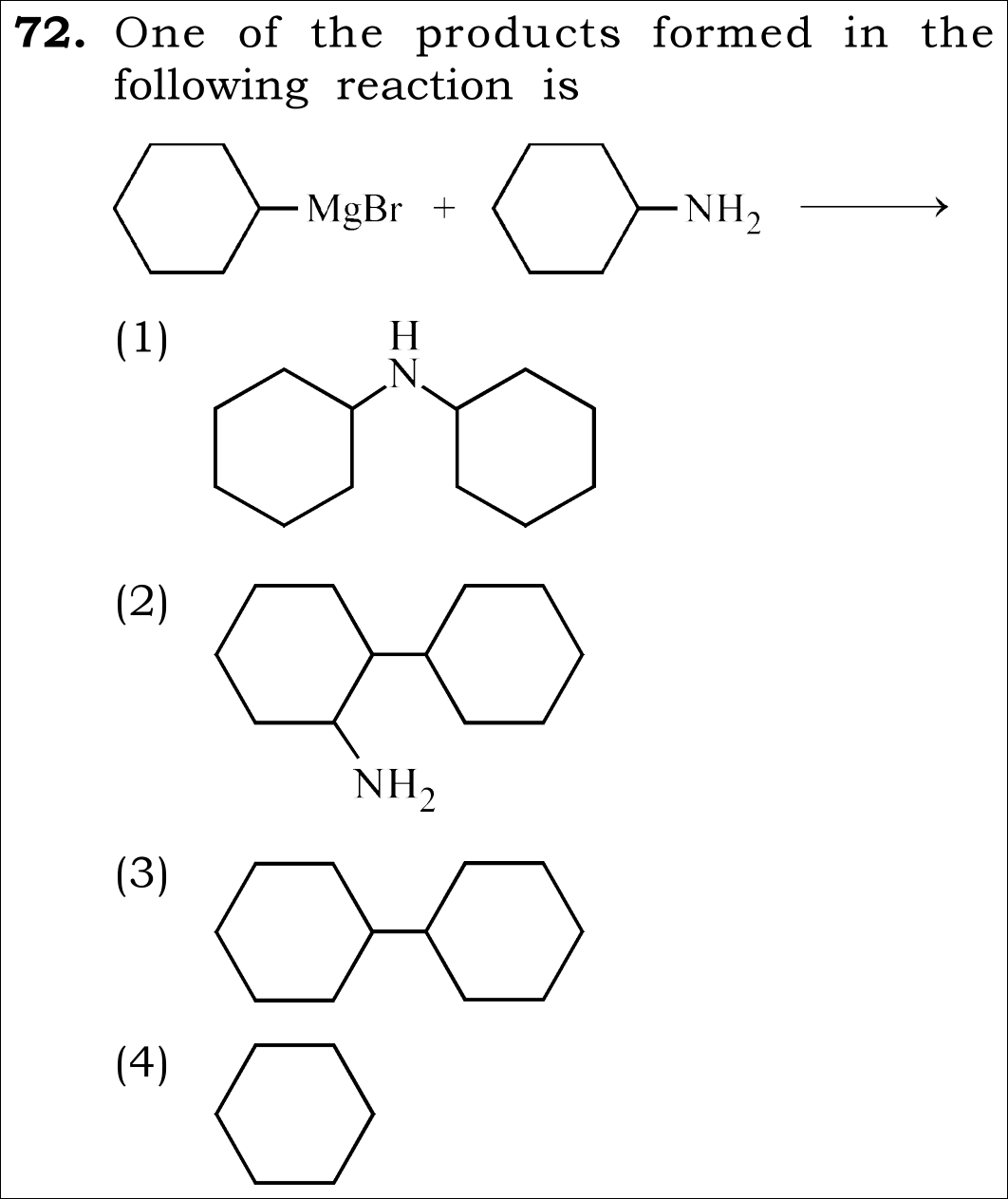
Primary amines possess two acidic protons bonded to the electronegative nitrogen atom (-NH₂). The cyclohexyl group of the Grignard reagent abstracts a proton from the amino group of cyclohexylamine.
- • The carbanion equivalent C₆H₁₁⁻ receives a proton H⁺ to become neutral cyclohexane (C₆H₁₂).
- • The byproduct is cyclohexylaminomagnesium bromide.
Match with Given Structures
Structure (1) is dicyclohexylamine; Structure (2) is 2-cyclohexylcyclohexanamine; Structure (3) is bicyclohexyl; Structure (4) is a plain cyclohexyl ring (cyclohexane).
- • Matches Option (4).
360° Option Elimination Engine Key Feature
Diagnose every choice: Know exactly why the right option works and why distractors fail.
Incorrect. Nucleophilic substitution on amine nitrogen does not occur.
Incorrect. No ring substitution or electrophilic aromatic-style addition can occur on an aliphatic cyclohexane ring.
Incorrect. Bicyclohexyl would be a Wurtz-coupling product, not formed in the presence of an amine.
Exact product of the Zerevitinov acid-base reaction between a Grignard reagent and an amine.
NTA Trap Alert: Looking for Complex Coupling Instead of Simple Acid-Base Reaction
Students see two large cyclohexyl rings and instinctively look for a bonded dimer or secondary amine (Structures 1, 2, or 3). They forget that Grignard reagents are among the STRONGEST BASES known and simply steal a proton to yield an alkane!
Core NEET Syllabus Standard
"Grignard reagents react with compounds containing active hydrogen atoms to form hydrocarbons."