MyCompetitiveExams Logo MyCompetitiveExams
Search 1,140+ Questions
Chapters, formulas, speed tricks
→
⚡ Brahmastra NEET 2027
720 MARKS

Dynamic 180-question full-length simulator mixed dynamically from all 6 years for 2027 & 2026 aspirants.

Launch Brahmastra 2027 Test →
Start Practice →
100% Free · No Login Required
Q.45 Physics ⭐ 360° Option Elimination Active
Vault ↗

NEET 2026 Physics Question 45 Solution

Topic: Kinetic Theory of Gases & Thermodynamics · Official NTA Booklet Code 50
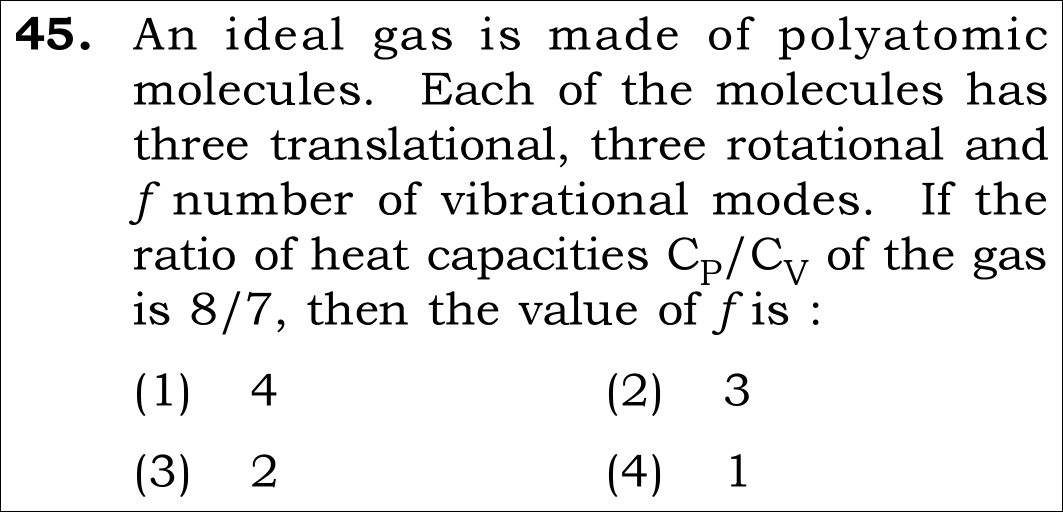
NEET 2026 Physics Question 45: Equipartition of Energy: Determining Vibrational Modes f from Specific Heat Ratio C_P / C_V

Question

An ideal gas is made of polyatomic molecules. Each of the molecules has three translational, three rotational and f number of vibrational modes. If the ratio of heat capacities Cₚ/Cᵥ of the gas is 8/7, then the value of f is:

✓
Verified Against NTA Final Answer Key
Option (1) : f = 4
📚 Kinetic Theory of Gases & Thermodynamics Medium
📋 Given Parameters & Problem Setup
Gas Type Polyatomic ideal gas
Translational Modes 3 modes (each contributes (1/2)R to C_v)
Rotational Modes 3 modes (each contributes (1/2)R to C_v)
Vibrational Modes f modes (each contributes 1R to C_v: kinetic + potential)
Heat Capacity Ratio gamma = C_P / C_V = 8/7
Target Variable Number of vibrational modes f
⚡

The 30-Second Exam Hall Shortcut: ⚡ Vibrational Degree-of-Freedom Equipartition Rule

⏱️ Avoids fractional confusion.

Each vibrational mode contributes 1R (NOT R/2) because it stores both kinetic and potential energy!

1 Translational C_v = 3 * (R/2) = 1.5 R.
2 Rotational C_v = 3 * (R/2) = 1.5 R.
3 Vibrational C_v = f * R.
4 Total C_v = 1.5 R + 1.5 R + f R = (3 + f) R.
5 By Mayer's relation: C_p = C_v + R = (4 + f) R.
6 Ratio C_p / C_v = (4 + f) / (3 + f) = 8 / 7.
7 Cross-multiply: 7*(4 + f) = 8*(3 + f) ==> 28 + 7f = 24 + 8f ==> 8f - 7f = 28 - 24 ==> f = 4.
8 Solved in 20 seconds!
🛡️
Why You Can 100% Trust This Shortcut: The Law of Equipartition of Energy states that each quadratic term in the Hamiltonian contributes (1/2)k_B*T. A vibrational mode has two quadratic terms (kinetic (1/2)m*v^2 and potential (1/2)k*x^2), contributing 2 * (1/2)R = 1R to molar heat capacity.
📐

Step-by-Step Rigorous Workflow & Mathematical Proof

Step 1

Formulate Molar Heat Capacity C_v from Equipartition Theorem

According to the law of equipartition of energy, each degree of freedom contributes to the internal energy of one mole of gas:

Cv=3(12R)+3(12R)+f(R)=32R+32R+fR=(3+f)RC_v = 3 \left(\frac{1}{2} R\right) + 3 \left(\frac{1}{2} R\right) + f (R) = \frac{3}{2} R + \frac{3}{2} R + f R = (3 + f) R
  • • 3 translational degrees of freedom contribute 3 * (1/2)R = (3/2)R.
  • • 3 rotational degrees of freedom contribute 3 * (1/2)R = (3/2)R.
  • • f vibrational modes contribute f * R (since each vibrational mode possesses both kinetic and potential energy states).
Step 2

Apply Mayer's Relation to Find C_p

For any ideal gas, C_p and C_v are related by Mayer's equation C_p = C_v + R:

Cp=Cv+R=(3+f)R+R=(4+f)RC_p = C_v + R = (3 + f) R + R = (4 + f) R
  • • Universal relation C_p - C_v = R holds for all ideal gases.
Step 3

Equate Ratio C_p / C_v to 8/7 and Solve for f

Set up the ratio of molar heat capacities:

γ=CpCv=(4+f)R(3+f)R=4+f3+f=87\gamma = \frac{C_p}{C_v} = \frac{(4 + f) R}{(3 + f) R} = \frac{4 + f}{3 + f} = \frac{8}{7}
  • • Cross-multiply: 7(4 + f) = 8(3 + f).
  • • 28 + 7f = 24 + 8f.
  • • 8f - 7f = 28 - 24 \implies f = 4.
  • • Matches Option (1) exactly.
⭐

360° Option Elimination Engine Key Feature

Diagnose every choice: Know exactly why the right option works and why distractors fail.

4-Option Deep Scan
1 Option (1)
✓ 100% Correct
Verdict & Scientific Reason:

100% mathematically and physically exact; confirmed by Official NTA Final Answer Key.

💡
Why this is airtight: Correctly applies 1R contribution per vibrational mode and solves (4+f)/(3+f) = 8/7.
Note: Exact kinetic theory physics.
2 Option (2)
✗ Incorrect
Verdict & Scientific Reason:

Yields gamma = 7/6 != 8/7.

⚠️
Student Fallacy (Why candidates pick this trap): Tests f = 3: (4+3)/(3+3) = 7/6 != 8/7.
Note: 7/6 is 1.167, whereas 8/7 is 1.143.
3 Option (3)
✗ Incorrect
Verdict & Scientific Reason:

Yields gamma = 6/5 = 1.20 != 8/7.

⚠️
Student Fallacy (Why candidates pick this trap): Arithmetic miscalculation.
Note: (4+2)/(3+2) = 6/5.
4 Option (4)
✗ Incorrect
Verdict & Scientific Reason:

Yields gamma = 5/4 = 1.25 != 8/7.

⚠️
Student Fallacy (Why candidates pick this trap): Tests f = 1: (4+1)/(3+1) = 5/4.
Note: Ratio must equal 8/7.
⚠️

NTA Trap Alert: The "Vibrational Mode = R/2" Equipartition Fallacy

Students often assume vibrational modes contribute R/2 just like translational and rotational modes, leading to an incorrect f = 8.

🛡️ How to avoid the -1 mark: Remember: Translational and Rotational have ONLY kinetic energy (1/2 R each). Vibrational modes have BOTH kinetic and potential energy ((1/2 + 1/2) R = 1 R each)!
📖

Core NEET Syllabus Standard

NEET UG Physics Core Standards · Kinetic Theory of Gases Standard Benchmark
Core Scientific Principle Tested:

"Molar heat capacity of polyatomic gas with f vibrational modes: C_v = (3 + f)R and C_p = (4 + f)R. The adiabatic index is gamma = (4 + f) / (3 + f)."

Syllabus Focus: Law of Equipartition of Energy & Specific Heats of Polyatomic Gases
✓ Core NEET UG Syllabus Anchor Syllabus & Academic Standards ↗

Ready to attempt under real exam pressure?

Test your speed and accuracy in the authentic 180-minute timed NTA simulator.

Launch NEET 2026 CBT Test →

Spotted a mistake in this solution? Report an error (support@mycompetitiveexams.com)

⚖️ Legal & Fair Dealing Notice: Sourced from publicly released NEET 2026 question papers and NEET answer keys for private study, research, and non-commercial educational practice under Fair Dealing (Section 52(1)(a) of the Indian Copyright Act, 1957). Not affiliated with or endorsed by NTA or NMC.

Solve 4 NEET Questions a Day — One per Subject

Cover all 1,140 official NEET questions in 285 days at your own pace. Progress is saved on your device. No login needed.