MyCompetitiveExams Logo MyCompetitiveExams
Search 1,140+ Questions
Chapters, formulas, speed tricks
→
⚡ Brahmastra NEET 2027
720 MARKS

Dynamic 180-question full-length simulator mixed dynamically from all 6 years for 2027 & 2026 aspirants.

Launch Brahmastra 2027 Test →
Start Practice →
100% Free · No Login Required
Q.90 Chemistry ⭐ 360° Option Elimination Active
Vault ↗

NEET 2021 Chemistry Question 90 Solution

Topic: Thermodynamics · Official NTA Booklet Code M1
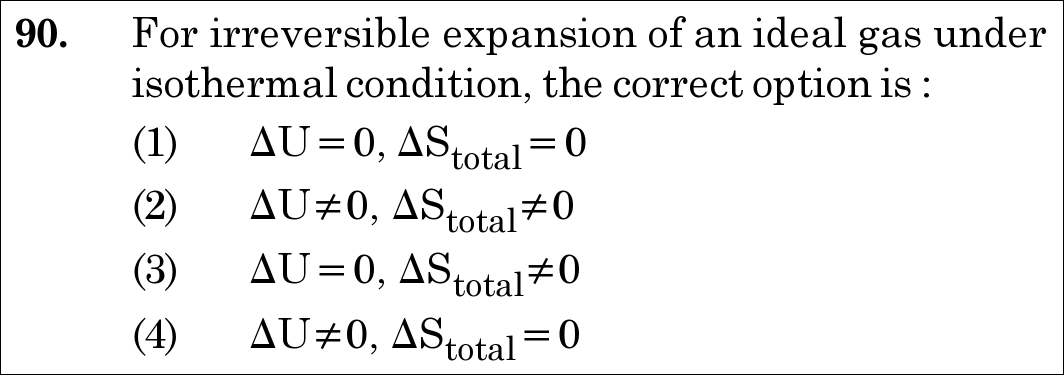
NEET 2021 Chemistry Question 90: Irreversible Isothermal Expansion of Ideal Gas: ΔU = 0 and ΔStotal ≠ 0

Question

For irreversible expansion of an ideal gas under isothermal condition, the correct option is:

✓
Verified Against NTA Final Answer Key
Option (3) : ΔU = 0, ΔStotal ≠ 0
📚 Thermodynamics Easy
📋 Given Parameters & Problem Setup
Working Substance Ideal gas
Process Type Irreversible expansion
Thermal Condition Isothermal (T = constant)
⚡

The 30-Second Exam Hall Shortcut: ⚡ Isothermal Ideal Gas   ⟹  \implies ΔU = 0; Irreversible Process   ⟹  \implies ΔStotal > 0

⏱️ Save ~15 seconds

For an ideal gas, internal energy depends SOLELY on temperature: isothermal means ΔT=0  ⟹  ΔU=nCvΔT=0\Delta T = 0 \implies \Delta U = n C_v \Delta T = 0. By the Second Law of Thermodynamics, any irreversible (spontaneous) process strictly produces positive total entropy: ΔStotal=ΔSsys+ΔSsurr>0  ⟹  ΔStotal≠0\Delta S_{\text{total}} = \Delta S_{\text{sys}} + \Delta S_{\text{surr}} > 0 \implies \Delta S_{\text{total}} \neq 0. Therefore, ΔU=0,ΔStotal≠0\Delta U = 0, \Delta S_{\text{total}} \neq 0! Match Option (3)!

1 Isothermal condition: Temperature is constant (ΔT=0\Delta T = 0).
2 For an ideal gas: Internal energy is a function of temperature alone (U=f(T)U = f(T))   ⟹  ΔU=0\implies \Delta U = 0.
3 Expansion is irreversible: According to the Second Law of Thermodynamics, all spontaneous/irreversible processes increase the entropy of the universe.
4 Therefore: ΔStotal>0\Delta S_{\text{total}} > 0, which means ΔStotal≠0\Delta S_{\text{total}} \neq 0. (ΔStotal=0\Delta S_{\text{total}} = 0 only for a reversible process).
5 Result: ΔU=0,ΔStotal≠0\Delta U = 0, \Delta S_{\text{total}} \neq 0.
6 Match Option (3).
🛡️
Why You Can 100% Trust This Shortcut: Canonical First and Second Laws of Thermodynamics from NCERT Chemical Thermodynamics.
📐

Step-by-Step Rigorous Workflow & Mathematical Proof

Step 1

Applying the First Law to an Isothermal Ideal Gas

For an ideal gas, intermolecular forces of attraction are zero. Consequently, internal energy UU depends solely on temperature (Joule's Law of ideal gases): U=f(T)  ⟹  dU=nCVdTU = f(T) \implies dU = n C_V dT In any isothermal process, temperature remains strictly constant (ΔT=0\Delta T = 0): ΔU=nCVΔT=0\Delta U = n C_V \Delta T = 0

Step 2

Applying the Second Law to an Irreversible Process

The total entropy change of the universe (system plus surroundings) is defined by the Second Law of Thermodynamics: ΔStotal=ΔSsys+ΔSsurr\Delta S_{\text{total}} = \Delta S_{\text{sys}} + \Delta S_{\text{surr}} - For an idealized reversible process: ΔStotal=0\Delta S_{\text{total}} = 0. - For any real, irreversible (spontaneous) process: entropy generation occurs due to dissipation, requiring: ΔStotal>0  ⟹  ΔStotal≠0\Delta S_{\text{total}} > 0 \implies \Delta S_{\text{total}} \neq 0

Step 3

Combining Both Thermodynamic Conditions

Combining the isothermal criterion (ΔU=0\Delta U = 0) with the irreversibility criterion (ΔStotal≠0\Delta S_{\text{total}} \neq 0):

ΔU=0,ΔStotal≠0\mathbf{\Delta U = 0, \quad \Delta S_{\text{total}} \neq 0}
⭐

360° Option Elimination Engine Key Feature

Diagnose every choice: Know exactly why the right option works and why distractors fail.

4-Option Deep Scan
1 1
✗ Incorrect
Verdict & Scientific Reason:

ΔStotal=0\Delta S_{\text{total}} = 0 is true ONLY for a REVERSIBLE process, whereas the prompt explicitly states IRREVERSIBLE.

⚠️
Student Fallacy (Why candidates pick this trap): Assuming total entropy is conserved in an irreversible process.
2 2
✗ Incorrect
Verdict & Scientific Reason:

ΔU=0\Delta U = 0 for any isothermal process of an ideal gas; claiming ΔU≠0\Delta U \neq 0 violates Joule's law.

⚠️
Student Fallacy (Why candidates pick this trap): Assuming internal energy changes during expansion.
3 3
✓ 100% Correct
Verdict & Scientific Reason:

Exact thermodynamic conditions: ΔU=0\Delta U = 0 (isothermal ideal gas) and ΔStotal>0\Delta S_{\text{total}} > 0 (irreversible process).

💡
Why this is airtight: None; rigorous First and Second Law mastery.
4 4
✗ Incorrect
Verdict & Scientific Reason:

Violates both the isothermal condition and the Second Law for irreversible processes.

⚠️
Student Fallacy (Why candidates pick this trap): Complete inversion of thermodynamic principles.
⚠️

NTA Trap Alert: Reversible vs. Irreversible Total Entropy Trap

Candidates frequently choose Option (1) (ΔU=0,ΔStotal=0\Delta U = 0, \Delta S_{\text{total}} = 0) because they recall ΔStotal=0\Delta S_{\text{total}} = 0 from reversible Carnot cycles. For any IRREVERSIBLE expansion, total entropy of the universe MUST increase (ΔStotal>0  ⟹  ΔStotal≠0\Delta S_{\text{total}} > 0 \implies \Delta S_{\text{total}} \neq 0).

🛡️ How to avoid the -1 mark: Irreversible   ⟹  ΔStotal>0  ⟹  ΔStotal≠0\implies \Delta S_{\text{total}} > 0 \implies \Delta S_{\text{total}} \neq 0. Isothermal ideal gas   ⟹  ΔU=0\implies \Delta U = 0.
📖

Core NEET Syllabus Standard

NCERT Chemistry · Thermodynamics Standard Benchmark
Core Scientific Principle Tested:

"For an isothermal expansion of an ideal gas, ΔU=0\Delta U = 0. For any irreversible process, ΔStotal>0\Delta S_{\text{total}} > 0, hence ΔStotal≠0\Delta S_{\text{total}} \neq 0."

Syllabus Focus: First and Second Laws of Thermodynamics (Spontaneity and Entropy)
✓ Core NEET UG Syllabus Anchor Syllabus & Academic Standards ↗

Ready to attempt under real exam pressure?

Test your speed and accuracy in the authentic 200-minute timed NTA simulator.

Launch NEET 2021 CBT Test →

Spotted a mistake in this solution? Report an error (support@mycompetitiveexams.com)

⚖️ Legal & Fair Dealing Notice: Sourced from publicly released NEET 2021 question papers and NEET answer keys for private study, research, and non-commercial educational practice under Fair Dealing (Section 52(1)(a) of the Indian Copyright Act, 1957). Not affiliated with or endorsed by NTA or NMC.

Solve 4 NEET Questions a Day — One per Subject

Cover all 1,140 official NEET questions in 285 days at your own pace. Progress is saved on your device. No login needed.