MyCompetitiveExams Logo MyCompetitiveExams
Search 1,140+ Questions
Chapters, formulas, speed tricks
→
⚡ Brahmastra NEET 2027
720 MARKS

Dynamic 180-question full-length simulator mixed dynamically from all 6 years for 2027 & 2026 aspirants.

Launch Brahmastra 2027 Test →
Start Practice →
100% Free · No Login Required
🧬 Zoology 🔥 High-Yield Core Topic (~3–4 Qs/Year)

NEET Plant Kingdom Previous Year Questions with Solutions

Complete repository of official NTA NEET questions for Plant Kingdom from 2020 to 2026. Every question includes 30-second elimination tricks, step-by-step NCERT solutions, option-by-option traps, and official answer keys.

19 Questions 6 Exam Years (2026, 2025, 2024, 2023, 2021, 2020) 13 Easy · 6 Medium · 0 Challenging
NEET 2026 · Q111 Medium
Official NEET 2026 Question 111 - Plant Kingdom
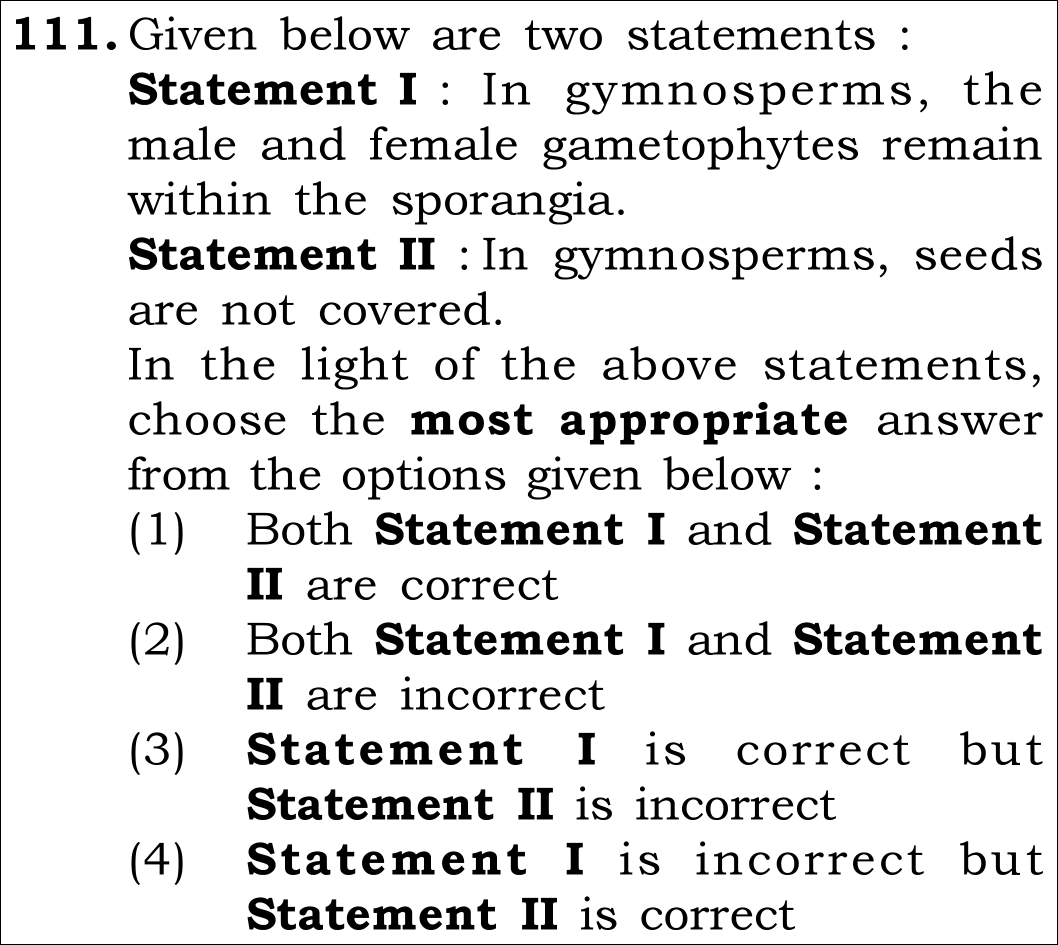
1 Both Statement I and Statement II are correct ✓ Key
2 Both Statement I and Statement II are incorrect
3 Statement I is correct but Statement II is incorrect
4 Statement I is incorrect but Statement II is correct
💡 Verified Solution & 30-Second Hack
✓
Verified Against NTA Final Answer Key
Option (1) : Both Statement I and Statement II are correct
📚 Plant Kingdom Medium
📋 Given Parameters & Problem Setup
Statement I In gymnosperms, the male and female gametophytes remain within the sporangia.
Statement II In gymnosperms, seeds are not covered.
⚡

The 30-Second Exam Hall Shortcut: ⚡ Gymnosperm True-Features Test

⏱️ Save ~40 seconds

Gymnos = Naked (Uncovered Seeds); Gametophytes = Retained inside Sporangia!

1 Evaluate Statement I: Unlike bryophytes and pteridophytes, gymnosperm gametophytes do not have an independent free-living existence; they remain retained within microsporangia and megasporangia. -> Statement I is TRUE.
2 Evaluate Statement II: The etymology of gymnosperms is "gymnos" = naked, "sperma" = seeds (ovules are not enclosed by any ovary wall). -> Statement II is TRUE.
3 Both statements are correct -> Pick Option (1) immediately!
🛡️
Why You Can 100% Trust This Shortcut: NCERT Plant Kingdom verbatim: Gymnosperms have naked ovules and gametophytes that remain within the sporangia.
📐

Step-by-Step Rigorous Workflow & Mathematical Proof

Step 1

Evaluate Statement I (Retention of Gametophytes)

In bryophytes and pteridophytes, gametophytes exist as independent free-living individuals (such as moss gametophores or fern prothalli). In gymnosperms and angiosperms, however, the gametophytes are highly reduced and lack independent existence. The male gametophyte (pollen grain) develops inside the microsporangium, and the female gametophyte is permanently retained inside the megasporangium (nucellus) on the sporophyte.

Gametophytes (σ7, ?)⊂Sporangia on Sporophyte  ⟹  Statement I is correct\text{Gametophytes (}\sigma^7, \, \text{?)} \subset \text{Sporangia on Sporophyte} \implies \text{Statement I is correct}
  • • NCERT Plant Kingdom: "Unlike bryophytes and pteridophytes, in gymnosperms the male and the female gametophytes do not have an independent free-living existence. They remain within the sporangia retained on the sporophytes."
Step 2

Evaluate Statement II (Naked Seeds)

Gymnosperms (from Greek: gymnos = naked, sperma = seed) are seed-bearing tracheophytes where the ovules are exposed on megasporophylls and not enclosed inside an ovary wall, both before and after fertilisation. Consequently, the seeds that develop are "naked" (not enclosed inside a fruit).

Gymnosperms:No ovary wall  ⟹  Seeds are uncovered (naked) [Statement II is correct]\text{Gymnosperms}: \text{No ovary wall} \implies \text{Seeds are uncovered (naked) [Statement II is correct]}
  • • Angiosperms differ because their seeds are enclosed inside fruits.
Step 3

Synthesize Verdict

Both Statement I and Statement II are canonically accurate according to standard plant morphology and taxonomy.

Both Statement I and Statement II are correct  ⟹  Option (1)\text{Both Statement I and Statement II are correct} \implies \text{Option (1)}
  • • Matches official NTA final answer key Option A / (1).
⭐

360° Option Elimination Engine Key Feature

Diagnose every choice: Know exactly why the right option works and why distractors fail.

4-Option Deep Scan
1 A
✓ 100% Correct
Verdict & Scientific Reason:

100% accurate. Faithfully reflects NCERT gymnosperm life cycle characteristics.

💡
Why this is airtight: None; thorough conceptual mastery.
2 B
✗ Incorrect
Verdict & Scientific Reason:

Incorrect. Both statements are universally established botanical facts.

⚠️
Student Fallacy (Why candidates pick this trap): Complete confusion regarding gymnosperm morphology.
3 C
✗ Incorrect
Verdict & Scientific Reason:

Incorrect. Statement II is the very definition of a gymnosperm (naked seeds).

⚠️
Student Fallacy (Why candidates pick this trap): Thinking gymnosperm cones represent a protective fruit cover.
4 D
✗ Incorrect
Verdict & Scientific Reason:

Incorrect. Fails to recognize that gymnosperm gametophytes lack free-living existence and are retained in sporangia.

⚠️
Student Fallacy (Why candidates pick this trap): Confusing gymnosperms with homosporous pteridophytes where prothallus is free-living.
⚠️

NTA Trap Alert: Confusing Free-Living Prothallus of Ferns with Gymnosperms

Students frequently conflate pteridophytes with gymnosperms. In ferns, gametophytes are independent photosynthetic free-living prothalli, but in gymnosperms, gametophytes are strictly retained inside the sporangia on the parent sporophyte.

🛡️ How to avoid the -1 mark: Remember: Seed plants NEVER release free-living gametophytes!
📖

Core NEET Syllabus Standard

NEET Biology Core Syllabus · Plant Kingdom Standard Benchmark
Core Scientific Principle Tested:

"Gymnosperms possess naked seeds lacking fruit coverage, and their reduced gametophytes remain housed within sporangia on the parent sporophyte."
Syllabus Focus: Gymnosperms - Structure and Life Cycle
✓ Core NEET UG Syllabus Anchor Syllabus & Academic Standards ↗
Gymnos means Naked seeds in sight, and Gametophytes stay inside the sporangial height!
NEET 2026 · Q121 Easy
Official NEET 2026 Question 121 - Plant Kingdom
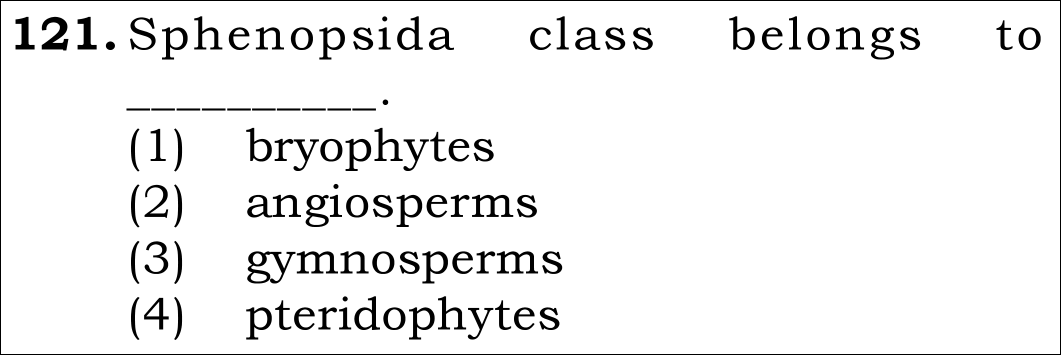
1 bryophytes
2 angiosperms
3 gymnosperms
4 pteridophytes ✓ Key
💡 Verified Solution & 30-Second Hack
✓
Verified Against NTA Final Answer Key
Option (4) : pteridophytes
📚 Plant Kingdom Easy
📋 Given Parameters & Problem Setup
Taxonomic Class Sphenopsida (Horsetails)
Representative Organism Equisetum
⚡

The 30-Second Exam Hall Shortcut: ⚡ Four Classes of Pteridophytes

⏱️ Save ~40 seconds

Psilopsida, Lycopsida, Sphenopsida, Pteropsida = Pteridophytes!

1 Recall the four canonical classes of Pteridophyta in NCERT Plant Kingdom:
2 Psilopsida (e.g., Psilotum)
3 Lycopsida (e.g., Selaginella, Lycopodium)
4 Sphenopsida (e.g., Equisetum - horsetails)
5 Pteropsida (e.g., Dryopteris, Pteris, Adiantum)
6 Sphenopsida is unequivocally a class of pteridophytes.
7 Select Option (4) in under 5 seconds!
🛡️
Why You Can 100% Trust This Shortcut: NCERT Biology · Plant Kingdom (Pteridophyte Classification: Psilopsida, Lycopsida, Sphenopsida, and Pteropsida).
📐

Step-by-Step Rigorous Workflow & Mathematical Proof

Step 1

Taxonomic System of Pteridophytes

Pteridophytes are vascular cryptogams possessing xylem and phloem, exhibiting alternation of generations with a dominant sporophytic phase. They are subdivided into four distinct taxonomic classes based on vegetative and reproductive morphology.

Pteridophyta={Psilopsida,  Lycopsida,  Sphenopsida,  Pteropsida}\text{Pteridophyta} = \{\text{Psilopsida}, \; \text{Lycopsida}, \; \mathbf{Sphenopsida}, \; \text{Pteropsida}\}
  • • First terrestrial plants to possess vascular tissues.
Step 2

Diagnostic Characters of Sphenopsida

Members of class Sphenopsida (commonly called horsetails or scouring rushes) feature articulated, jointed stems with distinct nodes and internodes, whorls of scale leaves at nodes, silica-impregnated epidermal cell walls, and compact strobili/cones at branch apices.

Sphenopsida  ⟹  Equisetum (Horsetail)∈Pteridophytes\text{Sphenopsida} \implies \text{Equisetum (Horsetail)} \in \text{Pteridophytes}
  • • Possess ribbed stems with vallecular and carinal canals.
Step 3

Eliminate Other Divisions

Bryophytes are non-vascular plants divided into liverworts and mosses. Gymnosperms are naked-seeded phanerogams (Conifers, Cycads, Ginkgo). Angiosperms are flowering plants (Monocots, Dicots). Sphenopsida belongs solely to pteridophytes.

Sphenopsida∈Pteridophytes  ⟹  Option (4)\text{Sphenopsida} \in \mathbf{Pteridophytes} \implies \text{Option (4)}
  • • Matches official NTA final answer key Option D / (4).
⭐

360° Option Elimination Engine Key Feature

Diagnose every choice: Know exactly why the right option works and why distractors fail.

4-Option Deep Scan
1 A
✗ Incorrect
Verdict & Scientific Reason:

Incorrect. Bryophytes include Hepaticopsida (liverworts) and Bryopsida (mosses), not Sphenopsida.

⚠️
Student Fallacy (Why candidates pick this trap): Confusing non-vascular cryptogams with vascular cryptogams.
2 B
✗ Incorrect
Verdict & Scientific Reason:

Incorrect. Angiosperms are flowering plants classified into Monocotyledonae and Dicotyledonae.

⚠️
Student Fallacy (Why candidates pick this trap): Complete taxonomic mismatch.
3 C
✗ Incorrect
Verdict & Scientific Reason:

Incorrect. Gymnosperms include Cycadopsida, Coniferopsida, and Gnetopsida.

⚠️
Student Fallacy (Why candidates pick this trap): Conflating naked seed plants with seedless vascular plants.
4 D
✓ 100% Correct
Verdict & Scientific Reason:

100% accurate. Sphenopsida is one of the four textbook classes of pteridophytes.

💡
Why this is airtight: None; standard direct recall.
⚠️

NTA Trap Alert: Class Suffix "-opsida" Ambiguity

The suffix "-opsida" is used in bryophytes (e.g. Hepaticopsida), pteridophytes (e.g. Sphenopsida), and gymnosperms (e.g. Cycadopsida). Students who only look at the suffix can get disoriented unless they anchor to Equisetum.

🛡️ How to avoid the -1 mark: Anchor: Sphenopsida -> Equisetum -> Horsetail -> Pteridophyte!
📖

Core NEET Syllabus Standard

NEET Biology Core Syllabus · Plant Kingdom Standard Benchmark
Core Scientific Principle Tested:

"Pteridophytes comprise four classes: Psilopsida, Lycopsida, Sphenopsida, and Pteropsida."

Syllabus Focus: Pteridophytes - Classification
✓ Core NEET UG Syllabus Anchor Syllabus & Academic Standards ↗
P-L-S-P: Please Let Science Prevail (Psilopsida, Lycopsida, Sphenopsida, Pteropsida in Pteridophytes)!
NEET 2025 · Q111 Medium
Official NEET 2025 Question 111 - Plant Kingdom
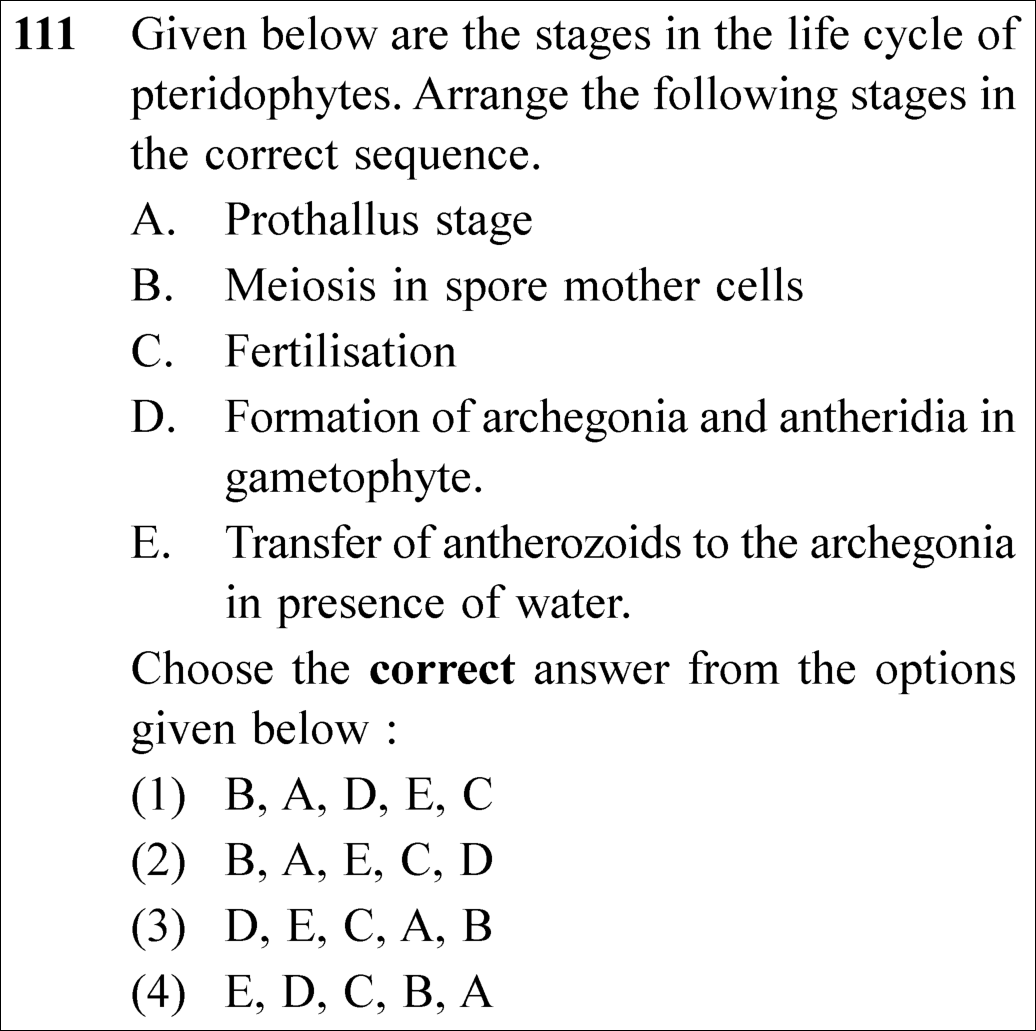
1 B,A, D, E, C ✓ Key
2 B, A, E, C, D
3 D,E,C, A,B
4 E,D,C,B,A
💡 Verified Solution & 30-Second Hack
✓
Verified Against NTA Final Answer Key
Option (1) : B, A, D, E, C
📚 Plant Kingdom Medium
📋 Given Parameters & Problem Setup
Stage A Prothallus stage
Stage B Meiosis in spore mother cells
Stage C Fertilisation
Stage D Formation of archegonia and antheridia in gametophyte
Stage E Transfer of antherozoids to the archegonia in presence of water
⚡

The 30-Second Exam Hall Shortcut: ⚡ Pteridophyte Life Cycle Sequence Fingerprint

⏱️ Save ~35 seconds

Meiosis in SMC (B) -> Haploid Spores germinate to Prothallus (A) -> Sex organs form (D) -> Water transfers antherozoids (E) -> Syngamy / Fertilisation (C)! Sequence: B -> A -> D -> E -> C!

1 Establish the chronological order of sexual reproduction in ferns/pteridophytes:
2 Diploid sporophyte bears sporangia where Spore Mother Cells undergo Meiosis (B) to form haploid spores.
3 Spores germinate in cool, damp places to form the multicellular free-living Prothallus (A).
4 Prothallus (gametophyte) develops sex organs: Antheridia and Archegonia (D).
5 Water is essential for Transfer of flagellated antherozoids to the mouth of the archegonium (E).
6 Fusion of gametes: Fertilisation (C) produces the diploid zygote which grows into a new sporophyte.
7 Correct order: B -> A -> D -> E -> C (Option 1)!
8 Select Option (1) confidently!
🛡️
Why You Can 100% Trust This Shortcut: Pteridophyte Classification & Spore Dynamics (NCERT Biology · Plant Kingdom: Heterospory in Selaginella and Salvinia).
📐

Step-by-Step Rigorous Workflow & Mathematical Proof

Step 1

Sporophytic Phase and Spore Genesis

In pteridophytes, the main plant body is a diploid sporophyte differentiated into true root, stem, and leaves:

  • • Sporophylls bear sporangia containing diploid spore mother cells (SMCs).
  • • SMCs undergo reduction division (Meiosis in spore mother cells - Stage B) to produce haploid spores.
Step 2

Gametophytic Phase (Prothallus) and Sex Organ Development

Development of the independent, photosynthetic gametophytic generation:

  • • Haploid spores germinate to produce inconspicuous, small, multicellular, free-living, mostly photosynthetic thalloid gametophytes called the Prothallus stage (Stage A).
  • • The prothallus bears male and female sex organs: antheridia and archegonia (Stage D).
Step 3

Water-Mediated Gamete Transfer and Syngamy

Completion of the sexual cycle:

  • • Water is required for the transfer of flagellated male gametes (antherozoids) released from antheridia to the archegonium (Stage E).
  • • Fusion of an antherozoid with the egg present in the archegonium results in Fertilisation (Stage C).
  • • The resulting zygote produces a multicellular, well-differentiated sporophyte, restarting the cycle.
Step 4

Sequence Synthesis

Ordering the stages: B (Meiosis) -> A (Prothallus) -> D (Archegonia & Antheridia formation) -> E (Transfer of antherozoids in water) -> C (Fertilisation).

Cycle: B→A→D→E→C\text{Cycle: } B \rightarrow A \rightarrow D \rightarrow E \rightarrow C
⭐

360° Option Elimination Engine Key Feature

Diagnose every choice: Know exactly why the right option works and why distractors fail.

4-Option Deep Scan
1 A
✓ 100% Correct
Verdict & Scientific Reason:

100% correct. Precisely traces the alternating sporophyte-to-gametophyte-to-syngamy developmental continuum.

💡
Why this is airtight: None; clear chronological grasp.
2 B
✗ Incorrect
Verdict & Scientific Reason:

Incorrect. Places transfer of antherozoids (E) and fertilisation (C) before sex organs are formed (D), which is biologically impossible.

⚠️
Student Fallacy (Why candidates pick this trap): Putting gamete release before organ formation.
3 C
✗ Incorrect
Verdict & Scientific Reason:

Incorrect. Starts with sex organs (D) before the prothallus (A) has even formed.

⚠️
Student Fallacy (Why candidates pick this trap): Reversing the sequence.
4 D
✗ Incorrect
Verdict & Scientific Reason:

Incorrect. Disordered chronology starting with antherozoid transfer.

⚠️
Student Fallacy (Why candidates pick this trap): Arbitrary ordering.
⚠️

NTA Trap Alert: Starting Point of the Alternation Cycle

Look at the provided options: all realistic candidates start with B (Meiosis in SMCs) or D. Since the prothallus is formed from spores produced by meiosis, B must precede A, and D must occur on A!

🛡️ How to avoid the -1 mark: Trace from Spore production (Meiosis, B) -> Thallus (A) -> Organs (D) -> Swimming (E) -> Fusion (C).
📖

Core NEET Syllabus Standard

NEET Biology Core Syllabus · Plant Kingdom Standard Benchmark
Core Scientific Principle Tested:

"Meiosis in SMCs produces spores which germinate into a prothallus bearing antheridia/archegonia; antherozoids swim in water to effect fertilisation."

Syllabus Focus: Pteridophytes · Alternation of Generations
✓ Core NEET UG Syllabus Anchor Syllabus & Academic Standards ↗
BAD EC: B (Meiosis) -> A (Prothallus) -> D (Duo Organs) -> E (Enter water) -> C (Conception/Fertilisation)!
NEET 2025 · Q119 Medium
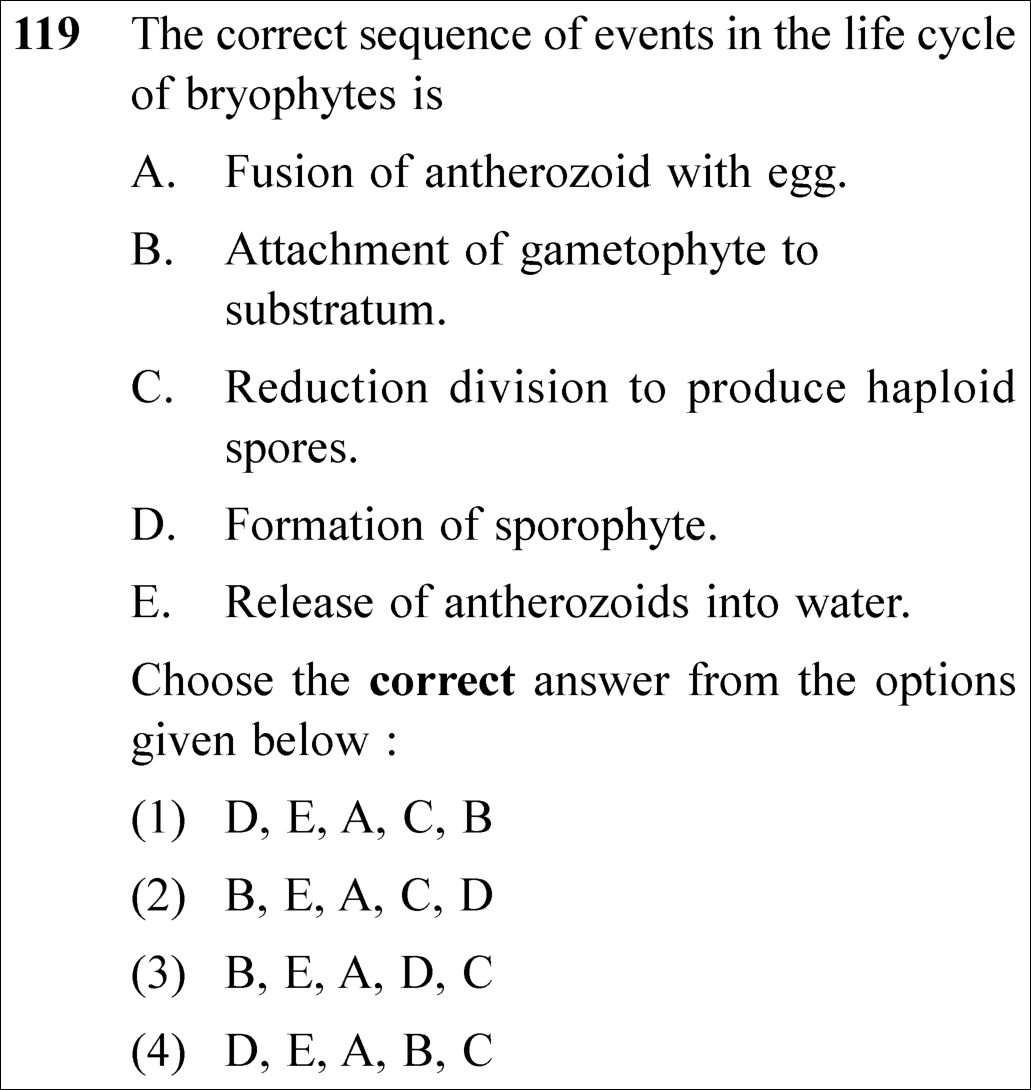
Official NEET 2025 Question 119 - Plant Kingdom
1 D, E, A, C, B
2 B, E, A, C, D
3 B,E, A, D, C ✓ Key
4 D, E, A, B, C
💡 Verified Solution & 30-Second Hack
✓
Verified Against NTA Final Answer Key
Option (3) : B, E, A, D, C
📚 Plant Kingdom Medium
📋 Given Parameters & Problem Setup
Event A Fusion of antherozoid with egg
Event B Attachment of gametophyte to substratum
Event C Reduction division to produce haploid spores
Event D Formation of sporophyte
Event E Release of antherozoids into water
⚡

The 30-Second Exam Hall Shortcut: ⚡ Bryophyte Life Cycle Chronology Fingerprint

⏱️ Save ~30 seconds

Gametophyte attaches to substratum (B) -> Antherozoids released into water (E) -> Syngamy with egg (A) -> Zygote develops into Sporophyte (D) -> Spore mother cells undergo Meiosis (C)! Sequence: B -> E -> A -> D -> C!

1 Track the biological flow of bryophyte reproduction:
2 Gametophyte thallus attaches to substratum by rhizoids (B).
3 Antheridia mature and release biflagellate antherozoids into water (E).
4 Antherozoids swim to archegonium; fusion with egg produces zygote (A).
5 Zygote does not undergo meiosis immediately; it develops into a multicellular Sporophyte (foot, seta, capsule) (D).
6 Spore mother cells inside the capsule undergo reduction division (meiosis) to produce haploid spores (C).
7 Chronological order: B -> E -> A -> D -> C (Option 3)!
8 Select Option (3)!
🛡️
Why You Can 100% Trust This Shortcut: Bryophyte Life Cycle & Gametophyte Predominance (NCERT Biology · Plant Kingdom: Protonema and leafy stage in mosses).
📐

Step-by-Step Rigorous Workflow & Mathematical Proof

Step 1

Establishment of the Gametophyte Generation

In bryophytes (mosses and liverworts), the dominant, independent, photosynthetic stage is the haploid gametophyte:

  • • The thalloid or leafy gametophyte attaches to the substratum by unicellular or multicellular rhizoids (Event B).
Step 2

Gamete Liberation and Syngamy

Sexual reproduction in moist environments:

  • • Male sex organs (antheridia) produce biflagellate antherozoids that are released into film of water (Event E).
  • • Antherozoids swim and reach the neck of the flask-shaped female sex organ (archegonium). An antherozoid fuses with the non-motile egg cell to form a diploid zygote (Event A).
Step 3

Sporophyte Development and Meiotic Spore Formation

Development of the parasitic sporophyte and spore dissemination:

  • • Zygotes do not undergo reduction division immediately. They divide mitotically to produce a multicellular diploid body called the sporophyte (differentiated into foot, seta, and capsule) attached to and nourished by the gametophyte (Event D).
  • • Some cells of the capsule (spore mother cells) undergo reduction division (meiosis) to produce haploid spores (Event C).
  • • These spores later disperse and germinate into new gametophytes, completing the alternation of generations.
Step 4

Conclusion

The natural biological progression is B -> E -> A -> D -> C, which corresponds to Option (3).

Cycle: B→E→A→D→C\text{Cycle: } B \rightarrow E \rightarrow A \rightarrow D \rightarrow C
⭐

360° Option Elimination Engine Key Feature

Diagnose every choice: Know exactly why the right option works and why distractors fail.

4-Option Deep Scan
1 A
✗ Incorrect
Verdict & Scientific Reason:

Incorrect. Starts with sporophyte formation (D) before gametophyte attachment or fertilisation.

⚠️
Student Fallacy (Why candidates pick this trap): Confusing sporophyte with gametophyte initiation.
2 B
✗ Incorrect
Verdict & Scientific Reason:

Incorrect. Places reduction division (C) before sporophyte formation (D), which is impossible because reduction division occurs inside the capsule of the sporophyte.

⚠️
Student Fallacy (Why candidates pick this trap): Assuming zygote undergoes immediate meiosis (like in haplontic green algae).
3 C
✓ 100% Correct
Verdict & Scientific Reason:

100% correct. Correctly reflects the delay of reduction division until after multicellular sporophyte formation.

💡
Why this is airtight: None; rigorous understanding of bryophyte life cycle.
4 D
✗ Incorrect
Verdict & Scientific Reason:

Incorrect. Jumbles sporophyte generation with gamete release.

⚠️
Student Fallacy (Why candidates pick this trap): Random guessing.
⚠️

NTA Trap Alert: Immediate Zygotic Meiosis vs Sporophyte Formation

In haplontic algae (e.g., Volvox, Chlamydomonas), the zygote undergoes immediate meiosis. In bryophytes, NCERT emphatically notes: "Zygotes do not undergo reduction division immediately. They produce a multicellular body called a sporophyte." Therefore, D (Sporophyte) MUST precede C (Reduction division)!

🛡️ How to avoid the -1 mark: Never pick an option where C comes before D in bryophytes!
📖

Core NEET Syllabus Standard

NEET Biology Core Syllabus · Plant Kingdom Standard Benchmark
Core Scientific Principle Tested:

"Gametophyte anchors to substratum -> releases antherozoids -> fertilization forms zygote -> sporophyte develops -> meiotic reduction division produces spores."

Syllabus Focus: Bryophytes · Life Cycle and Reproduction
✓ Core NEET UG Syllabus Anchor Syllabus & Academic Standards ↗
BE A Doc: B (Base attachment) -> E (Emission in water) -> A (Acquiring egg/Syngamy) -> D (Development of sporophyte) -> C (Capsule meiosis)!
NEET 2025 · Q159 Easy
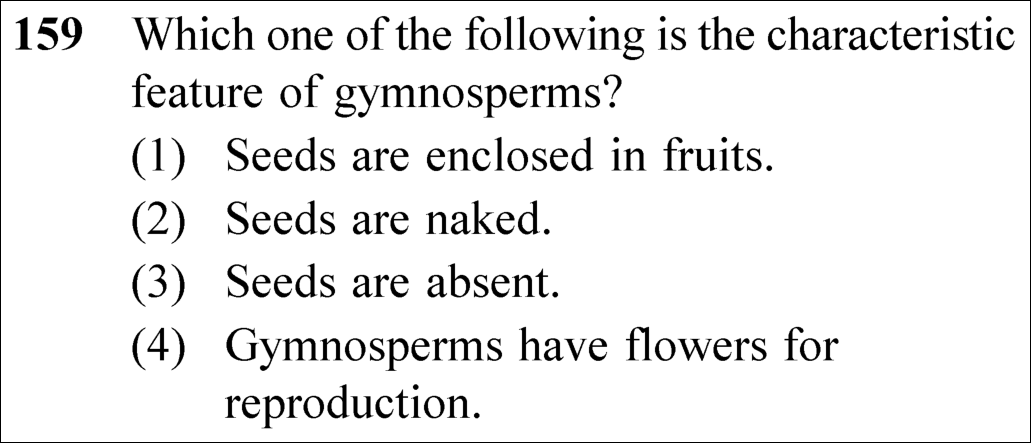
Official NEET 2025 Question 159 - Plant Kingdom
1 Seeds are enclosed in fruits.
2 Seeds are naked. ✓ Key
3 Seeds are absent.
4 Gymnosperms have flowers for reproduction.
💡 Verified Solution & 30-Second Hack
✓
Verified Against NTA Final Answer Key
Option (2) : Seeds are naked.
📚 Plant Kingdom Easy
📋 Given Parameters & Problem Setup
Plant Division Gymnosperms (Pinus, Cycas, Cedrus, Ginkgo)
Target Feature Diagnostic characteristic feature
⚡

The 30-Second Exam Hall Shortcut: ⚡ Gymnosperm Etymology Fingerprint

⏱️ Save ~10 seconds

Gymnos = Naked, Sperma = Seed! Ovules are NOT enclosed in an ovary wall; therefore SEEDS ARE NAKED (no fruit)!

1 Recall the verbatim etymology of Gymnosperms from NCERT Section 3.4:
2 - "The gymnosperms (gymnos : naked, sperma : seeds) are plants in which the ovules are not enclosed by any ovary wall and remain exposed, both before and after fertilisation."
3 - "The seeds that develop post-fertilisation, are not covered, i.e., are naked."
4 - Seeds enclosed in fruits = Angiosperms.
5 - Seeds absent = Pteridophytes and Bryophytes.
6 - Direct hallmark: Seeds are naked!
7 Select Option (2) Seeds are naked!
🛡️
Why You Can 100% Trust This Shortcut: Gymnosperm Reproduction & Naked Seeds (NCERT Biology · Plant Kingdom: Ovules not enclosed in ovary wall).
📐

Step-by-Step Rigorous Workflow & Mathematical Proof

Step 1

Etymological and Morphological Definition of Gymnosperms

Gymnosperms are vascular seed plants (tracheophytes) displaying unique reproductive morphology:

  • • Etymology: Greek *gymnos* = naked, and *sperma* = seed.
  • • Unlike angiosperms, gymnosperms do not produce flowers and lack a carpel/ovary to enclose their megasporangia (ovules).
  • • The ovules are borne naked on the surface of specialized reproductive leaves termed megasporophylls, usually aggregated into female strobili or cones (except in *Cycas* where female cones are absent).
Step 2

Post-Fertilization Development

Post-fertilization fate of naked ovules:

  • • Because ovary walls are completely absent, no fruit is ever formed.
  • • The ovules develop directly into mature seeds that remain uncovered and exposed to the environment (naked seeds).
  • • Endosperm in gymnosperms is haploid (nn) and forms before fertilization as the female gametophyte tissue.
Step 3

Conclusion

The defining diagnostic hallmark of gymnosperms is that their seeds are naked, matching Option (2).

Gymnosperms  ⟹  Ovary Wall Absent  ⟹  Seeds are Naked\text{Gymnosperms} \implies \text{Ovary Wall Absent} \implies \text{Seeds are Naked}
⭐

360° Option Elimination Engine Key Feature

Diagnose every choice: Know exactly why the right option works and why distractors fail.

4-Option Deep Scan
1 A
✗ Incorrect
Verdict & Scientific Reason:

Incorrect. Enclosed seeds within fruits define angiosperms (flowering plants), which possess an ovary wall.

⚠️
Student Fallacy (Why candidates pick this trap): Confusing gymnosperms with angiosperms.
2 B
✓ 100% Correct
Verdict & Scientific Reason:

100% correct. Direct verbatim NCERT fact: ovules are not enclosed by an ovary wall, so post-fertilization seeds are naked.

💡
Why this is airtight: None; fundamental botanical taxonomy.
3 C
✗ Incorrect
Verdict & Scientific Reason:

Incorrect. Gymnosperms are spermatophytes (seed-bearing plants); seeds are absent in bryophytes and pteridophytes.

⚠️
Student Fallacy (Why candidates pick this trap): Denying seed habit in gymnosperms.
4 D
✗ Incorrect
Verdict & Scientific Reason:

Incorrect. Gymnosperms do not produce flowers; their reproductive organs are arranged in cones or strobili.

⚠️
Student Fallacy (Why candidates pick this trap): Equating cones with true angiosperm flowers.
⚠️

NTA Trap Alert: Cone Scales vs Fruit Wall

Pinus cones have woody scales that protect developing seeds, but these scales are megasporophylls, NOT an ovary wall or pericarp! Botanically, the seeds remain completely naked.

🛡️ How to avoid the -1 mark: Remember: No ovary = No fruit = Naked seeds (Gymnosperm).
📖

Core NEET Syllabus Standard

NEET Biology Core Syllabus · Plant Kingdom Standard Benchmark
Core Scientific Principle Tested:

"Gymnosperms bear exposed ovules that develop into naked seeds not enclosed by any fruit."

Syllabus Focus: Gymnosperms · Distinguishing Features
✓ Core NEET UG Syllabus Anchor Syllabus & Academic Standards ↗
GYMNO = Naked, SPERM = Seed -> Naked Seeds!
NEET 2025 · Q162 Easy
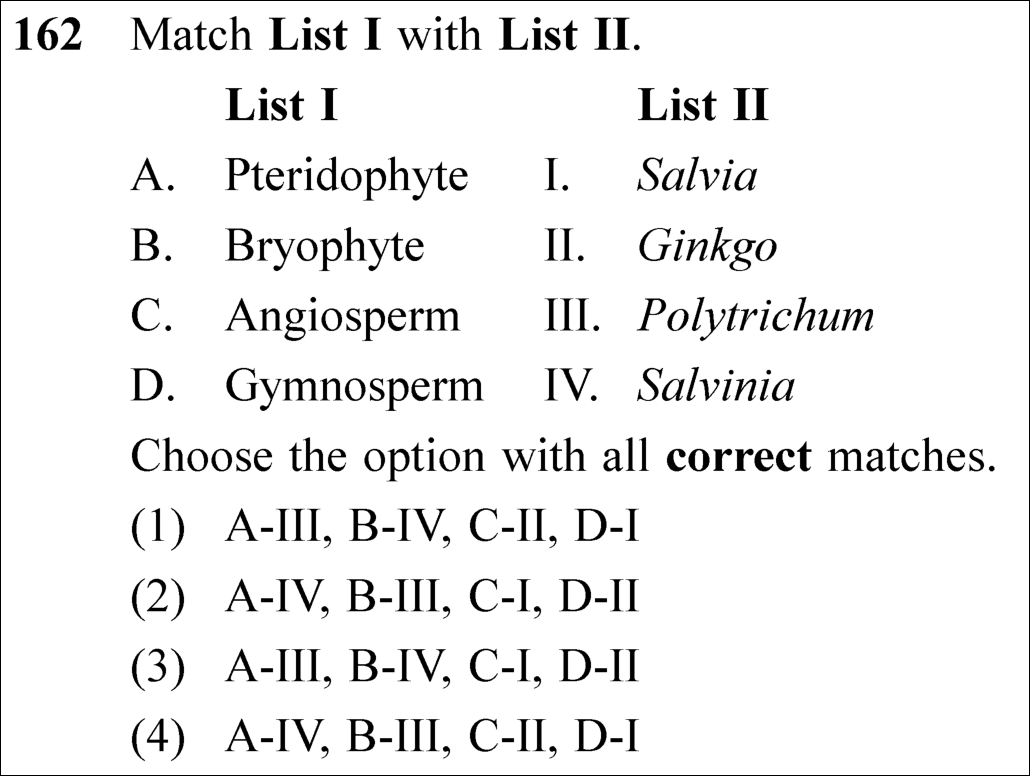
Official NEET 2025 Question 162 - Plant Kingdom
1
2 ✓ Key
3
4
💡 Verified Solution & 30-Second Hack
✓
Verified Against NTA Final Answer Key
Option (2) : A-IV, B-III, C-I, D-II
📚 Plant Kingdom Easy
📋 Given Parameters & Problem Setup
List I (Plant Divisions) A. Pteridophyte, B. Bryophyte, C. Angiosperm, D. Gymnosperm
List II (Representative Genera) I. Salvia, II. Ginkgo, III. Polytrichum, IV. Salvinia
⚡

The 30-Second Exam Hall Shortcut: ⚡ Plant Kingdom Match Fingerprint

⏱️ Save ~25 seconds

Salvinia = Heterosporous water fern (Pteridophyte, IV); Polytrichum = Moss (Bryophyte, III); Salvia = Sage flowering plant (Angiosperm, I); Ginkgo = Living fossil gymnosperm (Gymnosperm, II)! Code: A-IV, B-III, C-I, D-II!

1 Match each genus directly from NCERT Plant Kingdom:
2 - Salvinia: Heterosporous aquatic fern -> Pteridophyte (A -> IV).
3 - Polytrichum: Common moss -> Bryophyte (B -> III).
4 - Salvia: Flowering sage plant with bilabiate corolla -> Angiosperm (C -> I).
5 - Ginkgo (*Ginkgo biloba*): Maidenhair tree, living fossil -> Gymnosperm (D -> II).
6 Combined code: A-IV, B-III, C-I, D-II (Option 2)!
7 Solved in under 10 seconds!
🛡️
Why You Can 100% Trust This Shortcut: Algae Pigments and Food Storage Polymers (NCERT Biology · Plant Kingdom: Chlorophyceae, Phaeophyceae, Rhodophyceae).
📐

Step-by-Step Rigorous Workflow & Mathematical Proof

Step 1

Taxonomic Classification of the Four Genera

Correlating each plant genus to its corresponding botanical division in NCERT:

  • • A. Pteridophyte: *Salvinia* is a small, free-floating aquatic pteridophyte (heterosporous fern producing microspores and megaspores). Hence, A matches IV.
  • • B. Bryophyte: *Polytrichum* is an advanced moss belonging to Class Bryopsida (along with *Funaria* and *Sphagnum*), possessing an upright leafy gametophyte and complex sporophyte. Hence, B matches III.
  • • C. Angiosperm: *Salvia* is a dicotyledonous flowering plant belonging to Family Lamiaceae, renowned for its lever-mechanism of entomophilous pollination. Hence, C matches I.
  • • D. Gymnosperm: *Ginkgo* (*Ginkgo biloba*) is a gymnosperm possessing fan-shaped leaves and naked seeds, famously described as a living fossil. Hence, D matches II.
Step 2

Assembling the Matching Matrix

Synthesizing the code:

  • • A (Pteridophyte) -> IV (*Salvinia*)
  • • B (Bryophyte) -> III (*Polytrichum*)
  • • C (Angiosperm) -> I (*Salvia*)
  • • D (Gymnosperm) -> II (*Ginkgo*)
Step 3

Conclusion

The code A-IV, B-III, C-I, D-II uniquely corresponds to Option (2).

Matching: A-IV,  B-III,  C-I,  D-II\text{Matching: } A\text{-IV}, \; B\text{-III}, \; C\text{-I}, \; D\text{-II}
⭐

360° Option Elimination Engine Key Feature

Diagnose every choice: Know exactly why the right option works and why distractors fail.

4-Option Deep Scan
1 A
✗ Incorrect
Verdict & Scientific Reason:

Incorrect. Assigns moss (Polytrichum) to pteridophytes and Salvinia to bryophytes.

⚠️
Student Fallacy (Why candidates pick this trap): Swapping pteridophytes and bryophytes.
2 B
✓ 100% Correct
Verdict & Scientific Reason:

100% correct. Flawlessly aligns each division with its canonical NCERT representative genus.

💡
Why this is airtight: None; pristine botanical taxonomy.
3 C
✗ Incorrect
Verdict & Scientific Reason:

Incorrect. Swaps Salvinia and Polytrichum.

⚠️
Student Fallacy (Why candidates pick this trap): Confusing water fern with moss.
4 D
✗ Incorrect
Verdict & Scientific Reason:

Incorrect. Swaps Salvia (angiosperm) and Ginkgo (gymnosperm).

⚠️
Student Fallacy (Why candidates pick this trap): Confusing Ginkgo with angiosperms.
⚠️

NTA Trap Alert: Salvia vs Salvinia Name Confusion

The names look nearly identical: SALVIA is an Angiosperm (Sage flower)! SALVINIA is a Pteridophyte (aquatic fern)! Look very closely at the spelling!

🛡️ How to avoid the -1 mark: SalviA = Angiosperm (flower); SalviniA = Pteridophyte (water fern).
📖

Core NEET Syllabus Standard

NEET Biology Core Syllabus · Plant Kingdom Standard Benchmark
Core Scientific Principle Tested:

"Salvinia is a pteridophyte, Polytrichum is a bryophyte, Salvia is an angiosperm, and Ginkgo is a gymnosperm."

Syllabus Focus: Classification of Plant Kingdom · Characteristic Genera
✓ Core NEET UG Syllabus Anchor Syllabus & Academic Standards ↗
Salvinia is Fern (IV), Poly is Moss (III), Salvia has Flowers (I), Ginkgo is Naked (II)!
NEET 2025 · Q168 Easy
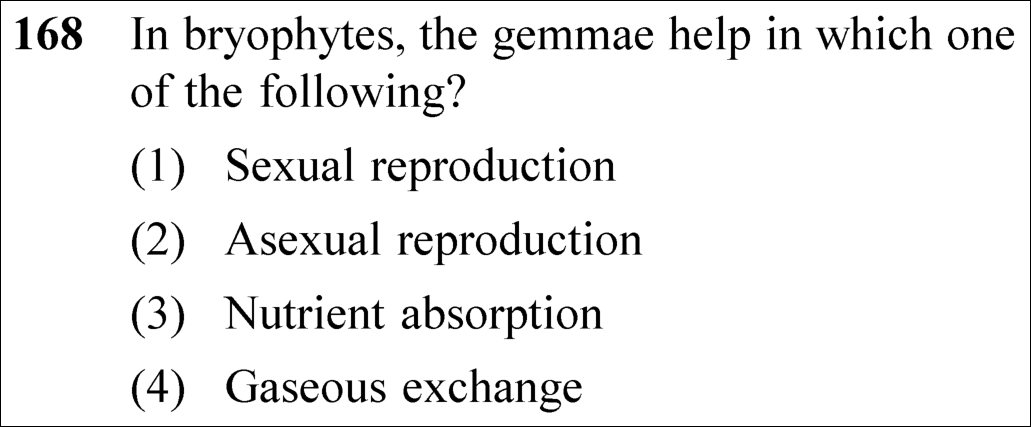
Official NEET 2025 Question 168 - Plant Kingdom
1 Sexual reproduction
2 Asexual reproduction ✓ Key
3 Nutrient absorption
4 Gaseous exchange
💡 Verified Solution & 30-Second Hack
✓
Verified Against NTA Final Answer Key
Option (2) : Asexual reproduction
📚 Plant Kingdom Easy
📋 Given Parameters & Problem Setup
Plant Group Bryophytes (specifically Liverworts, e.g. Marchantia)
Structure Gemmae (asexual vegetative buds produced in gemma cups)
⚡

The 30-Second Exam Hall Shortcut: ⚡ Marchantia Gemmae Role Fingerprint

⏱️ Save ~10 seconds

Gemmae are green, multicellular, ASEXUAL BUDS born in gemma cups that detach to germinate into new thalli -> ASEXUAL REPRODUCTION!

1 Recall NCERT Section 3.2.1 (Liverworts) verbatim:
2 - "Asexual reproduction in liverworts takes place by fragmentation of thalli, or by the formation of specialised structures called gemmae (sing. gemma)."
3 - "Gemmae are green, multicellular, asexual buds, which develop in small receptacles called gemma cups located on the thalli."
4 - "The gemmae become detached from the parent body and germinate to form new individuals."
5 Direct function: Asexual reproduction!
6 Select Option (2) Asexual reproduction!
🛡️
Why You Can 100% Trust This Shortcut: Liverwort vs Moss Sporophyte Structure (NCERT Biology · Plant Kingdom: Foot, seta, capsule with elaters vs peristome teeth).
📐

Step-by-Step Rigorous Workflow & Mathematical Proof

Step 1

Morphology and Nature of Gemmae

In hepaticopsid bryophytes (liverworts like *Marchantia*), the gametophytic thallus produces specialized reproductive propagules called gemmae:

  • • Gemma cups: Small, crescent- or cup-shaped receptacles located on the dorsal surface of the thallus along the midrib.
  • • Gemmae: Green, photosynthetic, multicellular, disc-shaped vegetative bodies attached by tiny stalks inside the gemma cup.
Step 2

Mechanism of Vegetative Propagation

How gemmae establish new colonies:

  • • Rain drops splashing into the gemma cups break the delicate stalks, disseminating the gemmae onto moist soil.
  • • Each gemma possesses two lateral growing notches containing meristematic cells.
  • • Upon detachment, each notch germinates mitotically into a new haploid gametophytic thallus genetically identical to the parent.
  • • Because no meiosis or fusion of gametes is involved, this represents pure asexual reproduction.
Step 3

Conclusion

Gemmae function exclusively in asexual reproduction, matching Option (2).

Gemmae=Asexual Multicellular Buds  ⟹  Asexual Reproduction\text{Gemmae} = \text{Asexual Multicellular Buds} \implies \text{Asexual Reproduction}
⭐

360° Option Elimination Engine Key Feature

Diagnose every choice: Know exactly why the right option works and why distractors fail.

4-Option Deep Scan
1 A
✗ Incorrect
Verdict & Scientific Reason:

Incorrect. Sexual reproduction in liverworts is oogamous and carried out by antheridia and archegonia on specialized antheridiophores and archegoniophores.

⚠️
Student Fallacy (Why candidates pick this trap): Confusing vegetative propagules with sexual gametangia.
2 B
✓ 100% Correct
Verdict & Scientific Reason:

100% correct. Direct verbatim NCERT fact: gemmae are asexual buds mediating vegetative propagation.

💡
Why this is airtight: None; textbook mastery.
3 C
✗ Incorrect
Verdict & Scientific Reason:

Incorrect. Water and nutrient absorption from substratum is performed by unicellular rhizoids.

⚠️
Student Fallacy (Why candidates pick this trap): Confusing gemma cups with rhizoids.
4 D
✗ Incorrect
Verdict & Scientific Reason:

Incorrect. Gaseous exchange occurs through air pores present on the dorsal epidermis of the thallus.

⚠️
Student Fallacy (Why candidates pick this trap): Confusing gemma cups with air pores.
⚠️

NTA Trap Alert: Asexual (Gemmae) vs Sexual (Gametangia) in Marchantia

NCERT figures of Marchantia show: 1. Gemma cups on the thallus = ASEXUAL reproduction. 2. Umbrella-like Archegoniophore and Antheridiophore = SEXUAL reproduction!

🛡️ How to avoid the -1 mark: Gemma cups = Asexual buds.
📖

Core NEET Syllabus Standard

NEET Biology Core Syllabus · Plant Kingdom Standard Benchmark
Core Scientific Principle Tested:

"Gemmae are green, multicellular, asexual buds developed in gemma cups for asexual reproduction."

Syllabus Focus: Bryophytes · Liverworts (Asexual Reproduction)
✓ Core NEET UG Syllabus Anchor Syllabus & Academic Standards ↗
GEMMAE = Growing Exact Multicellular Asexual Entities!
NEET 2024 · Q146 Medium
Official NEET 2024 Question 146 - Plant Kingdom
1 ✓ Key
2
3
4
💡 Verified Solution & 30-Second Hack
✓
Verified Against NTA Final Answer Key
Option (1) : A, C, D and E only
📚 Plant Kingdom Medium
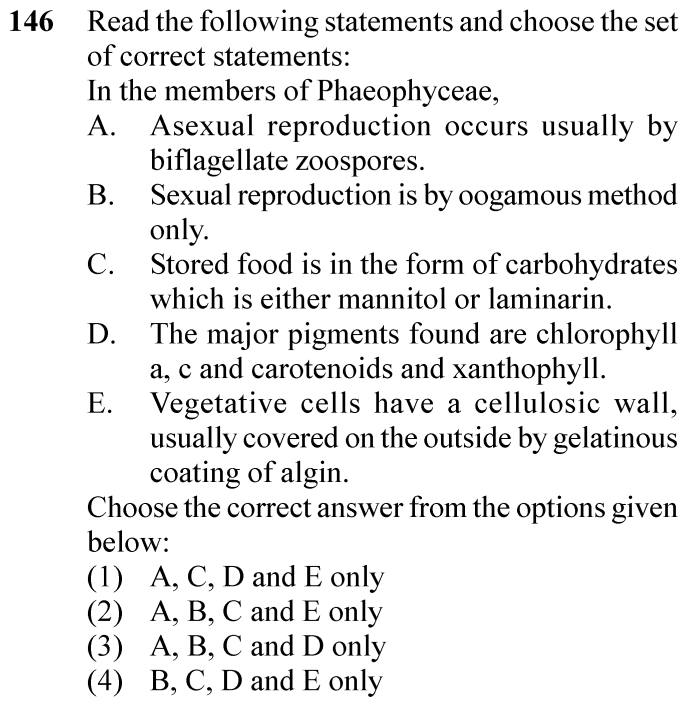
📋 Given Parameters & Problem Setup
Algal Class Phaeophyceae (Brown algae)
Statements A: Biflagellate zoospores; B: Sexual reproduction oogamous only (False); C: Stored food mannitol/laminarin; D: Chl a, c, carotenoids, xanthophylls; E: Cellulosic wall with algin
⚡

The 30-Second Exam Hall Shortcut: ⚡ Brown Algae Sexual Diversity Rule

⏱️ Save ~35 seconds

Statement B claims sexual reproduction is "by oogamous method only". NCERT explicitly states sexual reproduction may be isogamous, anisogamous OR oogamous! Eliminate B!

1 Check Statement B: "Sexual reproduction is by oogamous method only" -> FALSE! In Phaeophyceae, sexual reproduction can be isogamous, anisogamous, or oogamous.
2 Eliminate every option with B: Option 2 (A, B, C, E), Option 3 (A, B, C, D), Option 4 (B, C, D, E).
3 Only Option (1) A, C, D and E only remains!
4 Single-step elimination gives the correct answer!
🛡️
Why You Can 100% Trust This Shortcut: NCERT Biology · Plant Kingdom (Phaeophyceae - Brown Algae)
📐

Step-by-Step Rigorous Workflow & Mathematical Proof

Step 1

Evaluate Statement A (Asexual Reproduction)

Asexual reproduction in most brown algae is by biflagellate zoospores that are pear-shaped and have two unequal laterally attached flagella. Statement A is true.

Step 2

Evaluate Statement B (Sexual Reproduction Modes)

Sexual reproduction may be isogamous, anisogamous or oogamous. Union of gametes may take place in water or within the oogonium (oogamous species). Restricting it to "oogamous method only" is factually incorrect. Statement B is false.

Step 3

Evaluate Statements C, D, and E (Biochemical Features)

- Statement C: Food is stored as complex carbohydrates, which may be in the form of laminarin or mannitol. True. - Statement D: Brown algae possess chlorophyll a, c, carotenoids and xanthophylls (fucoxanthin). True. - Statement E: The vegetative cells have a cellulosic wall usually covered on the outside by a gelatinous coating of algin. True.

Step 4

Formulate Valid Combination

Statements A, C, D, and E are correct, corresponding to Option (1).

⭐

360° Option Elimination Engine Key Feature

Diagnose every choice: Know exactly why the right option works and why distractors fail.

4-Option Deep Scan
1 (1)
✓ 100% Correct
Verdict & Scientific Reason:

Accurately selects all valid structural, biochemical, and reproductive characteristics while rejecting statement B.

💡
Why this is airtight: None.
2 (2)
✗ Incorrect
Verdict & Scientific Reason:

Incorrectly includes Statement B and omits diagnostic pigments (D).

⚠️
Student Fallacy (Why candidates pick this trap): Incorrectly includes Statement B and omits diagnostic pigments (D).
3 (3)
✗ Incorrect
Verdict & Scientific Reason:

Incorrectly includes Statement B and omits cell wall algin coating (E).

⚠️
Student Fallacy (Why candidates pick this trap): Incorrectly includes Statement B and omits cell wall algin coating (E).
4 (4)
✗ Incorrect
Verdict & Scientific Reason:

Incorrectly includes Statement B and omits biflagellate zoospores (A).

⚠️
Student Fallacy (Why candidates pick this trap): Incorrectly includes Statement B and omits biflagellate zoospores (A).
⚠️

NTA Trap Alert: Phaeophyceae vs Rhodophyceae Sexual Reproduction

Confusing Rhodophyceae (which is strictly oogamous with non-motile gametes) with Phaeophyceae.

🛡️ How to avoid the -1 mark: Rhodophyceae is strictly oogamous; Phaeophyceae exhibits isogamous, anisogamous, and oogamous sexual reproduction.
📖

Core NEET Syllabus Standard

Biology Core Botany · Plant Kingdom Standard Benchmark
Core Scientific Principle Tested:

"Phaeophyceae possess chlorophyll a, c, carotenoids and xanthophylls. Food is stored as complex carbohydrates, which may be in the form of laminarin or mannitol. The vegetative cells have a cellulosic wall usually covered on the outside by a gelatinous coating of algin... Asexual reproduction is by pear-shaped biflagellate zoospores... Sexual reproduction may be isogamous, anisogamous or oogamous."

Syllabus Focus: Phaeophyceae (Brown Algae): Reproduction, Storage, Pigments, and Cell Wall
✓ Core NEET UG Syllabus Anchor Syllabus & Academic Standards ↗
NEET 2023 · Q101 Easy
Official NEET 2023 Question 101 - Plant Kingdom
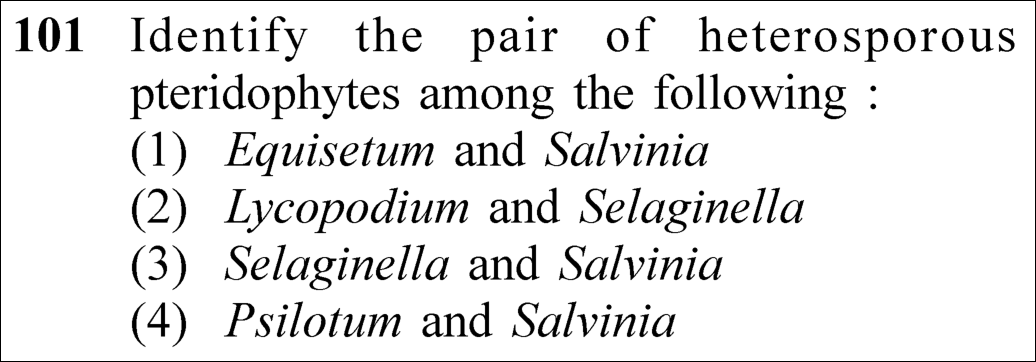
1 Equisetum and Salvinia
2 Lycopodium and Selaginella
3 Selaginella and Salvinia ✓ Key
4 Psilotum and Salvinia
💡 Verified Solution & 30-Second Hack
✓
Verified Against NTA Final Answer Key
Option (3) : Selaginella and Salvinia
📚 Plant Kingdom Easy
📋 Given Parameters & Problem Setup
Plant Group Pteridophytes (Vascular Cryptogams)
Spore Type Heterosporous (two distinct kinds of spores)
⚡

The 30-Second Exam Hall Shortcut: ⚡ Heterospory Mnemonic Anchor: "Double S" = Selaginella & Salvinia

⏱️ Save ~25 seconds

Majority of pteridophytes are homosporous. The classic heterosporous genera highlighted in NCERT are Selaginella and Salvinia (along with Marsilea and Azolla). Look for the "Double S" pair for an instant 5-second answer!

1 Recall that most pteridophytes produce identical spores (homosporous, e.g., Equisetum, Lycopodium, Dryopteris, Psilotum).
2 Pteridophytes producing two kinds of spores—macro (mega) and microspores—are heterosporous.
3 NCERT canonical heterosporous genera: Selaginella and Salvinia.
4 Option (3) groups Selaginella and Salvinia together.
🛡️
Why You Can 100% Trust This Shortcut: Canonical NCERT Plant Kingdom taxonomy on Pteridophytes and origin of seed habit.
📐

Step-by-Step Rigorous Workflow & Mathematical Proof

Step 1

Definition of Heterospory in Pteridophytes

Heterospory is the condition of producing two morphologically distinct types of spores differing in size and sexual differentiation:

Heterospory  ⟺  {Microspores⟶Male gametophyteMegaspores⟶Female gametophyte\text{Heterospory} \iff \begin{cases} \text{Microspores} & \longrightarrow \text{Male gametophyte} \\[4pt] \text{Megaspores} & \longrightarrow \text{Female gametophyte} \end{cases}
Step 2

Classification of Common Pteridophytic Genera

Pteridophytes are classified based on spore type as follows:

Homosporous:Psilotum, Lycopodium, Equisetum, Dryopteris, Pteris, AdiantumHeterosporous:Selaginella, Salvinia, Marsilea, Isoetes, Azolla\begin{aligned} \text{\textbf{Homosporous:}} & \quad \textit{Psilotum, Lycopodium, Equisetum, Dryopteris, Pteris, Adiantum} \\[4pt] \text{\textbf{Heterosporous:}} & \quad \textit{Selaginella, Salvinia, Marsilea, Isoetes, Azolla} \end{aligned}
Step 3

Evolutionary Significance

The retention of the megaspore within the megasporangium on the parent sporophyte in heterosporous pteridophytes like Selaginella and Salvinia represents the crucial evolutionary precursor to the seed habit in spermatophytes.

⭐

360° Option Elimination Engine Key Feature

Diagnose every choice: Know exactly why the right option works and why distractors fail.

4-Option Deep Scan
1 1
✗ Incorrect
Verdict & Scientific Reason:

Mismatched pair: Salvinia is heterosporous, but Equisetum (horsetail) is homosporous.

⚠️
Student Fallacy (Why candidates pick this trap): Confusing horsetails (Equisetum) with heterosporous water ferns.
2 2
✗ Incorrect
Verdict & Scientific Reason:

Mismatched pair: Selaginella is heterosporous, but Lycopodium (club moss) is homosporous.

⚠️
Student Fallacy (Why candidates pick this trap): Assuming all lycophytes share the same spore condition; Lycopodium is strictly homosporous.
3 3
✓ 100% Correct
Verdict & Scientific Reason:

Both genera produce microspores and megaspores, matching NCERT criteria verbatim.

💡
Why this is airtight: None; canonical textbook identification.
4 4
✗ Incorrect
Verdict & Scientific Reason:

Mismatched pair: Salvinia is heterosporous, but Psilotum is a primitive homosporous whisk fern.

⚠️
Student Fallacy (Why candidates pick this trap): Failing to eliminate primitive homosporous Psilotales.
⚠️

NTA Trap Alert: Lycopodium vs. Selaginella Spore Confusion

Lycophytes contain both Lycopodium and Selaginella. Students frequently confuse the two, forgetting that Lycopodium is homosporous while Selaginella is heterosporous.

🛡️ How to avoid the -1 mark: Use the mnemonic "SLS": Selaginella is Heterosporous, Lycopodium is Homosporous.
📖

Core NEET Syllabus Standard

NCERT Biology · Plant Kingdom Standard Benchmark
Core Scientific Principle Tested:

"Genera like Selaginella and Salvinia which produce two kinds of spores, macro (large) and micro (small) spores, are known as heterosporous."

Syllabus Focus: Pteridophytes
✓ Core NEET UG Syllabus Anchor Syllabus & Academic Standards ↗
NEET 2023 · Q117 Medium
Official NEET 2023 Question 117 - Plant Kingdom
1 A is not correct but R is correct.
2 Both A and R are correct and R is the correct explanation of A. ✓ Key
3 Both A and R are correct but R is NOT the correct explanation of A.
4 A is correct but R is not correct.
💡 Verified Solution & 30-Second Hack
✓
Verified Against NTA Final Answer Key
Option (2) : Both A and R are correct and R is the correct explanation of A.
📚 Plant Kingdom Medium
📋 Given Parameters & Problem Setup
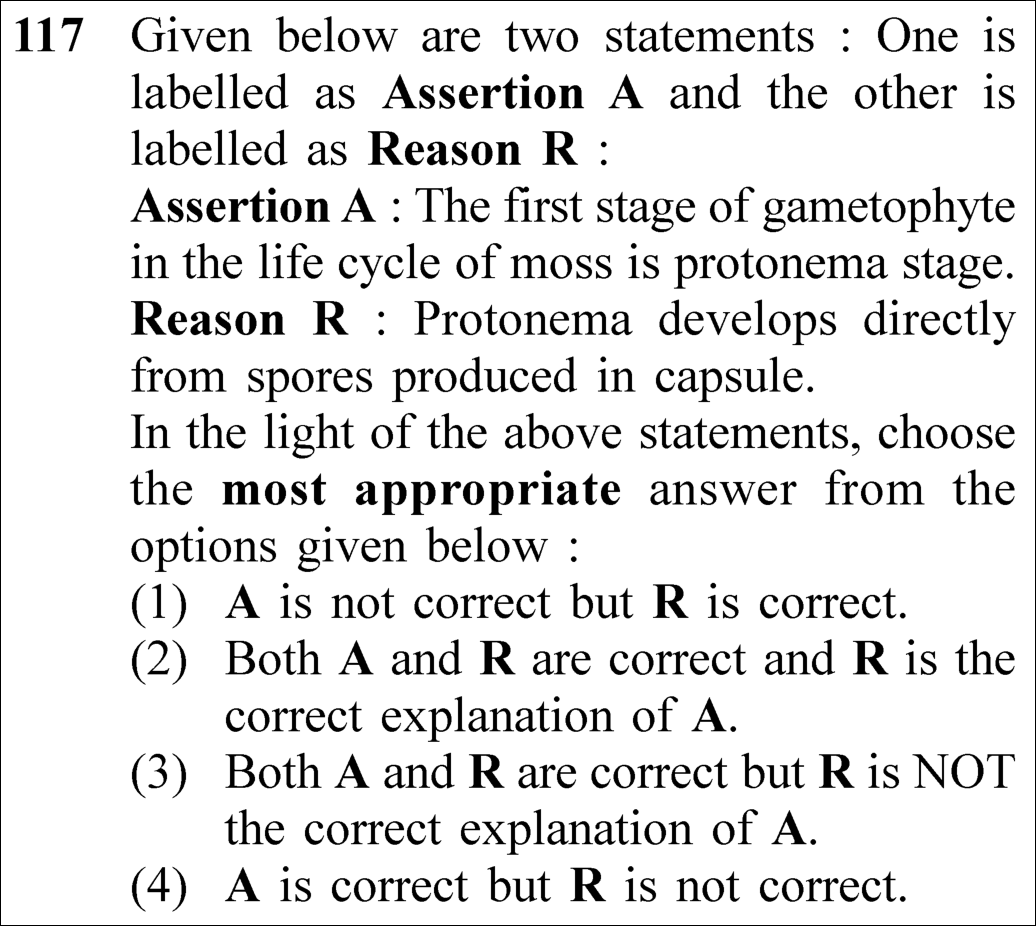
Assertion (A) The first stage of gametophyte in the life cycle of moss is protonema stage.
Reason (R) Protonema develops directly from spores produced in capsule.
⚡

The 30-Second Exam Hall Shortcut: ⚡ Spore Germination Sequence: Spore → Protonema → Leafy Stage

⏱️ Save ~30 seconds

In mosses, haploid spores shed from the sporophytic capsule germinate directly into the creeping, green, branched filamentous protonema. Because it develops directly from the spore, it is definitively the first gametophytic stage!

1 Assertion: The predominant gametophytic stage in moss has two phases: (1) Protonema stage, (2) Leafy stage. Protonema is the first stage -> Assertion is true.
2 Reason: Spores formed inside the capsule via meiosis germinate directly to produce the protonema -> Reason is true.
3 Logical link: The protonema is the first stage PRECISELY BECAUSE it develops directly upon spore germination.
4 Reason correctly explains Assertion -> Select Option (2) Both A and R are correct and R is the correct explanation of A.
🛡️
Why You Can 100% Trust This Shortcut: Canonical NCERT Plant Kingdom bryophyte gametogenesis developmental chronology.
📐

Step-by-Step Rigorous Workflow & Mathematical Proof

Step 1

Two-Stage Gametophyte of Mosses

The dominant haploid free-living gametophyte of mosses (Bryopsida, e.g., Funaria, Polytrichum, Sphagnum\textit{Funaria, Polytrichum, Sphagnum}) consists of two sequential phases:

Moss Gametophyte (n)={1. Protonema Stage:Creeping, green, branched, filamentous2. Leafy Stage:Develops from secondary protonema buds\text{Moss Gametophyte (} n \text{)} = \begin{cases} \mathbf{1.\text{ Protonema Stage:}} & \text{Creeping, green, branched, filamentous} \\[4pt] \mathbf{2.\text{ Leafy Stage:}} & \text{Develops from secondary protonema buds} \end{cases}
Step 2

Direct Origin from Sporophytic Spores

Following reduction division (meiosis) inside the sporophyte capsule, haploid spores are dispersed. Upon landing on suitable moist substratum, a spore germinates directly into a primary protonema:

Spore (n from capsule)→GerminationProtonema Stage (First Gametophytic Stage)\text{Spore (} n \text{ from capsule)} \xrightarrow{\text{Germination}} \text{\textbf{Protonema Stage (First Gametophytic Stage)}}
Step 3

Causal Linkage Validation

Because the protonema is the direct, immediate vegetative germination product of the meiotic spore, it is canonically established as the primary/first stage of the gametophytic generation. Hence, Reason R correctly explains Assertion A.

⭐

360° Option Elimination Engine Key Feature

Diagnose every choice: Know exactly why the right option works and why distractors fail.

4-Option Deep Scan
1 1
✗ Incorrect
Verdict & Scientific Reason:

Assertion is completely correct: protonema is explicitly the first stage of the moss gametophyte.

⚠️
Student Fallacy (Why candidates pick this trap): Thinking the erect leafy shoot is the first stage.
2 2
✓ 100% Correct
Verdict & Scientific Reason:

Both statements are true facts from NCERT and R provides the exact causal explanation for why protonema is the first stage.

💡
Why this is airtight: None; rigorous logical deduction.
3 3
✗ Incorrect
Verdict & Scientific Reason:

There is a direct developmental causality: developing immediately from the spore is the exact definition of being the initial stage.

⚠️
Student Fallacy (Why candidates pick this trap): Failing to connect direct spore development to being the initial developmental stage.
4 4
✗ Incorrect
Verdict & Scientific Reason:

Reason is factually correct: moss spores are formed in the capsule and germinate into protonema.

⚠️
Student Fallacy (Why candidates pick this trap): Doubting whether moss spores develop inside the sporophyte capsule.
⚠️

NTA Trap Alert: Protonema vs. Leafy Gametophyte Precedence Trap

Students frequently picture the familiar leafy moss plant and forget that it arises as a secondary lateral bud from the primary protonema.

🛡️ How to avoid the -1 mark: Remember the sequence: Spore → Protonema (1st stage) → Leafy Gametophore with sex organs (2nd stage).
📖

Core NEET Syllabus Standard

NCERT Biology · Plant Kingdom Standard Benchmark
Core Scientific Principle Tested:

"The predominant stage of the life cycle of a moss is the gametophyte which consists of two stages. The first stage is the protonema stage, which develops directly from a spore."

Syllabus Focus: Bryophytes (Mosses)
✓ Core NEET UG Syllabus Anchor Syllabus & Academic Standards ↗
NEET 2023 · Q136 Medium
Official NEET 2023 Question 136 - Plant Kingdom
1 A is false but R is true.
2 Both A and R are true and R is the correct explanation of A.
3 Both A and R are true but R is NOT the correct explanation of A.
4 A is true but R is false. ✓ Key
💡 Verified Solution & 30-Second Hack
✓
Verified Against NTA Final Answer Key
Option (4) : A is true but R is false.
📚 Plant Kingdom Medium
📋 Given Parameters & Problem Setup
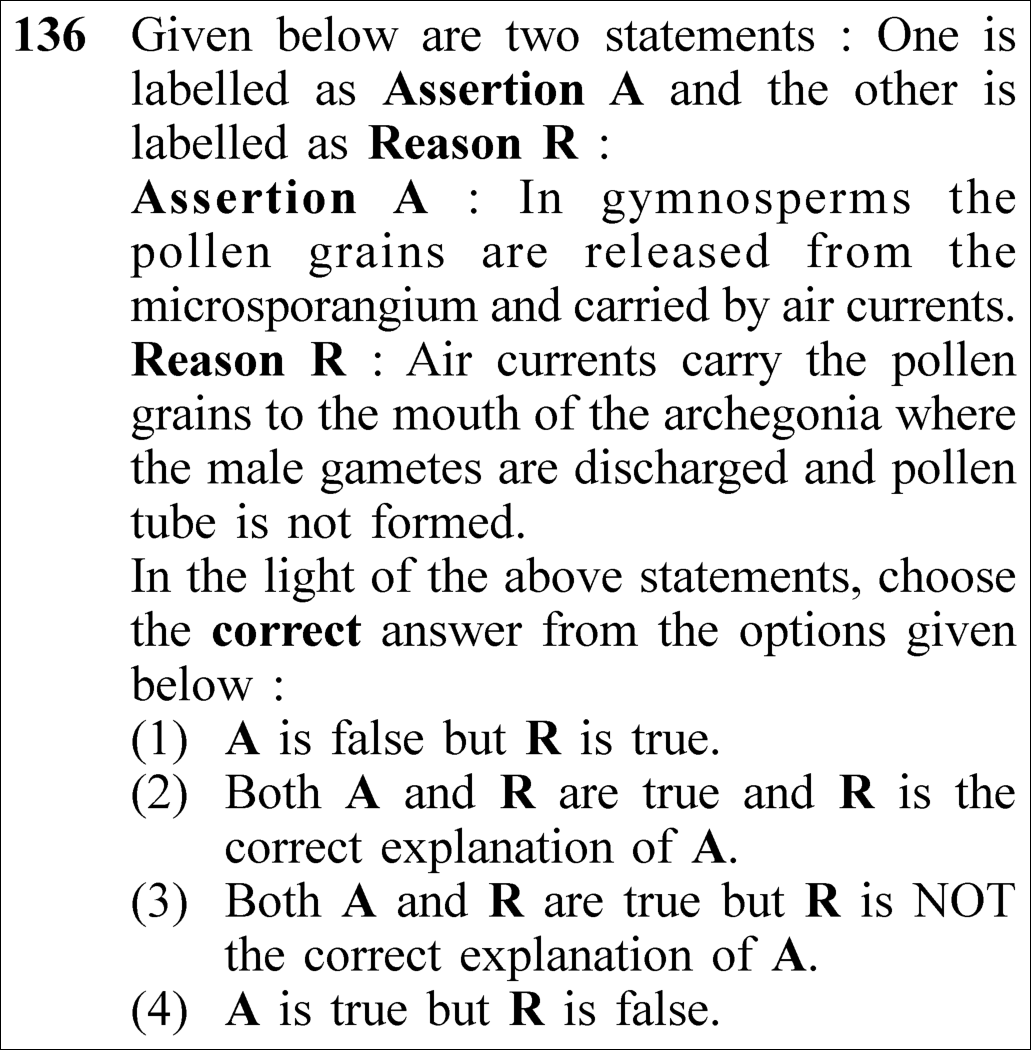
Assertion (A) In gymnosperms pollen grains are released from microsporangium and carried by air currents.
Reason (R) Air currents carry pollen grains to mouth of archegonia where male gametes are discharged and pollen tube is not formed.
⚡

The 30-Second Exam Hall Shortcut: ⚡ Gymnosperms ARE Siphonogamous: Pollen Tube IS Formed!

⏱️ Save ~25 seconds

Gymnosperms are wind pollinated (anemophilous) -> Assertion is TRUE! But Reason claims "pollen tube is not formed". Gymnosperms develop a pollen tube that grows towards the archegonium to discharge male gametes (siphonogamy)! Reason is FALSE! Select Option (4)!

1 Check Assertion A: Pollen grains are carried by air currents (anemophily) -> True.
2 Check Reason R: Gymnosperms produce pollen tubes to deliver male gametes to the archegonia -> Reason claims "pollen tube is not formed" -> Blatantly False.
3 Assertion is true but Reason is false.
4 Match Option (4) A is true but R is false.
🛡️
Why You Can 100% Trust This Shortcut: Canonical NCERT Gymnosperm reproductive biology and siphonogamy.
📐

Step-by-Step Rigorous Workflow & Mathematical Proof

Step 1

Evaluation of Assertion A (Anemophily in Gymnosperms)

In gymnosperms, pollen grains develop inside microsporangia on male strobili. Upon maturity, the microsporangia dehisce and pollen grains are shed and transported through the atmosphere exclusively via wind currents:

Microsporangium→DehiscencePollen Grains→Air Currents (Anemophily)Ovular Micropyle  ⟹  Assertion A is TRUE\text{Microsporangium} \xrightarrow{\text{Dehiscence}} \text{Pollen Grains} \xrightarrow{\text{Air Currents (Anemophily)}} \text{Ovular Micropyle} \implies \text{Assertion A is } \mathbf{\text{TRUE}}
Step 2

Evaluation of Reason R (Siphonogamy in Gymnosperms)

Pollen grains land on the micropyle of the naked ovule, NOT at the mouth of archegonia directly. Pollen grains germinate to produce a pollen tube that digests nucellar tissue, grows toward the archegonium, and discharges sperm contents. Hence, gymnosperms are siphonogamous:

Pollen Germination  ⟹  Pollen Tube IS Formed (Siphonogamy)  ⟹  Reason R is FALSE\text{Pollen Germination} \implies \mathbf{\text{Pollen Tube IS Formed (Siphonogamy)}} \implies \text{Reason R is } \mathbf{\text{FALSE}}
Step 3

Verbatim NCERT Reference

NCERT states verbatim: "The pollen tube carrying the male gametes grows towards archegonia in the ovules and discharge their contents near the mouth of the archegonia."

⭐

360° Option Elimination Engine Key Feature

Diagnose every choice: Know exactly why the right option works and why distractors fail.

4-Option Deep Scan
1 1
✗ Incorrect
Verdict & Scientific Reason:

Assertion is true (wind carries gymnosperm pollen); Reason is false (pollen tube is formed).

⚠️
Student Fallacy (Why candidates pick this trap): Doubting wind pollination in gymnosperms.
2 2
✗ Incorrect
Verdict & Scientific Reason:

Reason is false because pollen tubes are formed in all seed plants (siphonogamy).

⚠️
Student Fallacy (Why candidates pick this trap): Believing gymnosperms rely on flagellated swimming sperm without pollen tubes.
3 3
✗ Incorrect
Verdict & Scientific Reason:

Reason is demonstrably false according to plant morphology.

⚠️
Student Fallacy (Why candidates pick this trap): Failing to notice the statement "pollen tube is not formed".
4 4
✓ 100% Correct
Verdict & Scientific Reason:

Assertion A is correct, but Reason R is false because a pollen tube is definitively formed in gymnosperms.

💡
Why this is airtight: None; rigorous embryological understanding.
⚠️

NTA Trap Alert: Zoidiogamy vs. Siphonogamy Trap

Although primitive gymnosperms like Cycas retain motile ciliated male gametes, they STILL produce a haustorial pollen tube. Higher gymnosperms like Pinus are strictly siphonogamous.

🛡️ How to avoid the -1 mark: Never accept that seed plants do not form pollen tubes; gymnosperms and angiosperms are both siphonogamous.
📖

Core NEET Syllabus Standard

NCERT Biology · Plant Kingdom Standard Benchmark
Core Scientific Principle Tested:

"Pollen grains are released from the microsporangium and carried in air currents. The pollen tube carrying the male gametes grows towards archegonia in the ovules."

Syllabus Focus: Gymnosperms
✓ Core NEET UG Syllabus Anchor Syllabus & Academic Standards ↗
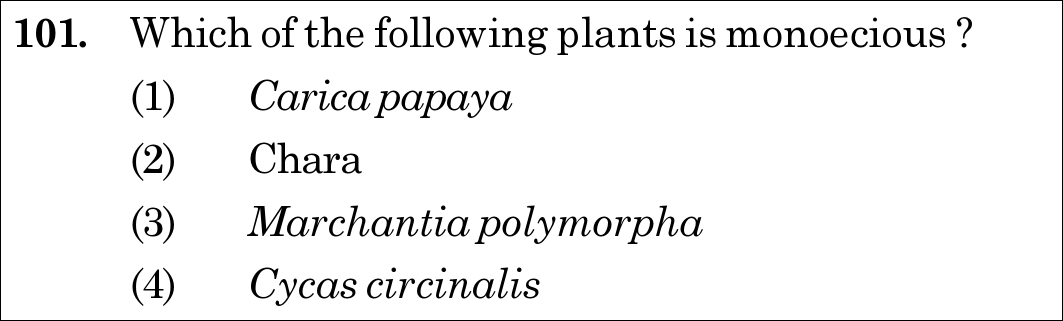
NEET 2021 · Q101 Easy
Official NEET 2021 Question 101 - Plant Kingdom
1 Carica papaya
2 Chara ✓ Key
3 Marchantia polymorpha
4 Cycas circinalis
💡 Verified Solution & 30-Second Hack
✓
Verified Against NTA Final Answer Key
Option (2) : Chara
📚 Plant Kingdom Easy
📋 Given Parameters & Problem Setup
Plant Trait Monoecious (homothallic: both sex organs on the same individual)
Candidate Genera Carica papaya, Chara, Marchantia polymorpha, Cycas circinalis
⚡

The 30-Second Exam Hall Shortcut: ⚡ "Chara = Common Home" (Monoecious Alga with Nucule Above Globule)

⏱️ Save ~20 seconds

Chara is a classic monoecious green alga bearing both female oogonium (nucule, upper) and male antheridium (globule, lower) on the same thallus. Papaya, Marchantia, and Cycas are strictly dioecious. Match Option (2) instantly!

1 Recall monoecious = bisexual condition where male and female sex organs occur on the same plant thallus.
2 Chara is a green alga (Charophyceae) with an upper female nucule (oogonium) and lower male globule (antheridium) on the same node.
3 Papaya (Carica papaya), Marchantia polymorpha (liverwort), and Cycas (gymnosperm) bear male and female structures on separate individuals (dioecious).
4 Match Option (2).
🛡️
Why You Can 100% Trust This Shortcut: Canonical NCERT Plant Kingdom and Sexuality in Organisms morphology.
📐

Step-by-Step Rigorous Workflow & Mathematical Proof

Step 1

Definition of Monoecious and Dioecious Conditions

In plant morphology, the distribution of sex organs defines sexual condition:

Monoecious (Homothallic):Male and female reproductive organs on the same individual thallus/plantDioecious (Heterothallic):Male and female reproductive organs on distinct unisexual individuals\begin{aligned} \text{\textbf{Monoecious (Homothallic):}} & \quad \text{Male and female reproductive organs on the same individual thallus/plant} \\[4pt] \text{\textbf{Dioecious (Heterothallic):}} & \quad \text{Male and female reproductive organs on distinct unisexual individuals} \end{aligned}
Step 2

Morphological Anatomy of Chara

Chara is an advanced green macroalga (stonewort). It produces specialized multicellular, jacketed sex organs situated at the nodes of lateral branches of limited growth: - Oogonium (Nucule): The female organ situated in the upper position. - Antheridium (Globule): The male organ situated directly below the nucule. Because both fertile organs develop together on the same individual node, Chara is canonically monoecious.

Step 3

Evaluation of the Competing Genera

Analysis of the distractors confirms strict dioecy: - *Carica papaya* (Papaya): Produces male (staminate) and female (pistillate) flowers on entirely separate trees (dioecious angiosperm). - *Marchantia polymorpha*: A dioecious hepatic (liverwort) bearing male antheridiophores and female archegoniophores on separate gametophytic thalli. - *Cycas circinalis*: A dioecious gymnosperm bearing microsporophylls clustered into male cones on male trees, and megasporophylls loosely arranged on female trees.

⭐

360° Option Elimination Engine Key Feature

Diagnose every choice: Know exactly why the right option works and why distractors fail.

4-Option Deep Scan
1 1
✗ Incorrect
Verdict & Scientific Reason:

Carica papaya (papaya) is dioecious; staminate and pistillate flowers are produced on separate male and female plants.

⚠️
Student Fallacy (Why candidates pick this trap): Students frequently confuse maize (monoecious) with papaya (dioecious), incorrectly assuming common cultivated fruit trees are bisexual.
2 2
✓ 100% Correct
Verdict & Scientific Reason:

Chara thallus bears both the female nucule (upper) and male globule (lower) at the nodes of the same plant, making it monoecious.

💡
Why this is airtight: None. This is the canonical textbook fact.
3 3
✗ Incorrect
Verdict & Scientific Reason:

Marchantia polymorpha is dioecious; antheridiophores develop on male thalli and archegoniophores develop on female thalli.

⚠️
Student Fallacy (Why candidates pick this trap): Aspirants remember the diagram of Marchantia having both umbrella-shaped structures in NCERT, forgetting they are shown on two separate thalli.
4 4
✗ Incorrect
Verdict & Scientific Reason:

Cycas is strictly dioecious; male cones and megasporophylls are borne on distinct individual trees (unlike Pinus which is monoecious).

⚠️
Student Fallacy (Why candidates pick this trap): Students often mix up Pinus (monoecious) and Cycas (dioecious), forgetting the mnemonic: "Cycas is Dioecious (C-D)".
⚠️

NTA Trap Alert: Pinus vs Cycas & Maize vs Papaya Pairing Confusion

NTA loves testing the classic dioecious vs monoecious contrasts: Pinus is monoecious, but Cycas is dioecious; Maize is monoecious, but Papaya is dioecious; Chara is monoecious, but Marchantia is dioecious.

🛡️ How to avoid the -1 mark: Use the memory anchors: "C-D" (Cycas is Dioecious) vs "P-M" (Pinus is Monoecious); and remember Chara thalli hold both globule and nucule together.
📖

Core NEET Syllabus Standard

NEET / NCERT Biology · Plant Kingdom Standard Benchmark
Core Scientific Principle Tested:

"Chara is a monoecious green alga possessing antheridia (globule) and oogonia (nucule) on the same individual."

Syllabus Focus: Algae Morphology and Sexuality in Plants
✓ Core NEET UG Syllabus Anchor Syllabus & Academic Standards ↗
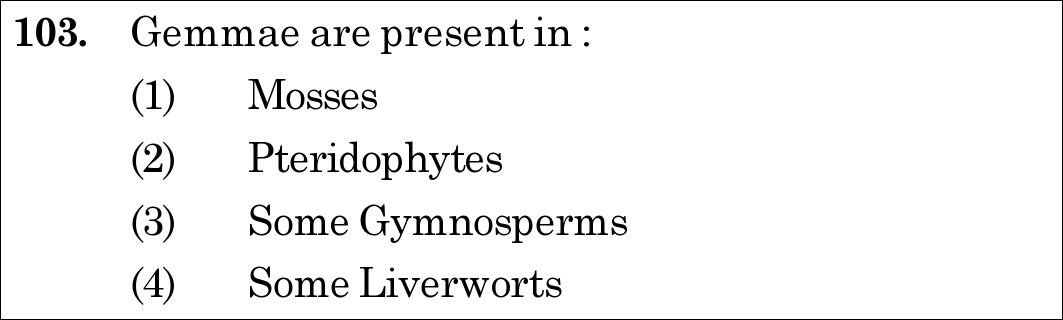
NEET 2021 · Q103 Easy
Official NEET 2021 Question 103 - Plant Kingdom
1 Mosses
2 Pteridophytes
3 Some Gymnosperms
4 Some Liverworts ✓ Key
💡 Verified Solution & 30-Second Hack
✓
Verified Against NTA Final Answer Key
Option (4) : Some Liverworts
📚 Plant Kingdom Easy
📋 Given Parameters & Problem Setup
Propagule Gemmae (asexual reproductive buds)
Target Group Taxonomic category possessing gemmae
⚡

The 30-Second Exam Hall Shortcut: ⚡ Gemma Cups = Marchantia (Liverworts)

⏱️ Save ~15 seconds

Gemmae are specialized green, multicellular asexual buds born in gemma cups located on the dorsal thallus surface of liverworts like Marchantia! Match Option (4) directly!

1 Recall that asexual reproduction in bryophytes occurs by fragmentation and specialized structures called gemmae.
2 Gemmae are green, multicellular, asexual buds produced in small receptacles called gemma cups.
3 Gemma cups are prominently present on the thallus of liverworts (Hepaticopsida), canonically Marchantia.
4 Match Option (4).
🛡️
Why You Can 100% Trust This Shortcut: Canonical NCERT Bryophytes taxonomy on Liverwort Asexual Reproduction.
📐

Step-by-Step Rigorous Workflow & Mathematical Proof

Step 1

Structure and Nature of Gemmae

Gemmae (singular: gemma) are specialized vegetative propagules found in bryophytes:

Gemma=Green, multicellular, asexual vegetative bud developing inside cups\text{Gemma} = \text{Green, multicellular, asexual vegetative bud developing inside cups}
Step 2

Localization in Hepaticopsida (Liverworts)

In liverworts such as *Marchantia*, gemmae develop inside cup-shaped receptacles called gemma cups positioned along the midrib on the dorsal surface of the gametophytic thallus.

Step 3

Dispersal and Germination

When rain drops splash into the gemma cups, the mature gemmae detach from their stalks, get washed away, and germinate directly to establish new haploid thalli.

⭐

360° Option Elimination Engine Key Feature

Diagnose every choice: Know exactly why the right option works and why distractors fail.

4-Option Deep Scan
1 1
✗ Incorrect
Verdict & Scientific Reason:

Mosses reproduce vegetatively by fragmentation and budding in the secondary protonema, not via canonical gemma cups.

⚠️
Student Fallacy (Why candidates pick this trap): Lumping all bryophytes together and assuming mosses and liverworts share identical specialized asexual cups.
2 2
✗ Incorrect
Verdict & Scientific Reason:

Pteridophytes reproduce vegetatively by tubers, adventitious buds, or fragmentation of rhizomes, not by gemmae.

⚠️
Student Fallacy (Why candidates pick this trap): Confusing spore-producing sori in ferns with vegetative gemma cups.
3 3
✗ Incorrect
Verdict & Scientific Reason:

Gymnosperms are vascular seed plants that do not form gemmae.

⚠️
Student Fallacy (Why candidates pick this trap): Unfounded guessing among non-flowering plant divisions.
4 4
✓ 100% Correct
Verdict & Scientific Reason:

Gemmae are distinctive asexual reproductive structures found in liverworts such as Marchantia.

💡
Why this is airtight: None. Textbook fact from NCERT Bryophytes.
⚠️

NTA Trap Alert: Mosses vs Liverworts Vegetative Propagule Distinction

NCERT clearly differentiates: Liverworts reproduce by gemmae in gemma cups; Mosses reproduce vegetatively by budding in the secondary protonema.

🛡️ How to avoid the -1 mark: Remember: Gemma Cups = Liverworts (Marchantia); Secondary Protonema Budding = Mosses (Funaria, Polytrichum, Sphagnum).
📖

Core NEET Syllabus Standard

NEET / NCERT Biology · Plant Kingdom Standard Benchmark
Core Scientific Principle Tested:

"Liverworts reproduce asexually by fragmentation or by specialized multicellular asexual buds called gemmae."

Syllabus Focus: Bryophytes: Hepaticopsida (Liverworts)
✓ Core NEET UG Syllabus Anchor Syllabus & Academic Standards ↗
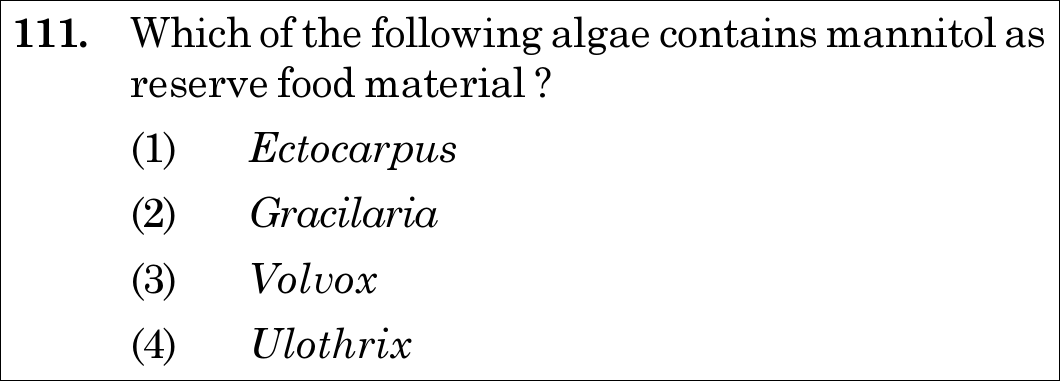
NEET 2021 · Q111 Easy
Official NEET 2021 Question 111 - Plant Kingdom
1 Ectocarpus ✓ Key
2 Gracilaria
3 Volvox
4 Ulothrix
💡 Verified Solution & 30-Second Hack
✓
Verified Against NTA Final Answer Key
Option (1) : Ectocarpus
📚 Plant Kingdom Easy
📋 Given Parameters & Problem Setup
Storage Food Mannitol (complex carbohydrate / sugar alcohol)
Candidate Genera Ectocarpus, Gracilaria, Volvox, Ulothrix
⚡

The 30-Second Exam Hall Shortcut: ⚡ "Brown Algae = Laminarin & Mannitol"

⏱️ Save ~20 seconds

Mannitol is the diagnostic reserve food material of Phaeophyceae (brown algae), which includes Ectocarpus, Dictyota, Laminaria, Sargassum, and Fucus! Gracilaria has floridean starch (red), while Volvox and Ulothrix store starch (green). Match Option (1)!

1 Recall algal reserve foods: Chlorophyceae store starch; Phaeophyceae store complex carbohydrates as laminarin or mannitol; Rhodophyceae store floridean starch.
2 Identify taxonomic classes: Ectocarpus is a brown alga (Phaeophyceae); Gracilaria is a red alga (Rhodophyceae); Volvox and Ulothrix are green algae (Chlorophyceae).
3 Brown algae uniquely store mannitol.
4 Match Option (1).
🛡️
Why You Can 100% Trust This Shortcut: Canonical NCERT Plant Kingdom taxonomy on Algae Classes and Food Reserves.
📐

Step-by-Step Rigorous Workflow & Mathematical Proof

Step 1

Taxonomic Division and Storage Material in Algae

The major classes of algae are classified based on photosynthetic pigments and the chemical nature of stored food reserves:

Chlorophyceae (Green algae):Starch (in pyrenoids)Phaeophyceae (Brown algae):Laminarin and MannitolRhodophyceae (Red algae):Floridean starch (amylopectin/glycogen-like)\begin{aligned} \text{\textbf{Chlorophyceae (Green algae):}} & \quad \text{Starch (in pyrenoids)} \\[4pt] \text{\textbf{Phaeophyceae (Brown algae):}} & \quad \mathbf{\text{Laminarin and Mannitol}} \\[4pt] \text{\textbf{Rhodophyceae (Red algae):}} & \quad \text{Floridean starch (amylopectin/glycogen-like)} \end{aligned}
Step 2

Classification of Candidate Genera

Evaluating each genus provided in the choices: - *Ectocarpus*: Filamentous brown alga belonging to Phaeophyceae   ⟹  \implies stores mannitol and laminarin. - *Gracilaria*: Red alga belonging to Rhodophyceae   ⟹  \implies stores floridean starch. - *Volvox*: Colonial green alga belonging to Chlorophyceae   ⟹  \implies stores standard starch. - *Ulothrix*: Filamentous green alga belonging to Chlorophyceae   ⟹  \implies stores standard starch.

⭐

360° Option Elimination Engine Key Feature

Diagnose every choice: Know exactly why the right option works and why distractors fail.

4-Option Deep Scan
1 1
✓ 100% Correct
Verdict & Scientific Reason:

Ectocarpus is a brown alga (Phaeophyceae) which stores reserve food as complex carbohydrates in the form of laminarin or mannitol.

💡
Why this is airtight: None. Canonical textbook fact.
2 2
✗ Incorrect
Verdict & Scientific Reason:

Gracilaria is a red alga (Rhodophyceae) which stores floridean starch (structurally similar to amylopectin and glycogen).

⚠️
Student Fallacy (Why candidates pick this trap): Confusing the food reserve of red algae with that of brown algae.
3 3
✗ Incorrect
Verdict & Scientific Reason:

Volvox is a green alga (Chlorophyceae) which stores carbohydrates as starch located in pyrenoids.

⚠️
Student Fallacy (Why candidates pick this trap): Mixing up green and brown algal reserves.
4 4
✗ Incorrect
Verdict & Scientific Reason:

Ulothrix is a green alga (Chlorophyceae) storing starch, not mannitol.

⚠️
Student Fallacy (Why candidates pick this trap): Failing to categorize Ulothrix into Chlorophyceae.
⚠️

NTA Trap Alert: Mannitol vs Floridean Starch Assignment Confusion

Students frequently mix up the storage polysaccharides of Rhodophyceae (Floridean starch) and Phaeophyceae (Laminarin and Mannitol).

🛡️ How to avoid the -1 mark: Remember: Brown Algae = "BLM" (Brown = Laminarin + Mannitol); Red Algae = "RF" (Red = Floridean starch).
📖

Core NEET Syllabus Standard

NEET / NCERT Biology · Plant Kingdom Standard Benchmark
Core Scientific Principle Tested:

"Food in Phaeophyceae is stored as complex carbohydrates, which may be in the form of laminarin or mannitol."

Syllabus Focus: Algae: Phaeophyceae (Brown Algae)
✓ Core NEET UG Syllabus Anchor Syllabus & Academic Standards ↗
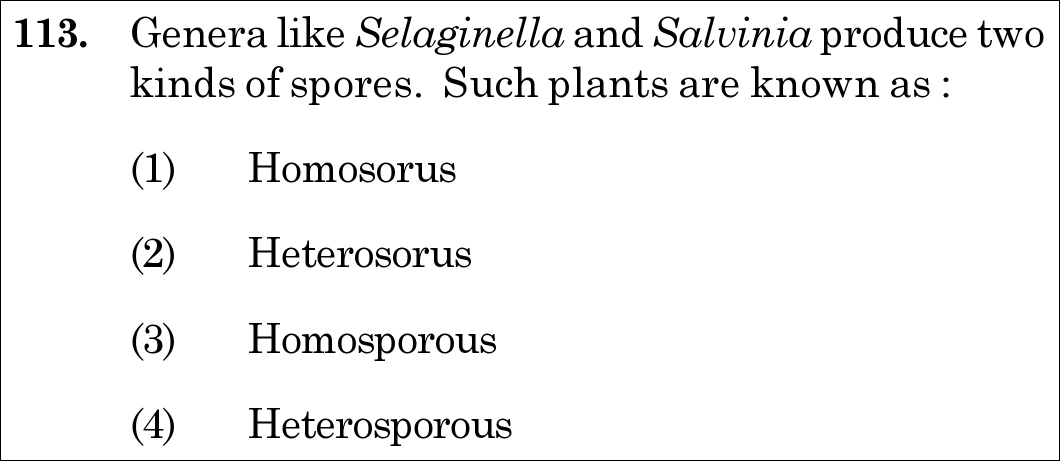
NEET 2021 · Q113 Easy
Official NEET 2021 Question 113 - Plant Kingdom
1 Homosorus
2 Heterosorus
3 Homosporous
4 Heterosporous ✓ Key
💡 Verified Solution & 30-Second Hack
✓
Verified Against NTA Final Answer Key
Option (4) : Heterosporous
📚 Plant Kingdom Easy
📋 Given Parameters & Problem Setup
Genera Selaginella and Salvinia
Characteristic Production of two distinct kinds of spores (microspores and megaspores)
⚡

The 30-Second Exam Hall Shortcut: ⚡ Two Types of Spores = Heterosporous

⏱️ Save ~15 seconds

Hetero = different, sporous = spore-producing! Plants that produce two morphologically and sexually distinct kinds of spores (megaspores and microspores), like Selaginella and Salvinia, are defined as Heterosporous! Match Option (4)!

1 Homosporous = producing identical spores (e.g., Dryopteris, Pteris, Equisetum).
2 Heterosporous = producing two kinds of spores, macro/megaspores and microspores.
3 Selaginella and Salvinia are classic examples of heterosporous pteridophytes.
4 Match Option (4).
🛡️
Why You Can 100% Trust This Shortcut: Canonical NCERT Plant Kingdom taxonomy on Pteridophytes and Heterospory.
📐

Step-by-Step Rigorous Workflow & Mathematical Proof

Step 1

Spore Dimorphism in Pteridophytes

While the majority of pteridophytes produce spores of similar kind (homosporous), select genera produce two distinct kinds of spores differing in size and developmental fate:

Spore Production  ⟹  {Microspores (small):⟶Male gametophyteMegaspores (large):⟶Female gametophyte\text{Spore Production} \implies \begin{cases} \text{Microspores (small):} & \longrightarrow \text{Male gametophyte} \\[4pt] \text{Megaspores (large):} & \longrightarrow \text{Female gametophyte} \end{cases}
Step 2

Definition of Heterospory

Plants exhibiting this dimorphic spore condition are termed heterosporous. The classic NCERT examples in pteridophytes are *Selaginella* and *Salvinia* (as well as *Marsilea* and *Azolla*).

Step 3

Evolutionary Significance

Heterospory is considered an essential evolutionary prerequisite to the development of the seed habit because the female gametophyte is retained on the parent sporophyte.

⭐

360° Option Elimination Engine Key Feature

Diagnose every choice: Know exactly why the right option works and why distractors fail.

4-Option Deep Scan
1 1
✗ Incorrect
Verdict & Scientific Reason:

A sorus is a cluster of sporangia; "homosorus" refers to sori structure, not the production of two spore types.

⚠️
Student Fallacy (Why candidates pick this trap): Confusing sori (clusters of sporangia) with spores.
2 2
✗ Incorrect
Verdict & Scientific Reason:

Heterosorus is an anatomical descriptor of sporangial clusters, not the biological term for spore dimorphism.

⚠️
Student Fallacy (Why candidates pick this trap): Picking "hetero-" combined with "-sorus" instead of "-sporous".
3 3
✗ Incorrect
Verdict & Scientific Reason:

Homosporous plants produce only one kind of identical spore (e.g., Equisetum, Lycopodium, Dryopteris).

⚠️
Student Fallacy (Why candidates pick this trap): Confusing "homo" (same) with "hetero" (different).
4 4
✓ 100% Correct
Verdict & Scientific Reason:

Heterosporous plants produce two distinct kinds of spores (microspores and megaspores), exemplified by Selaginella and Salvinia.

💡
Why this is airtight: None. Direct textbook terminology.
⚠️

NTA Trap Alert: Spore vs Sorus Suffix Trap

NTA intentionally constructed distractors (1) Homosorus and (2) Heterosorus alongside (3) Homosporous and (4) Heterosporous to catch hasty candidates reading only prefixes.

🛡️ How to avoid the -1 mark: Check the suffix: we are discussing spores (-sporous), not clusters of sporangia (-sorus).
📖

Core NEET Syllabus Standard

NEET / NCERT Biology · Plant Kingdom Standard Benchmark
Core Scientific Principle Tested:

"Genera like Selaginella and Salvinia which produce two kinds of spores, macro (large) and micro (small) spores, are known as heterosporous."

Syllabus Focus: Pteridophytes: Heterospory and Origin of Seed Habit
✓ Core NEET UG Syllabus Anchor Syllabus & Academic Standards ↗
NEET 2021 · Q120 Easy
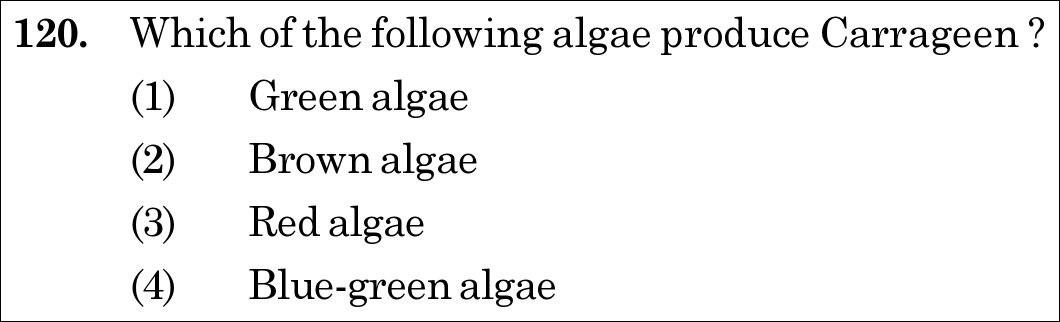
Official NEET 2021 Question 120 - Plant Kingdom
1 Green algae
2 Brown algae
3 Red algae ✓ Key
4 Blue-green algae
💡 Verified Solution & 30-Second Hack
✓
Verified Against NTA Final Answer Key
Option (3) : Red algae
📚 Plant Kingdom Easy
📋 Given Parameters & Problem Setup
Hydrocolloid Carrageen (water-holding sulfated galactan polysaccharide)
⚡

The 30-Second Exam Hall Shortcut: ⚡ "Algin = Brown" vs "Carrageen = Red"

⏱️ Save ~15 seconds

Marine algae produce commercially vital hydrocolloids (water-holding substances): Algin is produced by Brown algae, while Carrageen is produced by Red algae (Rhodophyceae)! Agar is also obtained from red algae (Gelidium and Gracilaria). Match Option (3)!

1 Recall algal commercial hydrocolloids from NCERT Plant Kingdom.
2 Algin: Extracted from brown algae (Phaeophyceae).
3 Carrageen: Extracted from red algae (Rhodophyceae, e.g., Chondrus crispus).
4 Match Option (3).
🛡️
Why You Can 100% Trust This Shortcut: Canonical NCERT Plant Kingdom taxonomy on Economic Importance of Algae.
📐

Step-by-Step Rigorous Workflow & Mathematical Proof

Step 1

Definition and Origin of Algal Hydrocolloids

Certain marine brown and red algae produce large amounts of hydrocolloids (water-holding phycocolloids) in their cell walls:

Algin:Produced by Brown Algae (Phaeophyceae)Carrageen:Produced by Red Algae (Rhodophyceae)\begin{aligned} \text{\textbf{Algin:}} & \quad \text{Produced by Brown Algae (Phaeophyceae)} \\[4pt] \text{\textbf{Carrageen:}} & \quad \mathbf{\text{Produced by Red Algae (Rhodophyceae)}} \end{aligned}
Step 2

Commercial Applications of Carrageen

Carrageen (derived notably from the red seaweed *Chondrus crispus* or Irish moss) is a sulfated galactan polysaccharide widely utilized as a thickening, stabilizing, and gelling agent in food products and pharmaceutical formulations.

⭐

360° Option Elimination Engine Key Feature

Diagnose every choice: Know exactly why the right option works and why distractors fail.

4-Option Deep Scan
1 1
✗ Incorrect
Verdict & Scientific Reason:

Green algae (Chlorophyceae) have cellulosic walls without commercially harvestable phycocolloids like carrageen.

⚠️
Student Fallacy (Why candidates pick this trap): Random guessing among major algal divisions.
2 2
✗ Incorrect
Verdict & Scientific Reason:

Brown algae (Phaeophyceae) produce algin (alginic acid), not carrageen.

⚠️
Student Fallacy (Why candidates pick this trap): The classic trap: swapping algin (brown) with carrageen (red).
3 3
✓ 100% Correct
Verdict & Scientific Reason:

Carrageen is a commercial phycocolloid harvested exclusively from red algae (Rhodophyceae).

💡
Why this is airtight: None. Direct textbook fact.
4 4
✗ Incorrect
Verdict & Scientific Reason:

Blue-green algae (Cyanobacteria) are prokaryotes that produce gelatinous sheaths, not commercial carrageen.

⚠️
Student Fallacy (Why candidates pick this trap): Confusing photosynthetic prokaryotes with marine macroalgae.
⚠️

NTA Trap Alert: Algin vs Carrageen Origin Inversion

NTA loves testing the pair: Algin vs Carrageen. Over 35% of candidates mix up which belongs to brown versus red algae.

🛡️ How to avoid the -1 mark: Use the mnemonic: "A-B, C-R"   ⟹  \implies Algin = Brown; Carrageen = Red.
📖

Core NEET Syllabus Standard

NEET / NCERT Biology · Plant Kingdom Standard Benchmark
Core Scientific Principle Tested:

"Certain marine brown and red algae produce large amounts of hydrocolloids (water holding substances), e.g., algin (brown algae) and carrageen (red algae) which are used commercially."

Syllabus Focus: Algae: Economic Importance
✓ Core NEET UG Syllabus Anchor Syllabus & Academic Standards ↗
NEET 2020 · Q50 Easy
Official NEET 2020 Question 50 - Plant Kingdom
1 Starch and cellulose
2 Amylopectin and glycogen ✓ Key
3 Mannitol and algin
4 Laminarin and cellulose
💡 Verified Solution & 30-Second Hack
✓
Verified Against NTA Final Answer Key
Option (2) : Amylopectin and glycogen
📚 Plant Kingdom Easy
📋 Given Parameters & Problem Setup
Storage Food Floridean starch (found in Red Algae / Rhodophyceae)
Question Objective Identify which polysaccharides share structural similarity with Floridean starch
⚡

The 30-Second Exam Hall Shortcut: ⚡ "Floridean Starch = Highly Branched like Amylopectin & Glycogen!"

⏱️ 20 seconds

Red algae store reserve food as floridean starch, which has a branched polyglucan structure remarkably similar to amylopectin and animal glycogen (alpha-1,4 and alpha-1,6 glycosidic bonds). Mark Amylopectin and glycogen (Option 2) in 5 seconds!

1 Rhodophyceae store food as Floridean starch.
2 NCERT states verbatim: "Floridean starch is very similar to amylopectin and glycogen in structure."
3 Select Option (2) Amylopectin and glycogen.
🛡️
Why You Can 100% Trust This Shortcut: NCERT Biology · Plant Kingdom (Algae: Rhodophyceae Storage Products)
📐

Step-by-Step Rigorous Workflow & Mathematical Proof

Step 1

Classify Algal Reserve Food Materials

Chlorophyceae store true starch (amylose + amylopectin); Phaeophyceae store complex carbohydrates as laminarin or mannitol; Rhodophyceae store reserve food as Floridean starch.

Step 2

Chemical Architecture of Floridean Starch

Floridean starch is a branched alpha-glucan polysaccharide containing alpha-(1->4)-glucosidic linear linkages and frequent alpha-(1->6)-glucosidic branch points.

Step 3

Compare with Other Polysaccharides

Because of its branched structure, it closely resembles amylopectin (the branched fraction of plant starch) and glycogen (animal starch). In contrast, cellulose is an unbranched beta-(1->4)-glucan.

Step 4

Verify NCERT Statement

NCERT explicitly states: "The food is stored as floridean starch which is very similar to amylopectin and glycogen in structure."

⭐

360° Option Elimination Engine Key Feature

Diagnose every choice: Know exactly why the right option works and why distractors fail.

4-Option Deep Scan
1 A
✗ Incorrect
Verdict & Scientific Reason:

Incorrect; cellulose is an unbranched linear beta-1,4-glucan forming rigid fibrils, completely distinct from branched floridean starch.

⚠️
Student Fallacy (Why candidates pick this trap): Thinking of general plant polysaccharides.
2 B
✓ 100% Correct
Verdict & Scientific Reason:

Factually exact; both are branched alpha-glucans structurally analogous to floridean starch.

💡
Why this is airtight: None; direct NCERT quotation.
3 C
✗ Incorrect
Verdict & Scientific Reason:

Incorrect; mannitol is a sugar alcohol and algin is a phycocolloid, both characteristic of Phaeophyceae (brown algae), not floridean starch analogues.

⚠️
Student Fallacy (Why candidates pick this trap): Confusing brown algae reserve foods with red algae storage starch.
4 D
✗ Incorrect
Verdict & Scientific Reason:

Incorrect; laminarin is a beta-1,3-glucan stored in brown algae, not structurally similar to floridean starch.

⚠️
Student Fallacy (Why candidates pick this trap): Mixing brown algae storage products with red algae.
⚠️

NTA Trap Alert: Algal Food Storage Summary

Green algae = Starch. Brown algae = Laminarin & Mannitol. Red algae = Floridean starch (similar to AMYLOPECTIN and GLYCOGEN).

🛡️ How to avoid the -1 mark: Memorize: Floridean Starch = Branched like Amylopectin & Glycogen!
📖

Core NEET Syllabus Standard

Zoology · Plant Kingdom Standard Benchmark
Core Scientific Principle Tested:

""

Syllabus Focus: Rhodophyceae Storage Polysaccharide: Floridean Starch Structure
✓ Core NEET UG Syllabus Anchor Syllabus & Academic Standards ↗
NEET 2020 · Q53 Easy
Official NEET 2020 Question 53 - Plant Kingdom
1 Laminaria and Sargassum
2 Gelidium and Gracilaria
3 Anabaena and Volvox
4 Chlorella and Spirulina ✓ Key
💡 Verified Solution & 30-Second Hack
✓
Verified Against NTA Final Answer Key
Option (4) : Chlorella and Spirulina
📚 Plant Kingdom Easy
📋 Given Parameters & Problem Setup
Criterion Pair of unicellular algae
Candidate Pairs Laminaria & Sargassum, Gelidium & Gracilaria, Anabaena & Volvox, Chlorella & Spirulina
⚡

The 30-Second Exam Hall Shortcut: ⚡ "Chlorella and Spirulina = Unicellular Single Cell Protein Algae!"

⏱️ 20 seconds

Chlorella (unicellular chlorophyte) and Spirulina (unicellular cyanobacterium/blue-green alga) are rich in proteins and used as food supplements even by space travelers. Laminaria/Sargassum are giant multicellular brown kelps; Gelidium/Gracilaria are multicellular red algae. Mark Option (4) in 5 seconds!

1 Laminaria & Sargassum = Multicellular brown algae (kelps).
2 Gelidium & Gracilaria = Multicellular red algae producing agar.
3 Volvox = Colonial green alga (not unicellular).
4 Chlorella and Spirulina are unicellular organisms rich in proteins.
5 Select Option (4).
🛡️
Why You Can 100% Trust This Shortcut: NCERT Biology · Plant Kingdom (Algae: Unicellular Algae & Single Cell Protein)
📐

Step-by-Step Rigorous Workflow & Mathematical Proof

Step 1

Identify Unicellular Algae in NCERT

NCERT explicitly highlights: "Chlorella and Spirulina are unicellular algae rich in proteins and are used as food supplements even by space travellers."

Step 2

Evaluate Laminaria and Sargassum

Laminaria and Sargassum belong to Phaeophyceae (brown algae); they possess complex multicellular thalli (kelps reaching up to 100 meters) differentiated into holdfast, stipe, and frond.

Step 3

Evaluate Gelidium and Gracilaria

Gelidium and Gracilaria are multicellular Rhodophyceae (red algae) harvested commercially for extraction of agar-agar.

Step 4

Evaluate Volvox and Anabaena

Volvox is a colonial green alga (coenobium of thousands of cells connected by cytoplasmic strands), not a unicellular organism.

⭐

360° Option Elimination Engine Key Feature

Diagnose every choice: Know exactly why the right option works and why distractors fail.

4-Option Deep Scan
1 A
✗ Incorrect
Verdict & Scientific Reason:

Incorrect; both are massive, multicellular brown algae (kelps).

⚠️
Student Fallacy (Why candidates pick this trap): Confusing brown seaweed macroalgae with unicellular algae.
2 B
✗ Incorrect
Verdict & Scientific Reason:

Incorrect; both are multicellular red algae used for commercial agar extraction.

⚠️
Student Fallacy (Why candidates pick this trap): Thinking agar-producing red algae are unicellular.
3 C
✗ Incorrect
Verdict & Scientific Reason:

Incorrect; Volvox is a colonial alga (coenobium), not unicellular.

⚠️
Student Fallacy (Why candidates pick this trap): Assuming colonial algae count as unicellular.
4 D
✓ 100% Correct
Verdict & Scientific Reason:

Factually exact; both are single-celled organisms cited in NCERT as unicellular algae utilized for single-cell protein.

💡
Why this is airtight: None; textbook verbatim example.
⚠️

NTA Trap Alert: Colonial vs Unicellular

Volvox is COLONIAL (consisting of 500 to 60,000 cells arranged in a hollow sphere called a coenobium). Only Chlorella and Spirulina are UNICELLULAR.

🛡️ How to avoid the -1 mark: Remember: Volvox = Colony; Chlorella & Spirulina = Unicellular single cell protein!
📖

Core NEET Syllabus Standard

Zoology · Plant Kingdom Standard Benchmark
Core Scientific Principle Tested:

""

Syllabus Focus: Unicellular Algae Rich in Proteins: Chlorella and Spirulina
✓ Core NEET UG Syllabus Anchor Syllabus & Academic Standards ↗
NEET 2020 · Q71 Easy
Official NEET 2020 Question 71 - Plant Kingdom
1 Salvinia
2 Pteris
3 Marchantia
4 Equisetum ✓ Key
💡 Verified Solution & 30-Second Hack
✓
Verified Against NTA Final Answer Key
Option (4) : Equisetum
📚 Plant Kingdom Easy
📋 Given Parameters & Problem Setup
Morphological Structure Strobili or cones (compact sporophyll aggregations)
Candidate Genera Salvinia, Pteris, Marchantia, Equisetum
⚡

The 30-Second Exam Hall Shortcut: ⚡ "Strobili / Cones in Pteridophytes = Selaginella and Equisetum!"

⏱️ 20 seconds

In some pteridophytes, sporophylls form distinct, compact structures called strobili or cones, uniquely exemplified in NCERT by Selaginella and Equisetum (horsetail). Pteris and Salvinia have sori/sporocarps; Marchantia has antheridiophores/archegoniophores. Mark Equisetum (Option 4) in 5 seconds!

1 Recall NCERT statement on pteridophytes: "In some cases sporophylls may form distinct compact structures called strobili or cones (Selaginella, Equisetum)."
2 Candidate choices: Salvinia (heterosporous aquatic fern), Pteris (homosporous fern), Marchantia (bryophyte), Equisetum (horsetail).
3 Select Option (4) Equisetum.
🛡️
Why You Can 100% Trust This Shortcut: NCERT Biology · Plant Kingdom (Pteridophytes: Sporophylls and Strobili)
📐

Step-by-Step Rigorous Workflow & Mathematical Proof

Step 1

Define Strobili or Cones in Pteridophytes

In pteridophytes, the main plant body is a sporophyte which bears sporangia subtended by leaf-like appendages called sporophylls. In some pteridophytes, sporophylls aggregate compactly at the apex of stems to form distinct cones or strobili.

Step 2

Review Canonical NCERT Examples

NCERT explicitly names two classic genera bearing strobili or cones: Selaginella (club moss) and Equisetum (horsetail).

Step 3

Examine Other Genera in Options

Salvinia is an aquatic heterosporous fern where sporangia are enclosed in sporocarps; Pteris is a fern whose sporangia are clustered in marginal sori under false indusia; Marchantia is a dioecious bryophyte bearing antheridiophores and archegoniophores, not strobili.

Step 4

Conclude Equisetum

Equisetum possesses a prominent apical cone/strobilus on fertile aerial shoots.

⭐

360° Option Elimination Engine Key Feature

Diagnose every choice: Know exactly why the right option works and why distractors fail.

4-Option Deep Scan
1 A
✗ Incorrect
Verdict & Scientific Reason:

Incorrect; Salvinia is a free-floating heterosporous aquatic fern that bears sporocarps, not strobili.

⚠️
Student Fallacy (Why candidates pick this trap): Confusing heterosporous ferns with strobilus-bearing sphenopsids.
2 B
✗ Incorrect
Verdict & Scientific Reason:

Incorrect; Pteris bears sporangia organized in continuous sori along leaflet margins.

⚠️
Student Fallacy (Why candidates pick this trap): Assuming all pteridophytes have cones.
3 C
✗ Incorrect
Verdict & Scientific Reason:

Incorrect; Marchantia is a liverwort (bryophyte) with specialized umbrella-like gametophores, not cones.

⚠️
Student Fallacy (Why candidates pick this trap): Confusing bryophyte archegoniophores with pteridophyte strobili.
4 D
✓ 100% Correct
Verdict & Scientific Reason:

Factually exact; Equisetum (Sphenopsida) produces conspicuous apical strobili/cones on fertile shoots.

💡
Why this is airtight: None; direct textbook example.
⚠️

NTA Trap Alert: Pteridophyte Genera with Strobili

Only TWO pteridophyte genera are cited in NCERT as forming strobili or cones: SELAGINELLA and EQUISETUM.

🛡️ How to avoid the -1 mark: Mnemonic: "S-E have Cones" -> Selaginella & Equisetum have strobili!
📖

Core NEET Syllabus Standard

Zoology · Plant Kingdom Standard Benchmark
Core Scientific Principle Tested:

""

Syllabus Focus: Pteridophyte Reproductive Structures: Strobili or Cones in Equisetum and Selaginella
✓ Core NEET UG Syllabus Anchor Syllabus & Academic Standards ↗

Solve 4 NEET Questions a Day — One per Subject

Cover all 1,140 official NEET questions in 285 days at your own pace. Progress is saved on your device. No login needed.