MyCompetitiveExams Logo MyCompetitiveExams
Search 1,140+ Questions
Chapters, formulas, speed tricks
→
⚡ Brahmastra NEET 2027
720 MARKS

Dynamic 180-question full-length simulator mixed dynamically from all 6 years for 2027 & 2026 aspirants.

Launch Brahmastra 2027 Test →
Start Practice →
100% Free · No Login Required
Q.168 Zoology ⭐ 360° Option Elimination Active
Vault ↗

NEET 2025 Zoology Question 168 Solution

Topic: Plant Kingdom · Official NTA Booklet Code 45
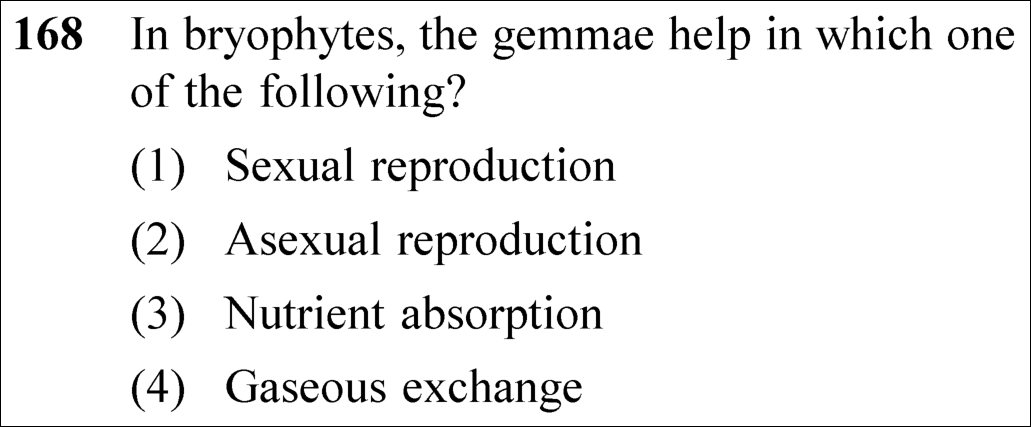
NEET 2025 Zoology Question 168: Asexual Reproduction in Liverworts via Gemmae

Question

In bryophytes, the gemmae help in which one of the following?

  1. (1)Sexual reproduction
  2. (2)Asexual reproduction
  3. (3)Nutrient absorption
  4. (4)Gaseous exchange
✓
Verified Against NTA Final Answer Key
Option (2) : Asexual reproduction
📚 Plant Kingdom Easy
📋 Given Parameters & Problem Setup
Plant Group Bryophytes (specifically Liverworts, e.g. Marchantia)
Structure Gemmae (asexual vegetative buds produced in gemma cups)
⚡

The 30-Second Exam Hall Shortcut: ⚡ Marchantia Gemmae Role Fingerprint

⏱️ Save ~10 seconds

Gemmae are green, multicellular, ASEXUAL BUDS born in gemma cups that detach to germinate into new thalli -> ASEXUAL REPRODUCTION!

1 Recall NCERT Section 3.2.1 (Liverworts) verbatim:
2 - "Asexual reproduction in liverworts takes place by fragmentation of thalli, or by the formation of specialised structures called gemmae (sing. gemma)."
3 - "Gemmae are green, multicellular, asexual buds, which develop in small receptacles called gemma cups located on the thalli."
4 - "The gemmae become detached from the parent body and germinate to form new individuals."
5 Direct function: Asexual reproduction!
6 Select Option (2) Asexual reproduction!
🛡️
Why You Can 100% Trust This Shortcut: Liverwort vs Moss Sporophyte Structure (NCERT Biology · Plant Kingdom: Foot, seta, capsule with elaters vs peristome teeth).
📐

Step-by-Step Rigorous Workflow & Mathematical Proof

Step 1

Morphology and Nature of Gemmae

In hepaticopsid bryophytes (liverworts like *Marchantia*), the gametophytic thallus produces specialized reproductive propagules called gemmae:

  • • Gemma cups: Small, crescent- or cup-shaped receptacles located on the dorsal surface of the thallus along the midrib.
  • • Gemmae: Green, photosynthetic, multicellular, disc-shaped vegetative bodies attached by tiny stalks inside the gemma cup.
Step 2

Mechanism of Vegetative Propagation

How gemmae establish new colonies:

  • • Rain drops splashing into the gemma cups break the delicate stalks, disseminating the gemmae onto moist soil.
  • • Each gemma possesses two lateral growing notches containing meristematic cells.
  • • Upon detachment, each notch germinates mitotically into a new haploid gametophytic thallus genetically identical to the parent.
  • • Because no meiosis or fusion of gametes is involved, this represents pure asexual reproduction.
Step 3

Conclusion

Gemmae function exclusively in asexual reproduction, matching Option (2).

Gemmae=Asexual Multicellular Buds  ⟹  Asexual Reproduction\text{Gemmae} = \text{Asexual Multicellular Buds} \implies \text{Asexual Reproduction}
⭐

360° Option Elimination Engine Key Feature

Diagnose every choice: Know exactly why the right option works and why distractors fail.

4-Option Deep Scan
1 A
✗ Incorrect
Verdict & Scientific Reason:

Incorrect. Sexual reproduction in liverworts is oogamous and carried out by antheridia and archegonia on specialized antheridiophores and archegoniophores.

⚠️
Student Fallacy (Why candidates pick this trap): Confusing vegetative propagules with sexual gametangia.
2 B
✓ 100% Correct
Verdict & Scientific Reason:

100% correct. Direct verbatim NCERT fact: gemmae are asexual buds mediating vegetative propagation.

💡
Why this is airtight: None; textbook mastery.
3 C
✗ Incorrect
Verdict & Scientific Reason:

Incorrect. Water and nutrient absorption from substratum is performed by unicellular rhizoids.

⚠️
Student Fallacy (Why candidates pick this trap): Confusing gemma cups with rhizoids.
4 D
✗ Incorrect
Verdict & Scientific Reason:

Incorrect. Gaseous exchange occurs through air pores present on the dorsal epidermis of the thallus.

⚠️
Student Fallacy (Why candidates pick this trap): Confusing gemma cups with air pores.
⚠️

NTA Trap Alert: Asexual (Gemmae) vs Sexual (Gametangia) in Marchantia

NCERT figures of Marchantia show: 1. Gemma cups on the thallus = ASEXUAL reproduction. 2. Umbrella-like Archegoniophore and Antheridiophore = SEXUAL reproduction!

🛡️ How to avoid the -1 mark: Gemma cups = Asexual buds.
📖

Core NEET Syllabus Standard

NEET Biology Core Syllabus · Plant Kingdom Standard Benchmark
Core Scientific Principle Tested:

"Gemmae are green, multicellular, asexual buds developed in gemma cups for asexual reproduction."

Syllabus Focus: Bryophytes · Liverworts (Asexual Reproduction)
✓ Core NEET UG Syllabus Anchor Syllabus & Academic Standards ↗
GEMMAE = Growing Exact Multicellular Asexual Entities!

Ready to attempt under real exam pressure?

Test your speed and accuracy in the authentic 180-minute timed NTA simulator.

Launch NEET 2025 CBT Test →

Spotted a mistake in this solution? Report an error (support@mycompetitiveexams.com)

⚖️ Legal & Fair Dealing Notice: Sourced from publicly released NEET 2025 question papers and NEET answer keys for private study, research, and non-commercial educational practice under Fair Dealing (Section 52(1)(a) of the Indian Copyright Act, 1957). Not affiliated with or endorsed by NTA or NMC.

Solve 4 NEET Questions a Day — One per Subject

Cover all 1,140 official NEET questions in 285 days at your own pace. Progress is saved on your device. No login needed.