MyCompetitiveExams Logo MyCompetitiveExams
Search 1,140+ Questions
Chapters, formulas, speed tricks
→
⚡ Brahmastra NEET 2027
720 MARKS

Dynamic 180-question full-length simulator mixed dynamically from all 6 years for 2027 & 2026 aspirants.

Launch Brahmastra 2027 Test →
Start Practice →
100% Free · No Login Required
🧬 Zoology ⭐ High Weightage (~2–3 Qs/Year)

NEET Chemical Coordination and Integration Previous Year Questions with Solutions

Complete repository of official NTA NEET questions for Chemical Coordination and Integration from 2020 to 2026. Every question includes 30-second elimination tricks, step-by-step NCERT solutions, option-by-option traps, and official answer keys.

14 Questions 6 Exam Years (2026, 2025, 2024, 2023, 2021, 2020) 12 Easy · 2 Medium · 0 Challenging
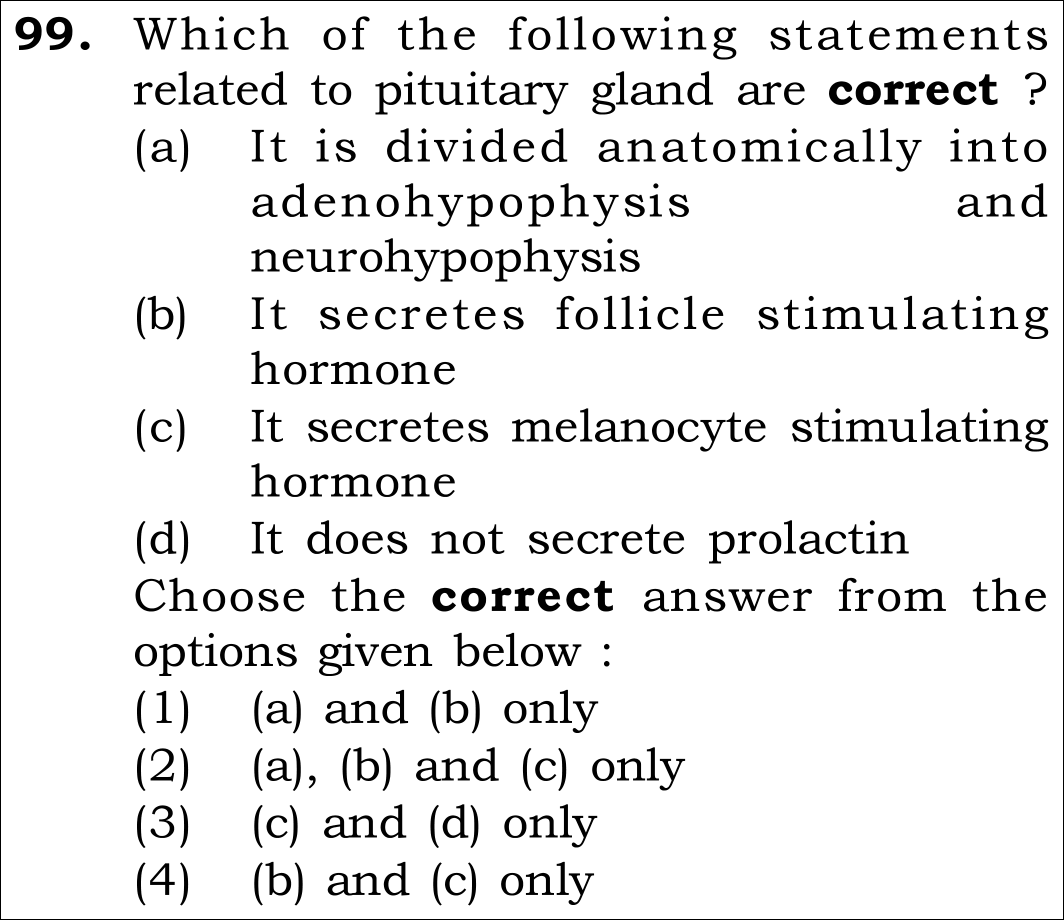
NEET 2026 · Q99 Medium
Official NEET 2026 Question 99 - Chemical Coordination and Integration
1 (a) and (b) only
2 (a), (b) and (c) only ✓ Key
3 (c) and (d) only
4 (b) and (c) only
💡 Verified Solution & 30-Second Hack
✓
Verified Against NTA Final Answer Key
Option (2) : (a), (b) and (c) only
📚 Chemical Coordination and Integration Medium
📋 Given Parameters & Problem Setup
Statement (a) It is divided anatomically into adenohypophysis and neurohypophysis
Statement (b) It secretes follicle stimulating hormone
Statement (c) It secretes melanocyte stimulating hormone
Statement (d) It does not secrete prolactin
⚡

The 30-Second Exam Hall Shortcut: ⚡ Spot the False Prolactin Claim!

⏱️ Save ~50 seconds

Pituitary gland DOES secrete prolactin! Statement (d) claiming it does NOT is FALSE!

1 Read Statement (d): "It does not secrete prolactin". False! Prolactin (PRL) is secreted by pars distalis of adenohypophysis to regulate mammary gland development.
2 Since (d) is false, eliminate Option (3) immediately.
3 Check (a): Pituitary is divided into adenohypophysis (anterior) and neurohypophysis (posterior) -> TRUE.
4 Check (b): Secretes Follicle Stimulating Hormone (FSH, gonadotropin) -> TRUE.
5 Check (c): Secretes Melanocyte Stimulating Hormone (MSH from pars intermedia) -> TRUE.
6 Statements (a), (b), and (c) only are correct -> Option (2) in 15 seconds!
🛡️
Why You Can 100% Trust This Shortcut: NCERT Endocrine System verbatim: Pars distalis produces GH, PRL, TSH, ACTH, LH, and FSH; Pars intermedia produces MSH.
📐

Step-by-Step Rigorous Workflow & Mathematical Proof

Step 1

Evaluate Statement (a): Anatomical Division of Pituitary

The pituitary gland (hypophysis) is lodged in a bony cavity called sella turcica and is attached to the hypothalamus by a stalk. Anatomically, it is divided into two main lobes: 1. Adenohypophysis: Comprising pars distalis (anterior pituitary) and pars intermedia. 2. Neurohypophysis: Pars nervosa (posterior pituitary).

Pituitary Gland=Adenohypophysis+Neurohypophysis\text{Pituitary Gland} = \text{Adenohypophysis} + \text{Neurohypophysis}
  • • Statement (a) is correct.
Step 2

Evaluate Statement (b): Secretion of FSH

Pars distalis region of the anterior pituitary secretes gonadotropins, specifically Luteinizing Hormone (LH) and Follicle Stimulating Hormone (FSH), which stimulate gonadal activity.

Pars Distalis⟶FSH (Follicle Stimulating Hormone)\text{Pars Distalis} \longrightarrow \text{FSH (Follicle Stimulating Hormone)}
  • • Statement (b) is correct.
Step 3

Evaluate Statement (c): Secretion of MSH

Pars intermedia secretes only one hormone in humans, called Melanocyte Stimulating Hormone (MSH), which acts on melanocytes to regulate skin pigmentation.

Pars Intermedia⟶MSH (Melanocyte Stimulating Hormone)\text{Pars Intermedia} \longrightarrow \text{MSH (Melanocyte Stimulating Hormone)}
  • • Statement (c) is correct.
Step 4

Evaluate Statement (d): Secretion of Prolactin

Prolactin (PRL) is a primary peptide hormone secreted by the lactotroph cells of the pars distalis of the adenohypophysis. It regulates the growth of mammary glands and milk formation. Statement (d) asserts that the pituitary "does not secrete prolactin", which is scientifically false.

Pituitary secretes Prolactin (PRL)  ⟹  Statement (d) is FALSE\text{Pituitary secretes Prolactin (PRL)} \implies \text{Statement (d) is FALSE}
  • • Therefore, statements (a), (b), and (c) only are correct.
⭐

360° Option Elimination Engine Key Feature

Diagnose every choice: Know exactly why the right option works and why distractors fail.

4-Option Deep Scan
1 A
✗ Incorrect
Verdict & Scientific Reason:

Incomplete. Neglects statement (c), which is true (MSH is secreted by pars intermedia of pituitary).

⚠️
Student Fallacy (Why candidates pick this trap): Forgetting that pars intermedia is part of the pituitary gland.
2 B
✓ 100% Correct
Verdict & Scientific Reason:

Exact match: Statements (a), (b), and (c) are true; (d) is false because prolactin is a pituitary hormone.

💡
Why this is airtight: None; comprehensive endocrine knowledge.
3 C
✗ Incorrect
Verdict & Scientific Reason:

Incorrect. Statement (d) is completely false.

⚠️
Student Fallacy (Why candidates pick this trap): Believing prolactin comes from the ovaries or placenta instead of the anterior pituitary.
4 D
✗ Incorrect
Verdict & Scientific Reason:

Incomplete. Fails to include the valid anatomical division in statement (a).

⚠️
Student Fallacy (Why candidates pick this trap): Overlooking the anatomical division of the pituitary.
⚠️

NTA Trap Alert: Missing Negative Phrasing in Statement (d)

Statement (d) says "It DOES NOT secrete prolactin". Students who know prolactin is related to milk often misread it as "It secretes prolactin" and mark (d) as true!

🛡️ How to avoid the -1 mark: Watch out for words like "does not". Pituitary DOES secrete prolactin, so statement (d) is FALSE.
📖

Core NEET Syllabus Standard

NEET Biology Core Syllabus · Chemical Coordination and Integration Standard Benchmark
Core Scientific Principle Tested:

"The pituitary gland consists of adenohypophysis and neurohypophysis, secreting trophic hormones including FSH, MSH, and Prolactin."
Syllabus Focus: Pituitary gland anatomy, hormones (GH, PRL, TSH, ACTH, LH, FSH, MSH)
✓ Core NEET UG Syllabus Anchor Syllabus & Academic Standards ↗
FLAT PIG: FSH, LH, ACTH, TSH, Prolactin, (I)ntermediate MSH, Growth hormone all come from Pituitary!
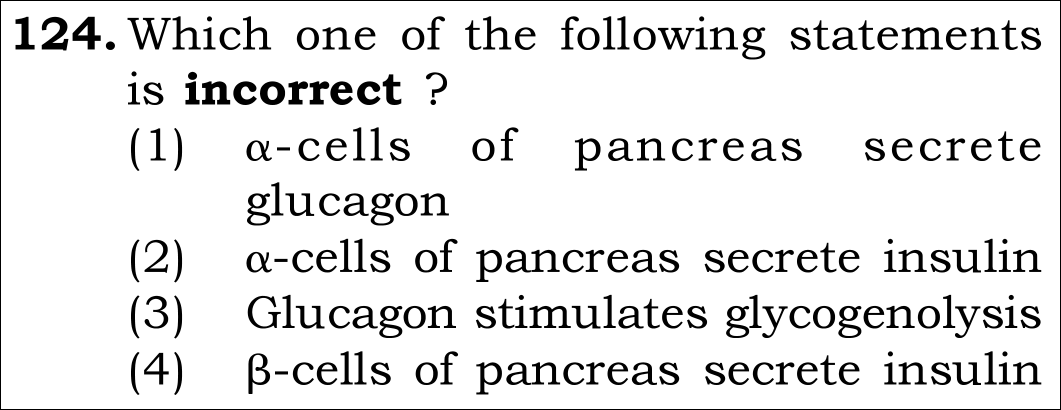
NEET 2026 · Q124 Easy
Official NEET 2026 Question 124 - Chemical Coordination and Integration
1
2 ✓ Key
3
4
💡 Verified Solution & 30-Second Hack
✓
Verified Against NTA Final Answer Key
Option (2) : α-cells of pancreas secrete insulin
📚 Chemical Coordination and Integration Easy
📋 Given Parameters & Problem Setup
Organ Endocrine pancreas (Islets of Langerhans)
Task Identify the INCORRECT physiological statement
⚡

The 30-Second Exam Hall Shortcut: ⚡ Pancreatic Cell Secretion Rule

⏱️ Save ~40 seconds

Alpha = Glucagon; Beta = Insulin! α-cells DO NOT secrete insulin!

1 Recall cell types in Islets of Langerhans:
2 α-cells (alpha cells) secrete GLUCAGON (hyperglycemic hormone).
3 β-cells (beta cells) secrete INSULIN (hypoglycemic hormone).
4 Statement (2) claims "α-cells of pancreas secrete insulin" -> Glaringly FALSE!
5 The question asks for the INCORRECT statement.
6 Select Option (2) in under 5 seconds!
🛡️
Why You Can 100% Trust This Shortcut: NCERT Biology · Chemical Coordination and Integration (Pancreatic Islets of Langerhans: Glucagon from alpha cells, Insulin from beta cells).
📐

Step-by-Step Rigorous Workflow & Mathematical Proof

Step 1

Histology of the Endocrine Pancreas

The pancreas is a composite (heterocrine) gland. The endocrine part consists of 1 to 2 million Islets of Langerhans representing only 1 to 2 percent of total pancreatic tissue. The two main cell types are alpha (α) cells and beta (β) cells.

Islets of Langerhans={α-cells:Secrete Glucagonβ-cells:Secrete Insulin\text{Islets of Langerhans} = \begin{cases} \alpha\text{-cells} &: \text{Secrete Glucagon} \\ \beta\text{-cells} &: \text{Secrete Insulin} \end{cases}
  • • α-cells comprise ~20% and β-cells comprise ~70% of islet cells.
Step 2

Physiological Roles of Glucagon and Insulin

Glucagon is a peptide hormone that maintains normal blood glucose levels by acting on hepatocytes to stimulate glycogenolysis (breakdown of glycogen into glucose) and gluconeogenesis, producing hyperglycemia. Insulin is a peptide hormone that enhances cellular glucose uptake and stimulates glycogenesis, lowering blood glucose (hypoglycemia).

Glucagon→LiverGlycogen→Glucose (Glycogenolysis)Insulin→Target cellsUptake of glucose→Glycogen (Glycogenesis)\begin{aligned} \text{Glucagon} &\xrightarrow{\text{Liver}} \text{Glycogen} \rightarrow \text{Glucose (Glycogenolysis)} \\ \text{Insulin} &\xrightarrow{\text{Target cells}} \text{Uptake of glucose} \rightarrow \text{Glycogen (Glycogenesis)} \end{aligned}
  • • Statement (1) is correct.
  • • Statement (3) is correct.
  • • Statement (4) is correct.
Step 3

Identify the Incorrect Statement

Statement (2) claims that α-cells secrete insulin. In reality, insulin is secreted exclusively by β-cells. Therefore, Statement (2) is incorrect.

Incorrect Statement="α-cells of pancreas secrete insulin"  ⟹  Option (2)\text{Incorrect Statement} = \text{"}\alpha\text{-cells of pancreas secrete insulin"} \implies \text{Option (2)}
  • • Matches official NTA final answer key Option B / (2).
⭐

360° Option Elimination Engine Key Feature

Diagnose every choice: Know exactly why the right option works and why distractors fail.

4-Option Deep Scan
1 A
✗ Incorrect
Verdict & Scientific Reason:

Factually true statement, so not the answer to this negative-stem question.

⚠️
Student Fallacy (Why candidates pick this trap): Failing to read "incorrect" in the prompt.
2 B
✓ 100% Correct
Verdict & Scientific Reason:

100% false statement, thus the correct answer. Insulin is secreted by β-cells, not α-cells.

💡
Why this is airtight: None; immediate recognition of endocrine cell swap.
3 C
✗ Incorrect
Verdict & Scientific Reason:

Factually true statement. Glucagon induces glycogen breakdown to elevate plasma glucose.

⚠️
Student Fallacy (Why candidates pick this trap): Confusing glycogenolysis with glycogenesis.
4 D
✗ Incorrect
Verdict & Scientific Reason:

Factually true statement.

⚠️
Student Fallacy (Why candidates pick this trap): Misreading options.
⚠️

NTA Trap Alert: Confusing Alpha and Beta Secretions

Students in a rush sometimes invert α and β cells, thinking α (first letter) must make the more famous hormone (insulin).

🛡️ How to avoid the -1 mark: Use alphabetical pairing: B comes before G? No, remember B-I (Beta-Insulin) and A-G (Alpha-Glucagon).
📖

Core NEET Syllabus Standard

NEET Biology Core Syllabus · Chemical Coordination and Integration Standard Benchmark
Core Scientific Principle Tested:

"In the Islets of Langerhans, α-cells secrete glucagon and β-cells secrete insulin. Glucagon stimulates hepatic glycogenolysis."

Syllabus Focus: Pancreas - Islets of Langerhans
✓ Core NEET UG Syllabus Anchor Syllabus & Academic Standards ↗
Alpha Glides with Glucagon; Beta Injects Insulin to carry on!
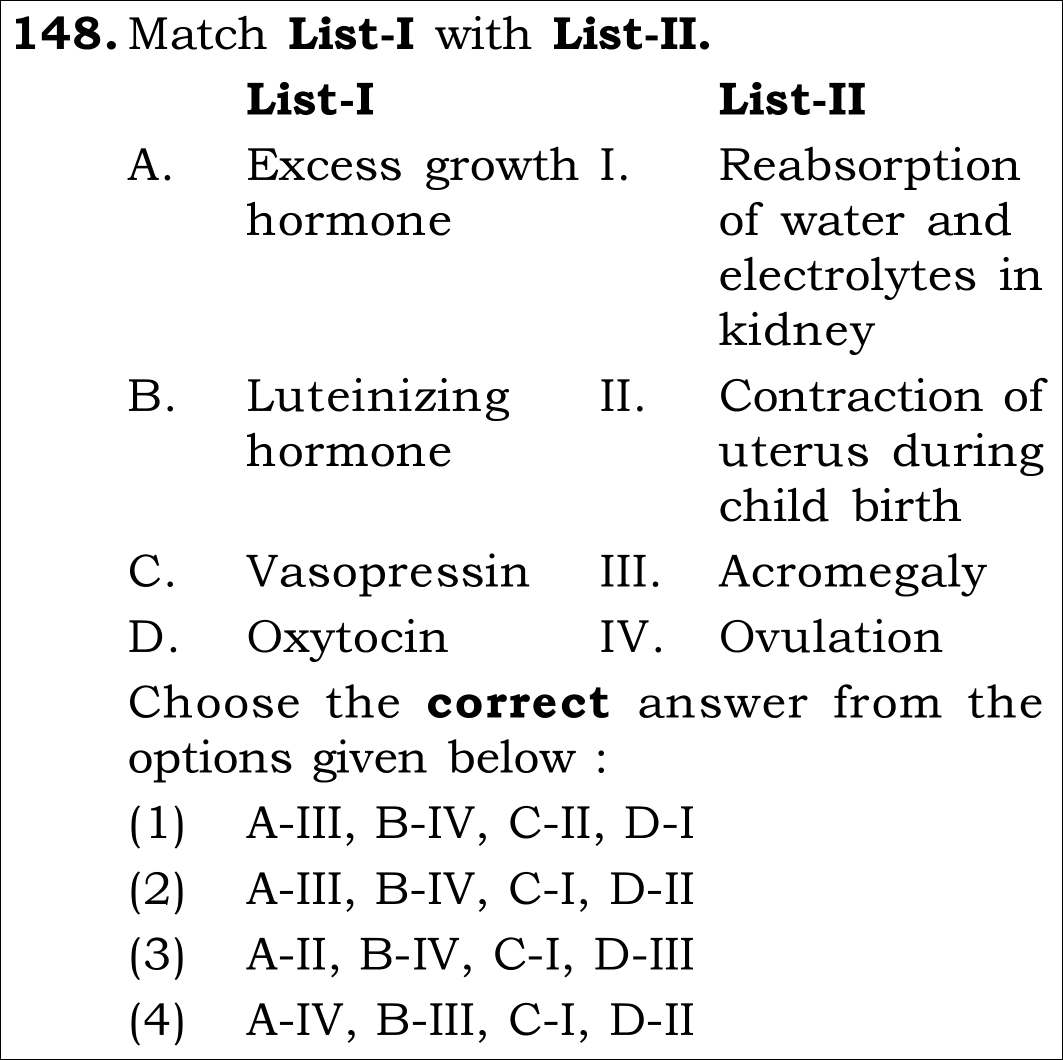
NEET 2026 · Q148 Easy
Official NEET 2026 Question 148 - Chemical Coordination and Integration
1
2 ✓ Key
3
4
💡 Verified Solution & 30-Second Hack
✓
Verified Against NTA Final Answer Key
Option (2) : A-III, B-IV, C-I, D-II
📚 Chemical Coordination and Integration Easy
📋 Given Parameters & Problem Setup
List-I Hormones & Conditions A. Excess growth hormone, B. Luteinizing hormone, C. Vasopressin, D. Oxytocin
List-II Physiological Effects I. Reabsorption of water and electrolytes in kidney, II. Contraction of uterus during child birth, III. Acromegaly, IV. Ovulation
⚡

The 30-Second Exam Hall Shortcut: ⚡ Pituitary Hormone Anchor Hack

⏱️ Save ~45 seconds

Oxytocin = Uterus contraction (D -> II); Excess GH in adults = Acromegaly (A -> III)!

1 Anchor D: Oxytocin induces vigorous contraction of uterus during child birth (D -> II).
2 Anchor A: Excess secretion of growth hormone in adults leads to Acromegaly (A -> III).
3 Anchor B: LH surge triggers Ovulation (B -> IV).
4 Anchor C: Vasopressin (ADH) stimulates reabsorption of water and electrolytes in kidney (C -> I).
5 Combination: A-III, B-IV, C-I, D-II -> Matches Option (2)!
6 Mark Option (2) in under 10 seconds.
🛡️
Why You Can 100% Trust This Shortcut: NCERT Biology · Chemical Coordination and Integration (Hypothalamic and Pituitary Hormones: GnRH stimulates gonadotropin release).
📐

Step-by-Step Rigorous Workflow & Mathematical Proof

Step 1

Correlate A: Excess Growth Hormone with Acromegaly

Hypersecretion of growth hormone (GH) in adults (middle-aged individuals after epiphyseal plate closure) causes disfigurement, especially of the face, hands, and feet. This clinical pathology is termed Acromegaly.

Excess GH in adults  ⟹  Acromegaly (III)\text{Excess GH in adults} \implies \mathbf{Acromegaly\text{ (III)}}
  • • A pairs with III.
Step 2

Correlate B: Luteinizing Hormone with Ovulation

In females, an LH surge at mid-cycle stimulates the rupture of the mature Graafian follicle and induces ovulation, and maintains the corpus luteum.

Luteinizing Hormone (LH)  ⟹  Ovulation (IV)\text{Luteinizing Hormone (LH)} \implies \mathbf{Ovulation\text{ (IV)}}
  • • B pairs with IV.
Step 3

Correlate C: Vasopressin with Renal Reabsorption

Vasopressin (Antidiuretic Hormone, ADH), released from neurohypophysis, acts mainly on the distal convoluted tubules and collecting ducts of the nephron to stimulate reabsorption of water and electrolytes.

Vasopressin (ADH)  ⟹  Reabsorption of water and electrolytes in kidney (I)\text{Vasopressin (ADH)} \implies \mathbf{Reabsorption\text{ of water and electrolytes in kidney (I)}}
  • • C pairs with I.
Step 4

Correlate D: Oxytocin with Parturition Uterine Contraction

Oxytocin acts on the smooth myometrium of the uterus, stimulating vigorous contractions during parturition (child birth) and milk ejection from mammary glands.

Oxytocin  ⟹  Contraction of uterus during child birth (II)\text{Oxytocin} \implies \mathbf{Contraction\text{ of uterus during child birth (II)}}
  • • D pairs with II.
Step 5

Synthesize the Complete Match

The combined match is A-III, B-IV, C-I, D-II. Looking at the options, this corresponds to Option (2).

Match:A-III,  B-IV,  C-I,  D-II  ⟹  Option (2)\text{Match}: \mathbf{A}\text{-III}, \; \mathbf{B}\text{-IV}, \; \mathbf{C}\text{-I}, \; \mathbf{D}\text{-II} \implies \text{Option (2)}
  • • Matches official NTA final answer key Option B / (2).
⭐

360° Option Elimination Engine Key Feature

Diagnose every choice: Know exactly why the right option works and why distractors fail.

4-Option Deep Scan
1 A
✗ Incorrect
Verdict & Scientific Reason:

Incorrect. Swaps Vasopressin and Oxytocin actions (assigns uterus contraction to Vasopressin).

⚠️
Student Fallacy (Why candidates pick this trap): Swapping posterior pituitary hormone functions.
2 B
✓ 100% Correct
Verdict & Scientific Reason:

100% accurate match for all four pituitary hormones and disorders according to NCERT.

💡
Why this is airtight: None; flawless endocrine recall.
3 C
✗ Incorrect
Verdict & Scientific Reason:

Incorrect. Links excess GH to uterine contraction and Oxytocin to Acromegaly.

⚠️
Student Fallacy (Why candidates pick this trap): Completely scrambled hormone effects.
4 D
✗ Incorrect
Verdict & Scientific Reason:

Incorrect. Assigns ovulation to excess GH and Acromegaly to LH.

⚠️
Student Fallacy (Why candidates pick this trap): Confusing anterior pituitary hormones.
⚠️

NTA Trap Alert: Posterior Pituitary Hormone Confusion (ADH vs Oxytocin)

Both ADH (Vasopressin) and Oxytocin are synthesized in the hypothalamus and released by neurohypophysis. Remember: Vasopressin acts on the VESSEL and NEPHRON (water saving); Oxytocin causes CONTRACTION of the uterus and milk ducts.

🛡️ How to avoid the -1 mark: Oxy = Quick Birth (Uterus); Vaso = Water Vessel (Kidney).
📖

Core NEET Syllabus Standard

NEET Biology Core Syllabus · Chemical Coordination and Integration Standard Benchmark
Core Scientific Principle Tested:

"Excess GH causes Acromegaly; LH triggers ovulation; Vasopressin promotes renal water reabsorption; Oxytocin induces uterine contractions."

Syllabus Focus: The Pituitary Gland - Hormones and Target Actions
✓ Core NEET UG Syllabus Anchor Syllabus & Academic Standards ↗
Acromegaly from GH, LH brings Ovum home, Vasopressin saves Water, Oxytocin makes Babies roam!
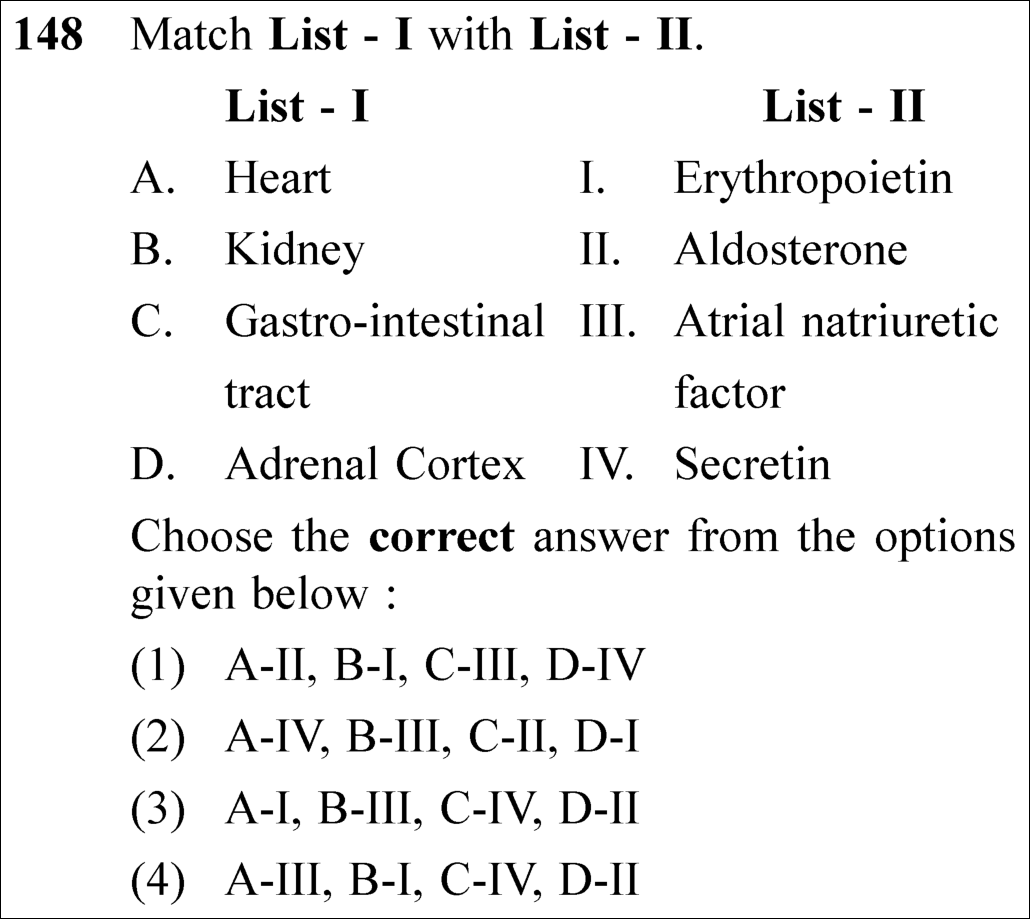
NEET 2025 · Q148 Easy
Official NEET 2025 Question 148 - Chemical Coordination and Integration
1
2
3
4 ✓ Key
💡 Verified Solution & 30-Second Hack
✓
Verified Against NTA Final Answer Key
Option (4) : A-III, B-I, C-IV, D-II
📚 Chemical Coordination and Integration Easy
📋 Given Parameters & Problem Setup
List - I (Organs / Tissues) A. Heart, B. Kidney, C. Gastro-intestinal tract, D. Adrenal Cortex
List - II (Hormones Secreted) I. Erythropoietin, II. Aldosterone, III. Atrial natriuretic factor, IV. Secretin
⚡

The 30-Second Exam Hall Shortcut: ⚡ Non-Endocrine Organ Hormones Fingerprint

⏱️ Save ~30 seconds

Heart atrial wall = ANF (Atrial Natriuretic Factor, III); Kidney JG cells = Erythropoietin (RBC production, I); GI tract = Secretin (exocrine pancreas stimulation, IV); Adrenal Cortex = Aldosterone (mineralocorticoid, II)! Code: A-III, B-I, C-IV, D-II!

1 Match endocrine secretions from non-classical organs from NCERT Section 22.4:
2 - Heart: Atrial wall secretes Atrial Natriuretic Factor (ANF), which dilates blood vessels and lowers BP (A -> III).
3 - Kidney: Juxtaglomerular cells produce a peptide hormone called Erythropoietin, stimulating erythropoiesis (B -> I).
4 - Gastro-intestinal tract: Endocrine cells secrete Secretin, stimulating water and bicarbonate secretion from pancreas (C -> IV).
5 - Adrenal Cortex: Zona glomerulosa secretes the principal mineralocorticoid Aldosterone (D -> II).
6 Unique combination: A-III, B-I, C-IV, D-II (Option 4)!
7 Solved in under 10 seconds!
🛡️
Why You Can 100% Trust This Shortcut: Adrenal Medulla and Cortex Hormones (NCERT Biology · Chemical Coordination and Integration: Catecholamines as fight-or-flight hormones).
📐

Step-by-Step Rigorous Workflow & Mathematical Proof

Step 1

Endocrine Secretions of Non-Classical Organs and Adrenal Cortex

Analyzing the specific endocrine functions of tissues outside the traditional pituitary/thyroid glands:

  • • A. Heart: The atrial wall of our heart secretes a very important peptide hormone called Atrial Natriuretic Factor (ANF). When blood pressure is increased, ANF is secreted causing vasodilation and thereby decreasing blood pressure. Hence, A matches III.
  • • B. Kidney: The juxtaglomerular (JG) cells of kidney produce a peptide hormone called Erythropoietin (EPO) which stimulates erythropoiesis (formation of RBCs in bone marrow). Hence, B matches I.
  • • C. Gastro-intestinal tract (GIT): Endocrine cells present in different parts of the gastro-intestinal tract secrete four major peptide hormones: gastrin, secretin, cholecystokinin (CCK), and gastric inhibitory peptide (GIP). Secretin acts on the exocrine pancreas and stimulates secretion of water and bicarbonate ions. Hence, C matches IV.
  • • D. Adrenal Cortex: Composed of three distinct layers (zona reticularis, zona fasciculata, zona glomerulosa). The outermost layer (zona glomerulosa) secretes mineralocorticoids, mainly Aldosterone, which regulates sodium and water reabsorption in renal distal tubules. Hence, D matches II.
Step 2

Formulating the Matching Code

Consolidating the four organ-hormone associations:

  • • A -> III (Heart - Atrial natriuretic factor)
  • • B -> I (Kidney - Erythropoietin)
  • • C -> IV (Gastro-intestinal tract - Secretin)
  • • D -> II (Adrenal Cortex - Aldosterone)
Step 3

Conclusion

The correct matching option is A-III, B-I, C-IV, D-II, exactly matching Option (4).

Matching: A-III,  B-I,  C-IV,  D-II\text{Matching: } A\text{-III}, \; B\text{-I}, \; C\text{-IV}, \; D\text{-II}
⭐

360° Option Elimination Engine Key Feature

Diagnose every choice: Know exactly why the right option works and why distractors fail.

4-Option Deep Scan
1 A
✗ Incorrect
Verdict & Scientific Reason:

Incorrect. Assigns aldosterone to heart and ANF to gastro-intestinal tract.

⚠️
Student Fallacy (Why candidates pick this trap): Scrambling cardiac and adrenal hormones.
2 B
✗ Incorrect
Verdict & Scientific Reason:

Incorrect. Assigns secretin to heart and erythropoietin to adrenal cortex.

⚠️
Student Fallacy (Why candidates pick this trap): Complete confusion across organ systems.
3 C
✗ Incorrect
Verdict & Scientific Reason:

Incorrect. Assigns erythropoietin to heart and ANF to kidney.

⚠️
Student Fallacy (Why candidates pick this trap): Inverting cardiac and renal hormones.
4 D
✓ 100% Correct
Verdict & Scientific Reason:

100% correct. Accurately links heart, kidney, gut, and adrenal cortex to their corresponding hormones.

💡
Why this is airtight: None; pristine endocrine knowledge.
⚠️

NTA Trap Alert: Heart vs Kidney in Blood Pressure Regulation

Kidney secretes RENIN (which triggers aldosterone to RAISE blood pressure) and ERYTHROPOIETIN (for RBCs). Heart secretes ANF to LOWER blood pressure. Do not mix up the organs!

🛡️ How to avoid the -1 mark: Heart = Atria = ANF. Kidney = JG cells = Erythropoietin.
📖

Core NEET Syllabus Standard

NEET Biology Core Syllabus · Chemical Coordination and Integration Standard Benchmark
Core Scientific Principle Tested:

"Heart secretes ANF, kidney produces erythropoietin, GIT secretes secretin, and adrenal cortex secretes aldosterone."

Syllabus Focus: Hormones of Heart, Kidney and Gastrointestinal Tract
✓ Core NEET UG Syllabus Anchor Syllabus & Academic Standards ↗
H-ANF (Heart), K-EPO (Kidney), G-Sec (Gut), C-Aldo (Cortex)!
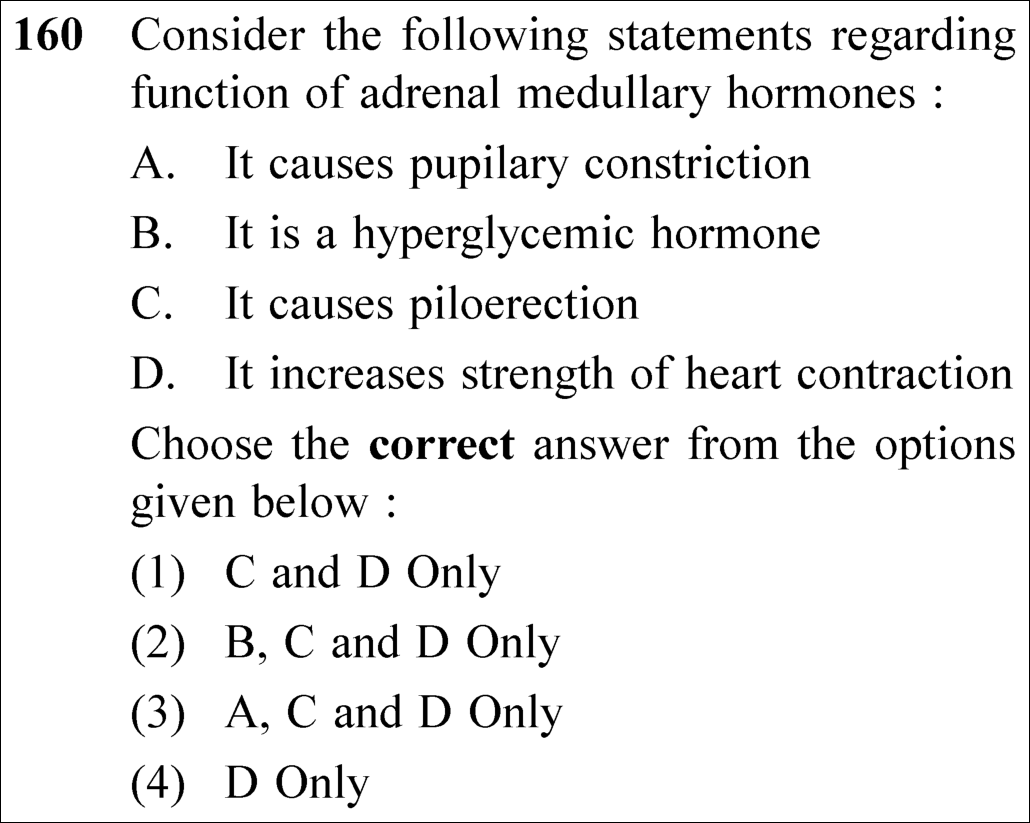
NEET 2025 · Q160 Medium
Official NEET 2025 Question 160 - Chemical Coordination and Integration
1
2 ✓ Key
3
4
💡 Verified Solution & 30-Second Hack
✓
Verified Against NTA Final Answer Key
Option (2) : B, C and D Only
📚 Chemical Coordination and Integration Medium
📋 Given Parameters & Problem Setup
Hormone Class Adrenal medullary hormones (Adrenaline / Epinephrine & Noradrenaline)
Statement A It causes pupilary constriction
Statement B It is a hyperglycemic hormone
Statement C It causes piloerection
Statement D It increases strength of heart contraction
⚡

The 30-Second Exam Hall Shortcut: ⚡ Fight-or-Flight Catecholamine Diagnostic

⏱️ Save ~25 seconds

Adrenaline prepares you for EMERGENCY: Dilates pupils for vision (A is FALSE, not constriction)! Stimulates glycogen breakdown -> Hyperglycemic (B is TRUE)! Causes goosebumps/piloerection (C is TRUE)! Increases heart force (D is TRUE)! B, C and D Only!

1 Check each catecholamine effect against NCERT Section 22.2.6:
2 - Statement A: Causes pupillary constriction? FALSE! It causes pupillary DILATION (mydriasis) to admit more light during emergencies.
3 - Statement B: "Catecholamines also stimulate the breakdown of glycogen resulting in an increased concentration of glucose in blood." -> Hyperglycemic! [TRUE]
4 - Statement C: "These hormones increase alertness, pupillary dilation, piloerection (raising of hairs), sweating etc." -> Piloerection! [TRUE]
5 - Statement D: "Both the hormones increase the heartbeat, the strength of heart contraction and the rate of respiration." -> Inotropic cardiac boost! [TRUE]
6 Correct combination: B, C and D Only (Option 2)!
7 Select Option (2)!
🛡️
Why You Can 100% Trust This Shortcut: Thyroid Hormones & Basal Metabolic Rate Regulation (NCERT Biology · Chemical Coordination and Integration: T3 and T4 synthesis requires iodine).
📐

Step-by-Step Rigorous Workflow & Mathematical Proof

Step 1

Secretion and Nature of Adrenal Medullary Hormones

The adrenal medulla secretes two catecholamines in response to stress or sympathetic stimulation: adrenaline (epinephrine) and noradrenaline (norepinephrine):

  • • Commonly called emergency hormones or hormones of Fight or Flight.
  • • They elicit coordinated physiological shifts to prepare the organism for intense physical exertion or survival emergencies.
Step 2

Ocular and Cutaneous Effects (Statements A & C)

Evaluating sensory and autonomic responses:

  • • Pupillary dynamics (Statement A): Catecholamines stimulate α1\alpha_1-adrenergic receptors on the pupillary dilator muscle, causing pupillary dilation (mydriasis) to maximize visual field and light capture. They do NOT cause pupillary constriction (miosis). Hence, Statement A is INCORRECT.
  • • Cutaneous dynamics (Statement C): Adrenaline causes contraction of arrector pili muscles attached to hair follicles, causing piloerection (raising of hairs or "goosebumps"). Hence, Statement C is CORRECT.
Step 3

Metabolic and Cardiovascular Effects (Statements B & D)

Evaluating energy mobilization and cardiac performance:

  • • Glucose homeostasis (Statement B): Catecholamines stimulate hepatic and muscular glycogenolysis (breakdown of glycogen into glucose) and lipolysis, sharply elevating blood glucose levels. Thus, adrenaline is a potent hyperglycemic hormone. Hence, Statement B is CORRECT.
  • • Cardiovascular output (Statement D): By stimulating β1\beta_1-adrenergic receptors on cardiomyocytes, catecholamines exert positive inotropic effects, significantly increasing the strength of heart contraction and cardiac output. Hence, Statement D is CORRECT.
Step 4

Conclusion

Statements B, C, and D are correct, while Statement A is false. This corresponds to Option (2).

Valid Actions={B,C,D}  ⟹  Option (2)\text{Valid Actions} = \{B, C, D\} \implies \text{Option (2)}
⭐

360° Option Elimination Engine Key Feature

Diagnose every choice: Know exactly why the right option works and why distractors fail.

4-Option Deep Scan
1 A
✗ Incorrect
Verdict & Scientific Reason:

Incorrect. Omits statement B (hyperglycemic action), which is a cardinal metabolic function of adrenaline.

⚠️
Student Fallacy (Why candidates pick this trap): Forgetting that adrenaline raises blood sugar levels.
2 B
✓ 100% Correct
Verdict & Scientific Reason:

100% correct. Perfectly identifies hyperglycemia (B), piloerection (C), and enhanced cardiac contractility (D) while eliminating pupillary constriction (A).

💡
Why this is airtight: None; textbook mastery of adrenal physiology.
3 C
✗ Incorrect
Verdict & Scientific Reason:

Incorrect. Erroneously includes statement A (adrenaline causes pupillary dilation, not constriction).

⚠️
Student Fallacy (Why candidates pick this trap): Confusing pupillary dilation with pupillary constriction.
4 D
✗ Incorrect
Verdict & Scientific Reason:

Incorrect. Overlooks both hyperglycemic (B) and piloerection (C) effects.

⚠️
Student Fallacy (Why candidates pick this trap): Selecting only the cardiac effect.
⚠️

NTA Trap Alert: Pupil Dilation vs Pupil Constriction

In an emergency (sympathetic state), your eyes WIDEN (pupillary DILATION) so you can see threats clearly in the dark. Parasympathetic states constrict pupils. Statement A claims constriction, which is false!

🛡️ How to avoid the -1 mark: Adrenaline = Fight or Flight = Dilation of pupils.
📖

Core NEET Syllabus Standard

NEET Biology Core Syllabus · Chemical Coordination and Integration Standard Benchmark
Core Scientific Principle Tested:

"Catecholamines cause pupillary dilation, piloerection, hyperglycemia, and increased strength of heart contraction."

Syllabus Focus: Adrenal Gland · Adrenal Medulla
✓ Core NEET UG Syllabus Anchor Syllabus & Academic Standards ↗
DILATE eyes (A is out), BOOST sugar (B), RAISE hairs (C), PUMP heart (D) -> B, C, D!
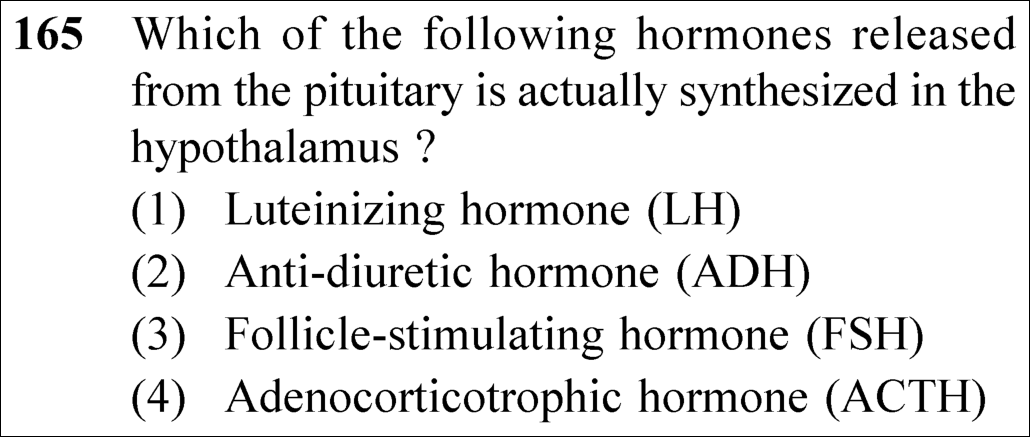
NEET 2025 · Q165 Easy
Official NEET 2025 Question 165 - Chemical Coordination and Integration
1 Luteinizing hormone (LH)
2 Anti-diuretic hormone (ADH) ✓ Key
3 Follicle-stimulating hormone (FSH)
4 Adenocorticotrophic hormone (ACTH)
💡 Verified Solution & 30-Second Hack
✓
Verified Against NTA Final Answer Key
Option (2) : Anti-diuretic hormone (ADH)
📚 Chemical Coordination and Integration Easy
📋 Given Parameters & Problem Setup
Site of Release Pituitary gland (posterior pituitary / neurohypophysis)
Site of Actual Synthesis Hypothalamus (supraoptic and paraventricular nuclei)
⚡

The 30-Second Exam Hall Shortcut: ⚡ Posterior Pituitary Synthesis Fingerprint

⏱️ Save ~15 seconds

Posterior pituitary (neurohypophysis) does NOT synthesize any hormones! It only STORES and RELEASES Oxytocin and ADH (Vasopressin), which are synthesized by the HYPOTHALAMUS! ADH is the answer!

1 Recall NCERT Section 22.2.2 (The Pituitary Gland) verbatim:
2 - "Neurohypophysis (pars nervosa) also known as posterior pituitary, stores and releases two hormones called oxytocin and vasopressin, which are actually synthesised by the hypothalamus and are transported axonally to neurohypophysis."
3 - Vasopressin is also known as Anti-diuretic hormone (ADH).
4 - LH, FSH, and ACTH are synthesized directly by cells of the anterior pituitary (pars distalis).
5 Synthesized in hypothalamus = Anti-diuretic hormone (ADH)!
6 Select Option (2) Anti-diuretic hormone (ADH)!
🛡️
Why You Can 100% Trust This Shortcut: Pituitary Hormones & Hypothalamic Axis Control (NCERT Biology · Chemical Coordination and Integration: Anterior vs Posterior neurohypophysis).
📐

Step-by-Step Rigorous Workflow & Mathematical Proof

Step 1

Anatomical Organization of the Pituitary Gland

The pituitary gland (hypophysis cerebri) is divided into two anatomically and embryologically distinct lobes:

  • • Adenohypophysis (Anterior Pituitary): Originates from Rathke's pouch (oral ectoderm). Its glandular cells synthesize and secrete true trophic hormones: Growth Hormone (GH), Prolactin (PRL), Thyroid Stimulating Hormone (TSH), Adrenocorticotrophic Hormone (ACTH), Luteinizing Hormone (LH), and Follicle Stimulating Hormone (FSH).
  • • Neurohypophysis (Posterior Pituitary / Pars Nervosa): Originates from downward neural outgrowth of the hypothalamus (infundibulum). It contains non-secretory pituicytes and axon terminals of hypothalamic neurosecretory cells.
Step 2

Synthesis in Hypothalamus and Axonal Transport

Mechanism of ADH and Oxytocin production:

  • • The cell bodies of neurosecretory neurons located in the supraoptic and paraventricular nuclei of the hypothalamus synthesize Oxytocin and Vasopressin (Anti-diuretic hormone / ADH).
  • • These peptide hormones are packaged into neurosecretory granules and transported down unmyelinated axons through the hypothalamo-hypophysial tract to nerve terminals in the neurohypophysis.
  • • The posterior pituitary stores and releases them into the systemic circulation upon appropriate physiological stimulation (e.g. osmoreceptor activation for ADH).
  • • Thus, the posterior pituitary synthesizes ZERO hormones itself; ADH is synthesized in the hypothalamus.
Step 3

Conclusion

Anti-diuretic hormone (ADH) is the pituitary-released hormone that is actually synthesized in the hypothalamus, matching Option (2).

Synthesized in Hypothalamus→Axonal TransportReleased by Posterior Pituitary: ADH & Oxytocin\text{Synthesized in Hypothalamus} \xrightarrow{\text{Axonal Transport}} \text{Released by Posterior Pituitary: ADH \& Oxytocin}
⭐

360° Option Elimination Engine Key Feature

Diagnose every choice: Know exactly why the right option works and why distractors fail.

4-Option Deep Scan
1 A
✗ Incorrect
Verdict & Scientific Reason:

Incorrect. LH is synthesized and secreted by gonadotroph cells of the anterior pituitary.

⚠️
Student Fallacy (Why candidates pick this trap): Confusing anterior pituitary gonadotropins with posterior pituitary neurohormones.
2 B
✓ 100% Correct
Verdict & Scientific Reason:

100% correct. Direct verbatim NCERT fact: ADH (vasopressin) is synthesized by hypothalamic neurons and released by neurohypophysis.

💡
Why this is airtight: None; textbook mastery.
3 C
✗ Incorrect
Verdict & Scientific Reason:

Incorrect. FSH is synthesized directly by anterior pituitary gonadotrophs under GnRH regulation.

⚠️
Student Fallacy (Why candidates pick this trap): Confusing hypothalamic releasing hormones with neurohypophysial products.
4 D
✗ Incorrect
Verdict & Scientific Reason:

Incorrect. ACTH is synthesized by corticotroph cells of the anterior pituitary.

⚠️
Student Fallacy (Why candidates pick this trap): Thinking all pituitary hormones originate in the hypothalamus.
⚠️

NTA Trap Alert: Hypothalamic Releasing Hormones vs Posterior Pituitary Hormones

The hypothalamus makes TWO kinds of hormones: 1. Releasing/Inhibiting hormones (GnRH, TRH, CRH) that travel via hypophysial portal circulation to control the ANTERIOR pituitary. 2. ADH and Oxytocin that travel axonally to be STORED and RELEASED by the POSTERIOR pituitary!

🛡️ How to avoid the -1 mark: Hormones released from posterior pituitary but made in hypothalamus = ADH and Oxytocin.
📖

Core NEET Syllabus Standard

NEET Biology Core Syllabus · Chemical Coordination and Integration Standard Benchmark
Core Scientific Principle Tested:

"Neurohypophysis stores and releases oxytocin and vasopressin (ADH), which are synthesized by the hypothalamus."

Syllabus Focus: The Pituitary Gland · Neurohypophysis
✓ Core NEET UG Syllabus Anchor Syllabus & Academic Standards ↗
HYPOTHALAMUS makes the PAIR: Oxytocin & ADH (Stored at Posterior Pituitary)!
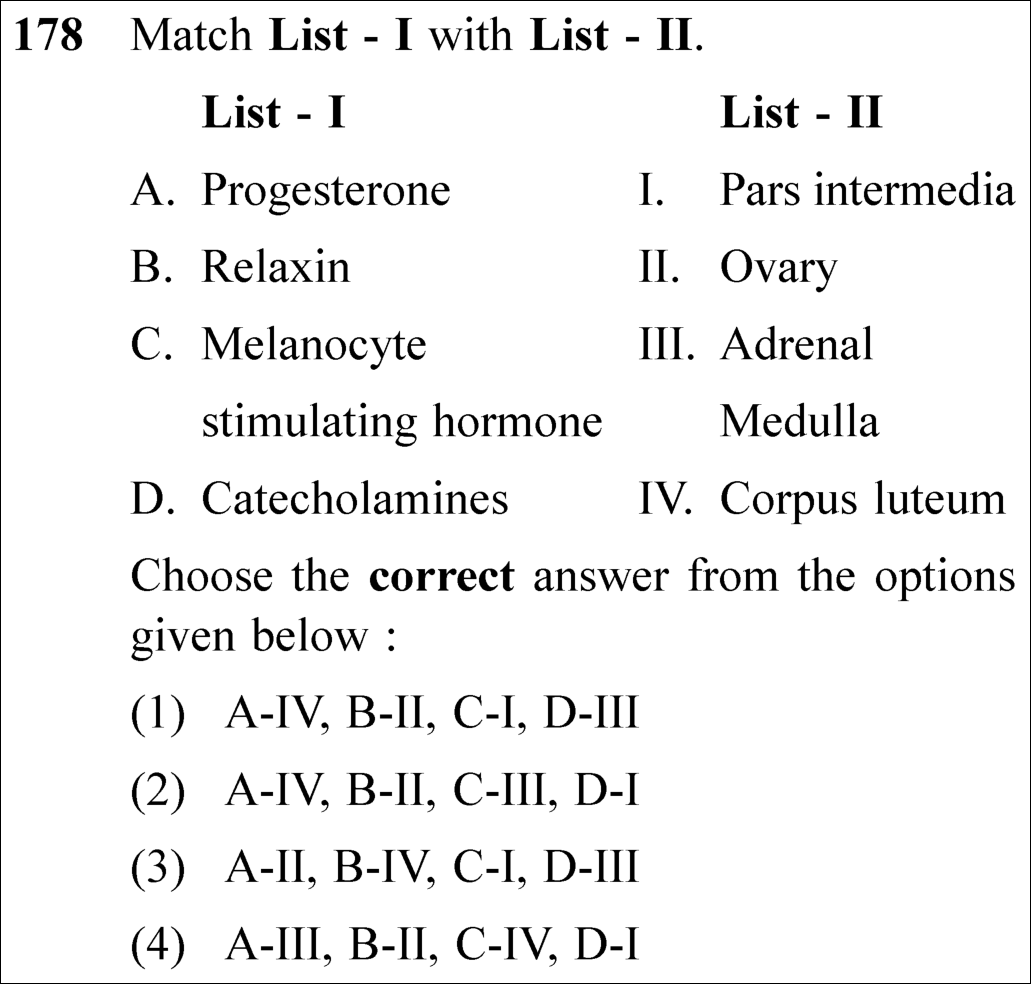
NEET 2025 · Q178 Easy
Official NEET 2025 Question 178 - Chemical Coordination and Integration
1 ✓ Key
2
3
4
💡 Verified Solution & 30-Second Hack
✓
Verified Against NTA Final Answer Key
Option (1) : A-IV, B-II, C-I, D-III
📚 Chemical Coordination and Integration Easy
📋 Given Parameters & Problem Setup
List - I (Hormones) A. Progesterone, B. Relaxin, C. Melanocyte stimulating hormone, D. Catecholamines
List - II (Endocrine Tissues / Glands) I. Pars intermedia, II. Ovary, III. Adrenal Medulla, IV. Corpus luteum
⚡

The 30-Second Exam Hall Shortcut: ⚡ Endocrine Hormone Match Fingerprint

⏱️ Save ~30 seconds

Progesterone = Corpus luteum (IV); Relaxin = Ovary (in later pregnancy, II); MSH = Pars intermedia of pituitary (I); Catecholamines = Adrenal Medulla (III)! Code: A-IV, B-II, C-I, D-III!

1 Match hormones to their canonical endocrine source from NCERT:
2 - Progesterone: Secreted in massive quantities by the Corpus luteum to support pregnancy (A -> IV).
3 - Relaxin: In the later phase of pregnancy, a hormone called relaxin is secreted by the Ovary (B -> II).
4 - Melanocyte stimulating hormone (MSH): Pars intermedia of pituitary secretes only one hormone: MSH (C -> I).
5 - Catecholamines (adrenaline & noradrenaline): Secreted by the Adrenal Medulla (D -> III).
6 Unique combination: A-IV, B-II, C-I, D-III (Option 1)!
7 Solved in under 10 seconds!
🛡️
Why You Can 100% Trust This Shortcut: Human Endocrine Feedback & Menstrual Hormones (NCERT Biology · Chemical Coordination and Integration & Human Reproduction).
📐

Step-by-Step Rigorous Workflow & Mathematical Proof

Step 1

Review of Endocrine Sites and Hormonal Secretions

Analyzing each endocrine gland and tissue pairing:

  • • A. Progesterone: After ovulation, the ruptured Graafian follicle transforms into a temporary yellow endocrine gland called the Corpus luteum. The corpus luteum secretes large amounts of progesterone which is essential for maintenance of the endometrium. Hence, A matches IV.
  • • B. Relaxin: NCERT Chapter 3 (Section 3.6) explicitly states: "In addition, in the later phase of pregnancy, a hormone called relaxin is also secreted by the ovary." (Relaxin facilitates parturition by loosening pubic symphysis). Hence, B matches II.
  • • C. Melanocyte stimulating hormone (MSH): The adenohypophysis consists of two portions, pars distalis and pars intermedia. In humans, pars intermedia secretes only one hormone: MSH (which acts on melanocytes to regulate skin pigmentation). Hence, C matches I.
  • • D. Catecholamines: The Adrenal Medulla secretes adrenaline (epinephrine) and noradrenaline (norepinephrine), commonly designated as catecholamines. Hence, D matches III.
Step 2

Assembling the Matching Matrix

Combining the verified associations:

  • • A -> IV (Progesterone - Corpus luteum)
  • • B -> II (Relaxin - Ovary)
  • • C -> I (Melanocyte stimulating hormone - Pars intermedia)
  • • D -> III (Catecholamines - Adrenal Medulla)
Step 3

Conclusion

The unambiguous combination is A-IV, B-II, C-I, D-III, exactly matching Option (1).

Matching: A-IV,  B-II,  C-I,  D-III\text{Matching: } A\text{-IV}, \; B\text{-II}, \; C\text{-I}, \; D\text{-III}
⭐

360° Option Elimination Engine Key Feature

Diagnose every choice: Know exactly why the right option works and why distractors fail.

4-Option Deep Scan
1 A
✓ 100% Correct
Verdict & Scientific Reason:

100% correct. Perfectly correlates each hormone with its NCERT canonical glandular source.

💡
Why this is airtight: None; pristine endocrine knowledge.
2 B
✗ Incorrect
Verdict & Scientific Reason:

Incorrect. Swaps MSH with catecholamines (MSH is not from adrenal medulla).

⚠️
Student Fallacy (Why candidates pick this trap): Confusing pituitary hormones with adrenal hormones.
3 C
✗ Incorrect
Verdict & Scientific Reason:

Incorrect. Swaps ovary and corpus luteum between progesterone and relaxin.

⚠️
Student Fallacy (Why candidates pick this trap): Failing to assign primary progesterone secretion to the corpus luteum.
4 D
✗ Incorrect
Verdict & Scientific Reason:

Incorrect. Assigns catecholamines to corpus luteum and progesterone to adrenal medulla.

⚠️
Student Fallacy (Why candidates pick this trap): Random guessing.
⚠️

NTA Trap Alert: Corpus Luteum vs Ovary for Progesterone and Relaxin

NCERT assigns Progesterone specifically to the CORPUS LUTEUM, and notes that in the later phase of pregnancy, Relaxin is secreted by the OVARY. Matching A to IV immediately locks in B to II!

🛡️ How to avoid the -1 mark: Progesterone = Corpus Luteum; Relaxin = Ovary.
📖

Core NEET Syllabus Standard

NEET Biology Core Syllabus · Chemical Coordination and Integration / Human Reproduction Standard Benchmark
Core Scientific Principle Tested:

"Progesterone is secreted by corpus luteum, relaxin by ovary, MSH by pars intermedia, and catecholamines by adrenal medulla."

Syllabus Focus: Endocrine Glands and Hormones · Ovary, Pituitary, Adrenal
✓ Core NEET UG Syllabus Anchor Syllabus & Academic Standards ↗
Prog = Luteum (IV), Relax = Ovary (II), MSH = Intermedia (I), Cat = Medulla (III)!
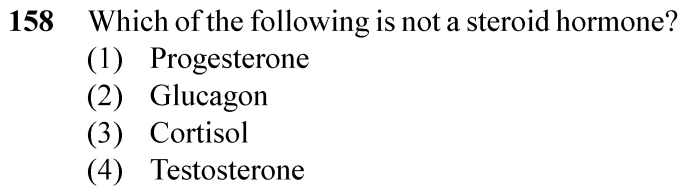
NEET 2024 · Q158 Easy
Official NEET 2024 Question 158 - Chemical Coordination and Integration
1 Progesterone
2 Glucagon ✓ Key
3 Cortisol
4 Testosterone
💡 Verified Solution & 30-Second Hack
✓
Verified Against NTA Final Answer Key
Option (2) : Glucagon
📚 Chemical Coordination and Integration Easy
📋 Given Parameters & Problem Setup
Criterion Not a steroid hormone (protein/peptide nature)
Candidates Progesterone, Glucagon, Cortisol, Testosterone
⚡

The 30-Second Exam Hall Shortcut: ⚡ Hormone Chemical Nature Fingerprint

⏱️ Save ~15 seconds

Steroid hormones derive from cholesterol: Cortisol, Testosterone, Estradiol, Progesterone. Glucagon is a 29-amino acid PEPTIDE hormone secreted by alpha-cells of pancreas!

1 Classify the given hormones by chemical nature:
2 - Progesterone: Steroid hormone (ovary / corpus luteum).
3 - Cortisol: Steroid hormone (adrenal cortex - glucocorticoid).
4 - Testosterone: Steroid hormone (testis - androgen).
5 - Glucagon: Peptide / protein hormone (pancreas).
6 Glucagon is NOT a steroid hormone -> Option (2) / B.
🛡️
Why You Can 100% Trust This Shortcut: NCERT Biology · Chemical Coordination and Integration (Classification of Hormones)
📐

Step-by-Step Rigorous Workflow & Mathematical Proof

Step 1

Review NCERT Chemical Classification of Hormones

Hormones are divided into four chemical classes: (i) Peptide, polypeptide, protein hormones: insulin, glucagon, pituitary hormones, hypothalamic hormones, etc. (ii) Steroids: e.g., cortisol, testosterone, estradiol and progesterone. (iii) Iodothyronines: thyroid hormones. (iv) Amino-acid derivatives: epinephrine.

Step 2

Identify Glucagon

Glucagon is a peptide hormone secreted by the alpha-cells of the islets of Langerhans that plays an important role in maintaining normal blood glucose levels (hyperglycemic factor).

⭐

360° Option Elimination Engine Key Feature

Diagnose every choice: Know exactly why the right option works and why distractors fail.

4-Option Deep Scan
1 (1)
✗ Incorrect
Verdict & Scientific Reason:

Progesterone is a steroid hormone synthesized by the corpus luteum.

⚠️
Student Fallacy (Why candidates pick this trap): Progesterone is a steroid hormone synthesized by the corpus luteum.
2 (2)
✓ 100% Correct
Verdict & Scientific Reason:

Glucagon is a peptide hormone, not a lipid-derived steroid.

💡
Why this is airtight: None.
3 (3)
✗ Incorrect
Verdict & Scientific Reason:

Cortisol is a glucocorticoid steroid hormone from the adrenal cortex.

⚠️
Student Fallacy (Why candidates pick this trap): Cortisol is a glucocorticoid steroid hormone from the adrenal cortex.
4 (4)
✗ Incorrect
Verdict & Scientific Reason:

Testosterone is a classic androgenic steroid hormone produced by Leydig cells.

⚠️
Student Fallacy (Why candidates pick this trap): Testosterone is a classic androgenic steroid hormone produced by Leydig cells.
⚠️

NTA Trap Alert: Reproductive vs Metabolic Hormone Assumption

Assuming only reproductive hormones are steroids.

🛡️ How to avoid the -1 mark: Adrenal cortex hormones (cortisol, aldosterone, DHEA) are also steroids derived from cholesterol.
📖

Core NEET Syllabus Standard

Biology Core Zoology · Chemical Coordination and Integration Standard Benchmark
Core Scientific Principle Tested:

"Hormones can be divided into groups: (i) peptide, polypeptide, protein hormones (e.g., insulin, glucagon, pituitary hormones...) (ii) steroids (e.g., cortisol, testosterone, estradiol and progesterone)."

Syllabus Focus: Chemical Classification of Hormones: Peptides vs Steroids
✓ Core NEET UG Syllabus Anchor Syllabus & Academic Standards ↗
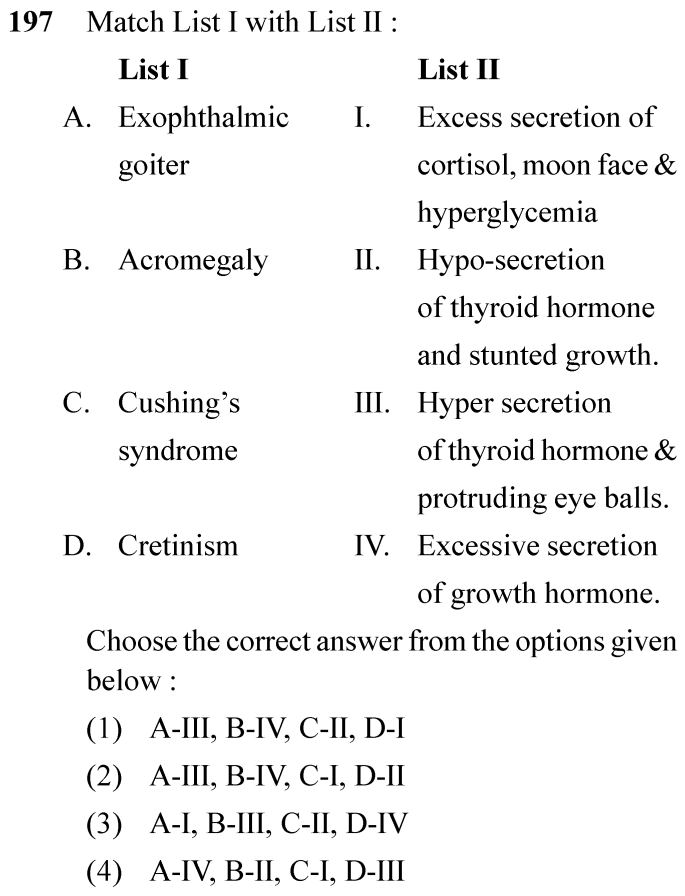
NEET 2024 · Q197 Easy
Official NEET 2024 Question 197 - Chemical Coordination and Integration
1
2 ✓ Key
3
4
💡 Verified Solution & 30-Second Hack
✓
Verified Against NTA Final Answer Key
Option (2) : A-III, B-IV, C-I, D-II
📚 Chemical Coordination and Integration Easy
📋 Given Parameters & Problem Setup
List I (Endocrine Pathologies) A: Exophthalmic goiter; B: Acromegaly; C: Cushing’s syndrome; D: Cretinism
List II (Pathophysiological Basis) I: Excess secretion of cortisol, moon face & hyperglycemia; II: Hypo-secretion of thyroid hormone and stunted growth; III: Hyper secretion of thyroid hormone & protruding eye balls; IV: Excessive secretion of growth hormone
⚡

The 30-Second Exam Hall Shortcut: ⚡ Endocrine Disease Landmark Match

⏱️ Save ~25 seconds

Exophthalmic goiter = Hyperthyroid & protruding eyeballs (III); Acromegaly = Excess GH in adults (IV); Cushing’s = Excess cortisol & moon face (I); Cretinism = Hypothyroid & stunted growth in children (II)! Match: A-III, B-IV, C-I, D-II!

1 A. Exophthalmic goiter (Graves’ disease): Hypersecretion of thyroid hormones, enlarged thyroid, protruding eyeballs, increased BMR (III).
2 B. Acromegaly: Hypersecretion of Growth Hormone (GH) in adults causing disfigurement (IV).
3 C. Cushing’s syndrome: Hypersecretion of cortisol (glucocorticoids) causing moon face, wasting, and hyperglycemia (I).
4 D. Cretinism: Hypothyroidism during pregnancy/infancy causing stunted growth, mental retardation, deaf-mutism (II).
5 Matching order: A-III, B-IV, C-I, D-II -> Option (2) / B.
🛡️
Why You Can 100% Trust This Shortcut: NCERT Biology · Chemical Coordination and Integration (Endocrine Gland Hyper- and Hyposecretion)
📐

Step-by-Step Rigorous Workflow & Mathematical Proof

Step 1

Match Thyroid Pathologies

Exophthalmic goitre is a form of hyperthyroidism, characterised by enlargement of the thyroid gland, protrusion of the eyeballs, increased basal metabolic rate, and weight loss, also called Graves' disease (A -> III). Hypothyroidism during pregnancy causes defective development and maturation of the growing baby leading to stunted growth (cretinism), mental retardation, low intelligence quotient, abnormal skin, deaf-mutism, etc. (D -> II).

Step 2

Match Pituitary and Adrenal Pathologies

Excess secretion of growth hormone in adults especially in middle age can result in severe disfigurement (especially of the face) called acromegaly (B -> IV). Hypersecretion of cortisol by the adrenal cortex leads to Cushing’s syndrome, characterized by fat accumulation in face ("moon face"), muscle breakdown, and hyperglycemia (C -> I).

Step 3

Confirm Final Option

A-III, B-IV, C-I, D-II corresponds to Option (2).

⭐

360° Option Elimination Engine Key Feature

Diagnose every choice: Know exactly why the right option works and why distractors fail.

4-Option Deep Scan
1 (1)
✗ Incorrect
Verdict & Scientific Reason:

Mismatches Cushing’s with stunted growth.

⚠️
Student Fallacy (Why candidates pick this trap): Mismatches Cushing’s with stunted growth.
2 (2)
✓ 100% Correct
Verdict & Scientific Reason:

Accurately pairs all four endocrine syndromes with their clinical manifestations and hormonal causes.

💡
Why this is airtight: None.
3 (3)
✗ Incorrect
Verdict & Scientific Reason:

Mismatches Exophthalmic goiter with cortisol excess.

⚠️
Student Fallacy (Why candidates pick this trap): Mismatches Exophthalmic goiter with cortisol excess.
4 (4)
✗ Incorrect
Verdict & Scientific Reason:

Mismatches Exophthalmic goiter with growth hormone.

⚠️
Student Fallacy (Why candidates pick this trap): Mismatches Exophthalmic goiter with growth hormone.
⚠️

NTA Trap Alert: Cretinism vs Pituitary Dwarfism

Confusing hypothyroid cretinism (stunted growth WITH mental retardation) with growth hormone dwarfism (stunted growth WITHOUT mental retardation).

🛡️ How to avoid the -1 mark: Cretinism specifically involves thyroid hyposecretion and mental disability.
📖

Core NEET Syllabus Standard

Biology Core Zoology · Chemical Coordination and Integration Standard Benchmark
Core Scientific Principle Tested:

"Exophthalmic goitre is a form of hyperthyroidism characterised by enlargement of thyroid gland, protrusion of eyeballs... Hypothyroidism during pregnancy causes cretinism (stunted growth). Excess secretion of growth hormone in adults results in acromegaly."

Syllabus Focus: Endocrine Disorders: Goiter, Acromegaly, Cushing’s, and Cretinism
✓ Core NEET UG Syllabus Anchor Syllabus & Academic Standards ↗
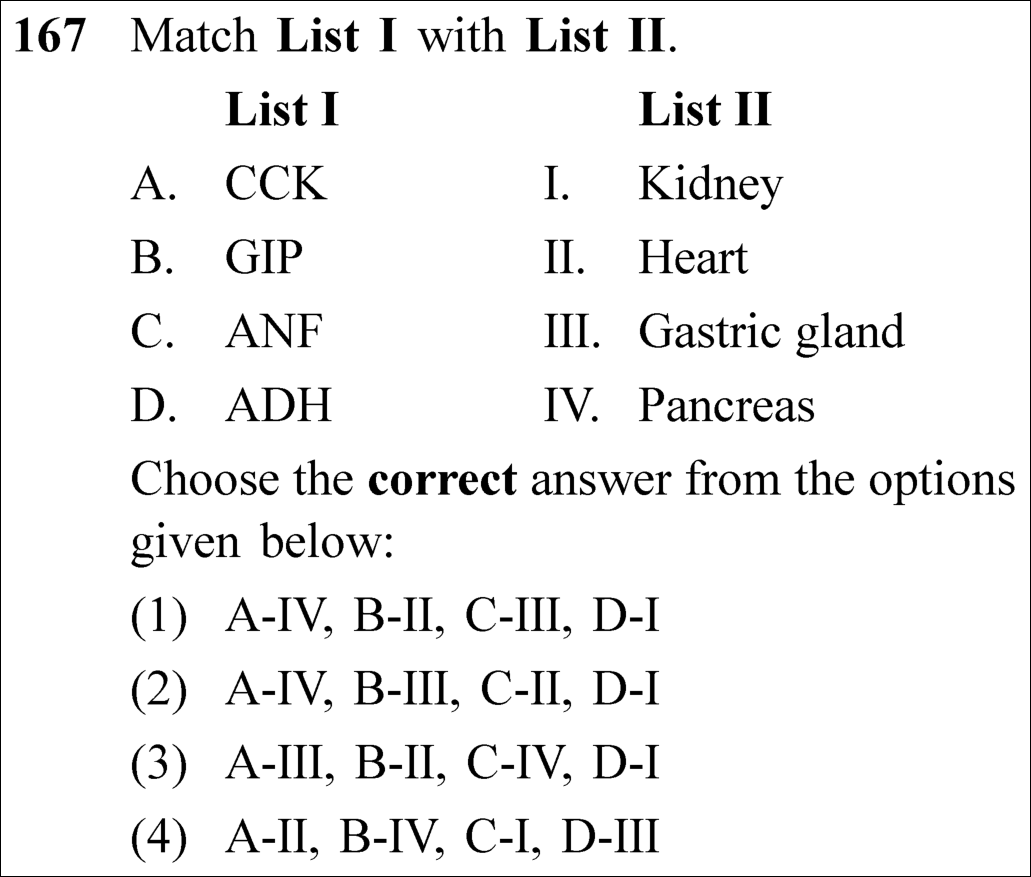
NEET 2023 · Q167 Easy
Official NEET 2023 Question 167 - Chemical Coordination and Integration
1
2 ✓ Key
3
4
💡 Verified Solution & 30-Second Hack
✓
Verified Against NTA Final Answer Key
Option (2) : A-IV, B-III, C-II, D-I
📚 Chemical Coordination and Integration Easy
📋 Given Parameters & Problem Setup
Hormones CCK (Cholecystokinin), GIP, ANF, ADH
Target / Source Organs Kidney, Heart, Gastric gland, Pancreas
⚡

The 30-Second Exam Hall Shortcut: ⚡ Peptide Hormone Source & Target Decoder

⏱️ Save ~25 seconds

Match each hormone to its textbook partner: CCK acts on the Pancreas (IV). GIP inhibits the Gastric gland (III). ANF is secreted by the Heart (II). ADH targets the Kidney (I)! Match Option (2)!

1 CCK (Cholecystokinin): Stimulates pancreas to secrete pancreatic enzymes and gall bladder to contract -> A-IV.
2 GIP (Gastric Inhibitory Peptide): Inhibits gastric secretion and motility -> B-III.
3 ANF (Atrial Natriuretic Factor): Secreted by atrial myocytes of the heart -> C-II.
4 ADH (Vasopressin): Acts on distal tubules of kidney to reabsorb water -> D-I.
5 Match combination: A-IV, B-III, C-II, D-I -> Option (2).
🛡️
Why You Can 100% Trust This Shortcut: Canonical NCERT Chemical Coordination and Integration non-endocrine hormones inventory.
📐

Step-by-Step Rigorous Workflow & Mathematical Proof

Step 1

Endocrine and Gastrointestinal Hormone Interactions

Analyzing the anatomical associations of peptide hormones secreted by heart, kidney, and gastrointestinal mucosa:

A. CCK:Cholecystokinin acts on exocrine Pancreas and gallbladder  ⟹  IVB. GIP:Gastric Inhibitory Peptide inhibits Gastric gland secretion  ⟹  IIIC. ANF:Atrial Natriuretic Factor secreted by atria of Heart  ⟹  IID. ADH:Antidiuretic Hormone acts on collecting ducts of Kidney  ⟹  I\begin{aligned} \text{\textbf{A. CCK:}} & \quad \text{Cholecystokinin acts on exocrine } \mathbf{\text{Pancreas}} \text{ and gallbladder} \implies \mathbf{\text{IV}} \\[4pt] \text{\textbf{B. GIP:}} & \quad \text{Gastric Inhibitory Peptide inhibits } \mathbf{\text{Gastric gland}} \text{ secretion} \implies \mathbf{\text{III}} \\[4pt] \text{\textbf{C. ANF:}} & \quad \text{Atrial Natriuretic Factor secreted by atria of } \mathbf{\text{Heart}} \implies \mathbf{\text{II}} \\[4pt] \text{\textbf{D. ADH:}} & \quad \text{Antidiuretic Hormone acts on collecting ducts of } \mathbf{\text{Kidney}} \implies \mathbf{\text{I}} \end{aligned}
Step 2

Verbatim NCERT References

NCERT states under Hormones of Heart, Kidney and Gastrointestinal Tract: - "CCK acts on both pancreas and gall bladder and stimulates the secretion of pancreatic enzymes and bile juice, respectively." - "GIP inhibits gastric secretion and motility." - "ANF is secreted by the atrial wall of our heart." - "ADH facilitates water reabsorption from latter parts of the tubule in the kidney."

Step 3

Option Elimination

A-IV is present in Options (1) and (2). B-III uniquely isolates Option (2), ruling out Option (1) which has B-II.

⭐

360° Option Elimination Engine Key Feature

Diagnose every choice: Know exactly why the right option works and why distractors fail.

4-Option Deep Scan
1 1
✗ Incorrect
Verdict & Scientific Reason:

Mismatches GIP with heart and ANF with gastric gland.

⚠️
Student Fallacy (Why candidates pick this trap): Swapping GIP and ANF targets/sources.
2 2
✓ 100% Correct
Verdict & Scientific Reason:

Flawless 1-to-1 match with the canonical NCERT hormone-organ pairs.

💡
Why this is airtight: None; textbook verbatim match.
3 3
✗ Incorrect
Verdict & Scientific Reason:

Mismatches CCK with gastric gland.

⚠️
Student Fallacy (Why candidates pick this trap): Confusing gastrin with CCK.
4 4
✗ Incorrect
Verdict & Scientific Reason:

Mismatches CCK with heart.

⚠️
Student Fallacy (Why candidates pick this trap): Scrambling multiple hormone associations.
⚠️

NTA Trap Alert: Secretin vs. CCK Pancreatic Action Trap

Secretin stimulates water and bicarbonate secretion from the exocrine pancreas; CCK stimulates pancreatic ENZYME secretion from the pancreas. Both act on the pancreas.

🛡️ How to avoid the -1 mark: Remember: CCK = Pancreatic enzymes + Gall bladder bile. GIP = Gastric inhibition.
📖

Core NEET Syllabus Standard

NCERT Biology · Chemical Coordination and Integration Standard Benchmark
Core Scientific Principle Tested:

"CCK acts on pancreas; GIP acts on gastric glands; ANF is secreted by heart; ADH acts on kidney."

Syllabus Focus: Hormones of Heart, Kidney and Gastrointestinal Tract
✓ Core NEET UG Syllabus Anchor Syllabus & Academic Standards ↗
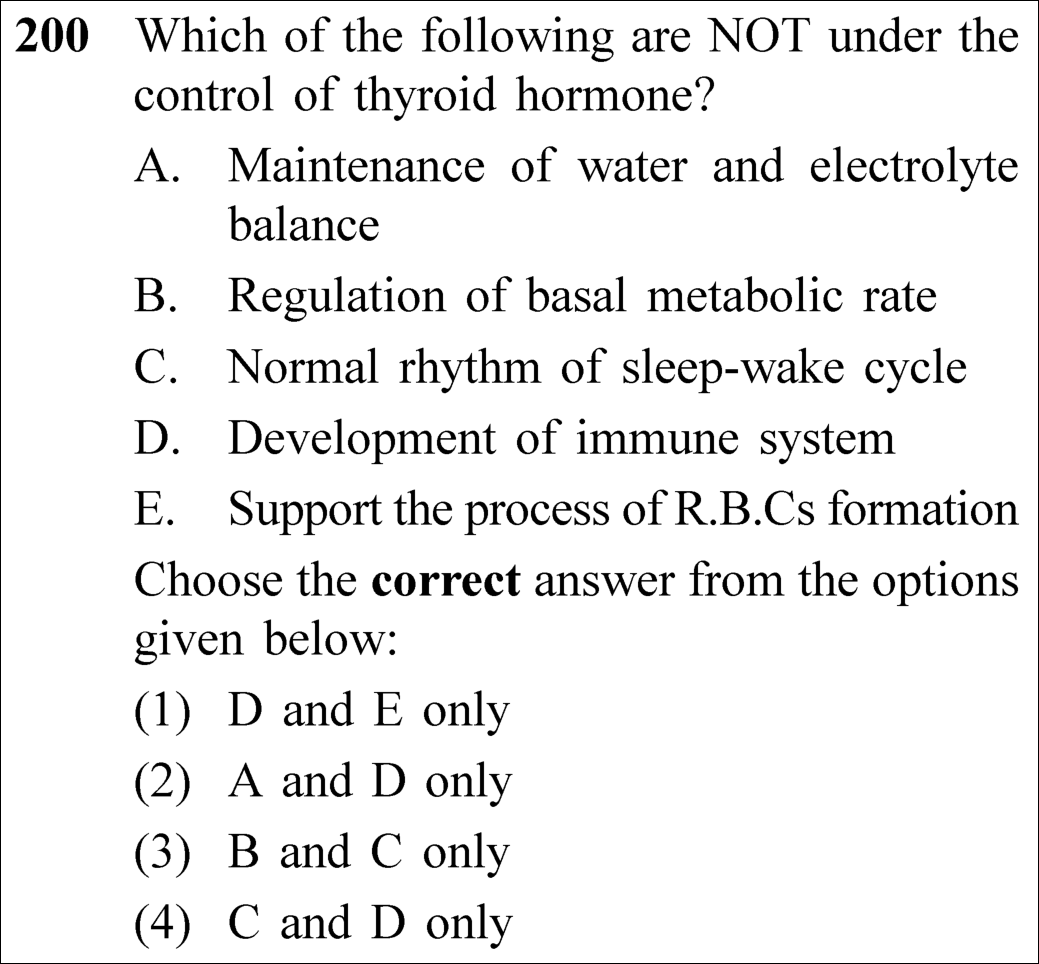
NEET 2023 · Q200 Easy
Official NEET 2023 Question 200 - Chemical Coordination and Integration
1 D and E only
2 A and D only
3 B and C only
4 C and D only ✓ Key
💡 Verified Solution & 30-Second Hack
✓
Verified Against NTA Final Answer Key
Option (4) : C and D only
📚 Chemical Coordination and Integration Easy
📋 Given Parameters & Problem Setup
Endocrine Gland Thyroid gland (T3T_3 and T4T_4)
Criterion Functions that are NOT under the control of thyroid hormone
⚡

The 30-Second Exam Hall Shortcut: ⚡ Pineal & Thymus Roles Filter: C & D Are NOT Thyroid Functions!

⏱️ Save ~25 seconds

Normal sleep-wake rhythm is regulated by MELATONIN from the Pineal gland (C). Immune system development is driven by THYMOSINS from the Thymus gland (D). Water balance (A), BMR (B), and erythropoiesis (E) are all controlled by thyroid hormones! Match Option (4) C and D only!

1 Sleep-wake cycle (circadian rhythm) -> Regulated by Melatonin (Pineal gland) -> C is NOT thyroid.
2 Development and differentiation of immune system -> Regulated by Thymosins (Thymus gland) -> D is NOT thyroid.
3 Thyroid hormone functions: Regulates BMR (B), supports RBC formation (E), maintains water and electrolyte balance (A).
4 Therefore, C and D are NOT under thyroid control.
5 Match Option (4) C and D only.
🛡️
Why You Can 100% Trust This Shortcut: Canonical NCERT Chemical Coordination and Integration thyroid physiological functions inventory.
📐

Step-by-Step Rigorous Workflow & Mathematical Proof

Step 1

Canonical Functions of Thyroid Hormones (T3 and T4)

Thyroxine (T4T_4) and triiodothyronine (T3T_3) exert widespread metabolic actions across human tissues:

Thyroid Hormones⟶{Regulation of basal metabolic rate (BMR) [B]Maintenance of water and electrolyte balance [A]Support of red blood cell formation (erythropoiesis) [E]Control of carbohydrate, protein, and lipid metabolism\text{\textbf{Thyroid Hormones}} \longrightarrow \begin{cases} \mathbf{\text{Regulation of basal metabolic rate (BMR) [B]}} \\[2pt] \mathbf{\text{Maintenance of water and electrolyte balance [A]}} \\[2pt] \mathbf{\text{Support of red blood cell formation (erythropoiesis) [E]}} \\[2pt] \text{Control of carbohydrate, protein, and lipid metabolism} \end{cases}
Step 2

Identification of Non-Thyroid Hormone Functions

Analyzing the specific endocrine control of functions C and D: - Function C (Sleep-wake cycle): Regulated by the hormone melatonin, secreted by the pineal gland to maintain 24-hour diurnal circadian rhythms. - Function D (Development of immune system): Regulated by peptide hormones called thymosins, secreted by the thymus gland to promote T-lymphocyte differentiation and humoral antibody production.

Function C (Sleep-wake rhythm):Melatonin (Pineal Gland)Function D (Immune system):Thymosins (Thymus Gland)\begin{aligned} \text{\textbf{Function C (Sleep-wake rhythm):}} & \quad \mathbf{\text{Melatonin (Pineal Gland)}} \\[3pt] \text{\textbf{Function D (Immune system):}} & \quad \mathbf{\text{Thymosins (Thymus Gland)}} \end{aligned}
Step 3

Verbatim NCERT Reference

NCERT states under Thyroid Gland: "Thyroid hormones play an important role in the regulation of the basal metabolic rate. These hormones also support the process of red blood cell formation... Maintenance of water and electrolyte balance is also influenced by thyroid hormones." Melatonin regulates "24-hour (diurnal) rhythm... sleep-wake cycle". Thymosins play "a major role in the differentiation of T-lymphocytes... development of immune system".

⭐

360° Option Elimination Engine Key Feature

Diagnose every choice: Know exactly why the right option works and why distractors fail.

4-Option Deep Scan
1 1
✗ Incorrect
Verdict & Scientific Reason:

RBC formation (E) IS supported by thyroid hormones.

⚠️
Student Fallacy (Why candidates pick this trap): Thinking thyroid hormone has no role in erythropoiesis.
2 2
✗ Incorrect
Verdict & Scientific Reason:

Water and electrolyte balance (A) IS influenced by thyroid hormones.

⚠️
Student Fallacy (Why candidates pick this trap): Assuming water/electrolyte balance is regulated solely by aldosterone/ADH.
3 3
✗ Incorrect
Verdict & Scientific Reason:

BMR regulation (B) is the quintessential primary action of thyroid hormones.

⚠️
Student Fallacy (Why candidates pick this trap): Denying thyroid control of basal metabolic rate.
4 4
✓ 100% Correct
Verdict & Scientific Reason:

Both C (sleep-wake cycle controlled by melatonin) and D (immune system controlled by thymosins) are NOT under thyroid control.

💡
Why this is airtight: None; textbook verbatim match.
⚠️

NTA Trap Alert: Water Balance & RBC Formation Under Thyroid Hormones Trap

Students often associate water balance only with ADH/Aldosterone and RBC formation only with Erythropoietin, forgetting that NCERT explicitly lists both as physiological functions of thyroid hormones as well.

🛡️ How to avoid the -1 mark: Remember: Thyroid controls BMR, RBCs, and Water/Electrolytes. Pineal controls Sleep-wake. Thymus controls Immune system.
📖

Core NEET Syllabus Standard

NCERT Biology · Chemical Coordination and Integration Standard Benchmark
Core Scientific Principle Tested:

"Thyroid hormones regulate BMR, RBC formation, and water/electrolyte balance. Melatonin regulates sleep-wake cycle; Thymosins regulate immune system development."

Syllabus Focus: Thyroid Gland, Pineal Gland & Thymus Gland
✓ Core NEET UG Syllabus Anchor Syllabus & Academic Standards ↗
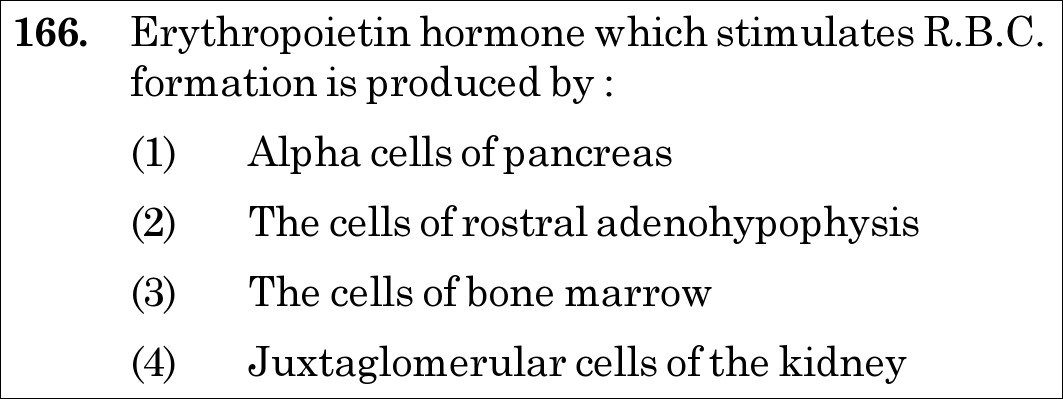
NEET 2021 · Q166 Easy
Official NEET 2021 Question 166 - Chemical Coordination and Integration
1 Alpha cells of pancreas
2 The cells of rostral adenohypophysis
3 The cells of bone marrow
4 Juxtaglomerular cells of the kidney ✓ Key
💡 Verified Solution & 30-Second Hack
✓
Verified Against NTA Final Answer Key
Option (4) : Juxtaglomerular cells of the kidney
📚 Chemical Coordination and Integration Easy
📋 Given Parameters & Problem Setup
Hormone Erythropoietin (EPO)
Biological Action Stimulates erythropoiesis (R.B.C. formation)
Question Objective Identify the endocrine source tissue of erythropoietin
⚡

The 30-Second Exam Hall Shortcut: ⚡ "EPO is Renal: Juxtaglomerular Cells of Kidney Secrete Erythropoietin"

⏱️ Save ~25 seconds

The juxtaglomerular (JG) cells of the kidney produce the peptide hormone erythropoietin (EPO) in response to hypoxia, directly stimulating bone marrow erythropoiesis. Mark Option (4) in under 15 seconds!

1 Recall non-endocrine organs with endocrine function: Heart (ANF), GI Tract (Gastrin, Secretin, CCK, GIP), and Kidney (Erythropoietin).
2 Identify renal endocrine cells: Juxtaglomerular (JG) cells secrete erythropoietin.
3 Contrast source vs target: Kidney is the source; red bone marrow is the target organ.
4 Match with Option (4).
🛡️
Why You Can 100% Trust This Shortcut: NCERT Biology · Chemical Coordination and Integration (Juxtaglomerular cells of kidney produce a peptide hormone called erythropoietin which stimulates erythropoiesis).
📐

Step-by-Step Rigorous Workflow & Mathematical Proof

Step 1

Endocrine Role of the Kidneys and Hypoxic Trigger

Although primarily excretory organs, the kidneys perform vital endocrine functions. When systemic arterial oxygen tension drops (hypoxia, anaemia, or high altitude), specialized oxygen-sensing juxtaglomerular (JG) cells situated along afferent arterioles secrete the glycoprotein hormone erythropoietin (EPO) into the circulation.

Renal Hypoxia→JG CellsErythropoietin (EPO)→Target: Bone Marrow↑Erythropoiesis (RBCs)\text{Renal Hypoxia} \xrightarrow{\text{JG Cells}} \text{Erythropoietin (EPO)} \xrightarrow{\text{Target: Bone Marrow}} \uparrow \text{Erythropoiesis (RBCs)}
Step 2

Mechanism of Action on Haematopoietic Stem Cells

Circulating erythropoietin binds to high-affinity EPO receptors (EpoR) on erythroid progenitor cells (CFU-E and proerythroblasts) in the red bone marrow, rescuing them from apoptosis, accelerating cellular proliferation, and boosting maturation into mature biconcave erythrocytes (RBCs).

Step 3

Differential Elimination of Competing Glands

- Alpha cells of pancreas: Synthesize and secrete *glucagon*, a hyperglycaemic peptide hormone regulating glycogenolysis. - Rostral adenohypophysis (anterior pituitary): Secretes trophic hormones (GH, PRL, TSH, ACTH, LH, FSH), not erythropoietin. - Bone marrow cells: Act as the effector / target tissue executing erythropoiesis, not the primary endocrine source of EPO.

⭐

360° Option Elimination Engine Key Feature

Diagnose every choice: Know exactly why the right option works and why distractors fail.

4-Option Deep Scan
1 1
✗ Incorrect
Verdict & Scientific Reason:

Incorrect. Alpha cells of islets of Langerhans secrete glucagon, not erythropoietin.

⚠️
Student Fallacy (Why candidates pick this trap): Confusing endocrine pancreatic cell types (alpha cells = glucagon, beta cells = insulin).
2 2
✗ Incorrect
Verdict & Scientific Reason:

Incorrect. The anterior pituitary (adenohypophysis) secretes master trophic hormones (ACTH, TSH, GH, LH, FSH, PRL), not erythropoietin.

⚠️
Student Fallacy (Why candidates pick this trap): Assuming master regulator hormones must originate from the pituitary gland.
3 3
✗ Incorrect
Verdict & Scientific Reason:

Incorrect. Bone marrow is the haematopoietic target site stimulated by erythropoietin, not its endocrine site of production.

⚠️
Student Fallacy (Why candidates pick this trap): Failing to distinguish between the site of hormone synthesis (kidney JG cells) and the site of action (bone marrow).
4 4
✓ 100% Correct
Verdict & Scientific Reason:

Correct. Juxtaglomerular cells produce and release erythropoietin to stimulate erythropoiesis.

💡
Why this is airtight: None. Candidate accurately identifies the juxtaglomerular apparatus as an endocrine gland for EPO.
⚠️

NTA Trap Alert: Target vs Source Confusion Trap

Many candidates associate RBC formation with bone marrow and impulsively mark "cells of bone marrow", failing to read that the question asks for the hormone producer (endocrine source), not the site of erythropoiesis.

🛡️ How to avoid the -1 mark: Always separate the endocrine producer (JG cells of kidney) from the haematopoietic responder organ (red bone marrow).
📖

Core NEET Syllabus Standard

NEET / NCERT Biology · Chemical Coordination and Integration Standard Benchmark
Core Scientific Principle Tested:

"Juxtaglomerular cells of kidney produce erythropoietin which stimulates erythropoiesis in bone marrow."

Syllabus Focus: Hormones of Heart, Kidney and Gastrointestinal Tract
✓ Core NEET UG Syllabus Anchor Syllabus & Academic Standards ↗
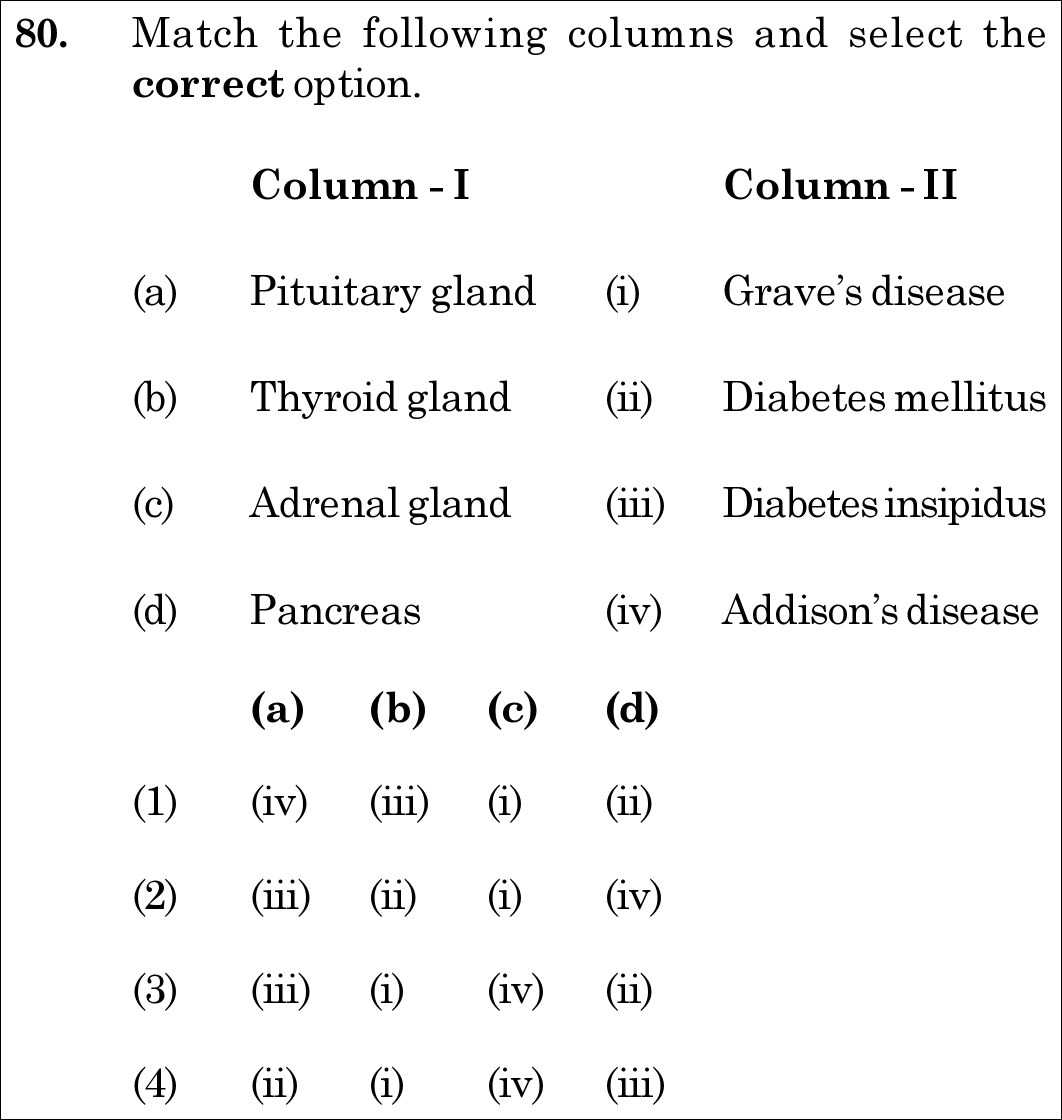
NEET 2020 · Q80 Easy
Official NEET 2020 Question 80 - Chemical Coordination and Integration
1 (iv) (iii) (i) (ii)
2 (iii) (ii) (i) (iv)
3 (iii) (i) (iv) (ii) ✓ Key
4 (ii) (i) (iv) (iii)
💡 Verified Solution & 30-Second Hack
✓
Verified Against NTA Final Answer Key
Option (3) : (a)-(iii), (b)-(i), (c)-(iv), (d)-(ii)
📚 Chemical Coordination and Integration Easy
📋 Given Parameters & Problem Setup
Column I (Endocrine Glands) (a) Pituitary gland, (b) Thyroid gland, (c) Adrenal gland, (d) Pancreas
Column II (Disorders) (i) Grave's disease, (ii) Diabetes mellitus, (iii) Diabetes insipidus, (iv) Addison's disease
⚡

The 30-Second Exam Hall Shortcut: ⚡ "Pituitary = Diabetes Insipidus; Thyroid = Grave's; Adrenal = Addison's; Pancreas = Diabetes Mellitus!"

⏱️ 25 seconds

Pituitary undersecretion of ADH causes Diabetes insipidus (a->iii). Thyroid hypersecretion causes Grave's disease (b->i). Adrenal cortex hyposecretion causes Addison's disease (c->iv). Pancreas insulin deficiency causes Diabetes mellitus (d->ii). Match: (iii), (i), (iv), (ii) -> Option 3 in 10 seconds!

1 Pituitary gland (neurohypophysis releases ADH): Deficiency leads to Diabetes insipidus -> (a)-(iii).
2 Thyroid gland: Hyperthyroidism causes Grave's disease (exophthalmic goitre) -> (b)-(i).
3 Adrenal gland (adrenal cortex hyposecretion): Addison's disease -> (c)-(iv).
4 Pancreas (beta-cells insulin deficiency): Diabetes mellitus -> (d)-(ii).
5 Mapping: (a)-(iii), (b)-(i), (c)-(iv), (d)-(ii) -> Option 3.
🛡️
Why You Can 100% Trust This Shortcut: NCERT Biology · Human Physiology: Chemical Coordination and Integration (Endocrine Disorders)
📐

Step-by-Step Rigorous Workflow & Mathematical Proof

Step 1

Match Pituitary Gland

The posterior pituitary (neurohypophysis) releases vasopressin/ADH. Hyposecretion or impairment of ADH synthesis leads to inability of kidney to conserve water, resulting in copious dilute urine excretion known as Diabetes insipidus. Thus, (a) matches (iii).

Step 2

Match Thyroid Gland

Grave's disease is a form of hyperthyroidism characterized by enlargement of the thyroid gland, protrusion of the eyeballs (exophthalmos), increased basal metabolic rate, and weight loss. Thus, (b) matches (i).

Step 3

Match Adrenal Gland

Underproduction of hormones by the adrenal cortex (mineralocorticoids and glucocorticoids) alters carbohydrate metabolism, causing acute weakness and fatigue, leading to Addison's disease. Thus, (c) matches (iv).

Step 4

Match Pancreas

Hyposecretion of insulin by the beta-cells of the islets of Langerhans in the pancreas impairs glucose uptake, leading to prolonged hyperglycemia, glycosuria, and ketone body formation (Diabetes mellitus). Thus, (d) matches (ii).

⭐

360° Option Elimination Engine Key Feature

Diagnose every choice: Know exactly why the right option works and why distractors fail.

4-Option Deep Scan
1 A
✗ Incorrect
Verdict & Scientific Reason:

Incorrect; attributes Addison's disease to the pituitary gland.

⚠️
Student Fallacy (Why candidates pick this trap): Confusing adrenal and pituitary disorders.
2 B
✗ Incorrect
Verdict & Scientific Reason:

Incorrect; attributes Diabetes mellitus to the thyroid gland.

⚠️
Student Fallacy (Why candidates pick this trap): Swapping thyroid and pancreatic pathologies.
3 C
✓ 100% Correct
Verdict & Scientific Reason:

Accurate pairing across all four endocrine glands and their respective clinical disorders.

💡
Why this is airtight: None; canonical endocrine disorder matching.
4 D
✗ Incorrect
Verdict & Scientific Reason:

Incorrect; confuses Diabetes mellitus (pancreas) with Diabetes insipidus (pituitary ADH).

⚠️
Student Fallacy (Why candidates pick this trap): Mixing up the two different types of Diabetes (Mellitus vs Insipidus).
⚠️

NTA Trap Alert: Diabetes Insipidus vs Diabetes Mellitus

Diabetes INSIPIDUS = Pituitary (ADH deficiency -> excessive water loss). Diabetes MELLITUS = Pancreas (Insulin deficiency -> high sugar/ketones).

🛡️ How to avoid the -1 mark: Remember: Mellitus = Sweet (Sugar/Pancreas); Insipidus = Tasteless (Water/Pituitary ADH)!
📖

Core NEET Syllabus Standard

Zoology · Chemical Coordination and Integration Standard Benchmark
Core Scientific Principle Tested:

""

Syllabus Focus: Endocrine Glands and Associated Disorders Match
✓ Core NEET UG Syllabus Anchor Syllabus & Academic Standards ↗
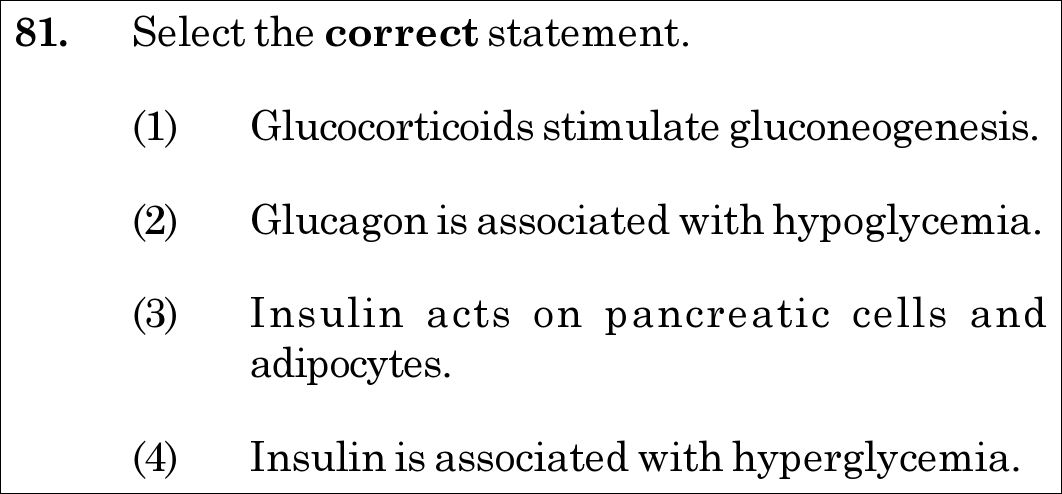
NEET 2020 · Q81 Easy
Official NEET 2020 Question 81 - Chemical Coordination and Integration
1 Glucocorticoids stimulate gluconeogenesis. ✓ Key
2 Glucagon is associated with hypoglycemia.
3 Insulin acts on pancreatic cells and adipocytes.
4 Insulin is associated with hyperglycemia.
💡 Verified Solution & 30-Second Hack
✓
Verified Against NTA Final Answer Key
Option (1) : Glucocorticoids stimulate gluconeogenesis.
📚 Chemical Coordination and Integration Easy
📋 Given Parameters & Problem Setup
Endocrine Regulators Glucocorticoids (cortisol), Glucagon, Insulin
Question Objective Select the factually CORRECT physiological statement
⚡

The 30-Second Exam Hall Shortcut: ⚡ "Cortisol Stimulates Gluconeogenesis; Glucagon = Hyperglycemia; Insulin = Hypoglycemia!"

⏱️ 20 seconds

Glucocorticoids (cortisol from adrenal cortex) stimulate gluconeogenesis, lipolysis, and proteolysis. Glucagon raises blood sugar (HYPERglycemic), and insulin lowers blood sugar (HYPOglycemic). Statement (1) is 100% correct! Mark Option (1) in 5 seconds.

1 Glucocorticoids (cortisol) stimulate gluconeogenesis, lipolysis, and proteolysis (Statement 1 is TRUE).
2 Glucagon is a hyperglycemic hormone, NOT hypoglycemic (Statement 2 is false).
3 Insulin acts primarily on hepatocytes and adipocytes, not pancreatic cells (Statement 3 is false).
4 Insulin is a hypoglycemic hormone, NOT hyperglycemic (Statement 4 is false).
5 Select Option (1).
🛡️
Why You Can 100% Trust This Shortcut: NCERT Biology · Human Physiology: Chemical Coordination and Integration (Adrenal Cortex & Pancreas)
📐

Step-by-Step Rigorous Workflow & Mathematical Proof

Step 1

Physiological Functions of Glucocorticoids

The adrenal cortex secretes glucocorticoids (mainly cortisol). Glucocorticoids stimulate gluconeogenesis (synthesis of glucose from non-carbohydrate precursors like amino acids and glycerol), lipolysis, and proteolysis, while inhibiting cellular uptake and utilization of amino acids.

Step 2

Evaluate Glucagon (Statement 2)

Glucagon is secreted by alpha-cells of the islets of Langerhans; it stimulates glycogenolysis and gluconeogenesis, acting as a HYPERglycemic hormone. Statement (2) incorrectly asserts it causes hypoglycemia.

Step 3

Evaluate Insulin Target Tissues (Statement 3)

Insulin acts primarily on hepatocytes (liver cells) and adipocytes (adipose tissue cells), stimulating cellular glucose uptake and glycogenesis. It does not act autocrinely on pancreatic cells.

Step 4

Evaluate Insulin Glycemic Impact (Statement 4)

Insulin promotes rapid movement of glucose from blood to hepatocytes and adipocytes, resulting in a decrease in blood glucose levels (HYPOglycemia). Statement (4) claims it causes hyperglycemia, which is false.

⭐

360° Option Elimination Engine Key Feature

Diagnose every choice: Know exactly why the right option works and why distractors fail.

4-Option Deep Scan
1 A
✓ 100% Correct
Verdict & Scientific Reason:

Factually exact; cortisol stimulates gluconeogenesis to elevate blood glucose levels.

💡
Why this is airtight: None; verbatim NCERT statement.
2 B
✗ Incorrect
Verdict & Scientific Reason:

Incorrect; glucagon raises blood glucose and is associated with HYPERglycemia.

⚠️
Student Fallacy (Why candidates pick this trap): Confusing glucagon (hyperglycemic) with insulin (hypoglycemic).
3 C
✗ Incorrect
Verdict & Scientific Reason:

Incorrect; insulin targets hepatocytes and adipocytes to enhance peripheral glucose clearance, not pancreatic cells.

⚠️
Student Fallacy (Why candidates pick this trap): Assuming insulin acts on the cells that synthesize it.
4 D
✗ Incorrect
Verdict & Scientific Reason:

Incorrect; insulin lowers blood glucose and is associated with HYPOglycemia.

⚠️
Student Fallacy (Why candidates pick this trap): Inverting insulin's hypoglycemic action.
⚠️

NTA Trap Alert: Hyperglycemic vs Hypoglycemic Hormones

Hyperglycemic hormones: Glucagon, Cortisol, Epinephrine, GH (raise blood sugar). Hypoglycemic hormone: INSULIN (the only major hormone that lowers blood sugar).

🛡️ How to avoid the -1 mark: Remember: Glucagon = Glucose Gone Up; Insulin = Inserts glucose into cells (lowers blood sugar)!
📖

Core NEET Syllabus Standard

Zoology · Chemical Coordination and Integration Standard Benchmark
Core Scientific Principle Tested:

""

Syllabus Focus: Metabolic Actions of Hormones: Glucocorticoids, Glucagon and Insulin
✓ Core NEET UG Syllabus Anchor Syllabus & Academic Standards ↗

Solve 4 NEET Questions a Day — One per Subject

Cover all 1,140 official NEET questions in 285 days at your own pace. Progress is saved on your device. No login needed.