MyCompetitiveExams Logo MyCompetitiveExams
Search 1,140+ Questions
Chapters, formulas, speed tricks
→
⚡ Brahmastra NEET 2027
720 MARKS

Dynamic 180-question full-length simulator mixed dynamically from all 6 years for 2027 & 2026 aspirants.

Launch Brahmastra 2027 Test →
Start Practice →
100% Free · No Login Required
🧬 Zoology ⭐ High Weightage (~2–3 Qs/Year)

NEET Excretory Products and their Elimination Previous Year Questions with Solutions

Complete repository of official NTA NEET questions for Excretory Products and their Elimination from 2020 to 2026. Every question includes 30-second elimination tricks, step-by-step NCERT solutions, option-by-option traps, and official answer keys.

8 Questions 5 Exam Years (2026, 2025, 2024, 2023, 2020) 2 Easy · 6 Medium · 0 Challenging
NEET 2026 · Q157 Medium
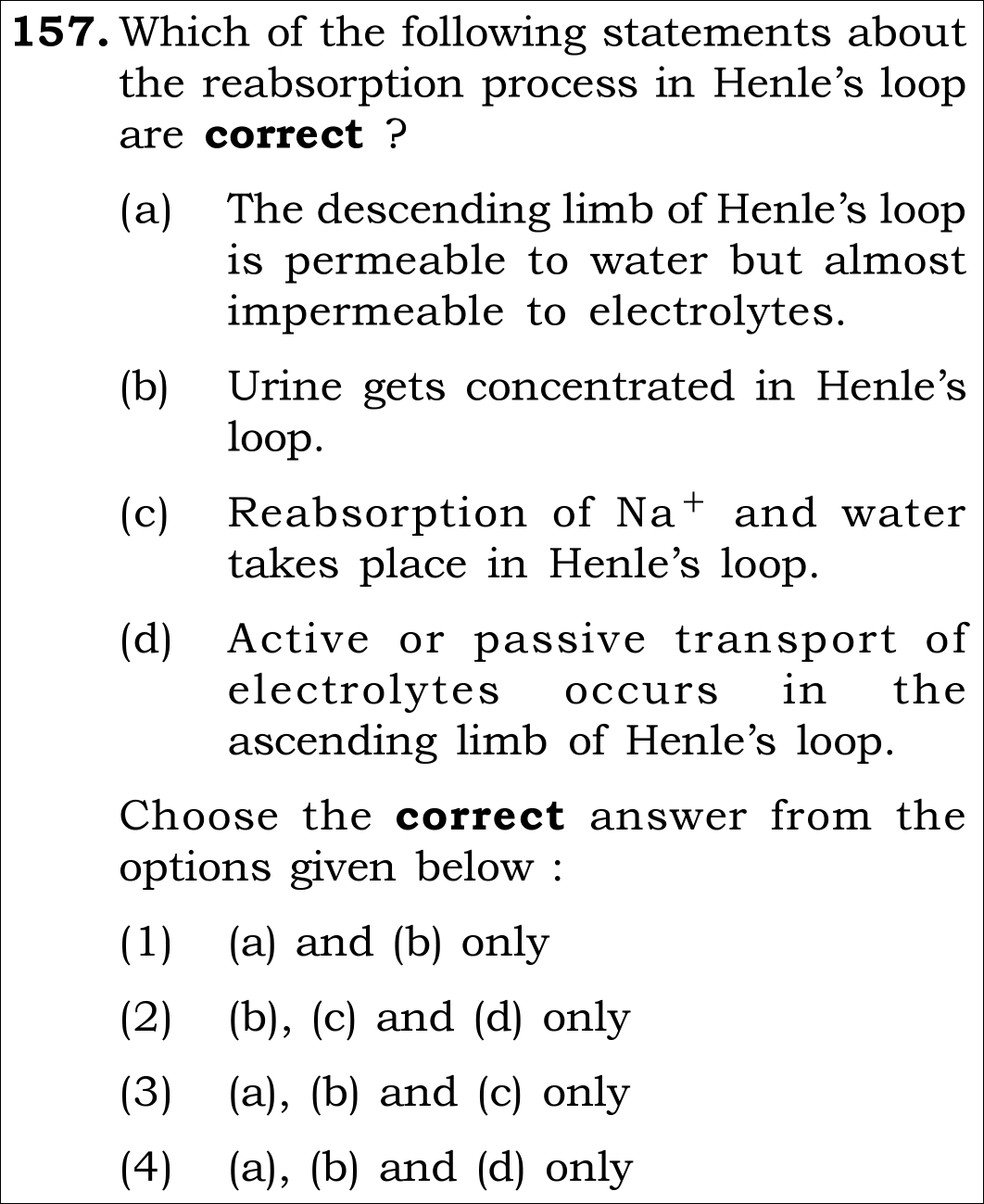
Official NEET 2026 Question 157 - Excretory Products and their Elimination
1
2
3
4 ✓ Key
💡 Verified Solution & 30-Second Hack
✓
Verified Against NTA Final Answer Key
Option (4) : (a), (b) and (d) only
📚 Excretory Products and their Elimination Medium
📋 Given Parameters & Problem Setup
Anatomical Structure Loop of Henle (Nephron)
Given Statements (a) Descending limb permeable to water, impermeable to electrolytes; (b) Concentrates filtrate downward; (c) Ascending limb permeable to water; (d) Dilution occurs moving upward in ascending limb
⚡

The 30-Second Exam Hall Shortcut: ⚡ Descending = H₂O, Ascending = Salt Rule

⏱️ Save ~50 seconds

Descending limb lets Water out; Ascending limb NEVER lets Water out (Impermeable)!

1 Check Statement (a): Descending limb permeable to water, impermeable to electrolytes -> TRUE.
2 Check Statement (b): Concentrates filtrate as it moves down (300 -> 1200 mOsm/L) -> TRUE.
3 Check Statement (c): "Ascending limb is permeable to water..." -> FALSE! Ascending limb is completely IMPERMEABLE to water.
4 Eliminate any option containing (c): Options (1), (2), and (3) all contain (c)!
5 Only Option (4) remains: (a), (b) and (d) only. Solved in 10 seconds via option elimination!
🛡️
Why You Can 100% Trust This Shortcut: NCERT Biology · Excretory Products and their Elimination (Juxtaglomerular Apparatus: RAAS pathway regulates GFR and blood pressure).
📐

Step-by-Step Rigorous Workflow & Mathematical Proof

Step 1

Physiology of Henle's Descending Limb

The descending limb of loop of Henle is permeable to water but almost impermeable to electrolytes. As the filtrate flows downward into the hypertonic medullary interstitium, water leaves by osmosis, concentrating the filtrate up to 1200 mOsm/L at the hairpin turn.

Descending Limb→Permeable to H2OWater Reabsorption  ⟹  Filtrate Concentrates (300 →1200 mOsm/L)\text{Descending Limb} \xrightarrow{\text{Permeable to } \text{H}_2\text{O}} \text{Water Reabsorption} \implies \text{Filtrate Concentrates (300 } \rightarrow 1200\text{ mOsm/L)}
  • • Statements (a) and (b) are both factually correct.
Step 2

Physiology of Henle's Ascending Limb

The ascending limb is impermeable to water but allows transport of electrolytes actively or passively. Therefore, as the concentrated filtrate passes upward, it gets diluted due to the passage of electrolytes out into the medullary fluid, dropping osmolarity to ~200 mOsm/L.

Ascending Limb→Impermeable to H2OActive/Passive NaCl Transport  ⟹  Filtrate Dilutes (1200 →200 mOsm/L)\text{Ascending Limb} \xrightarrow{\text{Impermeable to } \text{H}_2\text{O}} \text{Active/Passive NaCl Transport} \implies \text{Filtrate Dilutes (1200 } \rightarrow 200\text{ mOsm/L)}
  • • Statement (c) is false because it wrongly asserts ascending limb is permeable to water.
  • • Statement (d) is correct because filtrate is progressively diluted upward.
⭐

360° Option Elimination Engine Key Feature

Diagnose every choice: Know exactly why the right option works and why distractors fail.

4-Option Deep Scan
1 A
✗ Incorrect
Verdict & Scientific Reason:

Incorrect. Contains false statement (c); ascending limb is strictly impermeable to water.

⚠️
Student Fallacy (Why candidates pick this trap): Overlooking that ascending limb has zero water permeability.
2 B
✗ Incorrect
Verdict & Scientific Reason:

Incorrect. Contains false statement (c).

⚠️
Student Fallacy (Why candidates pick this trap): Failing to reject (c).
3 C
✗ Incorrect
Verdict & Scientific Reason:

Incorrect. Contains false statement (c) and omits valid statement (d).

⚠️
Student Fallacy (Why candidates pick this trap): Accepting (c) while ignoring (d).
4 D
✓ 100% Correct
Verdict & Scientific Reason:

100% correct. Statements (a), (b), and (d) are canonical NCERT facts, while statement (c) is false.

💡
Why this is airtight: None; flawless single-elimination logic.
⚠️

NTA Trap Alert: Water Permeability Inversion in Ascending Limb

Examiners frequently test the contrast between limbs. Descending limb = permeable to water, impermeable to salt. Ascending limb = impermeable to water, permeable to salt.

🛡️ How to avoid the -1 mark: Remember: Down = Dry out (water leaves); Up = Un-salt (salt leaves, water stays trapped).
📖

Core NEET Syllabus Standard

NEET Biology Core Syllabus · Excretory Products and their Elimination Standard Benchmark
Core Scientific Principle Tested:

"Descending limb is permeable to water, ascending limb is impermeable to water and transports electrolytes."
Syllabus Focus: Mechanism of Concentration of the Filtrate
✓ Core NEET UG Syllabus Anchor Syllabus & Academic Standards ↗
Down = Drink Water out (concentrates); Up = Unleash Salt (dilutes)!
NEET 2025 · Q125 Medium
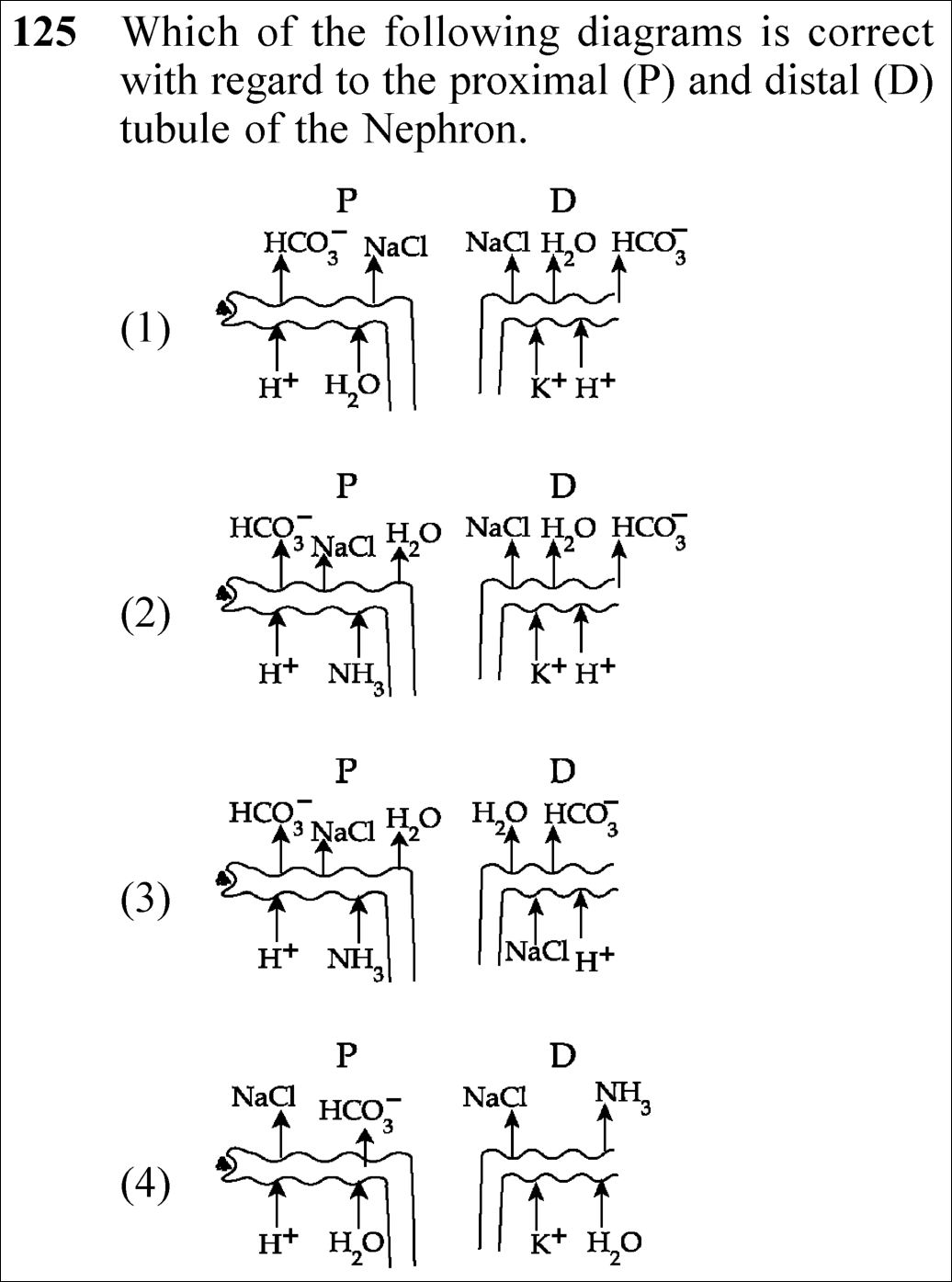
Official NEET 2025 Question 125 - Excretory Products and their Elimination
1
2 ✓ Key
3
4
💡 Verified Solution & 30-Second Hack
✓
Verified Against NTA Final Answer Key
Option (2) : P: Reabsorbs HCO₃⁻, NaCl, H₂O; Secretes H⁺, NH₃. D: Reabsorbs NaCl, H₂O, HCO₃⁻; Secretes K⁺, H⁺
📚 Excretory Products and their Elimination Medium
📋 Given Parameters & Problem Setup
Tubule P Proximal Convoluted Tubule (PCT)
Tubule D Distal Convoluted Tubule (DCT)
Target Correct arrow directions for reabsorption (out) and secretion (in)
⚡

The 30-Second Exam Hall Shortcut: ⚡ Nephron Transport Arrow Diagnostic

⏱️ Save ~35 seconds

PCT (P): REABSORBS HCO₃⁻, NaCl, H₂O (arrows pointing OUT); SECRETES H⁺, NH₃ (arrows pointing IN)! DCT (D): REABSORBS NaCl, H₂O, HCO₃⁻; SECRETES K⁺, H⁺! Option (2) matches NCERT Figure 19.5 with 100% precision!

1 Recall the canonical NCERT nephron diagram (Figure 19.5):
2 - Proximal Convoluted Tubule (P):
3 * Outward arrows (Reabsorbed into blood/interstitium): HCO₃⁻, NaCl, H₂O, Nutrients, K⁺.
4 * Inward arrows (Secreted from blood into filtrate): H⁺, NH₃.
5 - Distal Convoluted Tubule (D):
6 * Outward arrows (Conditional reabsorption): NaCl, H₂O, HCO₃⁻.
7 * Inward arrows (Selective secretion): K⁺, H⁺.
8 Compare with Option diagrams:
9 - In diagram (2), P shows outward arrows for HCO₃⁻, NaCl, H₂O and inward arrows for H⁺, NH₃.
10 - In diagram (2), D shows outward arrows for NaCl, H₂O, HCO₃⁻ and inward arrows for K⁺, H⁺.
11 Matches Option (2) perfectly!
12 Select Option (2)!
🛡️
Why You Can 100% Trust This Shortcut: Counter-Current Multiplier Mechanism (NCERT Biology · Excretory Products and their Elimination: Henle’s loop and vasa recta).
📐

Step-by-Step Rigorous Workflow & Mathematical Proof

Step 1

Physiology of the Proximal Convoluted Tubule (PCT / P)

PCT is lined by simple cuboidal brush border epithelium which greatly increases the surface area for reabsorption:

  • • Nearly all essential nutrients (glucose, amino acids) and 70–80% of electrolytes and water are reabsorbed here (indicated by outward arrows from lumen to interstitium: HCO3−HCO_3^-, NaClNaCl, H2OH_2O).
  • • PCT maintains pH and ionic balance of body fluids by selective secretion of hydrogen ions (H+H^+) and ammonia (NH3NH_3) into the filtrate (indicated by inward arrows into the tubule lumen).
Step 2

Physiology of the Distal Convoluted Tubule (DCT / D)

DCT performs conditional, hormonally regulated reabsorption and fine-tuning of acid-base balance:

  • • Conditional reabsorption of Na+Na^+ and water takes place in DCT under the influence of aldosterone and ADH (arrows pointing outwards: NaClNaCl, H2OH_2O).
  • • DCT is also capable of reabsorbing bicarbonate ions (HCO3−HCO_3^-) to preserve buffer capacity (arrow pointing outwards: HCO3−HCO_3^-).
  • • DCT selectively secretes potassium (K+K^+) and hydrogen (H+H^+) ions into the tubular fluid to maintain blood pH and Na+Na^+-K+K^+ balance (arrows pointing inwards into lumen: K+K^+, H+H^+).
Step 3

Comparison of the Given Diagrammatic Options

Evaluating the arrow schematics in Option (2):

  • • Diagram P has upward (outward) arrows for HCO3−HCO_3^-, NaClNaCl, and H2OH_2O, and upward (inward) arrows entering from the bottom for H+H^+ and NH3NH_3.
  • • Diagram D has upward (outward) arrows for NaClNaCl, H2OH_2O, and HCO3−HCO_3^-, and upward (inward) arrows entering from the bottom for K+K^+ and H+H^+.
  • • This is a literal, 1:1 reproduction of NCERT Figure 19.5.
Step 4

Conclusion

Diagram (2) represents the true transport vectors of the nephron.

Correct Schematic=Diagram (2)\text{Correct Schematic} = \text{Diagram (2)}
⭐

360° Option Elimination Engine Key Feature

Diagnose every choice: Know exactly why the right option works and why distractors fail.

4-Option Deep Scan
1 A
✗ Incorrect
Verdict & Scientific Reason:

Incorrect. Shows H₂O entering P (secreted into tubule) instead of being reabsorbed.

⚠️
Student Fallacy (Why candidates pick this trap): Failing to notice the inward water arrow in PCT.
2 B
✓ 100% Correct
Verdict & Scientific Reason:

100% correct. Correctly portrays all reabsorption and secretion vectors for both PCT and DCT.

💡
Why this is airtight: None; exceptional visual and physiological mastery of nephron dynamics.
3 C
✗ Incorrect
Verdict & Scientific Reason:

Incorrect. Shows NaCl entering D from interstitial fluid (secreted), which is physiologically impossible.

⚠️
Student Fallacy (Why candidates pick this trap): Overlooking the reverse arrow for NaCl in DCT.
4 D
✗ Incorrect
Verdict & Scientific Reason:

Incorrect. Reverses water and electrolyte vectors across both tubules.

⚠️
Student Fallacy (Why candidates pick this trap): Inverting tubular secretion and reabsorption.
⚠️

NTA Trap Alert: Secreted vs Reabsorbed Arrow Directions

Arrows pointing OUT of the tubule indicate REABSORPTION back into the peritubular capillaries (saving substances for the body). Arrows pointing INTO the tubule indicate SECRETION into urine (excretion). Never invert the direction!

🛡️ How to avoid the -1 mark: Out = Reabsorption (NaCl, H₂O, HCO₃⁻); In = Secretion (H⁺, NH₃, K⁺).
📖

Core NEET Syllabus Standard

NEET Biology Core Syllabus · Excretory Products and their Elimination Standard Benchmark
Core Scientific Principle Tested:

"PCT reabsorbs HCO₃⁻, NaCl, H₂O and secretes H⁺, NH₃; DCT reabsorbs NaCl, H₂O, HCO₃⁻ and secretes K⁺, H⁺."

Syllabus Focus: Function of the Tubules · PCT and DCT
✓ Core NEET UG Syllabus Anchor Syllabus & Academic Standards ↗
PCT spits out Salt & Water, sucks in Acid (H⁺/NH₃); DCT spits out Salt/Water/Bicarb, dumps K⁺ and H⁺!
NEET 2024 · Q157 Medium
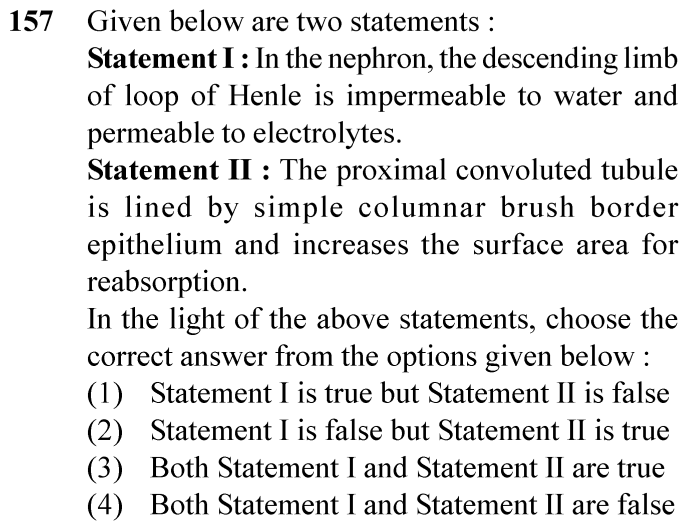
Official NEET 2024 Question 157 - Excretory Products and their Elimination
1 Statement I is true but Statement II is false
2 Statement I is false but Statement II is true
3 Both Statement I and Statement II are true
4 Both Statement I and Statement II are false ✓ Key
💡 Verified Solution & 30-Second Hack
✓
Verified Against NTA Final Answer Key
Option (4) : Both Statement I and Statement II are false
📚 Excretory Products and their Elimination Medium
📋 Given Parameters & Problem Setup
Statement I In the nephron, the descending limb of loop of Henle is impermeable to water and permeable to electrolytes.
Statement II The proximal convoluted tubule is lined by simple columnar brush border epithelium and increases the surface area for reabsorption.
⚡

The 30-Second Exam Hall Shortcut: ⚡ Double-Inversion Nephron Trap

⏱️ Save ~30 seconds

Descending limb is PERMEABLE to water and IMPERMEABLE to electrolytes (Statement I inverted!). PCT is lined by simple CUBOIDAL (not columnar!) brush border epithelium (Statement II false!). Both are false!

1 Check Statement I: Descending limb is permeable to water and almost impermeable to electrolytes. Statement I states the exact opposite -> FALSE.
2 Check Statement II: PCT is lined by simple CUBOIDAL brush border epithelium, which increases surface area for reabsorption. Statement II states "simple columnar" -> FALSE.
3 Both Statement I and Statement II are false -> Option (4) / D.
🛡️
Why You Can 100% Trust This Shortcut: NCERT Biology · Excretory Products and their Elimination (Function of the Tubules)
📐

Step-by-Step Rigorous Workflow & Mathematical Proof

Step 1

Evaluate Statement I (Loop of Henle Permeability)

NCERT explicitly states: "The descending limb of loop of Henle is permeable to water but almost impermeable to electrolytes. This concentrates the filtrate as it moves down." Statement I asserts it is "impermeable to water and permeable to electrolytes" (which is the property of the ascending limb). Thus, Statement I is false.

Step 2

Evaluate Statement II (PCT Epithelial Histology)

NCERT explicitly states: "Proximal Convoluted Tubule (PCT) is lined by simple cuboidal brush border epithelium which increases the surface area for reabsorption." Statement II claims it is lined by "simple columnar brush border epithelium". Thus, Statement II is false.

Step 3

Synthesize Verdict

Both Statement I and Statement II are false, corresponding to Option (4).

⭐

360° Option Elimination Engine Key Feature

Diagnose every choice: Know exactly why the right option works and why distractors fail.

4-Option Deep Scan
1 (1)
✗ Incorrect
Verdict & Scientific Reason:

Statement I is false regarding descending limb permeability.

⚠️
Student Fallacy (Why candidates pick this trap): Statement I is false regarding descending limb permeability.
2 (2)
✗ Incorrect
Verdict & Scientific Reason:

Statement II is false regarding simple columnar epithelium (it is cuboidal).

⚠️
Student Fallacy (Why candidates pick this trap): Statement II is false regarding simple columnar epithelium (it is cuboidal).
3 (3)
✗ Incorrect
Verdict & Scientific Reason:

Both statements contain deliberate factual errors.

⚠️
Student Fallacy (Why candidates pick this trap): Both statements contain deliberate factual errors.
4 (4)
✓ 100% Correct
Verdict & Scientific Reason:

Accurately recognizes that descending limb permeability was inverted and PCT epithelium is cuboidal, not columnar.

💡
Why this is airtight: None.
⚠️

NTA Trap Alert: Cuboidal vs Columnar Oversight

Seeing "brush border epithelium" in Statement II and automatically marking it true without checking that it says columnar instead of cuboidal.

🛡️ How to avoid the -1 mark: Always check both tissue geometry (cuboidal) and surface specialisation (brush border) in renal histology questions.
📖

Core NEET Syllabus Standard

Biology Core Zoology · Excretory Products and their Elimination Standard Benchmark
Core Scientific Principle Tested:

"PCT is lined by simple cuboidal brush border epithelium which increases the surface area for reabsorption... The descending limb of loop of Henle is permeable to water but almost impermeable to electrolytes."

Syllabus Focus: Henle’s Loop Permeability and PCT Brush Border Epithelium
✓ Core NEET UG Syllabus Anchor Syllabus & Academic Standards ↗
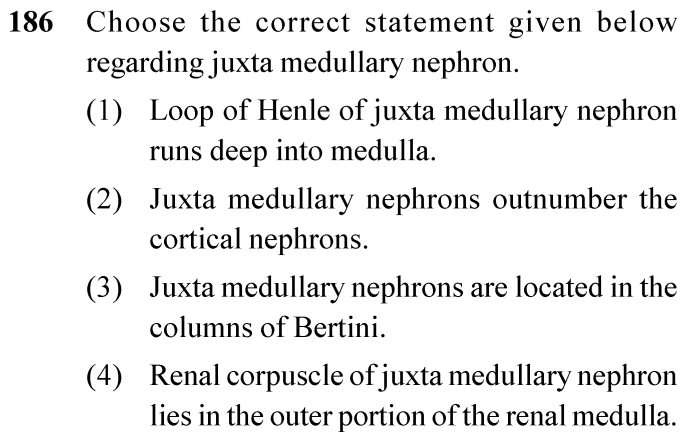
NEET 2024 · Q186 Easy
Official NEET 2024 Question 186 - Excretory Products and their Elimination
1 Loop of Henle of juxta medullary nephron runs deep into medulla. ✓ Key
2 Juxta medullary nephrons outnumber the cortical nephrons.
3 Juxta medullary nephrons are located in the columns of Bertini.
4 Renal corpuscle of juxta medullary nephron lies in the outer portion of the renal medulla.
💡 Verified Solution & 30-Second Hack
✓
Verified Against NTA Final Answer Key
Option (1) : Loop of Henle of juxta medullary nephron runs deep into medulla.
📚 Excretory Products and their Elimination Easy
📋 Given Parameters & Problem Setup
Nephron Type Juxtamedullary nephron
Evaluation Identify the correct factual statement
⚡

The 30-Second Exam Hall Shortcut: ⚡ Juxtamedullary Nephron Hallmark

⏱️ Save ~20 seconds

Juxtamedullary nephrons constitute ~15% of nephrons, have glomeruli near the corticomedullary border, and possess extremely LONG loops of Henle running deep into the inner medulla!

1 Recall comparative nephron anatomy:
2 - Cortical nephrons (85%): Short Henle's loop extending only very little into medulla; vasa recta reduced/absent.
3 - Juxtamedullary nephrons (15%): Renal corpuscle near inner cortex, very LONG Henle's loop running DEEP into the medulla, well-developed vasa recta essential for hyperosmotic countercurrent gradient.
4 Statement (1) states: "Loop of Henle of juxta medullary nephron runs deep into medulla" -> 100% TRUE.
5 Select Option (1) / A.
🛡️
Why You Can 100% Trust This Shortcut: NCERT Biology · Excretory Products and their Elimination (Cortical vs Juxtamedullary Nephrons)
📐

Step-by-Step Rigorous Workflow & Mathematical Proof

Step 1

Compare Cortical vs Juxtamedullary Nephrons

In majority of nephrons (cortical nephrons), the loop of Henle is too short and extends only very little into the medulla. In some of the nephrons, the loop of Henle is very long and runs deep into the medulla. These nephrons are called juxtamedullary nephrons.

Step 2

Evaluate Location of Renal Corpuscle

The Malpighian corpuscle, PCT and DCT of all nephrons are situated in the cortical region of the kidney. In juxtamedullary nephrons, the corpuscle lies in the deeper cortex close to the medulla (corticomedullary junction), but never inside the renal medulla itself.

Step 3

Verify Proportion in Kidney

Cortical nephrons constitute about 80-85% of total nephrons, whereas juxtamedullary nephrons constitute only 15-20%. Therefore, they do not outnumber cortical nephrons.

⭐

360° Option Elimination Engine Key Feature

Diagnose every choice: Know exactly why the right option works and why distractors fail.

4-Option Deep Scan
1 (1)
✓ 100% Correct
Verdict & Scientific Reason:

NCERT verbatim fact: Juxtamedullary nephrons have exceptionally long loops of Henle that run deep into the renal medulla.

💡
Why this is airtight: None.
2 (2)
✗ Incorrect
Verdict & Scientific Reason:

Cortical nephrons comprise ~85% of total nephrons, strongly outnumbering juxtamedullary nephrons (~15%).

⚠️
Student Fallacy (Why candidates pick this trap): Cortical nephrons comprise ~85% of total nephrons, strongly outnumbering juxtamedullary nephrons (~15%).
3 (3)
✗ Incorrect
Verdict & Scientific Reason:

Columns of Bertini are cortical extensions between medullary pyramids, not the specific anatomical home of juxtamedullary nephrons.

⚠️
Student Fallacy (Why candidates pick this trap): Columns of Bertini are cortical extensions between medullary pyramids, not the specific anatomical home of juxtamedullary nephrons.
4 (4)
✗ Incorrect
Verdict & Scientific Reason:

All renal corpuscles are strictly located in the renal cortex.

⚠️
Student Fallacy (Why candidates pick this trap): All renal corpuscles are strictly located in the renal cortex.
⚠️

NTA Trap Alert: Corpuscle in Medulla Misconception

Assuming "juxtamedullary" means the renal corpuscle is in the medulla.

🛡️ How to avoid the -1 mark: All glomeruli/corpuscles are exclusively in the cortex; "juxta" means next to the medulla.
📖

Core NEET Syllabus Standard

Biology Core Zoology · Excretory Products and their Elimination Standard Benchmark
Core Scientific Principle Tested:

"In majority of nephrons, the loop of Henle is too short and extends only very little into the medulla (cortical nephrons). In some of the nephrons, the loop of Henle is very long and runs deep into the medulla. These nephrons are called juxta medullary nephrons."

Syllabus Focus: Juxtamedullary Nephrons: Structural Hallmarks and Medullary Penetration
✓ Core NEET UG Syllabus Anchor Syllabus & Academic Standards ↗
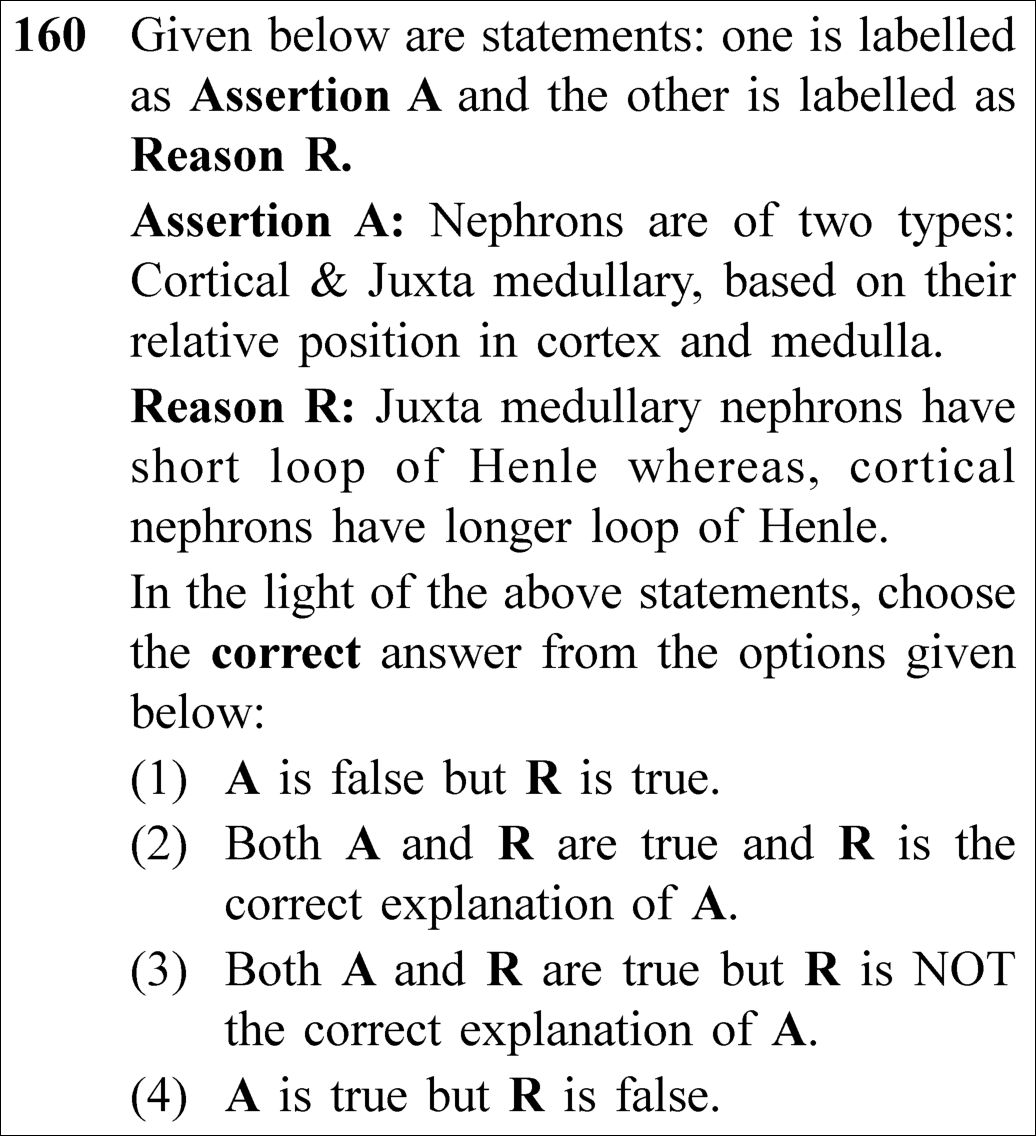
NEET 2023 · Q160 Medium
Official NEET 2023 Question 160 - Excretory Products and their Elimination
1 A is false but R is true.
2 Both A and R are true and R is the correct explanation of A.
3 Both A and R are true but R is NOT the correct explanation of A.
4 A is true but R is false. ✓ Key
💡 Verified Solution & 30-Second Hack
✓
Verified Against NTA Final Answer Key
Option (4) : A is true but R is false.
📚 Excretory Products and their Elimination Medium
📋 Given Parameters & Problem Setup
Assertion (A) Nephrons are of two types: Cortical & Juxtamedullary based on relative position in cortex and medulla.
Reason (R) Juxtamedullary nephrons have short loop of Henle whereas cortical nephrons have longer loop of Henle.
⚡

The 30-Second Exam Hall Shortcut: ⚡ Henle Loop Inversion Alert: Juxtamedullary has LONG Loop!

⏱️ Save ~25 seconds

Assertion is TRUE (cortical & juxtamedullary based on position). But Reason claims juxtamedullary nephrons have short loops! In reality, Juxtamedullary nephrons have very LONG loops running deep into the medulla to concentrate urine! Reason is completely FALSE! Select Option (4)!

1 Check Assertion A: Nephrons are categorized into cortical and juxtamedullary based on location -> True.
2 Check Reason R: Claims juxtamedullary have short loops and cortical have long loops -> Completely reversed! (Cortical = short loop; Juxtamedullary = long loop) -> Reason is False.
3 Assertion is true but Reason is false.
4 Match Option (4) A is true but R is false.
🛡️
Why You Can 100% Trust This Shortcut: Canonical NCERT Human Physiology nephron architecture and counter-current concentrating anatomy.
📐

Step-by-Step Rigorous Workflow & Mathematical Proof

Step 1

Evaluation of Assertion A (Nephron Types)

Nephrons are anatomically classified according to the depth of their renal corpuscles and extent of their loops within the kidney zones:

Nephron Types={Cortical (≈85%):Glomerulus in outer cortexJuxtamedullary (≈15%):Glomerulus at cortex-medulla junction  ⟹  Assertion is TRUE\text{Nephron Types} = \begin{cases} \mathbf{\text{Cortical (}\approx 85\%\text{):}} & \text{Glomerulus in outer cortex} \\[3pt] \mathbf{\text{Juxtamedullary (}\approx 15\%\text{):}} & \text{Glomerulus at cortex-medulla junction} \end{cases} \implies \text{Assertion is } \mathbf{\text{TRUE}}
Step 2

Evaluation of Reason R (Henle's Loop Dimensions)

The length of the loop of Henle differs sharply between the two classes:

Cortical Nephrons:Short loop of Henle (extends very little into medulla)Juxtamedullary Nephrons:Very long loop of Henle (runs deep into medulla with vasa recta)\begin{aligned} \text{\textbf{Cortical Nephrons:}} & \quad \mathbf{\text{Short loop of Henle}} \text{ (extends very little into medulla)} \\[4pt] \text{\textbf{Juxtamedullary Nephrons:}} & \quad \mathbf{\text{Very long loop of Henle}} \text{ (runs deep into medulla with vasa recta)} \end{aligned}
Step 3

Verbatim NCERT Reference

NCERT states verbatim: "In majority of nephrons, the loop of Henle is too short and extends only very little into the medulla. Such nephrons are called cortical nephrons. In some of the nephrons, the loop of Henle is very long and runs deep into the medulla. These nephrons are called juxta medullary nephrons." Reason R directly contradicts this and is unequivocally FALSE.

⭐

360° Option Elimination Engine Key Feature

Diagnose every choice: Know exactly why the right option works and why distractors fail.

4-Option Deep Scan
1 1
✗ Incorrect
Verdict & Scientific Reason:

Assertion is factually true, while Reason is blatantly false.

⚠️
Student Fallacy (Why candidates pick this trap): Accepting the inverted Henle loop lengths in Reason.
2 2
✗ Incorrect
Verdict & Scientific Reason:

Reason is false because juxtamedullary nephrons possess long loops of Henle.

⚠️
Student Fallacy (Why candidates pick this trap): Failing to catch the inverted description in Reason.
3 3
✗ Incorrect
Verdict & Scientific Reason:

Reason is factually false.

⚠️
Student Fallacy (Why candidates pick this trap): Assuming both statements are true without checking anatomical details.
4 4
✓ 100% Correct
Verdict & Scientific Reason:

Assertion A is correct, but Reason R is false due to complete reversal of Henle's loop length.

💡
Why this is airtight: None; rigorous anatomical precision.
⚠️

NTA Trap Alert: Cortical vs. Juxtamedullary Loop Length Inversion Trap

NTA frequently tests this exact inversion: juxtamedullary nephrons specialize in water conservation and creating the hyperosmotic medullary gradient, which REQUIRES a very long loop of Henle.

🛡️ How to avoid the -1 mark: Remember: Juxtamedullary = Deep in medulla = LONG loop of Henle. Cortical = Mostly in cortex = SHORT loop.
📖

Core NEET Syllabus Standard

NCERT Biology · Excretory Products and their Elimination Standard Benchmark
Core Scientific Principle Tested:

"Cortical nephrons have short loop of Henle extending very little into medulla; Juxtamedullary nephrons have very long loop of Henle running deep into medulla."

Syllabus Focus: Structure of Nephron
✓ Core NEET UG Syllabus Anchor Syllabus & Academic Standards ↗
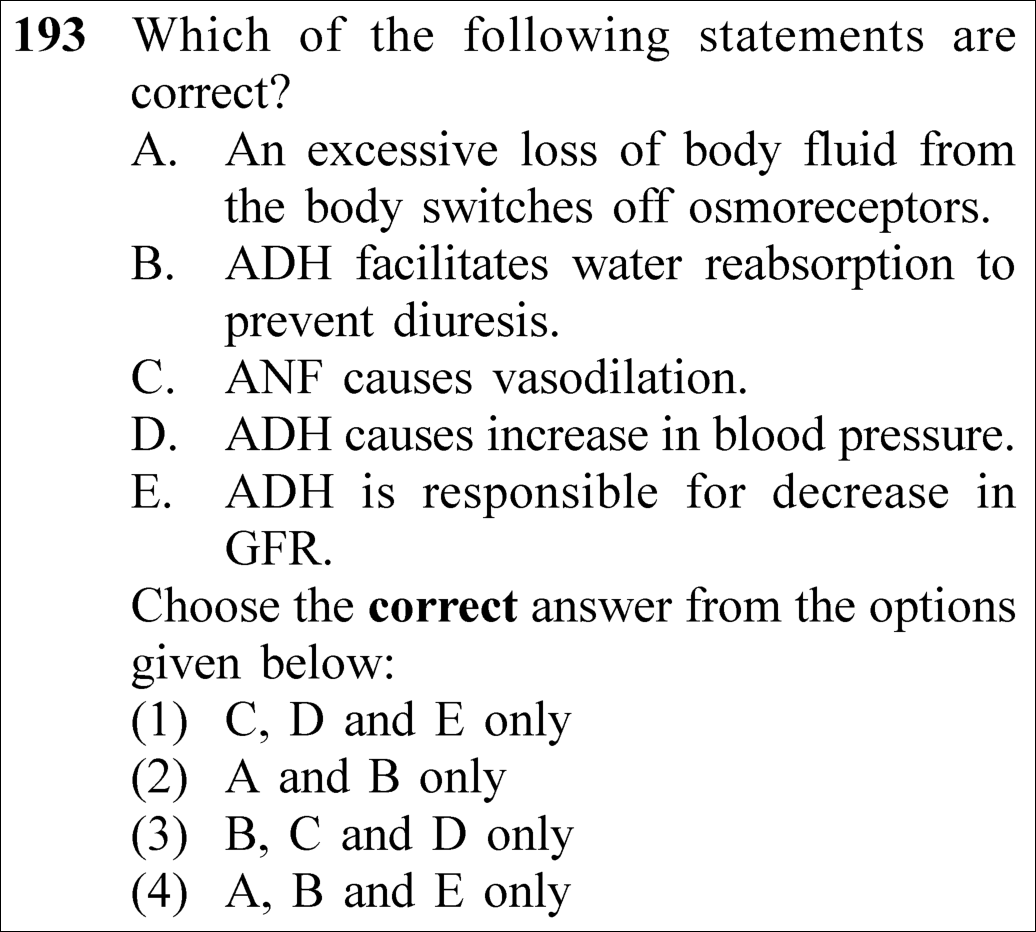
NEET 2023 · Q193 Medium
Official NEET 2023 Question 193 - Excretory Products and their Elimination
1 C, D and E only
2 A and B only
3 B, C and D only ✓ Key
4 A, B and E only
💡 Verified Solution & 30-Second Hack
✓
Verified Against NTA Final Answer Key
Option (3) : B, C and D only
📚 Excretory Products and their Elimination Medium
📋 Given Parameters & Problem Setup
Physiological Systems Osmoreceptors, ADH (Vasopressin), ANF, Blood pressure, and GFR
⚡

The 30-Second Exam Hall Shortcut: ⚡ Osmoreceptor & ADH Error Spotter: A & E are FALSE!

⏱️ Save ~25 seconds

Excess fluid loss ACTIVATES/switches ON osmoreceptors (not off, so A is false!). ADH increases blood pressure which INCREASES GFR (not decrease, so E is false!). B (ADH prevents diuresis), C (ANF causes vasodilation), and D (ADH increases BP) are all TRUE! Select Option (3)!

1 Statement A: Excessive loss of fluid switches off osmoreceptors -> False (Loss of fluid ACTIVATES osmoreceptors).
2 Statement B: ADH facilitates water reabsorption to prevent diuresis -> True.
3 Statement C: ANF causes vasodilation (opposing RAAS) -> True.
4 Statement D: ADH causes vasoconstriction and increases blood pressure -> True.
5 Statement E: ADH decreases GFR -> False (Increase in BP increases glomerular blood flow and GFR).
6 B, C and D only -> Select Option (3).
🛡️
Why You Can 100% Trust This Shortcut: Canonical NCERT Human Physiology renal autoregulation and endocrine control.
📐

Step-by-Step Rigorous Workflow & Mathematical Proof

Step 1

Evaluation of Statements B, C, and D (Valid Statements)

Analyzing the physiological mechanisms governing osmoregulation and blood volume:

Statement B:ADH inserts aquaporins in DCT/collecting duct   ⟹  Prevents Diuresis (TRUE)Statement C:ANF released by atrial stretch causes Vasodilation  ⟹  Decreases BP (TRUE)Statement D:Vasopressin (ADH) constricts arterioles   ⟹  Increases Blood Pressure (TRUE)\begin{aligned} \text{\textbf{Statement B:}} & \quad \text{ADH inserts aquaporins in DCT/collecting duct } \implies \mathbf{\text{Prevents Diuresis (TRUE)}} \\[4pt] \text{\textbf{Statement C:}} & \quad \text{ANF released by atrial stretch causes } \mathbf{\text{Vasodilation}} \implies \mathbf{\text{Decreases BP (TRUE)}} \\[4pt] \text{\textbf{Statement D:}} & \quad \text{Vasopressin (ADH) constricts arterioles } \implies \mathbf{\text{Increases Blood Pressure (TRUE)}} \end{aligned}
Step 2

Evaluation of Statements A and E (Invalid Statements)

Analyzing the specific contradictions planted in A and E: - Statement A: Osmoreceptors in the hypothalamus are stimulated by an *increase* in blood osmolarity (loss of fluid). Excessive fluid loss switches them ON, not off. Fluid gain switches them off. - Statement E: Because ADH increases systemic blood pressure, it elevates glomerular capillary hydrostatic pressure, thereby increasing (or maintaining) GFR, not decreasing it.

Step 3

Verbatim NCERT References

NCERT states under Regulation of Kidney Function: - "An excessive loss of fluid from the body can activate these receptors which stimulate the hypothalamus to release ADH..." - "ADH facilitates water reabsorption from latter parts of the tubule, thereby preventing diuresis." - "ADH has also constrictory effects on blood vessels. This causes an increase in blood pressure." - "An increase in blood pressure can increase the glomerular blood flow and thereby the GFR." - "ANF can cause vasodilation (dilation of blood vessels) and thereby decrease the blood pressure."

⭐

360° Option Elimination Engine Key Feature

Diagnose every choice: Know exactly why the right option works and why distractors fail.

4-Option Deep Scan
1 1
✗ Incorrect
Verdict & Scientific Reason:

Includes false statement E (ADH increases, not decreases, GFR).

⚠️
Student Fallacy (Why candidates pick this trap): Assuming vasoconstriction reduces glomerular filtration rate.
2 2
✗ Incorrect
Verdict & Scientific Reason:

Includes false statement A (fluid loss switches on osmoreceptors).

⚠️
Student Fallacy (Why candidates pick this trap): Misreading "switches off" for "switches on" in Statement A.
3 3
✓ 100% Correct
Verdict & Scientific Reason:

Statements B, C, and D are fully verified and accurate NCERT endocrinological principles.

💡
Why this is airtight: None; rigorous physiological discrimination.
4 4
✗ Incorrect
Verdict & Scientific Reason:

Includes both false statements A and E.

⚠️
Student Fallacy (Why candidates pick this trap): Accepting the erroneous osmoreceptor switch and GFR decrease claims.
⚠️

NTA Trap Alert: Osmoreceptor Activation vs. Deactivation Trigger Trap

Loss of body fluid = High blood osmolarity = Osmoreceptors switch ON (stimulated). Influx of water / excessive fluid = Low osmolarity = Osmoreceptors switch OFF.

🛡️ How to avoid the -1 mark: Fluid loss = Osmoreceptors ON. Fluid gain = Osmoreceptors OFF.
📖

Core NEET Syllabus Standard

NCERT Biology · Excretory Products and their Elimination Standard Benchmark
Core Scientific Principle Tested:

"ADH prevents diuresis and increases blood pressure; ANF causes vasodilation. Excessive fluid loss activates osmoreceptors."

Syllabus Focus: Regulation of Kidney Function
✓ Core NEET UG Syllabus Anchor Syllabus & Academic Standards ↗
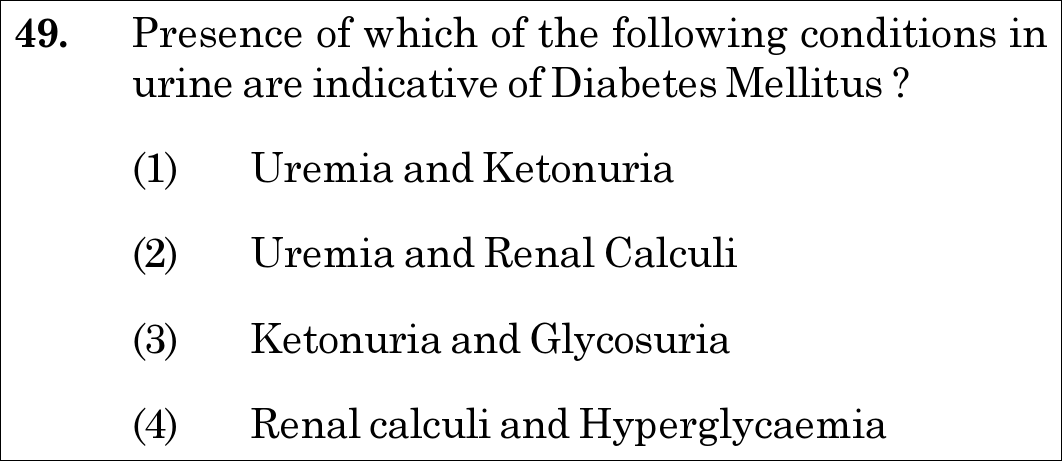
NEET 2020 · Q49 Easy
Official NEET 2020 Question 49 - Excretory Products and their Elimination
1 Uremia and Ketonuria
2 Uremia and Renal Calculi
3 Ketonuria and Glycosuria ✓ Key
4 Renal calculi and Hyperglycaemia
💡 Verified Solution & 30-Second Hack
✓
Verified Against NTA Final Answer Key
Option (3) : Ketonuria and Glycosuria
📚 Excretory Products and their Elimination Easy
📋 Given Parameters & Problem Setup
Clinical Condition Diabetes Mellitus
Excretory Specimen Urine analysis
Question Objective Identify which urinary findings indicate diabetes mellitus
⚡

The 30-Second Exam Hall Shortcut: ⚡ "Diabetes Mellitus Urine = Sugar + Ketones (Glycosuria & Ketonuria)!"

⏱️ 25 seconds

In diabetes mellitus, insulin deficiency or insensitivity causes hyperglycemia, leading to glucose spillover in urine (Glycosuria) and excessive fatty acid breakdown into ketone bodies in urine (Ketonuria). Uremia is high urea in blood. Mark Option (3) in 5 seconds!

1 Diabetes mellitus features hyperglycemia exceeding the renal threshold (180 mg/dL).
2 Excess glucose excreted in urine = Glycosuria.
3 Inability of cells to take up glucose causes fat catabolism, producing acetoacetate and beta-hydroxybutyrate excreted in urine = Ketonuria.
4 Select Option (3) Ketonuria and Glycosuria.
🛡️
Why You Can 100% Trust This Shortcut: NCERT Biology · Human Physiology: Excretory Products and their Elimination (Disorders of Excretory System)
📐

Step-by-Step Rigorous Workflow & Mathematical Proof

Step 1

Understand Diabetes Mellitus Pathophysiology

Diabetes mellitus is a metabolic disorder caused by deficiency of insulin or insulin resistance. As a result, blood glucose levels rise dramatically (hyperglycemia).

Step 2

Mechanism of Glycosuria

When blood glucose exceeds the renal threshold (normally ~180 mg/dL), proximal convoluted tubules cannot reabsorb all the filtered glucose, resulting in glucose excretion in urine (Glycosuria).

Step 3

Mechanism of Ketonuria

Because glucose cannot effectively enter insulin-dependent tissue cells, the body mobilizes fats for cellular energy. Accelerated beta-oxidation of fatty acids in the liver produces ketone bodies (acetoacetic acid, acetone) which spill into urine (Ketonuria).

Step 4

Eliminate Other Diagnostic Terms

Uremia is accumulation of urea in blood due to renal failure; Renal calculi are kidney stones composed of crystallized oxalates. Only Glycosuria and Ketonuria indicate Diabetes Mellitus.

⭐

360° Option Elimination Engine Key Feature

Diagnose every choice: Know exactly why the right option works and why distractors fail.

4-Option Deep Scan
1 A
✗ Incorrect
Verdict & Scientific Reason:

Incorrect; uremia is the accumulation of urea in the blood resulting from kidney failure, not a urinary indicator of diabetes mellitus.

⚠️
Student Fallacy (Why candidates pick this trap): Confusing blood urea accumulation (uremia) with glycosuria.
2 B
✗ Incorrect
Verdict & Scientific Reason:

Incorrect; renal calculi are insoluble stone formations (oxalates) and uremia is urea retention in blood.

⚠️
Student Fallacy (Why candidates pick this trap): Confusing renal failure/calculi with endocrine diabetes mellitus.
3 C
✓ 100% Correct
Verdict & Scientific Reason:

Factually exact; NCERT explicitly specifies that presence of glucose (glycosuria) and ketone bodies (ketonuria) in urine are indicative of diabetes mellitus.

💡
Why this is airtight: None; textbook diagnostic criteria.
4 D
✗ Incorrect
Verdict & Scientific Reason:

Incorrect; hyperglycemia is high glucose in BLOOD, not a condition in urine, and renal calculi are kidney stones.

⚠️
Student Fallacy (Why candidates pick this trap): Overlooking that the question asked for conditions in URINE, whereas hyperglycemia is a blood metric.
⚠️

NTA Trap Alert: Blood Finding vs Urine Finding

Hyperglycemia is in BLOOD; Glycosuria is in URINE. Uremia is high urea in BLOOD; Ketonuria is ketone bodies in URINE.

🛡️ How to avoid the -1 mark: Read the question carefully: "Presence in URINE indicative of Diabetes Mellitus" = Glycosuria and Ketonuria!
📖

Core NEET Syllabus Standard

Zoology · Excretory Products and their Elimination Standard Benchmark
Core Scientific Principle Tested:

""

Syllabus Focus: Disorders of the Excretory System: Diagnostic Urine Markers for Diabetes Mellitus
✓ Core NEET UG Syllabus Anchor Syllabus & Academic Standards ↗
NEET 2020 · Q68 Medium
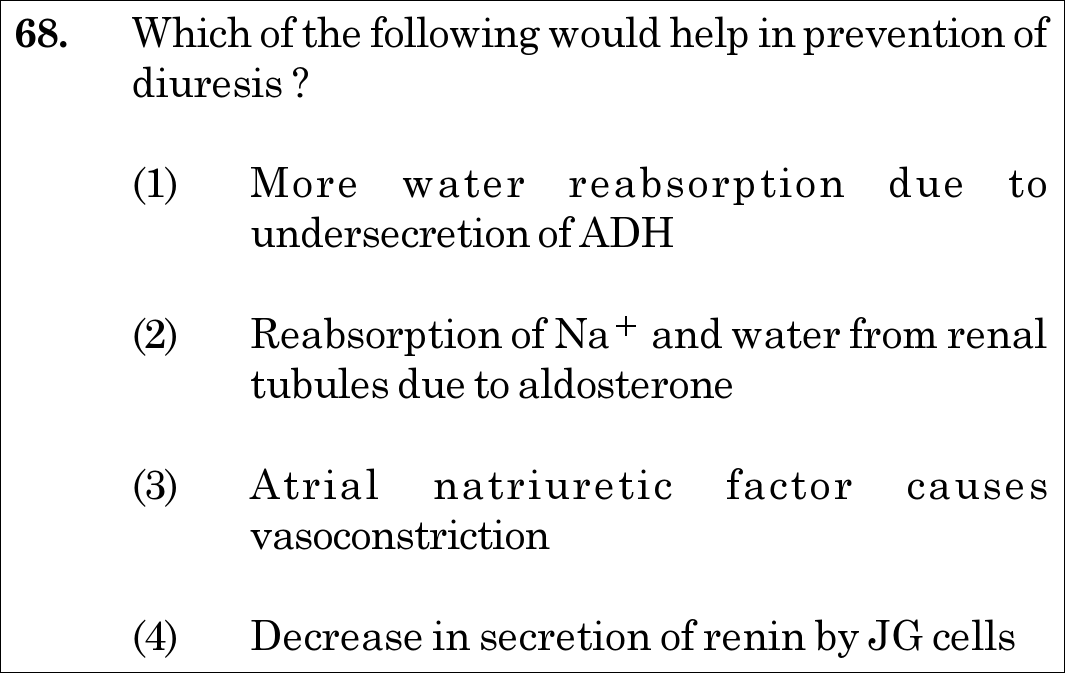
Official NEET 2020 Question 68 - Excretory Products and their Elimination
1 More water reabsorption due to undersecretion of ADH
2 Reabsorption of Na+ and water from renal tubules due to aldosterone ✓ Key
3 Atrial natriuretic factor causes vasoconstriction
4 Decrease in secretion of renin by JG cells
💡 Verified Solution & 30-Second Hack
✓
Verified Against NTA Final Answer Key
Option (2) : Reabsorption of Na+ and water from renal tubules due to aldosterone
📚 Excretory Products and their Elimination Medium
📋 Given Parameters & Problem Setup
Physiological Target Prevention of diuresis (retention of water / anti-diuresis)
Question Objective Identify which endocrine/renal mechanism would prevent diuresis
⚡

The 30-Second Exam Hall Shortcut: ⚡ "Aldosterone Conserves Na+ & Water -> Prevents Diuresis!"

⏱️ 30 seconds

Diuresis is excessive loss of water in urine. Aldosterone (from adrenal cortex) stimulates active reabsorption of Na+ and water from the distal tubules, concentrating urine and preventing diuresis! Undersecretion of ADH CAUSES diuresis (diabetes insipidus); ANF promotes natriuresis. Mark Option (2) in 10 seconds.

1 Diuresis = Excessive water loss in urine.
2 Prevention of diuresis requires increased water reabsorption back into blood.
3 Aldosterone causes reabsorption of Na+ and water from distal renal tubules, reducing urine volume.
4 Option (1) falsely claims "more water reabsorption due to undersecretion of ADH" (undersecretion CAUSES diuresis!).
5 Option (3) falsely claims ANF causes vasoconstriction (ANF is a vasodilator).
6 Select Option (2).
🛡️
Why You Can 100% Trust This Shortcut: NCERT Biology · Human Physiology: Excretory Products and their Elimination (Regulation of Kidney Function)
📐

Step-by-Step Rigorous Workflow & Mathematical Proof

Step 1

Define Diuresis and Anti-diuresis

Diuresis refers to increased production and excretion of dilute urine. Prevention of diuresis (anti-diuresis) means conserving water within the body by reabsorbing it from the nephron tubules.

Step 2

Action of Aldosterone in the RAAS Pathway

Angiotensin II stimulates the adrenal cortex to release aldosterone. Aldosterone stimulates the reabsorption of Na+ and water from the distal parts of the tubule (DCT and collecting duct). This prevents water loss, restores blood volume and pressure, and directly prevents diuresis.

Step 3

Evaluate Option (1): ADH Undersecretion

ADH (vasopressin) promotes water reabsorption from distal tubules. UNDERSECRETION of ADH leads to failure of water reabsorption, resulting in massive diuresis (Diabetes Insipidus). Thus, Option (1) is physiologically nonsensical.

Step 4

Evaluate Options (3) and (4): ANF and Renin

Atrial Natriuretic Factor (ANF) is released by the heart atria in response to high blood pressure; it causes VASODILATION (not vasoconstriction) and promotes natriuresis/diuresis (antagonizing RAAS). A decrease in renin secretion would reduce aldosterone, worsening water loss. Hence, only Option (2) prevents diuresis.

⭐

360° Option Elimination Engine Key Feature

Diagnose every choice: Know exactly why the right option works and why distractors fail.

4-Option Deep Scan
1 A
✗ Incorrect
Verdict & Scientific Reason:

Incorrect; undersecretion of ADH causes LESS water reabsorption and severe diuresis (diabetes insipidus), not more water reabsorption.

⚠️
Student Fallacy (Why candidates pick this trap): Misreading "undersecretion" as oversecretion.
2 B
✓ 100% Correct
Verdict & Scientific Reason:

Factually exact; aldosterone stimulates active Na+ and osmotic water reabsorption from distal convoluted tubules, concentrating urine and preventing diuresis.

💡
Why this is airtight: None; textbook RAAS mechanism.
3 C
✗ Incorrect
Verdict & Scientific Reason:

Incorrect; ANF causes VASODILATION (lowering blood pressure) and promotes diuresis, not vasoconstriction.

⚠️
Student Fallacy (Why candidates pick this trap): Confusing the actions of ANF (vasodilator) with Angiotensin II (vasoconstrictor).
4 D
✗ Incorrect
Verdict & Scientific Reason:

Incorrect; decrease in renin would lower Angiotensin II and aldosterone, reducing water reabsorption and promoting diuresis.

⚠️
Student Fallacy (Why candidates pick this trap): Thinking reduced renin conserves body water.
⚠️

NTA Trap Alert: ANF vs RAAS Opposing Actions

RAAS (Renin -> Angiotensin II -> Aldosterone) = VASOCONSTRICTION + Water retention (prevents diuresis). ANF = VASODILATION + Natriuresis (promotes diuresis).

🛡️ How to avoid the -1 mark: Remember: Aldosterone retains salt and water -> PREVENTS diuresis!
📖

Core NEET Syllabus Standard

Zoology · Excretory Products and their Elimination Standard Benchmark
Core Scientific Principle Tested:

""

Syllabus Focus: Prevention of Diuresis: Aldosterone, ADH, and Renin-Angiotensin System
✓ Core NEET UG Syllabus Anchor Syllabus & Academic Standards ↗

Solve 4 NEET Questions a Day — One per Subject

Cover all 1,140 official NEET questions in 285 days at your own pace. Progress is saved on your device. No login needed.