NEET 2021 Botany Question 101 Solution
Question
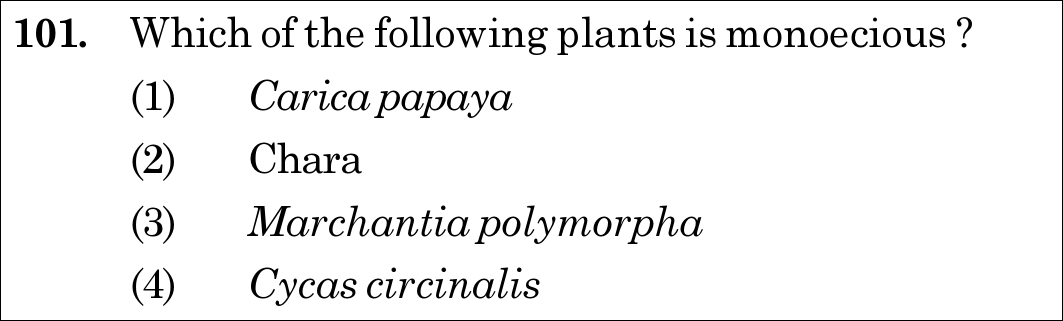
Which of the following plants is monoecious?
- (1)Carica papaya
- (2)Chara
- (3)Marchantia polymorpha
- (4)Cycas circinalis
Dynamic 180-question full-length simulator mixed dynamically from all 6 years for 2027 & 2026 aspirants.
Which of the following plants is monoecious?
Chara is a classic monoecious green alga bearing both female oogonium (nucule, upper) and male antheridium (globule, lower) on the same thallus. Papaya, Marchantia, and Cycas are strictly dioecious. Match Option (2) instantly!
In plant morphology, the distribution of sex organs defines sexual condition:
Chara is an advanced green macroalga (stonewort). It produces specialized multicellular, jacketed sex organs situated at the nodes of lateral branches of limited growth: - Oogonium (Nucule): The female organ situated in the upper position. - Antheridium (Globule): The male organ situated directly below the nucule. Because both fertile organs develop together on the same individual node, Chara is canonically monoecious.
Analysis of the distractors confirms strict dioecy: - *Carica papaya* (Papaya): Produces male (staminate) and female (pistillate) flowers on entirely separate trees (dioecious angiosperm). - *Marchantia polymorpha*: A dioecious hepatic (liverwort) bearing male antheridiophores and female archegoniophores on separate gametophytic thalli. - *Cycas circinalis*: A dioecious gymnosperm bearing microsporophylls clustered into male cones on male trees, and megasporophylls loosely arranged on female trees.
Diagnose every choice: Know exactly why the right option works and why distractors fail.
Carica papaya (papaya) is dioecious; staminate and pistillate flowers are produced on separate male and female plants.
Chara thallus bears both the female nucule (upper) and male globule (lower) at the nodes of the same plant, making it monoecious.
Marchantia polymorpha is dioecious; antheridiophores develop on male thalli and archegoniophores develop on female thalli.
Cycas is strictly dioecious; male cones and megasporophylls are borne on distinct individual trees (unlike Pinus which is monoecious).
NTA loves testing the classic dioecious vs monoecious contrasts: Pinus is monoecious, but Cycas is dioecious; Maize is monoecious, but Papaya is dioecious; Chara is monoecious, but Marchantia is dioecious.
"Chara is a monoecious green alga possessing antheridia (globule) and oogonia (nucule) on the same individual."
Test your speed and accuracy in the authentic 200-minute timed NTA simulator.
Spotted a mistake in this solution? Report an error (support@mycompetitiveexams.com)
Cover all 1,140 official NEET questions in 285 days at your own pace. Progress is saved on your device. No login needed.