MyCompetitiveExams Logo MyCompetitiveExams
Search 1,140+ Questions
Chapters, formulas, speed tricks
→
⚡ Brahmastra NEET 2027
720 MARKS

Dynamic 180-question full-length simulator mixed dynamically from all 6 years for 2027 & 2026 aspirants.

Launch Brahmastra 2027 Test →
Start Practice →
100% Free · No Login Required
Q.113 Botany ⭐ 360° Option Elimination Active
Vault ↗

NEET 2021 Botany Question 113 Solution

Topic: Plant Kingdom · Official NTA Booklet Code M1
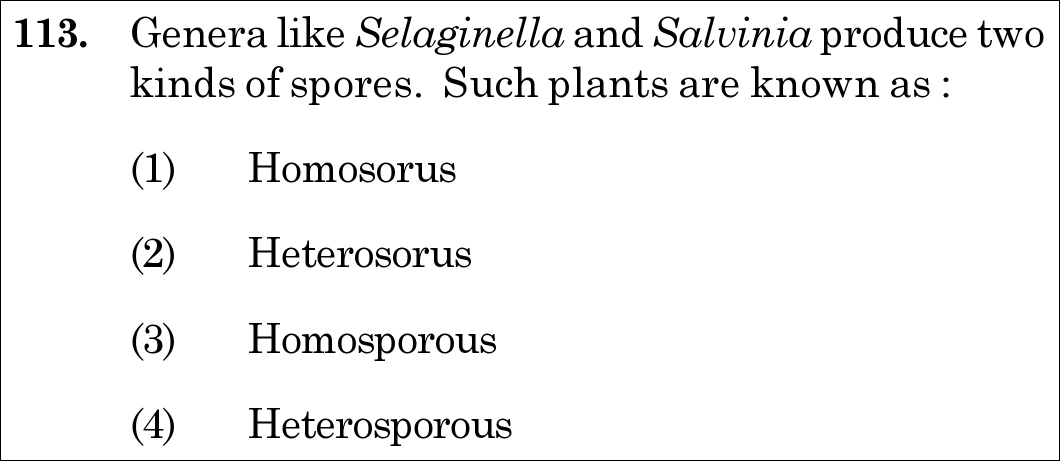
NEET 2021 Botany Question 113: Heterospory in Pteridophytes (Selaginella & Salvinia)

Question

Genera like Selaginella and Salvinia produce two kinds of spores. Such plants are known as:

  1. (1)Homosorus
  2. (2)Heterosorus
  3. (3)Homosporous
  4. (4)Heterosporous
✓
Verified Against NTA Final Answer Key
Option (4) : Heterosporous
📚 Plant Kingdom Easy
📋 Given Parameters & Problem Setup
Genera Selaginella and Salvinia
Characteristic Production of two distinct kinds of spores (microspores and megaspores)
⚡

The 30-Second Exam Hall Shortcut: ⚡ Two Types of Spores = Heterosporous

⏱️ Save ~15 seconds

Hetero = different, sporous = spore-producing! Plants that produce two morphologically and sexually distinct kinds of spores (megaspores and microspores), like Selaginella and Salvinia, are defined as Heterosporous! Match Option (4)!

1 Homosporous = producing identical spores (e.g., Dryopteris, Pteris, Equisetum).
2 Heterosporous = producing two kinds of spores, macro/megaspores and microspores.
3 Selaginella and Salvinia are classic examples of heterosporous pteridophytes.
4 Match Option (4).
🛡️
Why You Can 100% Trust This Shortcut: Canonical NCERT Plant Kingdom taxonomy on Pteridophytes and Heterospory.
📐

Step-by-Step Rigorous Workflow & Mathematical Proof

Step 1

Spore Dimorphism in Pteridophytes

While the majority of pteridophytes produce spores of similar kind (homosporous), select genera produce two distinct kinds of spores differing in size and developmental fate:

Spore Production  ⟹  {Microspores (small):⟶Male gametophyteMegaspores (large):⟶Female gametophyte\text{Spore Production} \implies \begin{cases} \text{Microspores (small):} & \longrightarrow \text{Male gametophyte} \\[4pt] \text{Megaspores (large):} & \longrightarrow \text{Female gametophyte} \end{cases}
Step 2

Definition of Heterospory

Plants exhibiting this dimorphic spore condition are termed heterosporous. The classic NCERT examples in pteridophytes are *Selaginella* and *Salvinia* (as well as *Marsilea* and *Azolla*).

Step 3

Evolutionary Significance

Heterospory is considered an essential evolutionary prerequisite to the development of the seed habit because the female gametophyte is retained on the parent sporophyte.

⭐

360° Option Elimination Engine Key Feature

Diagnose every choice: Know exactly why the right option works and why distractors fail.

4-Option Deep Scan
1 1
✗ Incorrect
Verdict & Scientific Reason:

A sorus is a cluster of sporangia; "homosorus" refers to sori structure, not the production of two spore types.

⚠️
Student Fallacy (Why candidates pick this trap): Confusing sori (clusters of sporangia) with spores.
2 2
✗ Incorrect
Verdict & Scientific Reason:

Heterosorus is an anatomical descriptor of sporangial clusters, not the biological term for spore dimorphism.

⚠️
Student Fallacy (Why candidates pick this trap): Picking "hetero-" combined with "-sorus" instead of "-sporous".
3 3
✗ Incorrect
Verdict & Scientific Reason:

Homosporous plants produce only one kind of identical spore (e.g., Equisetum, Lycopodium, Dryopteris).

⚠️
Student Fallacy (Why candidates pick this trap): Confusing "homo" (same) with "hetero" (different).
4 4
✓ 100% Correct
Verdict & Scientific Reason:

Heterosporous plants produce two distinct kinds of spores (microspores and megaspores), exemplified by Selaginella and Salvinia.

💡
Why this is airtight: None. Direct textbook terminology.
⚠️

NTA Trap Alert: Spore vs Sorus Suffix Trap

NTA intentionally constructed distractors (1) Homosorus and (2) Heterosorus alongside (3) Homosporous and (4) Heterosporous to catch hasty candidates reading only prefixes.

🛡️ How to avoid the -1 mark: Check the suffix: we are discussing spores (-sporous), not clusters of sporangia (-sorus).
📖

Core NEET Syllabus Standard

NEET / NCERT Biology · Plant Kingdom Standard Benchmark
Core Scientific Principle Tested:

"Genera like Selaginella and Salvinia which produce two kinds of spores, macro (large) and micro (small) spores, are known as heterosporous."

Syllabus Focus: Pteridophytes: Heterospory and Origin of Seed Habit
✓ Core NEET UG Syllabus Anchor Syllabus & Academic Standards ↗

Ready to attempt under real exam pressure?

Test your speed and accuracy in the authentic 200-minute timed NTA simulator.

Launch NEET 2021 CBT Test →

Spotted a mistake in this solution? Report an error (support@mycompetitiveexams.com)

⚖️ Legal & Fair Dealing Notice: Sourced from publicly released NEET 2021 question papers and NEET answer keys for private study, research, and non-commercial educational practice under Fair Dealing (Section 52(1)(a) of the Indian Copyright Act, 1957). Not affiliated with or endorsed by NTA or NMC.

Solve 4 NEET Questions a Day — One per Subject

Cover all 1,140 official NEET questions in 285 days at your own pace. Progress is saved on your device. No login needed.