MyCompetitiveExams Logo MyCompetitiveExams
Search 1,140+ Questions
Chapters, formulas, speed tricks
→
⚡ Brahmastra NEET 2027
720 MARKS

Dynamic 180-question full-length simulator mixed dynamically from all 6 years for 2027 & 2026 aspirants.

Launch Brahmastra 2027 Test →
Start Practice →
100% Free · No Login Required
🌿 Botany 🔥 High-Yield Core Topic (~3–4 Qs/Year)

NEET Plant Growth and Development Previous Year Questions with Solutions

Complete repository of official NTA NEET questions for Plant Growth and Development from 2020 to 2026. Every question includes 30-second elimination tricks, step-by-step NCERT solutions, option-by-option traps, and official answer keys.

17 Questions 6 Exam Years (2026, 2025, 2024, 2023, 2021, 2020) 16 Easy · 1 Medium · 0 Challenging
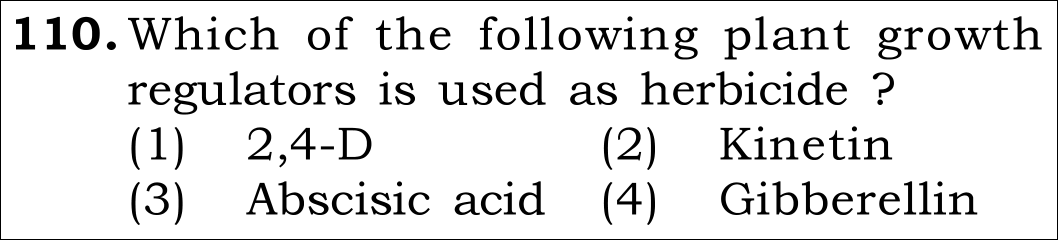
NEET 2026 · Q110 Easy
Official NEET 2026 Question 110 - Plant Growth and Development
1 2,4-D ✓ Key
2 Kinetin
3 Abscisic acid
4 Gibberellin
💡 Verified Solution & 30-Second Hack
✓
Verified Against NTA Final Answer Key
Option (1) : 2,4-D
📚 Plant Growth and Development Easy
📋 Given Parameters & Problem Setup
Target Chemical Class Plant growth regulator (PGR)
Agronomic Application Selective herbicide (weedicide)
⚡

The 30-Second Exam Hall Shortcut: ⚡ 2,4-D Dicot-Destroyer Rule

⏱️ Save ~40 seconds

2,4-D = Synthetic Auxin Herbicide that selectively wipes out broadleaf weeds!

1 Recall from NCERT: 2,4-D (2,4-dichlorophenoxyacetic acid) is widely used to kill broadleaf (dicotyledonous) weeds.
2 It leaves mature monocotyledonous plants unaffected, making it ideal for lawns and cereal fields.
3 Scan options: (1) 2,4-D. Instant match!
4 Mark Option (1) in under 5 seconds.
🛡️
Why You Can 100% Trust This Shortcut: NCERT Plant Growth and Development verbatim: 2,4-D is widely used to kill dicotyledonous weeds, does not affect mature monocotyledonous plants.
📐

Step-by-Step Rigorous Workflow & Mathematical Proof

Step 1

Understand Synthetic Auxin 2,4-D

Auxins were the first plant hormones discovered. While IAA and IBA are natural auxins, NAA and 2,4-D (2,4-dichlorophenoxyacetic acid) are synthetic auxins widely applied in agriculture and horticulture.

2,4-D=2,4-Dichlorophenoxyacetic acid (Synthetic Auxin)\text{2,4-D} = \text{2,4-Dichlorophenoxyacetic acid (Synthetic Auxin)}
  • • Promotes root initiation in stem cuttings and prevents premature fruit/leaf drop at low physiological concentrations.
Step 2

Action as a Selective Herbicide

At higher concentrations, 2,4-D acts as an effective selective herbicide. Dicotyledonous weeds possess broad leaves and distinct auxin sensitivity that leads to unregulated cellular elongation, vascular collapse, and plant death, whereas monocotyledonous grasses and cereal crops are unaffected.

2,4-D→High doseKills broadleaf (dicot) weeds while sparing monocot crops\text{2,4-D} \xrightarrow{\text{High dose}} \text{Kills broadleaf (dicot) weeds while sparing monocot crops}
  • • Commonly used by gardeners to create weed-free lawns.
Step 3

Eliminate Other Options

Kinetin is a cytokinin used to promote cell division and delay senescence. Abscisic acid (ABA) is a growth inhibitor (stress hormone) inducing stomatal closure and dormancy. Gibberellins promote stem elongation (bolting) and fruit enlargement. None of these act as weedicides.

Herbicide≡2,4-D  ⟹  Option (1)\text{Herbicide} \equiv \text{2,4-D} \implies \text{Option (1)}
  • • Matches official NTA final answer key Option A / (1).
⭐

360° Option Elimination Engine Key Feature

Diagnose every choice: Know exactly why the right option works and why distractors fail.

4-Option Deep Scan
1 A
✓ 100% Correct
Verdict & Scientific Reason:

100% accurate. 2,4-D is the canonical plant growth regulator used as a weedicide.

💡
Why this is airtight: None; fundamental NCERT recall.
2 B
✗ Incorrect
Verdict & Scientific Reason:

Incorrect. Kinetin is a cytokinin discovered by Skoog and Miller, used to stimulate cell division and shoot morphogenesis.

⚠️
Student Fallacy (Why candidates pick this trap): Confusing cytokinins with synthetic auxins.
3 C
✗ Incorrect
Verdict & Scientific Reason:

Incorrect. ABA is a natural stress hormone inducing stomatal closure and seed dormancy, not a weedicide.

⚠️
Student Fallacy (Why candidates pick this trap): Assuming "inhibitor" equates to weedicide.
4 D
✗ Incorrect
Verdict & Scientific Reason:

Incorrect. Gibberellins (GA3GA_3) promote internodal elongation, brewing malt production, and grape stalk lengthening.

⚠️
Student Fallacy (Why candidates pick this trap): Mistaking growth promoters with selective herbicides.
⚠️

NTA Trap Alert: Confusing Growth Inhibitor (ABA) with Herbicide (2,4-D)

Students often think that because Abscisic Acid (ABA) is classified as a plant growth inhibitor, it must be the herbicide. However, commercially and canonically in NCERT, 2,4-D is the specific PGR used as a weedicide.

🛡️ How to avoid the -1 mark: Remember: 2,4-D = Dicot Destroyer.
📖

Core NEET Syllabus Standard

NEET Biology Core Syllabus · Plant Growth and Development Standard Benchmark
Core Scientific Principle Tested:

"2,4-D is a synthetic auxin extensively employed as a selective weedicide to eliminate dicot weeds without harming monocot crops."
Syllabus Focus: Plant Growth Regulators - Auxins
✓ Core NEET UG Syllabus Anchor Syllabus & Academic Standards ↗
2,4-D: Dicot Destroyer for a Weed-free Lawn!
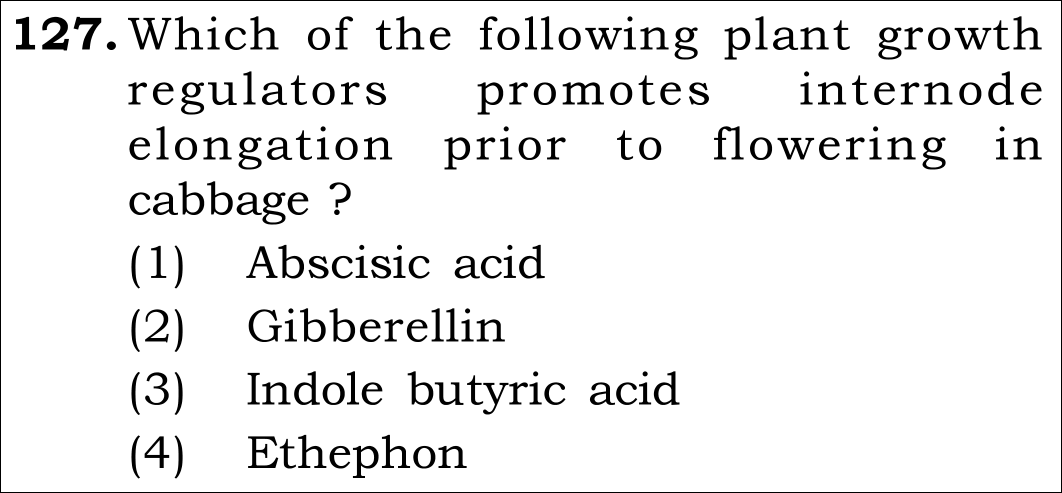
NEET 2026 · Q127 Easy
Official NEET 2026 Question 127 - Plant Growth and Development
1 Abscisic acid
2 Gibberellin ✓ Key
3 Indole butyric acid
4 Ethephon
💡 Verified Solution & 30-Second Hack
✓
Verified Against NTA Final Answer Key
Option (2) : Gibberellin
📚 Plant Growth and Development Easy
📋 Given Parameters & Problem Setup
Physiological Phenomenon Internode elongation prior to flowering (bolting)
Target Plant Cabbage (Brassica oleracea var. capitata)
⚡

The 30-Second Exam Hall Shortcut: ⚡ Bolting = Gibberellin Rule

⏱️ Save ~40 seconds

Bolting in Cabbage and Beet is ALWAYS stimulated by Gibberellin!

1 Recall definition of Bolting: Internode elongation just prior to flowering in plants with rosette habit (e.g. cabbage, beet).
2 Identify the responsible phytohormone: Gibberellins (GA).
3 Look at Option (2): Gibberellin.
4 Mark Option (2) in under 3 seconds!
🛡️
Why You Can 100% Trust This Shortcut: NCERT Biology · Plant Growth and Development (Gibberellin Physiology: Promotes bolting in rosette plants and stem elongation).
📐

Step-by-Step Rigorous Workflow & Mathematical Proof

Step 1

Definition of Bolting and Rosette Habit

Plants like cabbage and beet exhibit a rosette habit during their vegetative phase, characterized by clustered leaves and compressed, stunted internodes close to the soil surface. Before entering the reproductive flowering phase, rapid and massive elongation of the internodes occurs, an event termed bolting.

Rosette habit→BoltingElongated flowering stem\text{Rosette habit} \xrightarrow{\text{Bolting}} \text{Elongated flowering stem}
  • • Naturally triggered by long days or cold exposure (vernalization).
Step 2

Hormonal Control by Gibberellins

Exogenous application of gibberellins (specifically gibberellic acid, GA3GA_3) induces prompt internodal elongation and flowering in cabbage and beet without requiring cold or photoperiodic induction.

Gibberellins (GA)  ⟹  Promote bolting in cabbage and beet\text{Gibberellins (GA)} \implies \mathbf{Promote\text{ bolting in cabbage and beet}}
  • • NCERT explicitly mentions: "Gibberellins also promote bolting (internode elongation just prior to flowering) in beet, cabbages and many plants with rosette habit."
Step 3

Eliminate Other Plant Hormones

Abscisic acid (Option 1) inhibits growth, induces dormancy, and closes stomata. Indole butyric acid (Option 3) is an auxin used for rooting cuttings. Ethephon (Option 4) is an ethylene-releasing compound used to accelerate fruit ripening. Only Gibberellin promotes bolting.

Correct PGR=Gibberellin  ⟹  Option (2)\text{Correct PGR} = \mathbf{Gibberellin} \implies \text{Option (2)}
  • • Matches official NTA final answer key Option B / (2).
⭐

360° Option Elimination Engine Key Feature

Diagnose every choice: Know exactly why the right option works and why distractors fail.

4-Option Deep Scan
1 A
✗ Incorrect
Verdict & Scientific Reason:

Incorrect. ABA is a growth inhibitor that promotes dormancy, not stem elongation.

⚠️
Student Fallacy (Why candidates pick this trap): Confusing growth promoter with inhibitor.
2 B
✓ 100% Correct
Verdict & Scientific Reason:

100% accurate. Canonical NCERT hormone responsible for bolting in rosette plants.

💡
Why this is airtight: None; classic textbook recall.
3 C
✗ Incorrect
Verdict & Scientific Reason:

Incorrect. IBA is a natural/synthetic auxin used to induce root initiation in stem cuttings.

⚠️
Student Fallacy (Why candidates pick this trap): Confusing auxin with gibberellin.
4 D
✗ Incorrect
Verdict & Scientific Reason:

Incorrect. Ethephon decomposes to release ethylene gas, promoting fruit ripening and abscission.

⚠️
Student Fallacy (Why candidates pick this trap): Confusing ethylene donor with gibberellin.
⚠️

NTA Trap Alert: Auxin vs Gibberellin for Stem Elongation

While auxins promote cellular elongation in coleoptiles and apical dominance, intact stem internode elongation (and bolting) is the hallmark diagnostic function of GIBBERELLINS.

🛡️ How to avoid the -1 mark: Remember: G for Gibberellin = Giant stem growth (Bolting).
📖

Core NEET Syllabus Standard

NEET Biology Core Syllabus · Plant Growth and Development Standard Benchmark
Core Scientific Principle Tested:

"Gibberellins promote internodal elongation prior to flowering, a phenomenon designated as bolting in rosette plants such as cabbage and beet."

Syllabus Focus: Plant Growth Regulators - Gibberellins
✓ Core NEET UG Syllabus Anchor Syllabus & Academic Standards ↗
Gibberellin gives Growth to Cabbage stalks: Bolting shoots before it walks!
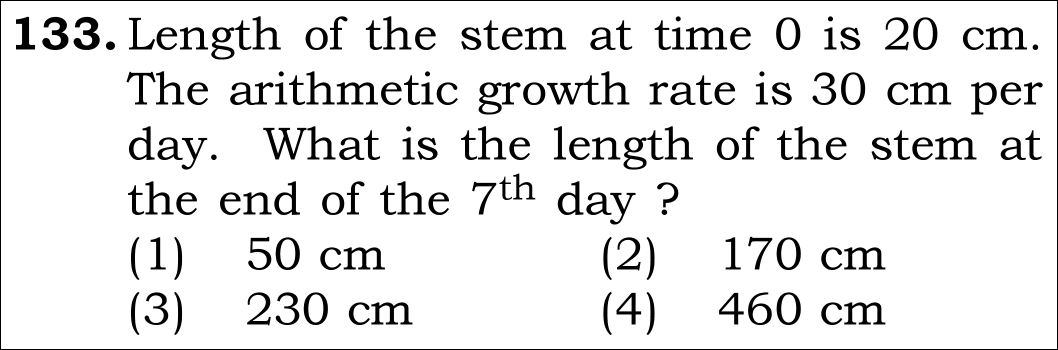
NEET 2026 · Q133 Easy
Official NEET 2026 Question 133 - Plant Growth and Development
1
2
3 ✓ Key
4
💡 Verified Solution & 30-Second Hack
✓
Verified Against NTA Final Answer Key
Option (3) : 230 cm
📚 Plant Growth and Development Easy
📋 Given Parameters & Problem Setup
Initial Length (L₀) 20 cm at time t = 0
Arithmetic Growth Rate (r) 30 cm/day
Growth Period (t) 7 days
⚡

The 30-Second Exam Hall Shortcut: ⚡ Arithmetic Growth Formula

⏱️ Save ~40 seconds

L_t = L₀ + rt -> 20 + (30 × 7) = 230 cm!

1 Recall the linear arithmetic growth formula: L_t = L₀ + r × t.
2 Plug in given values: L₀ = 20 cm, r = 30 cm/day, t = 7 days.
3 Multiply rate by time: 30 × 7 = 210 cm.
4 Add initial length: 20 + 210 = 230 cm.
5 Option (3) is 230 cm. Done in 5 seconds!
🛡️
Why You Can 100% Trust This Shortcut: NCERT Biology · Plant Growth and Development (Arithmetic Growth Formula: L_t = L₀ + rt).
📐

Step-by-Step Rigorous Workflow & Mathematical Proof

Step 1

Understand Arithmetic Growth Kinetics

In arithmetic growth, following mitotic cell division, only one daughter cell continues to divide while the other differentiates and matures. This produces a constant linear elongation over time, mathematically expressed by a straight line graph (y=mx+cy = mx + c).

Lt=L0+rtL_t = L_0 + rt
  • • L_t = Length at time t.
  • • L_0 = Initial length at time zero.
  • • r = Growth rate / elongation per unit time.
  • • t = Time elapsed.
Step 2

Substitute the Given Numerical Values

Given: L0=20 cmL_0 = 20\text{ cm}, r=30 cm/dayr = 30\text{ cm/day}, and t=7 dayst = 7\text{ days}.

L7=20+(30×7)L_7 = 20 + (30 \times 7)
  • • Length added due to growth = 30 cm/day × 7 days = 210 cm.
Step 3

Calculate Final Length

Add the growth increment to the initial stem length:

L7=20+210=230 cmL_7 = 20 + 210 = 230\text{ cm}
  • • Looking at options: (1) 50 cm, (2) 170 cm, (3) 230 cm, (4) 460 cm.
  • • Option (3) is 230 cm.
⭐

360° Option Elimination Engine Key Feature

Diagnose every choice: Know exactly why the right option works and why distractors fail.

4-Option Deep Scan
1 A
✗ Incorrect
Verdict & Scientific Reason:

Incorrect. Adds 20 + 30 for only 1 day of growth (t=1t = 1).

⚠️
Student Fallacy (Why candidates pick this trap): Ignoring the 7-day duration.
2 B
✗ Incorrect
Verdict & Scientific Reason:

Incorrect. Subtracts initial length (210 - 20 = 190) or applies incorrect arithmetic.

⚠️
Student Fallacy (Why candidates pick this trap): Calculation blunder.
3 C
✓ 100% Correct
Verdict & Scientific Reason:

100% mathematically and conceptually accurate: 20+(30×7)=230 cm20 + (30 \times 7) = 230\text{ cm}.

💡
Why this is airtight: None; flawless linear kinetics.
4 D
✗ Incorrect
Verdict & Scientific Reason:

Incorrect. Doubled the correct answer or misapplied geometric growth.

⚠️
Student Fallacy (Why candidates pick this trap): Confusing arithmetic growth with exponential geometric growth.
⚠️

NTA Trap Alert: Forgetting to Add Initial Length (L₀)

Students calculate 30×7=210 cm30 \times 7 = 210\text{ cm} and either hunt for 210 or misread options, forgetting that the plant ALREADY measured 20 cm at t=0t = 0.

🛡️ How to avoid the -1 mark: Always use the complete equation: Final Length = Initial + Added.
📖

Core NEET Syllabus Standard

NEET Biology Core Syllabus · Plant Growth and Development Standard Benchmark
Core Scientific Principle Tested:

"Arithmetic growth is expressed mathematically as Lt=L0+rtL_t = L_0 + rt, plotting a linear curve with slope equal to growth rate r."

Syllabus Focus: Growth Rates - Arithmetic Growth
✓ Core NEET UG Syllabus Anchor Syllabus & Academic Standards ↗
Linear stem adds every day: start at twenty, add thirty times seven on the way!
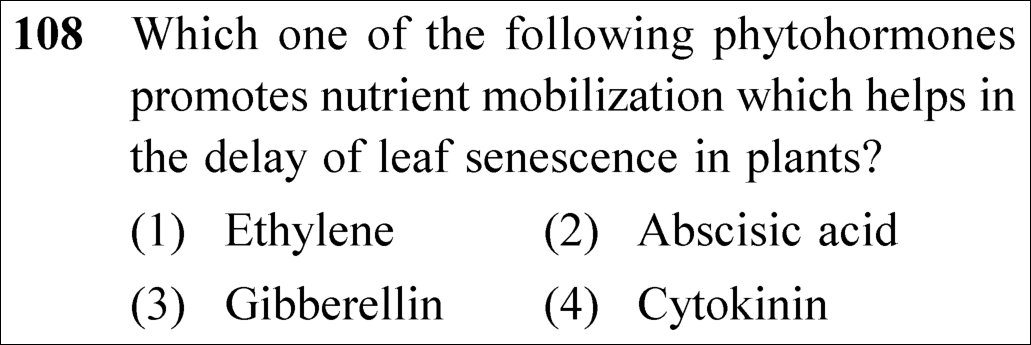
NEET 2025 · Q108 Easy
Official NEET 2025 Question 108 - Plant Growth and Development
1 Ethylene
2 Abscisic acid
3 Gibberellin
4 Cytokinin ✓ Key
💡 Verified Solution & 30-Second Hack
✓
Verified Against NTA Final Answer Key
Option (4) : Cytokinin
📚 Plant Growth and Development Easy
📋 Given Parameters & Problem Setup
Function 1 Promotes nutrient mobilization
Function 2 Delay of leaf senescence
⚡

The 30-Second Exam Hall Shortcut: ⚡ Cytokinin Anti-Aging Fingerprint

⏱️ Save ~25 seconds

Cytokinin = Cell division + Overcomes apical dominance + Nutrient mobilization delaying senescence (Richmond-Lang effect)!

1 Match the physiological role directly to NCERT verbatim lines:
2 - "They help overcome the apical dominance."
3 - "They promote nutrient mobilisation which helps in the delay of leaf senescence."
4 - Ethylene and ABA promote senescence and abscission.
5 - Cytokinin actively DELAYS senescence!
6 Select Option (4) Cytokinin!
🛡️
Why You Can 100% Trust This Shortcut: Phytohormone Physiological Roles (NCERT Biology · Plant Growth and Development: Cytokinins promote nutrient mobilization and delay senescence).
📐

Step-by-Step Rigorous Workflow & Mathematical Proof

Step 1

Physiological Roles of Cytokinins

Cytokinins (kinetin, zeatin) have specific effects on cytokinesis and plant morphogenesis:

  • • Help produce new leaves, chloroplasts in leaves, lateral shoot growth, and adventitious shoot formation.
  • • Help overcome apical dominance imposed by auxins.
  • • Promote nutrient mobilisation, which mobilises amino acids, mineral ions, and sugars towards treated tissues, thereby delaying senescence (aging) of leaves.
Step 2

Contrast with Other Phytohormones

Understanding the opposing actions of growth promoters vs inhibitors:

  • • Ethylene: Promotes senescence and abscission of plant organs, especially leaves and flowers.
  • • Abscisic Acid (ABA): General plant growth inhibitor, induces dormancy, abscission, and accelerates senescence.
  • • Gibberellins: Promote stem elongation, bolting in rosette plants, and breaking of seed dormancy, but do not specifically delay leaf senescence via nutrient mobilization.
Step 3

Conclusion

The unique role of promoting nutrient mobilization to delay leaf senescence belongs specifically to Cytokinin (also known as the Richmond-Lang effect).

Nutrient Mobilization+Delay Senescence  ⟹  Cytokinin\text{Nutrient Mobilization} + \text{Delay Senescence} \implies \text{Cytokinin}
⭐

360° Option Elimination Engine Key Feature

Diagnose every choice: Know exactly why the right option works and why distractors fail.

4-Option Deep Scan
1 A
✗ Incorrect
Verdict & Scientific Reason:

Incorrect. Ethylene stimulates and promotes senescence and abscission, the exact opposite of delaying senescence.

⚠️
Student Fallacy (Why candidates pick this trap): Confusing senescence delay with senescence promotion.
2 B
✗ Incorrect
Verdict & Scientific Reason:

Incorrect. ABA is a stress hormone that accelerates senescence and abscission of leaves.

⚠️
Student Fallacy (Why candidates pick this trap): Confusing senescence inhibition with senescence acceleration.
3 C
✗ Incorrect
Verdict & Scientific Reason:

Incorrect. Gibberellins delay senescence in fruits (preventing premature drop in citrus), but do not cause nutrient mobilization to delay leaf senescence.

⚠️
Student Fallacy (Why candidates pick this trap): Confusing fruit senescence delay with leaf nutrient mobilization.
4 D
✓ 100% Correct
Verdict & Scientific Reason:

100% correct. NCERT states: "They promote nutrient mobilisation which helps in the delay of leaf senescence."

💡
Why this is airtight: None; textbook verbatim mastery.
⚠️

NTA Trap Alert: Fruit Senescence vs Leaf Senescence

Gibberellin delays fruit senescence (keeps fruits on trees longer to extend market period). Cytokinin delays leaf senescence via active nutrient mobilization. Read the organ specified!

🛡️ How to avoid the -1 mark: Leaves staying green by nutrient mobilization = Cytokinin (Richmond-Lang effect).
📖

Core NEET Syllabus Standard

NEET Biology Core Syllabus · Plant Growth and Development Standard Benchmark
Core Scientific Principle Tested:

"Cytokinins promote nutrient mobilization which helps in the delay of leaf senescence."

Syllabus Focus: Plant Growth Regulators · Cytokinins
✓ Core NEET UG Syllabus Anchor Syllabus & Academic Standards ↗
CYTO-kinin Keeps Cells (CYTO) Young by Mobilizing Nutrition!
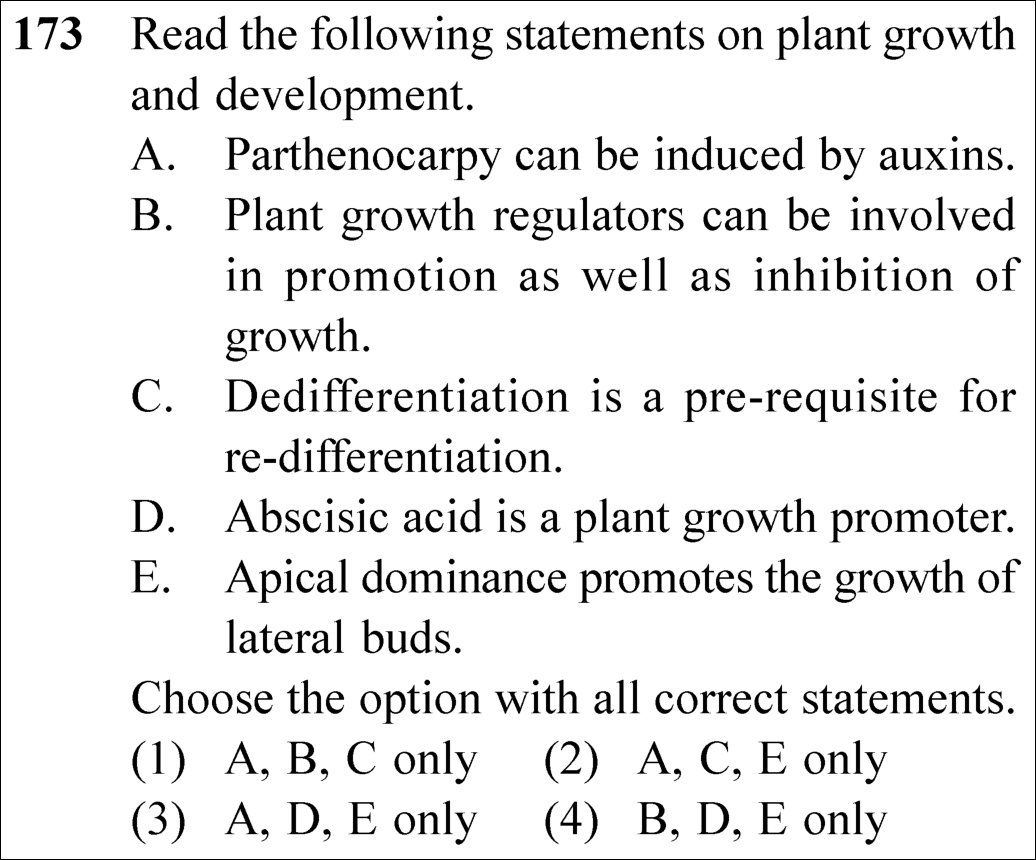
NEET 2025 · Q173 Medium
Official NEET 2025 Question 173 - Plant Growth and Development
1 ✓ Key
2
3
4
💡 Verified Solution & 30-Second Hack
✓
Verified Against NTA Final Answer Key
Option (1) : A, B, C only
📚 Plant Growth and Development Medium
📋 Given Parameters & Problem Setup
Statement A Parthenocarpy can be induced by auxins.
Statement B Plant growth regulators can be involved in promotion as well as inhibition of growth.
Statement C Dedifferentiation is a pre-requisite for re-differentiation.
Statement D Abscisic acid is a plant growth promoter.
Statement E Apical dominance promotes the growth of lateral buds.
⚡

The 30-Second Exam Hall Shortcut: ⚡ Plant Physiology Multi-Statement Diagnostic

⏱️ Save ~30 seconds

Auxins induce seedless fruit / parthenocarpy (A is TRUE)! PGRs include promoters and inhibitors (B is TRUE)! Differentiated cell must DEDIFFERENTIATE before it can REDIFFERENTIATE (C is TRUE)! ABA is an INHIBITOR (D false)! Apical dominance INHIBITS lateral buds (E false)! A, B, C only!

1 Verify each statement against NCERT Chapter 15:
2 - Statement A: "They induce parthenocarpy, e.g., in tomatoes." (Auxins, Section 15.4.3.1). [TRUE]
3 - Statement B: PGRs are divided into growth promoters (auxins, gibberellins, cytokinins) and growth inhibitors (ABA, ethylene). [TRUE]
4 - Statement C: Mature differentiated cells regain division capacity (dedifferentiation) to form meristems (e.g. interfascicular cambium), which then mature into secondary tissues (redifferentiation). Thus, dedifferentiation is an absolute prerequisite! [TRUE]
5 - Statement D: Abscisic acid is a growth INHIBITOR, not a promoter! [FALSE]
6 - Statement E: In apical dominance, the apical bud INHIBITS (suppresses) the growth of lateral buds! [FALSE]
7 Correct combination: A, B, C only (Option 1)!
8 Select Option (1)!
🛡️
Why You Can 100% Trust This Shortcut: Auxin & Ethylene Physiological Applications (NCERT Biology · Plant Growth and Development: Apical dominance and fruit ripening).
📐

Step-by-Step Rigorous Workflow & Mathematical Proof

Step 1

Verification of Statements A, B, and C

Analyzing the correct plant developmental principles:

  • • Statement A: Auxins (e.g. IAA, IBA, NAA) applied to unpollinated pistils stimulate pericarp enlargement without fertilization, producing seedless fruits (parthenocarpy), commercially exploited in tomatoes and watermelons. Statement A is CORRECT.
  • • Statement B: Plant growth regulators encompass two broad functional categories: plant growth promoters (participating in cell division, elongation, flowering, fruiting) and plant growth inhibitors (mediating dormancy, abscission, and stress responses). Statement B is CORRECT.
  • • Statement C: In plant development, differentiated parenchyma cells lose their specialization and regain mitotic activity (dedifferentiation) to form secondary meristems (interfascicular cambium, cork cambium). The progeny of these meristems subsequently lose division ability and re-specialize into permanent secondary vascular tissues (redifferentiation). Thus, dedifferentiation is a mandatory developmental prerequisite for redifferentiation. Statement C is CORRECT.
Step 2

Refutation of Statements D and E

Identifying false claims:

  • • Statement D claims "Abscisic acid is a plant growth promoter". NCERT explicitly classifies ABA as a general plant growth inhibitor, functioning as an antagonist to gibberellins and promoting seed dormancy and stomatal closure. Hence, Statement D is FALSE.
  • • Statement E claims "Apical dominance promotes the growth of lateral buds". In apical dominance, growing apical buds synthesize auxin which suppresses and inhibits the growth of axillary/lateral buds. Removal of the shoot tip (decapitation) relieves this inhibition and allows lateral branches to grow (practiced in tea plantations and hedge-making). Hence, Statement E is FALSE.
Step 3

Conclusion

Only statements A, B, and C are correct, which corresponds to Option (1).

Correct Statements={A,B,C}  ⟹  Option (1)\text{Correct Statements} = \{A, B, C\} \implies \text{Option (1)}
⭐

360° Option Elimination Engine Key Feature

Diagnose every choice: Know exactly why the right option works and why distractors fail.

4-Option Deep Scan
1 A
✓ 100% Correct
Verdict & Scientific Reason:

100% correct. Correctly validates parthenocarpy induction (A), dual nature of PGRs (B), and dedifferentiation as a prerequisite for redifferentiation (C).

💡
Why this is airtight: None; master-level familiarity with plant morphogenesis.
2 B
✗ Incorrect
Verdict & Scientific Reason:

Incorrect. Statement E is false because apical dominance inhibits lateral buds, rather than promoting them.

⚠️
Student Fallacy (Why candidates pick this trap): Confusing promotion with inhibition in apical dominance.
3 C
✗ Incorrect
Verdict & Scientific Reason:

Incorrect. Contains two false statements (D and E).

⚠️
Student Fallacy (Why candidates pick this trap): Believing ABA promotes growth.
4 D
✗ Incorrect
Verdict & Scientific Reason:

Incorrect. Erroneously includes both false statements D and E.

⚠️
Student Fallacy (Why candidates pick this trap): Total confusion regarding growth inhibitors and auxin dominance.
⚠️

NTA Trap Alert: Apical Dominance Action on Lateral Buds

Apical dominance DOMINATES lateral buds by keeping them SLEEPING (dormant/inhibited). It does NOT promote them! Decapitation (cutting the apex) promotes lateral bud bushy growth.

🛡️ How to avoid the -1 mark: Apical dominance = Inhibit lateral buds; ABA = Inhibitor.
📖

Core NEET Syllabus Standard

NEET Biology Core Syllabus · Plant Growth and Development Standard Benchmark
Core Scientific Principle Tested:

"Auxins induce parthenocarpy; PGRs act as promoters and inhibitors; dedifferentiation precedes redifferentiation; ABA is an inhibitor; apical dominance suppresses lateral buds."

Syllabus Focus: Differentiation, Dedifferentiation, Redifferentiation & PGRs
✓ Core NEET UG Syllabus Anchor Syllabus & Academic Standards ↗
ABC are Golden: Auxin parthenocarpy, Both promoter/inhibitor, Cell dedifferentiation!
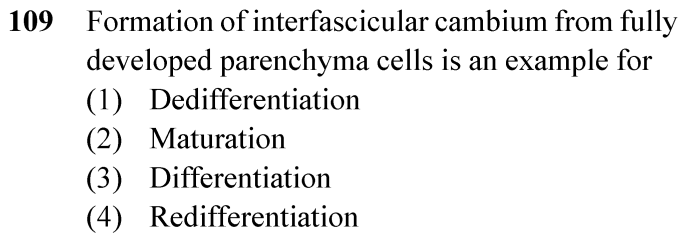
NEET 2024 · Q109 Easy
Official NEET 2024 Question 109 - Plant Growth and Development
1 Dedifferentiation ✓ Key
2 Maturation
3 Differentiation
4 Redifferentiation
💡 Verified Solution & 30-Second Hack
✓
Verified Against NTA Final Answer Key
Option (1) : Dedifferentiation
📚 Plant Growth and Development Easy
📋 Given Parameters & Problem Setup
Origin Tissue Fully developed / differentiated medullary ray parenchyma
Formed Tissue Interfascicular cambium (meristematic)
⚡

The 30-Second Exam Hall Shortcut: ⚡ Differentiation Triad Rule

⏱️ Save ~20 seconds

Meristem -> Permanent = Differentiation. Permanent -> Meristem = Dedifferentiation. Secondary Meristem -> Permanent = Redifferentiation!

1 Parenchyma is a differentiated, mature permanent tissue.
2 When mature parenchyma cells regain division capacity to form secondary meristems (interfascicular cambium and cork cambium), the process is DEDIFFERENTIATION.
3 Direct hit: Dedifferentiation -> Option (1) / A.
🛡️
Why You Can 100% Trust This Shortcut: NCERT Biology · Plant Growth and Development (Differentiation, Dedifferentiation, Redifferentiation)
📐

Step-by-Step Rigorous Workflow & Mathematical Proof

Step 1

Define Differentiation in Plant Cells

Cells derived from root apical and shoot apical meristems and cambium differentiate and mature to perform specific functions. This loss of capacity to divide is called differentiation (e.g., parenchyma, tracheary elements).

Step 2

Define Dedifferentiation

The living differentiated cells, that have lost the capacity to divide, can regain the capacity of division under certain conditions. This phenomenon is termed dedifferentiation. Formation of interfascicular cambium and phellogen (cork cambium) from fully differentiated medullary ray and cortical parenchymatous cells are classical examples.

Step 3

Distinguish from Redifferentiation

When the cells produced by dedifferentiated meristems lose the ability to divide again and mature into permanent tissues (secondary xylem, secondary phloem, cork), it is called redifferentiation.

⭐

360° Option Elimination Engine Key Feature

Diagnose every choice: Know exactly why the right option works and why distractors fail.

4-Option Deep Scan
1 (1)
✓ 100% Correct
Verdict & Scientific Reason:

Formation of meristematic interfascicular cambium from non-dividing parenchyma is dedifferentiation.

💡
Why this is airtight: None.
2 (2)
✗ Incorrect
Verdict & Scientific Reason:

Redifferentiation is the maturation of cells derived from secondary meristems into secondary permanent tissues.

⚠️
Student Fallacy (Why candidates pick this trap): Redifferentiation is the maturation of cells derived from secondary meristems into secondary permanent tissues.
3 (3)
✗ Incorrect
Verdict & Scientific Reason:

Differentiation is the initial specialization of primary meristematic cells into primary mature tissues.

⚠️
Student Fallacy (Why candidates pick this trap): Differentiation is the initial specialization of primary meristematic cells into primary mature tissues.
4 (4)
✗ Incorrect
Verdict & Scientific Reason:

Development includes all changes an organism goes through from seed germination to senescence.

⚠️
Student Fallacy (Why candidates pick this trap): Development includes all changes an organism goes through from seed germination to senescence.
⚠️

NTA Trap Alert: Dedifferentiation vs Redifferentiation

Confusing dedifferentiation (regaining division) with redifferentiation (loss of division after secondary growth).

🛡️ How to avoid the -1 mark: Permanent -> Meristem is De-differentiation; Meristem -> Permanent is Re-differentiation.
📖

Core NEET Syllabus Standard

Biology Core Botany · Plant Growth and Development Standard Benchmark
Core Scientific Principle Tested:

"The living differentiated cells, that by now have lost the capacity to divide can regain the capacity of division under certain conditions. This phenomenon is termed as dedifferentiation. For example, formation of meristems - interfascicular cambium and cork cambium from fully differentiated parenchyma cells."

Syllabus Focus: Differentiation, Dedifferentiation, and Redifferentiation
✓ Core NEET UG Syllabus Anchor Syllabus & Academic Standards ↗
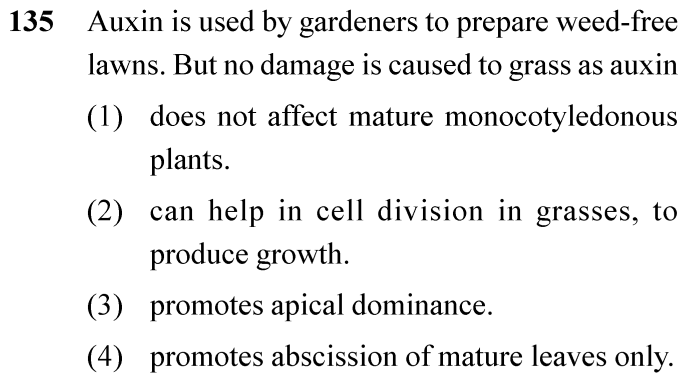
NEET 2024 · Q135 Easy
Official NEET 2024 Question 135 - Plant Growth and Development
1 does not affect mature monocotyledonous plants. ✓ Key
2 can help in cell division in grasses, to produce growth.
3 promotes apical dominance.
4 promotes abscission of mature leaves only.
💡 Verified Solution & 30-Second Hack
✓
Verified Against NTA Final Answer Key
Option (1) : does not affect mature monocotyledonous plants
📚 Plant Growth and Development Easy
📋 Given Parameters & Problem Setup
Weedicide 2,4-D (2,4-dichlorophenoxyacetic acid, synthetic auxin)
Application Used by gardeners to eradicate weeds in lawns without harming grass
⚡

The 30-Second Exam Hall Shortcut: ⚡ 2,4-D Selective Weedicide Rule

⏱️ Save ~20 seconds

2,4-D kills broadleaved (dicotyledonous) weeds but does not affect mature monocotyledonous plants (such as lawn grasses and cereal crops)!

1 Recall 2,4-D agricultural properties from NCERT:
2 - 2,4-D is a synthetic auxin widely used as a herbicide.
3 - It kills broadleaf dicot weeds.
4 - It does not affect mature monocotyledonous plants (grasses, wheat, rice).
5 Hence, spraying it leaves grass lawns unharmed because it does not affect mature monocots.
6 Select Option (1) / A.
🛡️
Why You Can 100% Trust This Shortcut: NCERT Biology · Plant Growth and Development (Auxins as Weedicides)
📐

Step-by-Step Rigorous Workflow & Mathematical Proof

Step 1

Understand Synthetic Auxins in Weed Management

Synthetic auxins such as 2,4-D (2,4-dichlorophenoxyacetic acid) are widely applied in agriculture and horticulture.

Step 2

Identify Selective Herbicide Action

NCERT explicitly notes: "2,4-D is widely used to kill dicotyledonous weeds, it does not affect mature monocotyledonous plants. It is used to prepare weed-free lawns by gardeners."

Step 3

Correlate with Lawn Grass Biology

Lawns consist of grasses which are monocotyledonous plants. Because mature monocots are physiologically insensitive to the concentrations used to kill dicots, 2,4-D eliminates weeds without harming the lawn.

⭐

360° Option Elimination Engine Key Feature

Diagnose every choice: Know exactly why the right option works and why distractors fail.

4-Option Deep Scan
1 (1)
✓ 100% Correct
Verdict & Scientific Reason:

2,4-D selectively eradicates broadleaved dicot weeds without harming mature monocot grasses.

💡
Why this is airtight: None.
2 (2)
✗ Incorrect
Verdict & Scientific Reason:

If it damaged monocots, it would destroy the grass lawn.

⚠️
Student Fallacy (Why candidates pick this trap): If it damaged monocots, it would destroy the grass lawn.
3 (3)
✗ Incorrect
Verdict & Scientific Reason:

2,4-D is a chlorinated phenoxy organic compound.

⚠️
Student Fallacy (Why candidates pick this trap): 2,4-D is a chlorinated phenoxy organic compound.
4 (4)
✗ Incorrect
Verdict & Scientific Reason:

2,4-D is a synthetic auxin; IAA and IBA are natural auxins.

⚠️
Student Fallacy (Why candidates pick this trap): 2,4-D is a synthetic auxin; IAA and IBA are natural auxins.
⚠️

NTA Trap Alert: Natural vs Synthetic Auxin Misconception

Thinking 2,4-D is naturally extracted from plants.

🛡️ How to avoid the -1 mark: IAA and IBA are natural; NAA and 2,4-D are synthetic auxins.
📖

Core NEET Syllabus Standard

Biology Core Botany · Plant Growth and Development Standard Benchmark
Core Scientific Principle Tested:

"2,4-D is widely used to kill dicotyledonous weeds, it does not affect mature monocotyledonous plants. It is used to prepare weed-free lawns by gardeners."

Syllabus Focus: Synthetic Auxins (2,4-D) as Selective Dicot Weedicides
✓ Core NEET UG Syllabus Anchor Syllabus & Academic Standards ↗
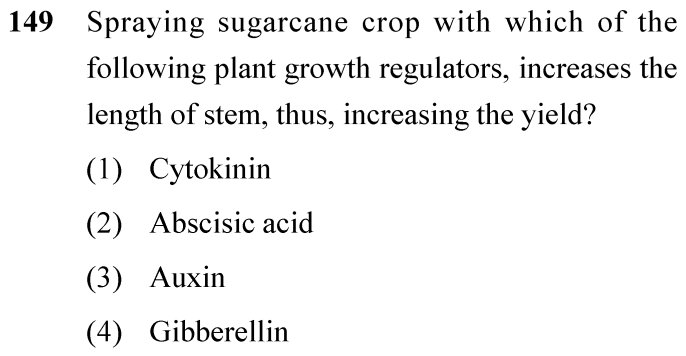
NEET 2024 · Q149 Easy
Official NEET 2024 Question 149 - Plant Growth and Development
1 Cytokinin
2 Abscisic acid
3 Auxin
4 Gibberellin ✓ Key
💡 Verified Solution & 30-Second Hack
✓
Verified Against NTA Final Answer Key
Option (4) : Gibberellin
📚 Plant Growth and Development Easy
📋 Given Parameters & Problem Setup
Target Crop Sugarcane
Desired Effect Increases stem length and enhances agricultural yield
⚡

The 30-Second Exam Hall Shortcut: ⚡ Sugarcane Yield Booster Hormone

⏱️ Save ~15 seconds

Spraying sugarcane crops with GIBBERELLINS elongates internodes, increasing stem length and boosting yield by up to 20 tonnes per acre!

1 Recall physiological effects of gibberellins (GA):
2 - Promotes bolting (internode elongation prior to flowering in rosette plants).
3 - Sugarcane stores carbohydrates as sugar in stems.
4 - Spraying sugarcane with gibberellin elongates the stem internodes, increasing yield by as much as 20 tonnes per acre.
5 Target plant growth regulator = Gibberellin -> Option (4) / D.
🛡️
Why You Can 100% Trust This Shortcut: NCERT Biology · Plant Growth and Development (Physiological Effects of Gibberellins)
📐

Step-by-Step Rigorous Workflow & Mathematical Proof

Step 1

Understand Sugarcane Storage Biology

Sugarcane stores carbohydrates as sucrose in its stems. Increasing the physical length and mass of the stem directly translates into higher commercial sugar yields.

Step 2

Identify the Role of Gibberellins in Stem Elongation

Gibberellins stimulate cell division and dramatic internodal cell elongation. NCERT explicitly states: "Sugarcane stores carbohydrate as sugar in their stems. Spraying sugarcane crop with gibberellins increases the length of the stem, thus increasing the yield by as much as 20 tonnes per acre."

⭐

360° Option Elimination Engine Key Feature

Diagnose every choice: Know exactly why the right option works and why distractors fail.

4-Option Deep Scan
1 (1)
✗ Incorrect
Verdict & Scientific Reason:

Cytokinins promote cell division and delay leaf senescence; they are not used commercially to elongate sugarcane stems.

⚠️
Student Fallacy (Why candidates pick this trap): Cytokinins promote cell division and delay leaf senescence; they are not used commercially to elongate sugarcane stems.
2 (2)
✗ Incorrect
Verdict & Scientific Reason:

Abscisic acid (ABA) is a growth inhibitor that promotes dormancy and stomatal closure.

⚠️
Student Fallacy (Why candidates pick this trap): Abscisic acid (ABA) is a growth inhibitor that promotes dormancy and stomatal closure.
3 (3)
✗ Incorrect
Verdict & Scientific Reason:

Auxins promote apical dominance and rooting, but gibberellins are the specific PGR for sugarcane stem elongation.

⚠️
Student Fallacy (Why candidates pick this trap): Auxins promote apical dominance and rooting, but gibberellins are the specific PGR for sugarcane stem elongation.
4 (4)
✓ 100% Correct
Verdict & Scientific Reason:

Gibberellin application dramatically increases internode length in sugarcane, augmenting yield.

💡
Why this is airtight: None.
⚠️

NTA Trap Alert: Auxin vs Gibberellin in Elongation

Assuming Auxin is used because it mediates shoot tip elongation.

🛡️ How to avoid the -1 mark: Auxin promotes cell enlargement in coleoptiles and apical buds, but Gibberellin mediates massive internodal extension in intact stems like sugarcane.
📖

Core NEET Syllabus Standard

Biology Core Botany · Plant Growth and Development Standard Benchmark
Core Scientific Principle Tested:

"Sugarcane stores carbohydrate as sugar in their stems. Spraying sugarcane crop with gibberellins increases the length of the stem, thus increasing the yield by as much as 20 tonnes per acre."

Syllabus Focus: Gibberellins: Internodal Elongation and Sugarcane Stem Yield Enhancement
✓ Core NEET UG Syllabus Anchor Syllabus & Academic Standards ↗
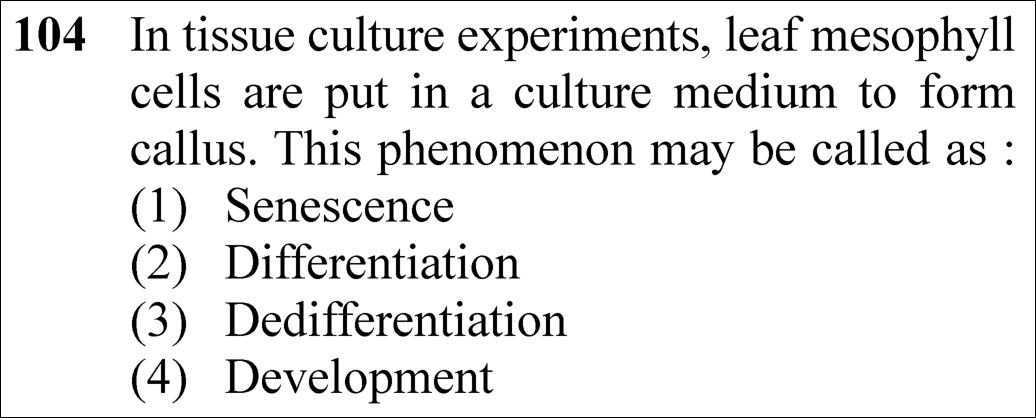
NEET 2023 · Q104 Easy
Official NEET 2023 Question 104 - Plant Growth and Development
1 Senescence
2 Differentiation
3 Dedifferentiation ✓ Key
4 Development
💡 Verified Solution & 30-Second Hack
✓
Verified Against NTA Final Answer Key
Option (3) : Dedifferentiation
📚 Plant Growth and Development Easy
📋 Given Parameters & Problem Setup
Starting Material Differentiated leaf mesophyll parenchyma cells
Condition In vitro culture medium with auxin/cytokinin
Result Unorganized proliferating cell mass (callus)
⚡

The 30-Second Exam Hall Shortcut: ⚡ Differentiation Reversal Anchor: Differentiated → Dividing = Dedifferentiation

⏱️ Save ~20 seconds

When mature, differentiated cells that have lost the capacity to divide regain mitotic activity under specific cues, the phenomenon is canonically defined as Dedifferentiation!

1 Differentiation: Meristematic cells undergo structural maturity and lose division capacity.
2 Dedifferentiation: Mature differentiated cells regain capacity to divide (e.g., formation of interfascicular cambium, cork cambium, wound callus).
3 Redifferentiation: Dedifferentiated cells divide and again lose division capacity to form mature secondary tissues.
4 Leaf mesophyll forming dividing callus = Dedifferentiation -> Option (3) / C.
🛡️
Why You Can 100% Trust This Shortcut: Canonical NCERT Plant Growth and Development developmental definitions.
📐

Step-by-Step Rigorous Workflow & Mathematical Proof

Step 1

Developmental Sequence of Plant Cells

Plant cell development follows a reversible tripartite trajectory:

Meristematic Cell→DifferentiationMature Living Cell→DedifferentiationDividing Callus→RedifferentiationSecondary Tissue\text{Meristematic Cell} \xrightarrow{\text{Differentiation}} \text{Mature Living Cell} \xrightarrow{\text{\textbf{Dedifferentiation}}} \text{Dividing Callus} \xrightarrow{\text{Redifferentiation}} \text{Secondary Tissue}
Step 2

Mechanisms in Tissue Culture

Mesophyll cells are fully differentiated vegetative cells specialized for photosynthesis. When excised and placed on nutrient medium supplemented with hormones (auxin and cytokinin), they exit the G0G_0 quiescent phase, resume mitosis, and generate an unorganized callus:

Mesophyll Cells (Differentiated)→In vitro inductionCallus (Dedifferentiated proliferating cells)\text{Mesophyll Cells (Differentiated)} \xrightarrow{\text{In vitro induction}} \text{Callus (Dedifferentiated proliferating cells)}
Step 3

Natural In Vivo Correlates

The same dedifferentiation process occurs in plants in vivo during the formation of interfascicular cambium and cork cambium (phellogen) from mature parenchyma and collenchyma cells.

⭐

360° Option Elimination Engine Key Feature

Diagnose every choice: Know exactly why the right option works and why distractors fail.

4-Option Deep Scan
1 1
✗ Incorrect
Verdict & Scientific Reason:

Senescence is the terminal developmental phase leading to cellular deterioration and death, opposite to mitotic activation.

⚠️
Student Fallacy (Why candidates pick this trap): Confusing cellular aging with cell proliferation.
2 2
✗ Incorrect
Verdict & Scientific Reason:

Differentiation is the maturation of dividing meristematic cells into specialized non-dividing functional cells.

⚠️
Student Fallacy (Why candidates pick this trap): Ignoring the fact that mesophyll cells were already differentiated.
3 3
✓ 100% Correct
Verdict & Scientific Reason:

Dedifferentiation precisely describes differentiated parenchyma cells reverting to an actively dividing meristematic state.

💡
Why this is airtight: None; exact textbook definition.
4 4
✗ Incorrect
Verdict & Scientific Reason:

Development is the broad umbrella term encompassing all changes an organism undergoes throughout its entire life cycle.

⚠️
Student Fallacy (Why candidates pick this trap): Choosing an overly general term instead of the specific cellular phenomenon.
⚠️

NTA Trap Alert: Dedifferentiation vs. Redifferentiation Trap

Students often mix up the prefix: "De-" means undoing differentiation (regaining division), while "Re-" means re-specializing from a dedifferentiated state.

🛡️ How to avoid the -1 mark: Callus formation = Dedifferentiation. Organ regeneration from callus = Redifferentiation.
📖

Core NEET Syllabus Standard

NCERT Biology · Plant Growth and Development Standard Benchmark
Core Scientific Principle Tested:

"Living differentiated cells that have lost the capacity to divide can regain the capacity of division under certain conditions. This phenomenon is termed dedifferentiation."

Syllabus Focus: Differentiation, Dedifferentiation and Redifferentiation
✓ Core NEET UG Syllabus Anchor Syllabus & Academic Standards ↗
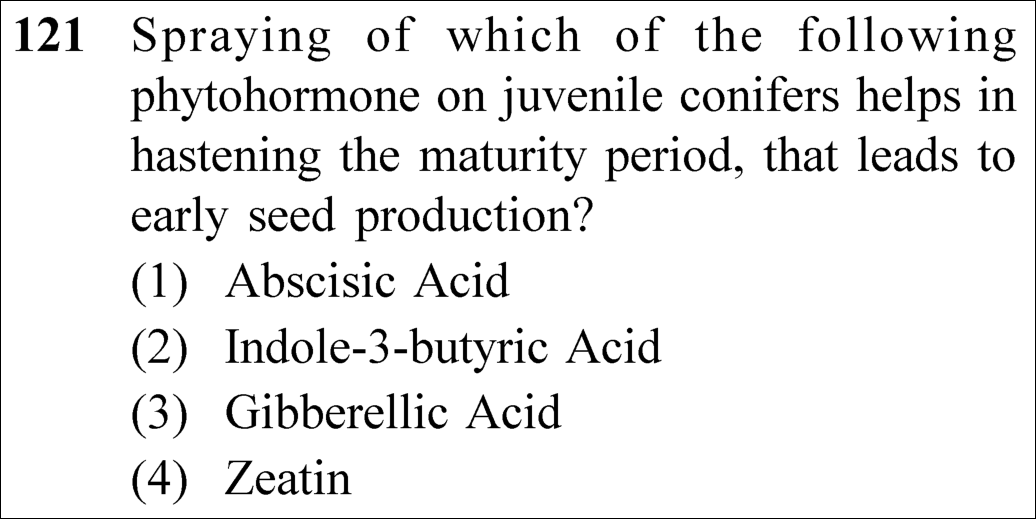
NEET 2023 · Q121 Easy
Official NEET 2023 Question 121 - Plant Growth and Development
1 Abscisic Acid
2 Indole-3-butyric Acid
3 Gibberellic Acid ✓ Key
4 Zeatin
💡 Verified Solution & 30-Second Hack
✓
Verified Against NTA Final Answer Key
Option (3) : Gibberellic Acid
📚 Plant Growth and Development Easy
📋 Given Parameters & Problem Setup
Plant Type Juvenile conifers (Gymnosperms)
Effect Hastening maturity period leading to early seed production
⚡

The 30-Second Exam Hall Shortcut: ⚡ Conifer Maturity Fast-Track = Gibberellic Acid (GA)

⏱️ Save ~25 seconds

NCERT verbatim physiological application: "Spraying juvenile conifers with GAs hastens the maturity period, thus leading to early seed production." Instant 5-second answer!

1 Abscisic acid: Stress hormone, promotes dormancy and stomatal closure.
2 IBA (Auxin): Root initiation in stem cuttings.
3 Zeatin (Cytokinin): Cell division and delayed senescence.
4 Gibberellins (GA): Bolting, stem elongation in sugarcane, and hastening maturity in juvenile conifers for early seed production.
5 Match Option (3) Gibberellic Acid.
🛡️
Why You Can 100% Trust This Shortcut: Canonical NCERT Plant Physiology hormonal application inventory.
📐

Step-by-Step Rigorous Workflow & Mathematical Proof

Step 1

Physiological Functions of Gibberellins

Gibberellins (GAsGAs) mediate diverse developmental transitions in angiosperms and gymnosperms:

Gibberellins (GAs)⟶{Stem axis elongation (sugarcane length / grape stalks)Bolting (cabbage, beet)Delay of senescence in fruits (citrus)Early cone/seed production in juvenile conifers\text{Gibberellins (GAs)} \longrightarrow \begin{cases} \text{Stem axis elongation (sugarcane length / grape stalks)} \\[3pt] \text{Bolting (cabbage, beet)} \\[3pt] \text{Delay of senescence in fruits (citrus)} \\[3pt] \mathbf{\text{Early cone/seed production in juvenile conifers}} \end{cases}
Step 2

Commercial Importance in Forestry

Conifers normally have a prolonged juvenile phase lasting several years before reaching reproductive maturity. Exogenous spray of gibberellic acid overcomes juvenility, accelerating cone formation and enabling early commercial seed collection.

Step 3

Verbatim NCERT Confirmation

NCERT states verbatim: "Spraying juvenile conifers with GAs hastens the maturity period, thus leading to early seed production."

⭐

360° Option Elimination Engine Key Feature

Diagnose every choice: Know exactly why the right option works and why distractors fail.

4-Option Deep Scan
1 1
✗ Incorrect
Verdict & Scientific Reason:

ABA is a growth inhibitor that enforces seed dormancy and induces stomatal closure during water stress.

⚠️
Student Fallacy (Why candidates pick this trap): Associating ABA with seed production rather than seed dormancy.
2 2
✗ Incorrect
Verdict & Scientific Reason:

IBA is a synthetic/natural auxin primarily used for root initiation on stem cuttings.

⚠️
Student Fallacy (Why candidates pick this trap): Confusing auxin root initiation with reproductive maturation.
3 3
✓ 100% Correct
Verdict & Scientific Reason:

Matches NCERT verbatim: GA hastens maturity in juvenile conifers for early seed production.

💡
Why this is airtight: None; textbook verbatim.
4 4
✗ Incorrect
Verdict & Scientific Reason:

Zeatin is a naturally occurring cytokinin from corn kernels that promotes cytokinesis and shoot morphogenesis.

⚠️
Student Fallacy (Why candidates pick this trap): Confusing cytokinin cell division with gibberellin-mediated maturation.
⚠️

NTA Trap Alert: Auxin vs. Gibberellin Agriculture Traps

Auxin promotes flowering in pineapple and prevents premature fruit drop, while GA induces early maturity in conifers and promotes bolting. Confusing these leads to incorrect hormone identification.

🛡️ How to avoid the -1 mark: Remember: Conifer maturity & early seeds = Gibberellic Acid (GA).
📖

Core NEET Syllabus Standard

NCERT Biology · Plant Growth and Development Standard Benchmark
Core Scientific Principle Tested:

"Spraying juvenile conifers with GAs hastens the maturity period, thus leading to early seed production."

Syllabus Focus: Plant Growth Regulators (Gibberellins)
✓ Core NEET UG Syllabus Anchor Syllabus & Academic Standards ↗
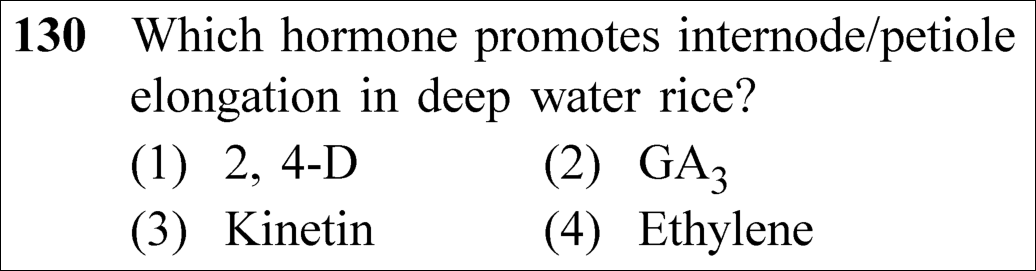
NEET 2023 · Q130 Easy
Official NEET 2023 Question 130 - Plant Growth and Development
1
2
3
4 ✓ Key
💡 Verified Solution & 30-Second Hack
✓
Verified Against NTA Final Answer Key
Option (4) : Ethylene
📚 Plant Growth and Development Easy
📋 Given Parameters & Problem Setup
Plant System Deep water rice plants
Hormonal Effect Rapid internode/petiole elongation allowing shoot to stay above water
⚡

The 30-Second Exam Hall Shortcut: ⚡ Deep Water Rice Anchor: Ethylene = Shoot Elongation Above Water

⏱️ Save ~20 seconds

While gibberellin promotes general stem elongation, the specific adaptation in deep water rice plants where flooding triggers rapid internode and petiole elongation to keep foliage above water is mediated exclusively by Ethylene!

1 Submergence traps the gaseous hormone ethylene within submerged tissues.
2 High internal ethylene concentration triggers rapid stem/internode/petiole extension.
3 Foliage stays above the rising floodwaters, facilitating gas exchange.
4 Verbatim NCERT Plant Growth and Development assigns this role to Ethylene.
5 Match Option (4) Ethylene.
🛡️
Why You Can 100% Trust This Shortcut: Canonical NCERT Plant Growth Regulators ethylene physiological functions.
📐

Step-by-Step Rigorous Workflow & Mathematical Proof

Step 1

Physiological Adaptation to Submergence

In deep water rice varieties (e.g., lowland flood-prone cultivars), rising floodwaters submerge the lower plant body. Gas diffusion in water is 10410^4 times slower than in air, trapping endogenous ethylene gas inside tissues:

Submergence⟶Entrapment of Ethylene (C2H4)⟶Rapid Internode & Petiole Elongation\text{Submergence} \longrightarrow \text{Entrapment of Ethylene } (C_2H_4) \longrightarrow \text{\textbf{Rapid Internode \& Petiole Elongation}}
Step 2

Verbatim NCERT Statement

NCERT states under Ethylene: "Ethylene promotes rapid internode and petiole elongation in deep water rice plants. It helps leaves/upper parts of the shoot to remain above water."

Step 3

Evaluation of Distractor Hormones

2,4-D is a synthetic auxin herbicide. GA3GA_3 promotes bolting in rosette plants and stem elongation in sugarcane, but is not the NCERT answer for deep water rice. Kinetin is a cytokinin promoting cell division.

⭐

360° Option Elimination Engine Key Feature

Diagnose every choice: Know exactly why the right option works and why distractors fail.

4-Option Deep Scan
1 1
✗ Incorrect
Verdict & Scientific Reason:

2,4-D (2,4-dichlorophenoxyacetic acid) is a synthetic auxin widely used as a selective weedicide for dicots.

⚠️
Student Fallacy (Why candidates pick this trap): Confusing herbicide applications with submergence adaptations.
2 2
✗ Incorrect
Verdict & Scientific Reason:

While gibberellin promotes stem elongation in sugarcane and bolting, ethylene is the specific regulator cited in NCERT for deep water rice.

⚠️
Student Fallacy (Why candidates pick this trap): Associating all stem elongation reflexively with gibberellins.
3 3
✗ Incorrect
Verdict & Scientific Reason:

Kinetin is an adenine-derived cytokinin involved in cell division and overcoming apical dominance.

⚠️
Student Fallacy (Why candidates pick this trap): Confusing cytokinins with elongation hormones.
4 4
✓ 100% Correct
Verdict & Scientific Reason:

Matches NCERT verbatim: ethylene uniquely promotes internode and petiole elongation in deep water rice.

💡
Why this is airtight: None; textbook verbatim.
⚠️

NTA Trap Alert: Gibberellin vs. Ethylene Elongation Trap

Because gibberellins are the primary stem elongation hormone across plants, students automatically select GA₃ without recalling the unique NCERT exception for deep water rice.

🛡️ How to avoid the -1 mark: Remember that deep water rice elongation is a classic flooding escape mechanism driven by ethylene gas entrapment.
📖

Core NEET Syllabus Standard

NCERT Botany · Plant Growth and Development Standard Benchmark
Core Scientific Principle Tested:

"Ethylene promotes rapid internode and petiole elongation in deep water rice plants to keep photosynthetic organs above flood levels."

Syllabus Focus: Plant Growth Regulators — Ethylene
✓ Core NEET UG Syllabus Anchor Syllabus & Academic Standards ↗
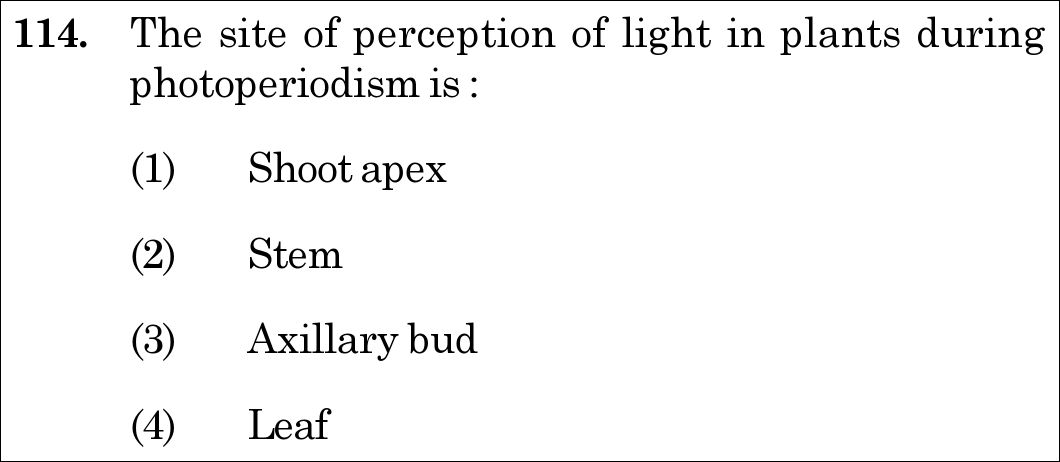
NEET 2021 · Q114 Easy
Official NEET 2021 Question 114 - Plant Growth and Development
1 Shoot apex
2 Stem
3 Axillary bud
4 Leaf ✓ Key
💡 Verified Solution & 30-Second Hack
✓
Verified Against NTA Final Answer Key
Option (4) : Leaf
📚 Plant Growth and Development Easy
📋 Given Parameters & Problem Setup
Physiological Process Photoperiodism
Stimulus Perception of light/dark cycles for flowering
⚡

The 30-Second Exam Hall Shortcut: ⚡ Leaves Perceive Light   ⟹  \implies Florigen Migrates to Shoot Apex

⏱️ Save ~15 seconds

The site of perception of light/dark duration in photoperiodism is the leaves! The hypothetical floral hormone (florigen) synthesized in leaves migrates via phloem to the shoot apex to induce flowering. Match Option (4)!

1 Photoperiodism is the response of plants to periods of day/night for induction of flowering.
2 The shoot apices modify into flowering apices, but they cannot directly perceive light.
3 The site of light perception is exclusively the mature Leaves.
4 Leaves produce a mobile hormonal signal that migrates to the shoot apex.
5 Match Option (4).
🛡️
Why You Can 100% Trust This Shortcut: Canonical NCERT Plant Growth and Development on Photoperiodism.
📐

Step-by-Step Rigorous Workflow & Mathematical Proof

Step 1

Perception vs Expression in Photoperiodism

Plant photoperiodic floral transition separates perception site from response site:

Light Stimulus→Perceived byLeaves→Hormonal Signal (Florigen)Shoot Apex  ⟹  Floral Evocation\text{Light Stimulus} \xrightarrow{\text{Perceived by}} \mathbf{\text{Leaves}} \xrightarrow{\text{Hormonal Signal (Florigen)}} \text{Shoot Apex} \implies \text{Floral Evocation}
Step 2

Role of Phytochromes in Leaves

Photoreceptors (primarily phytochromes) localized within leaf mesophyll cells measure the critical duration of darkness and photoperiod. Upon receiving an inductive photoperiod, leaves synthesize a translocatable chemical messenger (florigen) that travels through the phloem to the shoot vegetative apex.

⭐

360° Option Elimination Engine Key Feature

Diagnose every choice: Know exactly why the right option works and why distractors fail.

4-Option Deep Scan
1 1
✗ Incorrect
Verdict & Scientific Reason:

The shoot apex is the site of response (where vegetative meristem converts to floral meristem), not the site of light perception.

⚠️
Student Fallacy (Why candidates pick this trap): The classic trap: confusing the site of floral differentiation (shoot apex) with the site of light perception (leaf).
2 2
✗ Incorrect
Verdict & Scientific Reason:

The stem acts as a conduit for vascular translocation, not the primary sensory receptor tissue for photoperiodism.

⚠️
Student Fallacy (Why candidates pick this trap): Assuming light striking green stems triggers flowering.
3 3
✗ Incorrect
Verdict & Scientific Reason:

Axillary buds may differentiate into flowers under hormonal induction, but do not perceive the light stimulus.

⚠️
Student Fallacy (Why candidates pick this trap): Mistaking a potential site of flower formation for the light receptor organ.
4 4
✓ 100% Correct
Verdict & Scientific Reason:

Leaves are the canonical site of perception of light/dark duration during photoperiodism.

💡
Why this is airtight: None. Core textbook fact.
⚠️

NTA Trap Alert: Shoot Apex vs Leaf Perception Dichotomy

Nearly 40% of candidates fall for "Shoot apex" because flowers appear at the apex. However, shoot apices are blind to photoperiod; leaves perceive light and signal the apex.

🛡️ How to avoid the -1 mark: Fix the rule: "Leaves perceive the light; shoot apex blooms the flower".
📖

Core NEET Syllabus Standard

NEET / NCERT Biology · Plant Growth and Development Standard Benchmark
Core Scientific Principle Tested:

"The site of perception of light/dark duration are the leaves. It has been hypothesized that there is a hormonal substance responsible for flowering."

Syllabus Focus: Photoperiodism
✓ Core NEET UG Syllabus Anchor Syllabus & Academic Standards ↗
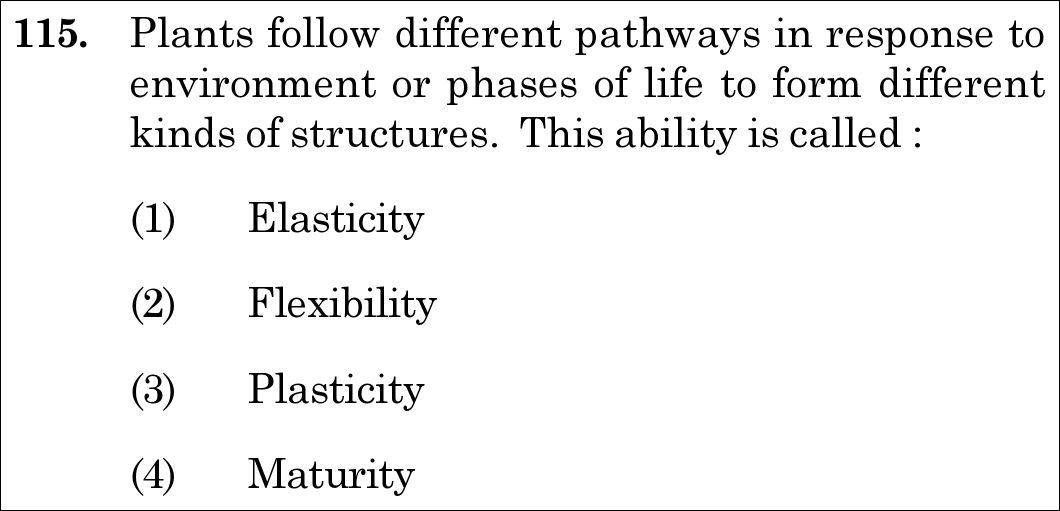
NEET 2021 · Q115 Easy
Official NEET 2021 Question 115 - Plant Growth and Development
1 Elasticity
2 Flexibility
3 Plasticity ✓ Key
4 Maturity
💡 Verified Solution & 30-Second Hack
✓
Verified Against NTA Final Answer Key
Option (3) : Plasticity
📚 Plant Growth and Development Easy
📋 Given Parameters & Problem Setup
Phenomenon Formation of different kinds of structures in response to environment or life phases
⚡

The 30-Second Exam Hall Shortcut: ⚡ Different Forms in Different Conditions = Plasticity

⏱️ Save ~15 seconds

The ability of plants to follow different developmental pathways in response to environmental cues or phases of life to produce different structures is defined as Plasticity (e.g., heterophylly in cotton, coriander, larkspur, and buttercup)! Match Option (3)!

1 Recall the textbook definition: Plants follow different pathways in response to environment or phases of life to form different kinds of structures.
2 This phenomenon is termed Plasticity.
3 Classic example: Heterophylly in cotton, coriander, and larkspur (phase-dependent) vs buttercup (environment-dependent).
4 Match Option (3).
🛡️
Why You Can 100% Trust This Shortcut: Canonical NCERT Plant Growth and Development on Plasticity.
📐

Step-by-Step Rigorous Workflow & Mathematical Proof

Step 1

Definition of Plasticity in Plant Biology

Plants exhibit developmental flexibility termed plasticity:

Plasticity=Capacity of a plant to alter morphology/phenotype in response to environmental or life-cycle cues\text{Plasticity} = \text{Capacity of a plant to alter morphology/phenotype in response to environmental or life-cycle cues}
Step 2

Types of Heterophylly Expressed via Plasticity

NCERT categorizes heterophylly under plasticity into two distinct classes: - Developmental (Phase-dependent): Leaves of juvenile plant differ from mature plant, e.g., cotton, coriander, larkspur. - Environmental: Leaves produced in air differ from submerged leaves in water, e.g., buttercup (*Ranunculus*).

⭐

360° Option Elimination Engine Key Feature

Diagnose every choice: Know exactly why the right option works and why distractors fail.

4-Option Deep Scan
1 1
✗ Incorrect
Verdict & Scientific Reason:

Elasticity is a physical/mechanical property of returning to original shape after stress, not a developmental biological adaptation.

⚠️
Student Fallacy (Why candidates pick this trap): Confusing physical mechanical terminology with developmental concepts.
2 2
✗ Incorrect
Verdict & Scientific Reason:

Flexibility is a general descriptive term, not the scientific term defined in plant physiology.

⚠️
Student Fallacy (Why candidates pick this trap): Selecting a colloquial synonym instead of the precise scientific term.
3 3
✓ 100% Correct
Verdict & Scientific Reason:

Plasticity is the canonical biological term for the ability to produce different structures along alternative developmental pathways.

💡
Why this is airtight: None. Verbatim textbook match.
4 4
✗ Incorrect
Verdict & Scientific Reason:

Maturity refers to the completion of growth and reproductive readiness, not phenotypic adaptability.

⚠️
Student Fallacy (Why candidates pick this trap): Equating phase-dependent differences solely with the arrival of maturity.
⚠️

NTA Trap Alert: Colloquial Terminology Distraction

Terms like "Flexibility" sound biologically intuitive. However, NCERT strictly uses the technical term "Plasticity".

🛡️ How to avoid the -1 mark: Remember: Forming different leaf shapes = Plasticity (manifested as Heterophylly).
📖

Core NEET Syllabus Standard

NEET / NCERT Biology · Plant Growth and Development Standard Benchmark
Core Scientific Principle Tested:

"Plants follow different pathways in response to environment or phases of life to form different kinds of structures. This ability is called plasticity."

Syllabus Focus: Development: Plasticity
✓ Core NEET UG Syllabus Anchor Syllabus & Academic Standards ↗
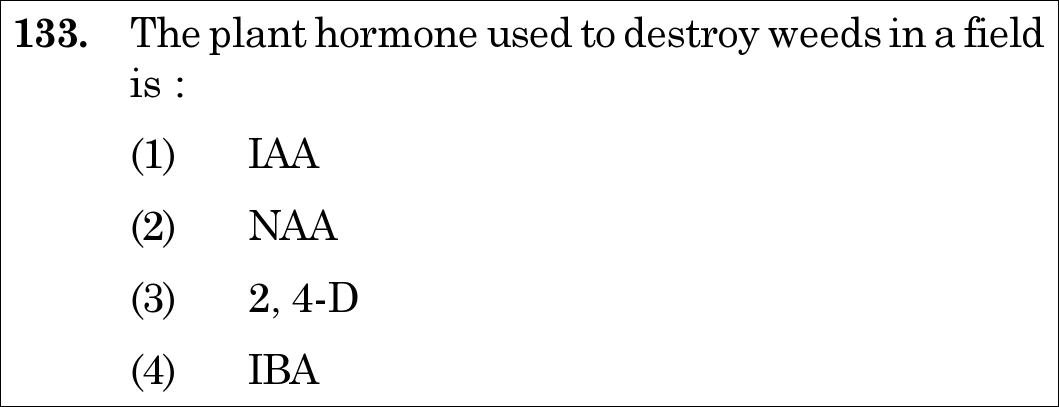
NEET 2021 · Q133 Easy
Official NEET 2021 Question 133 - Plant Growth and Development
1 IAA
2 NAA
3 2, 4-D ✓ Key
4 IBA
💡 Verified Solution & 30-Second Hack
✓
Verified Against NTA Final Answer Key
Option (3) : 2, 4-D
📚 Plant Growth and Development Easy
📋 Given Parameters & Problem Setup
Agronomic Objective Eradicate weeds in agricultural fields / lawns
Chemical Class Synthetic auxin weedicide
⚡

The 30-Second Exam Hall Shortcut: ⚡ 2, 4-D = Dicot Weedicide in Monocot Lawns!

⏱️ Save ~15 seconds

The synthetic auxin 2,4-dichlorophenoxyacetic acid (2, 4-D) is widely used to kill broad-leaved dicotyledonous weeds while having zero detrimental effect on mature monocotyledonous plants (cereal crops and lawns)! Match Option (3)!

1 IAA and IBA are natural auxins promoting apical dominance and root initiation.
2 NAA is a synthetic auxin used for rooting and preventing premature fruit drop.
3 2, 4-D (2,4-dichlorophenoxyacetic acid) is a synthetic auxin specifically formulated as a selective weedicide.
4 Match Option (3).
🛡️
Why You Can 100% Trust This Shortcut: Canonical NCERT Plant Growth and Development on Auxin Applications.
📐

Step-by-Step Rigorous Workflow & Mathematical Proof

Step 1

Auxin Classification and Agricultural Roles

Auxins include both naturally occurring phytohormones and synthetic chemical analogues:

Natural Auxins:Indole-3-acetic acid (IAA), Indole-3-butyric acid (IBA)Synthetic Auxins:Naphthalene acetic acid (NAA), 2,4-Dichlorophenoxyacetic acid (2, 4-D)\begin{aligned} \text{\textbf{Natural Auxins:}} & \quad \text{Indole-3-acetic acid (IAA), Indole-3-butyric acid (IBA)} \\[4pt] \text{\textbf{Synthetic Auxins:}} & \quad \text{Naphthalene acetic acid (NAA), 2,4-Dichlorophenoxyacetic acid (2, 4-D)} \end{aligned}
Step 2

Selective Herbicide Mechanism of 2, 4-D

At elevated concentrations, 2, 4-D acts as a systemic hormonal herbicide. It induces uncontrolled, aberrant cell division and vascular crushing in broad-leaved (dicotyledonous) weeds, leading to their rapid death. Monocotyledonous plants (such as wheat, rice, corn, and turf grasses) rapidly metabolize and conjugate 2, 4-D, remaining unharmed. Hence, it is universally applied to maintain weed-free lawns and cereal fields.

⭐

360° Option Elimination Engine Key Feature

Diagnose every choice: Know exactly why the right option works and why distractors fail.

4-Option Deep Scan
1 1
✗ Incorrect
Verdict & Scientific Reason:

IAA (Indole-3-acetic acid) is an endogenous plant growth promoter that induces cell elongation, apical dominance, and rooting, not a commercial weedicide.

⚠️
Student Fallacy (Why candidates pick this trap): Confusing natural auxin physiological functions with synthetic weedicide applications.
2 2
✗ Incorrect
Verdict & Scientific Reason:

NAA (Naphthalene acetic acid) is used to induce rooting in stem cuttings and prevent pre-harvest fruit drop in apples, not as a weedicide.

⚠️
Student Fallacy (Why candidates pick this trap): Conflating synthetic auxin roles.
3 3
✓ 100% Correct
Verdict & Scientific Reason:

2, 4-D (2,4-dichlorophenoxyacetic acid) is the canonical synthetic auxin employed globally to destroy dicot weeds in agricultural fields.

💡
Why this is airtight: None. Textbook application fact.
4 4
✗ Incorrect
Verdict & Scientific Reason:

IBA (Indole-3-butyric acid) is primarily utilized as a root-inducing hormone in vegetative propagation cuttings.

⚠️
Student Fallacy (Why candidates pick this trap): Confusing root-promoting hormone with weedicide.
⚠️

NTA Trap Alert: All Four Choices are Auxins: Need Exact Specific Function

IAA, NAA, 2, 4-D, and IBA are all auxins! Students must remember the exact agricultural application assigned to each in NCERT.

🛡️ How to avoid the -1 mark: Anchor: 2, 4-D = "Destroy" Dicot weeds (D for Dicot & Destroy).
📖

Core NEET Syllabus Standard

NEET / NCERT Biology · Plant Growth and Development Standard Benchmark
Core Scientific Principle Tested:

"2, 4-D, widely used to kill dicotyledonous weeds, does not affect mature monocotyledonous plants. It is used to prepare weed-free lawns by gardeners."

Syllabus Focus: Plant Growth Regulators: Auxins
✓ Core NEET UG Syllabus Anchor Syllabus & Academic Standards ↗
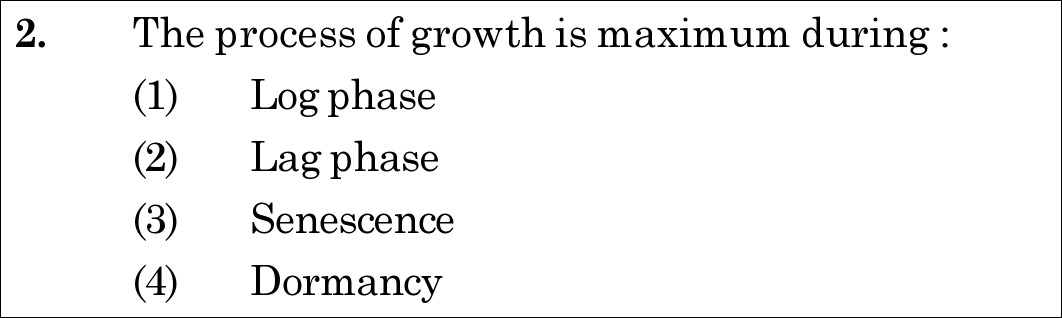
NEET 2020 · Q2 Easy
Official NEET 2020 Question 2 - Plant Growth and Development
1 Log phase ✓ Key
2 Lag phase
3 Senescence
4 Dormancy
💡 Verified Solution & 30-Second Hack
✓
Verified Against NTA Final Answer Key
Option (1) : Log phase
📚 Plant Growth and Development Easy
📋 Given Parameters & Problem Setup
Growth Curve Model Geometric / Sigmoid (S-shaped) Growth Curve
Question Objective Identify the phase where the process of growth is maximum
⚡

The 30-Second Exam Hall Shortcut: ⚡ "Sigmoid Curve: Lag (Slow) → Log (MAXIMUM / Exponential) → Stationary (Plateau)"

⏱️ Save ~20 seconds

In an S-shaped sigmoid growth curve, growth begins slowly (lag phase), surges exponentially to its MAXIMUM rate during the log (exponential) phase, and slows down due to limited resources (stationary phase). Growth is maximum in the Log phase! Mark Option (1).

1 Recall the classical geometric growth sigmoid phases: Lag phase →\to Log (Exponential) phase →\to Stationary phase.
2 Analyze growth rate: Lag phase = initial slow acceleration; Log phase = maximum exponential cell division and enlargement.
3 Contrast with senescence and dormancy: Senescence is terminal aging; Dormancy is metabolic inactivity.
4 Conclude: Growth rate peaks in the Log phase.
🛡️
Why You Can 100% Trust This Shortcut: NCERT Biology · Plant Growth and Development (Phases of Growth: A sigmoid curve is a characteristic of living organism growing in a natural environment. It is typical for all cells, tissues and organs. In geometric growth, after a slow initial lag phase, growth increases rapidly at an exponential/log phase where it reaches maximum rate).
📐

Step-by-Step Rigorous Workflow & Mathematical Proof

Step 1

Kinetics of the Sigmoid Growth Curve

Living cells, plant organs, and microbial populations growing in natural environments exhibit a characteristic sigmoid (S-shaped) growth curve comprising three successive phases: 1. Lag Phase: Initial phase where cells adapt biochemically, synthesize enzymes, and grow slowly without massive division. 2. Log (Exponential) Phase: Following the lag phase, both daughter cells retain the ability to divide. Cell division and cell elongation proceed at an accelerated exponential rate (W1=W0ertW_1 = W_0 e^{rt}), where the rate of growth reaches its absolute biological maximum. 3. Stationary Phase: As space, nutrients, and resources become limiting, the rate of growth decelerates and levels off.

W1=W0ert  ⟹  Growth Rate (dWdt) is Maximum during the Log PhaseW_1 = W_0 e^{rt} \implies \text{Growth Rate } \left(\frac{dW}{dt}\right) \text{ is } \mathbf{Maximum} \text{ during the } \mathbf{Log\,Phase}
Step 2

Elimination of Degenerative and Inactive Phases

- Senescence: The irreversible, terminal developmental phase of aging leading to tissue degradation and programmed death, characterized by negative growth. - Dormancy: A state of suspended metabolic development and zero mitotic growth, designed to survive adverse environmental conditions (e.g. seed dormancy).

⭐

360° Option Elimination Engine Key Feature

Diagnose every choice: Know exactly why the right option works and why distractors fail.

4-Option Deep Scan
1 A
✓ 100% Correct
Verdict & Scientific Reason:

Correct. The log (exponential) phase is characterized by unrestricted, maximal mitotic division and cellular expansion.

💡
Why this is airtight: None. Direct recall of plant physiological growth kinetics.
2 B
✗ Incorrect
Verdict & Scientific Reason:

Incorrect. The lag phase is the slow initial preparatory period before exponential multiplication.

⚠️
Student Fallacy (Why candidates pick this trap): Confusing the start of growth with the peak of growth rate.
3 C
✗ Incorrect
Verdict & Scientific Reason:

Incorrect. Senescence is biological aging and deteriorative breakdown preceding death.

⚠️
Student Fallacy (Why candidates pick this trap): Confusing size accumulation with rate of growth.
4 D
✗ Incorrect
Verdict & Scientific Reason:

Incorrect. Dormancy involves arrested growth and minimal metabolic activity.

⚠️
Student Fallacy (Why candidates pick this trap): Total misunderstanding of dormancy.
⚠️

NTA Trap Alert: Total Mass vs Growth Rate Trap

At the stationary phase or late maturity, total plant mass (WW) is highest, but the *rate of growth* (dW/dtdW/dt) is zero. The question explicitly asks when the *process/rate of growth* is maximum, which occurs during the log phase.

🛡️ How to avoid the -1 mark: Remember: Steepest slope on the sigmoid curve = Log phase = Maximum growth rate.
📖

Core NEET Syllabus Standard

NEET / NCERT Biology · Plant Growth and Development Standard Benchmark
Core Scientific Principle Tested:

"In geometric growth, the process of growth is maximum during the exponential/log phase."

Syllabus Focus: Phases of Growth and Sigmoid Curve
✓ Core NEET UG Syllabus Anchor Syllabus & Academic Standards ↗
NEET 2020 · Q64 Easy
Official NEET 2020 Question 64 - Plant Growth and Development
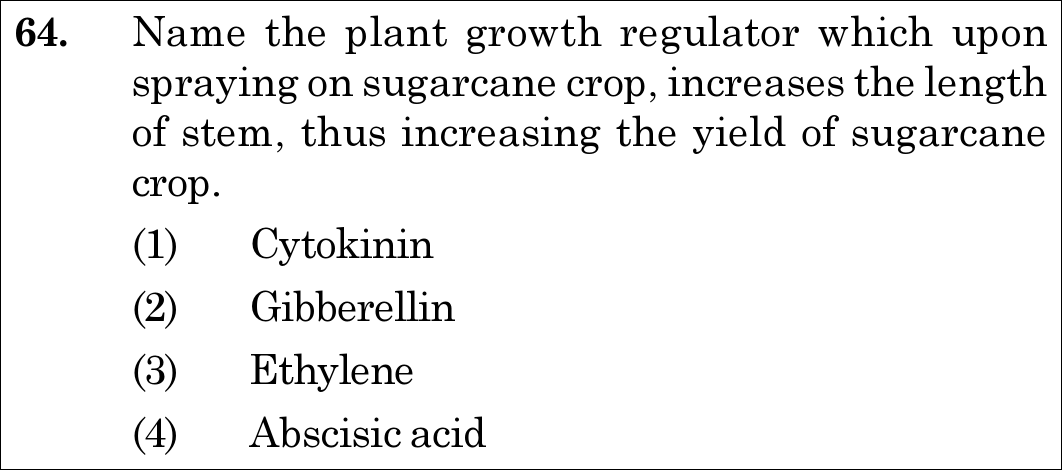
1 Cytokinin
2 Gibberellin ✓ Key
3 Ethylene
4 Abscisic acid
💡 Verified Solution & 30-Second Hack
✓
Verified Against NTA Final Answer Key
Option (2) : Gibberellin
📚 Plant Growth and Development Easy
📋 Given Parameters & Problem Setup
Target Crop Sugarcane (Saccharum officinarum)
Morphological Effect Increases the length of stem/internodes
Agronomic Yield Increases yield by up to 20 tonnes per acre
⚡

The 30-Second Exam Hall Shortcut: ⚡ "Sugarcane Stem Elongation = GIBBERELLINS (GA)!"

⏱️ 20 seconds

Sugarcane stores carbohydrates (sucrose) in its stems. Spraying sugarcane crop with Gibberellins increases the length of the stem/internodes, thereby increasing the yield by as much as 20 tonnes per acre! Mark Gibberellin (Option 2) in 5 seconds.

1 Sugarcane stores sugar in its stem internodes.
2 Gibberellins cause rapid internodal elongation (stem lengthening).
3 Spraying GA increases sugarcane yield by up to 20 tonnes per acre.
4 Select Option (2) Gibberellin.
🛡️
Why You Can 100% Trust This Shortcut: NCERT Biology · Plant Growth and Development (Plant Growth Regulators: Gibberellins)
📐

Step-by-Step Rigorous Workflow & Mathematical Proof

Step 1

Understand Sugarcane Agronomy

Sugarcane stores sugar as sucrose in the parenchymatous cells of its stem. Consequently, a taller stem with longer internodes directly translates to greater sucrose yield.

Step 2

Physiological Action of Gibberellins

Gibberellins (GA3) promote rapid cell elongation and cell division, causing elongation of intact stems and internodes.

Step 3

NCERT Quantitative Landmark

NCERT explicitly states: "Sugarcane stores carbohydrate as sugar in their stems. Spraying sugarcane crop with gibberellins increases the length of the stem, thus increasing the yield by as much as 20 tonnes per acre."

Step 4

Eliminate Other Regulators

Cytokinins promote cell division and delay senescence; Ethylene promotes fruit ripening and causes horizontal growth of seedlings; Abscisic acid is a stress hormone inhibiting growth.

⭐

360° Option Elimination Engine Key Feature

Diagnose every choice: Know exactly why the right option works and why distractors fail.

4-Option Deep Scan
1 A
✗ Incorrect
Verdict & Scientific Reason:

Incorrect; cytokinins delay leaf senescence and overcome apical dominance, but are not used to elongate sugarcane stems.

⚠️
Student Fallacy (Why candidates pick this trap): Confusing cell division promotion with stem internodal elongation.
2 B
✓ 100% Correct
Verdict & Scientific Reason:

Factually exact; gibberellin spray induces internode elongation in sugarcane, boosting yield by 20 tonnes/acre.

💡
Why this is airtight: None; classic textbook agronomic application.
3 C
✗ Incorrect
Verdict & Scientific Reason:

Incorrect; ethylene is a gaseous ripening hormone that inhibits stem elongation and promotes horizontal swelling.

⚠️
Student Fallacy (Why candidates pick this trap): Confusing ripening with stem growth.
4 D
✗ Incorrect
Verdict & Scientific Reason:

Incorrect; abscisic acid is a growth inhibitor that promotes dormancy and stomatal closure.

⚠️
Student Fallacy (Why candidates pick this trap): Selecting a growth inhibitor instead of an elongation promoter.
⚠️

NTA Trap Alert: Auxin vs Gibberellin for Stem Growth

Auxin promotes apical dominance and root initiation. Gibberellin promotes INTERNODE ELONGATION in genetically dwarf plants, rosette plants (bolting), and sugarcane stems.

🛡️ How to avoid the -1 mark: Internode elongation = Gibberellin (Bolting & Sugarcane yield)!
📖

Core NEET Syllabus Standard

Zoology · Plant Growth and Development Standard Benchmark
Core Scientific Principle Tested:

""

Syllabus Focus: Agricultural Application of Gibberellins in Sugarcane: Internode Elongation
✓ Core NEET UG Syllabus Anchor Syllabus & Academic Standards ↗
NEET 2020 · Q66 Easy
Official NEET 2020 Question 66 - Plant Growth and Development
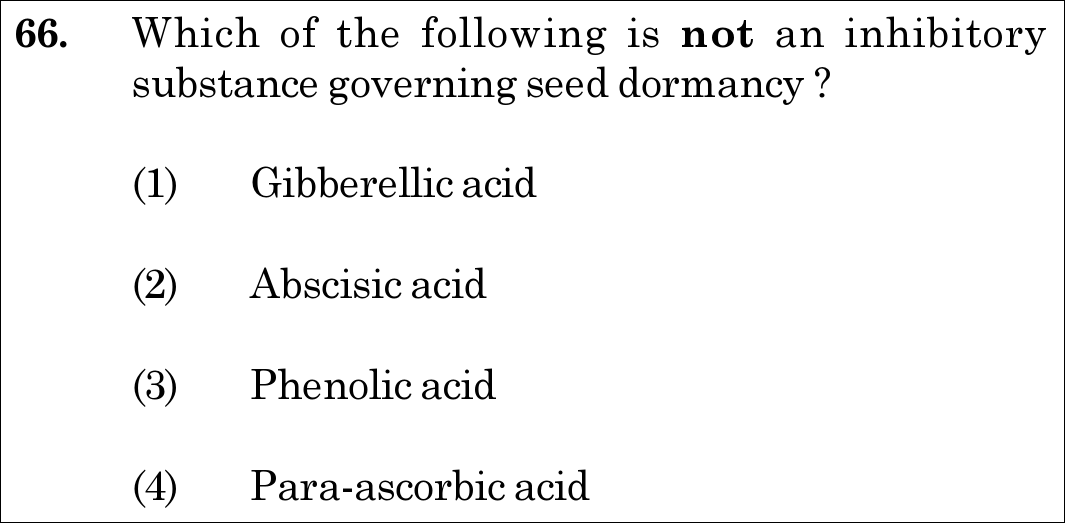
1 Gibberellic acid ✓ Key
2 Abscisic acid
3 Phenolic acid
4 Para-ascorbic acid
💡 Verified Solution & 30-Second Hack
✓
Verified Against NTA Final Answer Key
Option (1) : Gibberellic acid
📚 Plant Growth and Development Easy
📋 Given Parameters & Problem Setup
Physiological State Seed dormancy
Question Objective Identify which listed substance is NOT an inhibitory substance governing seed dormancy
⚡

The 30-Second Exam Hall Shortcut: ⚡ "Gibberellic Acid BREAKS Dormancy, It Never Inhibits!"

⏱️ 20 seconds

Abscisic acid (ABA), Phenolic acids, and Para-ascorbic acid are well-known chemical inhibitors that enforce and govern seed dormancy. Gibberellic acid (GA) stimulates alpha-amylase synthesis to BREAK seed dormancy and promote germination! Mark Gibberellic acid (Option 1) in 5 seconds.

1 Inhibitory substances causing seed dormancy: Abscisic acid (ABA), phenolic acid, para-ascorbic acid.
2 Seed dormancy breakers: Gibberellic acid (GA) and nitrates.
3 Thus, Gibberellic acid is NOT an inhibitory substance.
4 Select Option (1).
🛡️
Why You Can 100% Trust This Shortcut: NCERT Biology · Plant Growth and Development (Seed Dormancy: Endogenous Chemical Inhibitors)
📐

Step-by-Step Rigorous Workflow & Mathematical Proof

Step 1

Understand Endogenous Seed Dormancy

In many plants, viable seeds fail to germinate even when external environmental conditions (moisture, temperature, oxygen) are favorable. This state is called seed dormancy.

Step 2

Identify Endogenous Chemical Inhibitors

NCERT explicitly identifies chemical inhibitors present in the seed coat or embryo that induce and maintain dormancy: Abscisic acid (ABA), phenolic acids, and para-ascorbic acid.

Step 3

Role of Gibberellic Acid (GA)

Dormancy can be overcome by treating seeds with gibberellic acid and nitrates. Gibberellins induce the synthesis of hydrolytic enzymes (such as alpha-amylase in aleurone layer of cereals) that mobilize food reserves, triggering seed germination.

Step 4

Conclude the Non-Inhibitory Substance

Therefore, Gibberellic acid acts antagonistically to ABA as a promoter of germination, NOT an inhibitory substance governing dormancy.

⭐

360° Option Elimination Engine Key Feature

Diagnose every choice: Know exactly why the right option works and why distractors fail.

4-Option Deep Scan
1 A
✓ 100% Correct
Verdict & Scientific Reason:

Accurate; gibberellic acid is a germination promoter that overcomes seed dormancy, not an inhibitor.

💡
Why this is airtight: None; core plant hormone antagonism (GA vs ABA).
2 B
✗ Incorrect
Verdict & Scientific Reason:

Incorrect; abscisic acid (ABA) is the primary endogenous dormin/inhibitor that induces and maintains seed dormancy.

⚠️
Student Fallacy (Why candidates pick this trap): Failing to notice the negative prompt "is NOT an inhibitory substance".
3 C
✗ Incorrect
Verdict & Scientific Reason:

Incorrect; phenolic acids are chemical inhibitors explicitly listed in NCERT that cause seed dormancy.

⚠️
Student Fallacy (Why candidates pick this trap): Unfamiliarity with secondary chemical inhibitors mentioned in NCERT.
4 D
✗ Incorrect
Verdict & Scientific Reason:

Incorrect; para-ascorbic acid is an endogenous chemical inhibitor governing seed dormancy cited in NCERT.

⚠️
Student Fallacy (Why candidates pick this trap): Assuming para-ascorbic acid is a promoter.
⚠️

NTA Trap Alert: Spot the Negative in the Question

The question asks: "Which is NOT an inhibitory substance governing seed dormancy?" Three options are inhibitors (ABA, phenolic acid, para-ascorbic acid); only Gibberellic acid is a PROMOTER.

🛡️ How to avoid the -1 mark: Circle the word "NOT"! Gibberellic acid promotes germination (breaks dormancy).
📖

Core NEET Syllabus Standard

Zoology · Plant Growth and Development Standard Benchmark
Core Scientific Principle Tested:

""

Syllabus Focus: Chemical Regulators of Seed Dormancy: Inhibitors vs Germination Promoters
✓ Core NEET UG Syllabus Anchor Syllabus & Academic Standards ↗

Solve 4 NEET Questions a Day — One per Subject

Cover all 1,140 official NEET questions in 285 days at your own pace. Progress is saved on your device. No login needed.