MyCompetitiveExams Logo MyCompetitiveExams
Search 1,140+ Questions
Chapters, formulas, speed tricks
→
⚡ Brahmastra NEET 2027
720 MARKS

Dynamic 180-question full-length simulator mixed dynamically from all 6 years for 2027 & 2026 aspirants.

Launch Brahmastra 2027 Test →
Start Practice →
100% Free · No Login Required
Q.110 Botany ⭐ 360° Option Elimination Active
Vault ↗

NEET 2026 Botany Question 110 Solution

Topic: Plant Growth and Development · Official NTA Booklet Code 50
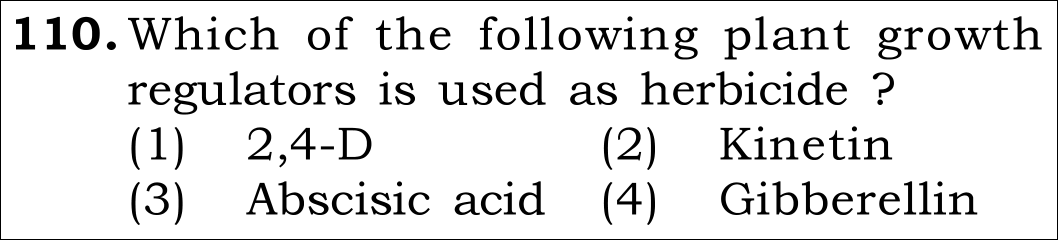
NEET 2026 Botany Question 110: Auxins & Synthetic Auxin Applications as Herbicides

Question

Which of the following plant growth regulators is used as herbicide?

  1. (1)2,4-D
  2. (2)Kinetin
  3. (3)Abscisic acid
  4. (4)Gibberellin
✓
Verified Against NTA Final Answer Key
Option (1) : 2,4-D
📚 Plant Growth and Development Easy
📋 Given Parameters & Problem Setup
Target Chemical Class Plant growth regulator (PGR)
Agronomic Application Selective herbicide (weedicide)
⚡

The 30-Second Exam Hall Shortcut: ⚡ 2,4-D Dicot-Destroyer Rule

⏱️ Save ~40 seconds

2,4-D = Synthetic Auxin Herbicide that selectively wipes out broadleaf weeds!

1 Recall from NCERT: 2,4-D (2,4-dichlorophenoxyacetic acid) is widely used to kill broadleaf (dicotyledonous) weeds.
2 It leaves mature monocotyledonous plants unaffected, making it ideal for lawns and cereal fields.
3 Scan options: (1) 2,4-D. Instant match!
4 Mark Option (1) in under 5 seconds.
🛡️
Why You Can 100% Trust This Shortcut: NCERT Plant Growth and Development verbatim: 2,4-D is widely used to kill dicotyledonous weeds, does not affect mature monocotyledonous plants.
📐

Step-by-Step Rigorous Workflow & Mathematical Proof

Step 1

Understand Synthetic Auxin 2,4-D

Auxins were the first plant hormones discovered. While IAA and IBA are natural auxins, NAA and 2,4-D (2,4-dichlorophenoxyacetic acid) are synthetic auxins widely applied in agriculture and horticulture.

2,4-D=2,4-Dichlorophenoxyacetic acid (Synthetic Auxin)\text{2,4-D} = \text{2,4-Dichlorophenoxyacetic acid (Synthetic Auxin)}
  • • Promotes root initiation in stem cuttings and prevents premature fruit/leaf drop at low physiological concentrations.
Step 2

Action as a Selective Herbicide

At higher concentrations, 2,4-D acts as an effective selective herbicide. Dicotyledonous weeds possess broad leaves and distinct auxin sensitivity that leads to unregulated cellular elongation, vascular collapse, and plant death, whereas monocotyledonous grasses and cereal crops are unaffected.

2,4-D→High doseKills broadleaf (dicot) weeds while sparing monocot crops\text{2,4-D} \xrightarrow{\text{High dose}} \text{Kills broadleaf (dicot) weeds while sparing monocot crops}
  • • Commonly used by gardeners to create weed-free lawns.
Step 3

Eliminate Other Options

Kinetin is a cytokinin used to promote cell division and delay senescence. Abscisic acid (ABA) is a growth inhibitor (stress hormone) inducing stomatal closure and dormancy. Gibberellins promote stem elongation (bolting) and fruit enlargement. None of these act as weedicides.

Herbicide≡2,4-D  ⟹  Option (1)\text{Herbicide} \equiv \text{2,4-D} \implies \text{Option (1)}
  • • Matches official NTA final answer key Option A / (1).
⭐

360° Option Elimination Engine Key Feature

Diagnose every choice: Know exactly why the right option works and why distractors fail.

4-Option Deep Scan
1 A
✓ 100% Correct
Verdict & Scientific Reason:

100% accurate. 2,4-D is the canonical plant growth regulator used as a weedicide.

💡
Why this is airtight: None; fundamental NCERT recall.
2 B
✗ Incorrect
Verdict & Scientific Reason:

Incorrect. Kinetin is a cytokinin discovered by Skoog and Miller, used to stimulate cell division and shoot morphogenesis.

⚠️
Student Fallacy (Why candidates pick this trap): Confusing cytokinins with synthetic auxins.
3 C
✗ Incorrect
Verdict & Scientific Reason:

Incorrect. ABA is a natural stress hormone inducing stomatal closure and seed dormancy, not a weedicide.

⚠️
Student Fallacy (Why candidates pick this trap): Assuming "inhibitor" equates to weedicide.
4 D
✗ Incorrect
Verdict & Scientific Reason:

Incorrect. Gibberellins (GA3GA_3) promote internodal elongation, brewing malt production, and grape stalk lengthening.

⚠️
Student Fallacy (Why candidates pick this trap): Mistaking growth promoters with selective herbicides.
⚠️

NTA Trap Alert: Confusing Growth Inhibitor (ABA) with Herbicide (2,4-D)

Students often think that because Abscisic Acid (ABA) is classified as a plant growth inhibitor, it must be the herbicide. However, commercially and canonically in NCERT, 2,4-D is the specific PGR used as a weedicide.

🛡️ How to avoid the -1 mark: Remember: 2,4-D = Dicot Destroyer.
📖

Core NEET Syllabus Standard

NEET Biology Core Syllabus · Plant Growth and Development Standard Benchmark
Core Scientific Principle Tested:

"2,4-D is a synthetic auxin extensively employed as a selective weedicide to eliminate dicot weeds without harming monocot crops."

Syllabus Focus: Plant Growth Regulators - Auxins
✓ Core NEET UG Syllabus Anchor Syllabus & Academic Standards ↗
2,4-D: Dicot Destroyer for a Weed-free Lawn!

Ready to attempt under real exam pressure?

Test your speed and accuracy in the authentic 180-minute timed NTA simulator.

Launch NEET 2026 CBT Test →

Spotted a mistake in this solution? Report an error (support@mycompetitiveexams.com)

⚖️ Legal & Fair Dealing Notice: Sourced from publicly released NEET 2026 question papers and NEET answer keys for private study, research, and non-commercial educational practice under Fair Dealing (Section 52(1)(a) of the Indian Copyright Act, 1957). Not affiliated with or endorsed by NTA or NMC.

Solve 4 NEET Questions a Day — One per Subject

Cover all 1,140 official NEET questions in 285 days at your own pace. Progress is saved on your device. No login needed.