MyCompetitiveExams Logo MyCompetitiveExams
Search 1,140+ Questions
Chapters, formulas, speed tricks
→
⚡ Brahmastra NEET 2027
720 MARKS

Dynamic 180-question full-length simulator mixed dynamically from all 6 years for 2027 & 2026 aspirants.

Launch Brahmastra 2027 Test →
Start Practice →
100% Free · No Login Required
Q.173 Zoology ⭐ 360° Option Elimination Active
Vault ↗

NEET 2025 Zoology Question 173 Solution

Topic: Plant Growth and Development · Official NTA Booklet Code 45
NEET 2025 Zoology Question 173: Parthenocarpy, PGR Classes, Dedifferentiation, and Apical Dominance

Question

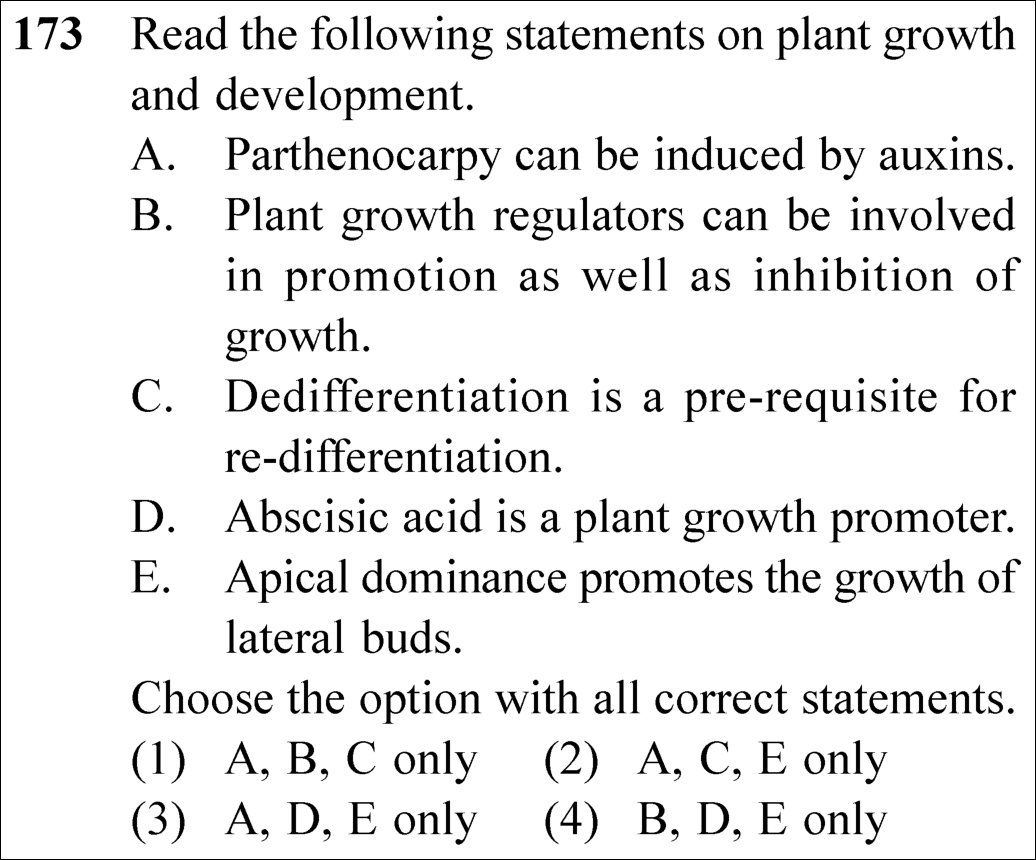
Read the following statements on plant growth and development. A. Parthenocarpy can be induced by auxins. B. Plant growth regulators can be involved in promotion as well as inhibition of growth. C. Dedifferentiation is a pre-requisite for re-differentiation. D. Abscisic acid is a plant growth promoter. E. Apical dominance promotes the growth of lateral buds. Choose the option with all correct statements.

✓
Verified Against NTA Final Answer Key
Option (1) : A, B, C only
📚 Plant Growth and Development Medium
📋 Given Parameters & Problem Setup
Statement A Parthenocarpy can be induced by auxins.
Statement B Plant growth regulators can be involved in promotion as well as inhibition of growth.
Statement C Dedifferentiation is a pre-requisite for re-differentiation.
Statement D Abscisic acid is a plant growth promoter.
Statement E Apical dominance promotes the growth of lateral buds.
⚡

The 30-Second Exam Hall Shortcut: ⚡ Plant Physiology Multi-Statement Diagnostic

⏱️ Save ~30 seconds

Auxins induce seedless fruit / parthenocarpy (A is TRUE)! PGRs include promoters and inhibitors (B is TRUE)! Differentiated cell must DEDIFFERENTIATE before it can REDIFFERENTIATE (C is TRUE)! ABA is an INHIBITOR (D false)! Apical dominance INHIBITS lateral buds (E false)! A, B, C only!

1 Verify each statement against NCERT Chapter 15:
2 - Statement A: "They induce parthenocarpy, e.g., in tomatoes." (Auxins, Section 15.4.3.1). [TRUE]
3 - Statement B: PGRs are divided into growth promoters (auxins, gibberellins, cytokinins) and growth inhibitors (ABA, ethylene). [TRUE]
4 - Statement C: Mature differentiated cells regain division capacity (dedifferentiation) to form meristems (e.g. interfascicular cambium), which then mature into secondary tissues (redifferentiation). Thus, dedifferentiation is an absolute prerequisite! [TRUE]
5 - Statement D: Abscisic acid is a growth INHIBITOR, not a promoter! [FALSE]
6 - Statement E: In apical dominance, the apical bud INHIBITS (suppresses) the growth of lateral buds! [FALSE]
7 Correct combination: A, B, C only (Option 1)!
8 Select Option (1)!
🛡️
Why You Can 100% Trust This Shortcut: Auxin & Ethylene Physiological Applications (NCERT Biology · Plant Growth and Development: Apical dominance and fruit ripening).
📐

Step-by-Step Rigorous Workflow & Mathematical Proof

Step 1

Verification of Statements A, B, and C

Analyzing the correct plant developmental principles:

  • • Statement A: Auxins (e.g. IAA, IBA, NAA) applied to unpollinated pistils stimulate pericarp enlargement without fertilization, producing seedless fruits (parthenocarpy), commercially exploited in tomatoes and watermelons. Statement A is CORRECT.
  • • Statement B: Plant growth regulators encompass two broad functional categories: plant growth promoters (participating in cell division, elongation, flowering, fruiting) and plant growth inhibitors (mediating dormancy, abscission, and stress responses). Statement B is CORRECT.
  • • Statement C: In plant development, differentiated parenchyma cells lose their specialization and regain mitotic activity (dedifferentiation) to form secondary meristems (interfascicular cambium, cork cambium). The progeny of these meristems subsequently lose division ability and re-specialize into permanent secondary vascular tissues (redifferentiation). Thus, dedifferentiation is a mandatory developmental prerequisite for redifferentiation. Statement C is CORRECT.
Step 2

Refutation of Statements D and E

Identifying false claims:

  • • Statement D claims "Abscisic acid is a plant growth promoter". NCERT explicitly classifies ABA as a general plant growth inhibitor, functioning as an antagonist to gibberellins and promoting seed dormancy and stomatal closure. Hence, Statement D is FALSE.
  • • Statement E claims "Apical dominance promotes the growth of lateral buds". In apical dominance, growing apical buds synthesize auxin which suppresses and inhibits the growth of axillary/lateral buds. Removal of the shoot tip (decapitation) relieves this inhibition and allows lateral branches to grow (practiced in tea plantations and hedge-making). Hence, Statement E is FALSE.
Step 3

Conclusion

Only statements A, B, and C are correct, which corresponds to Option (1).

Correct Statements={A,B,C}  ⟹  Option (1)\text{Correct Statements} = \{A, B, C\} \implies \text{Option (1)}
⭐

360° Option Elimination Engine Key Feature

Diagnose every choice: Know exactly why the right option works and why distractors fail.

4-Option Deep Scan
1 A
✓ 100% Correct
Verdict & Scientific Reason:

100% correct. Correctly validates parthenocarpy induction (A), dual nature of PGRs (B), and dedifferentiation as a prerequisite for redifferentiation (C).

💡
Why this is airtight: None; master-level familiarity with plant morphogenesis.
2 B
✗ Incorrect
Verdict & Scientific Reason:

Incorrect. Statement E is false because apical dominance inhibits lateral buds, rather than promoting them.

⚠️
Student Fallacy (Why candidates pick this trap): Confusing promotion with inhibition in apical dominance.
3 C
✗ Incorrect
Verdict & Scientific Reason:

Incorrect. Contains two false statements (D and E).

⚠️
Student Fallacy (Why candidates pick this trap): Believing ABA promotes growth.
4 D
✗ Incorrect
Verdict & Scientific Reason:

Incorrect. Erroneously includes both false statements D and E.

⚠️
Student Fallacy (Why candidates pick this trap): Total confusion regarding growth inhibitors and auxin dominance.
⚠️

NTA Trap Alert: Apical Dominance Action on Lateral Buds

Apical dominance DOMINATES lateral buds by keeping them SLEEPING (dormant/inhibited). It does NOT promote them! Decapitation (cutting the apex) promotes lateral bud bushy growth.

🛡️ How to avoid the -1 mark: Apical dominance = Inhibit lateral buds; ABA = Inhibitor.
📖

Core NEET Syllabus Standard

NEET Biology Core Syllabus · Plant Growth and Development Standard Benchmark
Core Scientific Principle Tested:

"Auxins induce parthenocarpy; PGRs act as promoters and inhibitors; dedifferentiation precedes redifferentiation; ABA is an inhibitor; apical dominance suppresses lateral buds."

Syllabus Focus: Differentiation, Dedifferentiation, Redifferentiation & PGRs
✓ Core NEET UG Syllabus Anchor Syllabus & Academic Standards ↗
ABC are Golden: Auxin parthenocarpy, Both promoter/inhibitor, Cell dedifferentiation!

Ready to attempt under real exam pressure?

Test your speed and accuracy in the authentic 180-minute timed NTA simulator.

Launch NEET 2025 CBT Test →

Spotted a mistake in this solution? Report an error (support@mycompetitiveexams.com)

⚖️ Legal & Fair Dealing Notice: Sourced from publicly released NEET 2025 question papers and NEET answer keys for private study, research, and non-commercial educational practice under Fair Dealing (Section 52(1)(a) of the Indian Copyright Act, 1957). Not affiliated with or endorsed by NTA or NMC.

Solve 4 NEET Questions a Day — One per Subject

Cover all 1,140 official NEET questions in 285 days at your own pace. Progress is saved on your device. No login needed.