MyCompetitiveExams Logo MyCompetitiveExams
Search 1,140+ Questions
Chapters, formulas, speed tricks
→
⚡ Brahmastra NEET 2027
720 MARKS

Dynamic 180-question full-length simulator mixed dynamically from all 6 years for 2027 & 2026 aspirants.

Launch Brahmastra 2027 Test →
Start Practice →
100% Free · No Login Required
🌿 Botany 🔥 High-Yield Core Topic (~3–4 Qs/Year)

NEET Evolution Previous Year Questions with Solutions

Complete repository of official NTA NEET questions for Evolution from 2020 to 2026. Every question includes 30-second elimination tricks, step-by-step NCERT solutions, option-by-option traps, and official answer keys.

18 Questions 6 Exam Years (2026, 2025, 2024, 2023, 2021, 2020) 13 Easy · 5 Medium · 0 Challenging
NEET 2026 · Q141 Medium
Official NEET 2026 Question 141 - Evolution
1
2 ✓ Key
3
4
💡 Verified Solution & 30-Second Hack
✓
Verified Against NTA Final Answer Key
Option (2) : (a), (c) and (d) only
📚 Evolution Medium
📋 Given Parameters & Problem Setup
Evolutionary Process Natural selection acting on phenotypic variation
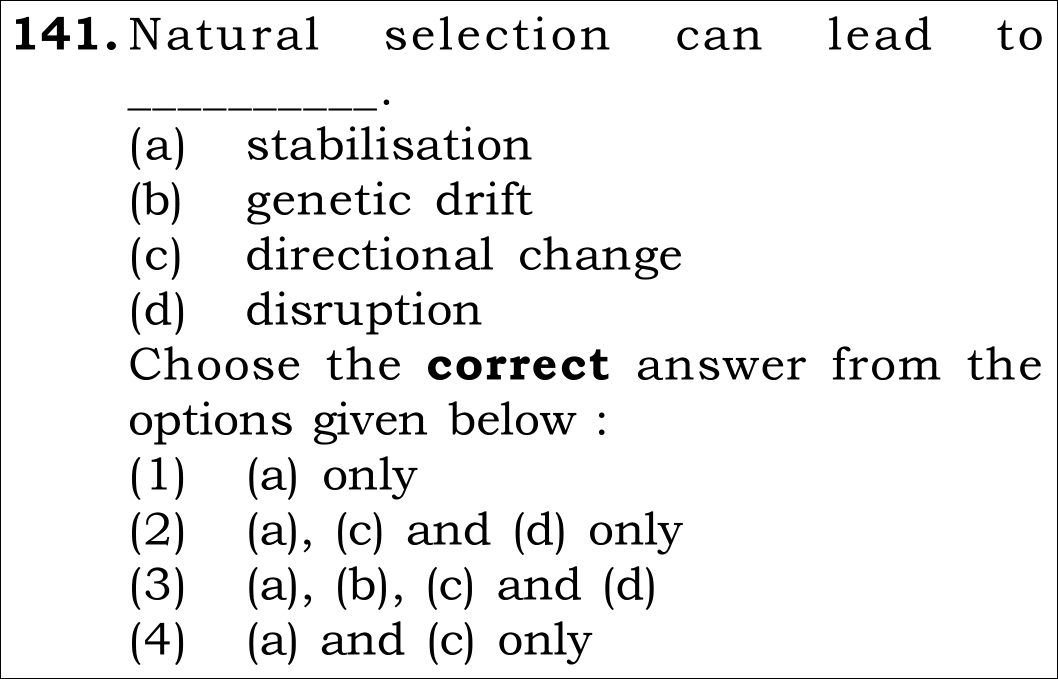
Candidate Phenomena (a) stabilisation, (b) genetic drift, (c) directional change, (d) disruption
⚡

The 30-Second Exam Hall Shortcut: ⚡ Triad of Natural Selection Graphs

⏱️ Save ~45 seconds

Selection Curves = Stabilising, Directional, Disruptive! Genetic Drift is CHANCE, not Selection!

1 Recall the three graphical outcomes of natural selection in NCERT Figure 7.8:
2 Stabilisation: Peak gets higher and narrower (favors mean phenotype).
3 Directional change: Peak shifts in one direction (favors one extreme).
4 Disruption: Two peaks form (favors both extremes over the mean).
5 Genetic drift is Sewall Wright effect: random chance fluctuation in allele frequencies in small populations, NOT an outcome of natural selection!
6 Eliminate (b) -> Correct set is (a), (c) and (d) only.
7 Select Option (2) in under 10 seconds!
🛡️
Why You Can 100% Trust This Shortcut: NCERT Biology · Evolution (Natural Selection Types: Stabilizing, Directional, and Disruptive selection).
📐

Step-by-Step Rigorous Workflow & Mathematical Proof

Step 1

Review the Three Outcomes of Natural Selection

Based on which phenotypes are favored relative to environmental pressures, natural selection on continuous polygenic traits produces three distinct demographic patterns:

Natural Selection Outcomes={Stabilisation:More individuals acquire mean character valueDirectional Change:More individuals acquire value other than meanDisruption:Individuals acquire peripheral values at both ends\text{Natural Selection Outcomes} = \begin{cases} \mathbf{Stabilisation} &: \text{More individuals acquire mean character value} \\ \mathbf{Directional\text{ Change}} &: \text{More individuals acquire value other than mean} \\ \mathbf{Disruption} &: \text{Individuals acquire peripheral values at both ends} \end{cases}
  • • All three are depicted and explained in NCERT Figure 7.8.
Step 2

Evaluate Genetic Drift

Genetic drift refers to stochastic (random sampling) fluctuations in allele frequencies from generation to generation in small, isolated populations. It operates independently of natural selection (often fixing neutral or deleterious alleles purely by chance, such as in the founder effect or bottleneck effect). Therefore, natural selection does NOT lead to genetic drift.

Genetic Drift=Random stochastic sampling error≠Natural Selection outcome\text{Genetic Drift} = \text{Random stochastic sampling error} \neq \text{Natural Selection outcome}
  • • Statement (b) must be excluded.
Step 3

Select Matching Option

Statements (a), (c), and (d) are legitimate outcomes of natural selection, while (b) is an independent evolutionary mechanism. The matching combination is Option (2).

Correct Set=(a),(c) and (d) only  ⟹  Option (2)\text{Correct Set} = \mathbf{(a), (c) \text{ and } (d) \text{ only}} \implies \text{Option (2)}
  • • Matches official NTA final answer key Option B / (2).
⭐

360° Option Elimination Engine Key Feature

Diagnose every choice: Know exactly why the right option works and why distractors fail.

4-Option Deep Scan
1 A
✗ Incorrect
Verdict & Scientific Reason:

Incorrect. Directional change and disruption are also standard modes of natural selection.

⚠️
Student Fallacy (Why candidates pick this trap): Restricting selection to stabilizing mode only.
2 B
✓ 100% Correct
Verdict & Scientific Reason:

100% accurate. Natural selection leads to stabilization, directional change, or disruption, but not genetic drift.

💡
Why this is airtight: None; rigorous conceptual demarcation between selection and drift.
3 C
✗ Incorrect
Verdict & Scientific Reason:

Incorrect. Erroneously includes genetic drift as an outcome of natural selection.

⚠️
Student Fallacy (Why candidates pick this trap): Lumping all evolutionary terms together into one basket.
4 D
✗ Incorrect
Verdict & Scientific Reason:

Incorrect. Omits disruptive selection.

⚠️
Student Fallacy (Why candidates pick this trap): Forgetting disruptive selection produces two peripheral peaks.
⚠️

NTA Trap Alert: Conflating Selection with Chance Drift

Students frequently view "evolution" as a single blur and assume natural selection causes genetic drift. Natural selection is deterministic (survival of the fittest); genetic drift is purely random chance!

🛡️ How to avoid the -1 mark: Selection selects; Drift drifts by chance!
📖

Core NEET Syllabus Standard

NEET Biology Core Syllabus · Evolution Standard Benchmark
Core Scientific Principle Tested:

"Natural selection operates through three primary modes: stabilizing selection, directional selection, and disruptive selection. Genetic drift is an independent stochastic process."
Syllabus Focus: Mechanism of Evolution - Natural Selection
✓ Core NEET UG Syllabus Anchor Syllabus & Academic Standards ↗
Natural Selection acts in Three: Stabilize, Direct, or Disrupt the tree; Drift is Chance, so set it free!
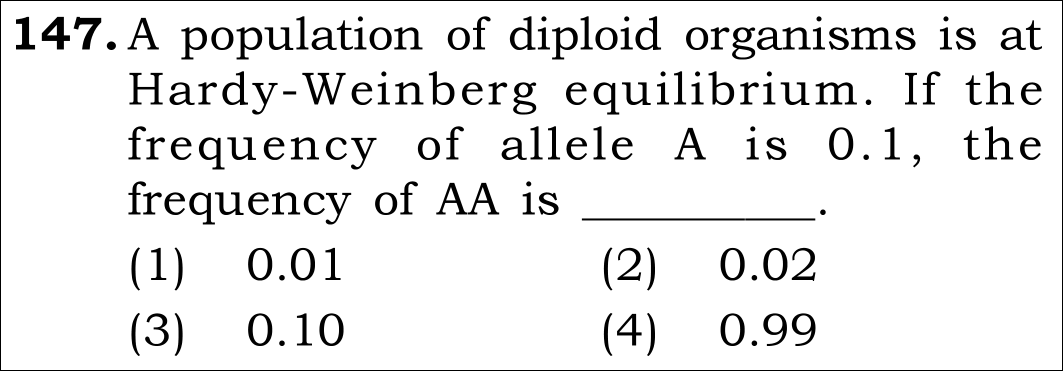
NEET 2026 · Q147 Easy
Official NEET 2026 Question 147 - Evolution
1 0.01 ✓ Key
2 0.02
3 0.10
4 0.99
💡 Verified Solution & 30-Second Hack
✓
Verified Against NTA Final Answer Key
Option (1) : 0.01
📚 Evolution Easy
📋 Given Parameters & Problem Setup
Condition Population at Hardy-Weinberg equilibrium
Allele Frequency of A (p) p = 0.1
Target Genotype Homozygous dominant (AA)
⚡

The 30-Second Exam Hall Shortcut: ⚡ Hardy-Weinberg p² Rule

⏱️ Save ~40 seconds

Frequency of AA = p² = (0.1)² = 0.01!

1 Recall Hardy-Weinberg binomial expansion: p² + 2pq + q² = 1.
2 Here, frequency of allele A is p = 0.1.
3 Frequency of homozygous genotype AA is simply p².
4 Calculate: (0.1)² = 0.01.
5 Option (1) is 0.01. Done in 3 seconds!
🛡️
Why You Can 100% Trust This Shortcut: NCERT Biology · Evolution (Hardy-Weinberg Equilibrium: p² + 2pq + q² = 1 for genetic stability).
📐

Step-by-Step Rigorous Workflow & Mathematical Proof

Step 1

State the Hardy-Weinberg Principle

In a large, randomly mating diploid population where evolutionary forces (mutation, gene flow, genetic drift, natural selection) are absent, allele frequencies and genotype frequencies remain constant from generation to generation.

p2+2pq+q2=1p^2 + 2pq + q^2 = 1
  • • p = frequency of dominant allele A.
  • • q = frequency of recessive allele a.
  • • p² = frequency of homozygous genotype AA.
  • • 2pq = frequency of heterozygous genotype Aa.
  • • q² = frequency of homozygous genotype aa.
Step 2

Calculate Frequency of Genotype AA

We are given that the frequency of allele A is p=0.1p = 0.1. To find the frequency of individuals possessing genotype AA:

Frequency(AA)=p2=(0.1)2=0.01\text{Frequency}(AA) = p^2 = (0.1)^2 = 0.01
  • • p² = 0.01 (or 1% of the population).
Step 3

Evaluate Options

Option (1) gives 0.01, which is exact. Option (2) gives 0.02. Option (3) gives 0.10 (allele frequency p). Option (4) gives 0.99. Option (1) is correct.

Correct Value=0.01  ⟹  Option (1)\text{Correct Value} = \mathbf{0.01} \implies \text{Option (1)}
  • • Matches official NTA final answer key Option A / (1).
⭐

360° Option Elimination Engine Key Feature

Diagnose every choice: Know exactly why the right option works and why distractors fail.

4-Option Deep Scan
1 A
✓ 100% Correct
Verdict & Scientific Reason:

100% mathematically and genetically accurate: p2=(0.1)2=0.01p^2 = (0.1)^2 = 0.01.

💡
Why this is airtight: None; straightforward population genetics calculation.
2 B
✗ Incorrect
Verdict & Scientific Reason:

Incorrect. Represents an arithmetic error multiplying 0.1 by 2 instead of squaring.

⚠️
Student Fallacy (Why candidates pick this trap): Calculating 2p instead of p².
3 C
✗ Incorrect
Verdict & Scientific Reason:

Incorrect. Confuses genotype frequency (p²) with allele frequency (p).

⚠️
Student Fallacy (Why candidates pick this trap): Reporting allele frequency p directly instead of genotype frequency.
4 D
✗ Incorrect
Verdict & Scientific Reason:

Incorrect. Subtracts 0.01 from 1.

⚠️
Student Fallacy (Why candidates pick this trap): Confusing genotype frequency with its complement.
⚠️

NTA Trap Alert: Allele Frequency vs Genotype Frequency

Allele frequency is p or q (single letter). Genotype frequency is p², 2pq, or q² (two letters: AA, Aa, or aa). Always square the allele frequency to find the homozygous genotype frequency!

🛡️ How to avoid the -1 mark: Genotype has two alleles, so take the allele frequency to the POWER OF TWO: (0.1)² = 0.01.
📖

Core NEET Syllabus Standard

NEET Biology Core Syllabus · Evolution Standard Benchmark
Core Scientific Principle Tested:

"In Hardy-Weinberg equilibrium, the frequency of homozygous dominant genotype AA is given by p2p^2."

Syllabus Focus: Hardy-Weinberg Principle
✓ Core NEET UG Syllabus Anchor Syllabus & Academic Standards ↗
Single letter is p, Double letters square thee: AA = p² = 0.01!
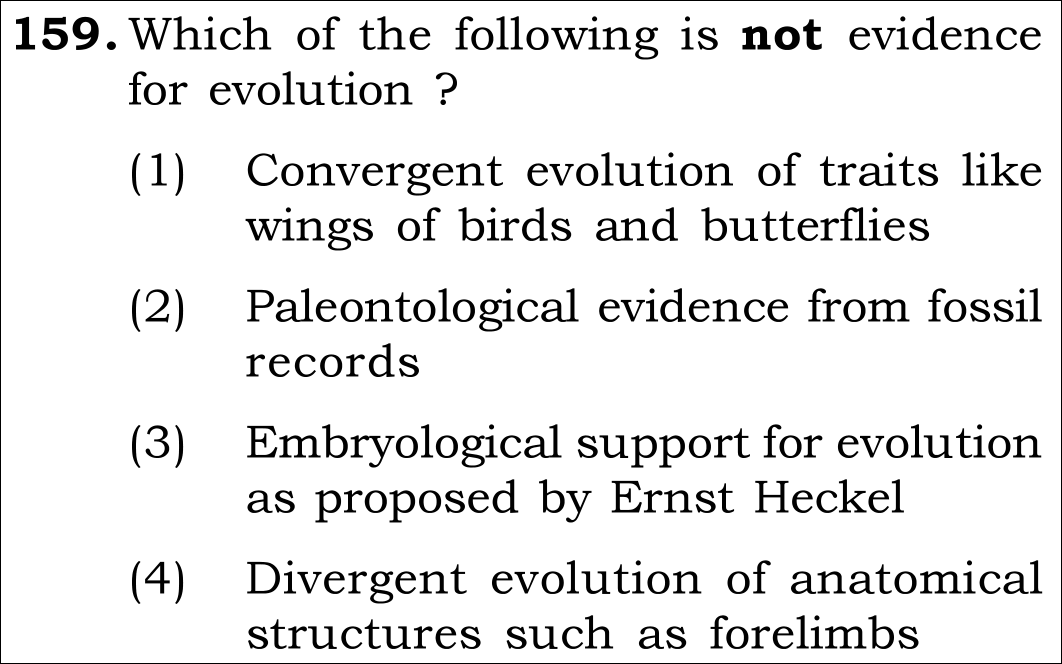
NEET 2026 · Q159 Easy
Official NEET 2026 Question 159 - Evolution
1
2
3 ✓ Key
4
💡 Verified Solution & 30-Second Hack
✓
Verified Against NTA Final Answer Key
Option (3) : Embryological support for evolution as proposed by Ernst Haeckel
📚 Evolution Easy
📋 Given Parameters & Problem Setup
Context Evidence for Evolution in modern evolutionary biology
Criterion NOT an accepted evidence
⚡

The 30-Second Exam Hall Shortcut: ⚡ von Baer Disproof Trigger

⏱️ Save ~35 seconds

Ernst Haeckel’s Biogenetic Law was DISPROVED by Karl Ernst von Baer!

1 Notice negative query: "Which of the following is NOT an accepted evidence...".
2 Recall NCERT Evolution Section 7.3: Ernst Haeckel proposed embryological support based on observation that certain features during embryonic stages common to all vertebrates are absent in adult.
3 However, this proposal was disapproved/rejected by Karl Ernst von Baer, who noted that embryos never pass through the adult stages of other animals.
4 Homology, Analogy, and Industrial melanism are all accepted, rigorous evidences.
5 Pick Option (3) immediately.
🛡️
Why You Can 100% Trust This Shortcut: NCERT Biology · Evolution (Adaptive Radiation: Darwin’s finches evolving from ancestral seed-eating stock).
📐

Step-by-Step Rigorous Workflow & Mathematical Proof

Step 1

Haeckel’s Proposal and von Baer’s Disproof

Ernst Haeckel proposed embryological support for evolution based on the observation of certain features during embryonic stages common to all vertebrates that are absent in adults (e.g., vestigial gill slits in human embryos).

Haeckel: Ontogeny Recapitulates Phylogeny→Disproved byKarl Ernst von Baer (Embryos never pass adult stages)\text{Haeckel: Ontogeny Recapitulates Phylogeny} \xrightarrow{\text{Disproved by}} \text{Karl Ernst von Baer (Embryos never pass adult stages)}
  • • Von Baer noted that embryos never pass through the adult stages of other animals; hence Haeckel’s generalization is not an accepted evolutionary law.
Step 2

Evaluate Accepted Evidences

Homologous organs (divergent evolution, e.g., vertebrate forelimbs), analogous organs (convergent evolution, e.g., sweet potato and potato), and industrial melanism (natural selection in Biston betularia) are fully accepted empirical evidences.

Accepted: Homology, Analogy, Natural Selection≠Haeckel’s Embryology (Rejected)\text{Accepted: Homology, Analogy, Natural Selection} \neq \text{Haeckel's Embryology (Rejected)}
  • • Thus, Option (3) is the single non-accepted proposal.
⭐

360° Option Elimination Engine Key Feature

Diagnose every choice: Know exactly why the right option works and why distractors fail.

4-Option Deep Scan
1 A
✗ Incorrect
Verdict & Scientific Reason:

Incorrect choice because it IS an accepted, robust evidence for evolution (indicates common ancestry).

⚠️
Student Fallacy (Why candidates pick this trap): Missing the "NOT" in the question stem.
2 B
✗ Incorrect
Verdict & Scientific Reason:

Incorrect choice because it IS an accepted evidence demonstrating adaptive convergence in similar habitats.

⚠️
Student Fallacy (Why candidates pick this trap): Overlooking that analogy is standard evolutionary evidence.
3 C
✓ 100% Correct
Verdict & Scientific Reason:

100% correct. Ernst Haeckel’s proposal was officially disapproved by Karl Ernst von Baer and is rejected as valid evidence.

💡
Why this is airtight: None; direct textbook recall.
4 D
✗ Incorrect
Verdict & Scientific Reason:

Incorrect choice because industrial melanism IS classic, accepted evidence of natural selection in action.

⚠️
Student Fallacy (Why candidates pick this trap): Failing to realize industrial melanism is accepted empirical evidence.
⚠️

NTA Trap Alert: Embryological Homology vs. Haeckel’s Biogenetic Law

Comparative embryology in general provides insights, but Ernst Haeckel’s specific proposal ("ontogeny recapitulates phylogeny") was explicitly discarded after Karl Ernst von Baer showed embryos never pass through adult stages.

🛡️ How to avoid the -1 mark: Associate Haeckel with the word "disapproved" in NCERT.
📖

Core NEET Syllabus Standard

NEET Biology Core Syllabus · Evolution Standard Benchmark
Core Scientific Principle Tested:

"Embryological support proposed by Ernst Haeckel was disapproved by Karl Ernst von Baer."

Syllabus Focus: Evidences for Evolution
✓ Core NEET UG Syllabus Anchor Syllabus & Academic Standards ↗
Haeckel was Held back and Disapproved by von Baer!
NEET 2026 · Q160 Medium
Official NEET 2026 Question 160 - Evolution
1 Both Statement I and Statement II are correct
2 Both Statement I and Statement II are incorrect
3 Statement I is correct but Statement II is incorrect
4 Statement I is incorrect but Statement II is correct ✓ Key
💡 Verified Solution & 30-Second Hack
✓
Verified Against NTA Final Answer Key
Option (4) : Statement I is incorrect but Statement II is correct
📚 Evolution Medium
📋 Given Parameters & Problem Setup
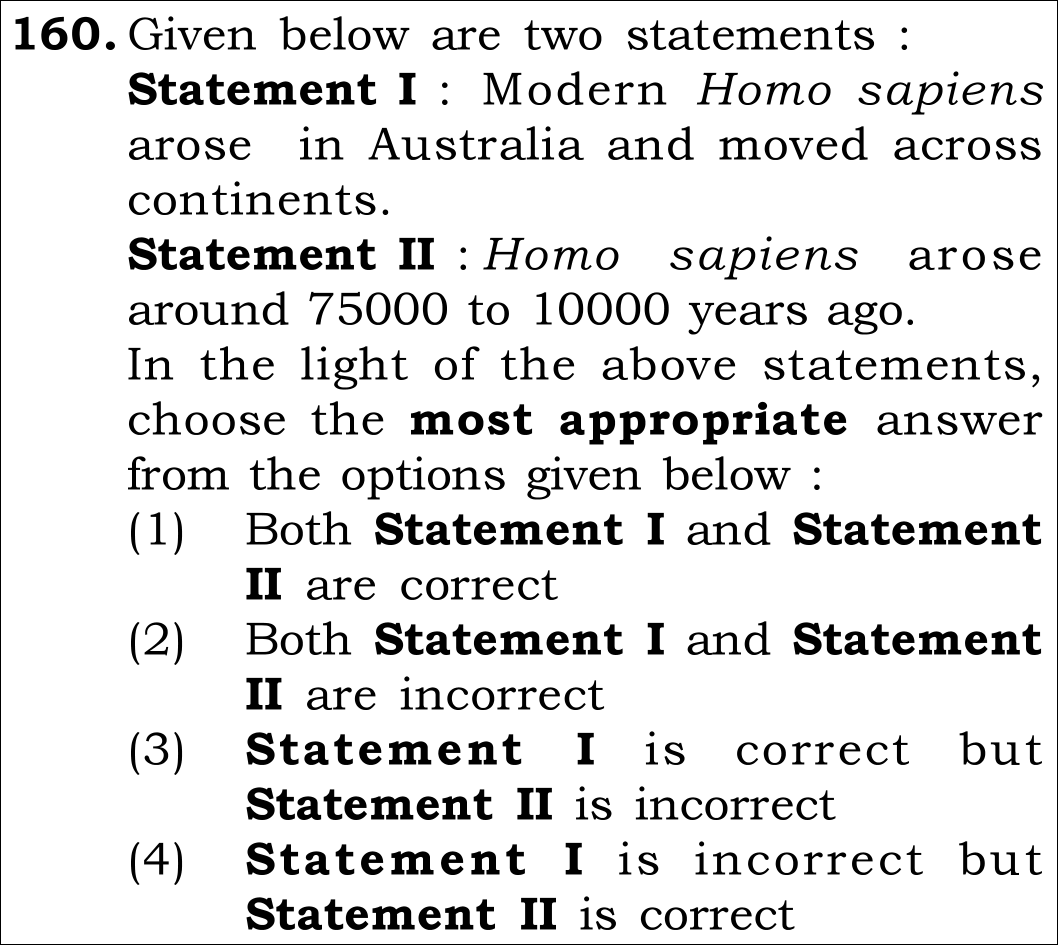
Statement I Homo sapiens arose in Australia and moved across continents.
Statement II During ice age between 75,000-10,000 years ago modern Homo sapiens arose.
⚡

The 30-Second Exam Hall Shortcut: ⚡ Cradle of Humankind (Africa Rule)

⏱️ Save ~40 seconds

Homo sapiens arose in AFRICA (not Australia)! Ice Age = 75k - 10k years ago!

1 Analyze Statement I: "Homo sapiens arose in Australia..." -> FALSE! NCERT states: "Homo sapiens arose in Africa and moved across continents".
2 Analyze Statement II: "During ice age between 75,000-10,000 years ago modern Homo sapiens arose." -> TRUE (NCERT verbatim).
3 Conclusion: Statement I is incorrect, but Statement II is correct.
4 Select Option (4) directly.
🛡️
Why You Can 100% Trust This Shortcut: NCERT Biology · Evolution (Human Evolution: Homo habilis brain capacity 650-800 cc, did not eat meat).
📐

Step-by-Step Rigorous Workflow & Mathematical Proof

Step 1

Geographical Origin of Modern Homo sapiens

Anthropological and genetic evidence documented in NCERT confirms that Homo sapiens arose in Africa and moved across continents and developed into distinct races.

Origin of Homo sapiens≡Africa(≠Australia)  ⟹  Statement I is False\text{Origin of } \textit{Homo sapiens} \equiv \mathbf{Africa} \quad (\neq \text{Australia}) \implies \text{Statement I is False}
  • • Australia was colonized much later via maritime migration.
Step 2

Timeline of Modern Homo sapiens

During the ice age between 75,000–10,000 years ago, modern Homo sapiens arose. Pre-historic cave art developed about 18,000 years ago, and agriculture started around 10,000 years back.

75,000−10,000 years ago (Ice Age)  ⟹  Modern Homo sapiens arose  ⟹  Statement II is True75{,}000 - 10{,}000 \text{ years ago (Ice Age)} \implies \text{Modern } \textit{Homo sapiens} \text{ arose} \implies \text{Statement II is True}
  • • Cave paintings at Bhimbetka rock shelter date back to ~18,000 years ago.
⭐

360° Option Elimination Engine Key Feature

Diagnose every choice: Know exactly why the right option works and why distractors fail.

4-Option Deep Scan
1 A
✗ Incorrect
Verdict & Scientific Reason:

Incorrect because Statement I is false (Africa, not Australia).

⚠️
Student Fallacy (Why candidates pick this trap): Overlooking the geographical error in Statement I.
2 B
✗ Incorrect
Verdict & Scientific Reason:

Incorrect because Statement II is completely correct.

⚠️
Student Fallacy (Why candidates pick this trap): Doubting the ice age timeline.
3 C
✗ Incorrect
Verdict & Scientific Reason:

Incorrect. Statement I is false and Statement II is true.

⚠️
Student Fallacy (Why candidates pick this trap): Reversing the truth values of both statements.
4 D
✓ 100% Correct
Verdict & Scientific Reason:

100% correct. Statement I is false (Homo sapiens arose in Africa) and Statement II is true (75,000-10,000 years ago).

💡
Why this is airtight: None; precise NCERT recall.
⚠️

NTA Trap Alert: Geographical Substitution Trap

NTA replaced "Africa" with "Australia". Fast readers often skim "Homo sapiens arose in [starts with A]..." and mistakenly read Africa.

🛡️ How to avoid the -1 mark: Never skim place names in statement questions; read every syllable carefully.
📖

Core NEET Syllabus Standard

NEET Biology Core Syllabus · Evolution Standard Benchmark
Core Scientific Principle Tested:

"Homo sapiens arose in Africa and moved across continents; modern Homo sapiens arose during the ice age between 75,000-10,000 years ago."

Syllabus Focus: Origin and Evolution of Man
✓ Core NEET UG Syllabus Anchor Syllabus & Academic Standards ↗
Out of AFRICA (not Australia) into the Ice Age!
NEET 2026 · Q164 Medium
Official NEET 2026 Question 164 - Evolution
1 divergent evolution
2 convergent evolution ✓ Key
3 founder effect
4 genetic drift
💡 Verified Solution & 30-Second Hack
✓
Verified Against NTA Final Answer Key
Option (2) : Convergent evolution
📚 Evolution Medium
📋 Given Parameters & Problem Setup
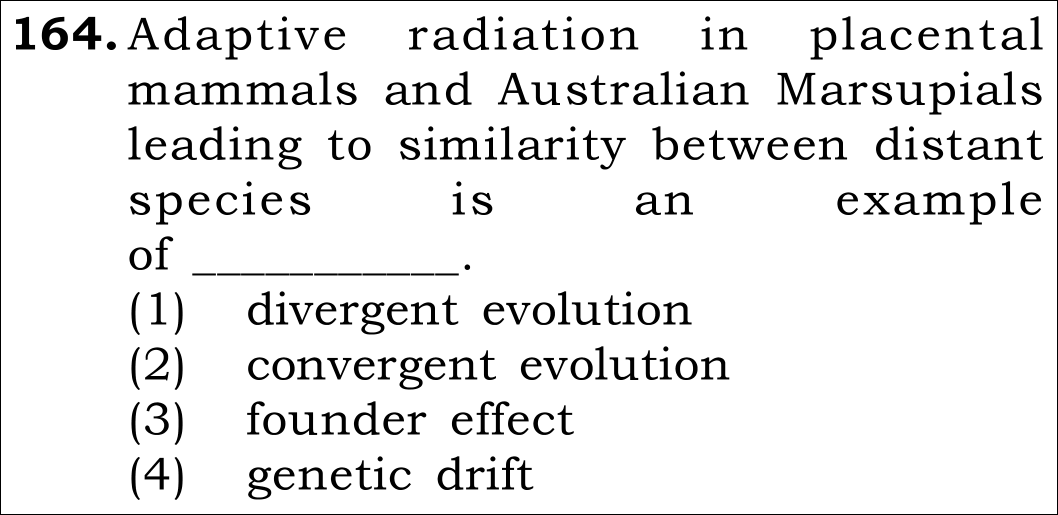
Phenomenon Multiple adaptive radiations in isolated geographical areas
Example Placental mammals of North America resembling Australian marsupials (Placental wolf vs. Tasmanian wolf)
⚡

The 30-Second Exam Hall Shortcut: ⚡ Dual Radiation Principle

⏱️ Save ~40 seconds

Multiple Adaptive Radiations in isolated areas = CONVERGENT EVOLUTION!

1 Read key phrase: "When more than one adaptive radiation appeared to have occurred in an isolated geographical area...".
2 NCERT verbatim: "When more than one adaptive radiation appeared to have occurred in an isolated geographical area (representing different habitats), one can call this convergent evolution."
3 Example: Placental wolf and Tasmanian wolf look remarkably similar because they fill the same ecological niche in separate lineages.
4 Match Option (2): Convergent evolution.
5 Bubble Option (2) in under 15 seconds!
🛡️
Why You Can 100% Trust This Shortcut: NCERT Biology · Evolution (Origin of Life: Miller-Urey experiment synthesized amino acids in reducing atmosphere).
📐

Step-by-Step Rigorous Workflow & Mathematical Proof

Step 1

Adaptive Radiation vs. Convergent Evolution

Adaptive radiation within a single lineage produces diverse forms (e.g., Darwin’s finches on Galapagos or Australian marsupials starting from an ancestral stock).

Single Ancestral Stock→RadiationDiverse Species(Adaptive Radiation)\text{Single Ancestral Stock} \xrightarrow{\text{Radiation}} \text{Diverse Species} \quad (\text{Adaptive Radiation})
  • • Marsupials radiated into marsupial mole, banded anteater, Tasmanian wolf, sugar glider, etc.
Step 2

Convergence of Parallel Adaptive Radiations

When two independent lineages (placental mammals and Australian marsupials) undergo adaptive radiation into similar ecological niches, species in both lineages evolve analogous structures and similar appearances. This parallel adaptation of different lineages to similar environmental pressures is convergent evolution.

Placental Wolf (Placental)↔Convergent EvolutionTasmanian Wolf (Marsupial)\text{Placental Wolf (Placental)} \xleftrightarrow{\text{Convergent Evolution}} \text{Tasmanian Wolf (Marsupial)}
  • • Placental anteater resembles Numbat; Lemur resembles Spotted cuscus; Bobcat resembles Tasmanian tiger cat.
⭐

360° Option Elimination Engine Key Feature

Diagnose every choice: Know exactly why the right option works and why distractors fail.

4-Option Deep Scan
1 A
✗ Incorrect
Verdict & Scientific Reason:

Incorrect. Divergent evolution occurs within a single ancestral lineage radiating outwards (homology), whereas here two distinct lineages evolve towards similar forms.

⚠️
Student Fallacy (Why candidates pick this trap): Confusing within-lineage radiation (divergence) with cross-lineage resemblance (convergence).
2 B
✓ 100% Correct
Verdict & Scientific Reason:

100% correct. NCERT explicitly designates the resemblance between placental mammals and Australian marsupials as convergent evolution.

💡
Why this is airtight: None; textbook verbatim.
3 C
✗ Incorrect
Verdict & Scientific Reason:

Incorrect. Saltation refers to single-step large mutation (de Vries), which is unrelated to this macroevolutionary pattern.

⚠️
Student Fallacy (Why candidates pick this trap): Confusing saltational mutation theory with ecological convergence.
4 D
✗ Incorrect
Verdict & Scientific Reason:

Incorrect. "Adaptive divergence" describes divergence away from a common ancestor, not independent lineages evolving similar traits.

⚠️
Student Fallacy (Why candidates pick this trap): Using an inverted evolutionary descriptor.
⚠️

NTA Trap Alert: Radiation vs. Convergence Semantics Trap

One marsupial radiating into many is adaptive radiation. But comparing a placental mammal to a marsupial counterpart is CONVERGENT EVOLUTION.

🛡️ How to avoid the -1 mark: Ask: Are we comparing one lineage branching out (radiation), or two lineages meeting at the same design (convergence)? Two lineages = Convergence.
📖

Core NEET Syllabus Standard

NEET Biology Core Syllabus · Evolution Standard Benchmark
Core Scientific Principle Tested:

"When more than one adaptive radiation occurs in isolated geographical areas, it leads to convergent evolution."

Syllabus Focus: Adaptive Radiation & Convergent Evolution
✓ Core NEET UG Syllabus Anchor Syllabus & Academic Standards ↗
Two Radiations Converge: Marsupial Wolf + Placental Wolf = Convergent evolution!
NEET 2026 · Q170 Easy
Official NEET 2026 Question 170 - Evolution
1 Both A and R are correct and R is the correct explanation of A ✓ Key
2 Both A and R are true, but R is not the correct explanation of A
3 A is true but R is false
4 A is false but R is true
💡 Verified Solution & 30-Second Hack
✓
Verified Against NTA Final Answer Key
Option (1) : Both (A) and (R) are true and (R) is the correct explanation of (A)
📚 Evolution Easy
📋 Given Parameters & Problem Setup
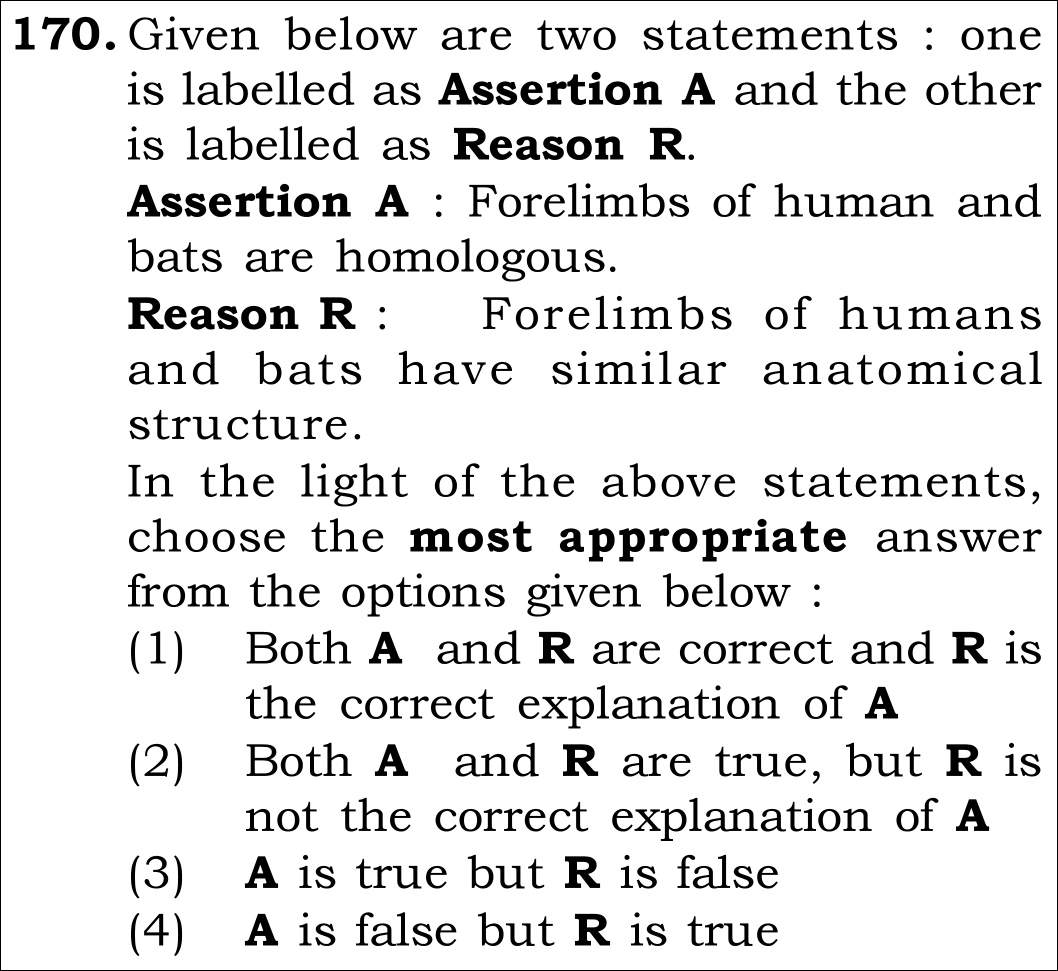
Assertion (A) Forelimbs of whales, bats, cheetah, and humans are homologous organs.
Reason (R) They have similar anatomical structure and developmental origin, though they perform different functions.
⚡

The 30-Second Exam Hall Shortcut: ⚡ Homology "Because" Test

⏱️ Save ~40 seconds

They are homologous organs BECAUSE they share the same anatomical plan despite differing functions!

1 Read Assertion (A): Forelimbs of whales, bats, cheetah, and humans are homologous -> TRUE (NCERT textbook exemplar).
2 Read Reason (R): They have similar anatomical structure and origin though perform different functions -> TRUE (canonical definition of homology).
3 Apply the "BECAUSE" connector: Forelimbs are homologous organs BECAUSE they possess the same basic pentadactyl skeletal blueprint (humerus, radius, ulna, carpals, metacarpals, phalanges) inherited from a common ancestor, modified for diverse functions (swimming, flying, running, grasping).
4 Reason (R) is the direct, correct explanation for Assertion (A).
5 Select Option (1) immediately.
🛡️
Why You Can 100% Trust This Shortcut: NCERT Biology · Evolution (Embryological Support for Evolution: Ernst Haeckel biogenetic law refuted by Karl Ernst von Baer).
📐

Step-by-Step Rigorous Workflow & Mathematical Proof

Step 1

Evaluate Assertion (A)

Whales, bats, cheetah, and humans (all mammals) share similarities in the pattern of bones of forelimbs. Though these forelimbs perform different functions (whale for swimming, bat for flying, cheetah for running, human for grasping), they are homologous organs showing divergent evolution.

Forelimbs of Whale, Bat, Cheetah, Human≡Homologous Organs (Divergent Evolution)\text{Forelimbs of Whale, Bat, Cheetah, Human} \equiv \text{Homologous Organs (Divergent Evolution)}
  • • Assertion (A) is completely true.
Step 2

Evaluate Reason (R) and Explanatory Link

Homology is defined as structural similarity due to common ancestry and developmental origin, even if adapted to different functions in different habitats. Because these mammalian forelimbs share the exact same skeletal elements (humerus, radius, ulna, carpals, metacarpals, and phalanges), Reason (R) is true and perfectly explains Assertion (A).

Same Anatomy (Humerus, Radius, Ulna)+Different Functions≡Homology  ⟹  (R) explains (A)\text{Same Anatomy (Humerus, Radius, Ulna)} + \text{Different Functions} \equiv \mathbf{Homology} \implies (R) \text{ explains } (A)
  • • Analogy, in contrast, represents different structures evolving for the same function (convergent evolution).
⭐

360° Option Elimination Engine Key Feature

Diagnose every choice: Know exactly why the right option works and why distractors fail.

4-Option Deep Scan
1 A
✓ 100% Correct
Verdict & Scientific Reason:

100% correct. Reason (R) is the textbook definition of homology and directly explains why mammalian forelimbs are classified as homologous.

💡
Why this is airtight: None; quintessential assertion-reason question.
2 B
✗ Incorrect
Verdict & Scientific Reason:

Incorrect. (R) is the precise scientific justification for (A).

⚠️
Student Fallacy (Why candidates pick this trap): Failing to see that shared developmental anatomy is the core reason for homology.
3 C
✗ Incorrect
Verdict & Scientific Reason:

Incorrect. Reason (R) is factually accurate.

⚠️
Student Fallacy (Why candidates pick this trap): Doubting the anatomical homology of mammals.
4 D
✗ Incorrect
Verdict & Scientific Reason:

Incorrect. Assertion (A) is the classic NCERT example of homologous organs.

⚠️
Student Fallacy (Why candidates pick this trap): Confusing homology with analogy.
⚠️

NTA Trap Alert: Homologous vs. Analogous Organ Inversion

Students sometimes think that because whale forelimbs (flippers) and bat forelimbs (wings) have completely different uses, they must be "analogous". Analogy means same function, different anatomy; Homology means same anatomy, different function.

🛡️ How to avoid the -1 mark: Remember: HOMO-logy = SAME origin/anatomy; ANA-logy = SAME function.
📖

Core NEET Syllabus Standard

NEET Biology Core Syllabus · Evolution Standard Benchmark
Core Scientific Principle Tested:

"Homologous structures share similar anatomical origin and structure adapted for different functions, indicating divergent evolution."

Syllabus Focus: Homology and Analogy
✓ Core NEET UG Syllabus Anchor Syllabus & Academic Standards ↗
Homologous = Heritage (Same bones, different jobs)!
NEET 2025 · Q151 Easy
Official NEET 2025 Question 151 - Evolution
1 Analogy, convergent ✓ Key
2 Homology, divergent
3 Homology, convergent
4 Analogy, divergent
💡 Verified Solution & 30-Second Hack
✓
Verified Against NTA Final Answer Key
Option (1) : Analogy, convergent
📚 Evolution Easy
📋 Given Parameters & Problem Setup
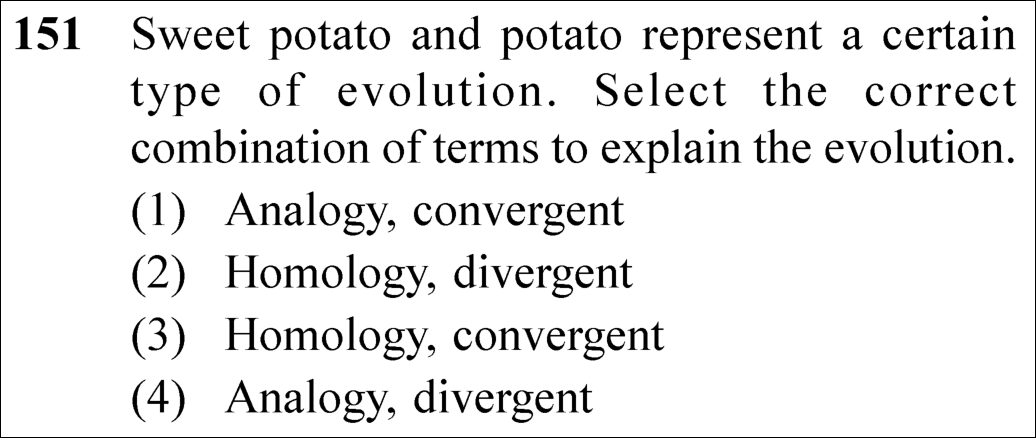
Example Pair Sweet potato (Ipomoea batatas) and Potato (Solanum tuberosum)
Target Combination Type of anatomical relationship and evolutionary pattern
⚡

The 30-Second Exam Hall Shortcut: ⚡ Analogy vs Homology Fingerprint

⏱️ Save ~25 seconds

Sweet potato (ROOT modification) and Potato (STEM tuber) perform the SAME function (food storage) from DIFFERENT anatomical origins -> ANALOGY via CONVERGENT evolution!

1 Examine anatomical origins and functions from NCERT Section 7.3:
2 - Sweet potato: Modified adventitious ROOT specialized for storage.
3 - Potato: Modified underground STEM (tuber) specialized for storage.
4 - Different anatomical origins + Same function (storage of starch) = ANALOGOUS organs.
5 - Analogous structures arise due to adaptation to similar environmental needs = CONVERGENT evolution.
6 Pair: Analogy, convergent (Option 1)!
7 Solved in under 5 seconds!
🛡️
Why You Can 100% Trust This Shortcut: Homologous vs Analogous Organs & Divergent Evolution (NCERT Biology · Evolution: Forelimbs of vertebrates share common ancestry).
📐

Step-by-Step Rigorous Workflow & Mathematical Proof

Step 1

Morphological and Anatomical Origins of the Tubers

Examining the developmental genesis of both storage organs:

  • • Potato (*Solanum tuberosum*): An underground modified stem (stem tuber). It bears nodes ("eyes" with scale leaves and axillary buds) and internodes, characteristic of cauline anatomy.
  • • Sweet potato (*Ipomoea batatas*): A modified adventitious root (root tuber). It lacks nodes, internodes, and scale leaves.
Step 2

Evolutionary Significance: Analogy and Convergent Evolution

Relating structure and function to evolutionary trajectories:

  • • Analogy: Structures that are not anatomically similar (different embryonic origins) but perform similar biological functions (both store food/starch underground).
  • • Convergent Evolution: Different ancestral structures independently evolve similar phenotypic adaptations in response to similar selective pressures or habitats.
  • • NCERT states verbatim: "Sweet potato (root modification) and potato (stem modification) is another example for analogy... Analogous structures are a result of convergent evolution."
Step 3

Conclusion

The correct combination of terms is Analogy and Convergent evolution, corresponding to Option (1).

Root+Stem→Food StorageAnalogy (Convergent Evolution)\text{Root} + \text{Stem} \xrightarrow{\text{Food Storage}} \text{Analogy (Convergent Evolution)}
⭐

360° Option Elimination Engine Key Feature

Diagnose every choice: Know exactly why the right option works and why distractors fail.

4-Option Deep Scan
1 A
✓ 100% Correct
Verdict & Scientific Reason:

100% correct. Accurately links different anatomical origins performing similar storage functions to analogy and convergent evolution.

💡
Why this is airtight: None; textbook mastery.
2 B
✗ Incorrect
Verdict & Scientific Reason:

Incorrect. Homologous organs share a common anatomical origin (e.g., Bougainvillea thorn and Cucurbita tendril), which is not the case here.

⚠️
Student Fallacy (Why candidates pick this trap): Confusing similar function with common origin.
3 C
✗ Incorrect
Verdict & Scientific Reason:

Incorrect. Homology results from divergent evolution, not convergent evolution.

⚠️
Student Fallacy (Why candidates pick this trap): Mismatched evolutionary concepts.
4 D
✗ Incorrect
Verdict & Scientific Reason:

Incorrect. Analogy is driven by convergent evolution, never divergent evolution.

⚠️
Student Fallacy (Why candidates pick this trap): Failing to remember that analogy always pairs with convergence.
⚠️

NTA Trap Alert: HD vs AC Mnemonic Rule

Never mix up the pairs: Homology -> Divergent evolution (HD); Analogy -> Convergent evolution (AC). Sweet potato (root) and potato (stem) are AC!

🛡️ How to avoid the -1 mark: Remember: HD (High Definition = Homology Divergent) and AC (Air Conditioner = Analogy Convergent).
📖

Core NEET Syllabus Standard

NEET Biology Core Syllabus · Evolution Standard Benchmark
Core Scientific Principle Tested:

"Sweet potato (root) and potato (stem) are analogous organs resulting from convergent evolution."

Syllabus Focus: Evidences for Evolution · Comparative Anatomy and Morphology
✓ Core NEET UG Syllabus Anchor Syllabus & Academic Standards ↗
AC: Analogy = Convergent (Sweet Potato + Potato)!
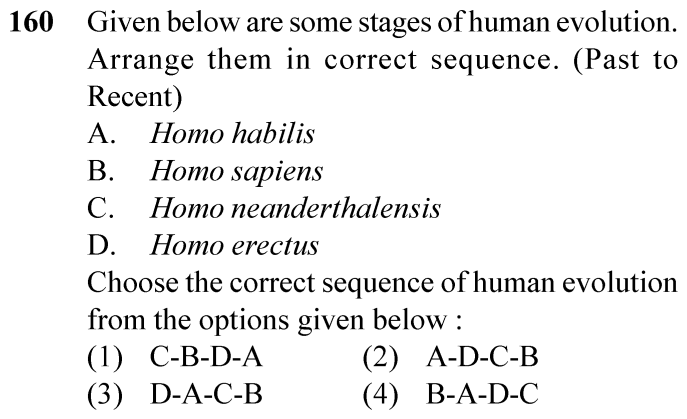
NEET 2024 · Q160 Easy
Official NEET 2024 Question 160 - Evolution
1 C-B-D-A
2 A-D-C-B ✓ Key
3 D-A-C-B
4 B-A-D-C
💡 Verified Solution & 30-Second Hack
✓
Verified Against NTA Final Answer Key
Option (2) : A-D-C-B
📚 Evolution Easy
📋 Given Parameters & Problem Setup
Hominid Stages A: Homo habilis; B: Homo sapiens; C: Homo neanderthalensis; D: Homo erectus
Ordering Direction Chronological from past to recent
⚡

The 30-Second Exam Hall Shortcut: ⚡ Hominid Evolution Timeline Mnemonic

⏱️ Save ~25 seconds

Homo habilis (2 mya, 650-800 cc) -> Homo erectus (1.5 mya, 900 cc) -> Neanderthal (100k-40k ya, 1400 cc) -> Homo sapiens (75k-10k ya)! Sequence: A -> D -> C -> B!

1 A. Homo habilis: The first human-like being (hominid), brain capacity 650-800 cc, ~2 million years ago.
2 D. Homo erectus: Fossils discovered in Java in 1891, ~1.5 mya, brain capacity ~900 cc.
3 C. Homo neanderthalensis: Lived 100,000 to 40,000 years ago, brain capacity 1400 cc.
4 B. Homo sapiens: Modern man arose during ice age between 75,000-10,000 years ago.
5 Chronological order (Past to Recent): A -> D -> C -> B -> Option (2) / B.
🛡️
Why You Can 100% Trust This Shortcut: NCERT Biology · Evolution (Origin and Evolution of Man)
📐

Step-by-Step Rigorous Workflow & Mathematical Proof

Step 1

Review Geological Epochs and Cranial Capacities

The evolutionary progression of genus Homo documented in NCERT follows: 1. Homo habilis: First hominid tool-maker, brain 650-800 cc (Stage A). 2. Homo erectus: Java man around 1.5 million years ago, brain ~900 cc (Stage D). 3. Neanderthal man (Homo neanderthalensis): Lived in near east and central Asia between 100,000-40,000 years ago, brain 1400 cc (Stage C). 4. Homo sapiens: Modern human species arose in Africa and migrated between 75,000-10,000 years ago (Stage B).

Step 2

Assemble Chronological Trajectory

From past to recent, the sequence is uniquely A -> D -> C -> B.

⭐

360° Option Elimination Engine Key Feature

Diagnose every choice: Know exactly why the right option works and why distractors fail.

4-Option Deep Scan
1 (1)
✗ Incorrect
Verdict & Scientific Reason:

Places Neanderthal before Homo erectus and habilis.

⚠️
Student Fallacy (Why candidates pick this trap): Places Neanderthal before Homo erectus and habilis.
2 (2)
✓ 100% Correct
Verdict & Scientific Reason:

Accurately traces chronological hominid evolution from Homo habilis to Homo erectus, Neanderthal man, and Homo sapiens.

💡
Why this is airtight: None.
3 (3)
✗ Incorrect
Verdict & Scientific Reason:

Places Homo erectus before Homo habilis.

⚠️
Student Fallacy (Why candidates pick this trap): Places Homo erectus before Homo habilis.
4 (4)
✗ Incorrect
Verdict & Scientific Reason:

Places modern Homo sapiens at the beginning of the evolutionary timeline.

⚠️
Student Fallacy (Why candidates pick this trap): Places modern Homo sapiens at the beginning of the evolutionary timeline.
⚠️

NTA Trap Alert: Homo habilis vs Homo erectus Priority

Placing Homo erectus before Homo habilis.

🛡️ How to avoid the -1 mark: Remember: Habilis ("handy man", 650-800 cc) preceded Erectus ("upright man", 900 cc).
📖

Core NEET Syllabus Standard

Biology Core Zoology · Evolution Standard Benchmark
Core Scientific Principle Tested:

"The first human-like being the hominid and was called Homo habilis. The brain capacities were between 650-800cc... fossils discovered in Java in 1891 revealed the next stage, i.e. Homo erectus about 1.5 mya. The Neanderthal man with a brain size of 1400cc lived near east and central Asia between 100,000-40,000 years ago. Homo sapiens arose in Africa and moved across continents."

Syllabus Focus: Chronological Sequence of Hominid Fossil Forms (Past to Recent)
✓ Core NEET UG Syllabus Anchor Syllabus & Academic Standards ↗
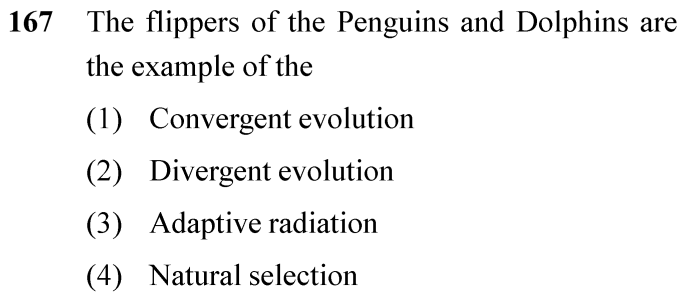
NEET 2024 · Q167 Easy
Official NEET 2024 Question 167 - Evolution
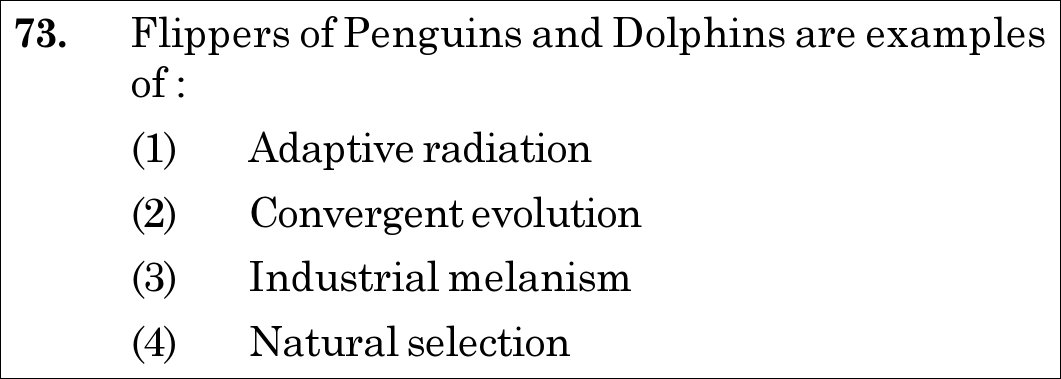
1 Convergent evolution ✓ Key
2 Divergent evolution
3 Adaptive radiation
4 Natural selection
💡 Verified Solution & 30-Second Hack
✓
Verified Against NTA Final Answer Key
Option (1) : Convergent evolution
📚 Evolution Easy
📋 Given Parameters & Problem Setup
Structures Flippers of Penguins (Aves) and Dolphins (Mammalia)
Evolutionary Phenomenon Type of evolutionary adaptation
⚡

The 30-Second Exam Hall Shortcut: ⚡ Analogous Structures = Convergent Evolution

⏱️ Save ~15 seconds

Flippers of penguins (birds) and dolphins (mammals) have different anatomical origins but similar functions for aquatic locomotion -> Classic Convergent Evolution!

1 Compare origins and functions:
2 - Penguin: Bird (Aves).
3 - Dolphin: Aquatic mammal (Mammalia).
4 - Their flippers have different embryonic/structural ancestry but converge on the same hydrodynamic function (swimming).
5 Analogous organs arise due to CONVERGENT EVOLUTION.
6 Select Option (1) / A.
🛡️
Why You Can 100% Trust This Shortcut: NCERT Biology · Evolution (Homology and Analogy)
📐

Step-by-Step Rigorous Workflow & Mathematical Proof

Step 1

Define Analogy and Convergent Evolution

Analogy refers to structures that are not anatomically similar though they perform similar functions. It is the result of convergent evolution—different structures evolving for the same function and hence having similarity.

Step 2

Apply NCERT Classic Example

NCERT states: "Other examples of analogy are the eye of the octopus and of mammals or the flippers of Penguins and Dolphins. One can say that it is the similar habitat that has resulted in selection of similar adaptive features in different groups of organisms but toward the same function: this is convergent evolution."

⭐

360° Option Elimination Engine Key Feature

Diagnose every choice: Know exactly why the right option works and why distractors fail.

4-Option Deep Scan
1 (1)
✓ 100% Correct
Verdict & Scientific Reason:

Penguin and dolphin flippers are analogous structures evolved via convergent adaptation to aquatic locomotion.

💡
Why this is airtight: None.
2 (2)
✗ Incorrect
Verdict & Scientific Reason:

Divergent evolution produces homologous structures derived from a common ancestral plan (e.g., forelimbs of cheetah, whale, bat).

⚠️
Student Fallacy (Why candidates pick this trap): Divergent evolution produces homologous structures derived from a common ancestral plan (e.g., forelimbs of cheetah, whale, bat).
3 (3)
✗ Incorrect
Verdict & Scientific Reason:

Adaptive radiation is the evolutionary diversification from a single ancestral species radiating into different ecological niches (e.g., Darwin’s finches).

⚠️
Student Fallacy (Why candidates pick this trap): Adaptive radiation is the evolutionary diversification from a single ancestral species radiating into different ecological niches (e.g., Darwin’s finches).
4 (4)
✗ Incorrect
Verdict & Scientific Reason:

Natural selection is the general evolutionary mechanism driving both divergence and convergence, but the specific pattern here is convergent evolution.

⚠️
Student Fallacy (Why candidates pick this trap): Natural selection is the general evolutionary mechanism driving both divergence and convergence, but the specific pattern here is convergent evolution.
⚠️

NTA Trap Alert: Homology vs Analogy Reversal

Assuming because both are tetrapod forelimbs they must be homologous.

🛡️ How to avoid the -1 mark: While tetrapod skeletal bones share homology at the arm level, modified swimming paddle flippers across birds and mammals specifically exemplify analogy and convergent evolution in NCERT.
📖

Core NEET Syllabus Standard

Biology Core Zoology · Evolution Standard Benchmark
Core Scientific Principle Tested:

"Other examples of analogy are the eye of the octopus and of mammals or the flippers of Penguins and Dolphins... it is the similar habitat that has resulted in selection of similar adaptive features in different groups of organisms but toward the same function: this is convergent evolution."

Syllabus Focus: Analogous Organs and Convergent Evolution (Penguins and Dolphins)
✓ Core NEET UG Syllabus Anchor Syllabus & Academic Standards ↗
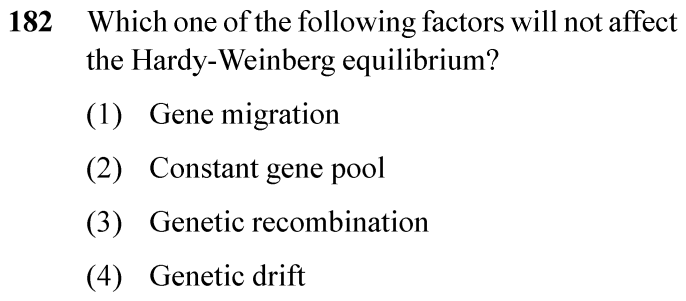
NEET 2024 · Q182 Easy
Official NEET 2024 Question 182 - Evolution
1 Gene migration
2 Constant gene pool ✓ Key
3 Genetic recombination
4 Genetic drift
💡 Verified Solution & 30-Second Hack
✓
Verified Against NTA Final Answer Key
Option (2) : Constant gene pool
📚 Evolution Easy
📋 Given Parameters & Problem Setup
Principle Hardy-Weinberg equilibrium (p^2 + 2pq + q^2 = 1)
Question Factor that will NOT affect / disrupt the Hardy-Weinberg equilibrium
⚡

The 30-Second Exam Hall Shortcut: ⚡ Hardy-Weinberg Five Disturbing Factors

⏱️ Save ~20 seconds

Five factors disrupt Hardy-Weinberg equilibrium: Gene migration, Genetic drift, Mutation, Genetic recombination, and Natural selection. A CONSTANT gene pool maintains equilibrium!

1 Recall the five forces that alter allele frequencies in a population:
2 Gene migration or gene flow
3 Genetic drift
4 Mutation
5 Genetic recombination
6 Natural selection
7 A "Constant gene pool" means allele frequencies remain unchanged from generation to generation—this is the very definition of equilibrium, so it does NOT disrupt it!
8 Select Option (2) / B.
🛡️
Why You Can 100% Trust This Shortcut: NCERT Biology · Evolution (Hardy-Weinberg Principle and Gene Frequency Stability)
📐

Step-by-Step Rigorous Workflow & Mathematical Proof

Step 1

Understand the Hardy-Weinberg Principle

This principle states that allele frequencies in a population are stable and is constant from generation to generation. The gene pool (total genes and their alleles in a population) remains a constant. This is called genetic equilibrium. Sum total of all the allelic frequencies is 1 (p2+2pq+q2=1p^2 + 2pq + q^2 = 1).

Step 2

Identify the Five Factors that Disrupt Equilibrium

NCERT lists five factors known to affect Hardy-Weinberg equilibrium: (i) Gene migration or gene flow (ii) Genetic drift (iii) Mutation (iv) Genetic recombination (v) Natural selection

Step 3

Evaluate Given Options

Gene migration (1), Genetic recombination (3), and Genetic drift (4) all alter allelic frequencies and disrupt equilibrium. A constant gene pool (2) describes the maintenance of equilibrium itself, thus having no disruptive effect.

⭐

360° Option Elimination Engine Key Feature

Diagnose every choice: Know exactly why the right option works and why distractors fail.

4-Option Deep Scan
1 (1)
✗ Incorrect
Verdict & Scientific Reason:

Gene migration adds or removes alleles, altering gene frequencies.

⚠️
Student Fallacy (Why candidates pick this trap): Gene migration adds or removes alleles, altering gene frequencies.
2 (2)
✓ 100% Correct
Verdict & Scientific Reason:

A constant gene pool represents the condition of genetic equilibrium, so it does not alter or disrupt it.

💡
Why this is airtight: None.
3 (3)
✗ Incorrect
Verdict & Scientific Reason:

Recombination reshuffles alleles during meiotic crossing over, generating new combinations that affect equilibrium.

⚠️
Student Fallacy (Why candidates pick this trap): Recombination reshuffles alleles during meiotic crossing over, generating new combinations that affect equilibrium.
4 (4)
✗ Incorrect
Verdict & Scientific Reason:

Genetic drift causes random fluctuations in allele frequencies in small populations, disrupting equilibrium.

⚠️
Student Fallacy (Why candidates pick this trap): Genetic drift causes random fluctuations in allele frequencies in small populations, disrupting equilibrium.
⚠️

NTA Trap Alert: Disturbing Factor vs Equilibrium Definition

Looking for a mutation or drift force without recognizing that "constant gene pool" is the steady state itself.

🛡️ How to avoid the -1 mark: Read carefully: the question asks which factor will NOT affect (i.e. not disturb) the equilibrium.
📖

Core NEET Syllabus Standard

Biology Core Zoology · Evolution Standard Benchmark
Core Scientific Principle Tested:

"This principle says that allele frequencies in a population are stable and is constant from generation to generation. The gene pool remains a constant. Five factors are known to affect Hardy-Weinberg equilibrium: gene migration or gene flow, genetic drift, mutation, genetic recombination and natural selection."

Syllabus Focus: Hardy-Weinberg Equilibrium: Factors Disrupting vs Maintaining Equilibrium
✓ Core NEET UG Syllabus Anchor Syllabus & Academic Standards ↗
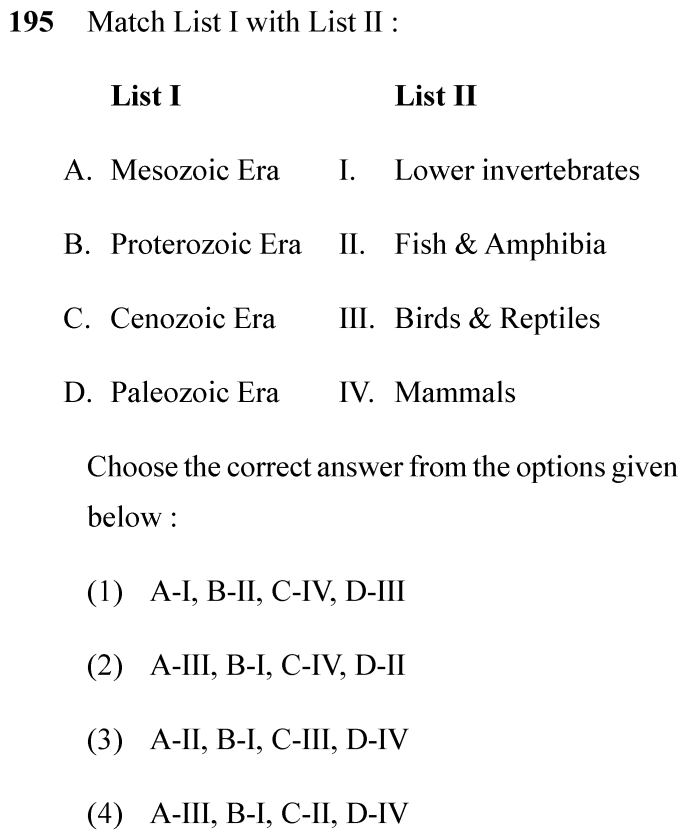
NEET 2024 · Q195 Medium
Official NEET 2024 Question 195 - Evolution
1 A-III, B-IV, C-I, D-II Choose the correct answer from the options given
2 A-II, B-I, C-IV, D-III below : ✓ Key
3 A-II, B-I, C-III, D-IV
4 A-IV, B-III, C-I, D-II
💡 Verified Solution & 30-Second Hack
✓
Verified Against NTA Final Answer Key
Option (2) : A-III, B-I, C-IV, D-II
📚 Evolution Medium
📋 Given Parameters & Problem Setup
List I (Geological Eras) A: Mesozoic Era; B: Proterozoic Era; C: Cenozoic Era; D: Paleozoic Era
List II (Dominant / Characteristic Taxa) I: Lower invertebrates; II: Fish & Amphibia; III: Birds & Reptiles; IV: Mammals
⚡

The 30-Second Exam Hall Shortcut: ⚡ Geological Era Dominance Sequence

⏱️ Save ~25 seconds

Mesozoic = Age of Reptiles & origin of Birds (III); Proterozoic = Early lower invertebrates (I); Cenozoic = Age of Mammals (IV); Paleozoic = Age of Fish & Amphibians (II)! Match: A-III, B-I, C-IV, D-II!

1 Recall evolutionary dominance across the geological time scale:
2 - Mesozoic Era: Age of Reptiles (dinosaurs) and radiation of Birds (III).
3 - Proterozoic Era: Precambrian era marked by early primitive lower invertebrates (I).
4 - Cenozoic Era: Modern era, known as the "Age of Mammals" (and angiosperms) (IV).
5 - Paleozoic Era: Ancient era dominated successively by marine invertebrates, fishes, and amphibians (II).
6 Matching order: A-III, B-I, C-IV, D-II -> Option (2) / B.
🛡️
Why You Can 100% Trust This Shortcut: NCERT Biology · Evolution (Geological History and Evolutionary Eras)
📐

Step-by-Step Rigorous Workflow & Mathematical Proof

Step 1

Trace Geological Eras in Chronological Order

The geological history of life on Earth is partitioned into major eras: 1. Proterozoic Era (Precambrian): Characterized by the dawn of multicellular life and lower invertebrates (B -> I). 2. Paleozoic Era: Spans Cambrian to Permian, known for the proliferation of marine invertebrates, early jawless and jawed fishes (Devonian: Age of Fishes), and amphibians (Carboniferous) (D -> II). 3. Mesozoic Era: Spans Triassic, Jurassic, and Cretaceous, celebrated as the Age of Reptiles (dinosaurs) and origin of birds (A -> III). 4. Cenozoic Era: Spans Tertiary and Quaternary, recognized as the Age of Mammals (C -> IV).

Step 2

Combine Matches

A-III, B-I, C-IV, D-II matches Option (2).

⭐

360° Option Elimination Engine Key Feature

Diagnose every choice: Know exactly why the right option works and why distractors fail.

4-Option Deep Scan
1 (1)
✗ Incorrect
Verdict & Scientific Reason:

Mismatches Mesozoic with Lower invertebrates.

⚠️
Student Fallacy (Why candidates pick this trap): Mismatches Mesozoic with Lower invertebrates.
2 (2)
✓ 100% Correct
Verdict & Scientific Reason:

Accurately pairs all four major geological eras with their respective dominant animal lineages.

💡
Why this is airtight: None.
3 (3)
✗ Incorrect
Verdict & Scientific Reason:

Mismatches Mesozoic with Fish & Amphibia.

⚠️
Student Fallacy (Why candidates pick this trap): Mismatches Mesozoic with Fish & Amphibia.
4 (4)
✗ Incorrect
Verdict & Scientific Reason:

Mismatches Cenozoic with Fish & Amphibia and Paleozoic with Mammals.

⚠️
Student Fallacy (Why candidates pick this trap): Mismatches Cenozoic with Fish & Amphibia and Paleozoic with Mammals.
⚠️

NTA Trap Alert: Mesozoic vs Cenozoic Animals

Confusing the Age of Reptiles (Mesozoic) with the Age of Mammals (Cenozoic).

🛡️ How to avoid the -1 mark: Mesozoic = Dinosaurs, Reptiles, Birds; Cenozoic = Modern Mammals and humans.
📖

Core NEET Syllabus Standard

Biology Core Zoology · Evolution Standard Benchmark
Core Scientific Principle Tested:

"In the Mesozoic era, reptiles dominated the earth... In the Cenozoic era, mammals dominated the earth... In the Paleozoic era, jawless fishes evolved around 350 mya and amphibians dominated."

Syllabus Focus: Geological Eras and Dominant Animal Forms
✓ Core NEET UG Syllabus Anchor Syllabus & Academic Standards ↗
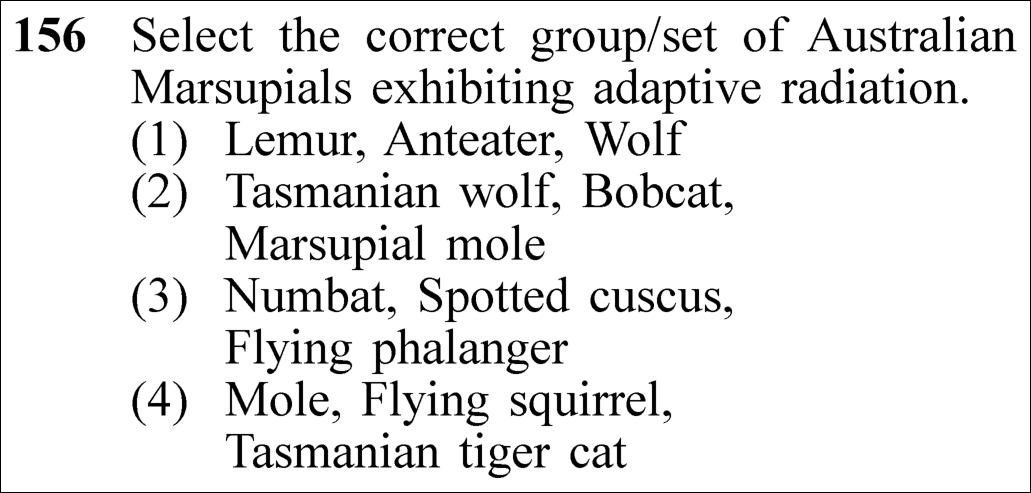
NEET 2023 · Q156 Medium
Official NEET 2023 Question 156 - Evolution
1 Lemur, Anteater, Wolf
2 Tasmanian wolf, Bobcat, Marsupial mole
3 Numbat, Spotted cuscus, Flying phalanger ✓ Key
4 Mole, Flying squirrel, Tasmanian tiger cat
💡 Verified Solution & 30-Second Hack
✓
Verified Against NTA Final Answer Key
Option (3) : Numbat, Spotted cuscus, Flying phalanger
📚 Evolution Medium
📋 Given Parameters & Problem Setup
Evolutionary Phenomenon Adaptive Radiation
Target Group Exclusively Australian Marsupials
⚡

The 30-Second Exam Hall Shortcut: ⚡ Marsupial vs. Placental Mammal Filter

⏱️ Save ~25 seconds

Filter out the placental mammals: Anteater, Lemur, Wolf, Bobcat, Mole, and Flying squirrel are all PLACENTAL mammals! Option (3) contains Numbat (banded anteater), Spotted cuscus, and Flying phalanger (sugar glider)—all 100% Australian marsupials!

1 Option (1): Lemur, Anteater, Wolf -> All 3 are placental mammals.
2 Option (2): Contains Bobcat -> Placental mammal.
3 Option (4): Contains Mole and Flying squirrel -> Placental mammals.
4 Option (3): Numbat, Spotted cuscus, Flying phalanger -> All 3 are Australian marsupials.
5 Match Option (3).
🛡️
Why You Can 100% Trust This Shortcut: Canonical NCERT Evolution comparative chart of adaptive radiation in Australian marsupials.
📐

Step-by-Step Rigorous Workflow & Mathematical Proof

Step 1

Adaptive Radiation of Australian Marsupials

In Australia, an ancestral marsupial stock underwent adaptive radiation to occupy diverse ecological niches in geographic isolation:

Australian Marsupials={Tasmanian wolf, Tiger catBanded anteater (Numbat)Marsupial mole, Wombat, Bandicoot, Koala, KangarooSpotted cuscus, Flying phalanger (Sugar glider)\text{Australian Marsupials} = \begin{cases} \text{Tasmanian wolf, Tiger cat} \\[2pt] \mathbf{\text{Banded anteater (Numbat)}} \\[2pt] \text{Marsupial mole, Wombat, Bandicoot, Koala, Kangaroo} \\[2pt] \mathbf{\text{Spotted cuscus, Flying phalanger (Sugar glider)}} \end{cases}
Step 2

Convergent Evolution with Placental Mammals

Placental mammals evolved parallel convergent phenotypes resembling these marsupials:

Placental Mole⟷Marsupial MolePlacental Anteater⟷Numbat (Banded Anteater)Placental Lemur⟷Spotted CuscusPlacental Flying squirrel⟷Flying PhalangerPlacental Bobcat⟷Tasmanian Tiger CatPlacental Wolf⟷Tasmanian Wolf\begin{aligned} \text{Placental Mole} & \longleftrightarrow \text{Marsupial Mole} \\[2pt] \text{Placental Anteater} & \longleftrightarrow \text{Numbat (Banded Anteater)} \\[2pt] \text{Placental Lemur} & \longleftrightarrow \text{Spotted Cuscus} \\[2pt] \text{Placental Flying squirrel} & \longleftrightarrow \text{Flying Phalanger} \\[2pt] \text{Placental Bobcat} & \longleftrightarrow \text{Tasmanian Tiger Cat} \\[2pt] \text{Placental Wolf} & \longleftrightarrow \text{Tasmanian Wolf} \end{aligned}
Step 3

Option Elimination

Options 1, 2, and 4 all contain placental mammals (Lemur, Bobcat, Mole, Flying squirrel). Only Option (3) consists entirely of Australian marsupials.

⭐

360° Option Elimination Engine Key Feature

Diagnose every choice: Know exactly why the right option works and why distractors fail.

4-Option Deep Scan
1 1
✗ Incorrect
Verdict & Scientific Reason:

All three are placental mammals, not Australian marsupials.

⚠️
Student Fallacy (Why candidates pick this trap): Selecting the placental counter-column from the NCERT diagram.
2 2
✗ Incorrect
Verdict & Scientific Reason:

Bobcat is a placental carnivore (convergent counterpart of Tasmanian tiger cat).

⚠️
Student Fallacy (Why candidates pick this trap): Failing to notice Bobcat is a placental mammal.
3 3
✓ 100% Correct
Verdict & Scientific Reason:

All three species are genuine Australian marsupials depicting adaptive radiation in the isolated island continent.

💡
Why this is airtight: None; precise taxonomic differentiation.
4 4
✗ Incorrect
Verdict & Scientific Reason:

Mole and Flying squirrel are placental mammals.

⚠️
Student Fallacy (Why candidates pick this trap): Overlooking that true moles and flying squirrels are placentals.
⚠️

NTA Trap Alert: Convergent Pair Intermixing Trap

NCERT presents a double-column diagram comparing Placental mammals on the left with Australian marsupials on the right. NTA mixes entries from both columns to catch students who memorized the names without their taxonomic category.

🛡️ How to avoid the -1 mark: Remember: Lemur, Bobcat, Wolf, Anteater, Flying squirrel = Placental. Numbat, Cuscus, Phalanger = Marsupial.
📖

Core NEET Syllabus Standard

NCERT Biology · Evolution Standard Benchmark
Core Scientific Principle Tested:

"A number of marsupials, each different from the other evolved from an ancestral stock, but all within the Australian island continent."

Syllabus Focus: Adaptive Radiation (Australian Marsupials)
✓ Core NEET UG Syllabus Anchor Syllabus & Academic Standards ↗
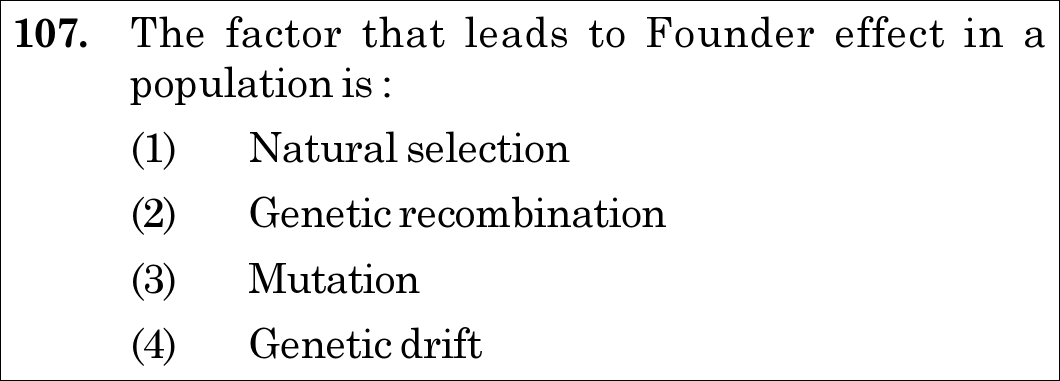
NEET 2021 · Q107 Easy
Official NEET 2021 Question 107 - Evolution
1 Natural selection
2 Genetic recombination
3 Mutation
4 Genetic drift ✓ Key
💡 Verified Solution & 30-Second Hack
✓
Verified Against NTA Final Answer Key
Option (4) : Genetic drift
📚 Evolution Easy
📋 Given Parameters & Problem Setup
Phenomenon Founder effect
Underlying Force Evolutionary factor driving the allele frequency shift
⚡

The 30-Second Exam Hall Shortcut: ⚡ Founder Effect & Bottleneck Effect = Genetic Drift

⏱️ Save ~15 seconds

The Founder effect is a direct manifestation of Genetic Drift operating in small colonizing groups! When a tiny fraction of a population migrates to form a new colony, random sampling of alleles drastically shifts gene frequencies. Match Option (4)!

1 Recall that Genetic Drift refers to random fluctuations in allele frequencies occurring purely by chance in small populations.
2 When a small group leaves the main population and establishes a new colony, they carry only a sample of original gene frequencies.
3 This founding sample forms the basis of the new population—termed the Founder Effect.
4 Therefore, the driving evolutionary factor is Genetic drift.
5 Match Option (4).
🛡️
Why You Can 100% Trust This Shortcut: Canonical NCERT Evolution principles on Hardy-Weinberg and Genetic Drift.
📐

Step-by-Step Rigorous Workflow & Mathematical Proof

Step 1

Definition of Genetic Drift

Genetic drift (Sewall Wright effect) refers to the random, non-directional changes in allele frequencies within a gene pool occurring purely due to chance sampling in small populations:

Genetic Drift=Δprandom∝12Ne\text{Genetic Drift} = \Delta p_{\text{random}} \propto \frac{1}{2N_e}
Step 2

Origin of the Founder Effect

When a small subset of individuals disperses from a large parental population to colonize a previously unoccupied habitat, they serve as the "founders." By chance, the allele frequencies of these founders differ substantially from the parent gene pool.

Step 3

Evolutionary Consequence

Over generations, the new colony evolves distinct genotype frequencies, and the original drifted population becomes founders of a distinct lineage or new species. This special case of genetic drift is termed the Founder Effect.

⭐

360° Option Elimination Engine Key Feature

Diagnose every choice: Know exactly why the right option works and why distractors fail.

4-Option Deep Scan
1 1
✗ Incorrect
Verdict & Scientific Reason:

Natural selection causes directional changes based on differential fitness, whereas Founder effect occurs due to random sampling chance.

⚠️
Student Fallacy (Why candidates pick this trap): Assuming all major population shifts are driven by natural selection.
2 2
✗ Incorrect
Verdict & Scientific Reason:

Recombination shuffles existing alleles during meiosis without altering overall population allele frequencies in Hardy-Weinberg equilibrium.

⚠️
Student Fallacy (Why candidates pick this trap): Confusing meiotic crossing-over with population-level gene frequency shifts.
3 3
✗ Incorrect
Verdict & Scientific Reason:

Mutation introduces novel alleles at low frequency, but the sampling effect of the colonizers is driven by genetic drift.

⚠️
Student Fallacy (Why candidates pick this trap): Believing new population traits require newly generated de novo mutations.
4 4
✓ 100% Correct
Verdict & Scientific Reason:

Founder effect is an extreme example of genetic drift resulting from random sampling during the founding of a new colony.

💡
Why this is airtight: None. Textbook definition.
⚠️

NTA Trap Alert: Confusing Founder Effect with Natural Selection

Students often think the new colony flourishes because it has "superior survival adaptations" (natural selection). However, the initial difference in allele frequency is purely random and non-adaptive (genetic drift).

🛡️ How to avoid the -1 mark: Anchor: Founder effect and Bottleneck effect are ALWAYS sub-categories of Genetic Drift.
📖

Core NEET Syllabus Standard

NEET / NCERT Biology · Evolution Standard Benchmark
Core Scientific Principle Tested:

"Sometimes the change in allele frequency is so different in the new sample of population that they become a different species; the original drifted population becomes founders and the effect is called founder effect."

Syllabus Focus: Hardy-Weinberg Principle and Factors Affecting Genetic Equilibrium
✓ Core NEET UG Syllabus Anchor Syllabus & Academic Standards ↗
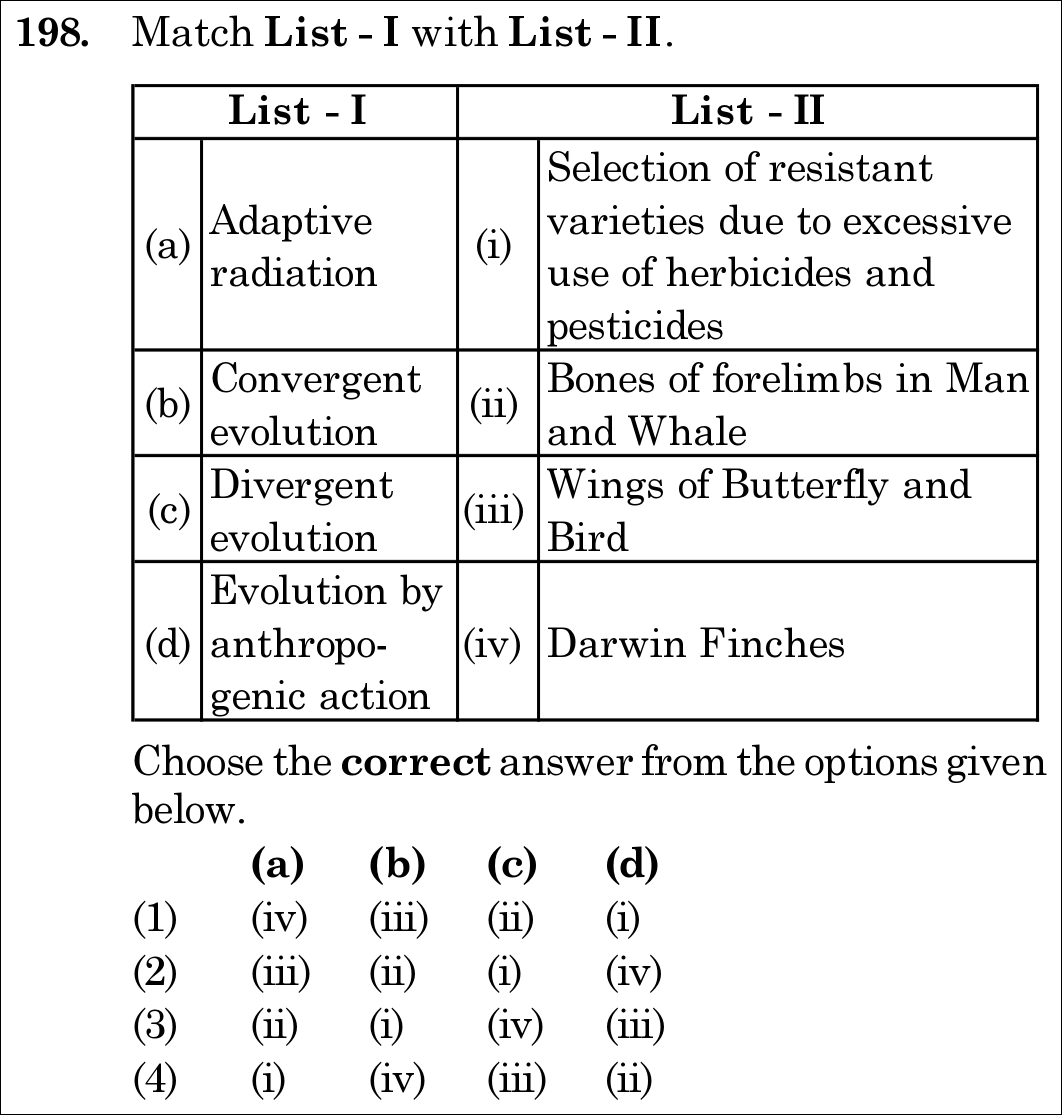
NEET 2021 · Q198 Easy
Official NEET 2021 Question 198 - Evolution
1 (iv) (iii) (ii) (i) ✓ Key
2 (iii) (ii) (i) (iv)
3 (ii) (i) (iv) (iii)
4 (i) (iv) (iii) (ii)
💡 Verified Solution & 30-Second Hack
✓
Verified Against NTA Final Answer Key
Option (1) : (a)-(iv), (b)-(iii), (c)-(ii), (d)-(i)
📚 Evolution Easy
📋 Given Parameters & Problem Setup
List I (Evolutionary Phenomena) (a) Adaptive radiation, (b) Convergent evolution, (c) Divergent evolution, (d) Evolution by anthropogenic action
List II (Examples) (i) Selection of resistant varieties due to excessive use of herbicides and pesticides, (ii) Bones of forelimbs in Man and Whale, (iii) Wings of Butterfly and Bird, (iv) Darwin Finches
⚡

The 30-Second Exam Hall Shortcut: ⚡ "Darwin Finches = Adaptive Radiation, Forelimbs Man/Whale = Divergent (Homology)"

⏱️ Save ~25 seconds

Darwin's finches radiate from common ancestral seed-eaters into insectivorous/vegetarian beaks (Adaptive Radiation: (a)-(iv)). Forelimbs of man and whale share common pentadactyl bone anatomy (Divergent evolution: (c)-(ii)). Wings of butterfly and bird are analogous structures (Convergent evolution: (b)-(iii)). Herbicide resistance is human-induced (Anthropogenic: (d)-(i)). Select Option (1)!

1 Match (a) Adaptive radiation -> (iv) Darwin Finches (canonical textbook example).
2 Match (b) Convergent evolution -> (iii) Wings of Butterfly and Bird (analogous structures with different origins performing same flight function).
3 Match (c) Divergent evolution -> (ii) Bones of forelimbs in Man and Whale (homologous structures with common skeletal ancestry adapting to different functions).
4 Match (d) Evolution by anthropogenic action -> (i) Selection of resistant varieties due to herbicides and pesticides.
5 Match pattern (iv), (iii), (ii), (i) -> Option (1).
🛡️
Why You Can 100% Trust This Shortcut: NCERT Biology · Evolution (Evidences for Evolution: Forelimbs of whales, bats, cheetah and humans are homologous and reflect divergent evolution; Wings of butterfly and birds are analogous and reflect convergent evolution; Darwin’s finches represent adaptive radiation; Excess use of herbicides and pesticides resulted in selection of resistant varieties by anthropogenic action).
📐

Step-by-Step Rigorous Workflow & Mathematical Proof

Step 1

Rigorous Mapping of Evolutionary Principles and Examples

- (a) Adaptive Radiation: The evolutionary divergence of members of a single ancestral species into a diverse array of ecologically different niches within a geographical area. Exemplified by Darwin’s Finches in the Galápagos archipelago, radiating from an ancestral South American seed-eating finch into insect-eating, cactus-feeding, and vegetarian beaks. - (b) Convergent Evolution: Unrelated evolutionary lineages independently evolve similar morphological adaptations and analogous structures in response to similar environmental pressures. Exemplified by the wings of a butterfly (insect) and bird (avian), which share the functional capacity for flight despite having totally distinct developmental origins. - (c) Divergent Evolution: Descendants from a common ancestor evolve differences in homologous structures adapted for divergent modes of life. Exemplified by the bones of forelimbs in Man and Whale (sharing humerus, radius, ulna, carpals, metacarpals, and phalanges despite differing functions in grasping vs swimming). - (d) Evolution by Anthropogenic Action: Artificial directional natural selection driven by human industrial and agricultural activities. Exemplified by the rapid selection of resistant varieties of pests, weeds, and microbes due to excessive use of chemical herbicides, pesticides, and antibiotics.

Adaptive Radiation  ⟺  Darwin Finches[(a)→(iv)]Convergent Evolution  ⟺  Wings of Butterfly and Bird[(b)→(iii)]Divergent Evolution  ⟺  Forelimbs in Man and Whale[(c)→(ii)]Anthropogenic Action  ⟺  Pesticide-Resistant Varieties[(d)→(i)]\begin{aligned} \text{Adaptive Radiation} &\iff \text{Darwin Finches} \quad [\text{(a)} \to \text{(iv)}] \\ \text{Convergent Evolution} &\iff \text{Wings of Butterfly and Bird} \quad [\text{(b)} \to \text{(iii)}] \\ \text{Divergent Evolution} &\iff \text{Forelimbs in Man and Whale} \quad [\text{(c)} \to \text{(ii)}] \\ \text{Anthropogenic Action} &\iff \text{Pesticide-Resistant Varieties} \quad [\text{(d)} \to \text{(i)}] \end{aligned}
Step 2

Option Alignment

Matching sequence is: (a)-(iv), (b)-(iii), (c)-(ii), (d)-(i). This corresponds unambiguously to Option (1).

⭐

360° Option Elimination Engine Key Feature

Diagnose every choice: Know exactly why the right option works and why distractors fail.

4-Option Deep Scan
1 1
✓ 100% Correct
Verdict & Scientific Reason:

Correct. Perfectly matches all four evolutionary phenomena to their canonical NCERT examples.

💡
Why this is airtight: None. Candidate recognizes homology, analogy, adaptive radiation, and anthropogenic selection.
2 2
✗ Incorrect
Verdict & Scientific Reason:

Incorrect. Assigns butterfly wings to adaptive radiation and man/whale forelimbs to convergent evolution.

⚠️
Student Fallacy (Why candidates pick this trap): Confusing homology (divergent) with analogy (convergent).
3 3
✗ Incorrect
Verdict & Scientific Reason:

Incorrect. Completely misattributes skeletal homology and adaptive radiation.

⚠️
Student Fallacy (Why candidates pick this trap): Random guessing among evolutionary categories.
4 4
✗ Incorrect
Verdict & Scientific Reason:

Incorrect. Links herbicide resistance to adaptive radiation and finches to convergent evolution.

⚠️
Student Fallacy (Why candidates pick this trap): Failing to identify the role of human activity in anthropogenic evolution.
⚠️

NTA Trap Alert: Convergent vs Divergent Evolution Pairing Trap

Students frequently swap Divergent (homology: same origin, divergent functions, e.g. whale flipper & human hand) and Convergent (analogy: different origin, convergent function, e.g. butterfly wing & bird wing).

🛡️ How to avoid the -1 mark: Remember: Homology = Divergent (HD TV mnemonic); Analogy = Convergent (AC air conditioner mnemonic).
📖

Core NEET Syllabus Standard

NEET / NCERT Biology · Evolution Standard Benchmark
Core Scientific Principle Tested:

"Darwin’s finches represent adaptive radiation; butterfly and bird wings represent convergent evolution; vertebrate forelimbs represent divergent evolution; herbicide resistance represents anthropogenic evolution."

Syllabus Focus: Evidences for Evolution
✓ Core NEET UG Syllabus Anchor Syllabus & Academic Standards ↗
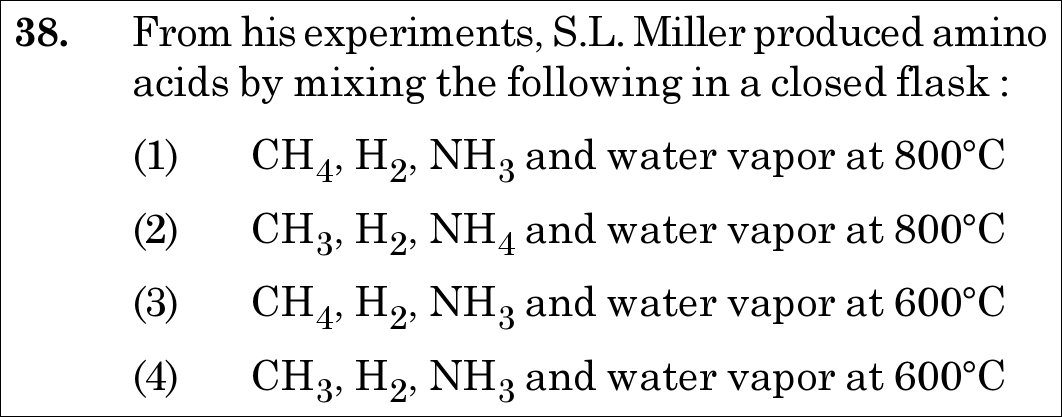
NEET 2020 · Q38 Easy
Official NEET 2020 Question 38 - Evolution
1 CH4, H2, NH3 and water vapor at 8008C ✓ Key
2 CH3, H2, NH4 and water vapor at 8008C
3 CH4, H2, NH3 and water vapor at 6008C
4 CH3, H2, NH3 and water vapor at 6008C
💡 Verified Solution & 30-Second Hack
✓
Verified Against NTA Final Answer Key
Option (1) : CH4, H2, NH3 and water vapor at 800°C
📚 Evolution Easy
📋 Given Parameters & Problem Setup
Experimenter S.L. Miller (1953)
Experimental Conditions Electric discharge spark in closed flask simulating primitive Earth
Question Objective Identify the exact gas mixture and temperature used
⚡

The 30-Second Exam Hall Shortcut: ⚡ "Miller = CH4 + H2 + NH3 + H2O at 800°C"

⏱️ 30 seconds

Miller used Methane (CH4), Hydrogen (H2), Ammonia (NH3), and water vapor (ratio 2:2:1 or 2:1:2) with electric spark discharge at exactly 800°C. Beware of fake formulas like CH3 or NH4, and lower temperatures like 600°C. Mark Option (1) in 5 seconds!

1 Check formulas: Methane is CH4 (not radical CH3); Ammonia is NH3 (not ammonium NH4).
2 Check temperature: Electric discharge occurred at 800°C (not 600°C).
3 Select Option (1).
🛡️
Why You Can 100% Trust This Shortcut: NCERT Biology · Evolution (Origin of Life: S.L. Miller's Simulation Experiment)
📐

Step-by-Step Rigorous Workflow & Mathematical Proof

Step 1

Recall S.L. Miller's 1953 Landmark Experiment

In 1953, Stanley L. Miller, an American scientist, created electric discharge in a closed flask containing CH4, H2, NH3, and water vapor at 800°C, simulating the prebiotic reducing atmospheric conditions of early Earth.

Step 2

Scrutinize Chemical Formulas

The gas molecules were methane (CH4, not methyl radical CH3), molecular hydrogen (H2), and ammonia (NH3, not ammonium cation NH4). Options (2) and (4) incorrectly use CH3 and NH4.

Step 3

Verify the Chamber Temperature

The electric spark discharge inside the closed simulation chamber operated at 800°C. Options (3) and (4) propose 600°C, which is historically and factually incorrect.

Step 4

Identify the Formed Products

After running the simulation for one week, Miller observed the synthesis of simple amino acids (glycine, alanine, and aspartic acid) from these inorganic precursors.

⭐

360° Option Elimination Engine Key Feature

Diagnose every choice: Know exactly why the right option works and why distractors fail.

4-Option Deep Scan
1 A
✓ 100% Correct
Verdict & Scientific Reason:

Factually and chemically exact; correctly identifies all four gaseous components and the precise temperature (800°C).

💡
Why this is airtight: None; exact textbook quotation.
2 B
✗ Incorrect
Verdict & Scientific Reason:

Incorrect chemical formulas; uses methyl (CH3) and ammonium (NH4) instead of methane (CH4) and ammonia (NH3).

⚠️
Student Fallacy (Why candidates pick this trap): Students failing to notice the subscripts "CH3" and "NH4".
3 C
✗ Incorrect
Verdict & Scientific Reason:

Incorrect temperature; Miller operated his electric spark discharge at 800°C, not 600°C.

⚠️
Student Fallacy (Why candidates pick this trap): Misremembering the numerical temperature value.
4 D
✗ Incorrect
Verdict & Scientific Reason:

Incorrect formula (CH3) and incorrect temperature (600°C).

⚠️
Student Fallacy (Why candidates pick this trap): Overlooking both subscript errors and temperature mismatch.
⚠️

NTA Trap Alert: Subscripts and Temperature Distractors

NTA purposefully plants typos in subscripts: CH3 vs CH4, and NH4 vs NH3, combined with temperature distractors (600°C vs 800°C).

🛡️ How to avoid the -1 mark: Double check every subscript: Methane has 4 hydrogens (CH4), Ammonia has 3 hydrogens (NH3), and the temperature is 800°C!
📖

Core NEET Syllabus Standard

Botany · Evolution Standard Benchmark
Core Scientific Principle Tested:

""

Syllabus Focus: Stanley Miller Spark-Discharge Experiment Parameters
✓ Core NEET UG Syllabus Anchor Syllabus & Academic Standards ↗
NEET 2020 · Q39 Easy
Official NEET 2020 Question 39 - Evolution
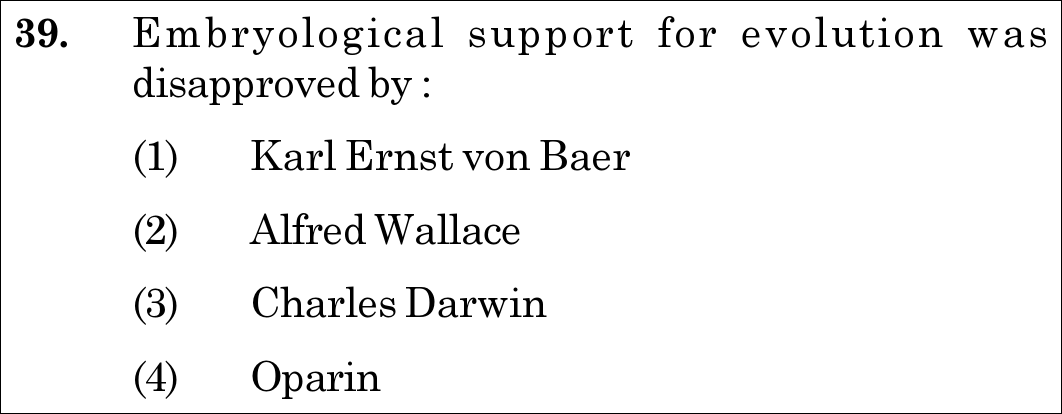
1 Karl Ernst von Baer ✓ Key
2 Alfred Wallace
3 Charles Darwin
4 Oparin
💡 Verified Solution & 30-Second Hack
✓
Verified Against NTA Final Answer Key
Option (1) : Karl Ernst von Baer
📚 Evolution Easy
📋 Given Parameters & Problem Setup
Hypothesis Embryological support for evolution (Ernst Haeckel: Ontogeny recapitulates phylogeny)
Question Objective Identify the scientist who disapproved/refuted this hypothesis
⚡

The 30-Second Exam Hall Shortcut: ⚡ "Haeckel Proposed, Karl Ernst von Baer Disapproved!"

⏱️ 25 seconds

Ernst Haeckel proposed embryological support for evolution based on the observation that embryos resemble ancestral forms. Karl Ernst von Baer carefully observed that embryos NEVER pass through the adult stages of other animals, disproving Haeckel! Mark Option (1) in 5 seconds.

1 Embryological evidence was proposed by Ernst Haeckel.
2 It was disapproved based on careful embryological observation by Karl Ernst von Baer.
3 Select Option (1).
🛡️
Why You Can 100% Trust This Shortcut: NCERT Biology · Evolution (Evidences for Evolution: Embryological Support)
📐

Step-by-Step Rigorous Workflow & Mathematical Proof

Step 1

Ernst Haeckel's Embryological Proposal

Ernst Haeckel proposed embryological support for evolution based on the observation of certain embryonic features common to all vertebrates (such as vestigial gill slits in early human embryos) that are absent in adults (Biogenetic law: Ontogeny recapitulates phylogeny).

Step 2

Von Baer's Refutation

This proposal was disapproved by Karl Ernst von Baer on the basis of careful comparative observation: he noted that embryos never pass through the adult stages of other animals.

Step 3

Review Other Scientists in Options

Alfred Wallace worked in the Malay Archipelago and independently conceived natural selection; Charles Darwin authored On the Origin of Species; Alexander Oparin proposed the biochemical origin of life from coacervates.

Step 4

Conclude Correct Scientist

Karl Ernst von Baer is the definitive scientist who disapproved the embryological hypothesis as stated in NCERT.

⭐

360° Option Elimination Engine Key Feature

Diagnose every choice: Know exactly why the right option works and why distractors fail.

4-Option Deep Scan
1 A
✓ 100% Correct
Verdict & Scientific Reason:

Factually exact; Karl Ernst von Baer definitively rejected Haeckel's biogenetic proposal.

💡
Why this is airtight: None; direct textbook citation.
2 B
✗ Incorrect
Verdict & Scientific Reason:

Incorrect; Wallace was a co-discoverer of natural selection, not the embryologist who refuted Haeckel.

⚠️
Student Fallacy (Why candidates pick this trap): Confusing contributors to natural selection theory.
3 C
✗ Incorrect
Verdict & Scientific Reason:

Incorrect; Darwin actually utilized embryological similarities as supporting evidence for common descent.

⚠️
Student Fallacy (Why candidates pick this trap): Defaulting to Darwin for any evolutionary question.
4 D
✗ Incorrect
Verdict & Scientific Reason:

Incorrect; Oparin proposed the biochemical coacervate theory of the origin of life.

⚠️
Student Fallacy (Why candidates pick this trap): Confusing chemical evolution theorists with comparative embryologists.
⚠️

NTA Trap Alert: Proposed vs Disapproved Wording

Haeckel PROPOSED embryological support; Karl Ernst von Baer DISAPPROVED it.

🛡️ How to avoid the -1 mark: Read the operative verb carefully: If it says "proposed", think Haeckel. If it says "disapproved", answer Karl Ernst von Baer!
📖

Core NEET Syllabus Standard

Botany · Evolution Standard Benchmark
Core Scientific Principle Tested:

""

Syllabus Focus: Embryological Support for Evolution Disapproved by Karl Ernst von Baer
✓ Core NEET UG Syllabus Anchor Syllabus & Academic Standards ↗
NEET 2020 · Q44 Easy
Official NEET 2020 Question 44 - Evolution
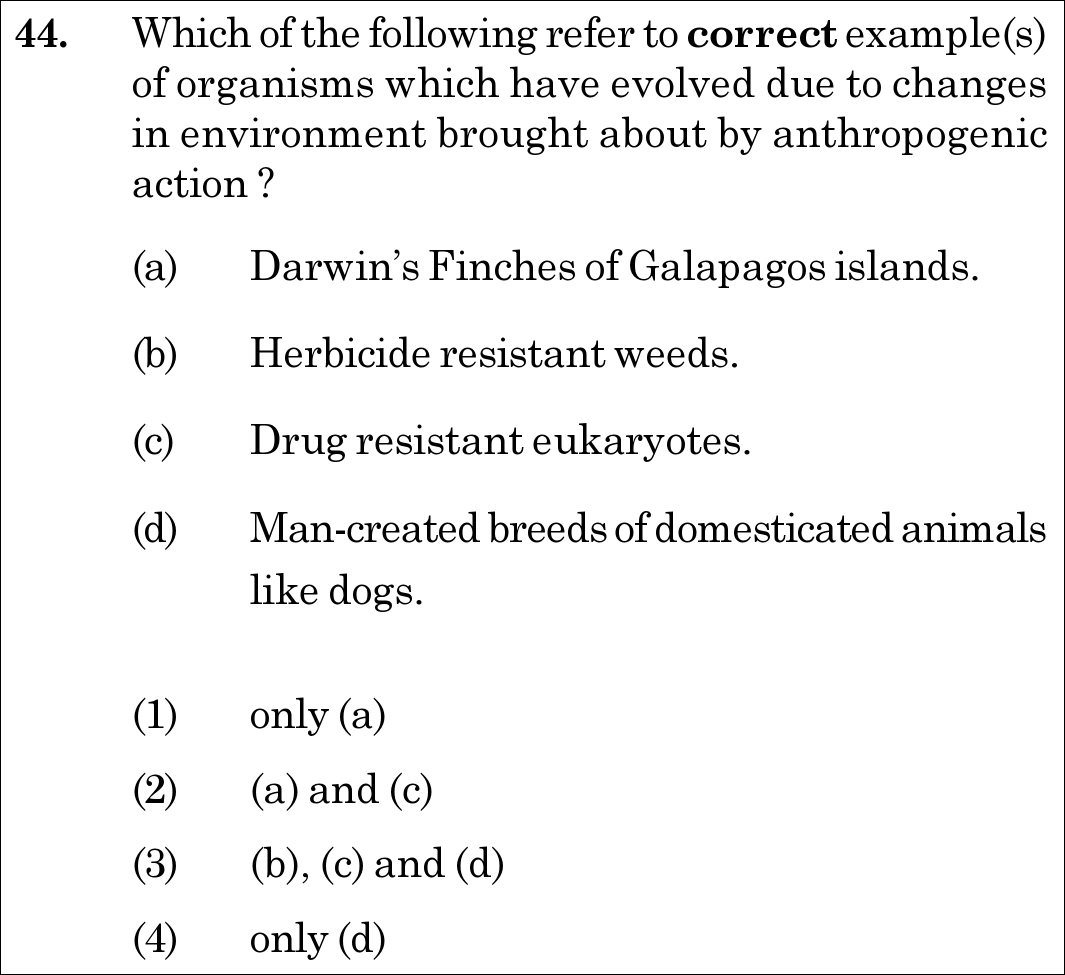
1 only (a)
2 (a) and (c)
3 (b), (c) and (d) ✓ Key
4 only (d)
💡 Verified Solution & 30-Second Hack
✓
Verified Against NTA Final Answer Key
Option (3) : (b), (c) and (d)
📚 Evolution Easy
📋 Given Parameters & Problem Setup
Example (a) Darwin's Finches of Galapagos islands
Example (b) Herbicide resistant weeds
Example (c) Drug resistant eukaryotes
Example (d) Man-created breeds of domesticated animals like dogs
Question Objective Identify which examples represent evolution by anthropogenic (human) action
⚡

The 30-Second Exam Hall Shortcut: ⚡ "Anthropogenic = Human-Driven! Finches Are Natural Adaptive Radiation!"

⏱️ 30 seconds

Darwin's finches (a) evolved by natural adaptive radiation in the wild without human intervention. Herbicide resistance (b), drug resistance (c), and artificial animal breeding (d) are direct results of human activities (anthropogenic action). Correct answer is (b), (c) and (d) (Option 3)!

1 Anthropogenic means caused or produced by human activity.
2 Darwin's finches (a) = Natural adaptive radiation (exclude a).
3 Herbicide resistance (b), drug resistance (c), and artificial breeding (d) = Anthropogenic evolution.
4 Match combination: (b), (c) and (d) -> Option 3.
🛡️
Why You Can 100% Trust This Shortcut: NCERT Biology · Evolution (Evolution by Anthropogenic Action: Pesticides, Drugs & Artificial Selection)
📐

Step-by-Step Rigorous Workflow & Mathematical Proof

Step 1

Define Anthropogenic Action in Evolution

Evolution by anthropogenic action refers to evolutionary changes and adaptations in organisms driven, accelerated, or mediated by human activities, such as artificial selection, environmental pollution, pesticide overuse, and antibiotic drug pressure.

Step 2

Evaluate Darwin's Finches (a)

Darwin's finches on the Galapagos islands diversified from a common ancestral seed-eating stock through natural adaptive radiation into diverse ecological niches, completely independent of human influence.

Step 3

Evaluate Chemical and Drug Resistances (b and c)

Excessive and uncontrolled human application of chemical herbicides and antiparasitic/antibiotic drugs has led to directional selection favoring resistant strains of weeds and resistant eukaryotes/microbes (e.g., chloroquine-resistant Plasmodium, antibiotic-resistant bacteria) within months or years. These are classic anthropogenic evolutionary cases highlighted in NCERT.

Step 4

Evaluate Artificial Dog Breeds (d)

Humans have artificially bred and selected various domesticated animal breeds (dogs, cattle, horses) over hundreds of years, representing classic artificial selection by anthropogenic action.

Step 5

Combine Correct Letters

Statements (b), (c), and (d) are all unambiguous examples of evolution brought about by anthropogenic action.

⭐

360° Option Elimination Engine Key Feature

Diagnose every choice: Know exactly why the right option works and why distractors fail.

4-Option Deep Scan
1 A
✗ Incorrect
Verdict & Scientific Reason:

Incorrect; Darwin's finches evolved by natural adaptive radiation, not anthropogenic action.

⚠️
Student Fallacy (Why candidates pick this trap): Misunderstanding the term "anthropogenic" as general evolution.
2 B
✗ Incorrect
Verdict & Scientific Reason:

Incorrect; erroneously includes (a) and omits (b) and (d).

⚠️
Student Fallacy (Why candidates pick this trap): Failing to distinguish natural ecological diversification from human-induced selection.
3 C
✓ 100% Correct
Verdict & Scientific Reason:

Factually exact; herbicide-resistant weeds, drug-resistant eukaryotes, and man-created dog breeds are all products of anthropogenic selection.

💡
Why this is airtight: None; matches the explicit examples provided in NCERT evolution chapter.
4 D
✗ Incorrect
Verdict & Scientific Reason:

Incorrect; incomplete because herbicide resistance and drug resistance are also prominent anthropogenic evolutionary adaptations.

⚠️
Student Fallacy (Why candidates pick this trap): Assuming anthropogenic action only applies to deliberate artificial breeding of pets.
⚠️

NTA Trap Alert: Adaptive Radiation vs Anthropogenic Selection

Darwin's finches and Australian marsupials are ADAPTIVE RADIATION. Industrial melanism in moths, pesticide/herbicide resistance, antibiotic resistance, and artificial breeding are ANTHROPOGENIC ACTION.

🛡️ How to avoid the -1 mark: Ask yourself: Did human activity cause the selection pressure? If yes = Anthropogenic. If wild nature = Natural adaptive radiation!
📖

Core NEET Syllabus Standard

Botany · Evolution Standard Benchmark
Core Scientific Principle Tested:

""

Syllabus Focus: Evolution by Anthropogenic Action vs Natural Adaptive Radiation
✓ Core NEET UG Syllabus Anchor Syllabus & Academic Standards ↗
NEET 2020 · Q73 Easy
Official NEET 2020 Question 73 - Evolution
1 Adaptive radiation
2 Convergent evolution ✓ Key
3 Industrial melanism
4 Natural selection
💡 Verified Solution & 30-Second Hack
✓
Verified Against NTA Final Answer Key
Option (2) : Convergent evolution
📚 Evolution Easy
📋 Given Parameters & Problem Setup
Structures Flippers of Penguins (Birds) and Flippers of Dolphins (Mammals)
Function Swimming in aquatic habitat
Question Objective Identify the evolutionary phenomenon exemplified
⚡

The 30-Second Exam Hall Shortcut: ⚡ "Flippers of Penguin & Dolphin = Analogous Organs = CONVERGENT EVOLUTION!"

⏱️ 20 seconds

Penguins (Aves) and Dolphins (Mammalia) belong to different vertebrate lineages. Their flippers have completely different anatomical structures and embryonic origins, but perform the same function (aquatic locomotion). Different origin + same function = Analogy = Convergent Evolution! Mark Option (2) in 5 seconds.

1 Penguin is a bird; Dolphin is an aquatic mammal.
2 Flippers serve the same swimming function but evolved independently from distinct structural backgrounds.
3 Analogy (different origin, similar function) is the result of Convergent Evolution.
4 Select Option (2) Convergent evolution.
🛡️
Why You Can 100% Trust This Shortcut: NCERT Biology · Evolution (Evidences for Evolution: Homology and Analogy)
📐

Step-by-Step Rigorous Workflow & Mathematical Proof

Step 1

Define Analogy and Convergent Evolution

Organs which are anatomically different in structure and embryonic origin but perform similar functions are called analogous structures. Such similarity arises when different organisms adapt to similar habitats or ecological niches, which is termed convergent evolution.

Step 2

Examine Penguin and Dolphin Flippers

The flippers of penguins (modified wings of birds) and dolphins (modified forelimbs of mammals) are structurally and phylogenetically distinct, yet both function as hydrofoils for swimming in water.

Step 3

NCERT Verbatim Citation

NCERT states explicitly: "Flippers of penguins and dolphins are examples of analogous organs resulting from convergent evolution."

Step 4

Differentiate Other Terms

Adaptive radiation leads to divergent evolution from a common ancestor (e.g. Darwin's finches, mammal forelimbs); industrial melanism is natural selection in Biston betularia.

⭐

360° Option Elimination Engine Key Feature

Diagnose every choice: Know exactly why the right option works and why distractors fail.

4-Option Deep Scan
1 A
✗ Incorrect
Verdict & Scientific Reason:

Incorrect; adaptive radiation involves one ancestral lineage diversifying into many forms with homologous traits (divergent evolution).

⚠️
Student Fallacy (Why candidates pick this trap): Confusing convergent evolution with adaptive radiation.
2 B
✓ 100% Correct
Verdict & Scientific Reason:

Factually exact; unrelated lineages (birds and mammals) independently evolving swimming flippers is a classic case of convergent evolution.

💡
Why this is airtight: None; textbook exemplar of analogy.
3 C
✗ Incorrect
Verdict & Scientific Reason:

Incorrect; industrial melanism describes directional natural selection in the peppered moth (Biston betularia) in response to soot pollution.

⚠️
Student Fallacy (Why candidates pick this trap): Random evolutionary concept.
4 D
✗ Incorrect
Verdict & Scientific Reason:

Incorrect; while natural selection is the broad driving force behind all adaptations, "convergent evolution" is the specific macroevolutionary pattern exemplified by analogous organs.

⚠️
Student Fallacy (Why candidates pick this trap): Selecting an overly broad mechanism instead of the specific anatomical pattern.
⚠️

NTA Trap Alert: Homology vs Analogy Mnemonic

Homology = Divergent evolution (Same origin, different function: Human arm, cheetah leg, bat wing). Analogy = Convergent evolution (Different origin, same function: Penguin & Dolphin flippers, Eye of octopus & mammal).

🛡️ How to avoid the -1 mark: Mnemonic: "H-D, A-C" -> Homology is Divergent; Analogy is Convergent!
📖

Core NEET Syllabus Standard

Zoology · Evolution Standard Benchmark
Core Scientific Principle Tested:

""

Syllabus Focus: Analogous Organs: Flippers of Penguins and Dolphins as Convergent Evolution
✓ Core NEET UG Syllabus Anchor Syllabus & Academic Standards ↗

Solve 4 NEET Questions a Day — One per Subject

Cover all 1,140 official NEET questions in 285 days at your own pace. Progress is saved on your device. No login needed.