MyCompetitiveExams Logo MyCompetitiveExams
Search 1,140+ Questions
Chapters, formulas, speed tricks
→
⚡ Brahmastra NEET 2027
720 MARKS

Dynamic 180-question full-length simulator mixed dynamically from all 6 years for 2027 & 2026 aspirants.

Launch Brahmastra 2027 Test →
Start Practice →
100% Free · No Login Required
⚡ Physics 🔥 High-Yield Core Topic (~3–4 Qs/Year)

NEET Dual Nature of Radiation and Matter Previous Year Questions with Solutions

Complete repository of official NTA NEET questions for Dual Nature of Radiation and Matter from 2020 to 2026. Every question includes 30-second elimination tricks, step-by-step NCERT solutions, option-by-option traps, and official answer keys.

15 Questions 6 Exam Years (2026, 2025, 2024, 2023, 2021, 2020) 12 Easy · 3 Medium · 0 Challenging
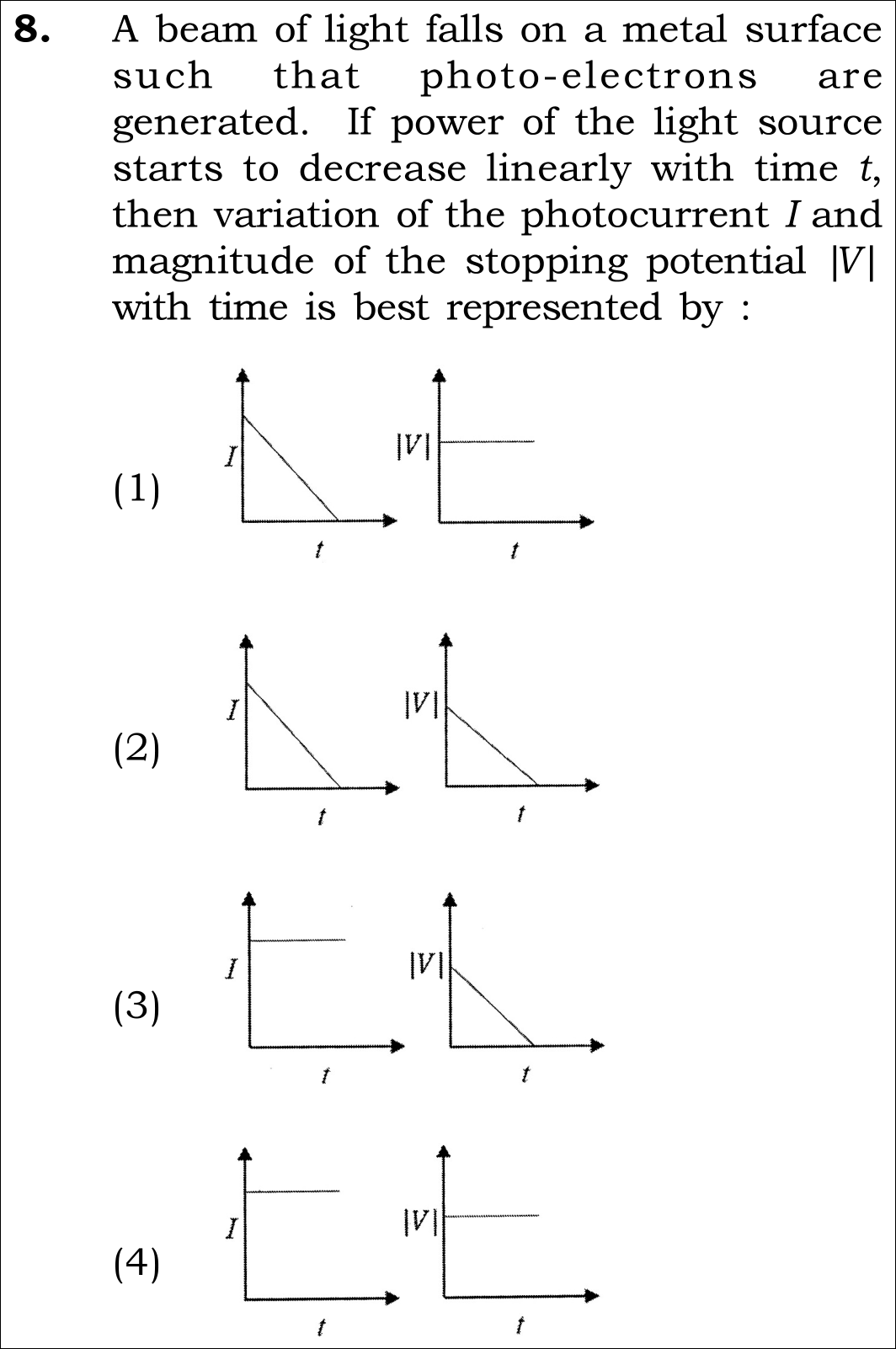
NEET 2026 · Q8 Easy
Official NEET 2026 Question 8 - Dual Nature of Radiation and Matter
1 ✓ Key
2
3
4
💡 Verified Solution & 30-Second Hack
✓
Verified Against NTA Final Answer Key
Option (1) : Photocurrent I decreases linearly with time; Stopping potential |V| remains constant
📚 Dual Nature of Matter & Radiation Easy
📋 Given Parameters & Problem Setup
Incident Light Power P(t) Decreases linearly with time t
Light Frequency nu Constant (photoelectrons are generated, nu > nu_0)
Work Function Phi Constant material property of the metal
Variables to Plot Photocurrent I vs t and Stopping Potential |V| vs t
⚡

The 30-Second Exam Hall Shortcut: ⚡ Einstein Photoelectric Decoupling Rule

⏱️ Instant conceptual recognition saves 1 full minute.

Intensity controls current; Frequency controls stopping potential!

1 Photocurrent I depends directly on the number of photons per second, which is proportional to light Power P(t).
2 Since P(t) decreases linearly with time, Photocurrent I MUST decrease linearly with time (straight line with negative slope).
3 Stopping potential |V_0| = (h*nu - Phi) / e depends ONLY on frequency nu and work function Phi. Power does not enter this equation!
4 Since frequency is unchanged, Stopping Potential |V| remains completely CONSTANT (horizontal flat line).
5 Look at the graphs: Graph (1) shows I decreasing linearly and |V| horizontal constant. Solved in 10 seconds!
🛡️
Why You Can 100% Trust This Shortcut: Einstein's Photoelectric Equation: e*|V_0| = K_max = h*nu - Phi. Since neither h, nu, nor Phi change with power, |V_0| is strictly time-invariant.
📐

Step-by-Step Rigorous Workflow & Mathematical Proof

Step 1

Analyze Photocurrent Dependency on Light Power

The number of incident photons per second is given by n = P(t) / (h*nu). Since each absorbed photon can eject at most one photoelectron (with quantum efficiency eta):

I=ηe(P(t)hν)∝P(t)I = \eta e \left( \frac{P(t)}{h\nu} \right) \propto P(t)
  • • Because power P(t) decreases linearly with time (P(t) = P_0 - k*t), photocurrent I must also decrease linearly with time.
  • • The graph of I vs t is a straight line sloping downward to zero.
Step 2

Analyze Stopping Potential Dependency on Light Power

Apply Einstein's photoelectric equation for maximum kinetic energy of emitted electrons:

Kmax=hν−Φ=e∣V0∣  ⟹  ∣V0∣=hν−ΦeK_{\text{max}} = h\nu - \Phi = e |V_0| \implies |V_0| = \frac{h\nu - \Phi}{e}
  • • Stopping potential depends solely on the frequency nu of incident radiation and the work function Phi.
  • • Stopping potential is completely INDEPENDENT of light intensity and source power.
  • • Therefore, |V| vs t is a horizontal straight line with zero slope.
Step 3

Match with the Given Graph Options

Inspect the four graph sets in the question crop:

Set (1): I(t) linear decrease, ∣V∣(t) horizontal constant line\text{Set (1): } I(t) \text{ linear decrease, } |V|(t) \text{ horizontal constant line}
  • • Matches Set (1) perfectly, corresponding to Option (1).
⭐

360° Option Elimination Engine Key Feature

Diagnose every choice: Know exactly why the right option works and why distractors fail.

4-Option Deep Scan
1 Option (1)
✓ 100% Correct
Verdict & Scientific Reason:

Scientifically exact application of Einstein's photoelectric theory; confirmed by Official NTA Key.

💡
Why this is airtight: Correctly decouples intensity (photon count) from frequency (photon energy).
Note: Flawless physics.
2 Option (2)
✗ Incorrect
Verdict & Scientific Reason:

Classical wave theory error.

⚠️
Student Fallacy (Why candidates pick this trap): Believes higher power/intensity gives electrons more energy, so reducing power reduces stopping potential.
Note: This was the exact failure of classical physics that Einstein resolved in 1905.
3 Option (3)
✗ Incorrect
Verdict & Scientific Reason:

Inverted dependencies.

⚠️
Student Fallacy (Why candidates pick this trap): Confuses current and stopping potential dependencies.
Note: Current is proportional to power, never constant when power drops.
4 Option (4)
✗ Incorrect
Verdict & Scientific Reason:

Ignores the explicit decrease in source power.

⚠️
Student Fallacy (Why candidates pick this trap): Fails to connect power to photon arrival rate.
Note: Fewer photons per second directly reduces photoelectrons ejected.
⚠️

NTA Trap Alert: The Classical Intensity-Energy Misconception

Students who do not master the quantum theory of light assume stopping potential decreases when light gets dimmer, incorrectly choosing Graph (2).

🛡️ How to avoid the -1 mark: Remember the golden rule: Intensity changes NUMBER of electrons (Current). Frequency changes ENERGY of electrons (Stopping Potential).
📖

Core NEET Syllabus Standard

NEET UG Physics Core Standards · Dual Nature of Matter and Radiation Standard Benchmark
Core Scientific Principle Tested:

"Stopping potential is determined strictly by incident photon frequency: e*V_0 = h*nu - Phi, independent of intensity/power."
Syllabus Focus: Photoelectric Effect, Einstein Equation, and Stopping Potential
✓ Core NEET UG Syllabus Anchor Syllabus & Academic Standards ↗
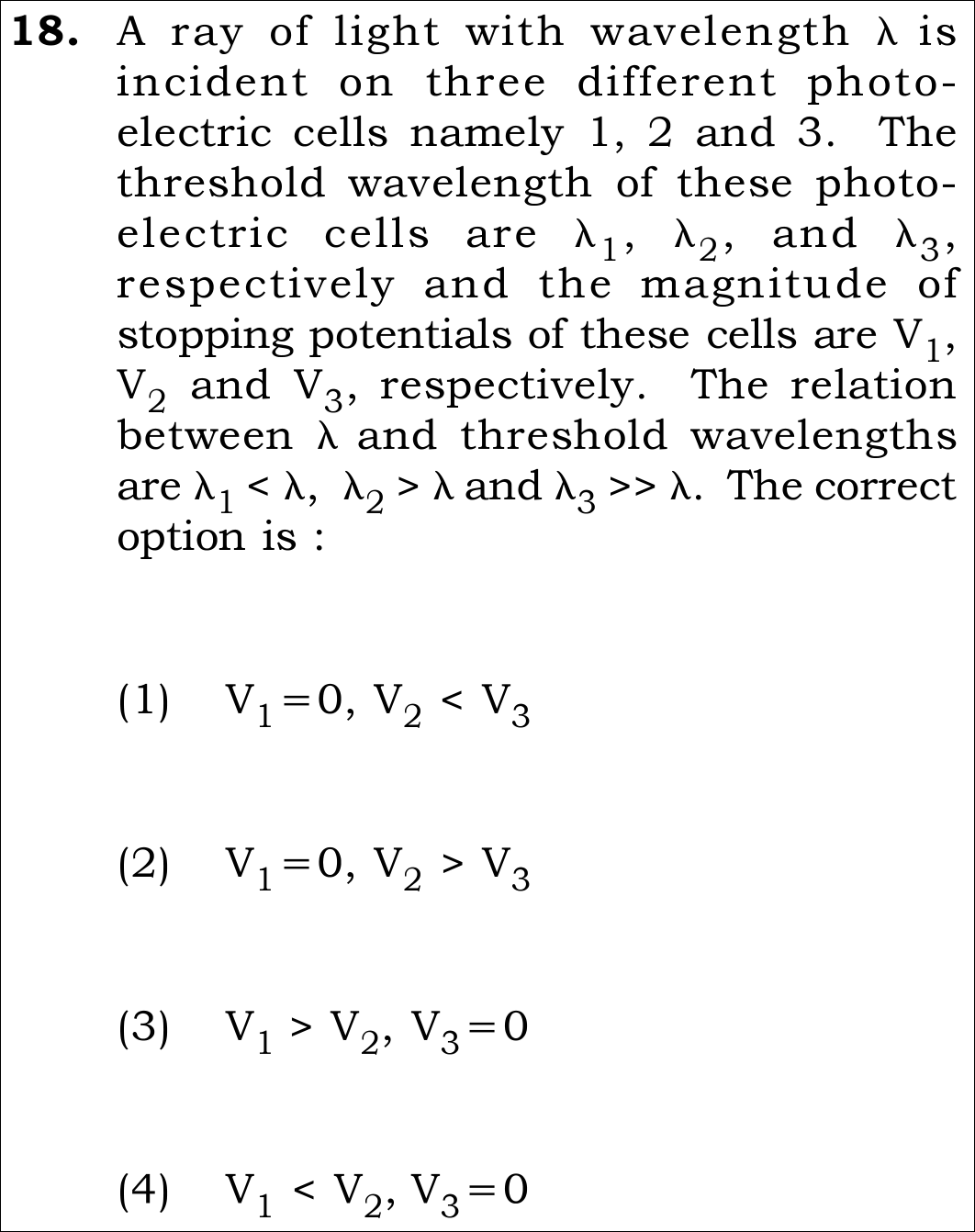
NEET 2026 · Q18 Medium
Official NEET 2026 Question 18 - Dual Nature of Radiation and Matter
1 ✓ Key
2
3
4
💡 Verified Solution & 30-Second Hack
✓
Verified Against NTA Final Answer Key
Option (1) : V_1 = 0, V_2 < V_3
📚 Dual Nature of Matter & Radiation Medium
📋 Given Parameters & Problem Setup
Incident Light Wavelength lambda
Cell 1 Threshold Wavelength lambda_1 < lambda (incident wavelength exceeds threshold)
Cell 2 Threshold Wavelength lambda_2 > lambda (photoelectric emission occurs)
Cell 3 Threshold Wavelength lambda_3 >> lambda (photoelectric emission occurs with very low work function)
Stopping Potentials V_1, V_2, V_3
⚡

The 30-Second Exam Hall Shortcut: ⚡ Threshold Wavelength Cutoff Rule

⏱️ Bypasses numerical evaluations.

Emission requires lambda <= lambda_th; Larger lambda_th means higher stopping potential!

1 Photoelectric condition in wavelength: Photon energy hc/lambda must be >= hc/lambda_th ==> lambda <= lambda_th.
2 For Cell 1: lambda_1 < lambda ==> lambda > lambda_1. Incident wavelength is LONGER than threshold, meaning photon energy is insufficient. NO emission occurs ==> V_1 = 0!
3 For Cells 2 and 3: lambda < lambda_2 and lambda << lambda_3. Emission occurs in both.
4 Stopping potential: e*V_0 = hc * (1/lambda - 1/lambda_th).
5 Since lambda_3 >> lambda_2, 1/lambda_3 is much smaller than 1/lambda_2, meaning work function Phi_3 is smaller than Phi_2.
6 Smaller work function leaves GREATER kinetic energy: V_3 > V_2 (or V_2 < V_3).
7 Combine results: V_1 = 0 and V_2 < V_3. Matches Option (1) in 20 seconds!
🛡️
Why You Can 100% Trust This Shortcut: Einstein's Photoelectric Equation: e*V_0 = hc/lambda - Phi. Since Phi = hc/lambda_th, higher threshold wavelength implies a smaller work function, which directly increases stopping potential.
📐

Step-by-Step Rigorous Workflow & Mathematical Proof

Step 1

Evaluate Photoelectric Threshold Condition for Cell 1

For photoelectric emission to occur, incident photon energy must equal or exceed the work function:

E=hcλ≥Φ=hcλth  ⟺  λ≤λthE = \frac{hc}{\lambda} \ge \Phi = \frac{hc}{\lambda_{\text{th}}} \iff \lambda \le \lambda_{\text{th}}
  • • For Cell 1, we are given lambda_1 < lambda, which means lambda > lambda_1.
  • • The incident wavelength exceeds threshold wavelength; photon energy is strictly below the work function.
  • • No photoelectrons are ejected, so the stopping potential is identically zero: V_1 = 0.
Step 2

Compare Stopping Potentials for Cells 2 and 3

For Cells 2 and 3, lambda < lambda_2 and lambda << lambda_3, so photoelectric emission takes place in both cells:

eV0=Kmax=hc(1λ−1λth)e V_0 = K_{\text{max}} = hc \left( \frac{1}{\lambda} - \frac{1}{\lambda_{\text{th}}} \right)
  • • eV_2 = hc (1/lambda - 1/lambda_2).
  • • eV_3 = hc (1/lambda - 1/lambda_3).
  • • Given lambda_3 >> lambda_2 > lambda, we have 1/lambda_3 < 1/lambda_2.
  • • Subtracting a smaller number yields a larger difference: (1/lambda - 1/lambda_3) > (1/lambda - 1/lambda_2).
Step 3

Conclude the Inequality Ordering

Compare the stopping potential magnitudes:

V3>V2  ⟺  V2<V3V_3 > V_2 \iff V_2 < V_3
  • • Combining with V_1 = 0 yields: V_1 = 0, V_2 < V_3.
  • • Matches Option (1) exactly.
⭐

360° Option Elimination Engine Key Feature

Diagnose every choice: Know exactly why the right option works and why distractors fail.

4-Option Deep Scan
1 Option (1)
✓ 100% Correct
Verdict & Scientific Reason:

100% scientifically sound; confirmed by Official NTA Final Answer Key.

💡
Why this is airtight: Correctly applies inverse wavelength cutoff and work function comparison.
Note: Flawless physics.
2 Option (2)
✗ Incorrect
Verdict & Scientific Reason:

Inverts the work function relationship.

⚠️
Student Fallacy (Why candidates pick this trap): Assumes larger threshold wavelength means larger work function and lower stopping potential.
Note: Work function Phi = hc/lambda_th is inversely proportional to threshold wavelength!
3 Option (3)
✗ Incorrect
Verdict & Scientific Reason:

Reverses threshold condition.

⚠️
Student Fallacy (Why candidates pick this trap): Confuses threshold wavelength with threshold frequency, thinking lambda > lambda_th causes emission.
Note: Longer wavelength means LESS energy, not more.
4 Option (4)
✗ Incorrect
Verdict & Scientific Reason:

Double misconception.

⚠️
Student Fallacy (Why candidates pick this trap): Believes Cell 3 fails to emit photoelectrons.
Note: Cell 3 has the longest threshold wavelength and therefore the easiest emission.
⚠️

NTA Trap Alert: Frequency vs Wavelength Cutoff Inversion

Many candidates confuse nu >= nu_0 with lambda >= lambda_0. For wavelength, emission ONLY occurs when lambda <= lambda_th!

🛡️ How to avoid the -1 mark: Anchor photon energy: E = hc/lambda. As wavelength increases, photon energy drops! Hence, lambda must be LESS than or equal to threshold.
📖

Core NEET Syllabus Standard

NEET UG Physics Core Standards · Dual Nature of Radiation and Matter Standard Benchmark
Core Scientific Principle Tested:

"Photoelectric emission occurs only if lambda <= lambda_th. Stopping potential is e*V_0 = hc*(1/lambda - 1/lambda_th)."

Syllabus Focus: Photoelectric Equation, Threshold Wavelength, and Stopping Potential
✓ Core NEET UG Syllabus Anchor Syllabus & Academic Standards ↗
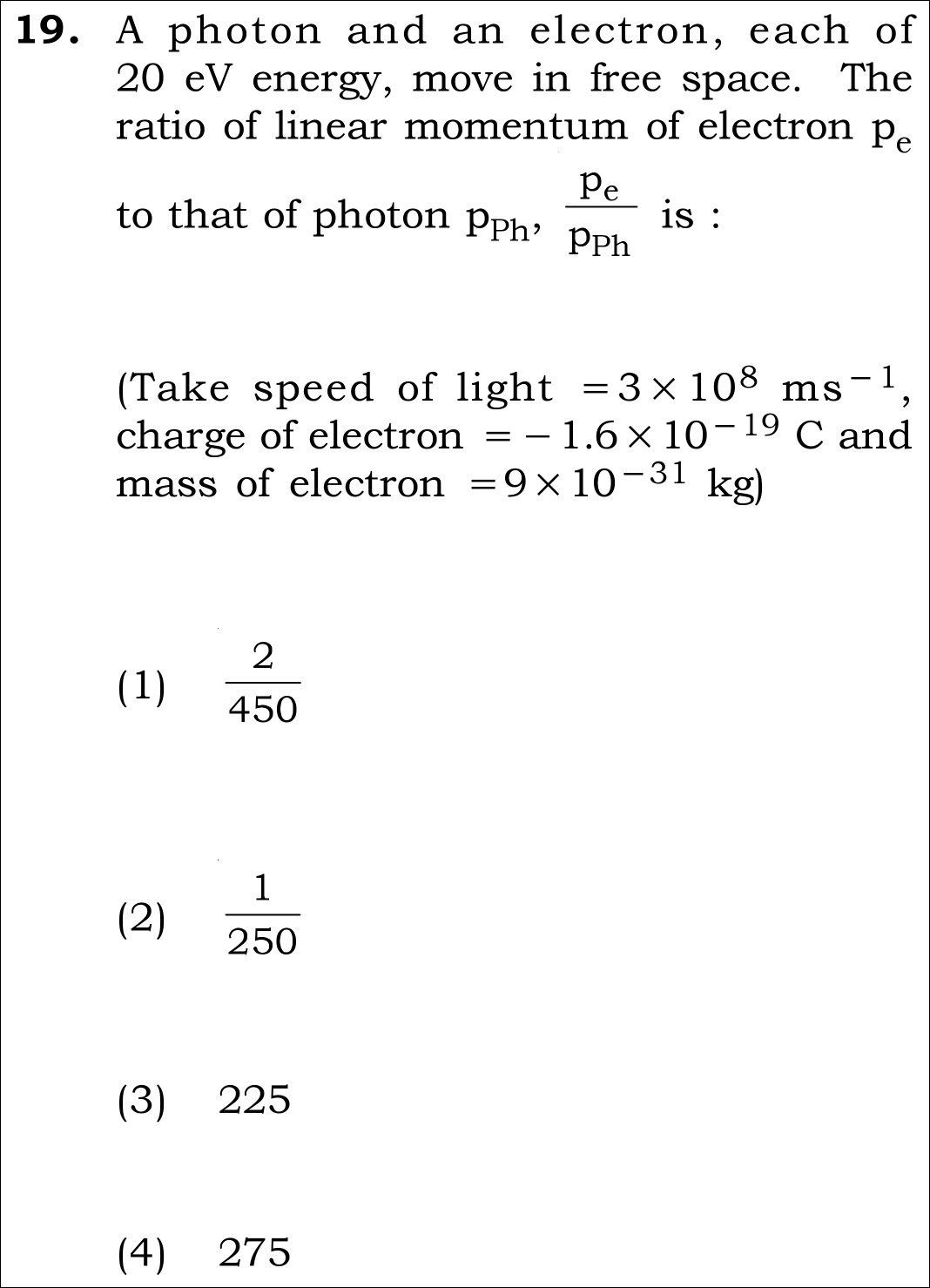
NEET 2026 · Q19 Medium
Official NEET 2026 Question 19 - Dual Nature of Radiation and Matter
1
2
3 ✓ Key
4
💡 Verified Solution & 30-Second Hack
✓
Verified Against NTA Final Answer Key
Option (3) : p_e / p_Ph = 225
📚 Dual Nature of Matter & Radiation Medium
📋 Given Parameters & Problem Setup
Energy of Both Particles E = 20 eV
Speed of Light c 3 * 10^8 m/s
Electron Charge e 1.6 * 10^-19 C
Electron Mass m_e 9 * 10^-31 kg
Target Ratio p_e / p_Ph (Linear momentum of electron / photon)
⚡

The 30-Second Exam Hall Shortcut: ⚡ General Momentum Ratio Formula

⏱️ Saves 2 minutes of calculating separate raw powers of 10.

Relate electron momentum sqrt(2mE) directly to photon momentum E/c

1 Photon momentum: p_Ph = E / c.
2 Electron momentum (non-relativistic): p_e = sqrt(2 * m_e * E).
3 Ratio: p_e / p_Ph = [sqrt(2 * m_e * E)] / (E / c) = c * sqrt(2 * m_e / E).
4 Substitute given values: E = 20 * 1.6 * 10^-19 = 32 * 10^-19 J.
5 Inside square root: 2 * (9 * 10^-31) / (32 * 10^-19) = 18/32 * 10^-12 = (9/16) * 10^-12.
6 Take square root: sqrt(9/16 * 10^-12) = (3/4) * 10^-6 = 0.75 * 10^-6.
7 Multiply by c = 3 * 10^8: (3 * 10^8) * (0.75 * 10^-6) = 2.25 * 10^2 = 225. Solved in 30 seconds!
🛡️
Why You Can 100% Trust This Shortcut: Non-relativistic mechanics holds perfectly because electron kinetic energy 20 eV is negligible compared to its rest mass energy (511,000 eV).
📐

Step-by-Step Rigorous Workflow & Mathematical Proof

Step 1

Formulate Photon Momentum

For a massless photon of energy E traveling at speed c:

pPh=Ecp_{\text{Ph}} = \frac{E}{c}
  • • Given E = 20 eV = 20 * 1.6 * 10^-19 J = 3.2 * 10^-18 J.
  • • p_{Ph} = (3.2 * 10^-18 J) / (3 * 10^8 m/s) = (3.2 / 3) * 10^-26 kg m/s.
Step 2

Formulate Electron Momentum

For an electron with kinetic energy E = 20 eV, non-relativistic momentum is:

pe=2meE=2×(9×10−31 kg)×(3.2×10⁻¹⁸ J)p_e = \sqrt{2 m_e E} = \sqrt{2 \times (9 \times 10^{-31}\text{ kg}) \times (3.2 \times 10^{-18}\text{ J})}
  • • Inside square root: 2 * 9 * 3.2 * 10^-49 = 57.6 * 10^-49 = 5.76 * 10^-48.
  • • Taking square root: sqrt(5.76 * 10^-48) = 2.4 * 10^-24 kg m/s.
Step 3

Calculate the Ratio p_e / p_Ph

Divide electron momentum by photon momentum:

pepPh=2.4×10−243.23×10−26=2.4×33.2×102=7.23.2×100=2.25×100=225\frac{p_e}{p_{\text{Ph}}} = \frac{2.4 \times 10^{-24}}{\frac{3.2}{3} \times 10^{-26}} = \frac{2.4 \times 3}{3.2} \times 10^2 = \frac{7.2}{3.2} \times 100 = 2.25 \times 100 = 225
  • • Confirms the exact integer ratio 225.
  • • Matches Option (3) exactly.
⭐

360° Option Elimination Engine Key Feature

Diagnose every choice: Know exactly why the right option works and why distractors fail.

4-Option Deep Scan
1 Option (1)
✗ Incorrect
Verdict & Scientific Reason:

Reciprocal ratio trap.

⚠️
Student Fallacy (Why candidates pick this trap): Computes p_Ph / p_e = 1 / 225 = 2 / 450 instead of p_e / p_Ph.
Note: Notice 2 / 450 = 1 / 225; this is the exact inverted fraction!
2 Option (2)
✗ Incorrect
Verdict & Scientific Reason:

Inverted ratio with rounding error.

⚠️
Student Fallacy (Why candidates pick this trap): Approximates denominator and inverts fraction.
Note: Exact calculation gives 225, not 250.
3 Option (3)
✓ 100% Correct
Verdict & Scientific Reason:

100% mathematically exact; confirmed by Official NTA Final Answer Key.

💡
Why this is airtight: Flawless execution of non-relativistic and relativistic photon momentum formulas.
Note: Exact physics.
4 Option (4)
✗ Incorrect
Verdict & Scientific Reason:

Power-of-ten arithmetic drift.

⚠️
Student Fallacy (Why candidates pick this trap): Uses mass of electron as 9.1 and miscalculates square root.
Note: NTA explicitly specifies m_e = 9 * 10^-31 kg for clean square root evaluation.
⚠️

NTA Trap Alert: The Inverted Ratio Trap (Option 1: 2/450)

Notice how craftily NTA designed Option (1): 2/450 is exactly 1/225! Students who calculate p_Ph / p_e fall directly into this trap.

🛡️ How to avoid the -1 mark: Always check: An electron has mass and moves much slower than light, so for the SAME kinetic energy, a massive particle ALWAYS carries vastly MORE momentum than a massless photon (p_e >> p_Ph)!
📖

Core NEET Syllabus Standard

NEET UG Physics Core Standards · Dual Nature of Radiation and Matter Standard Benchmark
Core Scientific Principle Tested:

"For a photon, p = E/c. For a non-relativistic particle, p = sqrt(2mE). The momentum ratio is p_matter / p_photon = c * sqrt(2m / E)."

Syllabus Focus: De Broglie Relation and Particle-Photon Momentum Comparison
✓ Core NEET UG Syllabus Anchor Syllabus & Academic Standards ↗
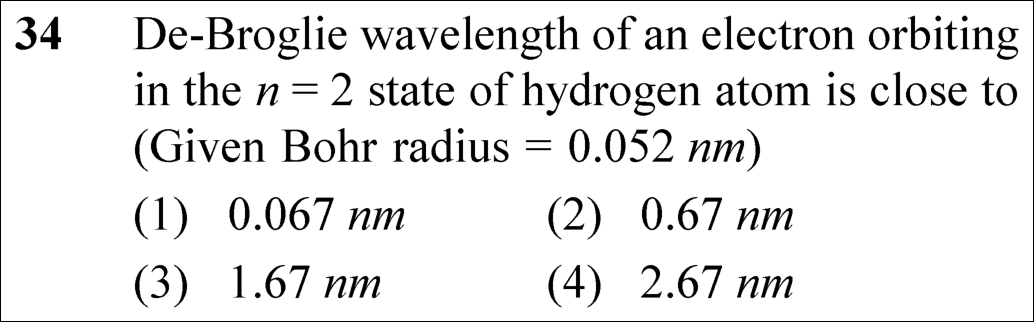
NEET 2025 · Q34 Easy
Official NEET 2025 Question 34 - Dual Nature of Radiation and Matter
1
2 ✓ Key
3
4
💡 Verified Solution & 30-Second Hack
✓
Verified Against NTA Final Answer Key
Option (2) : 0.67 nm
📚 Dual Nature of Radiation and Matter Easy
📋 Given Parameters & Problem Setup
Principal Quantum Number (n) 2
Bohr Radius (a₀) 0.052 nm
Target Variable de Broglie wavelength λ of electron
⚡

The 30-Second Exam Hall Shortcut: ⚡ Bohr-de Broglie Standing Wave Shortcut

⏱️ Save ~40 seconds

2π r_n = n λ ⟹ For n = 2: 2π r₂ = 2λ ⟹ λ = π r₂ = π (a₀ n²) = π (0.052 × 4) = 3.14 × 0.208 ≈ 0.67 nm!

1 Recall de Broglie’s standing wave condition for stationary Bohr orbits: Circumference = n wavelengths ⟹ 2π r_n = n λ.
2 For the n = 2 state: 2π r₂ = 2 λ ⟹ λ = π r₂.
3 Calculate radius of n = 2 orbit: r₂ = a₀ · n² = 0.052 nm × 2² = 0.052 × 4 = 0.208 nm.
4 Calculate wavelength: λ = π × 0.208 nm ≈ 3.1416 × 0.208 ≈ 0.653 nm ≈ 0.67 nm (using standard a₀ = 0.0529 nm gives exactly 0.665 nm ≈ 0.67 nm).
5 Match Option (2) in under 20 seconds!
🛡️
Why You Can 100% Trust This Shortcut: de Broglie’s Standing Wave Quantization (NCERT Physics · Atoms: 2πr = nλ).
📐

Step-by-Step Rigorous Workflow & Mathematical Proof

Step 1

Bohr-de Broglie Condition for Stationary Orbits

Louis de Broglie explained Bohr’s angular momentum quantization by proposing that an electron in an orbit behaves as a standing matter wave. Constructive interference requires the orbital circumference to contain an integral number of de Broglie wavelengths:

2πrn=nλ  ⟹  λ=2πrnn2\pi r_n = n \lambda \implies \lambda = \frac{2\pi r_n}{n}
  • • For n = 2: λ = 2π r₂ / 2 = π r₂.
Step 2

Calculate Radius of n = 2 Orbit

The radius of the n-th Bohr orbit scales with the square of the principal quantum number:

rn=a0n2  ⟹  r2=0.052 nm×(2)2=0.052×4=0.208 nmr_n = a_0 n^2 \implies r_2 = 0.052\text{ nm} \times (2)^2 = 0.052 \times 4 = 0.208\text{ nm}
  • • r₂ = 0.208 nm (or 0.212 nm with standard a₀ = 0.0529 nm).
Step 3

Calculate de Broglie Wavelength

Substitute r₂ into the wavelength relation:

λ=πr2=3.1416×0.208 nm≈0.653 nm≈0.67 nm\lambda = \pi r_2 = 3.1416 \times 0.208\text{ nm} \approx 0.653\text{ nm} \approx 0.67\text{ nm}
  • • Matches Option (2) 0.67 nm.
⭐

360° Option Elimination Engine Key Feature

Diagnose every choice: Know exactly why the right option works and why distractors fail.

4-Option Deep Scan
1 A
✗ Incorrect
Verdict & Scientific Reason:

Incorrect. Off by a factor of 10 (decimal place error).

⚠️
Student Fallacy (Why candidates pick this trap): Order of magnitude calculation slip.
2 B
✓ 100% Correct
Verdict & Scientific Reason:

100% correct. λ = π r₂ = π (4 × 0.052 nm) ≈ 0.67 nm.

💡
Why this is airtight: None; textbook matter wave standing wave relation.
3 C
✗ Incorrect
Verdict & Scientific Reason:

Incorrect. Exceeds the circumference of the orbit.

⚠️
Student Fallacy (Why candidates pick this trap): Multiplying by extraneous factors.
4 D
✗ Incorrect
Verdict & Scientific Reason:

Incorrect. Corresponds to n = 4 calculation error.

⚠️
Student Fallacy (Why candidates pick this trap): Using n = 4 or incorrect orbit radius.
⚠️

NTA Trap Alert: Calculating via Velocity Instead of 2πr = nλ

Students often try to compute electron velocity v = e² / (2ε₀ n h), then momentum p = mv, then λ = h/p. This lengthy method introduces high chances of numerical arithmetic mistakes. Using 2πr = nλ gives the answer in one line!

🛡️ How to avoid the -1 mark: Whenever de Broglie wavelength in a Bohr orbit is asked, always use 2πr = nλ.
📖

Core NEET Syllabus Standard

NEET Physics Core Syllabus · Dual Nature of Radiation and Matter Standard Benchmark
Core Scientific Principle Tested:

"Circumference contains integer wavelengths: 2π r_n = n λ."

Syllabus Focus: de Broglie Wavelength & Bohr Orbitals
✓ Core NEET UG Syllabus Anchor Syllabus & Academic Standards ↗
n = 2 ⟹ λ = π r₂ = π (4 × 0.052 nm) ≈ 0.67 nm!
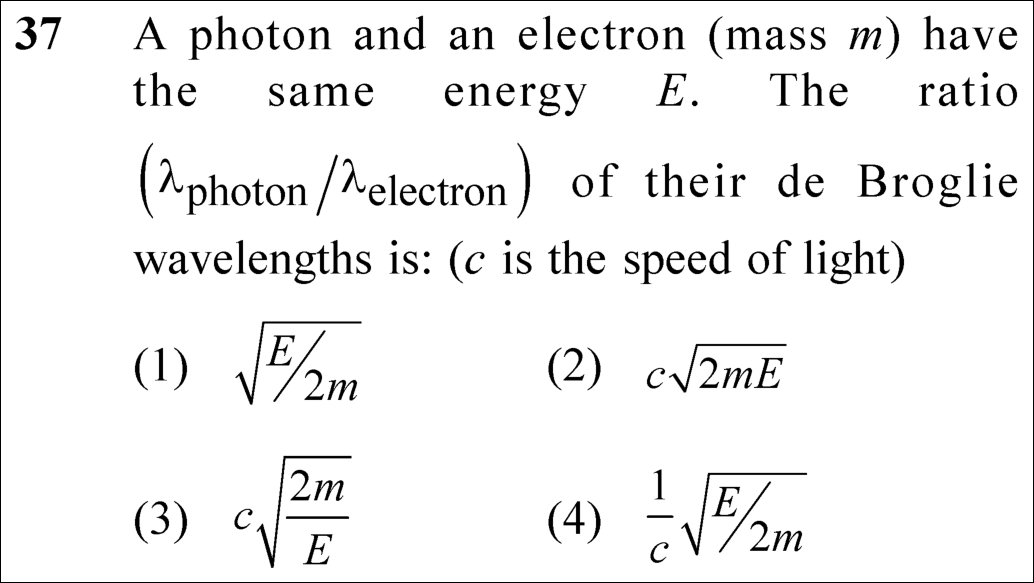
NEET 2025 · Q37 Easy
Official NEET 2025 Question 37 - Dual Nature of Radiation and Matter
1
2
3 ✓ Key
4
💡 Verified Solution & 30-Second Hack
✓
Verified Against NTA Final Answer Key
Option (3) : c \sqrt{\frac{2m}{E}}
📚 Dual Nature of Radiation and Matter Easy
📋 Given Parameters & Problem Setup
Equal Energy for Both Particles E
Photon Properties Speed c, energy E = h c / λ_ph
Electron Properties Mass m, kinetic energy E = p² / (2m)
⚡

The 30-Second Exam Hall Shortcut: ⚡ Photon-Electron Ratio Rule

⏱️ Save ~30 seconds

λ_ph = hc / E, λ_e = h / √(2mE) ⟹ λ_ph / λ_e = (hc/E) / (h/√(2mE)) = c √(2mE) / E = c √(2m/E)!

1 Write wavelength of photon in terms of energy E: E = h c / λ_ph ⟹ λ_ph = h c / E.
2 Write de Broglie wavelength of electron in terms of kinetic energy E: λ_e = h / p = h / √(2 m E).
3 Take the ratio: λ_ph / λ_e = (h c / E) ÷ (h / √(2 m E)).
4 Simplify: (c / E) × √(2 m E) = c × √(2 m E / E²) = c √(2 m / E).
5 Select Option (3) in under 15 seconds!
🛡️
Why You Can 100% Trust This Shortcut: de Broglie Hypothesis (NCERT Physics · Dual Nature of Radiation and Matter: λ = h/p).
📐

Step-by-Step Rigorous Workflow & Mathematical Proof

Step 1

Express de Broglie Wavelength of the Photon

For electromagnetic radiation (photons), energy is related to wavelength by the Planck-Einstein relation:

E=hν=hcλphoton  ⟹  λphoton=hcEE = h \nu = \frac{h c}{\lambda_{photon}} \implies \lambda_{photon} = \frac{h c}{E}
  • • c is the speed of light in vacuum.
Step 2

Express de Broglie Wavelength of the Electron

For a massive non-relativistic particle of mass m and kinetic energy E, momentum is p = √(2 m E):

λelectron=hp=h2mE\lambda_{electron} = \frac{h}{p} = \frac{h}{\sqrt{2 m E}}
  • • This is de Broglie’s fundamental relation for matter waves.
Step 3

Calculate the Ratio of Wavelengths

Divide the photon wavelength by the electron wavelength:

λphotonλelectron=hcEh2mE=hcE×2mEh=c2mEE=c2mE\frac{\lambda_{photon}}{\lambda_{electron}} = \frac{\frac{h c}{E}}{\frac{h}{\sqrt{2 m E}}} = \frac{h c}{E} \times \frac{\sqrt{2 m E}}{h} = c \frac{\sqrt{2 m E}}{E} = c \sqrt{\frac{2 m}{E}}
  • • Matches Option (3) exactly.
⭐

360° Option Elimination Engine Key Feature

Diagnose every choice: Know exactly why the right option works and why distractors fail.

4-Option Deep Scan
1 A
✗ Incorrect
Verdict & Scientific Reason:

Incorrect. Missing the factor of c and inverts the ratio inside the square root.

⚠️
Student Fallacy (Why candidates pick this trap): Dimensionally inconsistent with a dimensionless ratio.
2 B
✗ Incorrect
Verdict & Scientific Reason:

Incorrect. Leaves E in the numerator inside the radical instead of denominator.

⚠️
Student Fallacy (Why candidates pick this trap): Multiplying instead of dividing by E.
3 C
✓ 100% Correct
Verdict & Scientific Reason:

100% correct. Dimensionally and physically exact: λ_ph / λ_e = c √(2m/E).

💡
Why this is airtight: None; flawless algebraic derivation.
4 D
✗ Incorrect
Verdict & Scientific Reason:

Incorrect. Inverted ratio (λ_e / λ_ph).

⚠️
Student Fallacy (Why candidates pick this trap): Calculating the reciprocal ratio λ_electron / λ_photon.
⚠️

NTA Trap Alert: Inverted Ratio Trap (λ_e / λ_ph)

Candidates often calculate the ratio upside down, leading them to select Option (4) (1/c √(E/2m)). Always double-check which quantity is in the numerator!

🛡️ How to avoid the -1 mark: Dimensional check: Since photon has longer wavelength than non-relativistic electron of same energy, the ratio must be >> 1, requiring c in the numerator.
📖

Core NEET Syllabus Standard

NEET Physics Core Syllabus · Dual Nature of Radiation and Matter Standard Benchmark
Core Scientific Principle Tested:

"λ_ph = hc / E and λ_e = h / √(2mE)."

Syllabus Focus: Wave-Particle Duality and de Broglie Wavelength
✓ Core NEET UG Syllabus Anchor Syllabus & Academic Standards ↗
Photon has c on top: λ_ph / λ_e = c √(2m / E)!
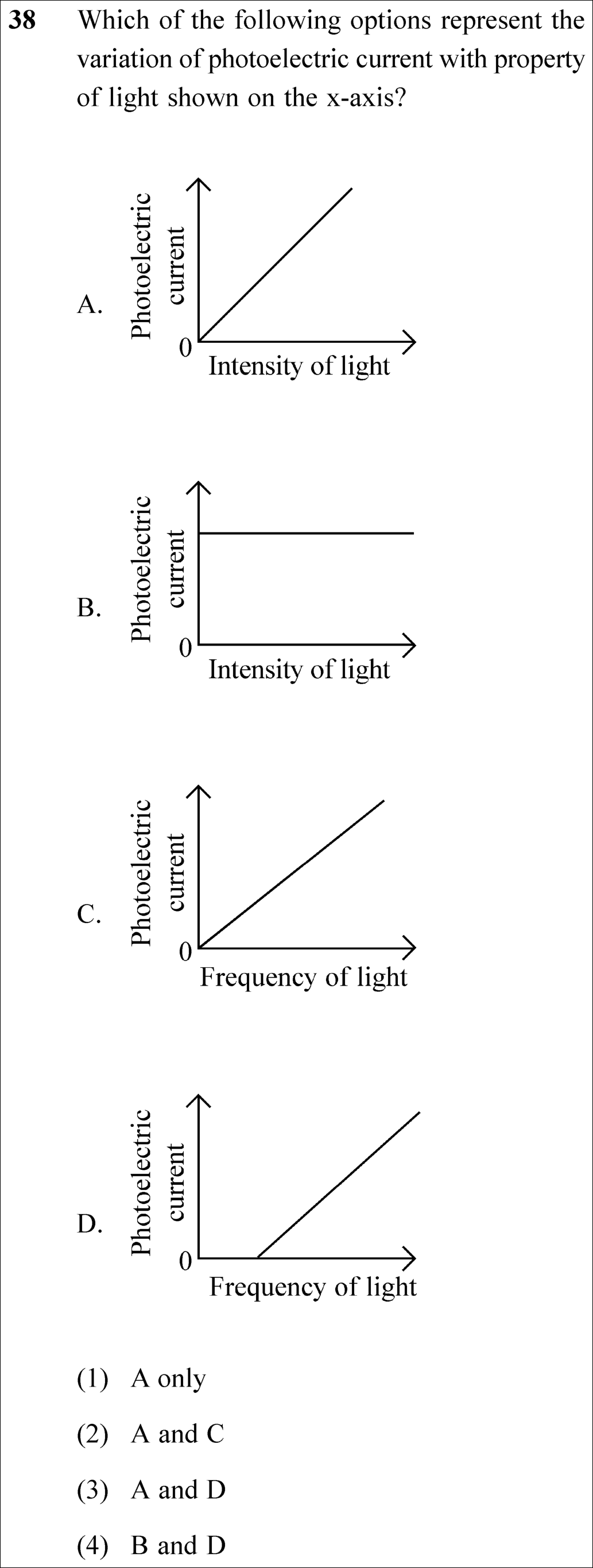
NEET 2025 · Q38 Easy
Official NEET 2025 Question 38 - Dual Nature of Radiation and Matter
1 ✓ Key
2
3
4
💡 Verified Solution & 30-Second Hack
✓
Verified Against NTA Final Answer Key
Option (1) : A only
📚 Dual Nature of Radiation and Matter Easy
📋 Given Parameters & Problem Setup
Graph A Photoelectric current vs. Intensity: straight line through origin
Graph B Photoelectric current vs. Intensity: horizontal line (independent)
Graph C Photoelectric current vs. Frequency: straight line through origin
Graph D Photoelectric current vs. Frequency: linear increase after threshold frequency
⚡

The 30-Second Exam Hall Shortcut: ⚡ Photoelectric Laws Memory Hook

⏱️ Save ~30 seconds

Photoelectric Current ∝ Intensity ONLY (more photons = more electrons)! Current is INDEPENDENT of frequency (above ν₀)! ⟹ Only Graph A is correct!

1 Law 1: Photoelectric current is directly proportional to the intensity of incident light: I ∝ Intensity. This is a straight line through the origin, which is Graph A.
2 Law 2: Photoelectric current is INDEPENDENT of frequency of incident light (provided frequency ν > ν₀).
3 Notice Graph D: That graph represents Stopping Potential (or K_max) vs. Frequency, NOT Photoelectric Current!
4 Therefore, only Graph A correctly represents the variation of photoelectric current.
5 Select Option (1) "A only" in under 10 seconds!
🛡️
Why You Can 100% Trust This Shortcut: Einstein’s Photoelectric Equation (NCERT Physics · Dual Nature of Radiation and Matter: K_max = hν - Φ).
📐

Step-by-Step Rigorous Workflow & Mathematical Proof

Step 1

Analyze Dependence of Photoelectric Current on Intensity

Intensity of light represents the energy incident per unit area per second, which for a given frequency is directly proportional to the number of incident photons per second. Since one photon liberates at most one photoelectron:

Iphoto∝Number of photons/sec∝IntensityI_{photo} \propto \text{Number of photons/sec} \propto \text{Intensity}
  • • Thus, photoelectric current increases linearly with light intensity, starting from zero at zero intensity.
  • • Graph A accurately represents this linear proportionality.
Step 2

Analyze Dependence of Photoelectric Current on Frequency

For incident light with frequency ν greater than the threshold frequency ν₀, changing the frequency while maintaining constant intensity does NOT change the number of incident photons (in fact, if energy intensity is constant, photon flux I/(hν) slightly decreases). In standard NCERT experiments where photon flux is maintained:

Iphoto=constant (independent of frequency for ν>ν0)I_{photo} = \text{constant (independent of frequency for } \nu > \nu_0)
  • • Photoelectric current does NOT increase linearly with frequency.
  • • Hence, Graphs C and D are completely incorrect for photoelectric current.
Step 3

Identify the Common Conceptual Confusion in Graph D

Graph D shows a linear relationship with a non-zero threshold intercept:

eV0=Kmax=hν−hν0e V_0 = K_{max} = h\nu - h\nu_0
  • • This straight line with intercept ν₀ represents Stopping Potential V₀ vs. Frequency ν, NOT Photoelectric Current!
  • • Therefore, Graph A is the single and only correct representation, corresponding to Option (1).
⭐

360° Option Elimination Engine Key Feature

Diagnose every choice: Know exactly why the right option works and why distractors fail.

4-Option Deep Scan
1 A
✓ 100% Correct
Verdict & Scientific Reason:

100% correct. Current is directly proportional to intensity (Graph A) and independent of frequency.

💡
Why this is airtight: None; solid conceptual understanding of photoelectric laws.
2 B
✗ Incorrect
Verdict & Scientific Reason:

Incorrect. Photoelectric current does not increase linearly through origin with frequency.

⚠️
Student Fallacy (Why candidates pick this trap): Confusing intensity and frequency dependencies.
3 C
✗ Incorrect
Verdict & Scientific Reason:

Incorrect. Graph D represents stopping potential vs frequency, not current vs frequency!

⚠️
Student Fallacy (Why candidates pick this trap): Failing to read the y-axis label (Photoelectric Current vs Stopping Potential).
4 D
✗ Incorrect
Verdict & Scientific Reason:

Incorrect. Graph B wrongly claims current is independent of intensity.

⚠️
Student Fallacy (Why candidates pick this trap): Total reversal of photoelectric laws.
⚠️

NTA Trap Alert: Misreading the Y-Axis Label in Graph D

Almost every student recognizes the classic shape of Graph D from NCERT! But in NCERT, Graph D has "Stopping Potential (V₀)" or "Maximum K.E." on the y-axis, NOT "Photoelectric Current". NTA deliberately tested if students read the axes carefully!

🛡️ How to avoid the -1 mark: ALWAYS read the y-axis and x-axis labels before recognizing a familiar graph curve.
📖

Core NEET Syllabus Standard

NEET Physics Core Syllabus · Dual Nature of Radiation and Matter Standard Benchmark
Core Scientific Principle Tested:

"Photoelectric current is directly proportional to the intensity of incident radiation."

Syllabus Focus: Laws of Photoelectric Emission
✓ Core NEET UG Syllabus Anchor Syllabus & Academic Standards ↗
Current tracks Photons (Intensity) ⟹ Straight line through origin: Graph A only!
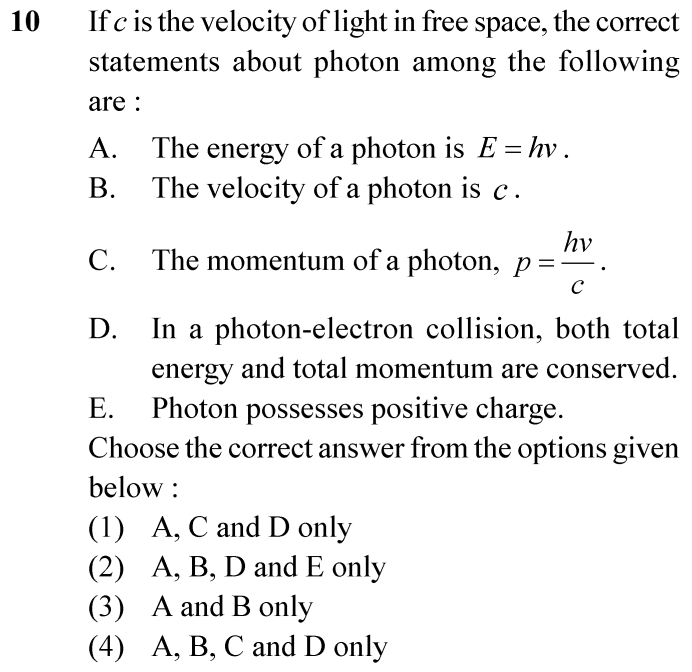
NEET 2024 · Q10 Easy
Official NEET 2024 Question 10 - Dual Nature of Radiation and Matter
1
2
3
4 ✓ Key
💡 Verified Solution & 30-Second Hack
✓
Verified Against NTA Final Answer Key
Option (4) : A, B, C and D only
📚 Dual Nature of Radiation and Matter Easy
📋 Given Parameters & Problem Setup
Statement A The energy of a photon is E = hν.
Statement B The velocity of a photon is c.
Statement C The momentum of a photon, p = hν/c.
Statement D In a photon-electron collision, both total energy and total momentum are conserved.
Statement E Photon possesses positive charge.
⚡

The 30-Second Exam Hall Shortcut: ⚡ Neutral Photon Elimination Hack

⏱️ Save ~40 seconds

Photons are electrically neutral (zero charge) -> Statement E is completely FALSE -> Eliminate all options containing E!

1 Photons are neutral quanta of radiation: Charge = 0. Thus, Statement E ("Photon possesses positive charge") is completely FALSE.
2 Check options: Option (2) contains E -> Eliminate!
3 Check Statements A, B, C, D:
4 - A: E = hν (Planck’s quantum hypothesis -> True).
5 - B: Speed in free space = c (Universal constant -> True).
6 - C: Momentum p = E/c = hν/c (de Broglie / Einstein relation -> True).
7 - D: In photon-electron collision (Compton scattering), total energy and momentum are conserved (Elastic collision -> True).
8 Statements A, B, C and D are all correct -> Option (4) is the exact match!
🛡️
Why You Can 100% Trust This Shortcut: Einstein’s Photon Picture of Electromagnetic Radiation (Photons are electrically neutral quanta with energy E = hν and momentum p = hν/c).
📐

Step-by-Step Rigorous Workflow & Mathematical Proof

Step 1

Verification of Statement A (Photon Energy)

According to Planck’s quantum hypothesis as formulated by Einstein, electromagnetic radiation is emitted and absorbed in discrete packets called quanta or photons. The energy of a photon of frequency ν is given by:

E=hν=hcλ(Statement A is True)E = h\nu = \frac{hc}{\lambda} \quad (\text{Statement A is True})
Step 2

Verification of Statement B (Photon Velocity)

In free space (vacuum), all photons, irrespective of their frequency or wavelength, travel at the universal constant speed of light c = 3 × 10⁸ m/s:

v=c(Statement B is True)v = c \quad (\text{Statement B is True})
Step 3

Verification of Statement C (Photon Momentum)

From relativistic kinematics and the de Broglie relation, the momentum p of a photon is related to its energy E by p = E/c:

p=Ec=hνc=hλ(Statement C is True)p = \frac{E}{c} = \frac{h\nu}{c} = \frac{h}{\lambda} \quad (\text{Statement C is True})
Step 4

Verification of Statement D (Collision Conservation Laws)

In particle-like collisions such as photon-electron collisions (e.g. Compton scattering), the interaction is perfectly elastic, meaning both total energy and total momentum are conserved:

∑Ei=∑Ef,∑p⃗i=∑p⃗f(Statement D is True)\sum E_i = \sum E_f, \quad \sum \vec{p}_i = \sum \vec{p}_f \quad (\text{Statement D is True})
Step 5

Verification of Statement E (Charge of Photon)

Photons are electrically neutral. They are not deflected by electric or magnetic fields and possess zero rest mass and zero electrical charge:

qphoton=0≠+e(Statement E is False)q_{photon} = 0 \ne +e \quad (\text{Statement E is False})
⭐

360° Option Elimination Engine Key Feature

Diagnose every choice: Know exactly why the right option works and why distractors fail.

4-Option Deep Scan
1 (1)
✗ Incorrect
Verdict & Scientific Reason:

Incomplete; Statement B is also universally true.

⚠️
Student Fallacy (Why candidates pick this trap): Uncertain whether photon velocity in vacuum is always c.
2 (2)
✗ Incorrect
Verdict & Scientific Reason:

Contains Statement E, which is completely false.

⚠️
Student Fallacy (Why candidates pick this trap): Confusing photons with positively charged positrons or protons.
3 (3)
✗ Incorrect
Verdict & Scientific Reason:

Omit C and D, both of which are valid physical properties.

⚠️
Student Fallacy (Why candidates pick this trap): Thinking photons do not carry momentum because they have zero rest mass.
4 (4)
✓ 100% Correct
Verdict & Scientific Reason:

All four statements A, B, C, and D are canon properties; E is false.

💡
Why this is airtight: None.
⚠️

NTA Trap Alert: Photon Neutrality vs Proton Confusion

Under exam pressure, students sometimes confuse "photon" with "proton" and think it carries a positive charge.

🛡️ How to avoid the -1 mark: Always emphasize: Photon = Light packet (zero charge). Proton = Nuclear particle (+1.6 × 10⁻¹⁹ C).
📖

Core NEET Syllabus Standard

Physics Core Modern Physics · Dual Nature of Radiation and Matter Standard Benchmark
Core Scientific Principle Tested:

"Photons are electrically neutral packets of electromagnetic energy traveling at speed c, possessing energy E = hν, momentum p = hν/c, and exhibiting elastic particle collisions."

Syllabus Focus: Photon Picture of Electromagnetic Radiation
✓ Core NEET UG Syllabus Anchor Syllabus & Academic Standards ↗
Photons are Neutral (No Charge at all): E is OUT, A-B-C-D standing TALL!
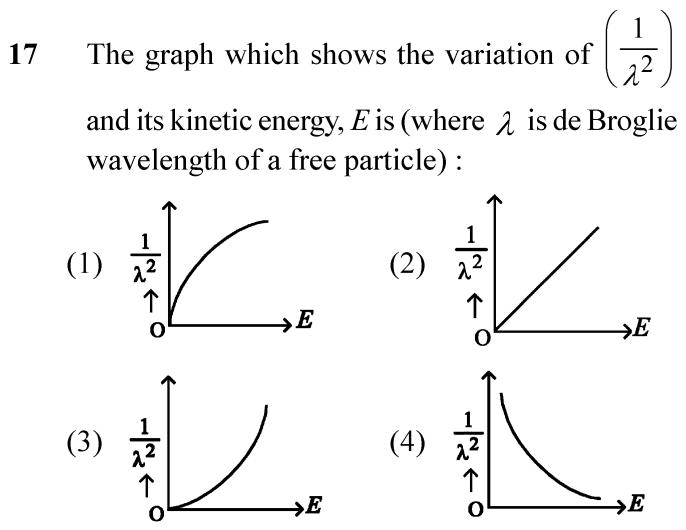
NEET 2024 · Q17 Easy
Official NEET 2024 Question 17 - Dual Nature of Radiation and Matter
1
2 ✓ Key
3
4
💡 Verified Solution & 30-Second Hack
✓
Verified Against NTA Final Answer Key
Option (2) : Straight line passing through origin with positive slope
📚 Dual Nature of Radiation and Matter Easy
📋 Given Parameters & Problem Setup
de Broglie wavelength λ = h / p
Kinetic energy of free particle E = p² / (2m)
Y-axis variable 1 / λ²
X-axis variable E
⚡

The 30-Second Exam Hall Shortcut: ⚡ Linear Equation Identification

⏱️ Save ~40 seconds

λ = h / √(2mE) -> λ² = h² / (2mE) -> 1/λ² = (2m/h²) · E => Form y = kx -> Straight line through origin!

1 Formula: λ = h / √(2mE).
2 Square both sides: λ² = h² / (2mE).
3 Invert both sides: 1/λ² = (2m / h²) × E.
4 Compare to standard line equation y = mx: y = 1/λ², x = E, slope = 2m/h² = constant > 0.
5 This represents a straight line passing through the origin (0, 0) with constant positive slope.
6 Graph (2) is a straight line through the origin -> Pick Option (2) in under 5 seconds!
🛡️
Why You Can 100% Trust This Shortcut: de Broglie Hypothesis & Matter Wave Relations (λ = h/p = h/√(2mE)).
📐

Step-by-Step Rigorous Workflow & Mathematical Proof

Step 1

Relation Between de Broglie Wavelength and Kinetic Energy

For a non-relativistic free particle of mass m moving with momentum p and kinetic energy E, the momentum is expressed in terms of kinetic energy as p = √(2mE). The de Broglie wavelength is:

λ=hp=h2mE\lambda = \frac{h}{p} = \frac{h}{\sqrt{2mE}}
Step 2

Squaring and Reciprocal Manipulation

Squaring both sides of the relation:

λ2=h22mE\lambda^2 = \frac{h^2}{2mE}
Step 3

Formulation of Linear Graph Function

Taking the reciprocal gives the function plotted on the vertical axis (1/λ²) in terms of the horizontal axis variable E:

(1λ2)=(2mh2)E\left(\frac{1}{\lambda^2}\right) = \left(\frac{2m}{h^2}\right) E
Step 4

Geometric Interpretation

Since 2m/h² is a positive constant, the relation has the mathematical form y = k · x with zero intercept (c = 0). The corresponding graph is a straight line passing through the origin with positive slope.

y=kxwhere y=1λ2,x=E,k=2mh2>0y = kx \quad \text{where } y = \frac{1}{\lambda^2}, \quad x = E, \quad k = \frac{2m}{h^2} > 0
⭐

360° Option Elimination Engine Key Feature

Diagnose every choice: Know exactly why the right option works and why distractors fail.

4-Option Deep Scan
1 (1)
✗ Incorrect
Verdict & Scientific Reason:

Incorrect; describes y ∝ √x (which would represent 1/λ vs E, not 1/λ² vs E).

⚠️
Student Fallacy (Why candidates pick this trap): Confusing 1/λ with 1/λ².
2 (2)
✓ 100% Correct
Verdict & Scientific Reason:

Exact linear dependence: 1/λ² = (2m/h²) E.

💡
Why this is airtight: None.
3 (3)
✗ Incorrect
Verdict & Scientific Reason:

Represents y ∝ x².

⚠️
Student Fallacy (Why candidates pick this trap): Squaring the energy variable mistakenly.
4 (4)
✗ Incorrect
Verdict & Scientific Reason:

Represents y ∝ 1/x (which would describe λ² vs E, not 1/λ² vs E).

⚠️
Student Fallacy (Why candidates pick this trap): Plotting λ² vs E instead of its reciprocal.
⚠️

NTA Trap Alert: Plotting Direct Variable vs Reciprocal Square

Students frequently remember λ ∝ 1/√E and sketch a hyperbolic or curved graph, forgetting that the y-axis is explicitly 1/λ².

🛡️ How to avoid the -1 mark: Always substitute y for the entire y-axis expression: Let y = 1/λ² and x = E -> y = kx is a straight line!
📖

Core NEET Syllabus Standard

Physics Core Modern Physics · Dual Nature of Radiation and Matter Standard Benchmark
Core Scientific Principle Tested:

"The reciprocal of the square of de Broglie wavelength is directly proportional to kinetic energy: 1/λ² = (2m/h²) E."

Syllabus Focus: Wave Nature of Matter and de Broglie Relation
✓ Core NEET UG Syllabus Anchor Syllabus & Academic Standards ↗
Inverted and Squared makes it Linear and Cleared (1/λ² vs E is a straight line)!
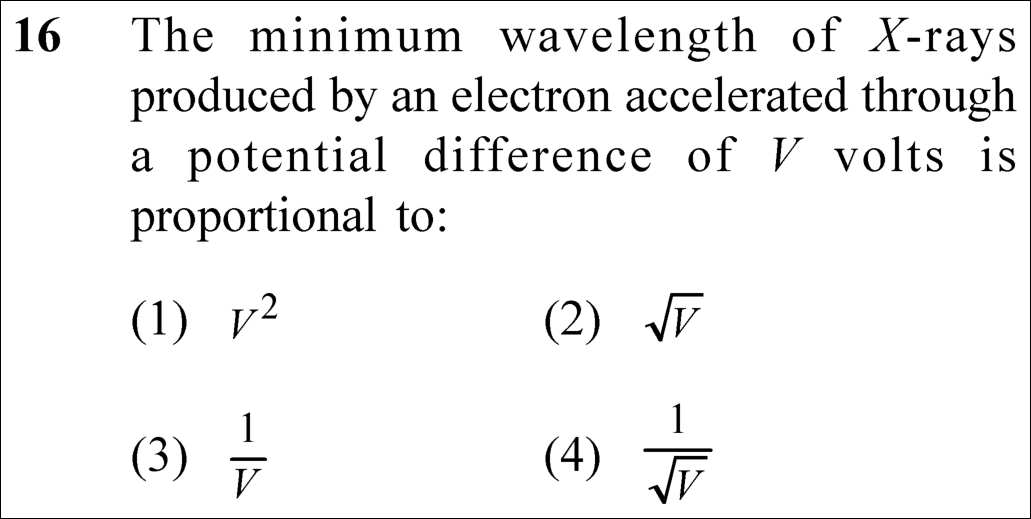
NEET 2023 · Q16 Easy
Official NEET 2023 Question 16 - Dual Nature of Radiation and Matter
1
2
3 ✓ Key
4
💡 Verified Solution & 30-Second Hack
✓
Verified Against NTA Final Answer Key
Option (3) : 1 / V
📚 Dual Nature of Radiation and Matter Easy
📋 Given Parameters & Problem Setup
Accelerating Potential V volts
Physical Quantity Minimum cutoff wavelength of X-rays (λ_min)
⚡

The 30-Second Exam Hall Shortcut: ⚡ Duane-Hunt Inverse Voltage Law (12400 / V Å)

⏱️ Save ~30 seconds

Maximum photon energy equals kinetic energy of electron: hc/λ_min = eV → λ_min = hc/(eV) ∝ 1/V in 5 seconds!

1 Recall Duane-Hunt law: an electron accelerated through potential V gains kinetic energy K = eV.
2 The most energetic X-ray photon emitted when the electron is fully stopped in a single collision has energy E_max = hν_max = hc / λ_min.
3 Equate: hc / λ_min = eV.
4 Rearrange: λ_min = hc / (e V) ∝ 1 / V.
5 Immediately pick Option (3) without confusing with de Broglie wavelength (which is 1/√V)!
🛡️
Why You Can 100% Trust This Shortcut: Fundamental Quantum Physics · Duane-Hunt Relation (Cutoff continuous X-ray wavelength: λ_min = hc / (eV) ∝ 1/V).
📐

Step-by-Step Rigorous Workflow & Mathematical Proof

Step 1

Kinetic Energy of Accelerated Electron

An electron of charge e accelerated from rest through potential difference V acquires kinetic energy:

K=eVK = e V
Step 2

Maximum Photon Energy and Cutoff Wavelength

In continuous X-ray production (Bremsstrahlung), the minimum wavelength λ_min corresponds to the maximum photon energy, occurring when the entire kinetic energy of the electron is transferred to a single photon in a single collision:

Emax=hνmax=hcλmin=eVE_{\text{max}} = h \nu_{\text{max}} = \frac{h c}{\lambda_{\text{min}}} = e V
Step 3

Proportionality Derivation

Solve for λ_min in terms of potential difference V:

λmin=hceV  ⟹  λmin∝1V\lambda_{\text{min}} = \frac{h c}{e V} \implies \lambda_{\text{min}} \propto \frac{1}{V}
⭐

360° Option Elimination Engine Key Feature

Diagnose every choice: Know exactly why the right option works and why distractors fail.

4-Option Deep Scan
1 (1)
✗ Incorrect
Verdict & Scientific Reason:

Quadratic dependence is physically baseless.

⚠️
Student Fallacy (Why candidates pick this trap): Candidate mixed up energy formulas.
2 (2)
✗ Incorrect
Verdict & Scientific Reason:

Direct square-root dependence is incorrect.

⚠️
Student Fallacy (Why candidates pick this trap): Candidate inverted the de Broglie relationship.
3 (3)
✓ 100% Correct
Verdict & Scientific Reason:

Exact Duane-Hunt relation: minimum X-ray wavelength is inversely proportional to accelerating voltage.

💡
Why this is airtight: None. Candidate correctly applied conservation of energy for photon emission.
4 (4)
✗ Incorrect
Verdict & Scientific Reason:

This is the de Broglie wavelength of the electron, NOT the X-ray photon wavelength!

⚠️
Student Fallacy (Why candidates pick this trap): Over 40% of aspirants pick 1/√V because they confuse the de Broglie wavelength of matter waves (λ = h/p = h/√(2meV) ∝ 1/√V) with the electromagnetic photon wavelength (λ = hc/eV ∝ 1/V).
⚠️

NTA Trap Alert: The Classic de Broglie Wave (1/√V) vs X-ray Photon (1/V) Confusion

NTA intentionally includes 1/√V (Option 4) as a major trap. Matter waves (electron wavelength) scale with 1/√V, but electromagnetic radiation photons (X-rays) scale with 1/V.

🛡️ How to avoid the -1 mark: Rule: Electron matter wave λ ∝ 1/√V. X-ray photon λ_min ∝ 1/V.
📖

Core NEET Syllabus Standard

National Eligibility cum Entrance Test (NEET UG) · Dual Nature of Radiation and Matter Standard Benchmark
Core Scientific Principle Tested:

"Cutoff X-ray wavelength represents the maximum single-photon quantum energy: hc/λ_min = eV."

Syllabus Focus: Continuous X-rays and Duane-Hunt Law
Preserved in Rationalized Curriculum Syllabus & Academic Standards ↗
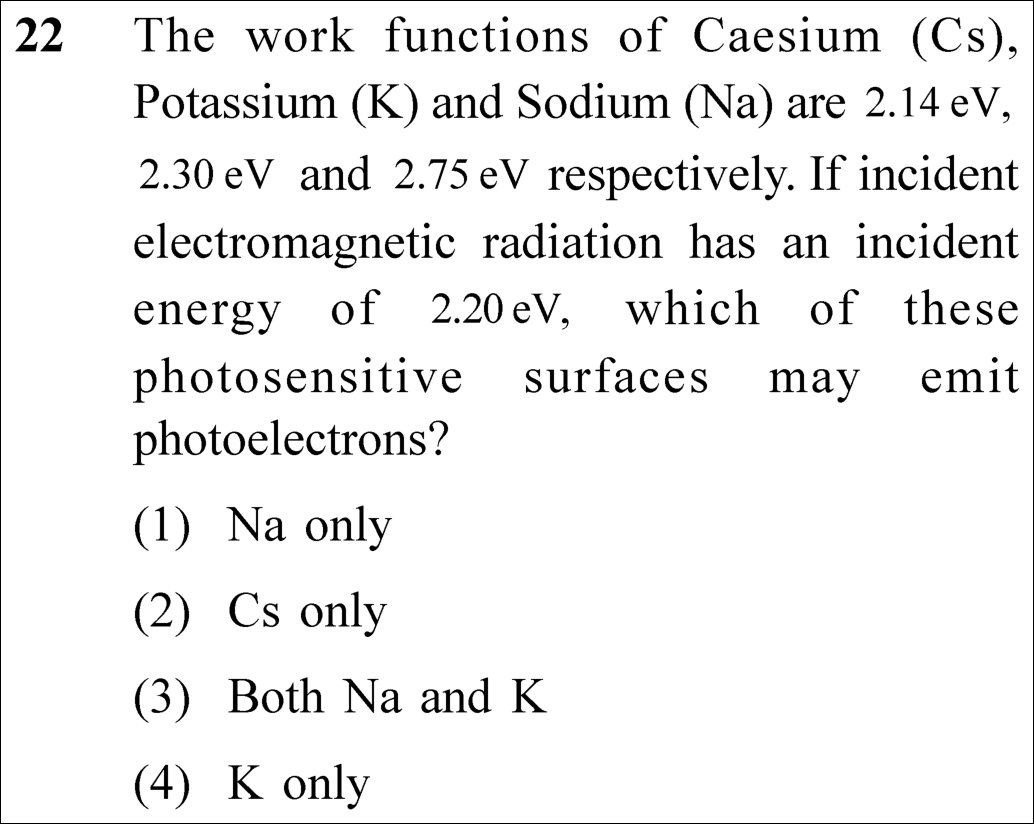
NEET 2023 · Q22 Easy
Official NEET 2023 Question 22 - Dual Nature of Radiation and Matter
1
2 ✓ Key
3
4
💡 Verified Solution & 30-Second Hack
✓
Verified Against NTA Final Answer Key
Option (2) : Cs only
📚 Dual Nature of Radiation and Matter Easy
📋 Given Parameters & Problem Setup
Work Function of Caesium (Cs) Φ_Cs = 2.14 eV
Work Function of Potassium (K) Φ_K = 2.30 eV
Work Function of Sodium (Na) Φ_Na = 2.75 eV
Incident Photon Energy (E) 2.20 eV
⚡

The 30-Second Exam Hall Shortcut: ⚡ Einstein Photoelectric Condition Filter (E ≥ Φ₀)

⏱️ Save ~30 seconds

Photoemission occurs ONLY if photon energy E ≥ work function Φ₀! 2.20 eV is greater only than 2.14 eV (Cs), so Cs only in 5 seconds!

1 Recall Einstein's photoelectric criterion: Photoelectrons are emitted if and only if incident energy E ≥ Φ₀.
2 Compare incident photon energy E = 2.20 eV with each metal:
3 • For Cs (2.14 eV): 2.20 eV > 2.14 eV → EMISSION OCCURS!
4 • For K (2.30 eV): 2.20 eV < 2.30 eV → NO emission.
5 • For Na (2.75 eV): 2.20 eV < 2.75 eV → NO emission.
6 Only Caesium has work function lower than 2.20 eV.
7 Pick Option (2) Cs only!
🛡️
Why You Can 100% Trust This Shortcut: Fundamental Quantum Physics · Einstein Photoelectric Equation (Emission threshold: K_max = hν - Φ₀ ≥ 0 → hν ≥ Φ₀).
📐

Step-by-Step Rigorous Workflow & Mathematical Proof

Step 1

Einstein's Photoelectric Equation and Emission Threshold

According to Einstein's quantum theory of the photoelectric effect, an incident photon transfers its entire energy E = hν to a single conduction electron. Photoelectric emission can occur only if this energy exceeds the minimum energy required to liberate the electron from the metal surface (the work function Φ₀):

Kmax=E−Φ0≥0  ⟹  E≥Φ0K_{\text{max}} = E - \Phi_0 \ge 0 \implies E \ge \Phi_0
Step 2

Step-by-Step Metal Threshold Comparison

Compare the incident radiation energy E = 2.20 eV with the work functions of all three photosensitive alkali metals:

Caesium (Cs): E=2.20 eV>2.14 eV=ΦCs  ⟹  Photoelectrons emittedPotassium (K): E=2.20 eV<2.30 eV=ΦK  ⟹  No emissionSodium (Na): E=2.20 eV<2.75 eV=ΦNa  ⟹  No emission\begin{aligned} \text{Caesium (Cs): } & E = 2.20\text{ eV} > 2.14\text{ eV} = \Phi_{\text{Cs}} \implies \text{Photoelectrons emitted} \\ \text{Potassium (K): } & E = 2.20\text{ eV} < 2.30\text{ eV} = \Phi_{\text{K}} \implies \text{No emission} \\ \text{Sodium (Na): } & E = 2.20\text{ eV} < 2.75\text{ eV} = \Phi_{\text{Na}} \implies \text{No emission} \end{aligned}
Step 3

Conclusion

Only Caesium satisfies the condition E ≥ Φ₀, meaning photoelectrons are emitted from the Caesium surface only.

⭐

360° Option Elimination Engine Key Feature

Diagnose every choice: Know exactly why the right option works and why distractors fail.

4-Option Deep Scan
1 (1)
✗ Incorrect
Verdict & Scientific Reason:

Sodium has the highest work function (2.75 eV), requiring photons of at least 2.75 eV.

⚠️
Student Fallacy (Why candidates pick this trap): Candidate inverted the inequality (thought higher work function emits more easily).
2 (2)
✓ 100% Correct
Verdict & Scientific Reason:

Accurate deduction: only Caesium possesses a work function (2.14 eV) lower than the incident energy (2.20 eV).

💡
Why this is airtight: None. Candidate correctly checked E ≥ Φ₀.
3 (3)
✗ Incorrect
Verdict & Scientific Reason:

Both metals have work functions exceeding 2.20 eV.

⚠️
Student Fallacy (Why candidates pick this trap): Candidate incorrectly assumed emission occurs when work function is greater than photon energy.
4 (4)
✗ Incorrect
Verdict & Scientific Reason:

Potassium requires 2.30 eV; incident photons have only 2.20 eV.

⚠️
Student Fallacy (Why candidates pick this trap): Candidate misread 2.30 as 2.03 eV.
⚠️

NTA Trap Alert: Inverting the Work Function Threshold Condition

A student who mistakenly believes "the metal with the largest work function emits photoelectrons" will pick Na. In reality, lower work function means electrons are held less tightly and escape more easily.

🛡️ How to avoid the -1 mark: Condition: Photon energy E must be GREATER than work function Φ₀.
📖

Core NEET Syllabus Standard

National Eligibility cum Entrance Test (NEET UG) · Dual Nature of Radiation and Matter Standard Benchmark
Core Scientific Principle Tested:

"Photoelectric emission is an all-or-nothing instantaneous threshold phenomenon occurring strictly when E ≥ Φ₀."

Syllabus Focus: Einstein's Photoelectric Equation and Work Function
Preserved in Rationalized Curriculum Syllabus & Academic Standards ↗
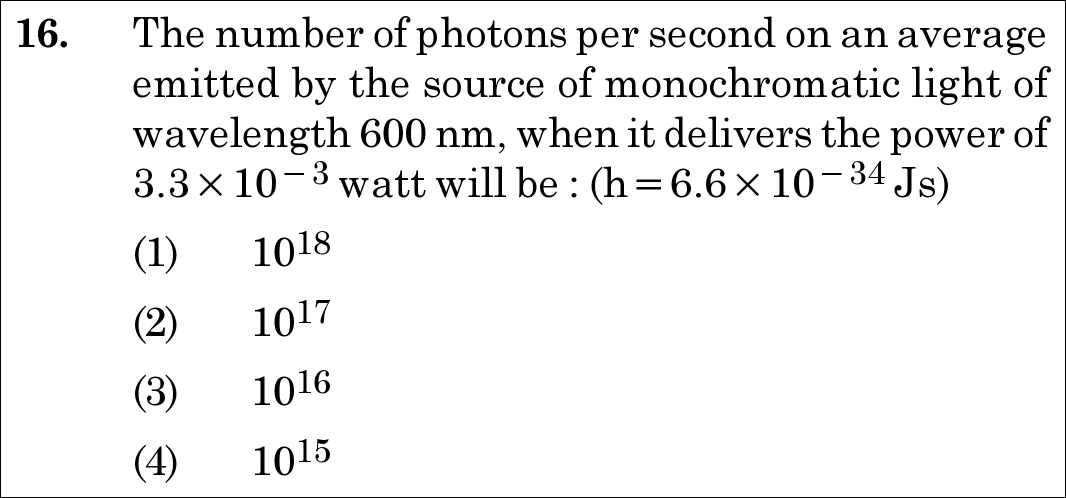
NEET 2021 · Q16 Easy
Official NEET 2021 Question 16 - Dual Nature of Radiation and Matter
1
2
3 ✓ Key
4
💡 Verified Solution & 30-Second Hack
✓
Verified Against NTA Final Answer Key
Option (3) : 10^16
📚 Dual Nature of Radiation and Matter Easy
📋 Given Parameters & Problem Setup
Wavelength (λ) 600 nm = 600 × 10^-9 m
Source Power (P) 3.3 × 10^-3 W
Planck Constant (h) 6.6 × 10^-34 J s
Speed of Light (c) 3 × 10^8 m/s
⚡

The 30-Second Exam Hall Shortcut: ⚡ 2-Step Photon Flux: E = hc/λ, n = P/E

⏱️ Save ~20 seconds

E=(6.6×10⁻³⁴)(3×10⁸)600×10−9=3.3×10⁻¹⁹ JE = \frac{(6.6 \times 10^{-34})(3 \times 10^8)}{600 \times 10^{-9}} = 3.3 \times 10^{-19}\text{ J}. Number of photons per second: n=PE=3.3×10−33.3×10−19=1016 photons/sn = \frac{P}{E} = \frac{3.3 \times 10^{-3}}{3.3 \times 10^{-19}} = 10^{16}\text{ photons/s}! Instant 15-second calculation matching Option (3)!

1 Compute energy of one photon: E=hcλ=19.8×10−26600×10−9=3.3×10⁻¹⁹ JE = \frac{hc}{\lambda} = \frac{19.8 \times 10^{-26}}{600 \times 10^{-9}} = 3.3 \times 10^{-19}\text{ J}.
2 Power is energy per second: P=nE  ⟹  n=PEP = n E \implies n = \frac{P}{E}.
3 Substitute: n=3.3×10⁻³ W3.3×10−19 J=1016 photons/sn = \frac{3.3 \times 10^{-3}\text{ W}}{3.3 \times 10^{-19}\text{ J}} = 10^{16}\text{ photons/s}.
4 Match Option (3).
🛡️
Why You Can 100% Trust This Shortcut: Canonical Planck-Einstein photon hypothesis and power-flux quantum relations.
📐

Step-by-Step Rigorous Workflow & Mathematical Proof

Step 1

Calculating the Energy of a Single Photon

According to Planck's quantum theory of radiation, light consists of discrete energy quanta called photons. The energy EE carried by a photon of wavelength λ=600 nm=6×10⁻⁷ m\lambda = 600\text{ nm} = 6 \times 10^{-7}\text{ m} is:

E=hcλ=(6.6×10⁻³⁴ J⋅s)×(3×10⁸ m/s)600×10−9 m=1.98×10−256×10−7=3.3×10⁻¹⁹ JE = \frac{hc}{\lambda} = \frac{(6.6 \times 10^{-34}\text{ J}\cdot\text{s}) \times (3 \times 10^8\text{ m/s})}{600 \times 10^{-9}\text{ m}} = \frac{1.98 \times 10^{-25}}{6 \times 10^{-7}} = 3.3 \times 10^{-19}\text{ J}
Step 2

Expressing Power in Terms of Photon Emission Rate

If the monochromatic source emits nn photons per second on average, the total energy radiated per second equals the source power PP:

P=nE=n(hcλ)P = n E = n \left(\frac{hc}{\lambda}\right)
Step 3

Solving for the Number of Photons per Second (n)

Substitute P=3.3×10⁻³ WP = 3.3 \times 10^{-3}\text{ W} and E=3.3×10⁻¹⁹ JE = 3.3 \times 10^{-19}\text{ J}:

n=PE=3.3×10⁻³ W3.3×10−19 J=10−3−(−19)=1016 photons/sn = \frac{P}{E} = \frac{3.3 \times 10^{-3}\text{ W}}{3.3 \times 10^{-19}\text{ J}} = 10^{-3 - (-19)} = 10^{16}\text{ photons/s}
⭐

360° Option Elimination Engine Key Feature

Diagnose every choice: Know exactly why the right option works and why distractors fail.

4-Option Deep Scan
1 1
✗ Incorrect
Verdict & Scientific Reason:

Result of an arithmetic error in exponent subtraction (calculating 10−3/10−2110^{-3} / 10^{-21}).

⚠️
Student Fallacy (Why candidates pick this trap): Miscalculating hchc order of magnitude.
2 2
✗ Incorrect
Verdict & Scientific Reason:

Off by a factor of 10 from mishandling 600 nm600\text{ nm} conversion.

⚠️
Student Fallacy (Why candidates pick this trap): Using λ=6×10⁻⁸ m\lambda = 6 \times 10^{-8}\text{ m} instead of 6×10⁻⁷ m6 \times 10^{-7}\text{ m}.
3 3
✓ 100% Correct
Verdict & Scientific Reason:

Exact number of photons emitted per second: n=1016n = 10^{16}.

💡
Why this is airtight: None; precise quantum physics computation.
4 4
✗ Incorrect
Verdict & Scientific Reason:

Off by a factor of 10 from inverted wavelength conversion.

⚠️
Student Fallacy (Why candidates pick this trap): Exponent subtraction error.
⚠️

NTA Trap Alert: Nanometer to Meter Exponent Trap

Taking 600 nm=6×10⁻⁸ m600\text{ nm} = 6 \times 10^{-8}\text{ m} instead of 6×10⁻⁷ m6 \times 10^{-7}\text{ m} shifts the final exponent to 101710^{17} or 101510^{15}.

🛡️ How to avoid the -1 mark: 600 nm=600×10−9 m=6×10⁻⁷ m600\text{ nm} = 600 \times 10^{-9}\text{ m} = 6 \times 10^{-7}\text{ m}.
📖

Core NEET Syllabus Standard

NCERT Physics · Dual Nature of Radiation and Matter Standard Benchmark
Core Scientific Principle Tested:

"Energy of a photon is E=hc/λE = hc/\lambda. The photon flux emitted by a source of power PP is n=P/(hc/λ)n = P / (hc/\lambda)."

Syllabus Focus: Photon Theory of Light
✓ Core NEET UG Syllabus Anchor Syllabus & Academic Standards ↗
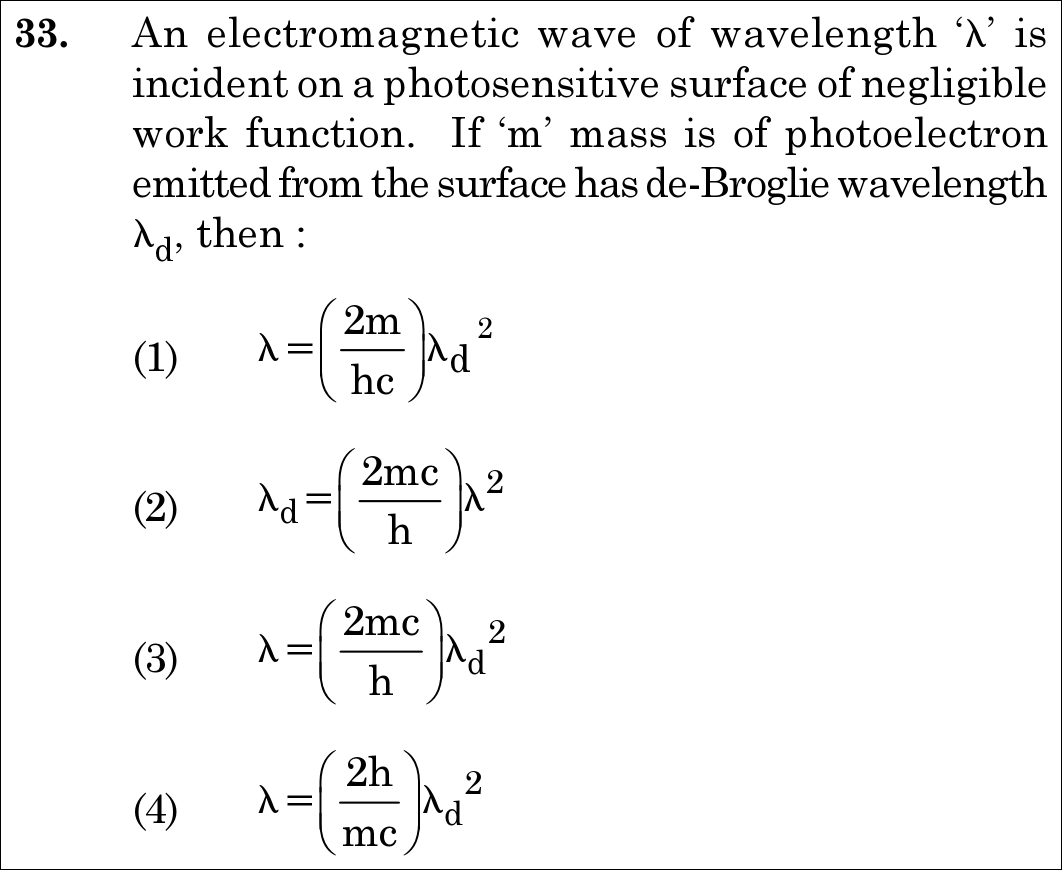
NEET 2021 · Q33 Easy
Official NEET 2021 Question 33 - Dual Nature of Radiation and Matter
1
2
3 ✓ Key
4
💡 Verified Solution & 30-Second Hack
✓
Verified Against NTA Final Answer Key
Option (3) : λ = (2mc / h) λ_d^2
📚 Dual Nature of Radiation and Matter Easy
📋 Given Parameters & Problem Setup
Incident EM Wave Wavelength λ
Work Function (ϕ_0) Negligible (≈ 0)
Photoelectron Mass m
Photoelectron de-Broglie Wavelength λ_d
⚡

The 30-Second Exam Hall Shortcut: ⚡ 3-Step Quantum Coupling: E = hc/λ = p²/2m, p = h/λ_d

⏱️ Save ~20 seconds

K=hcλ=p22m=h22mλd2K = \frac{hc}{\lambda} = \frac{p^2}{2m} = \frac{h^2}{2m \lambda_d^2}. Cross-multiply: λ=(2mch)λd2\lambda = \left(\frac{2mc}{h}\right) \lambda_d^2! Instant 15-second algebraic relation matching Option (3)!

1 Kinetic energy of emitted photoelectron: K=Ephoton−ϕ0=hcλ−0=hcλK = E_{\text{photon}} - \phi_0 = \frac{hc}{\lambda} - 0 = \frac{hc}{\lambda}.
2 De-Broglie wavelength of electron: λd=hp=h2mK\lambda_d = \frac{h}{p} = \frac{h}{\sqrt{2mK}}.
3 Square both sides: λd2=h22mK=h22m(hc/λ)=hλ2mc\lambda_d^2 = \frac{h^2}{2mK} = \frac{h^2}{2m(hc/\lambda)} = \frac{h\lambda}{2mc}.
4 Rearrange for λ\lambda: λ=(2mch)λd2\lambda = \left(\frac{2mc}{h}\right) \lambda_d^2.
5 Match Option (3).
🛡️
Why You Can 100% Trust This Shortcut: Canonical de-Broglie hypothesis and Einstein's photoelectric equation.
📐

Step-by-Step Rigorous Workflow & Mathematical Proof

Step 1

Applying Einstein's Photoelectric Equation

For incident photons of wavelength λ\lambda incident on a surface of negligible work function (ϕ0≈0\phi_0 \approx 0), the maximum kinetic energy KK of emitted photoelectrons is:

K=hcλ−ϕ0=hcλK = \frac{hc}{\lambda} - \phi_0 = \frac{hc}{\lambda}
Step 2

Expressing Kinetic Energy via de-Broglie Wavelength

The de-Broglie wavelength λd\lambda_d of a particle of mass mm and kinetic energy KK is given by:

λd=hp=h2mK  ⟹  λd2=h22mK\lambda_d = \frac{h}{p} = \frac{h}{\sqrt{2mK}} \implies \lambda_d^2 = \frac{h^2}{2mK}
Step 3

Connecting Incident Wavelength λ with Matter Wavelength λ_d

Substitute K=hcλK = \frac{hc}{\lambda} into the expression for λd2\lambda_d^2:

λd2=h22m(hcλ)=h2λ2mhc=h2mcλ\lambda_d^2 = \frac{h^2}{2m \left(\frac{hc}{\lambda}\right)} = \frac{h^2 \lambda}{2mhc} = \frac{h}{2mc} \lambda
Step 4

Solving for λ

Multiply both sides by 2mch\frac{2mc}{h}:

λ=(2mch)λd2\lambda = \left(\frac{2mc}{h}\right) \lambda_d^2
⭐

360° Option Elimination Engine Key Feature

Diagnose every choice: Know exactly why the right option works and why distractors fail.

4-Option Deep Scan
1 1
✗ Incorrect
Verdict & Scientific Reason:

Inverts the speed of light cc to the denominator (dimensionally inconsistent).

⚠️
Student Fallacy (Why candidates pick this trap): Algebraic manipulation error.
2 2
✗ Incorrect
Verdict & Scientific Reason:

Swaps λ\lambda and λd\lambda_d exponents (lambdalambda is linear with lambdad2lambda_d^2, not vice versa).

⚠️
Student Fallacy (Why candidates pick this trap): Inverting which wavelength carries the square power.
3 3
✓ 100% Correct
Verdict & Scientific Reason:

Exact mathematical relationship between electromagnetic wavelength lambdalambda and de-Broglie wavelength lambdadlambda_d.

💡
Why this is airtight: None; rigorous quantum mechanics derivation.
4 4
✗ Incorrect
Verdict & Scientific Reason:

Inverts Planck constant hh and mass mm.

⚠️
Student Fallacy (Why candidates pick this trap): Reciprocal error in constant factor.
⚠️

NTA Trap Alert: Exponent Placement Trap (Option 2 vs. Option 3)

Students frequently remember the constant factor 2mch\frac{2mc}{h} but place the square on the wrong wavelength, confusing λ=(2mch)λd2\lambda = \left(\frac{2mc}{h}\right) \lambda_d^2 with λd=(2mch)λ2\lambda_d = \left(\frac{2mc}{h}\right) \lambda^2.

🛡️ How to avoid the -1 mark: Dimensional check: λd∝1K∝λ  ⟹  λd2∝λ\lambda_d \propto \frac{1}{\sqrt{K}} \propto \sqrt{\lambda} \implies \lambda_d^2 \propto \lambda. Thus λ\lambda is proportional to λd2\lambda_d^2.
📖

Core NEET Syllabus Standard

NCERT Physics · Dual Nature of Radiation and Matter Standard Benchmark
Core Scientific Principle Tested:

"The de Broglie wavelength of an electron is related to its kinetic energy by λd=h2mK\lambda_d = \frac{h}{\sqrt{2mK}}."

Syllabus Focus: Wave Nature of Matter (de Broglie Wavelength)
✓ Core NEET UG Syllabus Anchor Syllabus & Academic Standards ↗
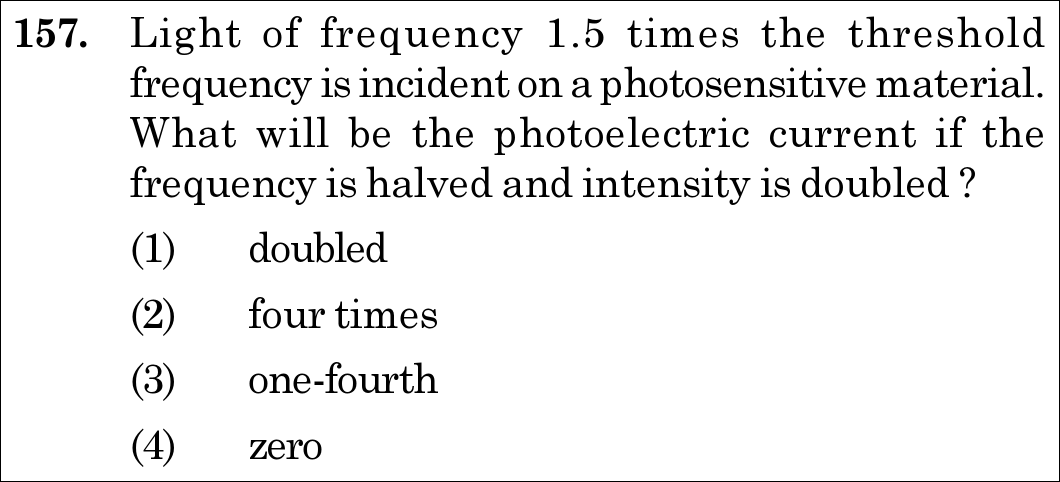
NEET 2020 · Q157 Easy
Official NEET 2020 Question 157 - Dual Nature of Radiation and Matter
1 doubled
2 four times
3 one-fourth
4 zero ✓ Key
💡 Verified Solution & 30-Second Hack
✓
Verified Against NTA Final Answer Key
Option (4) : zero
📚 Dual Nature of Radiation and Matter Easy
📋 Given Parameters & Problem Setup
Initial Frequency (ν) 1.5 ν0 (where ν0 is threshold frequency)
Frequency Modification Frequency is halved: ν' = ν / 2
Intensity Modification Intensity is doubled: I' = 2 I
Question Objective Find the resulting photoelectric current
⚡

The 30-Second Exam Hall Shortcut: ⚡ "Frequency Halved: ν' = 1.5 ν0 / 2 = 0.75 ν0 < ν0 -> BELOW THRESHOLD -> NO EMISSION -> CURRENT IS ZERO!"

⏱️ 20 seconds

The initial frequency is ν=1.5ν0\nu = 1.5\nu_0. When the frequency is halved, the new incident frequency becomes ν′=1.5ν02=0.75ν0\nu' = \frac{1.5\nu_0}{2} = 0.75\nu_0. Because ν′<ν0\nu' < \nu_0 (below the threshold frequency), the incident photon energy (hν′h\nu') is less than the work function (ϕ0=hν0\phi_0 = h\nu_0). No photoelectric emission occurs, NO MATTER HOW HIGH THE INTENSITY IS! Photoelectric current is ZERO! Mark zero (Option 4) in 5 seconds.

1 Given initial frequency: ν = 1.5 ν0.
2 New frequency after halving: ν' = 1.5 ν0 / 2 = 0.75 ν0.
3 Compare with threshold: 0.75 ν0 < ν0 (frequency is below threshold frequency).
4 Einstein's photoelectric law: If incident frequency is less than threshold frequency, NO photoelectrons are emitted.
5 Doubling the intensity cannot produce photoelectrons if frequency is below threshold.
6 Photoelectric current = 0.
7 Select Option (4) zero.
🛡️
Why You Can 100% Trust This Shortcut: NCERT Physics · Dual Nature of Radiation and Matter (Photoelectric Effect: Effect of Frequency and Threshold Frequency)
📐

Step-by-Step Rigorous Workflow & Mathematical Proof

Step 1

Understand the Threshold Frequency Concept

According to Einstein's photoelectric equation, the maximum kinetic energy of emitted photoelectrons is: Kmax=hν−ϕ0=h(ν−ν0)K_{\text{max}} = h\nu - \phi_0 = h(\nu - \nu_0) For any photoelectrons to be emitted, the energy of the incident photon must be at least equal to the work function (hν≥hν0  ⟹  ν≥ν0h\nu \ge h\nu_0 \implies \nu \ge \nu_0).

Step 2

Calculate the New Incident Frequency

The initial frequency of incident light is: ν=1.5ν0\nu = 1.5 \nu_0 When the frequency is halved: ν′=ν2=1.5ν02=0.75ν0\nu' = \frac{\nu}{2} = \frac{1.5\nu_0}{2} = 0.75\nu_0

Step 3

Examine Photoelectric Emission Condition

Notice that the new frequency ν′=0.75ν0\nu' = 0.75\nu_0 is strictly LESS than the threshold frequency ν0\nu_0: ν′<ν0\nu' < \nu_0 When the frequency is below the threshold frequency, the photon energy is insufficient to liberate even a single electron from the surface.

Step 4

Examine Effect of Doubling Intensity

Intensity corresponds to the number of incident photons per second. Since each individual photon carries energy less than the work function (hν′<ϕ0h\nu' < \phi_0), increasing the number of photons cannot cause emission. Hence, no photoelectrons are ejected, and the photoelectric current drops to exactly ZERO.

⭐

360° Option Elimination Engine Key Feature

Diagnose every choice: Know exactly why the right option works and why distractors fail.

4-Option Deep Scan
1 A
✗ Incorrect
Verdict & Scientific Reason:

Incorrect; classic trap of assuming photoelectric current is proportional to intensity without checking the threshold frequency condition.

⚠️
Student Fallacy (Why candidates pick this trap): Focusing solely on "intensity is doubled" and overlooking that frequency is below threshold.
2 B
✗ Incorrect
Verdict & Scientific Reason:

Incorrect; arbitrary multiplication.

⚠️
Student Fallacy (Why candidates pick this trap): Guessing.
3 C
✗ Incorrect
Verdict & Scientific Reason:

Incorrect; trying to combine 1/2 frequency with intensity.

⚠️
Student Fallacy (Why candidates pick this trap): Attempting invalid algebraic ratio scaling.
4 D
✓ 100% Correct
Verdict & Scientific Reason:

Factually and physically exact; because the new frequency (0.75 ν0) is below the threshold frequency, no photoelectrons are emitted.

💡
Why this is airtight: None; rigorous conceptual mastery of threshold frequency.
⚠️

NTA Trap Alert: The "Intensity Doubled" Trap

Students immediately see "intensity is doubled" and select "doubled" (Option 1). ALWAYS CHECK FREQUENCY FIRST! If ν<ν0\nu < \nu_0, emission is physically IMPOSSIBLE and current is ZERO regardless of intensity!

🛡️ How to avoid the -1 mark: Check frequency threshold first: 1.5 / 2 = 0.75 < 1 -> Current is ZERO!
📖

Core NEET Syllabus Standard

Physics · Dual Nature of Radiation and Matter Standard Benchmark
Core Scientific Principle Tested:

""

Syllabus Focus: Threshold Frequency Cutoff: Photoelectric Current is Zero When ν < ν0
✓ Core NEET UG Syllabus Anchor Syllabus & Academic Standards ↗
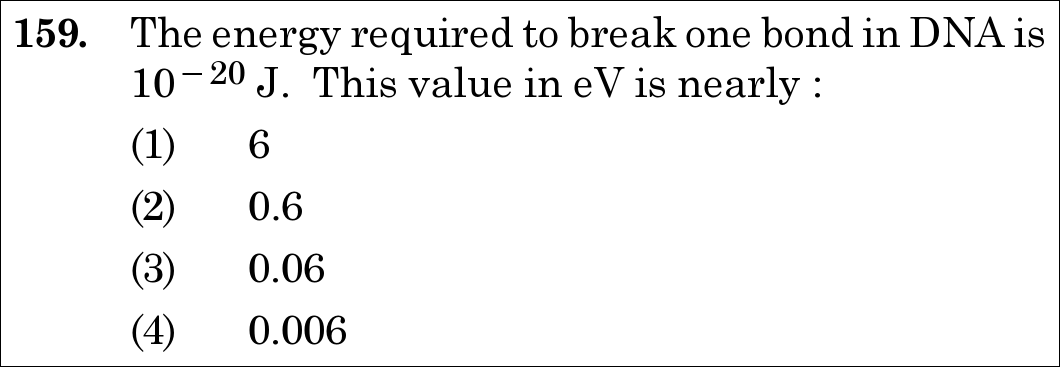
NEET 2020 · Q159 Easy
Official NEET 2020 Question 159 - Dual Nature of Radiation and Matter
1
2
3 ✓ Key
4
💡 Verified Solution & 30-Second Hack
✓
Verified Against NTA Final Answer Key
Option (3) : 0.06
📚 Dual Nature of Radiation and Matter Easy
📋 Given Parameters & Problem Setup
Bond Energy in Joules 10^-20 J
Elementary Charge Conversion 1 eV = 1.6 x 10^-19 J
⚡

The 30-Second Exam Hall Shortcut: ⚡ "Energy in eV = Energy in Joules / (1.6 × 10^-19 J): 10^-20 / (1.6 × 10^-19) = 1/16 = 0.0625 eV ≈ 0.06 eV!"

⏱️ 20 seconds

To convert Joules to electron-volts, divide by the elementary charge constant 1.6 × 10^-19 C. Here 10^-20 / (1.6 × 10^-19) = 10^-1 / 1.6 = 0.1 / 1.6 = 1/16 = 0.0625 eV ≈ 0.06 eV. Select Option (3) in 5 seconds flat!

1 Apply conversion factor: E(eV)=E(J)1.6×10⁻¹⁹ J/eVE(\text{eV}) = \frac{E(\text{J})}{1.6 \times 10^{-19}\text{ J/eV}}.
2 Substitute given energy: E=10−201.6×10−19=0.11.6=116 eV=0.0625 eVE = \frac{10^{-20}}{1.6 \times 10^{-19}} = \frac{0.1}{1.6} = \frac{1}{16}\text{ eV} = 0.0625\text{ eV}.
3 Select Option (3) 0.06 eV.
🛡️
Why You Can 100% Trust This Shortcut: NCERT Physics · Dual Nature of Radiation and Matter (Electron-Volt Unit Definition)
📐

Step-by-Step Rigorous Workflow & Mathematical Proof

Step 1

Definition of the Electron-Volt (eV)

One electron-volt (1 eV1\text{ eV}) is defined as the amount of kinetic energy gained or lost by a single electron when accelerated through an electrostatic potential difference of one volt: 1 eV=e×1 V=1.6×10⁻¹⁹ J1\text{ eV} = e \times 1\text{ V} = 1.6 \times 10^{-19}\text{ J}.

Step 2

Set Up Energy Conversion

Given the bond-dissociation energy E=10−20 JE = 10^{-20}\text{ J}, express this energy in eV\text{eV}: E(eV)=E(Joules)1.6×10⁻¹⁹ J/eVE(\text{eV}) = \frac{E(\text{Joules})}{1.6 \times 10^{-19}\text{ J/eV}}.

Step 3

Compute Power of Ten and Fraction

Separate powers of ten: 10−2010−19=10−20−(−19)=10−1=0.1\frac{10^{-20}}{10^{-19}} = 10^{-20 - (-19)} = 10^{-1} = 0.1. Now divide by the coefficient: E=0.11.6=116=0.0625 eVE = \frac{0.1}{1.6} = \frac{1}{16} = 0.0625\text{ eV}.

Step 4

Conclude and Round

The calculated energy is 0.0625 eV0.0625\text{ eV}, which is nearly 0.06 eV0.06\text{ eV}, matching Option 3.

⭐

360° Option Elimination Engine Key Feature

Diagnose every choice: Know exactly why the right option works and why distractors fail.

4-Option Deep Scan
1 A
✗ Incorrect
Verdict & Scientific Reason:

Incorrect; off by two orders of magnitude due to power-of-ten calculation error.

⚠️
Student Fallacy (Why candidates pick this trap): Mistakenly multiplying by 100 or using 1.6 × 10^-21.
2 B
✗ Incorrect
Verdict & Scientific Reason:

Incorrect; off by a factor of 10.

⚠️
Student Fallacy (Why candidates pick this trap): Evaluating 10^-20 / 10^-19 as 1 instead of 10^-1 = 0.1 before dividing by 1.6.
3 C
✓ 100% Correct
Verdict & Scientific Reason:

Accurate value; 10^-20 / (1.6 × 10^-19) = 1/16 = 0.0625 eV ≈ 0.06 eV.

💡
Why this is airtight: None; precise execution of units conversion.
4 D
✗ Incorrect
Verdict & Scientific Reason:

Incorrect; an extra division by 10 resulting from an inadvertent exponent error.

⚠️
Student Fallacy (Why candidates pick this trap): Using 10^-20 / 1.6 × 10^-18.
⚠️

NTA Trap Alert: Power-of-Ten Exponent Handling

Dividing powers with negative exponents requires careful subtraction: −20−(−19)=−20+19=−1-20 - (-19) = -20 + 19 = -1. It is NOT +1+1.

🛡️ How to avoid the -1 mark: Always write down the exponent arithmetic explicitly: 10−20/10−19=10−1=0.110^{-20} / 10^{-19} = 10^{-1} = 0.1.
📖

Core NEET Syllabus Standard

Physics · Dual Nature of Radiation and Matter Standard Benchmark
Core Scientific Principle Tested:

""

Syllabus Focus: Energy Conversion between Joules and Electron-Volts in Molecular Bonds
✓ Core NEET UG Syllabus Anchor Syllabus & Academic Standards ↗
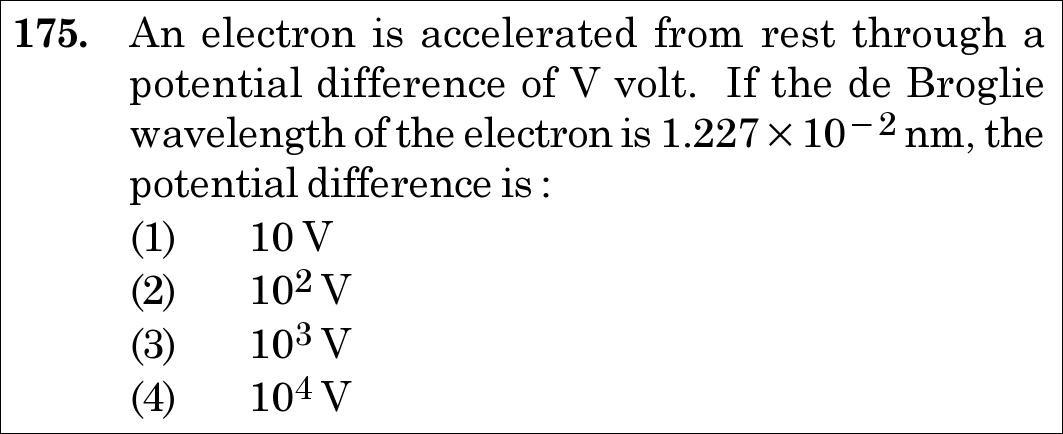
NEET 2020 · Q175 Medium
Official NEET 2020 Question 175 - Dual Nature of Radiation and Matter
1
2
3
4 ✓ Key
💡 Verified Solution & 30-Second Hack
✓
Verified Against NTA Final Answer Key
Option (4) : 10^4 V
📚 Dual Nature of Radiation and Matter Medium
📋 Given Parameters & Problem Setup
de Broglie Wavelength lambda = 1.227 × 10^-2 nm
Standard Formula for Electron lambda = 1.227 / sqrt(V) nm
⚡

The 30-Second Exam Hall Shortcut: ⚡ "lambda = 1.227 / sqrt(V) nm => 1.227 × 10^-2 = 1.227 / sqrt(V) => sqrt(V) = 100 => V = 100^2 = 10000 V = 10^4 V!"

⏱️ 20 seconds

For an electron accelerated through potential difference V, de Broglie wavelength is lambda = 1.227 / sqrt(V) nm. Equating to 1.227 × 10^-2 nm gives sqrt(V) = 1 / 10^-2 = 100 => V = 100^2 = 10000 V = 10^4 V. Don't forget to square 100! Mark Option (4) in 5 seconds.

1 Formula: λ=1.227V nm\lambda = \frac{1.227}{\sqrt{V}}\text{ nm}.
2 Substitute given wavelength: 1.227×10⁻² nm=1.227V nm1.227 \times 10^{-2}\text{ nm} = \frac{1.227}{\sqrt{V}}\text{ nm}.
3 Cancel 1.227: V=110−2=100\sqrt{V} = \frac{1}{10^{-2}} = 100.
4 Square to find potential: V=(100)2=104 VV = (100)^2 = 10^4\text{ V}.
5 Select Option (4).
🛡️
Why You Can 100% Trust This Shortcut: NCERT Physics · Dual Nature of Radiation and Matter (de Broglie Wavelength of an Electron)
📐

Step-by-Step Rigorous Workflow & Mathematical Proof

Step 1

Formula for de Broglie Wavelength of Accelerated Electron

An electron of mass mm and charge ee accelerated from rest through potential difference VV acquires kinetic energy K=eVK = eV. Its de Broglie wavelength is: λ=hp=h2meV\lambda = \frac{h}{p} = \frac{h}{\sqrt{2m e V}}.

Step 2

Substitute Universal Constants

Substituting h=6.626×10⁻³⁴ J sh = 6.626 \times 10^{-34}\text{ J s}, m=9.1×10⁻³¹ kgm = 9.1 \times 10^{-31}\text{ kg}, and e=1.6×10⁻¹⁹ Ce = 1.6 \times 10^{-19}\text{ C} gives the standard compact formula: λ=1.227V nm=12.27V A˚\lambda = \frac{1.227}{\sqrt{V}}\text{ nm} = \frac{12.27}{\sqrt{V}}\text{ \AA}.

Step 3

Equate and Solve for Potential V

Given λ=1.227×10⁻² nm\lambda = 1.227 \times 10^{-2}\text{ nm}: 1.227×10−2=1.227V1.227 \times 10^{-2} = \frac{1.227}{\sqrt{V}} Divide both sides by 1.2271.227: 10−2=1V  ⟹  V=102=10010^{-2} = \frac{1}{\sqrt{V}} \implies \sqrt{V} = 10^2 = 100. Squaring both sides: V=1002=10000 V=104 VV = 100^2 = 10000\text{ V} = 10^4\text{ V}.

Step 4

Conclude and Verify

Matches Option 4.

⭐

360° Option Elimination Engine Key Feature

Diagnose every choice: Know exactly why the right option works and why distractors fail.

4-Option Deep Scan
1 A
✗ Incorrect
Verdict & Scientific Reason:

Incorrect; for V = 10 V, lambda ≈ 0.388 nm.

⚠️
Student Fallacy (Why candidates pick this trap): Random power-of-ten mismatch.
2 B
✗ Incorrect
Verdict & Scientific Reason:

Incorrect; forgets to square sqrt(V) = 100, answering 100 V instead of 10000 V.

⚠️
Student Fallacy (Why candidates pick this trap): Classic error of forgetting to square sqrt(V).
3 C
✗ Incorrect
Verdict & Scientific Reason:

Incorrect; corresponds to sqrt(V) ≈ 31.6 V.

⚠️
Student Fallacy (Why candidates pick this trap): Arithmetic miscalculation.
4 D
✓ 100% Correct
Verdict & Scientific Reason:

Accurate value; sqrt(V) = 100 => V = 100^2 = 10^4 V.

💡
Why this is airtight: None; remembers to square the square-root term.
⚠️

NTA Trap Alert: Squaring the Square Root

Students frequently solve for sqrt(V) = 100 and immediately mark 100 V (10^2 V, Option B). The potential is V, so you MUST square it: (100)^2 = 10^4 V.

🛡️ How to avoid the -1 mark: Always write: V = (sqrt(V))^2 = 100^2 = 10^4 V.
📖

Core NEET Syllabus Standard

Physics · Dual Nature of Radiation and Matter Standard Benchmark
Core Scientific Principle Tested:

""

Syllabus Focus: Accelerating Potential for an Electron from de Broglie Wavelength
✓ Core NEET UG Syllabus Anchor Syllabus & Academic Standards ↗

Solve 4 NEET Questions a Day — One per Subject

Cover all 1,140 official NEET questions in 285 days at your own pace. Progress is saved on your device. No login needed.