MyCompetitiveExams Logo MyCompetitiveExams
Search 1,140+ Questions
Chapters, formulas, speed tricks
→
⚡ Brahmastra NEET 2027
720 MARKS

Dynamic 180-question full-length simulator mixed dynamically from all 6 years for 2027 & 2026 aspirants.

Launch Brahmastra 2027 Test →
Start Practice →
100% Free · No Login Required
Q.38 Physics ⭐ 360° Option Elimination Active
Vault ↗

NEET 2025 Physics Question 38 Solution

Topic: Dual Nature of Radiation and Matter · Official NTA Booklet Code 45
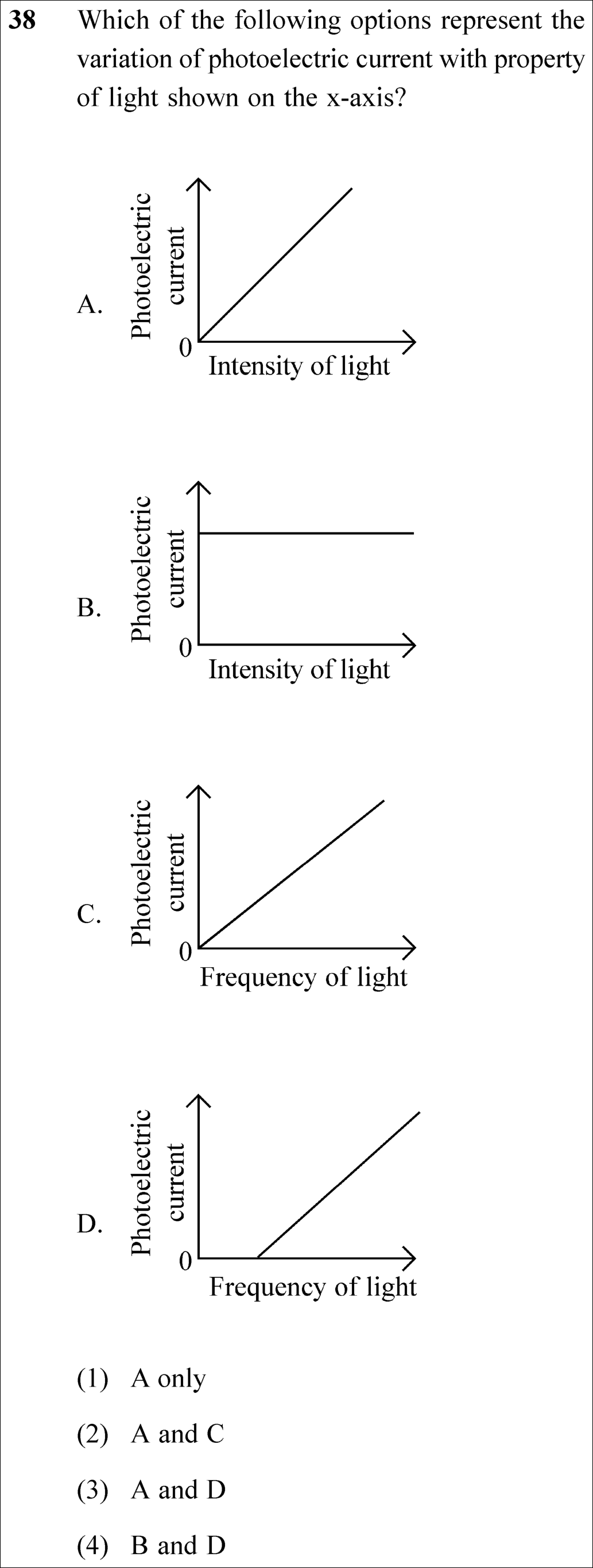
NEET 2025 Physics Question 38: Dependence of Photoelectric Current on Intensity and Frequency of Light

Question

Which of the following options represent the variation of photoelectric current with property of light shown on the x-axis?

✓
Verified Against NTA Final Answer Key
Option (1) : A only
📚 Dual Nature of Radiation and Matter Easy
📋 Given Parameters & Problem Setup
Graph A Photoelectric current vs. Intensity: straight line through origin
Graph B Photoelectric current vs. Intensity: horizontal line (independent)
Graph C Photoelectric current vs. Frequency: straight line through origin
Graph D Photoelectric current vs. Frequency: linear increase after threshold frequency
⚡

The 30-Second Exam Hall Shortcut: ⚡ Photoelectric Laws Memory Hook

⏱️ Save ~30 seconds

Photoelectric Current ∝ Intensity ONLY (more photons = more electrons)! Current is INDEPENDENT of frequency (above ν₀)! ⟹ Only Graph A is correct!

1 Law 1: Photoelectric current is directly proportional to the intensity of incident light: I ∝ Intensity. This is a straight line through the origin, which is Graph A.
2 Law 2: Photoelectric current is INDEPENDENT of frequency of incident light (provided frequency ν > ν₀).
3 Notice Graph D: That graph represents Stopping Potential (or K_max) vs. Frequency, NOT Photoelectric Current!
4 Therefore, only Graph A correctly represents the variation of photoelectric current.
5 Select Option (1) "A only" in under 10 seconds!
🛡️
Why You Can 100% Trust This Shortcut: Einstein’s Photoelectric Equation (NCERT Physics · Dual Nature of Radiation and Matter: K_max = hν - Φ).
📐

Step-by-Step Rigorous Workflow & Mathematical Proof

Step 1

Analyze Dependence of Photoelectric Current on Intensity

Intensity of light represents the energy incident per unit area per second, which for a given frequency is directly proportional to the number of incident photons per second. Since one photon liberates at most one photoelectron:

Iphoto∝Number of photons/sec∝IntensityI_{photo} \propto \text{Number of photons/sec} \propto \text{Intensity}
  • • Thus, photoelectric current increases linearly with light intensity, starting from zero at zero intensity.
  • • Graph A accurately represents this linear proportionality.
Step 2

Analyze Dependence of Photoelectric Current on Frequency

For incident light with frequency ν greater than the threshold frequency ν₀, changing the frequency while maintaining constant intensity does NOT change the number of incident photons (in fact, if energy intensity is constant, photon flux I/(hν) slightly decreases). In standard NCERT experiments where photon flux is maintained:

Iphoto=constant (independent of frequency for ν>ν0)I_{photo} = \text{constant (independent of frequency for } \nu > \nu_0)
  • • Photoelectric current does NOT increase linearly with frequency.
  • • Hence, Graphs C and D are completely incorrect for photoelectric current.
Step 3

Identify the Common Conceptual Confusion in Graph D

Graph D shows a linear relationship with a non-zero threshold intercept:

eV0=Kmax=hν−hν0e V_0 = K_{max} = h\nu - h\nu_0
  • • This straight line with intercept ν₀ represents Stopping Potential V₀ vs. Frequency ν, NOT Photoelectric Current!
  • • Therefore, Graph A is the single and only correct representation, corresponding to Option (1).
⭐

360° Option Elimination Engine Key Feature

Diagnose every choice: Know exactly why the right option works and why distractors fail.

4-Option Deep Scan
1 A
✓ 100% Correct
Verdict & Scientific Reason:

100% correct. Current is directly proportional to intensity (Graph A) and independent of frequency.

💡
Why this is airtight: None; solid conceptual understanding of photoelectric laws.
2 B
✗ Incorrect
Verdict & Scientific Reason:

Incorrect. Photoelectric current does not increase linearly through origin with frequency.

⚠️
Student Fallacy (Why candidates pick this trap): Confusing intensity and frequency dependencies.
3 C
✗ Incorrect
Verdict & Scientific Reason:

Incorrect. Graph D represents stopping potential vs frequency, not current vs frequency!

⚠️
Student Fallacy (Why candidates pick this trap): Failing to read the y-axis label (Photoelectric Current vs Stopping Potential).
4 D
✗ Incorrect
Verdict & Scientific Reason:

Incorrect. Graph B wrongly claims current is independent of intensity.

⚠️
Student Fallacy (Why candidates pick this trap): Total reversal of photoelectric laws.
⚠️

NTA Trap Alert: Misreading the Y-Axis Label in Graph D

Almost every student recognizes the classic shape of Graph D from NCERT! But in NCERT, Graph D has "Stopping Potential (V₀)" or "Maximum K.E." on the y-axis, NOT "Photoelectric Current". NTA deliberately tested if students read the axes carefully!

🛡️ How to avoid the -1 mark: ALWAYS read the y-axis and x-axis labels before recognizing a familiar graph curve.
📖

Core NEET Syllabus Standard

NEET Physics Core Syllabus · Dual Nature of Radiation and Matter Standard Benchmark
Core Scientific Principle Tested:

"Photoelectric current is directly proportional to the intensity of incident radiation."

Syllabus Focus: Laws of Photoelectric Emission
✓ Core NEET UG Syllabus Anchor Syllabus & Academic Standards ↗
Current tracks Photons (Intensity) ⟹ Straight line through origin: Graph A only!

Ready to attempt under real exam pressure?

Test your speed and accuracy in the authentic 180-minute timed NTA simulator.

Launch NEET 2025 CBT Test →

Spotted a mistake in this solution? Report an error (support@mycompetitiveexams.com)

⚖️ Legal & Fair Dealing Notice: Sourced from publicly released NEET 2025 question papers and NEET answer keys for private study, research, and non-commercial educational practice under Fair Dealing (Section 52(1)(a) of the Indian Copyright Act, 1957). Not affiliated with or endorsed by NTA or NMC.

Solve 4 NEET Questions a Day — One per Subject

Cover all 1,140 official NEET questions in 285 days at your own pace. Progress is saved on your device. No login needed.