MyCompetitiveExams Logo MyCompetitiveExams
Search 1,140+ Questions
Chapters, formulas, speed tricks
→
⚡ Brahmastra NEET 2027
720 MARKS

Dynamic 180-question full-length simulator mixed dynamically from all 6 years for 2027 & 2026 aspirants.

Launch Brahmastra 2027 Test →
Start Practice →
100% Free · No Login Required
Q.8 Physics ⭐ 360° Option Elimination Active
Vault ↗

NEET 2026 Physics Question 8 Solution

Topic: Dual Nature of Matter & Radiation · Official NTA Booklet Code 50
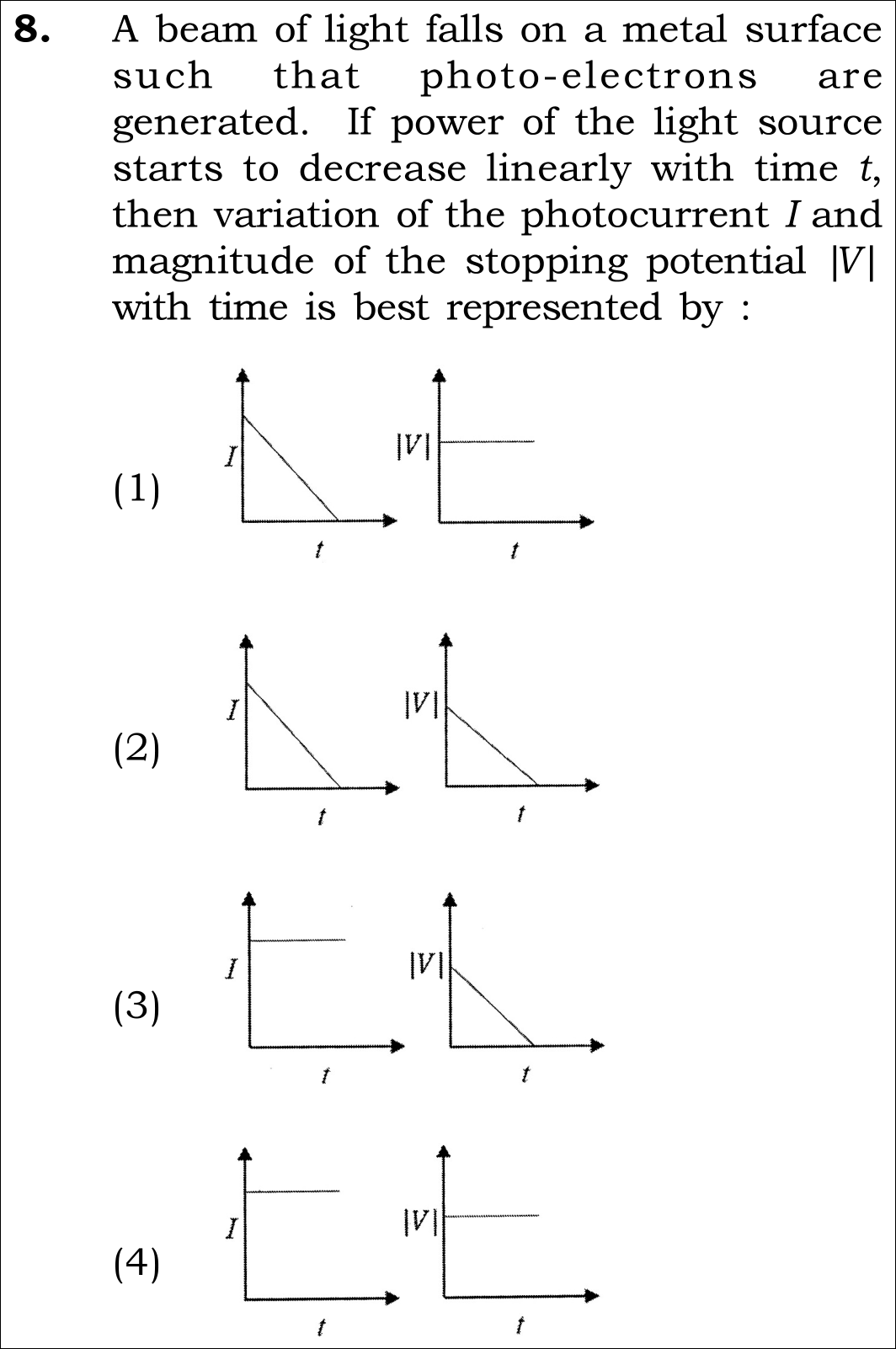
NEET 2026 Physics Question 8: Photocurrent and Stopping Potential Variation with Linearly Decreasing Light Power

Question

A beam of light falls on a metal surface such that photo-electrons are generated. If power of the light source starts to decrease linearly with time t, then variation of the photocurrent I and magnitude of the stopping potential |V| with time is best represented by:

✓
Verified Against NTA Final Answer Key
Option (1) : Photocurrent I decreases linearly with time; Stopping potential |V| remains constant
📚 Dual Nature of Matter & Radiation Easy
📋 Given Parameters & Problem Setup
Incident Light Power P(t) Decreases linearly with time t
Light Frequency nu Constant (photoelectrons are generated, nu > nu_0)
Work Function Phi Constant material property of the metal
Variables to Plot Photocurrent I vs t and Stopping Potential |V| vs t
⚡

The 30-Second Exam Hall Shortcut: ⚡ Einstein Photoelectric Decoupling Rule

⏱️ Instant conceptual recognition saves 1 full minute.

Intensity controls current; Frequency controls stopping potential!

1 Photocurrent I depends directly on the number of photons per second, which is proportional to light Power P(t).
2 Since P(t) decreases linearly with time, Photocurrent I MUST decrease linearly with time (straight line with negative slope).
3 Stopping potential |V_0| = (h*nu - Phi) / e depends ONLY on frequency nu and work function Phi. Power does not enter this equation!
4 Since frequency is unchanged, Stopping Potential |V| remains completely CONSTANT (horizontal flat line).
5 Look at the graphs: Graph (1) shows I decreasing linearly and |V| horizontal constant. Solved in 10 seconds!
🛡️
Why You Can 100% Trust This Shortcut: Einstein's Photoelectric Equation: e*|V_0| = K_max = h*nu - Phi. Since neither h, nu, nor Phi change with power, |V_0| is strictly time-invariant.
📐

Step-by-Step Rigorous Workflow & Mathematical Proof

Step 1

Analyze Photocurrent Dependency on Light Power

The number of incident photons per second is given by n = P(t) / (h*nu). Since each absorbed photon can eject at most one photoelectron (with quantum efficiency eta):

I=ηe(P(t)hν)∝P(t)I = \eta e \left( \frac{P(t)}{h\nu} \right) \propto P(t)
  • • Because power P(t) decreases linearly with time (P(t) = P_0 - k*t), photocurrent I must also decrease linearly with time.
  • • The graph of I vs t is a straight line sloping downward to zero.
Step 2

Analyze Stopping Potential Dependency on Light Power

Apply Einstein's photoelectric equation for maximum kinetic energy of emitted electrons:

Kmax=hν−Φ=e∣V0∣  ⟹  ∣V0∣=hν−ΦeK_{\text{max}} = h\nu - \Phi = e |V_0| \implies |V_0| = \frac{h\nu - \Phi}{e}
  • • Stopping potential depends solely on the frequency nu of incident radiation and the work function Phi.
  • • Stopping potential is completely INDEPENDENT of light intensity and source power.
  • • Therefore, |V| vs t is a horizontal straight line with zero slope.
Step 3

Match with the Given Graph Options

Inspect the four graph sets in the question crop:

Set (1): I(t) linear decrease, ∣V∣(t) horizontal constant line\text{Set (1): } I(t) \text{ linear decrease, } |V|(t) \text{ horizontal constant line}
  • • Matches Set (1) perfectly, corresponding to Option (1).
⭐

360° Option Elimination Engine Key Feature

Diagnose every choice: Know exactly why the right option works and why distractors fail.

4-Option Deep Scan
1 Option (1)
✓ 100% Correct
Verdict & Scientific Reason:

Scientifically exact application of Einstein's photoelectric theory; confirmed by Official NTA Key.

💡
Why this is airtight: Correctly decouples intensity (photon count) from frequency (photon energy).
Note: Flawless physics.
2 Option (2)
✗ Incorrect
Verdict & Scientific Reason:

Classical wave theory error.

⚠️
Student Fallacy (Why candidates pick this trap): Believes higher power/intensity gives electrons more energy, so reducing power reduces stopping potential.
Note: This was the exact failure of classical physics that Einstein resolved in 1905.
3 Option (3)
✗ Incorrect
Verdict & Scientific Reason:

Inverted dependencies.

⚠️
Student Fallacy (Why candidates pick this trap): Confuses current and stopping potential dependencies.
Note: Current is proportional to power, never constant when power drops.
4 Option (4)
✗ Incorrect
Verdict & Scientific Reason:

Ignores the explicit decrease in source power.

⚠️
Student Fallacy (Why candidates pick this trap): Fails to connect power to photon arrival rate.
Note: Fewer photons per second directly reduces photoelectrons ejected.
⚠️

NTA Trap Alert: The Classical Intensity-Energy Misconception

Students who do not master the quantum theory of light assume stopping potential decreases when light gets dimmer, incorrectly choosing Graph (2).

🛡️ How to avoid the -1 mark: Remember the golden rule: Intensity changes NUMBER of electrons (Current). Frequency changes ENERGY of electrons (Stopping Potential).
📖

Core NEET Syllabus Standard

NEET UG Physics Core Standards · Dual Nature of Matter and Radiation Standard Benchmark
Core Scientific Principle Tested:

"Stopping potential is determined strictly by incident photon frequency: e*V_0 = h*nu - Phi, independent of intensity/power."

Syllabus Focus: Photoelectric Effect, Einstein Equation, and Stopping Potential
✓ Core NEET UG Syllabus Anchor Syllabus & Academic Standards ↗

Ready to attempt under real exam pressure?

Test your speed and accuracy in the authentic 180-minute timed NTA simulator.

Launch NEET 2026 CBT Test →

Spotted a mistake in this solution? Report an error (support@mycompetitiveexams.com)

⚖️ Legal & Fair Dealing Notice: Sourced from publicly released NEET 2026 question papers and NEET answer keys for private study, research, and non-commercial educational practice under Fair Dealing (Section 52(1)(a) of the Indian Copyright Act, 1957). Not affiliated with or endorsed by NTA or NMC.

Solve 4 NEET Questions a Day — One per Subject

Cover all 1,140 official NEET questions in 285 days at your own pace. Progress is saved on your device. No login needed.