NEET 2025 Physics Question 34 Solution
Question
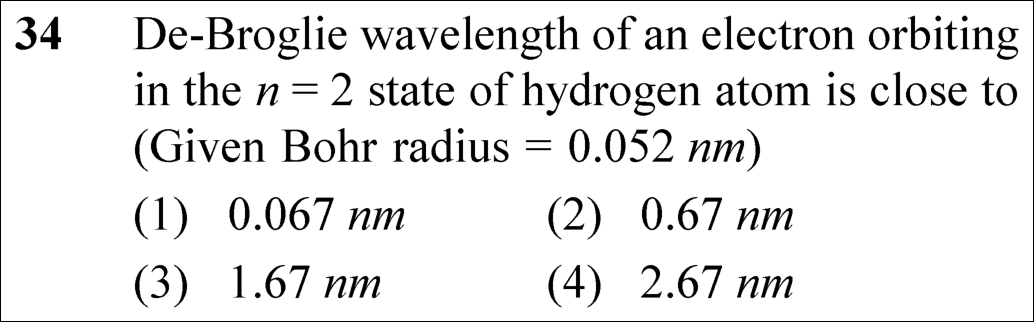
De-Broglie wavelength of an electron orbiting in the n = 2 state of hydrogen atom is close to (Given Bohr radius = 0.052 nm)
Dynamic 180-question full-length simulator mixed dynamically from all 6 years for 2027 & 2026 aspirants.
De-Broglie wavelength of an electron orbiting in the n = 2 state of hydrogen atom is close to (Given Bohr radius = 0.052 nm)
2π r_n = n λ ⟹ For n = 2: 2π r₂ = 2λ ⟹ λ = π r₂ = π (a₀ n²) = π (0.052 × 4) = 3.14 × 0.208 ≈ 0.67 nm!
Louis de Broglie explained Bohr’s angular momentum quantization by proposing that an electron in an orbit behaves as a standing matter wave. Constructive interference requires the orbital circumference to contain an integral number of de Broglie wavelengths:
The radius of the n-th Bohr orbit scales with the square of the principal quantum number:
Substitute r₂ into the wavelength relation:
Diagnose every choice: Know exactly why the right option works and why distractors fail.
Incorrect. Off by a factor of 10 (decimal place error).
100% correct. λ = π r₂ = π (4 × 0.052 nm) ≈ 0.67 nm.
Incorrect. Exceeds the circumference of the orbit.
Incorrect. Corresponds to n = 4 calculation error.
Students often try to compute electron velocity v = e² / (2ε₀ n h), then momentum p = mv, then λ = h/p. This lengthy method introduces high chances of numerical arithmetic mistakes. Using 2πr = nλ gives the answer in one line!
"Circumference contains integer wavelengths: 2π r_n = n λ."
Test your speed and accuracy in the authentic 180-minute timed NTA simulator.
Spotted a mistake in this solution? Report an error (support@mycompetitiveexams.com)
Cover all 1,140 official NEET questions in 285 days at your own pace. Progress is saved on your device. No login needed.