The 30-Second Exam Hall Shortcut: ⚡ Apparent Depth Ratio Method
Apparent depth = Real depth * (n_observer / n_object)
Step-by-Step Rigorous Workflow & Mathematical Proof
Determine the Real Depth of the Object from Both Interfaces
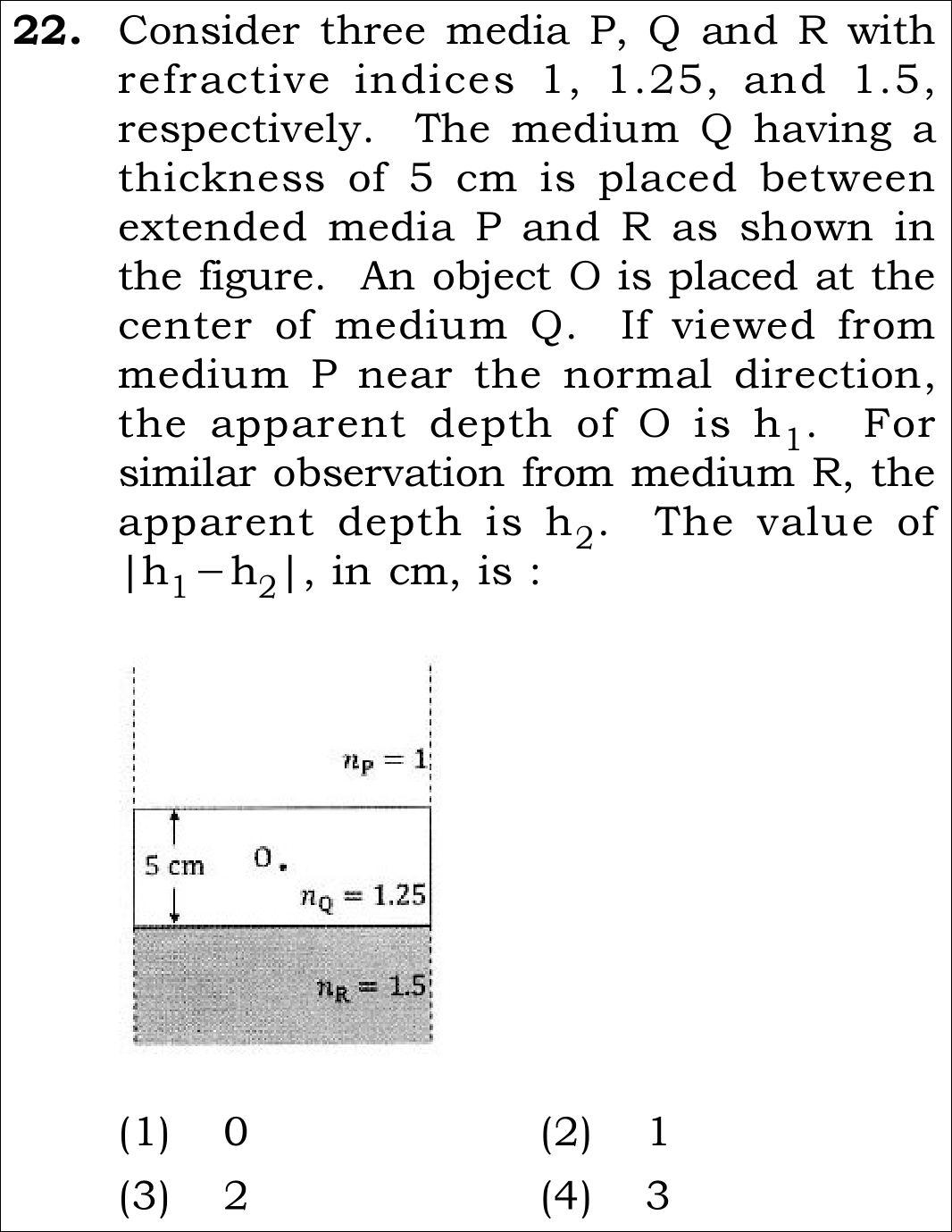
The slab of medium Q has a thickness of 5 cm. Since object O is located at its center:
- • d_1 is the real depth from the upper P-Q interface.
- • d_2 is the real depth from the lower Q-R interface.
Calculate Apparent Depth h_1 When Viewed from Medium P
Observer is in medium P (n_P = 1), looking at object O in medium Q (n_Q = 1.25):
- • The object appears shifted closer to the interface by 0.5 cm.
Calculate Apparent Depth h_2 When Viewed from Medium R
Observer is in medium R (n_R = 1.5), looking at object O in medium Q (n_Q = 1.25):
- • Because n_R > n_Q, the object appears further from the interface.
Compute the Absolute Difference |h_1 - h_2|
Subtract the two apparent depths:
- • Matches Option (2) exactly.
360° Option Elimination Engine Key Feature
Diagnose every choice: Know exactly why the right option works and why distractors fail.
Symmetry fallacy.
100% mathematically verified; confirmed by Official NTA Final Answer Key.
Used full thickness 5 cm.
Took h_2 value alone.
NTA Trap Alert: The Full Slab Thickness Oversight (Using 5 cm instead of 2.5 cm)
Many students use real depth d = 5 cm, calculating h_1 = 4 cm and h_2 = 6 cm, which leads to |h_1 - h_2| = 2 cm (Option 3).
Core NEET Syllabus Standard
"Apparent depth of an object observed from medium 1 inside medium 2: h_app = d_real * (n_1 / n_2)."