MyCompetitiveExams Logo MyCompetitiveExams
Search 1,140+ Questions
Chapters, formulas, speed tricks
→
⚡ Brahmastra NEET 2027
720 MARKS

Dynamic 180-question full-length simulator mixed dynamically from all 6 years for 2027 & 2026 aspirants.

Launch Brahmastra 2027 Test →
Start Practice →
100% Free · No Login Required
Q.76 Chemistry ⭐ 360° Option Elimination Active
Vault ↗

NEET 2025 Chemistry Question 76 Solution

Topic: Hydrocarbons · Official NTA Booklet Code 45
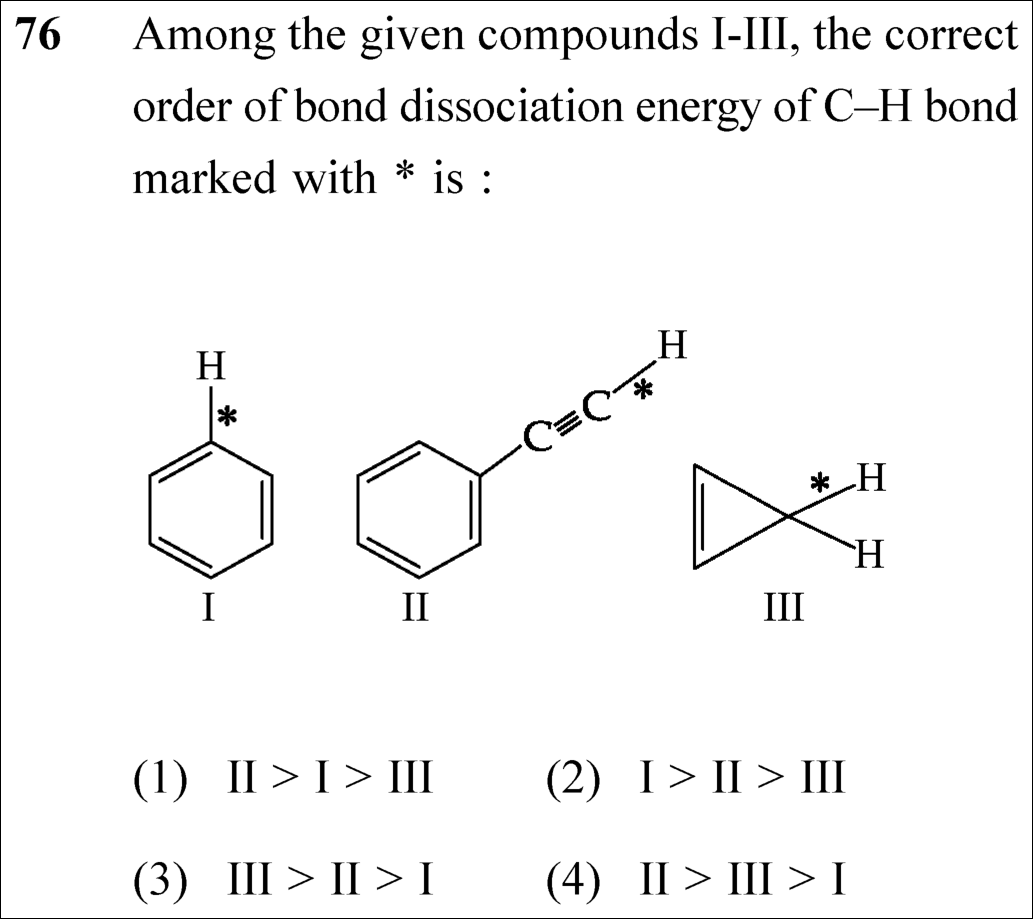
NEET 2025 Chemistry Question 76: Order of C-H Bond Dissociation Energy in Benzene, Phenylacetylene & Cyclopropene

Question

Among the given compounds I-III, the correct order of bond dissociation energy of C–H bond marked with * is: I. benzene (aromatic C–H) II. phenylacetylene (terminal alkyne C–H) III. cyclopropene (ring CH₂ C–H)

✓
Verified Against NTA Final Answer Key
Option (1) : II > I > III
📚 Hydrocarbons Medium
📋 Given Parameters & Problem Setup
Compound I Benzene (sp² C-H bond)
Compound II Phenylacetylene (sp C-H bond on terminal alkyne)
Compound III Cyclopropene (sp³ allylic C-H bond)
⚡

The 30-Second Exam Hall Shortcut: ⚡ s-Character and Radical Stability Shortcut

⏱️ Save ~40 seconds

Bond Dissociation Energy (BDE) ∝ s-character of C ∝ 1 / (Radical Stability)! Terminal alkyne (sp, 50% s) = STRONGEST bond (II, highest BDE). Benzene (sp², 33% s) = intermediate (I). Cyclopropene allylic C-H gives resonance-stabilized allylic radical = WEAKEST bond (III, lowest BDE)! ⟹ II > I > III!

1 Recall relationship: Higher s-character brings bonding electrons closer to nucleus, resulting in a shorter, stronger C-H bond with higher BDE.
2 Alternatively: BDE is inversely proportional to the stability of the free radical formed upon homolysis.
3 Compound II (Phenylacetylene): C-H is sp hybridized (50% s-character). It has the highest electronegativity and forms an unstable sp-radical ⟹ HIGHEST BDE (II).
4 Compound I (Benzene): C-H is sp² hybridized (33.3% s-character). The phenyl radical cannot delocalize into the aromatic π-system ⟹ intermediate BDE (I).
5 Compound III (Cyclopropene): Homolytic cleavage of the allylic C-H bond generates a resonance-stabilized allylic cyclopropenyl radical ⟹ LOWEST BDE (III).
6 Decreasing order of BDE: II > I > III.
7 Select Option (1) in under 15 seconds!
🛡️
Why You Can 100% Trust This Shortcut: Hybridization, s-Character, and Bond Strengths (NCERT Chemistry · Chemical Bonding and Hydrocarbons).
📐

Step-by-Step Rigorous Workflow & Mathematical Proof

Step 1

Fundamental Factors Governing C-H Bond Dissociation Energy

Bond dissociation energy (BDE) of a C-H bond is defined by homolytic cleavage: R-H ⟶ R• + H•. Thermodynamically, BDE reflects both orbital hybridization (s-character) and the stability of the resulting carbon radical:

BDE∝s-character of C-H bond∝1Stability of R∙\text{BDE} \propto \text{s-character of C-H bond} \propto \frac{1}{\text{Stability of } R^\bullet}
  • • Greater s-character holds the bonding pair closer to carbon, increasing bond strength.
  • • Forming an unstable radical requires significantly higher energy input.
Step 2

Evaluate Hybridization and BDE for Compounds II and I

Compare the terminal alkyne and aromatic C-H bonds:

II (Phenylacetylene): sp-hybridized C-H (50% s-character)  ⟹  BDE≈545−555 kJ/mol\text{II (Phenylacetylene): } sp\text{-hybridized C-H } (50\%\text{ s-character}) \implies \text{BDE} \approx 545-555\text{ kJ/mol}
  • • An sp-hybridized C-H bond is the strongest among all hydrocarbon C-H bonds.
  • • I (Benzene): sp²-hybridized C-H (33.3% s-character) has BDE ≈ 470 kJ/mol. The phenyl radical resides in an sp² orbital orthogonal to the aromatic π-electron cloud and cannot be resonance-stabilized.
  • • Thus BDE(II) > BDE(I).
Step 3

Evaluate Compound III (Allylic Cyclopropenyl C-H)

Homolysis of the saturated C-H bond in cyclopropene yields an allylic free radical:

III (Cyclopropene): Cleavage produces an allylically delocalized radical  ⟹  BDE≈360−375 kJ/mol\text{III (Cyclopropene): } \text{Cleavage produces an allylically delocalized radical} \implies \text{BDE} \approx 360-375\text{ kJ/mol}
  • • The unpaired electron is resonance-delocalized over the adjacent double bond, substantially lowering the energy needed to break the bond.
  • • Therefore, Compound III has the lowest BDE.
  • • Final decreasing order of BDE: II > I > III, matching Option (1).
⭐

360° Option Elimination Engine Key Feature

Diagnose every choice: Know exactly why the right option works and why distractors fail.

4-Option Deep Scan
1 A
✓ 100% Correct
Verdict & Scientific Reason:

100% correct. sp alkyne (II) > sp² phenyl (I) > allylic cyclopropenyl (III).

💡
Why this is airtight: None; flawless physical organic chemistry analysis.
2 B
✗ Incorrect
Verdict & Scientific Reason:

Incorrect. Falsely places sp² benzene above sp alkyne.

⚠️
Student Fallacy (Why candidates pick this trap): Underestimating the immense strength of an sp C-H bond.
3 C
✗ Incorrect
Verdict & Scientific Reason:

Incorrect. Inverts the entire order, confusing stability with bond energy.

⚠️
Student Fallacy (Why candidates pick this trap): Inverting the relationship between radical stability and BDE.
4 D
✗ Incorrect
Verdict & Scientific Reason:

Incorrect. Places allylic C-H ahead of benzene C-H.

⚠️
Student Fallacy (Why candidates pick this trap): Thinking ring strain in cyclopropene raises BDE above benzene.
⚠️

NTA Trap Alert: Confusing Ring Strain with C-H Bond Strength

Some candidates assume the ring strain in cyclopropene makes its C-H bond harder to break. In fact, generating the allylic radical relieves angle strain and provides allylic resonance, making this C-H bond the EASIEST to cleave (lowest BDE)!

🛡️ How to avoid the -1 mark: BDE follows hybridization: sp (alkyne) > sp² (benzene) > allylic (cyclopropene)!
📖

Core NEET Syllabus Standard

NEET Chemistry Core Syllabus · Hydrocarbons Standard Benchmark
Core Scientific Principle Tested:

"C-H bond strength increases with s-character: sp > sp² > sp³."

Syllabus Focus: Alkynes and Aromatic Hydrocarbons: C-H Bond Energies
✓ Core NEET UG Syllabus Anchor Syllabus & Academic Standards ↗
s-character rules: Triple (sp, II) > Double/Aromatic (sp², I) > Allylic (III) ⟹ II > I > III!

Ready to attempt under real exam pressure?

Test your speed and accuracy in the authentic 180-minute timed NTA simulator.

Launch NEET 2025 CBT Test →

Spotted a mistake in this solution? Report an error (support@mycompetitiveexams.com)

⚖️ Legal & Fair Dealing Notice: Sourced from publicly released NEET 2025 question papers and NEET answer keys for private study, research, and non-commercial educational practice under Fair Dealing (Section 52(1)(a) of the Indian Copyright Act, 1957). Not affiliated with or endorsed by NTA or NMC.

Solve 4 NEET Questions a Day — One per Subject

Cover all 1,140 official NEET questions in 285 days at your own pace. Progress is saved on your device. No login needed.