NEET 2026 Chemistry Question 77 Solution
Question
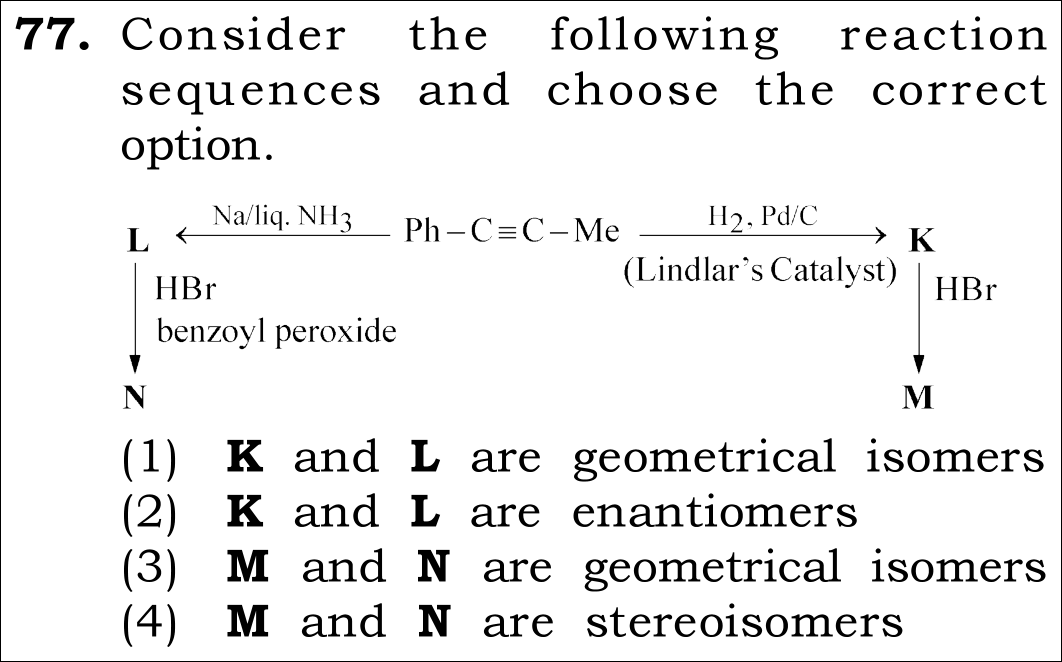
Consider the following reaction sequences and choose the correct option. Ph−C≡C−Me → (Na/liq. NH₃) L → (HBr, benzoyl peroxide) N; Ph−C≡C−Me → (H₂, Pd/C, Lindlar's Catalyst) K → (HBr) M
Dynamic 180-question full-length simulator mixed dynamically from all 6 years for 2027 & 2026 aspirants.
Consider the following reaction sequences and choose the correct option. Ph−C≡C−Me → (Na/liq. NH₃) L → (HBr, benzoyl peroxide) N; Ph−C≡C−Me → (H₂, Pd/C, Lindlar's Catalyst) K → (HBr) M
Catalytic Lindlar = cis-alkene (K); Dissolving metal Na/NH₃ = trans-alkene (L)!
Reaction of 1-phenylprop-1-yne with molecular hydrogen over deactivated palladium (Lindlar's catalyst, Pd/CaCO₃ or Pd/C poisoned with lead salts or quinoline) results in stereoselective syn-addition of hydrogen across the triple bond to form the (Z) or cis-alkene.
Reduction of an alkyne with sodium in liquid ammonia proceeds via sequential single-electron transfer and protonation through a radical anion. The radical anion adopts the more thermodynamically stable trans-configuration to minimize steric repulsion between the phenyl and methyl groups, yielding the (E) or trans-alkene.
Both K and L share identical molecular formulas and identical atom connectivity, but differ in the spatial orientation of groups around the carbon-carbon double bond (cis vs trans). Therefore, K and L are geometrical isomers (cis-trans diastereomers).
Diagnose every choice: Know exactly why the right option works and why distractors fail.
Flawless organic classification: K is cis-1-phenylpropene and L is trans-1-phenylpropene.
Incorrect. Geometrical isomers are non-mirror-image diastereomers, not non-superimposable mirror images (enantiomers).
Incorrect. M and N are saturated haloalkanes (following HBr addition) which do not exhibit geometrical isomerism.
Incorrect. Addition of HBr to cis-alkene and HBr/peroxide to trans-alkene yields different structural regioisomers (Markovnikov vs anti-Markovnikov adducts: Ph-CH(Br)-CH₂-Me vs Ph-CH₂-CH(Br)-Me), making them constitutional isomers, not stereoisomers.
Students spend minutes working out the complex regiochemistry of HBr vs HBr/peroxide on K and L to evaluate M and N. Option 1 tests K and L directly, which is solved in 5 seconds!
"Lindlar's catalyst yields cis-alkenes; Birch reduction yields trans-alkenes."
Test your speed and accuracy in the authentic 180-minute timed NTA simulator.
Spotted a mistake in this solution? Report an error (support@mycompetitiveexams.com)
Cover all 1,140 official NEET questions in 285 days at your own pace. Progress is saved on your device. No login needed.