MyCompetitiveExams Logo MyCompetitiveExams
Search 1,140+ Questions
Chapters, formulas, speed tricks
→
⚡ Brahmastra NEET 2027
720 MARKS

Dynamic 180-question full-length simulator mixed dynamically from all 6 years for 2027 & 2026 aspirants.

Launch Brahmastra 2027 Test →
Start Practice →
100% Free · No Login Required
Q.189 Zoology ⭐ 360° Option Elimination Active
Vault ↗

NEET 2021 Zoology Question 189 Solution

Topic: Human Reproduction · Official NTA Booklet Code M1
NEET 2021 Zoology Question 189: Neuroendocrine Mechanism of Parturition vs Lactation Induction

Question

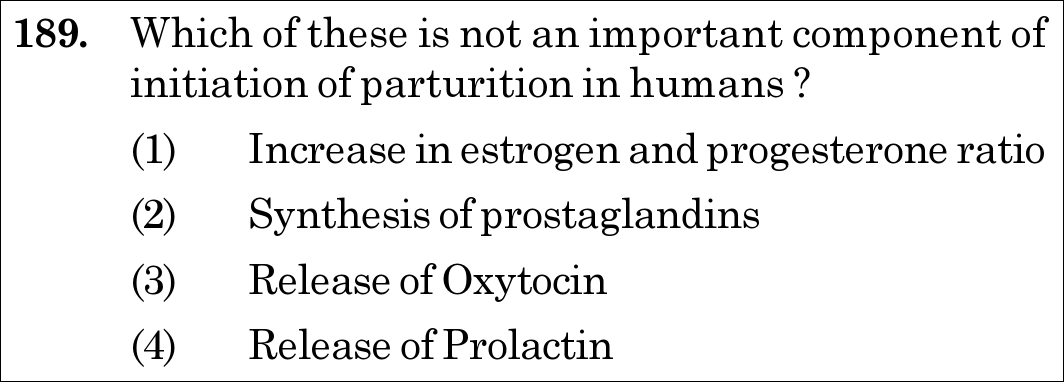
Which of these is not an important component of initiation of parturition in humans?

  1. (1)Increase in estrogen and progesterone ratio
  2. (2)Synthesis of prostaglandins
  3. (3)Release of Oxytocin
  4. (4)Release of Prolactin
✓
Verified Against NTA Final Answer Key
Option (4) : Release of Prolactin
📚 Human Reproduction Medium
📋 Given Parameters & Problem Setup
Physiological Process Initiation of Parturition (Childbirth / Labor)
Question Objective Identify the factor that is NOT an important component of parturition initiation
⚡

The 30-Second Exam Hall Shortcut: ⚡ "Prolactin is for LACTATION (Milk Synthesis), NOT Parturition (Labor)!"

⏱️ Save ~25 seconds

Parturition (labor) is triggered by the foetal ejection reflex, oxytocin, prostaglandins, and an increased estrogen/progesterone ratio. Prolactin acts AFTER delivery to stimulate milk synthesis by mammary alveoli for lactation. Prolactin plays NO role in initiating parturition! Select Option (4).

1 Separate childbirth (parturition) from nursing (lactation).
2 Parturition triggers: Oxytocin (uterine contractions), Prostaglandins (myometrial contraction & cervical softening), Estrogen/Progesterone ratio shift (upregulates oxytocin receptors).
3 Prolactin function: Synthesizes milk in mammary glands AFTER delivery (lactation).
4 Option (4) is not a component of initiating parturition.
🛡️
Why You Can 100% Trust This Shortcut: NCERT Biology · Human Reproduction (Parturition and Lactation: Parturition is induced by a complex neuroendocrine mechanism involving oxytocin, prostaglandins, and maternal hormones. Mammary glands produce milk towards the end of pregnancy by the process called lactation, mediated by prolactin).
📐

Step-by-Step Rigorous Workflow & Mathematical Proof

Step 1

Neuroendocrine Induction of Human Parturition

Parturition (the process of delivering the foetus through labor) is governed by an integrated neuroendocrine mechanism known as the foetal ejection reflex: - Signals for parturition originate from the fully developed foetus and placenta, inducing mild uterine contractions. - (1) Estrogen-to-Progesterone Ratio: In late pregnancy, placental estrogen synthesis rises while local progesterone dominance declines. This high estrogen/progesterone ratio upregulates oxytocin receptors on myometrial smooth muscle cells and promotes gap junction formation between myocytes. - (3) Oxytocin Release: Maternal posterior pituitary secretes oxytocin, which acts directly on the myometrium to cause vigorous contractions. - (2) Prostaglandin Synthesis: Uterine decidua and fetal membranes synthesize prostaglandins (PGF2αPGF_{2\alpha} and PGE2PGE_2), which further amplify uterine contractions and soften/dilate the cervix in a positive feedback loop (Ferguson reflex).

Step 2

Physiological Action of Prolactin

Prolactin (PRL) is an anterior pituitary peptide hormone that stimulates the differentiation of mammary alveolar epithelium and drives milk synthesis during the puerperium (lactation). During pregnancy, high circulating levels of placental steroids (estrogen and progesterone) block the lactogenic action of prolactin on the breasts. Following parturition and placental expulsion, steroid levels plummet, disinhibiting prolactin to initiate copious milk production. Prolactin has zero stimulatory effect on myometrial contraction or labor initiation.

⭐

360° Option Elimination Engine Key Feature

Diagnose every choice: Know exactly why the right option works and why distractors fail.

4-Option Deep Scan
1 1
✗ Incorrect
Verdict & Scientific Reason:

Incorrect. An increased estrogen-to-progesterone ratio is critical for increasing uterine excitability and oxytocin receptor expression.

⚠️
Student Fallacy (Why candidates pick this trap): Believing progesterone remains dominant during labor, unaware that functional progesterone withdrawal initiates labor.
2 2
✗ Incorrect
Verdict & Scientific Reason:

Incorrect. Prostaglandins are potent myometrial contractors and cervical ripeners directly involved in parturition.

⚠️
Student Fallacy (Why candidates pick this trap): Failing to realize that prostaglandins act synergistically with oxytocin.
3 3
✗ Incorrect
Verdict & Scientific Reason:

Incorrect. Oxytocin is the primary hormone driving strong labor contractions (foetal ejection reflex).

⚠️
Student Fallacy (Why candidates pick this trap): Denying the central role of the classic "birth hormone".
4 4
✓ 100% Correct
Verdict & Scientific Reason:

Correct as the non-component. Prolactin regulates milk synthesis (lactation), playing no role in the initiation of uterine labor contractions.

💡
Why this is airtight: None. Candidate distinguishes labor hormones from milk production hormones.
⚠️

NTA Trap Alert: Oxytocin (Birth & Ejection) vs Prolactin (Synthesis) Trap

Students frequently mix up oxytocin and prolactin. Oxytocin acts in BOTH parturition (labor contractions) and lactation (milk ejection / let-down). Prolactin acts ONLY in lactation (milk synthesis), never in parturition.

🛡️ How to avoid the -1 mark: Remember: Oxytocin pushes the baby OUT; Prolactin makes milk inside mammary glands.
📖

Core NEET Syllabus Standard

NEET / NCERT Biology · Human Reproduction Standard Benchmark
Core Scientific Principle Tested:

"Parturition is triggered by oxytocin, prostaglandins, and estrogen/progesterone shifts; prolactin regulates milk synthesis during lactation."

Syllabus Focus: Parturition and Lactation
✓ Core NEET UG Syllabus Anchor Syllabus & Academic Standards ↗

Ready to attempt under real exam pressure?

Test your speed and accuracy in the authentic 200-minute timed NTA simulator.

Launch NEET 2021 CBT Test →

Spotted a mistake in this solution? Report an error (support@mycompetitiveexams.com)

⚖️ Legal & Fair Dealing Notice: Sourced from publicly released NEET 2021 question papers and NEET answer keys for private study, research, and non-commercial educational practice under Fair Dealing (Section 52(1)(a) of the Indian Copyright Act, 1957). Not affiliated with or endorsed by NTA or NMC.

Solve 4 NEET Questions a Day — One per Subject

Cover all 1,140 official NEET questions in 285 days at your own pace. Progress is saved on your device. No login needed.