The 30-Second Exam Hall Shortcut: ⚡ The Even/Odd Rule for Trailing 5
When dropping a 5 followed by nothing: Even stays Even, Odd rounds Up!
Step-by-Step Rigorous Workflow & Mathematical Proof
Review the Fundamental Scientific Rounding Rules
In scientific calculations, bias in rounding is avoided using the round-half-to-even rule: 1. If the digit to be dropped is greater than 5, the preceding digit is increased by 1. 2. If the digit to be dropped is less than 5, the preceding digit is left unchanged. 3. If the digit to be dropped is 5 (not followed by non-zero digits): if the preceding digit is EVEN, it remains unchanged; if the preceding digit is ODD, it is increased by 1 to make it even.
- • Ensures statistical symmetry without systematic positive or negative bias.
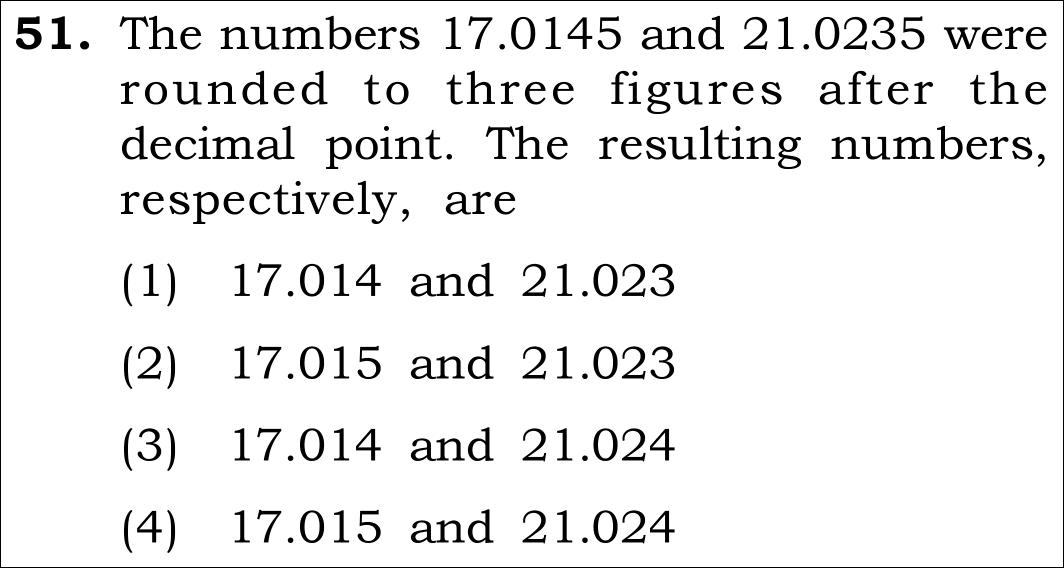
Round the First Number: 17.0145
We require 3 figures after the decimal point: 17.014[5]. The digit to be dropped is 5. The preceding digit is 4, which is an EVEN number. Therefore, according to the rule, 4 remains unchanged.
- • First rounded value: 17.014.
Round the Second Number: 21.0235
We require 3 figures after the decimal point: 21.023[5]. The digit to be dropped is 5. The preceding digit is 3, which is an ODD number. Therefore, according to the rule, 3 is increased by 1 to become 4.
- • Second rounded value: 21.024.
- • Resulting pair: 17.014 and 21.024 (Option 3).
360° Option Elimination Engine Key Feature
Diagnose every choice: Know exactly why the right option works and why distractors fail.
Incorrect. Truncated both numbers without rounding up the odd digit 3.
Incorrect. Inverted the rule by rounding up the even digit and keeping the odd digit unchanged.
Exact application of NCERT rounding rules: 4 is even so it stays 4; 3 is odd so it rounds up to 4.
Incorrect. Rounded up both numbers as if following elementary school rule (always round up on 5).
NTA Trap Alert: Applying Elementary School Rounding Instead of Scientific Rounding
Elementary school teaches students to always round 5 up to the next digit. In scientific chemistry and physics, this creates a positive bias, so the even/odd rule must be strictly applied.
Core NEET Syllabus Standard
"When the terminal digit is 5, the preceding digit is rounded up if odd, and retained if even."