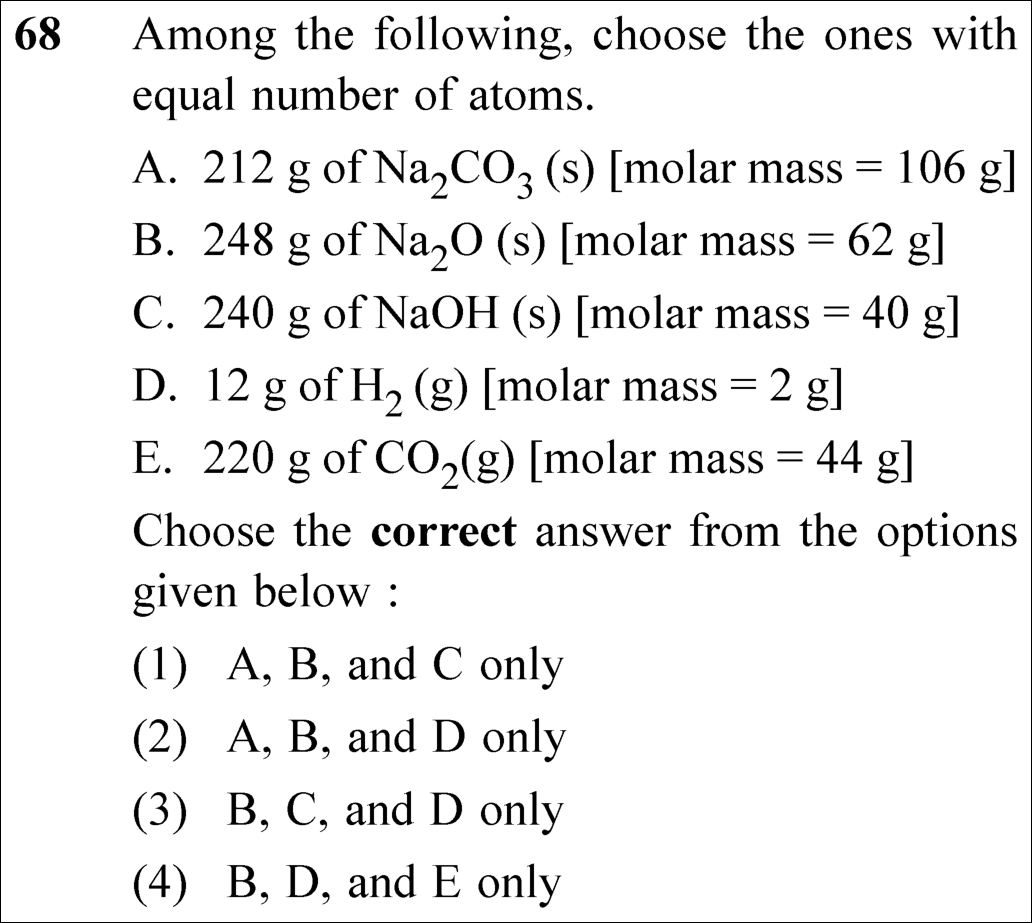
📋 Given Parameters & Problem Setup
Substance A 212 g of Na₂CO₃(s) [molar mass = 106 g]
Substance B 248 g of Na₂O(s) [molar mass = 62 g]
Substance C 240 g of NaOH(s) [molar mass = 40 g]
Substance D 12 g of H₂(g) [molar mass = 2 g]
Substance E 220 g of CO₂(g) [molar mass = 44 g]
Calculate (Mass / Molar Mass) × Atoms per molecule: A = (212/106) × 6 = 12 N_A. B = (248/62) × 3 = 12 N_A. C = (240/40) × 3 = 18 N_A. D = (12/2) × 2 = 12 N_A. E = (220/44) × 3 = 15 N_A! A, B, and D all equal 12 N_A!
1 A (Na₂CO₃): n = 212 / 106 = 2 moles. Atomicity = 2(Na) + 1(C) + 3(O) = 6. Total atoms = 2 × 6 = 12 N_A.
2 B (Na₂O): n = 248 / 62 = 4 moles. Atomicity = 2(Na) + 1(O) = 3. Total atoms = 4 × 3 = 12 N_A.
3 C (NaOH): n = 240 / 40 = 6 moles. Atomicity = 1(Na) + 1(O) + 1(H) = 3. Total atoms = 6 × 3 = 18 N_A.
4 D (H₂): n = 12 / 2 = 6 moles. Atomicity = 2(H) = 2. Total atoms = 6 × 2 = 12 N_A.
5 E (CO₂): n = 220 / 44 = 5 moles. Atomicity = 1(C) + 2(O) = 3. Total atoms = 5 × 3 = 15 N_A.
6 Equal atom count: A, B, and D all have exactly 12 moles of atoms (12 N_A)!
7 Match Option (2) in under 20 seconds!
🛡️ Why You Can 100% Trust This Shortcut: Mole Concept and Stoichiometric Calculations (NCERT Chemistry · Some Basic Concepts of Chemistry).
⚠️
Candidates sometimes only compute moles of the molecule (A = 2, B = 4, C = 6, D = 6, E = 5) and erroneously conclude that C and D are equal! The question explicitly asks for the NUMBER OF ATOMS, requiring multiplication by atomicity!
🛡️ How to avoid the -1 mark: Always underline "NUMBER OF ATOMS" and multiply by the formula unit atom count!
📖
NEET Chemistry Core Syllabus · Some Basic Concepts of Chemistry Standard Benchmark
Core Scientific Principle Tested:
"Number of atoms = (mass / molar mass) × atomicity × N_A."
Syllabus Focus: Mole Concept and Atomic Stoichiometry
Multiply by atoms in formula: A=12, B=12, D=12 ⟹ A, B, and D only!