MyCompetitiveExams Logo MyCompetitiveExams
Search 1,140+ Questions
Chapters, formulas, speed tricks
→
⚡ Brahmastra NEET 2027
720 MARKS

Dynamic 180-question full-length simulator mixed dynamically from all 6 years for 2027 & 2026 aspirants.

Launch Brahmastra 2027 Test →
Start Practice →
100% Free · No Login Required
Q.51 Chemistry ⭐ 360° Option Elimination Active
Vault ↗

NEET 2026 Chemistry Question 51 Solution

Topic: Some Basic Concepts of Chemistry · Official NTA Booklet Code 50
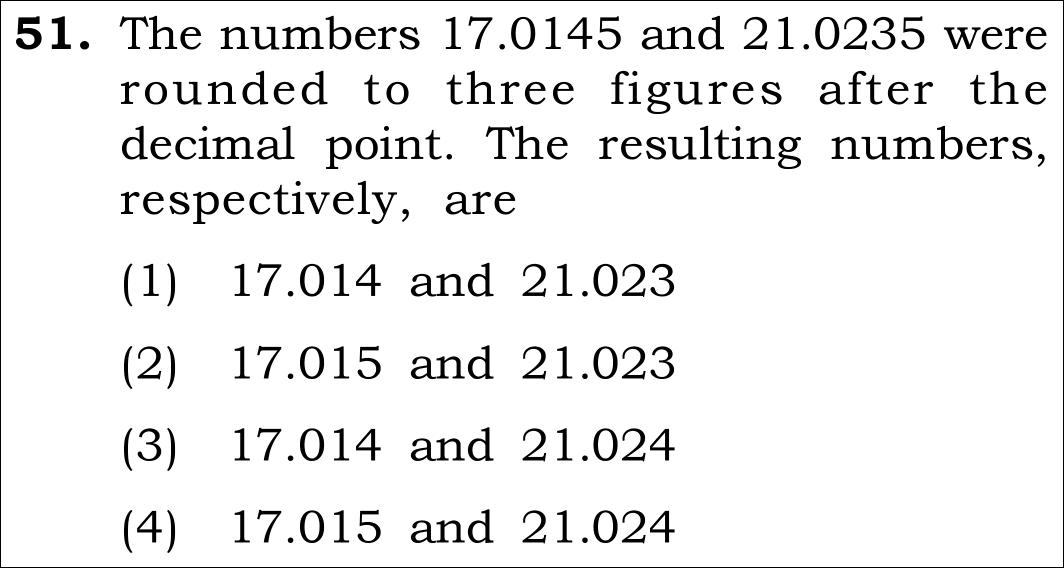
NEET 2026 Chemistry Question 51: Scientific Rounding-Off Rules for Dropped Digit 5

Question

The numbers 17.0145 and 21.0235 were rounded to three figures after the decimal point. The resulting numbers, respectively, are

  1. (1)17.014 and 21.023
  2. (2)17.015 and 21.023
  3. (3)17.014 and 21.024
  4. (4)17.015 and 21.024
✓
Verified Against NTA Final Answer Key
Option (3) : 17.014 and 21.024
📚 Some Basic Concepts of Chemistry Easy
📋 Given Parameters & Problem Setup
Number 1 17.0145
Number 2 21.0235
Requirement Round off each number to three figures after the decimal point (3 decimal places)
⚡

The 30-Second Exam Hall Shortcut: ⚡ The Even/Odd Rule for Trailing 5

⏱️ Save ~40 seconds

When dropping a 5 followed by nothing: Even stays Even, Odd rounds Up!

1 For 17.0145: Keep 3 decimal digits (17.014). The digit to drop is 5. The preceding digit is 4 (EVEN). It remains unchanged -> 17.014!
2 For 21.0235: Keep 3 decimal digits (21.023). The digit to drop is 5. The preceding digit is 3 (ODD). It is increased by 1 -> 21.024!
3 Resulting pair: 17.014 and 21.024. Done in 10 seconds!
🛡️
Why You Can 100% Trust This Shortcut: Canonical IUPAC / NCERT rule of significant figures: If the rightmost digit to be removed is a 5 followed by zeros (or nothing), the preceding number is not changed if it is even, and increased by one if it is odd.
📐

Step-by-Step Rigorous Workflow & Mathematical Proof

Step 1

Review the Fundamental Scientific Rounding Rules

In scientific calculations, bias in rounding is avoided using the round-half-to-even rule: 1. If the digit to be dropped is greater than 5, the preceding digit is increased by 1. 2. If the digit to be dropped is less than 5, the preceding digit is left unchanged. 3. If the digit to be dropped is 5 (not followed by non-zero digits): if the preceding digit is EVEN, it remains unchanged; if the preceding digit is ODD, it is increased by 1 to make it even.

Preceding digit={Unchangedif EVEN+1if ODD\text{Preceding digit} = \begin{cases} \text{Unchanged} & \text{if EVEN} \\ +1 & \text{if ODD} \end{cases}
  • • Ensures statistical symmetry without systematic positive or negative bias.
Step 2

Round the First Number: 17.0145

We require 3 figures after the decimal point: 17.014[5]. The digit to be dropped is 5. The preceding digit is 4, which is an EVEN number. Therefore, according to the rule, 4 remains unchanged.

17.0145→drop 5, preceding digit 4 is EVEN17.01417.0145 \xrightarrow{\text{drop 5, preceding digit 4 is EVEN}} 17.014
  • • First rounded value: 17.014.
Step 3

Round the Second Number: 21.0235

We require 3 figures after the decimal point: 21.023[5]. The digit to be dropped is 5. The preceding digit is 3, which is an ODD number. Therefore, according to the rule, 3 is increased by 1 to become 4.

21.0235→drop 5, preceding digit 3 is ODD21.02421.0235 \xrightarrow{\text{drop 5, preceding digit 3 is ODD}} 21.024
  • • Second rounded value: 21.024.
  • • Resulting pair: 17.014 and 21.024 (Option 3).
⭐

360° Option Elimination Engine Key Feature

Diagnose every choice: Know exactly why the right option works and why distractors fail.

4-Option Deep Scan
1 A
✗ Incorrect
Verdict & Scientific Reason:

Incorrect. Truncated both numbers without rounding up the odd digit 3.

⚠️
Student Fallacy (Why candidates pick this trap): Simple truncation rather than scientific rounding.
2 B
✗ Incorrect
Verdict & Scientific Reason:

Incorrect. Inverted the rule by rounding up the even digit and keeping the odd digit unchanged.

⚠️
Student Fallacy (Why candidates pick this trap): Applying the even/odd rule backwards.
3 C
✓ 100% Correct
Verdict & Scientific Reason:

Exact application of NCERT rounding rules: 4 is even so it stays 4; 3 is odd so it rounds up to 4.

💡
Why this is airtight: None; perfectly compliant with official convention.
4 D
✗ Incorrect
Verdict & Scientific Reason:

Incorrect. Rounded up both numbers as if following elementary school rule (always round up on 5).

⚠️
Student Fallacy (Why candidates pick this trap): Using naive school math rounding instead of scientific rounding.
⚠️

NTA Trap Alert: Applying Elementary School Rounding Instead of Scientific Rounding

Elementary school teaches students to always round 5 up to the next digit. In scientific chemistry and physics, this creates a positive bias, so the even/odd rule must be strictly applied.

🛡️ How to avoid the -1 mark: Remember: 5 leaves EVEN digits alone; 5 pushes ODD digits up to make them even!
📖

Core NEET Syllabus Standard

NEET Chemistry Core Syllabus · Some Basic Concepts of Chemistry Standard Benchmark
Core Scientific Principle Tested:

"When the terminal digit is 5, the preceding digit is rounded up if odd, and retained if even."

Syllabus Focus: Rules for rounding off significant figures
✓ Core NEET UG Syllabus Anchor Syllabus & Academic Standards ↗
Even stays Even; Odd steps Up!

Ready to attempt under real exam pressure?

Test your speed and accuracy in the authentic 180-minute timed NTA simulator.

Launch NEET 2026 CBT Test →

Spotted a mistake in this solution? Report an error (support@mycompetitiveexams.com)

⚖️ Legal & Fair Dealing Notice: Sourced from publicly released NEET 2026 question papers and NEET answer keys for private study, research, and non-commercial educational practice under Fair Dealing (Section 52(1)(a) of the Indian Copyright Act, 1957). Not affiliated with or endorsed by NTA or NMC.

Solve 4 NEET Questions a Day — One per Subject

Cover all 1,140 official NEET questions in 285 days at your own pace. Progress is saved on your device. No login needed.