MyCompetitiveExams Logo MyCompetitiveExams
Search 1,140+ Questions
Chapters, formulas, speed tricks
→
⚡ Brahmastra NEET 2027
720 MARKS

Dynamic 180-question full-length simulator mixed dynamically from all 6 years for 2027 & 2026 aspirants.

Launch Brahmastra 2027 Test →
Start Practice →
100% Free · No Login Required
Q.63 Chemistry ⭐ 360° Option Elimination Active
Vault ↗

NEET 2026 Chemistry Question 63 Solution

Topic: Some Basic Concepts of Chemistry · Official NTA Booklet Code 50
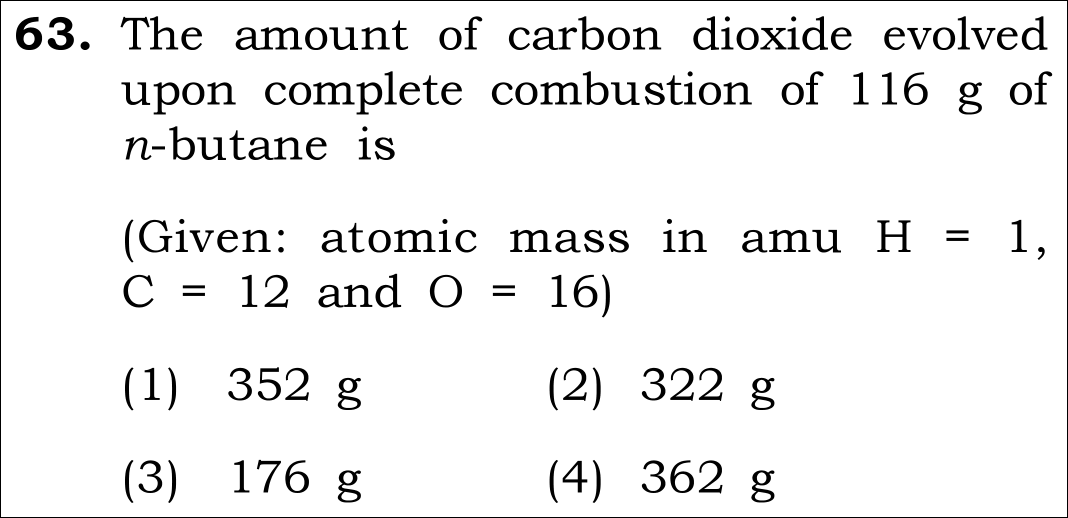
NEET 2026 Chemistry Question 63: Mass of Carbon Dioxide Evolved from Alkane Combustion

Question

The amount of carbon dioxide evolved upon complete combustion of 116 g of n-butane is (Given: atomic mass in amu H = 1, C = 12 and O = 16)

✓
Verified Against NTA Final Answer Key
Option (1) : 352 g
📚 Some Basic Concepts of Chemistry Easy
📋 Given Parameters & Problem Setup
Reactant n-butane (C₄H₁₀)
Mass of n-butane 116 g
Atomic Masses H = 1, C = 12, O = 16 amu
Target Mass of CO₂ evolved upon complete combustion
⚡

The 30-Second Exam Hall Shortcut: ⚡ Mole-Ratio Direct Multiplier

⏱️ Save ~50 seconds

Molar mass of butane is 58 g/mol -> 116 g is exactly 2 moles of butane!

1 Molar mass of C₄H₁₀ = (4 × 12) + (10 × 1) = 58 g/mol.
2 Moles of butane = 116 g / 58 g/mol = 2.0 moles.
3 Each butane molecule has 4 carbon atoms, producing 4 CO₂ molecules: Moles of CO₂ = 2 × 4 = 8 moles.
4 Molar mass of CO₂ = 12 + (2 × 16) = 44 g/mol.
5 Mass of CO₂ = 8 moles × 44 g/mol = 352 g!
6 Option (1) selected in 15 seconds!
🛡️
Why You Can 100% Trust This Shortcut: Law of conservation of mass: All carbon in the hydrocarbon quantitatively converts to CO₂ upon complete combustion.
📐

Step-by-Step Rigorous Workflow & Mathematical Proof

Step 1

Write the Balanced Chemical Equation for Combustion

Complete combustion of an alkane (C_n H_{2n+2}) with excess oxygen yields carbon dioxide and water vapor.

C4H10+132O2⟶4CO2+5H2O\text{C}_4\text{H}_{10} + \frac{13}{2}\text{O}_2 \longrightarrow 4\text{CO}_2 + 5\text{H}_2\text{O}
  • • 1 mole of n-butane produces 4 moles of CO₂.
Step 2

Calculate Moles of n-butane Burned

Determine the molecular mass of n-butane and calculate the number of moles in 116 g.

M(C4H10)=4(12)+10(1)=58 g mol−1M(\text{C}_4\text{H}_{10}) = 4(12) + 10(1) = 58\text{ g mol}^{-1}
  • • n(butane) = 116 g / 58 g mol⁻¹ = 2.0 mol.
Step 3

Calculate Mass of CO₂ Formed

Using stoichiometry, 2.0 moles of butane produce 8.0 moles of CO₂.

n(CO2)=2.0×4=8.0 moln(\text{CO}_2) = 2.0 \times 4 = 8.0\text{ mol}
  • • M(CO₂) = 12 + 2(16) = 44 g mol⁻¹.
  • • Mass of CO₂ = 8.0 mol × 44 g mol⁻¹ = 352 g.
  • • Matches Option (1).
⭐

360° Option Elimination Engine Key Feature

Diagnose every choice: Know exactly why the right option works and why distractors fail.

4-Option Deep Scan
1 A
✓ 100% Correct
Verdict & Scientific Reason:

Stoichiometrically exact: 2 moles of butane yield 8 moles of CO₂ = 352 g.

💡
Why this is airtight: None; standard stoichiometric execution.
2 B
✗ Incorrect
Verdict & Scientific Reason:

Incorrect. Arithmetic miscalculation.

⚠️
Student Fallacy (Why candidates pick this trap): Multiplication error when computing 8 × 44.
3 C
✗ Incorrect
Verdict & Scientific Reason:

Incorrect. Corresponds to 1 mole of butane instead of 2 moles: 4 × 44 = 176 g.

⚠️
Student Fallacy (Why candidates pick this trap): Forgetting to multiply by 2 moles of butane.
4 D
✗ Incorrect
Verdict & Scientific Reason:

Incorrect. Distractor value.

⚠️
Student Fallacy (Why candidates pick this trap): Using incorrect atomic weight for carbon or hydrogen.
⚠️

NTA Trap Alert: Calculating for 1 Mole Instead of the Given 116 g

Students frequently compute 4 × 44 = 176 g (Option 3) for 1 mole of butane and forget that 116 g contains TWO moles of butane.

🛡️ How to avoid the -1 mark: Always convert given mass to moles FIRST before applying mole ratios.
📖

Core NEET Syllabus Standard

NEET Chemistry Core Syllabus · Some Basic Concepts of Chemistry Standard Benchmark
Core Scientific Principle Tested:

"Each mole of C_n H_{2n+2} produces n moles of CO₂ upon complete combustion."

Syllabus Focus: Stoichiometric calculations and combustion reactions
✓ Core NEET UG Syllabus Anchor Syllabus & Academic Standards ↗
116 g is 2 moles of butane; 2 × 4 = 8 moles of CO₂; 8 × 44 = 352 g!

Ready to attempt under real exam pressure?

Test your speed and accuracy in the authentic 180-minute timed NTA simulator.

Launch NEET 2026 CBT Test →

Spotted a mistake in this solution? Report an error (support@mycompetitiveexams.com)

⚖️ Legal & Fair Dealing Notice: Sourced from publicly released NEET 2026 question papers and NEET answer keys for private study, research, and non-commercial educational practice under Fair Dealing (Section 52(1)(a) of the Indian Copyright Act, 1957). Not affiliated with or endorsed by NTA or NMC.

Solve 4 NEET Questions a Day — One per Subject

Cover all 1,140 official NEET questions in 285 days at your own pace. Progress is saved on your device. No login needed.