The 30-Second Exam Hall Shortcut: ⚡ STI Elimination Hack
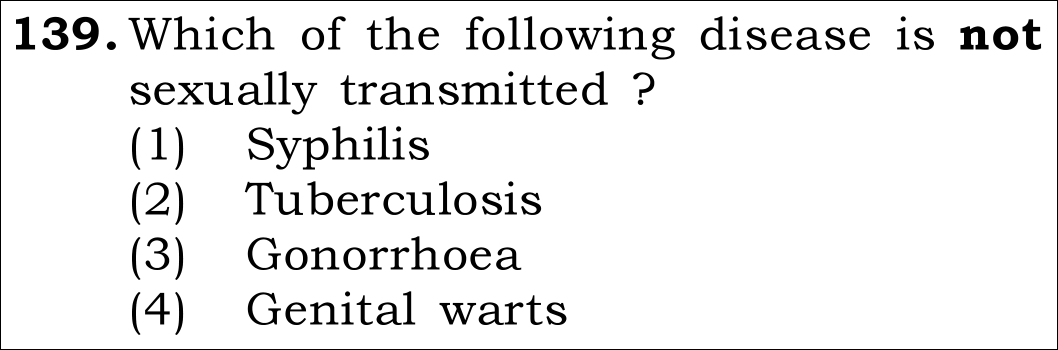
Tuberculosis is an Airborne Lung Infection (Droplet Transmission), NOT an STI!
Step-by-Step Rigorous Workflow & Mathematical Proof
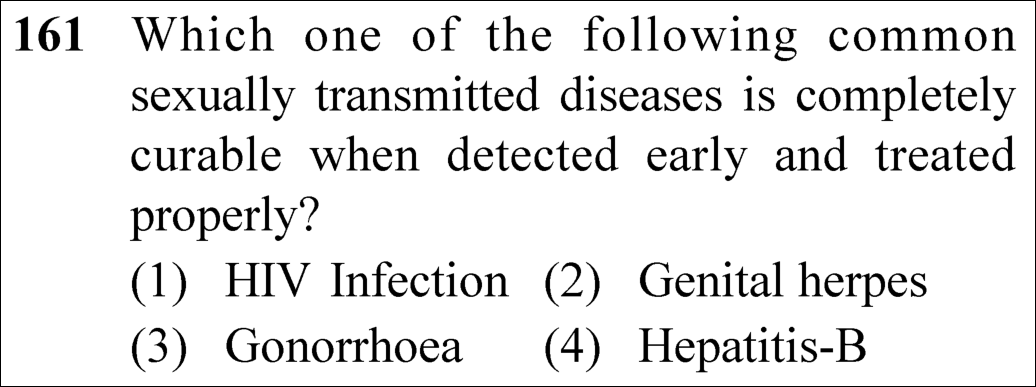
Definition and Catalog of Sexually Transmitted Infections
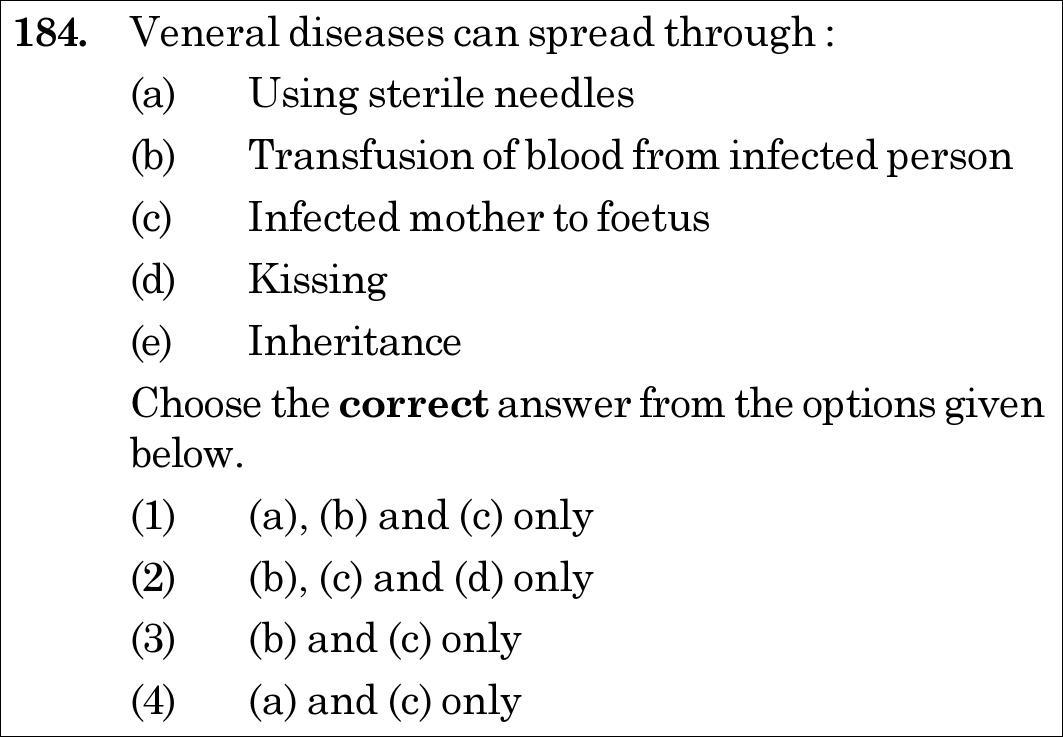
Infections or diseases that are transmitted through sexual intercourse are collectively termed Sexually Transmitted Infections (STIs) or Venereal Diseases (VD).
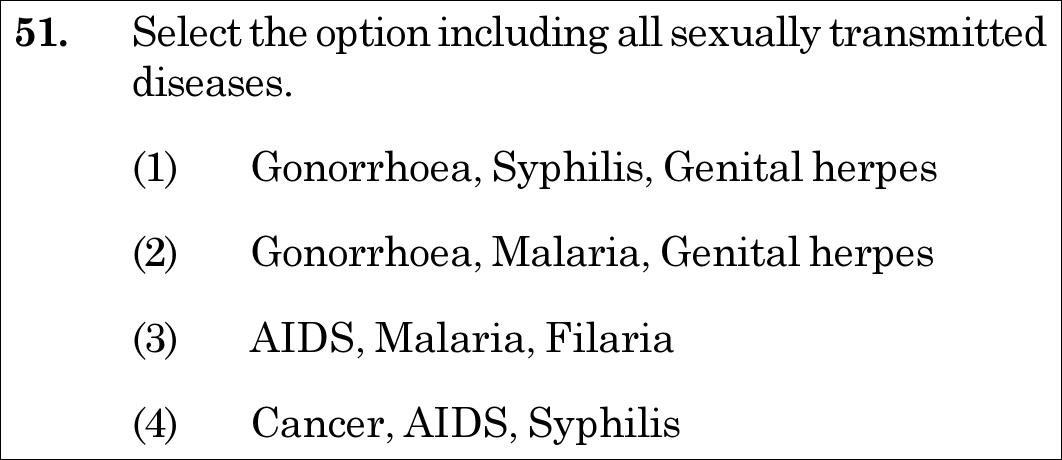
- • Options (1), (3), and (4) are all standard canonical STIs.
Transmission Mode of Tuberculosis
Tuberculosis (TB) is an infectious bacterial disease caused by Mycobacterium tuberculosis. It primarily attacks the pulmonary parenchyma and is transmitted through aerosols and airborne droplet nuclei released during coughing, sneezing, or spitting by an infected person.
- • It is not categorized as an STI.
Conclusion
Among the listed options, Tuberculosis is not a sexually transmitted disease.
- • Matches official NTA final answer key Option B / (2).
360° Option Elimination Engine Key Feature
Diagnose every choice: Know exactly why the right option works and why distractors fail.
Incorrect. Syphilis is a canonical bacterial STI caused by Treponema pallidum.
100% accurate. Tuberculosis is an airborne respiratory infection spread via droplet nuclei, not sexual contact.
Incorrect. Gonorrhoea is a major bacterial STI caused by Neisseria gonorrhoeae.
Incorrect. Genital warts are a viral STI caused by low-risk types of HPV.
NTA Trap Alert: Hepatitis B & HIV Transmission Confusion
While Hepatitis-B and HIV can also be transmitted via blood transfusion or needles, they ARE sexually transmitted. Tuberculosis, however, has zero sexual transmission etiology.
Core NEET Syllabus Standard
"STIs encompass gonorrhoea, syphilis, genital herpes, chlamydiasis, genital warts, trichomoniasis, hepatitis-B, and HIV. Tuberculosis is an airborne pulmonary disease."