MyCompetitiveExams Logo MyCompetitiveExams
Search 1,140+ Questions
Chapters, formulas, speed tricks
→
⚡ Brahmastra NEET 2027
720 MARKS

Dynamic 180-question full-length simulator mixed dynamically from all 6 years for 2027 & 2026 aspirants.

Launch Brahmastra 2027 Test →
Start Practice →
100% Free · No Login Required
Q.93 Botany ⭐ 360° Option Elimination Active
Vault ↗

NEET 2025 Botany Question 93 Solution

Topic: Reproductive Health · Official NTA Booklet Code 45
NEET 2025 Botany Question 93: Potential Drawbacks, Limitations and Ethical Concerns of IVF Adoption

Question

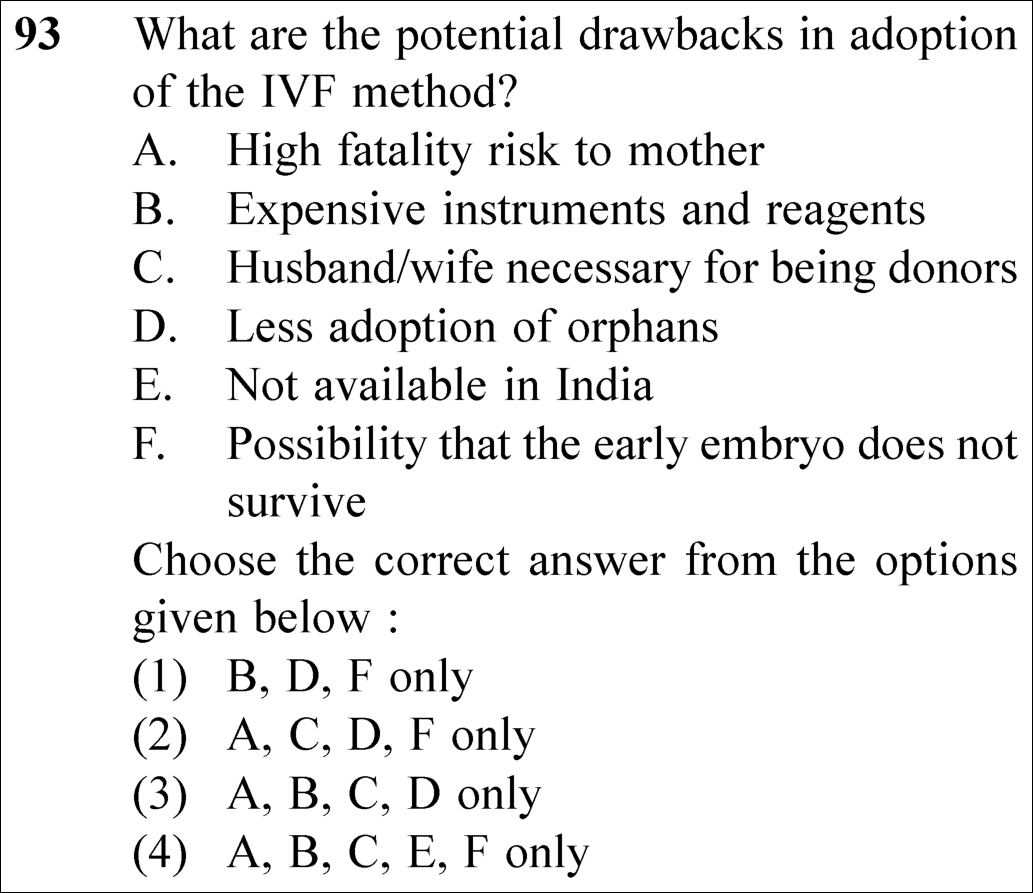
What are the potential drawbacks in adoption of the IVF method? A. High fatality risk to mother B. Expensive instruments and reagents C. Husband/wife necessary for being donors D. Less adoption of orphans E. Not available in India F. Possibility that the early embryo does not survive Choose the correct answer from the options given below:

  1. (1)B, D, F only
  2. (2)A, C, D, F only
  3. (3)A, B, C, D only
  4. (4)A, B, C, E, F only
✓
Verified Against NTA Final Answer Key
Option (1) : B, D, F only
📚 Reproductive Health Easy
📋 Given Parameters & Problem Setup
Statement A High fatality risk to mother (Incorrect, IVF has low maternal mortality)
Statement B Expensive instruments and reagents (Genuine economic drawback)
Statement C Husband/wife necessary for being donors (Incorrect, third-party donors are permitted)
Statement D Less adoption of orphans (Genuine socio-ethical consequence)
Statement E Not available in India (Incorrect, widely available across India)
Statement F Possibility that the early embryo does not survive (Genuine biological limitation)
⚡

The 30-Second Exam Hall Shortcut: ⚡ NCERT IVF Limitations Eliminator

⏱️ Save ~40 seconds

Is IVF available in India? YES (E is FALSE)! Is fatality risk to mother high? NO (A is FALSE)! Are husband/wife strictly necessary as donors? NO, donor gametes exist (C is FALSE)! Eliminating A, C, E leaves B, D, F only (Option 1)!

1 Examine Statement A: IVF does not carry a high fatality risk for the mother ⟹ A is FALSE. Discard options (2), (3), and (4) immediately!
2 This single elimination leaves Option (1) as the only possible answer!
3 Verify Statement B: IVF requires specialized high-precision instruments, sterile clean-rooms, and expensive culture reagents, making it unaffordable to many (TRUE).
4 Verify Statement D: Preoccupation with having biological children through expensive IVF discourages adoption of orphaned and abandoned children (NCERT socio-ethical point, TRUE).
5 Verify Statement F: Implantation rates per transferred embryo are limited; many early embryos fail to survive or develop (TRUE).
6 Select Option (1) in under 10 seconds!
🛡️
Why You Can 100% Trust This Shortcut: Assisted Reproductive Technologies (NCERT Biology · Reproductive Health: ZIFT vs IUT blastomere thresholds).
📐

Step-by-Step Rigorous Workflow & Mathematical Proof

Step 1

Evaluate Statements on Medical and Legal Accessibility (A, C, E)

Examine common misconceptions regarding in vitro fertilization:

Statements A, C, E are scientifically and legally false\text{Statements A, C, E are scientifically and legally false}
  • • A is false: IVF is a routine clinical procedure and does not carry a high fatality risk for the mother.
  • • C is false: Heterologous ART utilizes donor sperm or donor ova when either partner produces non-viable gametes.
  • • E is false: India possesses numerous world-class IVF and ART clinics.
Step 2

Evaluate Genuine Limitations of IVF (B, D, F)

Review the canonical clinical and socio-ethical limitations highlighted in NCERT:

Drawbacks: B (Financial), D (Socio-ethical), F (Biological)\text{Drawbacks: B (Financial), D (Socio-ethical), F (Biological)}
  • • B (Expensive instruments and reagents): Requires extremely high precision, specialized handling, and expensive instrumentation; thus available only to a limited number of people.
  • • D (Less adoption of orphans): NCERT explicitly emphasizes that in India, thousands of orphaned and destitute children need care, and adoption is legally available, but obsession with ART reduces adoption rates.
  • • F (Early embryo non-survival): In vitro culture and blastocyst transfer have finite success rates, with a significant probability that the transferred embryo fails to implant or survive.
Step 3

Select Matching Option

Statements B, D, and F represent the authentic potential drawbacks:

B, D, F only  ⟹  Option (1)\text{B, D, F only} \implies \text{Option (1)}
  • • Matches Option (1) perfectly.
⭐

360° Option Elimination Engine Key Feature

Diagnose every choice: Know exactly why the right option works and why distractors fail.

4-Option Deep Scan
1 A
✓ 100% Correct
Verdict & Scientific Reason:

100% correct. High cost (B), orphan adoption neglect (D), and embryo non-survival (F) are genuine drawbacks.

💡
Why this is airtight: None; critical understanding of ART limitations.
2 B
✗ Incorrect
Verdict & Scientific Reason:

Incorrect. Contains A (high fatality risk) and C (husband/wife necessary donors), which are false.

⚠️
Student Fallacy (Why candidates pick this trap): Believing IVF causes maternal fatality.
3 C
✗ Incorrect
Verdict & Scientific Reason:

Incorrect. Contains false statements A and C.

⚠️
Student Fallacy (Why candidates pick this trap): Thinking third-party donors are not allowed.
4 D
✗ Incorrect
Verdict & Scientific Reason:

Incorrect. Contains E (claiming IVF is not available in India).

⚠️
Student Fallacy (Why candidates pick this trap): Believing IVF is banned or unavailable in India.
⚠️

NTA Trap Alert: Believing IVF Poses High Fatality to the Mother

Some candidates think invasive egg retrieval carries a high fatality risk. While ovarian hyperstimulation syndrome (OHSS) is a known minor complication, maternal mortality is extremely rare. Statement A is unequivocally false!

🛡️ How to avoid the -1 mark: Eliminate A immediately: IVF is not a fatal procedure!
📖

Core NEET Syllabus Standard

NEET Biology Core Syllabus · Reproductive Health Standard Benchmark
Core Scientific Principle Tested:

"ART requires expensive precision instruments, has limited embryo survival, and adoption remains a neglected alternative."

Syllabus Focus: Assisted Reproductive Technologies (ART) & Infertility
✓ Core NEET UG Syllabus Anchor Syllabus & Academic Standards ↗
No fatality (No A), yes available in India (No E), donors allowed (No C) ⟹ B, D, F only (Option 1)!

Ready to attempt under real exam pressure?

Test your speed and accuracy in the authentic 180-minute timed NTA simulator.

Launch NEET 2025 CBT Test →

Spotted a mistake in this solution? Report an error (support@mycompetitiveexams.com)

⚖️ Legal & Fair Dealing Notice: Sourced from publicly released NEET 2025 question papers and NEET answer keys for private study, research, and non-commercial educational practice under Fair Dealing (Section 52(1)(a) of the Indian Copyright Act, 1957). Not affiliated with or endorsed by NTA or NMC.

Solve 4 NEET Questions a Day — One per Subject

Cover all 1,140 official NEET questions in 285 days at your own pace. Progress is saved on your device. No login needed.