MyCompetitiveExams Logo MyCompetitiveExams
Search 1,140+ Questions
Chapters, formulas, speed tricks
→
⚡ Brahmastra NEET 2027
720 MARKS

Dynamic 180-question full-length simulator mixed dynamically from all 6 years for 2027 & 2026 aspirants.

Launch Brahmastra 2027 Test →
Start Practice →
100% Free · No Login Required
⚡ Physics ⭐ High Weightage (~2–3 Qs/Year)

NEET Oscillations Previous Year Questions with Solutions

Complete repository of official NTA NEET questions for Oscillations from 2020 to 2026. Every question includes 30-second elimination tricks, step-by-step NCERT solutions, option-by-option traps, and official answer keys.

10 Questions 6 Exam Years (2026, 2025, 2024, 2023, 2021, 2020) 7 Easy · 3 Medium · 0 Challenging
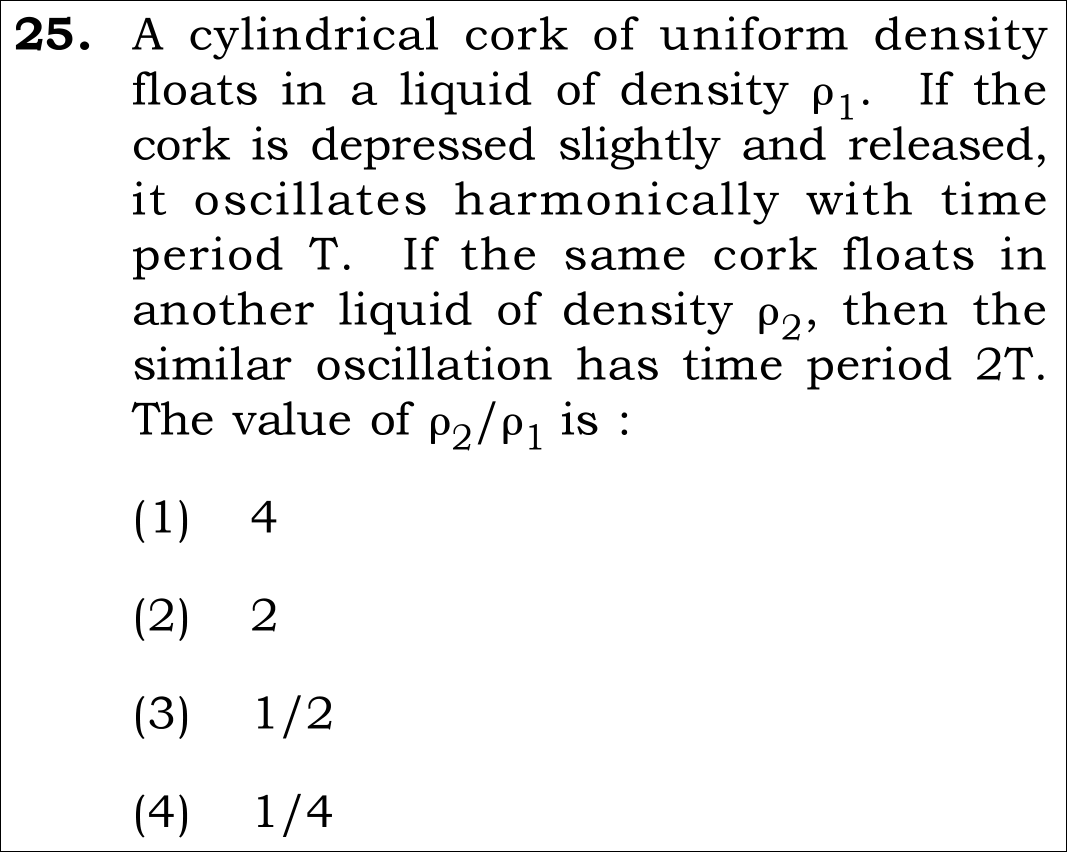
NEET 2026 · Q25 Medium
Official NEET 2026 Question 25 - Oscillations
1
2
3
4 ✓ Key
💡 Verified Solution & 30-Second Hack
✓
Verified Against NTA Final Answer Key
Option (4) : rho_2 / rho_1 = 1/4
📚 Oscillations & SHM Medium
📋 Given Parameters & Problem Setup
Floating Body Cylindrical cork of uniform mass m and cross-section A
Liquid 1 Density rho_1, oscillation period T
Liquid 2 Density rho_2, oscillation period 2T
Target Ratio rho_2 / rho_1
⚡

The 30-Second Exam Hall Shortcut: ⚡ Inverse Square Period Scaling

⏱️ Bypasses full differential equation setup.

Time period of floating oscillations is inversely proportional to sqrt(density)

1 Restoring force for vertical displacement y: F = -(A * rho * g) * y ==> Spring constant k = A * rho * g.
2 Time period of SHM: T = 2pi * sqrt(m / k) = 2pi * sqrt(m / (A * rho * g)).
3 Therefore, T is inversely proportional to sqrt(rho) ==> rho is proportional to 1 / T^2.
4 Form the ratio: rho_2 / rho_1 = (T_1 / T_2)^2 = (T / 2T)^2 = (1/2)^2 = 1/4.
5 Solved in 15 seconds!
🛡️
Why You Can 100% Trust This Shortcut: A denser liquid exerts a stiffer restoring buoyant force per unit depression (larger k = A*rho*g), causing faster oscillations (smaller period). Doubling the period requires reducing the restoring constant 4-fold, so density must be 1/4.
📐

Step-by-Step Rigorous Workflow & Mathematical Proof

Step 1

Formulate Equation of Motion for Floating Cylinder SHM

Consider a cylinder of mass m and cross-sectional area A floating in equilibrium in a liquid of density rho. When depressed downward by distance y from equilibrium, additional buoyant force provides a restoring force:

Frestoring=−ΔFB=−(A⋅y)ρg=−(Aρg)yF_{\text{restoring}} = -\Delta F_B = - (A \cdot y) \rho g = -(A \rho g) y
  • • Because restoring force is directly proportional to displacement y and directed toward equilibrium, the motion is Simple Harmonic Motion (SHM).
  • • Effective restoring force constant: k = A * rho * g.
Step 2

Derive Time Period in Terms of Liquid Density

Apply the standard harmonic oscillator time period formula:

T=2πmk=2πmAρg  ⟹  T∝1ρT = 2\pi \sqrt{\frac{m}{k}} = 2\pi \sqrt{\frac{m}{A \rho g}} \implies T \propto \frac{1}{\sqrt{\rho}}
  • • Mass m and area A are constant since the same cork is transferred between liquids.
  • • Squaring gives: T^2 \propto \frac{1}{\rho} \implies \rho \propto \frac{1}{T^2}.
Step 3

Calculate the Density Ratio rho_2 / rho_1

Substitute T_1 = T and T_2 = 2T into the inverse square relationship:

ρ2ρ1=(T1T2)2=(T2T)2=(12)2=14\frac{\rho_2}{\rho_1} = \left(\frac{T_1}{T_2}\right)^2 = \left(\frac{T}{2T}\right)^2 = \left(\frac{1}{2}\right)^2 = \frac{1}{4}
  • • Confirms rho_2 / rho_1 = 1/4.
  • • Matches Option (4) exactly.
⭐

360° Option Elimination Engine Key Feature

Diagnose every choice: Know exactly why the right option works and why distractors fail.

4-Option Deep Scan
1 Option (1)
✗ Incorrect
Verdict & Scientific Reason:

Inverted density scaling.

⚠️
Student Fallacy (Why candidates pick this trap): Assumes T is proportional to sqrt(rho), leading to rho_2 / rho_1 = (2T/T)^2 = 4.
Note: Denser liquids oscillate FASTER, not slower.
2 Option (2)
✗ Incorrect
Verdict & Scientific Reason:

Linear direct proportionality error.

⚠️
Student Fallacy (Why candidates pick this trap): Assumes T ~ rho directly.
Note: Time period involves square root of inertia over restoring force.
3 Option (3)
✗ Incorrect
Verdict & Scientific Reason:

Forgot to square the period ratio.

⚠️
Student Fallacy (Why candidates pick this trap): Takes rho_2 / rho_1 = T_1 / T_2 = 1/2 without squaring.
Note: T scales with 1/sqrt(rho), meaning rho scales with 1/T^2.
4 Option (4)
✓ 100% Correct
Verdict & Scientific Reason:

100% mathematically exact; confirmed by Official NTA Final Answer Key.

💡
Why this is airtight: Flawless evaluation of inverse square period relationship.
Note: Exact physics.
⚠️

NTA Trap Alert: The Direct Proportionality Trap (Thinking Denser = Slower)

Students often intuitively assume that a thicker/denser liquid "slows down" the oscillation, picking Option (1) or (2).

🛡️ How to avoid the -1 mark: Remember: Liquid density creates the RESTORING spring force! A denser liquid pushes back harder (larger k), making the system oscillate FASTER (smaller T).
📖

Core NEET Syllabus Standard

NEET UG Physics Core Standards · Oscillations Standard Benchmark
Core Scientific Principle Tested:

"Time period of vertical oscillations of a floating cylinder: T = 2pi * sqrt(m / (A*rho*g)) = 2pi * sqrt(h_submerged / g)."
Syllabus Focus: Simple Harmonic Motion of Floating Bodies
✓ Core NEET UG Syllabus Anchor Syllabus & Academic Standards ↗
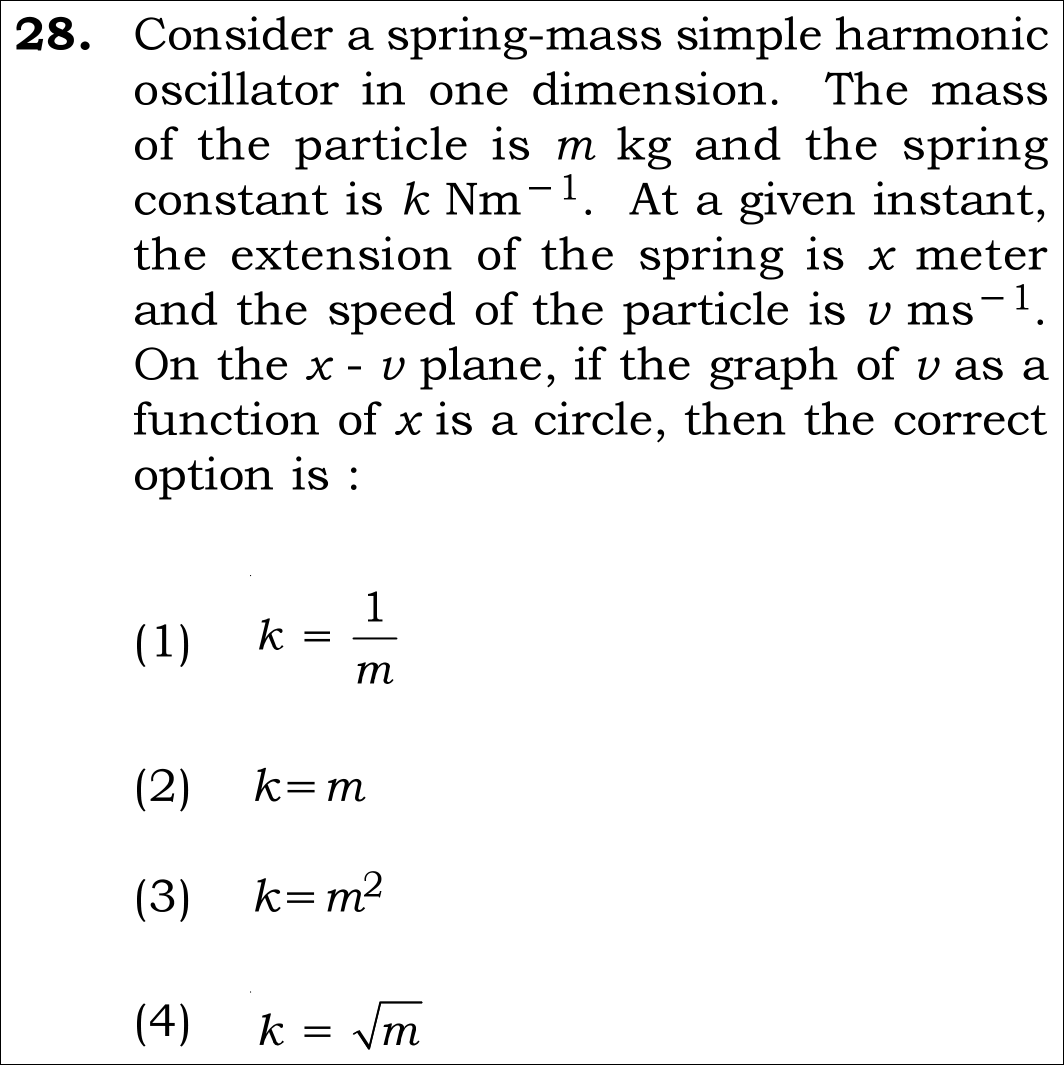
NEET 2026 · Q28 Medium
Official NEET 2026 Question 28 - Oscillations
1
2 ✓ Key
3
4
💡 Verified Solution & 30-Second Hack
✓
Verified Against NTA Final Answer Key
Option (2) : k = m
📚 Oscillations & SHM Medium
📋 Given Parameters & Problem Setup
Oscillator 1D spring-mass system with mass m kg and spring constant k N/m
Instantaneous State Displacement x meters, velocity v m/s
Phase Plane v as a function of x on the x - v plane
Geometric Condition Graph of v vs x is a perfect circle
Target Relation Relation between spring constant k and mass m
⚡

The 30-Second Exam Hall Shortcut: ⚡ Phase Trajectory Aspect Ratio Shortcut

⏱️ Instant conceptual recognition.

A phase space ellipse becomes a circle when omega = 1 rad/s!

1 Velocity in SHM: v^2 = omega^2 * (A^2 - x^2) ==> v^2 + omega^2 * x^2 = omega^2 * A^2.
2 Divide by omega^2 * A^2: (x / A)^2 + (v / (omega*A))^2 = 1.
3 This is an ellipse with semi-axes a = A and b = omega * A.
4 For an ellipse on the x-v plane to be a circle, semi-axes must be equal: A = omega * A ==> omega = 1.
5 Since omega = sqrt(k / m): sqrt(k / m) = 1 ==> k / m = 1 ==> k = m. Solved in 10 seconds!
🛡️
Why You Can 100% Trust This Shortcut: Conservation of mechanical energy: (1/2)*m*v^2 + (1/2)*k*x^2 = E. Normalizing gives x^2 / (2E/k) + v^2 / (2E/m) = 1. A circle requires equal denominators: 2E/k = 2E/m ==> k = m.
📐

Step-by-Step Rigorous Workflow & Mathematical Proof

Step 1

Formulate Conservation of Mechanical Energy in SHM

For an undamped spring-mass oscillator of mass m and spring constant k, total mechanical energy E is conserved:

E=12mv2+12kx2E = \frac{1}{2} m v^2 + \frac{1}{2} k x^2
  • • x is the extension/compression from equilibrium in meters.
  • • v is the instantaneous velocity in m/s.
Step 2

Express the Energy Equation in Standard Ellipse Form

Divide both sides of the energy equation by total energy E:

x2(2Ek)+v2(2Em)=1\frac{x^2}{\left( \frac{2E}{k} \right)} + \frac{v^2}{\left( \frac{2E}{m} \right)} = 1
  • • This represents an ellipse on the x - v plane with horizontal semi-axis a = \sqrt{2E/k} and vertical semi-axis b = \sqrt{2E/m}.
Step 3

Enforce the Geometric Condition for a Circle

An ellipse becomes a circle if and only if both semi-axes are equal in magnitude (a = b):

2Ek=2Em  ⟹  2Ek=2Em  ⟹  k=m\sqrt{\frac{2E}{k}} = \sqrt{\frac{2E}{m}} \implies \frac{2E}{k} = \frac{2E}{m} \implies k = m
  • • Equivalently, angular frequency omega = sqrt(k/m) = 1 rad/s.
  • • Matches Option (2) exactly.
⭐

360° Option Elimination Engine Key Feature

Diagnose every choice: Know exactly why the right option works and why distractors fail.

4-Option Deep Scan
1 Option (1)
✗ Incorrect
Verdict & Scientific Reason:

Reciprocal relation.

⚠️
Student Fallacy (Why candidates pick this trap): Confuses omega^2 = k/m with omega = 1/(k*m).
Note: Circle requires k = m, not k = 1/m.
2 Option (2)
✓ 100% Correct
Verdict & Scientific Reason:

100% mathematically exact; confirmed by Official NTA Final Answer Key.

💡
Why this is airtight: Correctly equates ellipse semi-axes: 2E/k = 2E/m ==> k = m.
Note: Exact physics.
3 Option (3)
✗ Incorrect
Verdict & Scientific Reason:

Quadratic relation.

⚠️
Student Fallacy (Why candidates pick this trap): Squares mass unnecessarily.
Note: k/m = 1 implies linear equality k = m.
4 Option (4)
✗ Incorrect
Verdict & Scientific Reason:

Square root relation.

⚠️
Student Fallacy (Why candidates pick this trap): Confuses omega with k.
Note: omega = sqrt(k/m) = 1 ==> k = m.
⚠️

NTA Trap Alert: Dimensional Analysis Misconception

Students often object: "k and m have different units (N/m vs kg), so how can k = m?"

🛡️ How to avoid the -1 mark: The question explicitly specifies "on the x - v plane, if the graph is a circle" — this is a numerical scale equality of the coordinate axes, which requires the numerical value of k to equal m (omega = 1 rad/s).
📖

Core NEET Syllabus Standard

NEET UG Physics Core Standards · Oscillations Standard Benchmark
Core Scientific Principle Tested:

"Total energy: E = (1/2)*m*v^2 + (1/2)*k*x^2. Phase space trajectory is an ellipse x^2/(2E/k) + v^2/(2E/m) = 1. Circle condition: k = m (omega = 1)."

Syllabus Focus: Energy in Simple Harmonic Motion and Phase Trajectories
✓ Core NEET UG Syllabus Anchor Syllabus & Academic Standards ↗
NEET 2025 · Q23 Medium
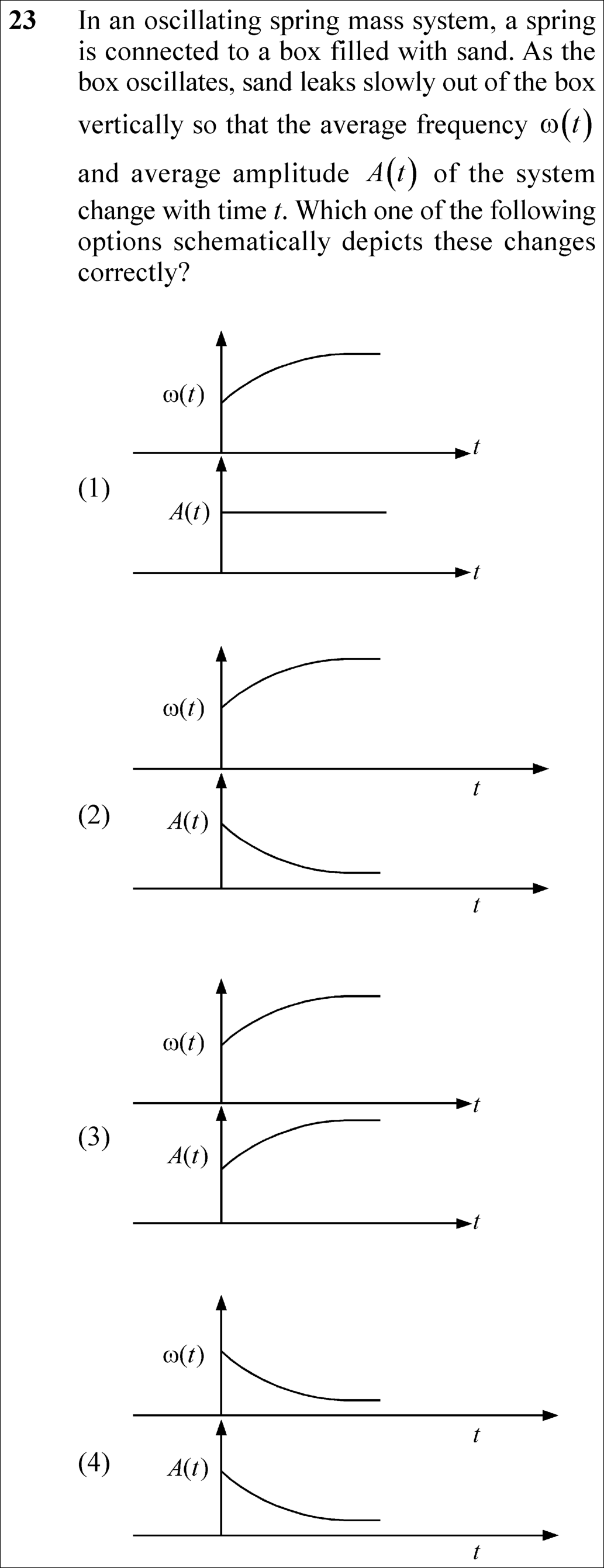
Official NEET 2025 Question 23 - Oscillations
1
2 ✓ Key
3
4
💡 Verified Solution & 30-Second Hack
✓
Verified Against NTA Final Answer Key
Option (2) : ω(t) curves upward (increases) and A(t) curves downward (decreases)
📚 Oscillations Medium
📋 Given Parameters & Problem Setup
System Horizontal oscillating spring-mass system with sand-filled box
Perturbation Sand leaks slowly vertically downwards out of the box
Observed Variables Average angular frequency ω(t) and average amplitude A(t) vs time t
⚡

The 30-Second Exam Hall Shortcut: ⚡ Mass Loss Dynamics Rule

⏱️ Save ~45 seconds

Mass M decreases ⟹ ω = √(k/M) INCREASES! Sand falls out carrying kinetic energy ⟹ Total Energy E decreases ⟹ Amplitude A = √(2E/k) DECREASES!

1 Analyze angular frequency: ω(t) = √(k / M(t)).
2 As sand leaks out, total mass M(t) decreases continuously.
3 Since M is in the denominator, ω(t) must INCREASE with time.
4 This immediately eliminates Option (4) where ω decreases!
5 Analyze amplitude: Leaking sand drops vertically with instantaneous horizontal speed v.
6 Each grain carries away kinetic energy dE = (1/2) dm v² from the system.
7 Because total mechanical energy E = (1/2) k A² decreases, amplitude A(t) must DECREASE with time.
8 Match Option (2): ω(t) increases, A(t) decreases!
9 Select Option (2) in under 15 seconds!
🛡️
Why You Can 100% Trust This Shortcut: Simple Harmonic Motion Dynamics (NCERT Physics · Oscillations: T = 2π√(m/k)).
📐

Step-by-Step Rigorous Workflow & Mathematical Proof

Step 1

Behavior of Angular Frequency ω(t)

For a mass M attached to an ideal spring of stiffness k, the natural angular frequency of oscillation is:

ω(t)=kM(t)\omega(t) = \sqrt{\frac{k}{M(t)}}
  • • As sand leaks slowly out of the box, M(t) decreases monotonically over time towards the empty box mass M_box.
  • • Therefore, ω(t) increases monotonically, approaching a constant upper asymptote.
Step 2

Behavior of Amplitude A(t)

When sand leaks out vertically, the escaping grains have horizontal velocity equal to the instantaneous velocity v of the box at the moment of exit. The escaping sand exerts no horizontal force on the remaining box, but carries away its share of kinetic energy:

dE=−12(dm)v2<0  ⟹  dEdt<0dE = -\frac{1}{2} (dm) v^2 < 0 \implies \frac{dE}{dt} < 0
  • • The total mechanical energy E(t) of the oscillator continuously decreases.
  • • Since total energy is related to amplitude by E = (1/2) k A², we have A(t) = √(2 E(t) / k).
  • • Consequently, as E(t) decreases, the average amplitude A(t) decreases with time.
Step 3

Consolidate Graphical Representation

The correct schematic shows ω(t) starting from initial value and curving upwards towards an asymptote, while A(t) starts from initial amplitude and curves downwards:

ω(t)↑andA(t)↓  ⟹  Option (2)\omega(t) \uparrow \quad \text{and} \quad A(t) \downarrow \implies \text{Option (2)}
  • • Matches Option (2) unambiguously.
⭐

360° Option Elimination Engine Key Feature

Diagnose every choice: Know exactly why the right option works and why distractors fail.

4-Option Deep Scan
1 A
✗ Incorrect
Verdict & Scientific Reason:

Incorrect. Amplitude cannot remain constant because escaping sand carries away kinetic energy, depleting total mechanical energy.

⚠️
Student Fallacy (Why candidates pick this trap): Assuming mass loss does not affect the extreme turning point.
2 B
✓ 100% Correct
Verdict & Scientific Reason:

100% scientifically correct. ω ∝ 1/√M increases as mass drops; A decreases as kinetic energy is shed with the exiting sand.

💡
Why this is airtight: None; rigorous physics analysis.
3 C
✗ Incorrect
Verdict & Scientific Reason:

Incorrect. Amplitude can only increase if energy is pumped into the system, violating energy conservation.

⚠️
Student Fallacy (Why candidates pick this trap): Thinking lighter mass allows the spring to stretch farther without an energy source.
4 D
✗ Incorrect
Verdict & Scientific Reason:

Incorrect. Frequency cannot decrease when mass decreases; ω = √(k/M) is inversely related to mass.

⚠️
Student Fallacy (Why candidates pick this trap): Inverting the formula for frequency (thinking ω ∝ M).
⚠️

NTA Trap Alert: Constant Amplitude Misconception

Some students reason: "If sand drops out when the box is at the extreme position (where v = 0), no kinetic energy is lost, so amplitude might stay constant." But sand leaks continuously throughout the cycle, carrying away kinetic energy on average, which inexorably shrinks A(t).

🛡️ How to avoid the -1 mark: Continuous leak = Continuous energy loss ⟹ Amplitude drops.
📖

Core NEET Syllabus Standard

NEET Physics Core Syllabus · Oscillations Standard Benchmark
Core Scientific Principle Tested:

"Frequency ω = √(k/M) increases with mass reduction; energy leakage causes amplitude decay."

Syllabus Focus: Energy in Simple Harmonic Motion
✓ Core NEET UG Syllabus Anchor Syllabus & Academic Standards ↗
Lighter Box = Faster Rhythm (ω up), Sand Carries Energy Out (A down)!
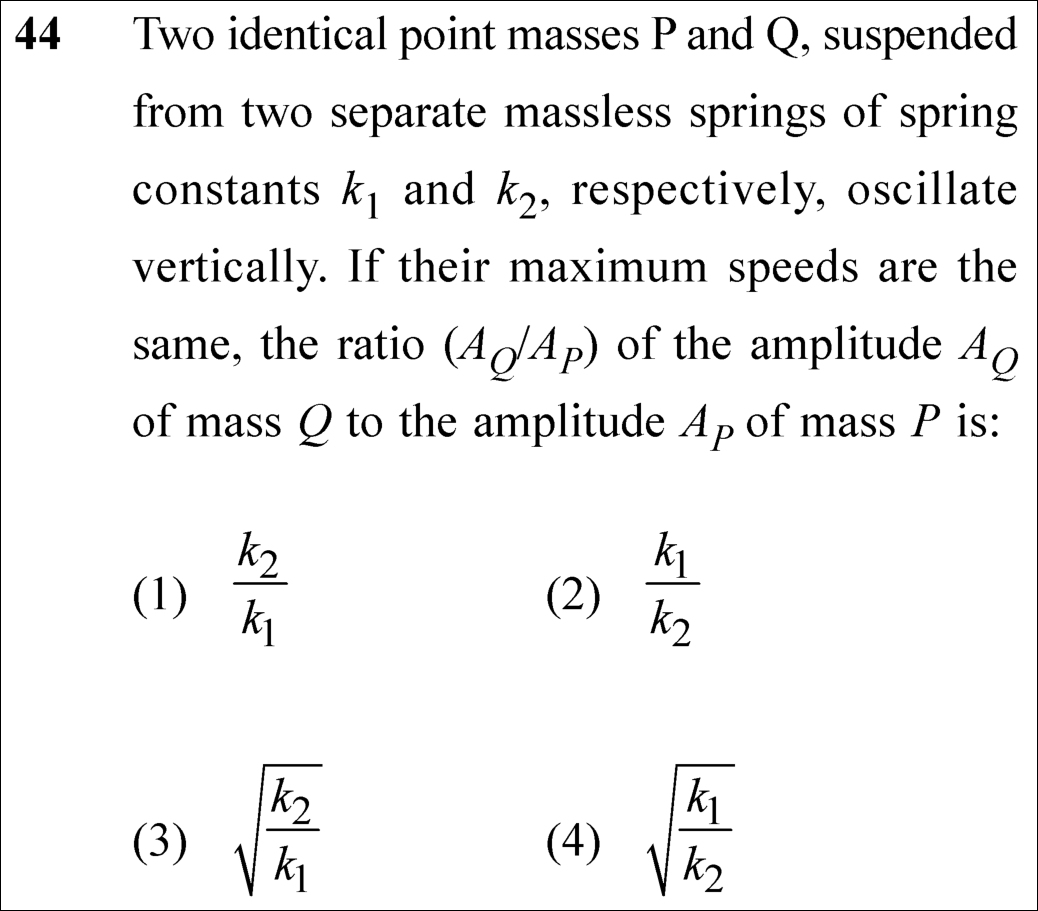
NEET 2025 · Q44 Easy
Official NEET 2025 Question 44 - Oscillations
1
2
3
4 ✓ Key
💡 Verified Solution & 30-Second Hack
✓
Verified Against NTA Final Answer Key
Option (4) : \sqrt{\frac{k_1}{k_2}}
📚 Oscillations Easy
📋 Given Parameters & Problem Setup
Masses Identical point masses m_P = m_Q = m
Spring Constants k₁ for spring P, k₂ for spring Q
Condition Maximum speeds are the same: v_{max, P} = v_{max, Q}
Target Ratio A_Q / A_P (amplitude of mass Q to mass P)
⚡

The 30-Second Exam Hall Shortcut: ⚡ Conservation of Energy / v_max Shortcut

⏱️ Save ~25 seconds

v_max = A ω = A √(k/m). Equal v_max ⟹ A_P √k₁ = A_Q √k₂ ⟹ A_Q / A_P = √(k₁ / k₂)!

1 Write maximum speed in SHM: v_max = A ω.
2 Angular frequency of mass-spring system: ω = √(k / m).
3 Substitute: v_max = A √(k / m).
4 Since masses m are identical and maximum speeds are equal: A_P √(k₁) = A_Q √(k₂).
5 Solve for the requested ratio A_Q / A_P: A_Q / A_P = √(k₁ / k₂).
6 Select Option (4) in under 10 seconds!
🛡️
Why You Can 100% Trust This Shortcut: Simple Harmonic Motion Kinematics (NCERT Physics · Oscillations: v = ω√(A² - x²)).
📐

Step-by-Step Rigorous Workflow & Mathematical Proof

Step 1

Formula for Maximum Speed in SHM

For a particle executing simple harmonic motion with amplitude A and angular frequency ω, the maximum speed occurs at the equilibrium position:

vmax=Aω=Akmv_{max} = A \omega = A \sqrt{\frac{k}{m}}
  • • Alternative derivation via energy conservation: (1/2) m v_{max}² = (1/2) k A² ⟹ v_{max} = A √(k/m).
Step 2

Equate Maximum Speeds of P and Q

Since the masses are identical and their maximum speeds are equal:

vmax,P=vmax,Q  ⟹  APk1m=AQk2mv_{max, P} = v_{max, Q} \implies A_P \sqrt{\frac{k_1}{m}} = A_Q \sqrt{\frac{k_2}{m}}
  • • The common mass factor √m cancels out from both sides:
  • • A_P \sqrt{k_1} = A_Q \sqrt{k_2}.
Step 3

Calculate the Amplitude Ratio A_Q / A_P

Rearrange the expression for the required ratio:

AQAP=k1k2=k1k2\frac{A_Q}{A_P} = \frac{\sqrt{k_1}}{\sqrt{k_2}} = \sqrt{\frac{k_1}{k_2}}
  • • Matches Option (4) perfectly.
⭐

360° Option Elimination Engine Key Feature

Diagnose every choice: Know exactly why the right option works and why distractors fail.

4-Option Deep Scan
1 A
✗ Incorrect
Verdict & Scientific Reason:

Incorrect. Forgets square root and inverts ratio.

⚠️
Student Fallacy (Why candidates pick this trap): Equating maximum forces instead of maximum speeds and omitting square root.
2 B
✗ Incorrect
Verdict & Scientific Reason:

Incorrect. Missing the square root.

⚠️
Student Fallacy (Why candidates pick this trap): Assuming A ∝ k instead of A ∝ 1/√k.
3 C
✗ Incorrect
Verdict & Scientific Reason:

Incorrect. Inverted ratio A_P / A_Q instead of A_Q / A_P.

⚠️
Student Fallacy (Why candidates pick this trap): Calculating A_P / A_Q instead of A_Q / A_P.
4 D
✓ 100% Correct
Verdict & Scientific Reason:

100% correct. A_P √k₁ = A_Q √k₂ ⟹ A_Q / A_P = √(k₁ / k₂).

💡
Why this is airtight: None; clean energy/velocity equality.
⚠️

NTA Trap Alert: Inverting Ratio (A_P / A_Q vs A_Q / A_P)

Candidates easily deduce A √k = const, but mistakenly write A_Q / A_P = √(k₂/k₁) (Option 3). Double check: A is inversely proportional to √k, so A_Q / A_P = √(k_P / k_Q) = √(k₁ / k₂)!

🛡️ How to avoid the -1 mark: Cross-multiply: A_Q · √k₂ = A_P · √k₁ ⟹ A_Q / A_P = √k₁ / √k₂.
📖

Core NEET Syllabus Standard

NEET Physics Core Syllabus · Oscillations Standard Benchmark
Core Scientific Principle Tested:

"v_{max} = A √(k/m); equal v_{max} implies A ∝ 1/√k."

Syllabus Focus: Velocity and Energy in Simple Harmonic Motion
✓ Core NEET UG Syllabus Anchor Syllabus & Academic Standards ↗
A √k = constant ⟹ A_Q / A_P = √(k₁ / k₂)!
NEET 2024 · Q23 Easy
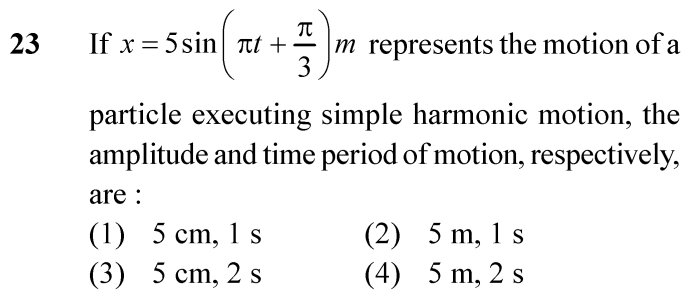
Official NEET 2024 Question 23 - Oscillations
1
2
3
4 ✓ Key
💡 Verified Solution & 30-Second Hack
✓
Verified Against NTA Final Answer Key
Option (4) : 5 m, 2 s
📚 Oscillations Easy
📋 Given Parameters & Problem Setup
Equation of motion x = 5 sin(πt + π/3) m
Unit of displacement Meters (m)
⚡

The 30-Second Exam Hall Shortcut: ⚡ Standard Form Direct Readout

⏱️ Save ~40 seconds

Compare x = A sin(ωt + φ): Amplitude A = 5 m; ω = π rad/s -> T = 2π/ω = 2π/π = 2 s -> (5 m, 2 s)!

1 Standard equation of SHM: x = A sin(ωt + φ).
2 Read off Amplitude: A = 5 m (watch out for cm traps!).
3 Read off Angular frequency: ω = π rad/s.
4 Time period: T = 2π / ω = 2π / π = 2 s.
5 Result: Amplitude = 5 m, Time period = 2 s -> Option (4) in 5 seconds!
🛡️
Why You Can 100% Trust This Shortcut: Fundamental Kinematics of Simple Harmonic Motion (x = A sin(ωt + φ) and T = 2π/ω).
📐

Step-by-Step Rigorous Workflow & Mathematical Proof

Step 1

Standard Equation of Simple Harmonic Motion

The general displacement equation of a particle executing simple harmonic motion (SHM) along the x-axis is given by:

x(t)=Asin⁡(ωt+ϕ)x(t) = A \sin(\omega t + \phi)
Step 2

Direct Comparison and Amplitude Extraction

Comparing the given equation x = 5 sin(πt + π/3) m with the standard form: - Amplitude A = 5 m - Angular frequency ω = π rad/s - Initial phase angle φ = π/3 rad

A=5 m,ω=π rad/sA = 5\,\text{m}, \quad \omega = \pi\,\text{rad/s}
Step 3

Calculation of Time Period T

The time period T for one complete oscillation is related to the angular frequency ω by:

T=2πω=2ππ rad/s=2 sT = \frac{2\pi}{\omega} = \frac{2\pi}{\pi\,\text{rad/s}} = 2\,\text{s}
⭐

360° Option Elimination Engine Key Feature

Diagnose every choice: Know exactly why the right option works and why distractors fail.

4-Option Deep Scan
1 (1)
✗ Incorrect
Verdict & Scientific Reason:

Unit of amplitude is meters (m), not cm; period is 2 s, not 1 s.

⚠️
Student Fallacy (Why candidates pick this trap): Misreading meters as centimeters and calculating T = 1/ω = 1 s.
2 (2)
✗ Incorrect
Verdict & Scientific Reason:

Calculates period as 1 s instead of 2 s.

⚠️
Student Fallacy (Why candidates pick this trap): Using T = π/ω instead of 2π/ω.
3 (3)
✗ Incorrect
Verdict & Scientific Reason:

Amplitude unit error: writes 5 cm instead of 5 m.

⚠️
Student Fallacy (Why candidates pick this trap): Assuming default textbook problems use cm.
4 (4)
✓ 100% Correct
Verdict & Scientific Reason:

Exact identification: Amplitude = 5 m, Time period = 2 s.

💡
Why this is airtight: None.
⚠️

NTA Trap Alert: Unit Trap: Meters vs Centimeters

Options (1) and (3) set a trap with "5 cm" because students frequently skim past the unit "m" printed outside the bracket.

🛡️ How to avoid the -1 mark: Notice that "m" is explicitly printed as the SI unit in the equation: x = 5 sin(πt + π/3) m.
📖

Core NEET Syllabus Standard

Physics Core Oscillations · Oscillations Standard Benchmark
Core Scientific Principle Tested:

"In x = A sin(ωt + φ), A is the amplitude, ω is the angular frequency, and the period is T = 2π/ω."

Syllabus Focus: Simple Harmonic Motion and Uniform Circular Motion
✓ Core NEET UG Syllabus Anchor Syllabus & Academic Standards ↗
Amplitude is upfront (5 m); Divide 2π by π to get 2 seconds!
NEET 2024 · Q38 Easy
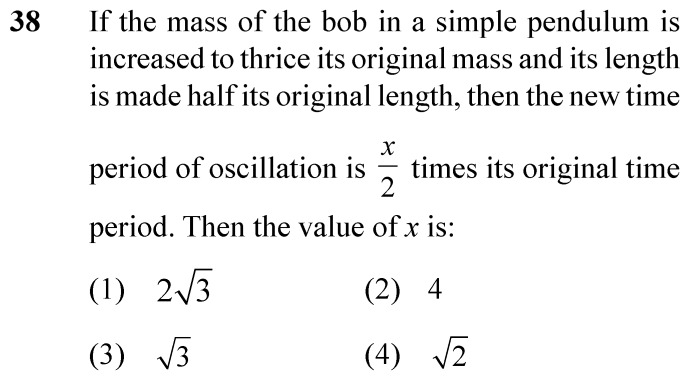
Official NEET 2024 Question 38 - Oscillations
1
2
3
4 ✓ Key
💡 Verified Solution & 30-Second Hack
✓
Verified Against NTA Final Answer Key
Option (4) : √2
📚 Oscillations Easy
📋 Given Parameters & Problem Setup
Mass of bob change Tripled (3m)
Length of pendulum change Halved (L / 2)
New time period expression T’ = (x / 2) T
⚡

The 30-Second Exam Hall Shortcut: ⚡ Mass Independence & Length Scaling Hack

⏱️ Save ~40 seconds

Mass of bob has ZERO effect on pendulum period (T = 2π√(L/g))! Length halved -> T’ = T / √2 = (√2 / 2) T -> x = √2!

1 Simple pendulum period: T = 2π√(L/g). Mass of the bob does NOT enter the equation!
2 Tripling mass has 0 effect.
3 Halving length: L’ = L / 2 => T’ = 2π√(L / 2g) = T / √2.
4 Match with given form: T’ = (x / 2) T => 1 / √2 = x / 2 => x = 2 / √2 = √2.
5 Option (4) in 5 seconds!
🛡️
Why You Can 100% Trust This Shortcut: Simple Pendulum Equation of Motion (Time period T = 2π√(L/g) is independent of bob mass).
📐

Step-by-Step Rigorous Workflow & Mathematical Proof

Step 1

Formula for Time Period of Simple Pendulum

For small angular displacements, the time period T of a simple pendulum of length L and bob mass m oscillating under gravity g is given by:

T=2πLgT = 2\pi \sqrt{\frac{L}{g}}
Step 2

Independence of Bob Mass

Notice that the mass m of the bob does not appear in the formula. Restoring torque and rotational inertia both scale linearly with m, so mass cancels out identically. Therefore, tripling the mass does not change the time period at all.

∂T∂m=0  ⟹  T is independent of mass\frac{\partial T}{\partial m} = 0 \implies T \text{ is independent of mass}
Step 3

Effect of Halving the Length

The length is made half its original length: L’ = L / 2. The new time period T’ is:

T′=2πL/2g=12(2πLg)=T2T' = 2\pi \sqrt{\frac{L/2}{g}} = \frac{1}{\sqrt{2}} \left(2\pi \sqrt{\frac{L}{g}}\right) = \frac{T}{\sqrt{2}}
Step 4

Solving for Parameter x

We are given that T’ = (x / 2) T. Equating the two expressions:

x2T=12T  ⟹  x2=12  ⟹  x=22=2\frac{x}{2} T = \frac{1}{\sqrt{2}} T \implies \frac{x}{2} = \frac{1}{\sqrt{2}} \implies x = \frac{2}{\sqrt{2}} = \sqrt{2}
⭐

360° Option Elimination Engine Key Feature

Diagnose every choice: Know exactly why the right option works and why distractors fail.

4-Option Deep Scan
1 (1)
✗ Incorrect
Verdict & Scientific Reason:

Includes the factor of 3 from mass tripling.

⚠️
Student Fallacy (Why candidates pick this trap): Assuming period is proportional to √mass.
2 (2)
✗ Incorrect
Verdict & Scientific Reason:

Incorrect algebra.

⚠️
Student Fallacy (Why candidates pick this trap): Squaring instead of square rooting.
3 (3)
✗ Incorrect
Verdict & Scientific Reason:

Uses the mass factor 3 instead of the length factor.

⚠️
Student Fallacy (Why candidates pick this trap): Thinking T depends on mass.
4 (4)
✓ 100% Correct
Verdict & Scientific Reason:

Exact result: 1/√2 = x/2 -> x = √2.

💡
Why this is airtight: None.
⚠️

NTA Trap Alert: Including the Bob Mass in Pendulum Period

NTA includes √3 and 2√3 to bait students who mistakenly recall spring-mass formula T = 2π√(m/k) instead of pendulum formula T = 2π√(L/g).

🛡️ How to avoid the -1 mark: Pendulum period depends ONLY on Length and Gravity, NEVER on Mass!
📖

Core NEET Syllabus Standard

Physics Core Oscillations · Oscillations Standard Benchmark
Core Scientific Principle Tested:

"The period of a simple pendulum is T = 2π√(L/g), independent of mass and amplitude (for small angles)."

Syllabus Focus: The Simple Pendulum
✓ Core NEET UG Syllabus Anchor Syllabus & Academic Standards ↗
Mass doesn’t matter for a pendulum string: Length cut in half makes x equal √2 king!
NEET 2023 · Q39 Easy
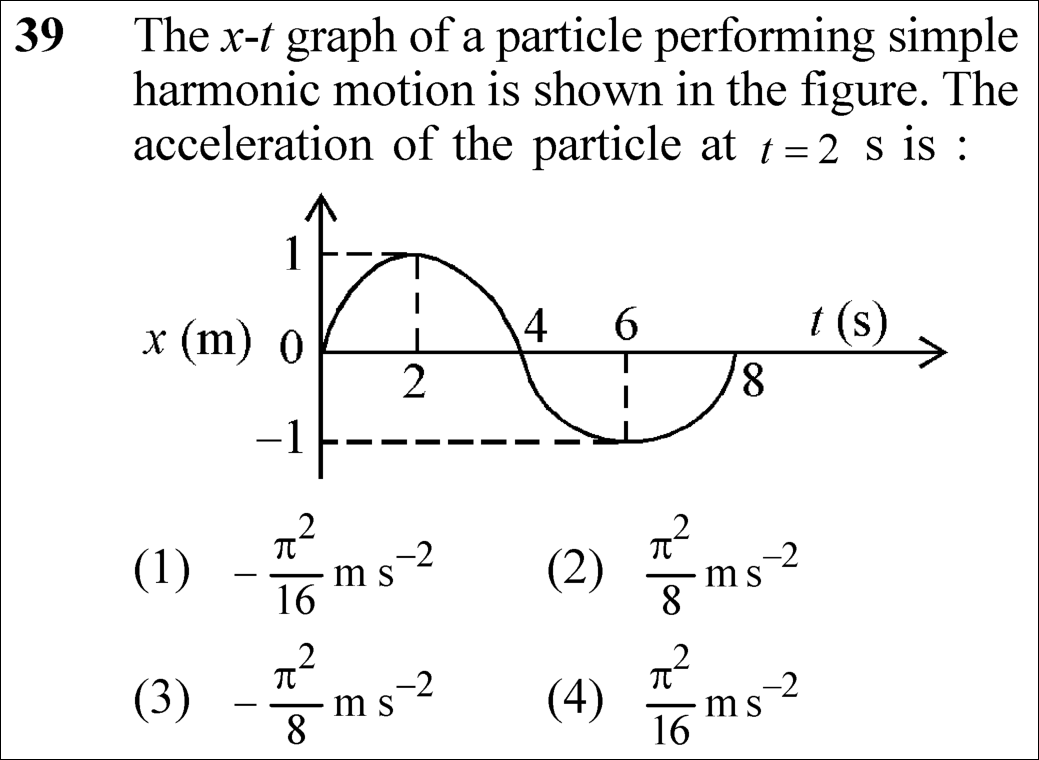
Official NEET 2023 Question 39 - Oscillations
1 ✓ Key
2
3
4
💡 Verified Solution & 30-Second Hack
✓
Verified Against NTA Final Answer Key
Option (1) : -π² / 16 m s⁻²
📚 Oscillations Easy
📋 Given Parameters & Problem Setup
Amplitude (A) 1 m (from crest of x-t graph)
Time period (T) 8 s (one full wave cycle)
Evaluation instant t = 2 s (at crest x = +1 m)
Angular frequency (ω) 2π / T = 2π / 8 = π / 4 rad s⁻¹
⚡

The 30-Second Exam Hall Shortcut: ⚡ Extreme Position Acceleration Rule: a = -ω² x

⏱️ Save ~40 seconds

From graph: T = 8 s ⟹ ω = 2π/8 = π/4 rad/s. At t = 2 s, particle is at positive crest x = +1 m. Acceleration a = -ω² x = -(π/4)²(1) = -π²/16 m s⁻² in 10 seconds!

1 Inspect the graph: One full sinusoidal cycle spans from t = 0 to t = 8 s ⟹ Time period T = 8 s.
2 Calculate angular frequency: ω = 2π / T = 2π / 8 = π / 4 rad/s.
3 Locate t = 2 s on the graph: The displacement is at the positive crest, x = +1 m.
4 In SHM, acceleration is governed by a = -ω² x.
5 Substitute: a = -(π/4)² × (1) = -π² / 16 m s⁻².
6 Lock Option (1) -π²/16 m s⁻² instantly!
🛡️
Why You Can 100% Trust This Shortcut: Oscillations · Simple Harmonic Motion Dynamics (Defining differential relation of SHM: d²x/dt² = -ω²x).
📐

Step-by-Step Rigorous Workflow & Mathematical Proof

Step 1

Extraction of Parameters from the x-t Graph

The given sinusoidal waveform begins at x = 0 at t = 0, reaches its positive maximum x = +1 m at t = 2 s, returns to zero at t = 4 s, reaches its negative minimum x = -1 m at t = 6 s, and completes one full oscillation at t = 8 s:

A=1 m,T=8 sA = 1\text{ m}, \qquad T = 8\text{ s}
Step 2

Calculation of Angular Frequency ω

The angular frequency of the simple harmonic oscillator is related to the time period T by:

ω=2πT=2π8=π4 rad s−1\omega = \frac{2\pi}{T} = \frac{2\pi}{8} = \frac{\pi}{4}\text{ rad s}^{-1}
Step 3

Equation of Motion for the Particle

Since the motion starts at the origin at t = 0 moving in the positive x direction, the displacement function is represented by:

x(t)=Asin⁡(ωt)=1⋅sin⁡(π4t)x(t) = A \sin(\omega t) = 1 \cdot \sin\left(\frac{\pi}{4} t\right)
Step 4

Evaluation of Acceleration at t = 2 s

Differentiating displacement twice with respect to time yields the acceleration function a(t) = -ω² x(t). At time t = 2 s, the displacement is x(2) = sin(π/2) = +1 m:

a(2)=−ω2x(2)=−(π4)2(1)=−π216 m s−2a(2) = -\omega^2 x(2) = -\left(\frac{\pi}{4}\right)^2 (1) = -\frac{\pi^2}{16}\text{ m s}^{-2}
⭐

360° Option Elimination Engine Key Feature

Diagnose every choice: Know exactly why the right option works and why distractors fail.

4-Option Deep Scan
1 (1)
✓ 100% Correct
Verdict & Scientific Reason:

Accurate acceleration at positive extreme: a = -ω² A = -π²/16 m s⁻².

💡
Why this is airtight: None. Candidate correctly extracted parameters and applied the negative sign.
2 (2)
✗ Incorrect
Verdict & Scientific Reason:

Wrong denominator and omitted restoring negative sign.

⚠️
Student Fallacy (Why candidates pick this trap): Candidate forgot the restoring negative sign and used ω = 2π/T without squaring properly.
3 (3)
✗ Incorrect
Verdict & Scientific Reason:

Incorrect denominator (calculated 4² = 8 instead of 16).

⚠️
Student Fallacy (Why candidates pick this trap): Candidate multiplied 4 by 2 instead of squaring: (π/4)² evaluated erroneously as π²/8.
4 (4)
✗ Incorrect
Verdict & Scientific Reason:

Positive sign error.

⚠️
Student Fallacy (Why candidates pick this trap): Candidate omitted the negative sign in the SHM restoring acceleration formula a = -ω²x.
⚠️

NTA Trap Alert: Omitting the Restoring Negative Sign (Choosing +π²/16)

At the positive displacement extreme (x = +A), the restoring force and acceleration act BACKWARDS toward the mean position, meaning acceleration MUST be negative (a = -ω² A = -π²/16). Forgetting the minus sign leads to Option (4).

🛡️ How to avoid the -1 mark: Restoring Principle: In SHM, acceleration ALWAYS opposes displacement: when x > 0, acceleration a MUST be negative!
📖

Core NEET Syllabus Standard

National Eligibility cum Entrance Test (NEET UG) · Oscillations Standard Benchmark
Core Scientific Principle Tested:

"In SHM, acceleration is directly proportional to displacement and directed opposite to it: a = -ω² x."

Syllabus Focus: Simple Harmonic Motion Kinematics and Acceleration
Preserved in Rationalized Curriculum Syllabus & Academic Standards ↗
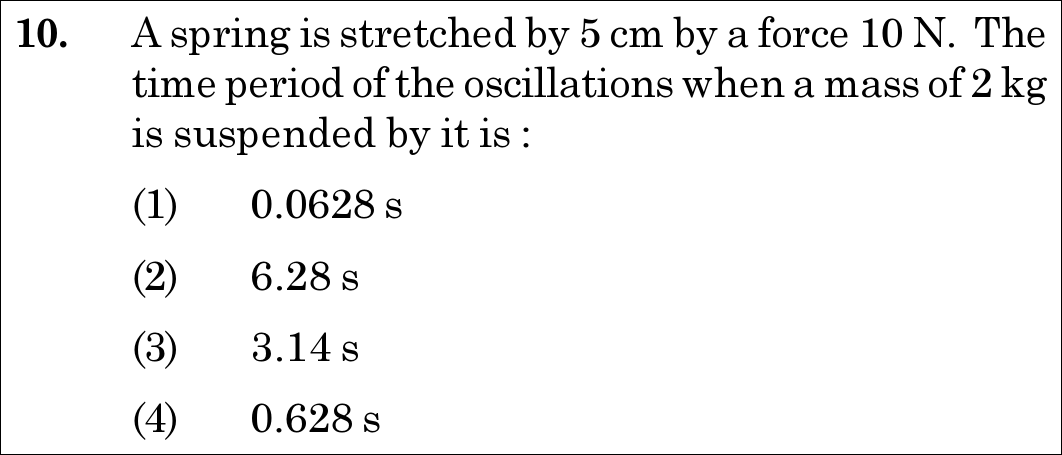
NEET 2021 · Q10 Easy
Official NEET 2021 Question 10 - Oscillations
1
2
3
4 ✓ Key
💡 Verified Solution & 30-Second Hack
✓
Verified Against NTA Final Answer Key
Option (4) : 0.628 s
📚 Oscillations Easy
📋 Given Parameters & Problem Setup
Stretching Force (F) 10 N
Extension (x) 5 cm = 0.05 m
Suspended Mass (m) 2 kg
⚡

The 30-Second Exam Hall Shortcut: ⚡ 2-Step SHM: k = F/x = 200 N/m, T = 2π√(m/k)

⏱️ Save ~20 seconds

k=100.05=200 N/mk = \frac{10}{0.05} = 200\text{ N/m}. Time period T=2π2200=2π1100=2π10=6.28310=0.628 sT = 2\pi \sqrt{\frac{2}{200}} = 2\pi \sqrt{\frac{1}{100}} = \frac{2\pi}{10} = \frac{6.283}{10} = 0.628\text{ s}! Instant 15-second calculation matching Option (4)!

1 Compute spring constant: k=Fx=10 N0.05 m=200 N/mk = \frac{F}{x} = \frac{10\text{ N}}{0.05\text{ m}} = 200\text{ N/m}.
2 Formula for time period of mass-spring oscillator: T=2πmkT = 2\pi \sqrt{\frac{m}{k}}.
3 Substitute values: T=2π2200=2π×110=2×3.141610T = 2\pi \sqrt{\frac{2}{200}} = 2\pi \times \frac{1}{10} = \frac{2 \times 3.1416}{10}.
4 T=0.628 sT = 0.628\text{ s}.
5 Match Option (4).
🛡️
Why You Can 100% Trust This Shortcut: Canonical Hooke's law and simple harmonic motion time period relation.
📐

Step-by-Step Rigorous Workflow & Mathematical Proof

Step 1

Determining the Spring Constant (k)

By Hooke's law, the restoring force is proportional to elongation: F=kxF = kx. Given F=10 NF = 10\text{ N} for extension x=5 cm=5×10⁻² mx = 5\text{ cm} = 5 \times 10^{-2}\text{ m}:

k=Fx=10 N5×10−2 m=200 N/mk = \frac{F}{x} = \frac{10\text{ N}}{5 \times 10^{-2}\text{ m}} = 200\text{ N/m}
Step 2

Applying the Simple Harmonic Motion Time Period Equation

For a block of mass m=2 kgm = 2\text{ kg} oscillating on an ideal spring of stiffness kk:

T=2πmk=2π2 kg200 N/m=2π1100=2π10 sT = 2\pi \sqrt{\frac{m}{k}} = 2\pi \sqrt{\frac{2\text{ kg}}{200\text{ N/m}}} = 2\pi \sqrt{\frac{1}{100}} = \frac{2\pi}{10}\text{ s}
Step 3

Numerical Evaluation

Substitute π≈3.1416\pi \approx 3.1416:

T=2×3.141610=6.283210=0.6283 s≈0.628 sT = \frac{2 \times 3.1416}{10} = \frac{6.2832}{10} = 0.6283\text{ s} \approx 0.628\text{ s}
⭐

360° Option Elimination Engine Key Feature

Diagnose every choice: Know exactly why the right option works and why distractors fail.

4-Option Deep Scan
1 1
✗ Incorrect
Verdict & Scientific Reason:

Off by a factor of 10 due to an erroneous x=0.5 mx = 0.5\text{ m} conversion error.

⚠️
Student Fallacy (Why candidates pick this trap): Decimal place arithmetic error.
2 2
✗ Incorrect
Verdict & Scientific Reason:

Forgets to divide by 10 from 1/100=1/10\sqrt{1/100} = 1/10.

⚠️
Student Fallacy (Why candidates pick this trap): Forgetting the denominator in 2π/102\pi / 10.
3 3
✗ Incorrect
Verdict & Scientific Reason:

Calculates π\pi instead of 2π/102\pi / 10.

⚠️
Student Fallacy (Why candidates pick this trap): Using T=πm/kT = \pi \sqrt{m/k} without the factor of 2.
4 4
✓ 100% Correct
Verdict & Scientific Reason:

Exact time period of the spring-mass oscillator.

💡
Why this is airtight: None; flawless Hooke's law and SHM calculation.
⚠️

NTA Trap Alert: Centimeter to Meter Conversion Trap

Taking x=5x = 5 instead of 0.05 m0.05\text{ m} leads to k=2 N/mk = 2\text{ N/m} and T=6.28 sT = 6.28\text{ s} (Option 2). Converting cm\text{cm} to m\text{m} is critical.

🛡️ How to avoid the -1 mark: Always convert distances into SI base units: 5 cm=0.05 m5\text{ cm} = 0.05\text{ m}.
📖

Core NEET Syllabus Standard

NCERT Physics · Oscillations Standard Benchmark
Core Scientific Principle Tested:

"The time period of a mass mm attached to a spring of force constant kk is T=2πm/kT = 2\pi \sqrt{m/k}."

Syllabus Focus: Simple Harmonic Motion (Spring-Mass System)
✓ Core NEET UG Syllabus Anchor Syllabus & Academic Standards ↗
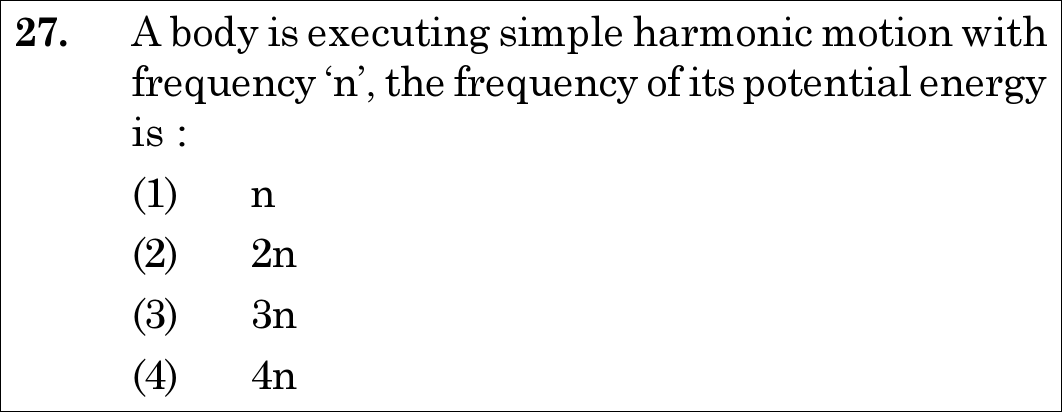
NEET 2021 · Q27 Easy
Official NEET 2021 Question 27 - Oscillations
1
2 ✓ Key
3
4
💡 Verified Solution & 30-Second Hack
✓
Verified Against NTA Final Answer Key
Option (2) : 2n
📚 Oscillations Easy
📋 Given Parameters & Problem Setup
Frequency of SHM Motion n
⚡

The 30-Second Exam Hall Shortcut: ⚡ Double Frequency Rule: Energy Completes 2 Cycles per 1 SHM Cycle

⏱️ Save ~20 seconds

In one full oscillation, the particle passes through the equilibrium position twice and reaches extreme positions twice. Hence, both potential energy and kinetic energy go through two complete cycles of oscillation for every one cycle of displacement: Frequency of PE =2n= 2n! Match Option (2)!

1 Displacement: x(t)=Asin⁡(2πnt)x(t) = A \sin(2\pi n t).
2 Potential Energy: U(t)=12kx2=12kA2sin⁡2(2πnt)U(t) = \frac{1}{2} k x^2 = \frac{1}{2} k A^2 \sin^2(2\pi n t).
3 Use trigonometric identity: sin⁡2θ=1−cos⁡(2θ)2\sin^2\theta = \frac{1 - \cos(2\theta)}{2}.
4 U(t)=14kA2[1−cos⁡(2×2πnt)]=14kA2[1−cos⁡(2π(2n)t)]U(t) = \frac{1}{4} k A^2 [1 - \cos(2 \times 2\pi n t)] = \frac{1}{4} k A^2 [1 - \cos(2\pi (2n) t)].
5 The oscillating term has frequency 2n2n.
6 Match Option (2).
🛡️
Why You Can 100% Trust This Shortcut: Canonical harmonic oscillator trigonometric identity sin⁡2(ωt)=1−cos⁡(2ωt)2\sin^2(\omega t) = \frac{1 - \cos(2\omega t)}{2}.
📐

Step-by-Step Rigorous Workflow & Mathematical Proof

Step 1

Expressing Displacement in Simple Harmonic Motion

For a particle executing simple harmonic motion with frequency nn (angular frequency ω=2πn\omega = 2\pi n) and amplitude AA, displacement from the mean position is:

x(t)=Asin⁡(ωt)=Asin⁡(2πnt)x(t) = A \sin(\omega t) = A \sin(2\pi n t)
Step 2

Formulating Potential Energy as a Function of Time

The potential energy UU of the harmonic oscillator with force constant kk is given by:

U(t)=12kx(t)2=12kA2sin⁡2(ωt)U(t) = \frac{1}{2} k x(t)^2 = \frac{1}{2} k A^2 \sin^2(\omega t)
Step 3

Applying the Power-Reduction Trigonometric Identity

Using the identity sin⁡2(ωt)=1−cos⁡(2ωt)2\sin^2(\omega t) = \frac{1 - \cos(2\omega t)}{2}:

U(t)=14kA2[1−cos⁡(2ωt)]=14kA2−14kA2cos⁡(2ωt)U(t) = \frac{1}{4} k A^2 \left[1 - \cos(2\omega t)\right] = \frac{1}{4} k A^2 - \frac{1}{4} k A^2 \cos(2\omega t)
Step 4

Determining the Frequency of the Oscillating Energy Term

The time-dependent harmonic term cos⁡(2ωt)\cos(2\omega t) has angular frequency ω′=2ω\omega' = 2\omega. Since ω=2πn\omega = 2\pi n:

ω′=2(2πn)=2π(2n)  ⟹  Frequency f′=2n\omega' = 2(2\pi n) = 2\pi (2n) \implies \text{Frequency } f' = 2n
⭐

360° Option Elimination Engine Key Feature

Diagnose every choice: Know exactly why the right option works and why distractors fail.

4-Option Deep Scan
1 1
✗ Incorrect
Verdict & Scientific Reason:

This is the frequency of displacement, velocity, and acceleration, but energy depends on the square of displacement (x2x^2), doubling its frequency.

⚠️
Student Fallacy (Why candidates pick this trap): Assuming energy oscillates at the same frequency as displacement.
2 2
✓ 100% Correct
Verdict & Scientific Reason:

Exact frequency of potential energy oscillations: ω′=2ω  ⟹  f′=2n\omega' = 2\omega \implies f' = 2n.

💡
Why this is airtight: None; rigorous mathematical SHM analysis.
3 3
✗ Incorrect
Verdict & Scientific Reason:

Unphysical harmonic multiplier.

⚠️
Student Fallacy (Why candidates pick this trap): Conflating third harmonics with quadratic functions.
4 4
✗ Incorrect
Verdict & Scientific Reason:

Incorrect quadrupling of frequency.

⚠️
Student Fallacy (Why candidates pick this trap): Confusing 4 quadrants of motion with frequency.
⚠️

NTA Trap Alert: Displacement Frequency vs. Energy Frequency Trap

Students frequently assume all parameters in SHM have frequency nn. Displacement, velocity, and acceleration have frequency nn. Kinetic energy and potential energy have frequency 2n2n. Total energy has frequency 00 (constant).

🛡️ How to avoid the -1 mark: Remember: x,v,ax, v, a oscillate at nn. Kinetic energy and potential energy oscillate at 2n2n. Total energy is constant (frequency = 0).
📖

Core NEET Syllabus Standard

NCERT Physics · Oscillations Standard Benchmark
Core Scientific Principle Tested:

"Both kinetic and potential energies of a particle in SHM vary periodically with twice the frequency of the displacement motion (f′=2nf' = 2n)."

Syllabus Focus: Energy in Simple Harmonic Motion
✓ Core NEET UG Syllabus Anchor Syllabus & Academic Standards ↗
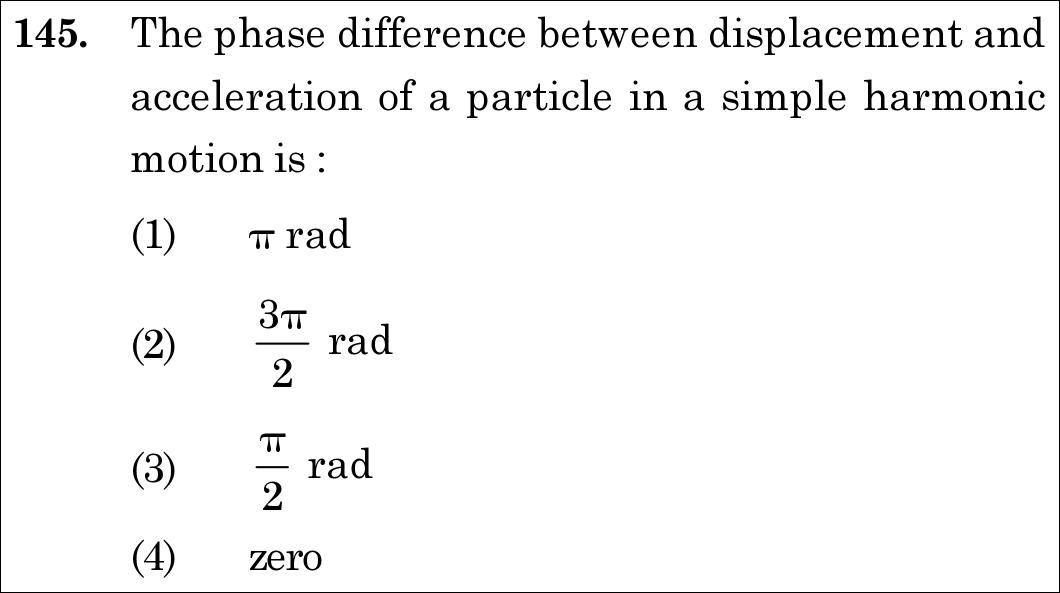
NEET 2020 · Q145 Easy
Official NEET 2020 Question 145 - Oscillations
1 ✓ Key
2
3
4
💡 Verified Solution & 30-Second Hack
✓
Verified Against NTA Final Answer Key
Option (1) : π rad
📚 Oscillations Easy
📋 Given Parameters & Problem Setup
Motion Simple Harmonic Motion (SHM)
Variables Displacement x(t) and Acceleration a(t)
Question Objective Find the phase difference between displacement and acceleration
⚡

The 30-Second Exam Hall Shortcut: ⚡ "a = -ω^2 x = ω^2 x with a minus sign -> MINUS SIGN = π rad (180°) Phase Difference!"

⏱️ 15 seconds

The governing equation of SHM is a=−ω2xa = -\omega^2 x. If displacement is x=Asin⁡(ωt)x = A \sin(\omega t), then acceleration is a=−ω2Asin⁡(ωt)=ω2Asin⁡(ωt+π)a = -\omega^2 A \sin(\omega t) = \omega^2 A \sin(\omega t + \pi). The phase difference between displacement and acceleration is π rad\pi\text{ rad} (180∘180^\circ, exactly in opposite phase)! Mark π rad (Option 1) in 5 seconds.

1 Displacement equation: x(t) = A sin(ωt).
2 Velocity equation: v(t) = dx/dt = Aω cos(ωt) = Aω sin(ωt + π/2) [leads displacement by π/2].
3 Acceleration equation: a(t) = dv/dt = -Aω^2 sin(ωt) = Aω^2 sin(ωt + π).
4 Phase difference: Δφ = (ωt + π) - (ωt) = π rad.
5 Select Option (1) π rad.
🛡️
Why You Can 100% Trust This Shortcut: NCERT Physics · Oscillations (Simple Harmonic Motion: Velocity and Acceleration Phase Relations)
📐

Step-by-Step Rigorous Workflow & Mathematical Proof

Step 1

Define Displacement in SHM

Consider a particle executing simple harmonic motion about the origin. Its displacement as a function of time is given by: x(t)=Asin⁡(ωt)x(t) = A \sin(\omega t) where AA is the amplitude and ω\omega is the angular frequency. The initial phase is ϕx=0\phi_x = 0.

Step 2

Differentiate to Find Velocity and Acceleration

Velocity is the first time derivative of displacement: v(t)=dxdt=Aωcos⁡(ωt)=Aωsin⁡(ωt+π2)v(t) = \frac{dx}{dt} = A \omega \cos(\omega t) = A \omega \sin\left(\omega t + \frac{\pi}{2}\right) Acceleration is the second time derivative of displacement: a(t)=dvdt=−Aω2sin⁡(ωt)a(t) = \frac{dv}{dt} = -A \omega^2 \sin(\omega t)

Step 3

Convert Acceleration into Standard Sine Form

Using the trigonometric identity −sin⁡(θ)=sin⁡(θ+π)-\sin(\theta) = \sin(\theta + \pi): a(t)=Aω2sin⁡(ωt+π)a(t) = A \omega^2 \sin(\omega t + \pi) Here, the phase of acceleration is ϕa=ωt+π\phi_a = \omega t + \pi.

Step 4

Calculate Phase Difference

The phase difference between acceleration and displacement is: Δϕ=ϕa−ϕx=(ωt+π)−(ωt)=π rad=180∘\Delta \phi = \phi_a - \phi_x = (\omega t + \pi) - (\omega t) = \pi\text{ rad} = 180^\circ Physically, when displacement is at its maximum positive value (+A+A), acceleration is directed toward the center at its maximum negative value (−ω2A-\omega^2 A).

⭐

360° Option Elimination Engine Key Feature

Diagnose every choice: Know exactly why the right option works and why distractors fail.

4-Option Deep Scan
1 A
✓ 100% Correct
Verdict & Scientific Reason:

Factually and mathematically exact; displacement and acceleration are opposite in phase (Δϕ=π rad\Delta \phi = \pi\text{ rad}).

💡
Why this is airtight: None; core SHM kinematics relation.
2 B
✗ Incorrect
Verdict & Scientific Reason:

Incorrect; phase difference between velocity and displacement is π/2\pi/2, between acceleration and velocity is π/2\pi/2, so between acceleration and displacement is π\pi, not 3π/23\pi/2.

⚠️
Student Fallacy (Why candidates pick this trap): Adding extra quadrant phase.
3 C
✗ Incorrect
Verdict & Scientific Reason:

Incorrect; π/2 rad\pi/2\text{ rad} is the phase difference between VELOCITY and displacement (or velocity and acceleration), not between acceleration and displacement.

⚠️
Student Fallacy (Why candidates pick this trap): Confusing displacement-acceleration phase difference with displacement-velocity phase difference.
4 D
✗ Incorrect
Verdict & Scientific Reason:

Incorrect; would imply displacement and acceleration are in phase, which violates the restoring nature of SHM (a∝−xa \propto -x).

⚠️
Student Fallacy (Why candidates pick this trap): Ignoring the negative sign in a=−ω2xa = -\omega^2 x.
⚠️

NTA Trap Alert: SHM Phase Hierarchy Ladder

- Between Displacement and Velocity: π/2 rad\pi/2\text{ rad}. - Between Velocity and Acceleration: π/2 rad\pi/2\text{ rad}. - Between Displacement and Acceleration: π rad\pi\text{ rad} (180∘180^\circ).

🛡️ How to avoid the -1 mark: Remember: a=−ω2xa = -\omega^2 x -> Negative sign = π rad\pi\text{ rad} phase difference!
📖

Core NEET Syllabus Standard

Physics · Oscillations Standard Benchmark
Core Scientific Principle Tested:

""

Syllabus Focus: Phase Relations in SHM: Phase Difference Between Displacement and Acceleration
✓ Core NEET UG Syllabus Anchor Syllabus & Academic Standards ↗

Solve 4 NEET Questions a Day — One per Subject

Cover all 1,140 official NEET questions in 285 days at your own pace. Progress is saved on your device. No login needed.