MyCompetitiveExams Logo MyCompetitiveExams
Search 1,140+ Questions
Chapters, formulas, speed tricks
→
⚡ Brahmastra NEET 2027
720 MARKS

Dynamic 180-question full-length simulator mixed dynamically from all 6 years for 2027 & 2026 aspirants.

Launch Brahmastra 2027 Test →
Start Practice →
100% Free · No Login Required
Q.27 Physics ⭐ 360° Option Elimination Active
Vault ↗

NEET 2021 Physics Question 27 Solution

Topic: Oscillations · Official NTA Booklet Code M1
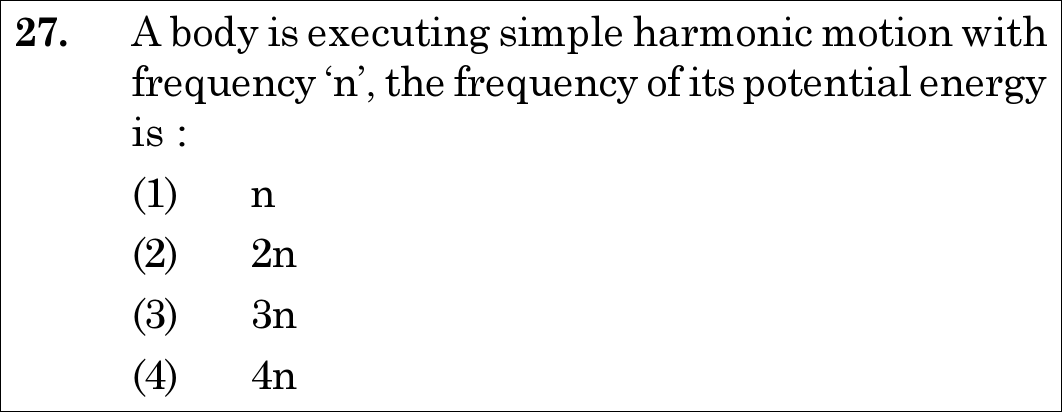
NEET 2021 Physics Question 27: Energy in Simple Harmonic Motion: Frequency of Potential and Kinetic Energy

Question

A body is executing simple harmonic motion with frequency 'n', the frequency of its potential energy is:

✓
Verified Against NTA Final Answer Key
Option (2) : 2n
📚 Oscillations Easy
📋 Given Parameters & Problem Setup
Frequency of SHM Motion n
⚡

The 30-Second Exam Hall Shortcut: ⚡ Double Frequency Rule: Energy Completes 2 Cycles per 1 SHM Cycle

⏱️ Save ~20 seconds

In one full oscillation, the particle passes through the equilibrium position twice and reaches extreme positions twice. Hence, both potential energy and kinetic energy go through two complete cycles of oscillation for every one cycle of displacement: Frequency of PE =2n= 2n! Match Option (2)!

1 Displacement: x(t)=Asin⁡(2πnt)x(t) = A \sin(2\pi n t).
2 Potential Energy: U(t)=12kx2=12kA2sin⁡2(2πnt)U(t) = \frac{1}{2} k x^2 = \frac{1}{2} k A^2 \sin^2(2\pi n t).
3 Use trigonometric identity: sin⁡2θ=1−cos⁡(2θ)2\sin^2\theta = \frac{1 - \cos(2\theta)}{2}.
4 U(t)=14kA2[1−cos⁡(2×2πnt)]=14kA2[1−cos⁡(2π(2n)t)]U(t) = \frac{1}{4} k A^2 [1 - \cos(2 \times 2\pi n t)] = \frac{1}{4} k A^2 [1 - \cos(2\pi (2n) t)].
5 The oscillating term has frequency 2n2n.
6 Match Option (2).
🛡️
Why You Can 100% Trust This Shortcut: Canonical harmonic oscillator trigonometric identity sin⁡2(ωt)=1−cos⁡(2ωt)2\sin^2(\omega t) = \frac{1 - \cos(2\omega t)}{2}.
📐

Step-by-Step Rigorous Workflow & Mathematical Proof

Step 1

Expressing Displacement in Simple Harmonic Motion

For a particle executing simple harmonic motion with frequency nn (angular frequency ω=2πn\omega = 2\pi n) and amplitude AA, displacement from the mean position is:

x(t)=Asin⁡(ωt)=Asin⁡(2πnt)x(t) = A \sin(\omega t) = A \sin(2\pi n t)
Step 2

Formulating Potential Energy as a Function of Time

The potential energy UU of the harmonic oscillator with force constant kk is given by:

U(t)=12kx(t)2=12kA2sin⁡2(ωt)U(t) = \frac{1}{2} k x(t)^2 = \frac{1}{2} k A^2 \sin^2(\omega t)
Step 3

Applying the Power-Reduction Trigonometric Identity

Using the identity sin⁡2(ωt)=1−cos⁡(2ωt)2\sin^2(\omega t) = \frac{1 - \cos(2\omega t)}{2}:

U(t)=14kA2[1−cos⁡(2ωt)]=14kA2−14kA2cos⁡(2ωt)U(t) = \frac{1}{4} k A^2 \left[1 - \cos(2\omega t)\right] = \frac{1}{4} k A^2 - \frac{1}{4} k A^2 \cos(2\omega t)
Step 4

Determining the Frequency of the Oscillating Energy Term

The time-dependent harmonic term cos⁡(2ωt)\cos(2\omega t) has angular frequency ω′=2ω\omega' = 2\omega. Since ω=2πn\omega = 2\pi n:

ω′=2(2πn)=2π(2n)  ⟹  Frequency f′=2n\omega' = 2(2\pi n) = 2\pi (2n) \implies \text{Frequency } f' = 2n
⭐

360° Option Elimination Engine Key Feature

Diagnose every choice: Know exactly why the right option works and why distractors fail.

4-Option Deep Scan
1 1
✗ Incorrect
Verdict & Scientific Reason:

This is the frequency of displacement, velocity, and acceleration, but energy depends on the square of displacement (x2x^2), doubling its frequency.

⚠️
Student Fallacy (Why candidates pick this trap): Assuming energy oscillates at the same frequency as displacement.
2 2
✓ 100% Correct
Verdict & Scientific Reason:

Exact frequency of potential energy oscillations: ω′=2ω  ⟹  f′=2n\omega' = 2\omega \implies f' = 2n.

💡
Why this is airtight: None; rigorous mathematical SHM analysis.
3 3
✗ Incorrect
Verdict & Scientific Reason:

Unphysical harmonic multiplier.

⚠️
Student Fallacy (Why candidates pick this trap): Conflating third harmonics with quadratic functions.
4 4
✗ Incorrect
Verdict & Scientific Reason:

Incorrect quadrupling of frequency.

⚠️
Student Fallacy (Why candidates pick this trap): Confusing 4 quadrants of motion with frequency.
⚠️

NTA Trap Alert: Displacement Frequency vs. Energy Frequency Trap

Students frequently assume all parameters in SHM have frequency nn. Displacement, velocity, and acceleration have frequency nn. Kinetic energy and potential energy have frequency 2n2n. Total energy has frequency 00 (constant).

🛡️ How to avoid the -1 mark: Remember: x,v,ax, v, a oscillate at nn. Kinetic energy and potential energy oscillate at 2n2n. Total energy is constant (frequency = 0).
📖

Core NEET Syllabus Standard

NCERT Physics · Oscillations Standard Benchmark
Core Scientific Principle Tested:

"Both kinetic and potential energies of a particle in SHM vary periodically with twice the frequency of the displacement motion (f′=2nf' = 2n)."

Syllabus Focus: Energy in Simple Harmonic Motion
✓ Core NEET UG Syllabus Anchor Syllabus & Academic Standards ↗

Ready to attempt under real exam pressure?

Test your speed and accuracy in the authentic 200-minute timed NTA simulator.

Launch NEET 2021 CBT Test →

Spotted a mistake in this solution? Report an error (support@mycompetitiveexams.com)

⚖️ Legal & Fair Dealing Notice: Sourced from publicly released NEET 2021 question papers and NEET answer keys for private study, research, and non-commercial educational practice under Fair Dealing (Section 52(1)(a) of the Indian Copyright Act, 1957). Not affiliated with or endorsed by NTA or NMC.

Solve 4 NEET Questions a Day — One per Subject

Cover all 1,140 official NEET questions in 285 days at your own pace. Progress is saved on your device. No login needed.