MyCompetitiveExams Logo MyCompetitiveExams
Search 1,140+ Questions
Chapters, formulas, speed tricks
→
⚡ Brahmastra NEET 2027
720 MARKS

Dynamic 180-question full-length simulator mixed dynamically from all 6 years for 2027 & 2026 aspirants.

Launch Brahmastra 2027 Test →
Start Practice →
100% Free · No Login Required
🌿 Botany 📌 Standard Frequency (~1–2 Qs/Year)

NEET Mineral Nutrition Previous Year Questions with Solutions

Complete repository of official NTA NEET questions for Mineral Nutrition from 2020 to 2026. Every question includes 30-second elimination tricks, step-by-step NCERT solutions, option-by-option traps, and official answer keys.

5 Questions 3 Exam Years (2023, 2021, 2020) 5 Easy · 0 Medium · 0 Challenging
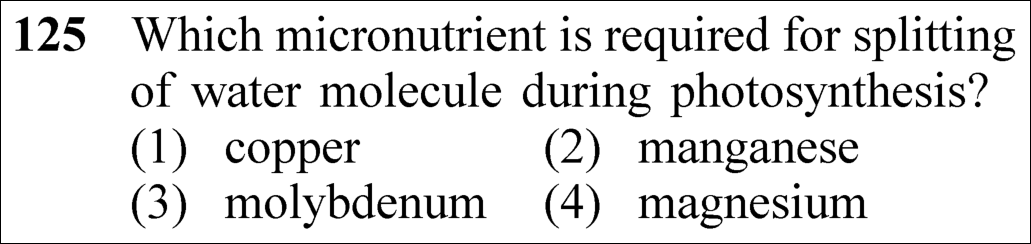
NEET 2023 · Q125 Easy
Official NEET 2023 Question 125 - Mineral Nutrition
1 copper
2 manganese ✓ Key
3 molybdenum
4 magnesium
💡 Verified Solution & 30-Second Hack
✓
Verified Against NTA Final Answer Key
Option (2) : manganese
📚 Mineral Nutrition Easy
📋 Given Parameters & Problem Setup
Biochemical Event Splitting of water (Photolysis) in PS II
Nutrient Category Micronutrient (Trace element)
⚡

The 30-Second Exam Hall Shortcut: ⚡ Photolysis of Water = Manganese (MnMn) & Chlorine (ClCl)

⏱️ Save ~20 seconds

The oxygen-evolving complex (OEC) of PS II contains a catalytic cluster of 4 manganese atoms (Mn4CaO5Mn_4CaO_5). NCERT explicitly states: "The best defined function of manganese is in the splitting of water to liberate oxygen during photosynthesis!"

1 Copper: Component of plastocyanin and cytochrome oxidase, redox reactions.
2 Molybdenum: Component of nitrogenase and nitrate reductase.
3 Magnesium: Central ring atom in chlorophyll, activator for RuBisCO/PEPCase (Macronutrient).
4 Manganese: Photolysis of water to liberate oxygen (Micronutrient).
5 Match Option (2) manganese.
🛡️
Why You Can 100% Trust This Shortcut: Canonical NCERT Mineral Nutrition micronutrient physiological roles.
📐

Step-by-Step Rigorous Workflow & Mathematical Proof

Step 1

Mechanism of Water Splitting in Photosystem II

Photolysis occurs on the inner (lumenal) face of the thylakoid membrane associated with PS II, requiring manganese (Mn2+Mn^{2+}), calcium (Ca2+Ca^{2+}), and chloride (Cl−Cl^-) ions:

2H2O→[Mn4CaO5 cluster]4H++4e−+O2↑2H_2O \xrightarrow{[Mn_4CaO_5\text{ cluster}]} 4H^+ + 4e^- + O_2\uparrow
Step 2

Verbatim NCERT Association

Under Manganese (MnMn), NCERT explicitly declares: "The best defined function of manganese is in the splitting of water to liberate oxygen during photosynthesis."
Step 3

Nutrient Classification Clarification

The question specifically stipulates "micronutrient". While magnesium (MgMg) is essential for photosynthesis as the central porphyrin ring coordinator of chlorophyll, magnesium is a macronutrient, whereas manganese is a micronutrient.

⭐

360° Option Elimination Engine Key Feature

Diagnose every choice: Know exactly why the right option works and why distractors fail.

4-Option Deep Scan
1 1
✗ Incorrect
Verdict & Scientific Reason:

Copper participates in electron transfer as a component of plastocyanin, but does not split water.

⚠️
Student Fallacy (Why candidates pick this trap): Confusing plastocyanin copper with the water-splitting complex.
2 2
✓ 100% Correct
Verdict & Scientific Reason:

Matches NCERT verbatim: manganese is the key catalytic micronutrient required for the photolysis of water.

💡
Why this is airtight: None; textbook verbatim.
3 3
✗ Incorrect
Verdict & Scientific Reason:

Molybdenum is an essential cofactor for nitrogenase and nitrate reductase in nitrogen metabolism.

⚠️
Student Fallacy (Why candidates pick this trap): Confusing nitrogen fixation enzymes with oxygen-evolving complexes.
4 4
✗ Incorrect
Verdict & Scientific Reason:

Magnesium is a macronutrient coordinated in the central ring of chlorophyll and an activator of RuBisCO; it does not split water.

⚠️
Student Fallacy (Why candidates pick this trap): Overlooking that magnesium is a macronutrient and does not catalyze photolysis.
⚠️

NTA Trap Alert: Manganese vs. Magnesium Trap

Students frequently mix up Manganese (MnMn, micronutrient for photolysis) with Magnesium (MgMg, macronutrient in chlorophyll core).

🛡️ How to avoid the -1 mark: Remember: Mg = in the middle of Green chlorophyll (Macro). Mn = split water to Make oxygen (Micro).
📖

Core NEET Syllabus Standard

NCERT Biology · Mineral Nutrition Standard Benchmark
Core Scientific Principle Tested:

"The best defined function of manganese is in the splitting of water to liberate oxygen during photosynthesis."
Syllabus Focus: Essential Mineral Elements (Manganese)
✓ Core NEET UG Syllabus Anchor Syllabus & Academic Standards ↗
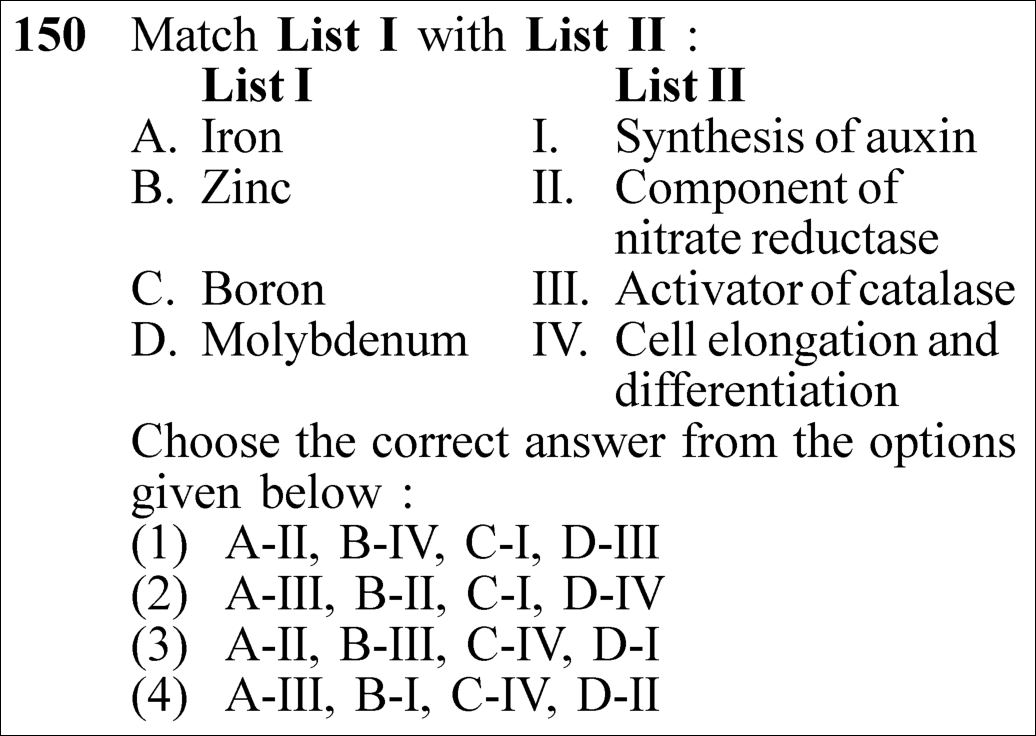
NEET 2023 · Q150 Easy
Official NEET 2023 Question 150 - Mineral Nutrition
1
2
3
4 ✓ Key
💡 Verified Solution & 30-Second Hack
✓
Verified Against NTA Final Answer Key
Option (4) : A-III, B-I, C-IV, D-II
📚 Mineral Nutrition Easy
📋 Given Parameters & Problem Setup
List I (Micronutrients) Iron (Fe), Zinc (Zn), Boron (B), Molybdenum (Mo)
List II (Functions) Auxin synthesis, Nitrate reductase component, Catalase activator, Cell elongation and differentiation
⚡

The 30-Second Exam Hall Shortcut: ⚡ Micronutrient Function Fingerprints

⏱️ Save ~25 seconds

Match each mineral to its unique physiological fingerprint: Iron activates Catalase (III). Zinc is needed for Auxin synthesis (I). Boron mediates Cell elongation and pollen germination (IV). Molybdenum is a cofactor of Nitrate reductase (II)! Match Option (4)!

1 Iron (Fe): Activator of catalase enzyme and involved in electron transfer (ferredoxin/cytochrome) -> A-III.
2 Zinc (Zn): Needed for synthesis of auxin (tryptophan-dependent pathway) -> B-I.
3 Boron (B): Required for pollen germination, cell elongation, and differentiation -> C-IV.
4 Molybdenum (Mo): Component of nitrate reductase and nitrogenase -> D-II.
5 Match combination: A-III, B-I, C-IV, D-II -> Option (4).
🛡️
Why You Can 100% Trust This Shortcut: Canonical NCERT Mineral Nutrition essential micronutrient physiological roles inventory.
📐

Step-by-Step Rigorous Workflow & Mathematical Proof

Step 1

Verbatim NCERT Physiological Functions of Micronutrients

Analyzing the specific biochemical roles assigned to each trace element in NCERT:

A. Iron (Fe):It activates catalase enzyme and is essential for chlorophyll formation  ⟹  IIIB. Zinc (Zn):It is needed in the synthesis of auxin  ⟹  IC. Boron (B):Required for pollen germination, cell elongation, and differentiation  ⟹  IVD. Molybdenum (Mo):It is a component of several enzymes, including nitrate reductase  ⟹  II\begin{aligned} \text{\textbf{A. Iron (Fe):}} & \quad \text{It activates catalase enzyme and is essential for chlorophyll formation} \implies \mathbf{\text{III}} \\[4pt] \text{\textbf{B. Zinc (Zn):}} & \quad \text{It is needed in the synthesis of auxin} \implies \mathbf{\text{I}} \\[4pt] \text{\textbf{C. Boron (B):}} & \quad \text{Required for pollen germination, cell elongation, and differentiation} \implies \mathbf{\text{IV}} \\[4pt] \text{\textbf{D. Molybdenum (Mo):}} & \quad \text{It is a component of several enzymes, including nitrate reductase} \implies \mathbf{\text{II}} \end{aligned}
Step 2

Elimination Strategy

A maps to III (immediately eliminates Options 1 and 3). B maps to I (confirms Option 4, while Option 2 incorrectly pairs B with II).

Step 3

Biochemical Corroboration

Nitrate reductase requires a molybdenum cofactor (MoCo). Auxin synthesis from tryptophan requires Zn2+Zn^{2+}-dependent enzymes. Catalase is a heme-iron enzyme containing ferric iron.

⭐

360° Option Elimination Engine Key Feature

Diagnose every choice: Know exactly why the right option works and why distractors fail.

4-Option Deep Scan
1 1
✗ Incorrect
Verdict & Scientific Reason:

Mismatches Iron with nitrate reductase (molybdenum).

⚠️
Student Fallacy (Why candidates pick this trap): Confusing iron enzymes with molybdenum enzymes.
2 2
✗ Incorrect
Verdict & Scientific Reason:

Mismatches Zinc with nitrate reductase and Boron with auxin.

⚠️
Student Fallacy (Why candidates pick this trap): Swapping zinc and molybdenum roles.
3 3
✗ Incorrect
Verdict & Scientific Reason:

Mismatches iron with nitrate reductase and zinc with catalase.

⚠️
Student Fallacy (Why candidates pick this trap): Scrambling multiple metalloenzyme functions.
4 4
✓ 100% Correct
Verdict & Scientific Reason:

Flawless 1-to-1 match with the canonical NCERT micronutrient roles.

💡
Why this is airtight: None; exact textbook recall.
⚠️

NTA Trap Alert: Zinc vs. Boron vs. Molybdenum Enzyme Assignment Trap

Students frequently remember that all these micronutrients act on enzymes, but interchange their targets: Zn with nitrate reductase or Mo with auxin.

🛡️ How to avoid the -1 mark: Remember: Zn = Auxin (zinc for hormones). Mo = Nitrogen/Nitrate reductase. Fe = Catalase. B = Pollen & cell elongation.
📖

Core NEET Syllabus Standard

NCERT Biology · Mineral Nutrition Standard Benchmark
Core Scientific Principle Tested:

"Iron activates catalase; Zinc is needed for auxin synthesis; Boron is required for cell elongation and differentiation; Molybdenum is a component of nitrate reductase."

Syllabus Focus: Essential Mineral Elements
✓ Core NEET UG Syllabus Anchor Syllabus & Academic Standards ↗
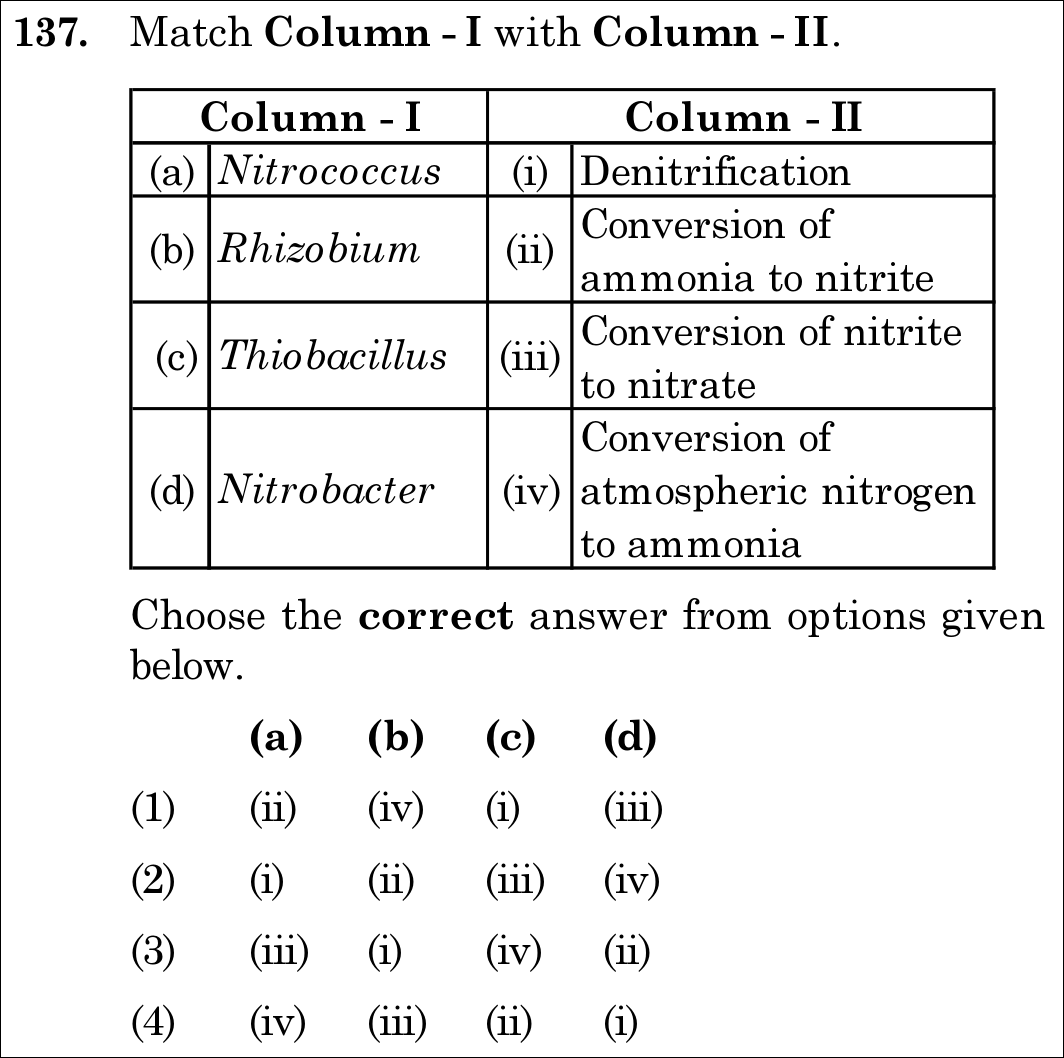
NEET 2021 · Q137 Easy
Official NEET 2021 Question 137 - Mineral Nutrition
1 (ii) (iv) (i) (iii) ✓ Key
2 (i) (ii) (iii) (iv)
3 (iii) (i) (iv) (ii)
4 (iv) (iii) (ii) (i)
💡 Verified Solution & 30-Second Hack
✓
Verified Against NTA Final Answer Key
Option (1) : (a)-(ii), (b)-(iv), (c)-(i), (d)-(iii)
📚 Mineral Nutrition Easy
📋 Given Parameters & Problem Setup
Column I (Microbes) (a) Nitrococcus, (b) Rhizobium, (c) Thiobacillus, (d) Nitrobacter
Column II (Processes) (i) Denitrification, (ii) Ammonia to nitrite, (iii) Nitrite to nitrate, (iv) Atmospheric nitrogen to ammonia
⚡

The 30-Second Exam Hall Shortcut: ⚡ Fast Nitrogen Pairing: Rhizobium Fixes N2 (b-iv) & Thiobacillus Denitrifies (c-i)

⏱️ Save ~20 seconds

Nitrococcus converts Ammonia →\to Nitrite (a-ii); Rhizobium fixes N2 →\to NH3 (b-iv); Thiobacillus/Pseudomonas carry out Denitrification (c-i); Nitrobacter converts Nitrite →\to Nitrate (d-iii). Gives (a)-(ii), (b)-(iv), (c)-(i), (d)-(iii)   ⟹  \implies Option (1)!

1 (a) Nitrococcus (and Nitrosomonas): 2NH3+3O2→2NO2−+2H++2H2O  ⟹  2\text{NH}_3 + 3\text{O}_2 \to 2\text{NO}_2^- + 2\text{H}^+ + 2\text{H}_2\text{O} \implies (ii).
2 (b) Rhizobium: Symbiotic biological nitrogen fixation (N2→NH3N_2 \to NH_3)   ⟹  \implies (iv).
3 (c) Thiobacillus (and Pseudomonas): Denitrification (NO3−→N2NO_3^- \to N_2)   ⟹  \implies (i).
4 (d) Nitrobacter: 2NO2−+O2→2NO3−  ⟹  2\text{NO}_2^- + \text{O}_2 \to 2\text{NO}_3^- \implies (iii).
5 Match Option (1).
🛡️
Why You Can 100% Trust This Shortcut: Canonical NCERT Mineral Nutrition on Nitrogen Cycle and Microorganisms.
📐

Step-by-Step Rigorous Workflow & Mathematical Proof

Step 1

Microbiological Steps of the Nitrogen Cycle

The biological transformation of nitrogen involves distinct specialized bacterial taxa:

1. Ammonia to Nitrite:2NH3+3O2→Nitrosomonas / Nitrococcus2NO2−+2H++2H2O  ⟹  (a)-(ii)2. Nitrite to Nitrate:2NO2−+O2→Nitrobacter2NO3−  ⟹  (d)-(iii)3. Nitrogen Fixation:N2+8e−+8H++16ATP→Rhizobium2NH3+H2+16ADP+16Pi  ⟹  (b)-(iv)4. Denitrification:NO3−→Pseudomonas / ThiobacillusN2  ⟹  (c)-(i)\begin{aligned} \text{\textbf{1. Ammonia to Nitrite:}} & \quad 2\text{NH}_3 + 3\text{O}_2 \xrightarrow{\text{\textit{Nitrosomonas} / \textit{Nitrococcus}}} 2\text{NO}_2^- + 2\text{H}^+ + 2\text{H}_2\text{O} \implies \text{(a)-(ii)} \\[4pt] \text{\textbf{2. Nitrite to Nitrate:}} & \quad 2\text{NO}_2^- + \text{O}_2 \xrightarrow{\text{\textit{Nitrobacter}}} 2\text{NO}_3^- \implies \text{(d)-(iii)} \\[4pt] \text{\textbf{3. Nitrogen Fixation:}} & \quad \text{N}_2 + 8\text{e}^- + 8\text{H}^+ + 16\text{ATP} \xrightarrow{\text{\textit{Rhizobium}}} 2\text{NH}_3 + \text{H}_2 + 16\text{ADP} + 16\text{P}_i \implies \text{(b)-(iv)} \\[4pt] \text{\textbf{4. Denitrification:}} & \quad \text{NO}_3^- \xrightarrow{\text{\textit{Pseudomonas} / \textit{Thiobacillus}}} \text{N}_2 \implies \text{(c)-(i)} \end{aligned}
Step 2

Matching Assembly

The correspondence yields (a)-(ii), (b)-(iv), (c)-(i), (d)-(iii), which is uniquely found in Option (1).

⭐

360° Option Elimination Engine Key Feature

Diagnose every choice: Know exactly why the right option works and why distractors fail.

4-Option Deep Scan
1 1
✓ 100% Correct
Verdict & Scientific Reason:

Every bacterial species is mapped precisely to its biochemical metabolic step in the nitrogen cycle.

💡
Why this is airtight: None. Textbook accurate mapping.
2 2
✗ Incorrect
Verdict & Scientific Reason:

Mismatches Nitrococcus with denitrification and Nitrobacter with nitrogen fixation.

⚠️
Student Fallacy (Why candidates pick this trap): Confusing nitrifiers with denitrifiers.
3 3
✗ Incorrect
Verdict & Scientific Reason:

Inverts Nitrococcus with Nitrobacter and Rhizobium with denitrification.

⚠️
Student Fallacy (Why candidates pick this trap): Swapping step 1 and step 2 of nitrification.
4 4
✗ Incorrect
Verdict & Scientific Reason:

Gross misassignment across all four bacterial classes.

⚠️
Student Fallacy (Why candidates pick this trap): Random guessing.
⚠️

NTA Trap Alert: Nitrosomonas/Nitrococcus vs Nitrobacter Step Inversion

Nitrosomonas and Nitrococcus convert NH3 to NO2- (Nitrite). Nitrobacter converts NO2- to NO3- (Nitrate).

🛡️ How to avoid the -1 mark: Alphabetical memory: "Coccus comes before Bacter"   ⟹  \implies Nitrococcus first (NH3→NO2−NH_3 \to NO_2^-), Nitrobacter second (NO2−→NO3−NO_2^- \to NO_3^-).
📖

Core NEET Syllabus Standard

NEET / NCERT Biology · Mineral Nutrition Standard Benchmark
Core Scientific Principle Tested:

"Ammonia is oxidized to nitrite by Nitrosomonas and/or Nitrococcus. Nitrite is oxidized to nitrate by Nitrobacter. Denitrification is carried out by Pseudomonas and Thiobacillus."

Syllabus Focus: Metabolism of Nitrogen: Nitrogen Cycle
✓ Core NEET UG Syllabus Anchor Syllabus & Academic Standards ↗
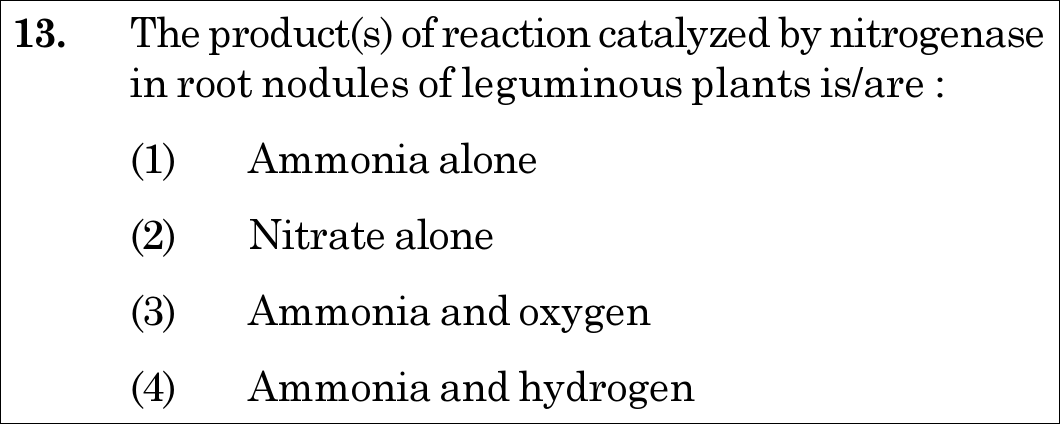
NEET 2020 · Q13 Easy
Official NEET 2020 Question 13 - Mineral Nutrition
1 Ammonia alone
2 Nitrate alone
3 Ammonia and oxygen
4 Ammonia and hydrogen ✓ Key
💡 Verified Solution & 30-Second Hack
✓
Verified Against NTA Final Answer Key
Option (4) : Ammonia and hydrogen
📚 Mineral Nutrition Easy
📋 Given Parameters & Problem Setup
Enzyme Nitrogenase (Mo-Fe protein complex)
Location Root nodules of leguminous plants (Bacteroids)
Question Objective Identify the product(s) of the reaction catalyzed by nitrogenase
⚡

The 30-Second Exam Hall Shortcut: ⚡ "Nitrogenase Reaction: N₂ + 8e⁻ + 8H⁺ + 16 ATP → 2 NH₃ + H₂ (Ammonia AND Hydrogen!)"

⏱️ Save ~20 seconds

The balanced biochemical equation for biological nitrogen fixation catalyzed by nitrogenase is: N₂ + 8e⁻ + 8H⁺ + 16 ATP → 2 NH₃ + H₂ + 16 ADP + 16 Pi. The products are AMMONIA AND HYDROGEN! Option (4) is 100% correct.

1 Recall the balanced nitrogenase stoichiometry from NCERT: N2+8e−+8H++16ATP→2NH3+H2+16ADP+16PiN_2 + 8e^- + 8H^+ + 16\text{ATP} \to 2\text{NH}_3 + \text{H}_2 + 16\text{ADP} + 16\text{P}_i.
2 Identify molecular products: 2 molecules of Ammonia (NH3\text{NH}_3) and 1 molecule of Hydrogen gas (H2\text{H}_2).
3 Discard Option (1) "Ammonia alone" (ignores obligatory stoichiometric H2H_2).
4 Discard Option (3) "Ammonia and oxygen" (nitrogenase is irreversibly poisoned by oxygen!).
5 Select Option (4): Ammonia and hydrogen.
🛡️
Why You Can 100% Trust This Shortcut: NCERT Biology · Mineral Nutrition (Metabolism of Nitrogen: The enzyme nitrogenase is a Mo-Fe protein and catalyses the conversion of atmospheric nitrogen to ammonia: N2 + 8e- + 8H+ + 16ATP -> 2NH3 + H2 + 16ADP + 16Pi).
📐

Step-by-Step Rigorous Workflow & Mathematical Proof

Step 1

Biochemical Mechanism and Stoichiometry of Nitrogenase

Biological nitrogen fixation is carried out exclusively by prokaryotes containing the oxygen-sensitive enzyme complex nitrogenase (consisting of an Fe protein dinitrogenase reductase and a Mo-Fe protein dinitrogenase): - The reduction of one mole of dinitrogen (N2N_2) to two moles of ammonia (NH3\text{NH}_3) is an energetically demanding, multi-step electron transfer process requiring 8 electrons and 8 protons. - Obligatory Proton Reduction: During the catalytic cycle, two electrons are obligatorily consumed to reduce two protons into molecular hydrogen gas (H2\text{H}_2). - Balanced Chemical Equation: N2+8e−+8H++16ATP→Nitrogenase2NH3+H2+16ADP+16Pi\text{N}_2 + 8e^- + 8\text{H}^+ + 16\text{ATP} \xrightarrow{\text{Nitrogenase}} 2\text{NH}_3 + \text{H}_2 + 16\text{ADP} + 16\text{P}_i - Thus, the definitive chemical products of the reaction are Ammonia and Hydrogen.

N2+8e−+8H++16ATP→Nitrogenase2 NH3+H2+16ADP+16PiN_2 + 8e^- + 8H^+ + 16\text{ATP} \xrightarrow{\mathbf{Nitrogenase}} \mathbf{2\,NH_3} + \mathbf{H_2} + 16\text{ADP} + 16P_i
Step 2

Critical Anaerobic Requirement

Nitrogenase is highly susceptible to irreversible oxidative denaturation by molecular oxygen. In legume root nodules, the oxygen-scavenging hemoprotein leghemoglobin maintains an anaerobic microenvironment. Therefore, oxygen can never be a product of this reaction.

⭐

360° Option Elimination Engine Key Feature

Diagnose every choice: Know exactly why the right option works and why distractors fail.

4-Option Deep Scan
1 A
✗ Incorrect
Verdict & Scientific Reason:

Incorrect. While ammonia is the primary nitrogenous product, 1 mole of hydrogen gas (H2) is obligatorily co-produced.

⚠️
Student Fallacy (Why candidates pick this trap): Forgetting the stoichiometry of the electron transfer cycle that generates H2.
2 B
✗ Incorrect
Verdict & Scientific Reason:

Incorrect. Nitrate is produced by nitrifying bacteria (Nitrobacter), not by nitrogenase.

⚠️
Student Fallacy (Why candidates pick this trap): Confusing nitrification with biological nitrogen fixation.
3 C
✗ Incorrect
Verdict & Scientific Reason:

Incorrect. Nitrogenase operates strictly under anaerobic conditions; oxygen is never produced.

⚠️
Student Fallacy (Why candidates pick this trap): Confusing photosynthesis (water photolysis producing O2) with nitrogen fixation.
4 D
✓ 100% Correct
Verdict & Scientific Reason:

Correct. Matches the verbatim stoichiometric equation from NCERT: 2 NH3 + H2.

💡
Why this is airtight: None. Candidate accurately recalls the balanced nitrogenase equation.
⚠️

NTA Trap Alert: The "Ammonia Alone" Incomplete Reduction Trap

Most students loosely define nitrogen fixation as "converting N₂ to NH₃" and hastily pick "Ammonia alone" (Option 1). NCERT explicitly emphasizes that reduction of N₂ requires 8 electrons, releasing 1 mole of H₂ alongside 2 moles of NH₃.

🛡️ How to avoid the -1 mark: Commit the equation to memory: N₂ + 8e⁻ + 8H⁺ → 2 NH₃ + H₂.
📖

Core NEET Syllabus Standard

NEET / NCERT Biology · Mineral Nutrition Standard Benchmark
Core Scientific Principle Tested:

"Nitrogenase catalyzes the reaction: N2 + 8e- + 8H+ + 16ATP -> 2NH3 + H2 + 16ADP + 16Pi."

Syllabus Focus: Biological Nitrogen Fixation
✓ Core NEET UG Syllabus Anchor Syllabus & Academic Standards ↗
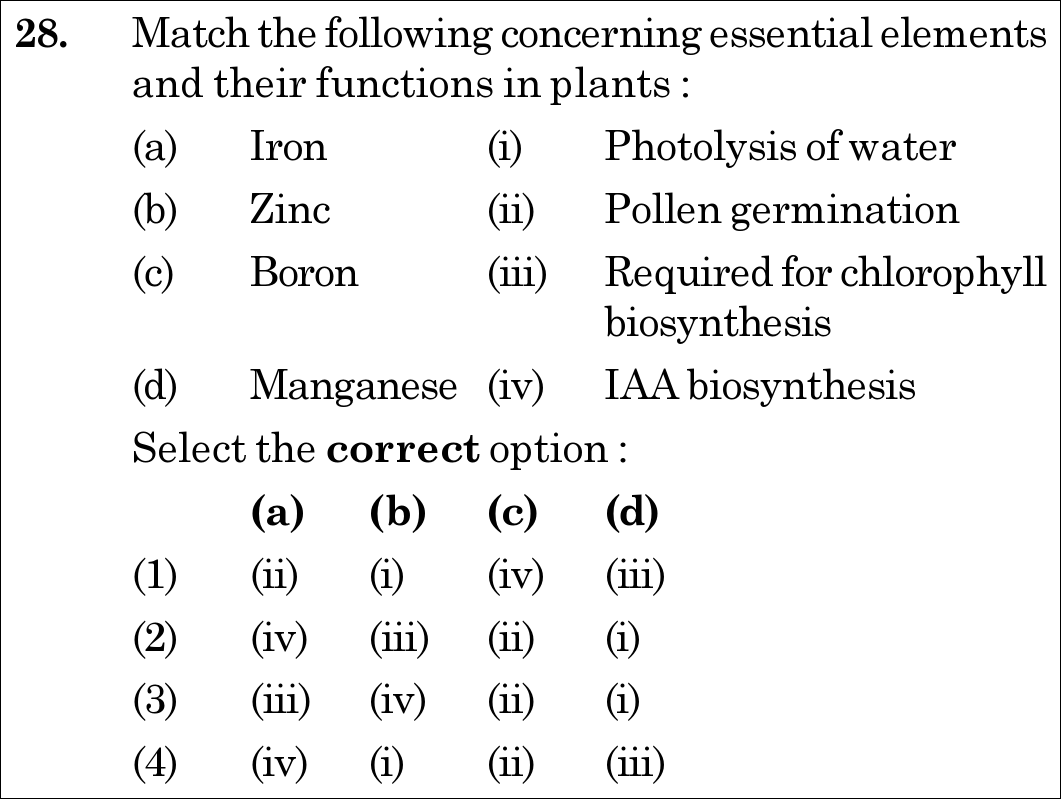
NEET 2020 · Q28 Easy
Official NEET 2020 Question 28 - Mineral Nutrition
1 (ii) (i) (iv) (iii)
2 (iv) (iii) (ii) (i)
3 (iii) (iv) (ii) (i) ✓ Key
4 (iv) (i) (ii) (iii)
💡 Verified Solution & 30-Second Hack
✓
Verified Against NTA Final Answer Key
Option (3) : (a)-(iii), (b)-(iv), (c)-(ii), (d)-(i)
📚 Mineral Nutrition Easy
📋 Given Parameters & Problem Setup
Column I (Micronutrients) (a) Iron, (b) Zinc, (c) Boron, (d) Manganese
Column II (Physiological Roles) (i) Photolysis of water, (ii) Pollen germination, (iii) Required for chlorophyll biosynthesis, (iv) IAA biosynthesis
⚡

The 30-Second Exam Hall Shortcut: ⚡ "Mn = Water Splitting, Boron = Pollen Germination, Zinc = Auxin (IAA)!"

⏱️ Save ~25 seconds

Manganese (along with Chlorine) splits water during non-cyclic photophosphorylation ((d)-(i)). Boron is required for pollen germination and carbohydrate translocation ((c)-(ii)). Zinc is an essential cofactor for auxin (IAA) biosynthesis ((b)-(iv)). Iron is essential for chlorophyll biosynthesis ((a)-(iii)). Match is (iii), (iv), (ii), (i) -> Option (3)!

1 Match (d) Manganese -> (i) Photolysis of water (best-known function in PS II oxygen-evolving complex).
2 Match (c) Boron -> (ii) Pollen germination (borate complexes aid pollen tube elongation).
3 Match (b) Zinc -> (iv) IAA biosynthesis (tryptophan-dependent auxin synthesis requires zinc).
4 Match (a) Iron -> (iii) Required for chlorophyll biosynthesis (activates aminolevulinic acid dehydratase).
5 Match pattern (iii), (iv), (ii), (i) -> Select Option (3).
🛡️
Why You Can 100% Trust This Shortcut: NCERT Biology · Mineral Nutrition (Essential Mineral Elements: Iron is essential for the formation of chlorophyll; Zinc is needed in the synthesis of auxin (IAA); Boron is required for pollen germination and carbohydrate translocation; Manganese is involved in the splitting of water to liberate oxygen during photosynthesis).
📐

Step-by-Step Rigorous Workflow & Mathematical Proof

Step 1

Physiological Profiling of Essential Plant Micronutrients

- (a) Iron (Fe3+Fe^{3+} / Fe2+Fe^{2+}): Constituent of cytochromes and ferredoxin in electron transport; reversibly oxidized during redox reactions. Although not a structural constituent of the chlorophyll porphyrin ring (which contains Mg2+Mg^{2+}), iron is an indispensable cofactor required for chlorophyll biosynthesis. - (b) Zinc (Zn2+Zn^{2+}): Activates diverse dehydrogenases and carbonic anhydrase; plays an obligatory catalytic role in the enzymatic biosynthesis of auxin (indole-3-acetic acid, IAA) from its amino acid precursor tryptophan. - (c) Boron (BO33−BO_3^{3-} / B4O72−B_4O_7^{2-}): Essential for Ca2+Ca^{2+} uptake and utilization, membrane functioning, cell elongation, carbohydrate translocation via phloem, and pollen germination. - (d) Manganese (Mn2+Mn^{2+}): Best known for its role in the photolysis of water (splitting of water) to evolve molecular oxygen (O2O_2) during light reactions of photosynthesis in Photosystem II.

Iron (Fe)  ⟺  Chlorophyll biosynthesis[(a)→(iii)]Zinc (Zn)  ⟺  IAA (Auxin) biosynthesis[(b)→(iv)]Boron (B)  ⟺  Pollen germination[(c)→(ii)]Manganese (Mn)  ⟺  Photolysis of water[(d)→(i)]\begin{aligned} \text{Iron (Fe)} &\iff \text{Chlorophyll biosynthesis} \quad [\text{(a)} \to \text{(iii)}] \\ \text{Zinc (Zn)} &\iff \text{IAA (Auxin) biosynthesis} \quad [\text{(b)} \to \text{(iv)}] \\ \text{Boron (B)} &\iff \text{Pollen germination} \quad [\text{(c)} \to \text{(ii)}] \\ \text{Manganese (Mn)} &\iff \text{Photolysis of water} \quad [\text{(d)} \to \text{(i)}] \end{aligned}
Step 2

Option Alignment

Matching sequence is: (a)-(iii), (b)-(iv), (c)-(ii), (d)-(i). This corresponds perfectly to Option (3).

⭐

360° Option Elimination Engine Key Feature

Diagnose every choice: Know exactly why the right option works and why distractors fail.

4-Option Deep Scan
1 A
✗ Incorrect
Verdict & Scientific Reason:

Incorrect. Assigns iron to pollen germination and zinc to photolysis of water.

⚠️
Student Fallacy (Why candidates pick this trap): Random misattribution of micronutrient roles.
2 B
✗ Incorrect
Verdict & Scientific Reason:

Incorrect. Swaps iron and zinc roles.

⚠️
Student Fallacy (Why candidates pick this trap): Confusing auxin synthesis with chlorophyll synthesis.
3 C
✓ 100% Correct
Verdict & Scientific Reason:

Correct. Accurately links all 4 micronutrients to their verbatim NCERT physiological functions.

💡
Why this is airtight: None. Candidate recalls the precise functions of plant mineral nutrients.
4 D
✗ Incorrect
Verdict & Scientific Reason:

Incorrect. Assigns manganese to chlorophyll biosynthesis.

⚠️
Student Fallacy (Why candidates pick this trap): Confusing magnesium (central in chlorophyll) with manganese.
⚠️

NTA Trap Alert: Magnesium vs Manganese & Chlorophyll Iron Trap

Students often get confused: Magnesium (MgMg) is the *central atom* in the chlorophyll ring; Iron (FeFe) is *required for the biosynthesis* of chlorophyll; and Manganese (MnMn) *splits water*. Do not confuse Mg, Mn, and Fe.

🛡️ How to avoid the -1 mark: Remember: Mn = Water splitting; Mg = In chlorophyll ring; Fe = Needed to make chlorophyll.
📖

Core NEET Syllabus Standard

NEET / NCERT Biology · Mineral Nutrition Standard Benchmark
Core Scientific Principle Tested:

"Iron is required for chlorophyll formation; zinc for auxin synthesis; boron for pollen germination; manganese for water photolysis."

Syllabus Focus: Role of Micronutrients
✓ Core NEET UG Syllabus Anchor Syllabus & Academic Standards ↗

Solve 4 NEET Questions a Day — One per Subject

Cover all 1,140 official NEET questions in 285 days at your own pace. Progress is saved on your device. No login needed.