MyCompetitiveExams Logo MyCompetitiveExams
Search 1,140+ Questions
Chapters, formulas, speed tricks
→
⚡ Brahmastra NEET 2027
720 MARKS

Dynamic 180-question full-length simulator mixed dynamically from all 6 years for 2027 & 2026 aspirants.

Launch Brahmastra 2027 Test →
Start Practice →
100% Free · No Login Required
🧬 Zoology 📌 Standard Frequency (~1–2 Qs/Year)

NEET Environmental Issues Previous Year Questions with Solutions

Complete repository of official NTA NEET questions for Environmental Issues from 2020 to 2026. Every question includes 30-second elimination tricks, step-by-step NCERT solutions, option-by-option traps, and official answer keys.

7 Questions 3 Exam Years (2023, 2021, 2020) 7 Easy · 0 Medium · 0 Challenging
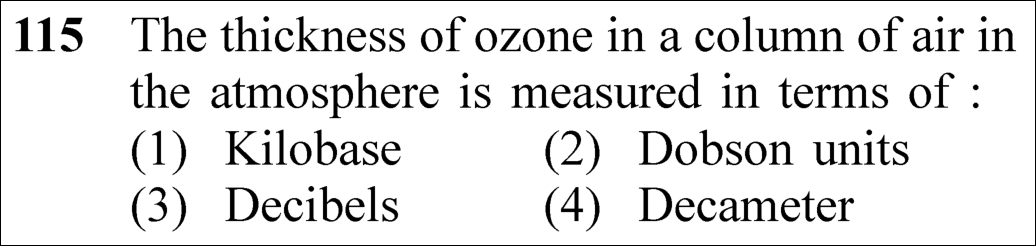
NEET 2023 · Q115 Easy
Official NEET 2023 Question 115 - Environmental Issues
1 Kilobase
2 Dobson units ✓ Key
3 Decibels
4 Decameter
💡 Verified Solution & 30-Second Hack
✓
Verified Against NTA Final Answer Key
Option (2) : Dobson units
📚 Environmental Issues Easy
📋 Given Parameters & Problem Setup
Parameter Thickness of stratospheric ozone column
Standard Unit Dobson Units (DUDU)
⚡

The 30-Second Exam Hall Shortcut: ⚡ Atmospheric Unit Anchor: Ozone Column = Dobson Units (DU)

⏱️ Save ~25 seconds

The standard physical unit to quantify the thickness of ozone in a vertical column of air from the ground to the top of the atmosphere is Dobson Units (DU). 1 DU=0.01 mm1\text{ DU} = 0.01\text{ mm} pure ozone at STP!

1 Kilobase (kbkb): Unit of nucleic acid length (1000 base pairs).
2 Decibel (dBdB): Unit of sound intensity / acoustic loudness.
3 Decameter (damdam): Metric unit of distance (10 meters).
4 Dobson Unit (DUDU): Unit of ozone column thickness.
5 Match Option (2) Dobson units.
🛡️
Why You Can 100% Trust This Shortcut: Canonical NCERT Environmental Issues stratospheric physics measurement standards.
📐

Step-by-Step Rigorous Workflow & Mathematical Proof

Step 1

Definition of Dobson Unit (DU)

One Dobson Unit (1 DU1\text{ DU}) is defined as the thickness of a pure layer of ozone that would be formed if the entire atmospheric ozone column were compressed to Standard Temperature and Pressure (STP:0∘C,1 atmSTP: 0^\circ\text{C}, 1\text{ atm}):

1 DU=10 μm=0.01 mm of pure O3 at STP(≈2.69×10¹⁶ molecules/cm2)1\text{ DU} = 10\,\mu\text{m} = 0.01\text{ mm of pure } O_3 \text{ at STP} \quad (\approx 2.69 \times 10^{16} \text{ molecules/cm}^2)
Step 2

Verbatim NCERT Statement

NCERT states verbatim: "The thickness of the ozone in a column of air from the ground to the top of the atmosphere is measured in terms of Dobson units (DU)."
Step 3

Evaluation of Distractor Units

Kilobase is a genetic measurement (103 bp10^3\text{ bp} of DNA). Decibel (dBdB) measures acoustic sound pressure level (>150 dB>150\text{ dB} damages eardrums). Decameter is an SI distance unit (10 m10\text{ m}).

⭐

360° Option Elimination Engine Key Feature

Diagnose every choice: Know exactly why the right option works and why distractors fail.

4-Option Deep Scan
1 1
✗ Incorrect
Verdict & Scientific Reason:

Kilobase (kbkb) measures DNA/RNA sequence length, not atmospheric gas concentration.

⚠️
Student Fallacy (Why candidates pick this trap): Confusing molecular biology terminology with atmospheric chemistry.
2 2
✓ 100% Correct
Verdict & Scientific Reason:

Standard international and NCERT unit for atmospheric ozone column thickness (DUDU).

💡
Why this is airtight: None; textbook verbatim.
3 3
✗ Incorrect
Verdict & Scientific Reason:

Decibel (dBdB) is the logarithmic unit of acoustic loudness and noise pollution.

⚠️
Student Fallacy (Why candidates pick this trap): Conflating noise pollution units with atmospheric ozone layers.
4 4
✗ Incorrect
Verdict & Scientific Reason:

Decameter is a linear distance unit (10 meters10\text{ meters}), inapplicable to gas column density.

⚠️
Student Fallacy (Why candidates pick this trap): Guessing a metric distance prefix.
⚠️

NTA Trap Alert: Acoustic vs. Ozone Unit Confusion

Both Decibels (dBdB) and Dobson units (DUDU) begin with "D", leading inattentive students under exam pressure to misread the choices.

🛡️ How to avoid the -1 mark: Decibels (dBdB) = Sound/Noise. Dobson Units (DUDU) = Ozone column thickness.
📖

Core NEET Syllabus Standard

NCERT Biology · Environmental Issues Standard Benchmark
Core Scientific Principle Tested:

"The thickness of the ozone in a column of air from the ground to the top of the atmosphere is measured in terms of Dobson units (DU)."
Syllabus Focus: Ozone Depletion in the Stratosphere
✓ Core NEET UG Syllabus Anchor Syllabus & Academic Standards ↗
NEET 2023 · Q149 Easy
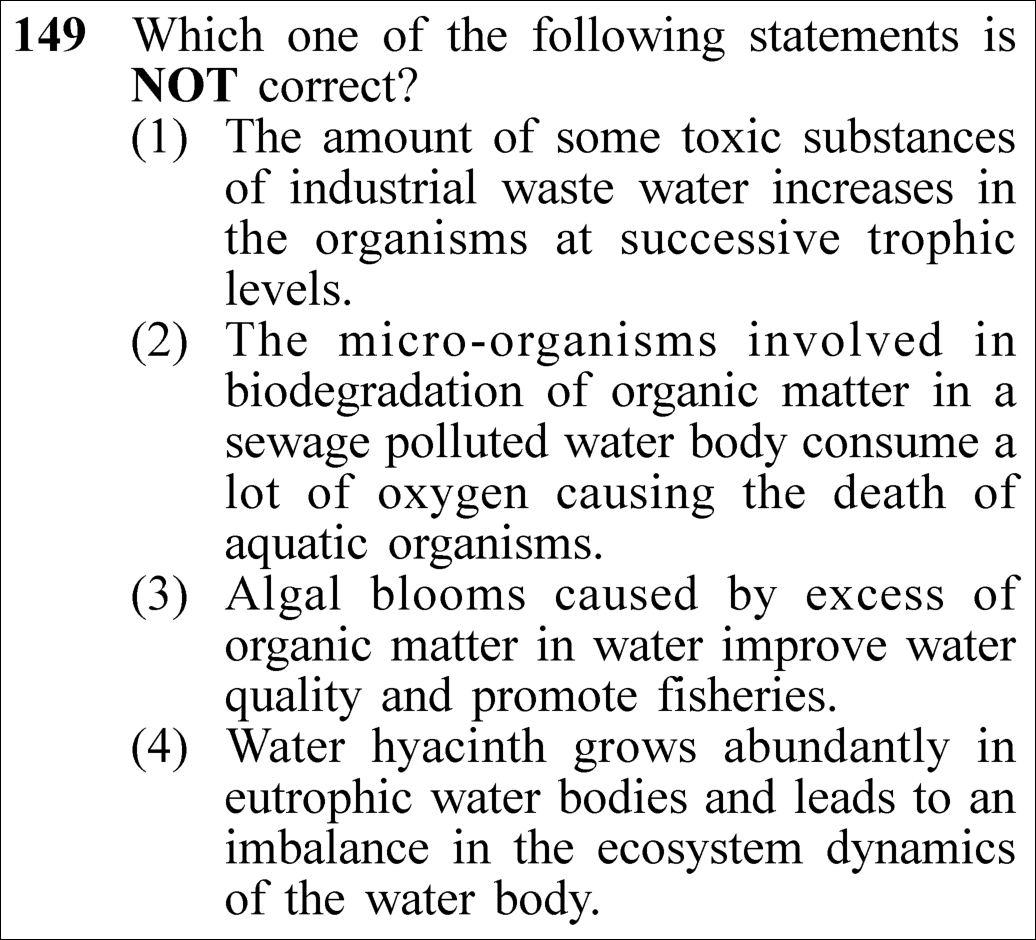
Official NEET 2023 Question 149 - Environmental Issues
1 The amount of some toxic substances of industrial waste water increases in the organisms at successive trophic levels.
2 The micro-organisms involved in biodegradation of organic matter in a sewage polluted water body consume a lot of oxygen causing the death of aquatic organisms.
3 Algal blooms caused by excess of organic matter in water improve water quality and promote fisheries. ✓ Key
4 Water hyacinth grows abundantly in eutrophic water bodies and leads to an imbalance in the ecosystem dynamics of the water body.
💡 Verified Solution & 30-Second Hack
✓
Verified Against NTA Final Answer Key
Option (3) : Algal blooms caused by excess of organic matter in water improve water quality and promote fisheries.
📚 Environmental Issues Easy
📋 Given Parameters & Problem Setup
Topic Water pollution and ecological consequences
Task Identify the statement that is NOT correct (incorrect)
⚡

The 30-Second Exam Hall Shortcut: ⚡ Negative Question Trap: Algal Blooms HARM Water & Kill Fish!

⏱️ Save ~20 seconds

The question asks for the statement that is NOT correct. Statement (3) claims algal blooms "improve water quality and promote fisheries". Algal blooms cause severe water deterioration, oxygen depletion, toxin secretion, and massive fish kills! Statement (3) is false and the correct answer!

1 Statement (1): Biomagnification causes increase in toxic substances at higher trophic levels -> Correct statement.
2 Statement (2): Microorganisms decomposing organic sewage consume dissolved O2 causing death of aquatic life -> Correct statement.
3 Statement (3): Algal blooms improve water quality and promote fisheries -> Blatantly False statement.
4 Statement (4): Water hyacinth (Eichhornia) thrives in eutrophic waters and disrupts ecosystem dynamics -> Correct statement.
5 Since (3) is false, select Option (3).
🛡️
Why You Can 100% Trust This Shortcut: Canonical NCERT Environmental Issues aquatic eutrophication impact facts.
📐

Step-by-Step Rigorous Workflow & Mathematical Proof

Step 1

Pathophysiology of Algal Blooms

Runoff of domestic sewage and agricultural fertilizers introduces excessive nitrogen and phosphorus into water bodies (cultural eutrophication), inducing explosive proliferation of planktonic algae:

Excess Inorganic Nutrients (N, P)⟶Algal Bloom  ⟹  {Depletes Dissolved Oxygen (DO ↓)Imparts foul odor and tasteSecretes potent cyanotoxinsCauses massive fish mortality\text{Excess Inorganic Nutrients (N, P)} \longrightarrow \text{Algal Bloom} \implies \begin{cases} \text{Depletes Dissolved Oxygen (DO } \downarrow) \\[3pt] \text{Imparts foul odor and taste} \\[3pt] \text{Secretes potent cyanotoxins} \\[3pt] \mathbf{\text{Causes massive fish mortality}} \end{cases}
Step 2

Verbatim NCERT Reference

NCERT states verbatim: "Presence of large amounts of nutrients in waters also causes excessive growth of planktonic (free-floating) algae, called an algal bloom. Algal blooms impart a distinct colour to the water bodies. Algal blooms cause deterioration of the water quality and fish mortality. Some bloom-forming algae are extremely toxic to human beings and animals."

Step 3

Evaluation of Other Statements

Statement (1) accurately defines biomagnification (e.g., DDT and mercury). Statement (2) accurately describes biochemical oxygen demand (BOD) and suffocating hypoxia. Statement (4) accurately describes the "Terror of Bengal" (Eichhornia crassipes\textit{Eichhornia crassipes}).

⭐

360° Option Elimination Engine Key Feature

Diagnose every choice: Know exactly why the right option works and why distractors fail.

4-Option Deep Scan
1 1
✗ Incorrect
Verdict & Scientific Reason:

This statement is scientifically true (biomagnification); hence not the incorrect option sought.

⚠️
Student Fallacy (Why candidates pick this trap): Selecting a true statement without noticing the negative prompt "NOT correct".
2 2
✗ Incorrect
Verdict & Scientific Reason:

This statement is factually true (BOD spike causing hypoxia); hence not the incorrect option.

⚠️
Student Fallacy (Why candidates pick this trap): Confusing high BOD impact with incorrect statement.
3 3
✓ 100% Correct
Verdict & Scientific Reason:

This statement is completely false (algal blooms severely deteriorate water quality and kill fish), making it the correct answer to the negative prompt.

💡
Why this is airtight: None; identifies the blatantly false claim.
4 4
✗ Incorrect
Verdict & Scientific Reason:

This statement is factually true (Eichhornia chokes eutrophic waters); hence not the incorrect option.

⚠️
Student Fallacy (Why candidates pick this trap): Failing to eliminate the true invasive plant statement.
⚠️

NTA Trap Alert: Negative Query "NOT Correct" Overlook Trap

Students reading too fast miss the capitalized "NOT correct" and select Option (1) because it is a true textbook fact about biomagnification.

🛡️ How to avoid the -1 mark: Always circle "NOT correct" in the question stem and actively hunt for the false statement.
📖

Core NEET Syllabus Standard

NCERT Biology · Environmental Issues Standard Benchmark
Core Scientific Principle Tested:

"Algal blooms cause deterioration of the water quality and fish mortality. Some bloom-forming algae are extremely toxic."

Syllabus Focus: Water Pollution and Its Control
✓ Core NEET UG Syllabus Anchor Syllabus & Academic Standards ↗
NEET 2023 · Q181 Easy
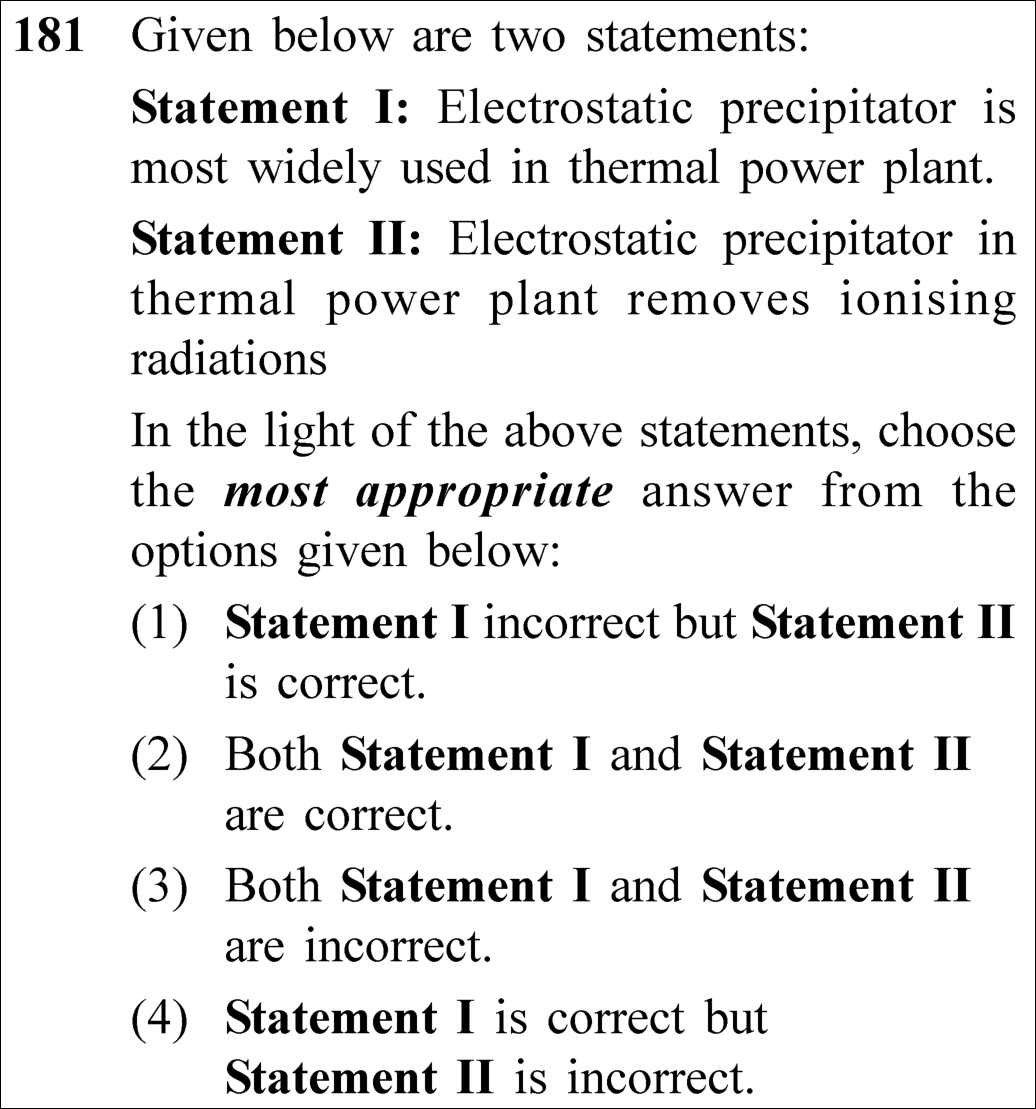
Official NEET 2023 Question 181 - Environmental Issues
1 Statement I incorrect but Statement II is correct.
2 Both Statement I and Statement II are correct.
3 Both Statement I and Statement II are incorrect.
4 Statement I is correct but Statement II is incorrect. ✓ Key
💡 Verified Solution & 30-Second Hack
✓
Verified Against NTA Final Answer Key
Option (4) : Statement I is correct but Statement II is incorrect.
📚 Environmental Issues Easy
📋 Given Parameters & Problem Setup
Statement I Electrostatic precipitator is most widely used in thermal power plant.
Statement II Electrostatic precipitator in thermal power plant removes ionising radiations.
⚡

The 30-Second Exam Hall Shortcut: ⚡ Electrostatic Precipitators Remove PARTICLES, Not Radiation!

⏱️ Save ~20 seconds

Electrostatic precipitators remove >99% of particulate matter (fly ash) from thermal power plant smokestacks (Statement I is TRUE). They do NOT remove ionizing radiation (which originates from nuclear sources)! Statement II is FALSE! Select Option (4)!

1 Check Statement I: Electrostatic precipitator is the most widely used device to remove particulate exhaust in thermal power plants -> Verbatim NCERT, Correct.
2 Check Statement II: Claims it removes ionizing radiation -> False (It removes particulate matter via corona discharge and grounded collecting plates).
3 Statement I is correct but Statement II is incorrect.
4 Match Option (4).
🛡️
Why You Can 100% Trust This Shortcut: Canonical NCERT Environmental Issues air pollution control industrial equipment.
📐

Step-by-Step Rigorous Workflow & Mathematical Proof

Step 1

Working Mechanism of Electrostatic Precipitator (ESP)

An electrostatic precipitator operates by maintaining electrode wires at thousands of volts to produce a corona discharge that releases electrons. Electrons attach to dust particles, giving them a net negative charge so that grounded collecting plates attract and capture them:

Dirty Flue Gas→High-voltage Corona (e−)Negatively Charged Dust→Grounded Plates>99% Particulate Matter Removed\text{Dirty Flue Gas} \xrightarrow{\text{High-voltage Corona } (e^-)} \text{Negatively Charged Dust} \xrightarrow{\text{Grounded Plates}} \mathbf{>99\%\text{ Particulate Matter Removed}}
Step 2

Evaluation of Statement I

NCERT states verbatim: "There are several ways of removing particulate matter; the most widely used of which is the electrostatic precipitator, which can remove over 99 per cent particulate matter present in the exhaust from a thermal power plant." Statement I is TRUE.

Step 3

Evaluation of Statement II

Ionizing radiations (alpha, beta, gamma rays) are nuclear emissions managed via thick lead shielding and deep geological disposal of nuclear wastes. ESPs have zero capability to neutralize radiation. Statement II is FALSE.

⭐

360° Option Elimination Engine Key Feature

Diagnose every choice: Know exactly why the right option works and why distractors fail.

4-Option Deep Scan
1 1
✗ Incorrect
Verdict & Scientific Reason:

Inverts the truth value of both statements.

⚠️
Student Fallacy (Why candidates pick this trap): Believing precipitators absorb nuclear radiation.
2 2
✗ Incorrect
Verdict & Scientific Reason:

Statement II is factually absurd from a physical and ecological perspective.

⚠️
Student Fallacy (Why candidates pick this trap): Assuming power plants emit radiation captured by precipitators.
3 3
✗ Incorrect
Verdict & Scientific Reason:

Statement I is an undisputed textbook fact regarding air pollution control.

⚠️
Student Fallacy (Why candidates pick this trap): Doubting thermal power plant reliance on electrostatic precipitators.
4 4
✓ 100% Correct
Verdict & Scientific Reason:

Statement I correctly cites the widespread use of ESPs for particulate capture; Statement II falsely claims it removes ionizing radiation.

💡
Why this is airtight: None; rigorous environmental technology analysis.
⚠️

NTA Trap Alert: Particulate Matter vs. Radiation Trap

Thermal power plants burn pulverized coal, producing massive amounts of particulate fly ash and smoke. Ionizing radiation is an issue for nuclear power plants, not thermal coal plants, and is unaffected by electrostatic precipitators.

🛡️ How to avoid the -1 mark: ESP = Removes Particulate Matter. Nuclear Shielding = Blocks Ionizing Radiation.
📖

Core NEET Syllabus Standard

NCERT Biology · Environmental Issues Standard Benchmark
Core Scientific Principle Tested:

"Electrostatic precipitator is most widely used in thermal power plants to remove over 99 per cent particulate matter."

Syllabus Focus: Air Pollution and Its Control
✓ Core NEET UG Syllabus Anchor Syllabus & Academic Standards ↗
NEET 2023 · Q183 Easy
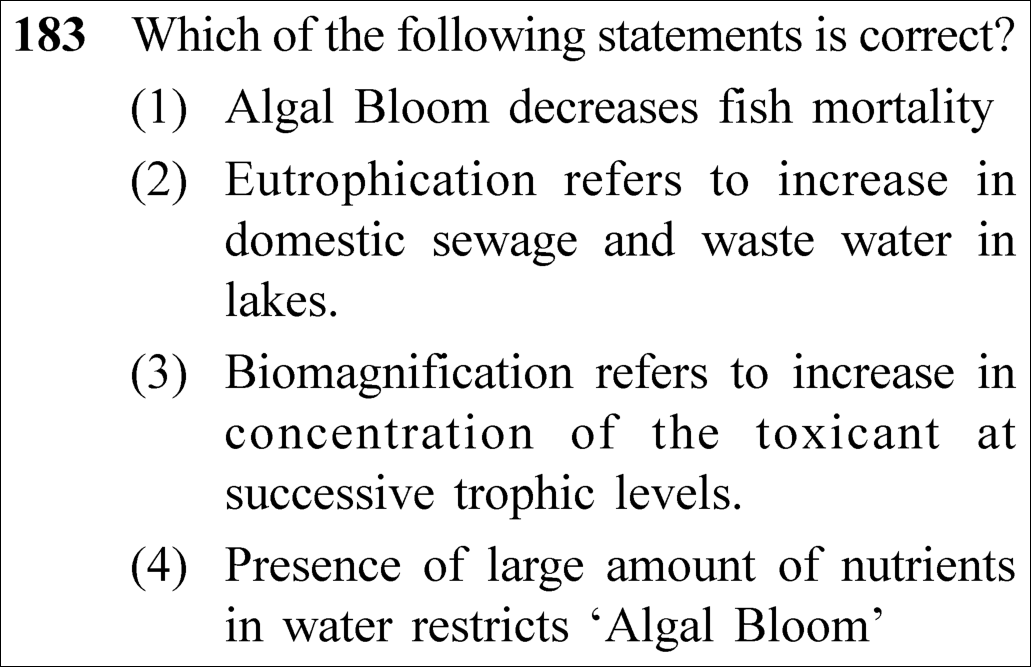
Official NEET 2023 Question 183 - Environmental Issues
1 Algal Bloom decreases fish mortality
2 Eutrophication refers to increase in domestic sewage and waste water in lakes.
3 Biomagnification refers to increase in concentration of the toxicant at successive trophic levels. ✓ Key
4 Presence of large amount of nutrients in water restricts 'Algal Bloom'
💡 Verified Solution & 30-Second Hack
✓
Verified Against NTA Final Answer Key
Option (3) : Biomagnification refers to increase in concentration of the toxicant at successive trophic levels.
📚 Environmental Issues Easy
📋 Given Parameters & Problem Setup
Topic Environmental pollution definitions
Task Identify the statement that is CORRECT
⚡

The 30-Second Exam Hall Shortcut: ⚡ Biomagnification Definition Anchor

⏱️ Save ~20 seconds

Verbatim NCERT sentence under Biomagnification: "Biomagnification refers to increase in concentration of the toxicant at successive trophic levels." Instant 5-second answer matching Option (3)!

1 Option (1): Algal blooms increase (not decrease) fish mortality -> False.
2 Option (2): Eutrophication refers to nutrient enrichment aging of water body, not just sewage volume -> False.
3 Option (3): Biomagnification refers to increase in toxicant concentration at successive trophic levels -> Verbatim NCERT, Correct.
4 Option (4): Nutrients stimulate (not restrict) algal blooms -> False.
5 Match Option (3).
🛡️
Why You Can 100% Trust This Shortcut: Canonical NCERT Environmental Issues ecotoxicology definitions.
📐

Step-by-Step Rigorous Workflow & Mathematical Proof

Step 1

Definition of Biological Biomagnification

Non-biodegradable lipophilic toxicants (such as DDT and mercury) cannot be metabolized or excreted by organisms and get passed to higher trophic levels, progressively concentrating up the food web:

Water (0.003 ppb)→ZooplanktonSmall Fish→Large FishFish-eating Birds (25 ppm)\text{Water } (0.003\text{ ppb}) \xrightarrow{\text{Zooplankton}} \text{Small Fish} \xrightarrow{\text{Large Fish}} \text{Fish-eating Birds } (25\text{ ppm})
Step 2

Verbatim NCERT Reference

NCERT states verbatim: "Biomagnification refers to increase in concentration of the toxicant at successive trophic levels. This happens because a toxic substance accumulated by an organism cannot be metabolised or excreted, and is thus passed on to the next higher trophic level."

Step 3

Refutation of False Distractors

Algal blooms cause hypoxia that sharply *increases* fish mortality (ruling out Option 1). Eutrophication is the *natural or accelerated nutrient enrichment aging* of a lake (ruling out Option 2). High nutrients *stimulate* explosive algal blooms rather than restricting them (ruling out Option 4).

⭐

360° Option Elimination Engine Key Feature

Diagnose every choice: Know exactly why the right option works and why distractors fail.

4-Option Deep Scan
1 1
✗ Incorrect
Verdict & Scientific Reason:

Algal blooms deplete dissolved oxygen and secrete toxins, causing massive increases in fish mortality.

⚠️
Student Fallacy (Why candidates pick this trap): Inverting the lethal effect of eutrophic algal blooms on fish.
2 2
✗ Incorrect
Verdict & Scientific Reason:

Eutrophication is scientifically defined as the natural or cultural nutrient enrichment (aging) of a lake, not merely wastewater addition.

⚠️
Student Fallacy (Why candidates pick this trap): Confusing the cause (sewage input) with the ecological definition (nutrient enrichment).
3 3
✓ 100% Correct
Verdict & Scientific Reason:

Matches NCERT verbatim as the definitive ecological principle of biomagnification.

💡
Why this is airtight: None; textbook verbatim precision.
4 4
✗ Incorrect
Verdict & Scientific Reason:

Abundant nitrogen and phosphorus triggers and accelerates algal blooms, it never restricts them.

⚠️
Student Fallacy (Why candidates pick this trap): Thinking excess nutrients somehow suppress algal growth.
⚠️

NTA Trap Alert: Eutrophication vs. Sewage Input Semantic Trap

Students frequently equate eutrophication simply with "pollution by sewage". NCERT rigorously defines eutrophication as the natural aging of a lake by nutrient enrichment.

🛡️ How to avoid the -1 mark: Look for the verbatim match: Biomagnification = increase in concentration of toxicant at successive trophic levels.
📖

Core NEET Syllabus Standard

NCERT Biology · Environmental Issues Standard Benchmark
Core Scientific Principle Tested:

"Biomagnification refers to increase in concentration of the toxicant at successive trophic levels."

Syllabus Focus: Biological Magnification
✓ Core NEET UG Syllabus Anchor Syllabus & Academic Standards ↗
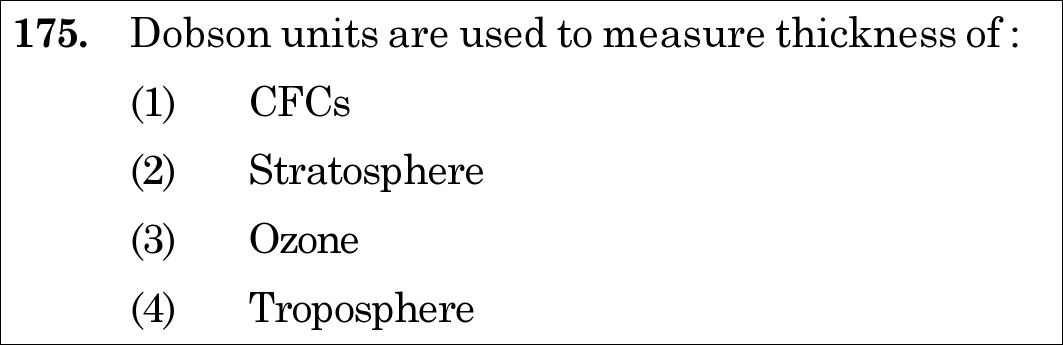
NEET 2021 · Q175 Easy
Official NEET 2021 Question 175 - Environmental Issues
1 CFCs
2 Stratosphere
3 Ozone ✓ Key
4 Troposphere
💡 Verified Solution & 30-Second Hack
✓
Verified Against NTA Final Answer Key
Option (3) : Ozone
📚 Environmental Issues Easy
📋 Given Parameters & Problem Setup
Unit of Measurement Dobson Units (DU)
Question Objective Identify which gas / atmospheric layer thickness is measured in Dobson units
⚡

The 30-Second Exam Hall Shortcut: ⚡ "Dobson Unit (DU) = Canonical Metric for Ozone Thickness"

⏱️ Save ~20 seconds

The thickness of ozone in a column of air from ground to top of atmosphere is standardly measured in Dobson Units (DU). 1 DU corresponds to 0.01 mm of pure ozone at standard temperature and pressure. Mark Ozone in 5 seconds!

1 Recall atmospheric measurement units: Dobson Unit (DU).
2 Connect directly to ozone: The thickness of the stratospheric ozone layer is expressed in Dobson Units.
3 Select Option (3).
🛡️
Why You Can 100% Trust This Shortcut: NCERT Biology · Environmental Issues (Ozone Depletion in the Stratosphere: The thickness of the ozone in a column of air from the ground to the top of the atmosphere is measured in terms of Dobson units (DU)).
📐

Step-by-Step Rigorous Workflow & Mathematical Proof

Step 1

Definition and Physical Basis of Dobson Units (DU)

The concentration and total thickness of the stratospheric ozone (O3O_3) layer in a vertical column extending from Earth's surface to outer space is measured in Dobson Units (DU), named after Gordon Dobson, who designed the first spectrophotometer to measure total column ozone. - One Dobson Unit represents a layer of pure ozone gas that would be 10 μm10\,\mu\text{m} (0.01 mm0.01\text{ mm}) thick under standard temperature and pressure (0∘C0^\circ\text{C} and 1 atm1\text{ atm}).

1 DU=0.01 mm of pure O3 at STP=2.69×10¹⁶ molecules of O3/cm21\,\text{DU} = 0.01\,\text{mm of pure } O_3 \text{ at STP} = 2.69 \times 10^{16}\,\text{molecules of } O_3 /\text{cm}^2
Step 2

Significance in Detecting the Antarctic Ozone Hole

Normal stratospheric ozone thickness ranges between 300 to 400 DU. A drop below 220 DU over the Antarctic continent is conventionally defined as the seasonal "ozone hole" caused by chlorofluorocarbons (CFCs).

⭐

360° Option Elimination Engine Key Feature

Diagnose every choice: Know exactly why the right option works and why distractors fail.

4-Option Deep Scan
1 1
✗ Incorrect
Verdict & Scientific Reason:

Incorrect. CFCs are ozone-depleting haloalkanes measured in parts per billion/trillion (ppb/ppt), not Dobson units.

⚠️
Student Fallacy (Why candidates pick this trap): Associating Dobson with CFCs because CFCs cause ozone depletion.
2 2
✗ Incorrect
Verdict & Scientific Reason:

Incorrect. Stratospheric thickness is measured in kilometers (km) of altitude, not Dobson units.

⚠️
Student Fallacy (Why candidates pick this trap): Confusing the gas (ozone) with the atmospheric layer in which it resides (stratosphere).
3 3
✓ 100% Correct
Verdict & Scientific Reason:

Correct. Standard scientific unit for total column ozone thickness is the Dobson Unit (DU).

💡
Why this is airtight: None. Verbatim recall of NCERT environmental definitions.
4 4
✗ Incorrect
Verdict & Scientific Reason:

Incorrect. The troposphere is the lower atmospheric layer (0–10 km altitude), measured in km.

⚠️
Student Fallacy (Why candidates pick this trap): Confusing bad ozone (tropospheric) with unit definition.
⚠️

NTA Trap Alert: Gas vs Atmospheric Layer Trap

Candidates sometimes choose "Stratosphere" because they recall that ozone is located in the stratosphere. Dobson units measure the thickness of the *ozone gas* column, not the thickness of the stratospheric layer itself.

🛡️ How to avoid the -1 mark: Remember: DU measures pure Ozone gas thickness.
📖

Core NEET Syllabus Standard

NEET / NCERT Biology · Environmental Issues Standard Benchmark
Core Scientific Principle Tested:

"Column ozone thickness is measured in Dobson Units (DU)."

Syllabus Focus: Ozone Depletion in the Stratosphere
✓ Core NEET UG Syllabus Anchor Syllabus & Academic Standards ↗
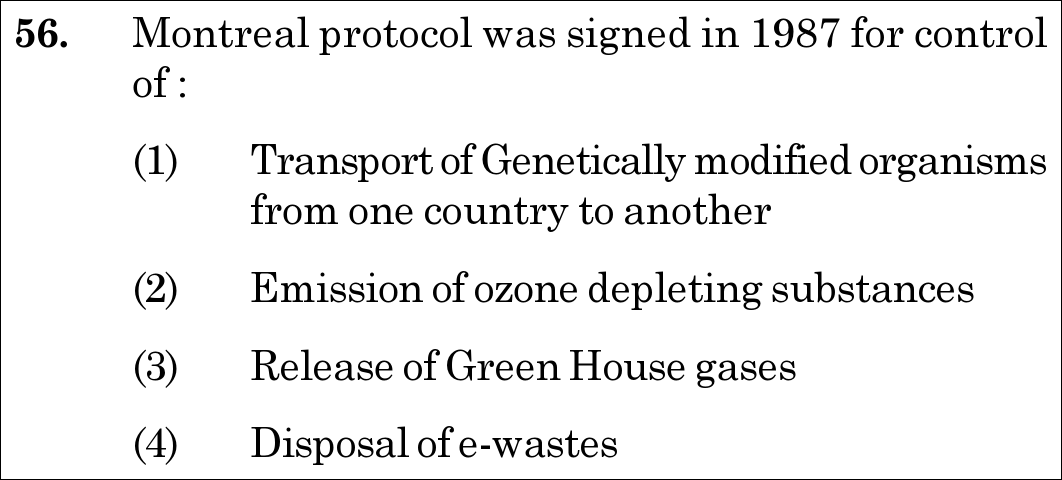
NEET 2020 · Q56 Easy
Official NEET 2020 Question 56 - Environmental Issues
1 Transport of Genetically modified organisms from one country to another
2 Emission of ozone depleting substances ✓ Key
3 Release of Green House gases
4 Disposal of e-wastes
💡 Verified Solution & 30-Second Hack
✓
Verified Against NTA Final Answer Key
Option (2) : Emission of ozone depleting substances
📚 Environmental Issues Easy
📋 Given Parameters & Problem Setup
International Treaty Montreal Protocol
Year Signed 1987 (Montreal, Canada; effective 1989)
Question Objective Identify the target environmental issue controlled by the treaty
⚡

The 30-Second Exam Hall Shortcut: ⚡ "Montreal = OZONE (ODSs); Kyoto = Greenhouse Gases!"

⏱️ 25 seconds

The Montreal Protocol was signed in Montreal (Canada) in 1987 to control the emission of Ozone Depleting Substances (ODSs like chlorofluorocarbons). The Kyoto Protocol controls Greenhouse Gases. Mark Emission of ozone depleting substances (Option 2) in 5 seconds!

1 Montreal Protocol (1987) = Control of ozone depleting substances (ODSs).
2 Kyoto Protocol (1997) = Reducing greenhouse gas emissions.
3 Basel Convention = Hazardous and electronic wastes.
4 Cartagena Protocol = Biosafety of genetically modified organisms.
5 Select Option (2).
🛡️
Why You Can 100% Trust This Shortcut: NCERT Biology · Environmental Issues (Ozone Depletion in Stratosphere & Montreal Protocol)
📐

Step-by-Step Rigorous Workflow & Mathematical Proof

Step 1

History of the Montreal Protocol

Recognizing the deleterious effects of ozone depletion over the Antarctic stratosphere caused by chlorofluorocarbons (CFCs), an international treaty, known as the Montreal Protocol, was signed at Montreal (Canada) in 1987 (and became effective in 1989).

Step 2

Core Objective of the Treaty

The explicit goal of the Montreal Protocol was to control and phase out the emission of ozone depleting substances (ODSs) globally.

Step 3

Differentiate Other Environmental Protocols

Kyoto Protocol (1997) is aimed at reducing greenhouse gas emissions to combat climate change; Cartagena Protocol regulates transboundary movements of Living Modified Organisms (GMOs); Basel Convention regulates hazardous waste disposal.

Step 4

Conclude Correct Option

Option (2) directly captures the mandated objective of the Montreal Protocol.

⭐

360° Option Elimination Engine Key Feature

Diagnose every choice: Know exactly why the right option works and why distractors fail.

4-Option Deep Scan
1 A
✗ Incorrect
Verdict & Scientific Reason:

Incorrect; transboundary movement of GMOs is governed by the Cartagena Protocol on Biosafety, not the Montreal Protocol.

⚠️
Student Fallacy (Why candidates pick this trap): Confusing biosafety treaties with atmospheric environmental treaties.
2 B
✓ 100% Correct
Verdict & Scientific Reason:

Factually exact; the Montreal Protocol was signed in 1987 specifically to curb substances that deplete the stratospheric ozone layer.

💡
Why this is airtight: None; classic environmental biology landmark.
3 C
✗ Incorrect
Verdict & Scientific Reason:

Incorrect; reduction of greenhouse gas emissions is the objective of the Kyoto Protocol and Paris Agreement, not Montreal.

⚠️
Student Fallacy (Why candidates pick this trap): Mixing up Montreal Protocol (Ozone) with Kyoto Protocol (Greenhouse gases).
4 D
✗ Incorrect
Verdict & Scientific Reason:

Incorrect; e-waste management is addressed under the Basel Convention, not the Montreal Protocol.

⚠️
Student Fallacy (Why candidates pick this trap): Confusing hazardous waste management with atmospheric ozone protection.
⚠️

NTA Trap Alert: Montreal vs Kyoto Protocol

Montreal Protocol (1987) = OZONE Depletion (CFCs/ODSs). Kyoto Protocol (1997) = GREENHOUSE Gases & Global Warming.

🛡️ How to avoid the -1 mark: Mnemonic: "M-O-K-G" -> Montreal = Ozone; Kyoto = Greenhouse!
📖

Core NEET Syllabus Standard

Zoology · Environmental Issues Standard Benchmark
Core Scientific Principle Tested:

""

Syllabus Focus: Montreal Protocol (1987): Control of Ozone Depleting Substances
✓ Core NEET UG Syllabus Anchor Syllabus & Academic Standards ↗
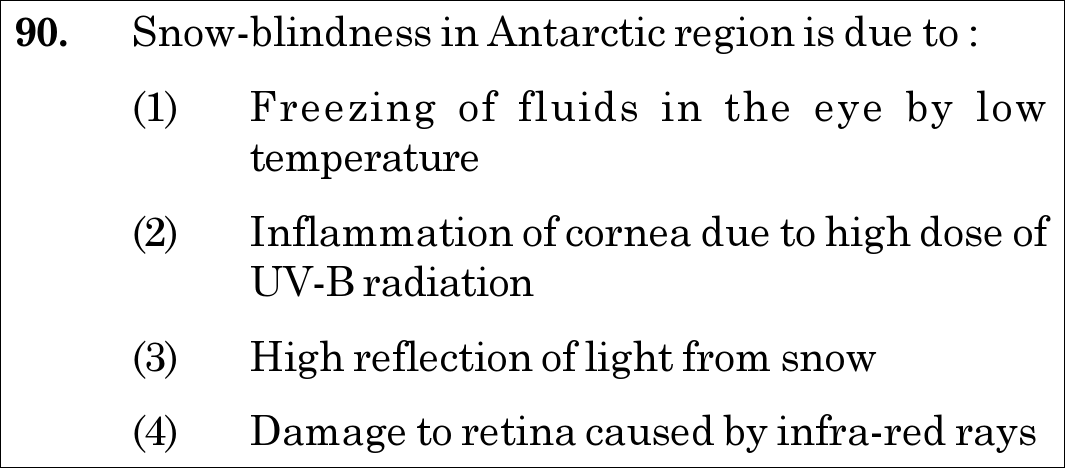
NEET 2020 · Q90 Easy
Official NEET 2020 Question 90 - Environmental Issues
1 Freezing of fluids in the eye by low temperature
2 Inflammation of cornea due to high dose of UV-B radiation ✓ Key
3 High reflection of light from snow
4 Damage to retina caused by infra-red rays
💡 Verified Solution & 30-Second Hack
✓
Verified Against NTA Final Answer Key
Option (2) : Inflammation of cornea due to high dose of UV-B radiation
📚 Environmental Issues Easy
📋 Given Parameters & Problem Setup
Pathological Condition Snow-blindness in Antarctic region
Etiological Factor Ozone hole and solar radiation
Question Objective Identify the exact pathophysiological cause
⚡

The 30-Second Exam Hall Shortcut: ⚡ "Snow-Blindness = INFLAMMATION OF CORNEA DUE TO UV-B RADIATION!"

⏱️ 20 seconds

Ozone thinning over Antarctica allows high doses of UV-B radiation to reach the Earth. The human cornea absorbs UV-B radiation, and a high dose of UV-B causes painful inflammation of the cornea, called snow-blindness (photokeratitis), and cataract! Mark Option (2) in 5 seconds.

1 UV-B radiation of wavelength shorter than UV-A is normally absorbed by the stratospheric ozone layer.
2 Due to the ozone hole over Antarctica, excessive UV-B reaches the surface.
3 In human eye, cornea absorbs UV-B radiation.
4 A high dose of UV-B causes inflammation of cornea, termed "snow-blindness" and cataract.
5 Select Option (2) Inflammation of cornea due to high dose of UV-B radiation.
🛡️
Why You Can 100% Trust This Shortcut: NCERT Biology · Environmental Issues (Ozone Depletion in Stratosphere: Effects of UV-B Radiation)
📐

Step-by-Step Rigorous Workflow & Mathematical Proof

Step 1

Understand Ozone Depletion and UV Radiations

UV radiation from the sun is categorized into UV-C, UV-B, and UV-A. UV-C is absorbed by the atmosphere; UV-B is largely absorbed by the stratospheric ozone shield. Thinning of the ozone layer over Antarctica allows excessive UV-B to penetrate to the surface.

Step 2

Biological Action of UV-B on the Eye

NCERT explicitly states: "In human eye, cornea absorbs UV-B radiation, and a high dose of UV-B causes inflammation of cornea, called snow-blindness, cataract, etc. Such exposure may permanently damage the cornea."

Step 3

Evaluate Distractor Options

- Option (1) claims freezing of fluids: Antarctic temperatures are cold, but eye fluids do not freeze while alive. - Option (3) claims reflection of visible light from snow: Snow reflects UV-B, but the direct cause of blindness is the corneal inflammation induced by UV-B, not mere visible light reflection. - Option (4) mentions infra-red damage to retina: Snow blindness involves UV-B damage to the CORNEA, not IR damage to the retina.

Step 4

Conclude Option 2

Option (2) precisely articulates the medical definition and NCERT explanation of snow-blindness.

⭐

360° Option Elimination Engine Key Feature

Diagnose every choice: Know exactly why the right option works and why distractors fail.

4-Option Deep Scan
1 A
✗ Incorrect
Verdict & Scientific Reason:

Incorrect; eye humors (aqueous and vitreous) are regulated at core body temperature and do not freeze in snow-blindness.

⚠️
Student Fallacy (Why candidates pick this trap): Associating "Antarctic" with physical freezing of the eye.
2 B
✓ 100% Correct
Verdict & Scientific Reason:

Factually exact; snow-blindness (photokeratitis) is acute inflammation of the corneal epithelium caused by excessive UV-B exposure.

💡
Why this is airtight: None; direct NCERT environmental health statement.
3 C
✗ Incorrect
Verdict & Scientific Reason:

Incorrect; while snow has a high albedo and reflects UV, the biological pathology itself is cornea inflammation caused specifically by UV-B rays, not mere bright visible light.

⚠️
Student Fallacy (Why candidates pick this trap): Attributing the disease solely to glare rather than the damaging UV-B spectrum.
4 D
✗ Incorrect
Verdict & Scientific Reason:

Incorrect; the affected tissue is the CORNEA (not retina) and the radiation type is UV-B (not infra-red).

⚠️
Student Fallacy (Why candidates pick this trap): Confusing corneal UV damage with retinal infrared thermal damage.
⚠️

NTA Trap Alert: Cornea vs Retina & UV-B vs IR

Snow-blindness affects the CORNEA (inflammation/photokeratitis) caused by UV-B radiation. Cataract also affects the lens due to UV-B.

🛡️ How to avoid the -1 mark: Match the pair: Snow-blindness = CORNEA + UV-B!
📖

Core NEET Syllabus Standard

Zoology · Environmental Issues Standard Benchmark
Core Scientific Principle Tested:

""

Syllabus Focus: Photokeratitis: Snow-Blindness Caused by UV-B Induced Inflammation of Cornea
✓ Core NEET UG Syllabus Anchor Syllabus & Academic Standards ↗

Solve 4 NEET Questions a Day — One per Subject

Cover all 1,140 official NEET questions in 285 days at your own pace. Progress is saved on your device. No login needed.