MyCompetitiveExams Logo MyCompetitiveExams
Search 1,140+ Questions
Chapters, formulas, speed tricks
→
⚡ Brahmastra NEET 2027
720 MARKS

Dynamic 180-question full-length simulator mixed dynamically from all 6 years for 2027 & 2026 aspirants.

Launch Brahmastra 2027 Test →
Start Practice →
100% Free · No Login Required
🌿 Botany ⭐ High Weightage (~2–3 Qs/Year)

NEET Breathing and Exchange of Gases Previous Year Questions with Solutions

Complete repository of official NTA NEET questions for Breathing and Exchange of Gases from 2020 to 2026. Every question includes 30-second elimination tricks, step-by-step NCERT solutions, option-by-option traps, and official answer keys.

8 Questions 5 Exam Years (2026, 2024, 2023, 2021, 2020) 8 Easy · 0 Medium · 0 Challenging
NEET 2026 · Q150 Easy
Official NEET 2026 Question 150 - Breathing and Exchange of Gases
1 ✓ Key
2
3
4
💡 Verified Solution & 30-Second Hack
✓
Verified Against NTA Final Answer Key
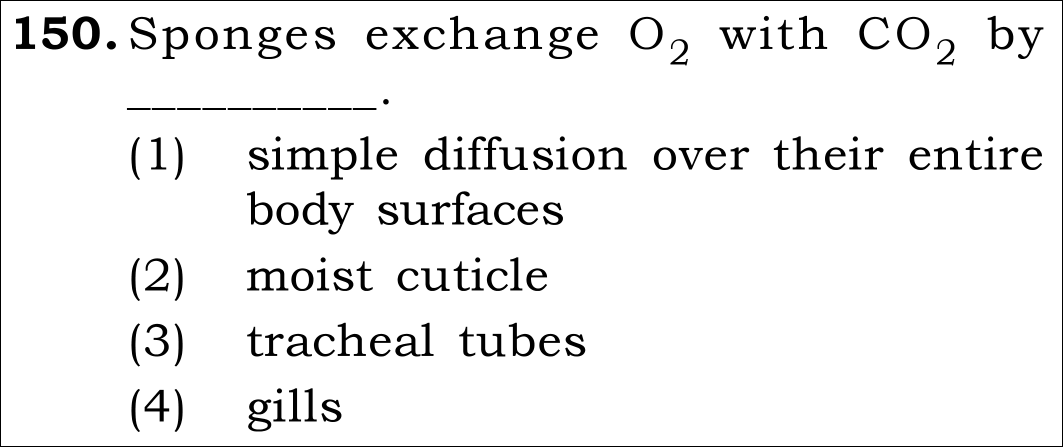
Option (1) : simple diffusion over their entire body surfaces
📚 Breathing and Exchange of Gases Easy
📋 Given Parameters & Problem Setup
Organism Group Sponges (Phylum Porifera)
Physiological Process Gas exchange (O₂ with CO₂)
⚡

The 30-Second Exam Hall Shortcut: ⚡ Simple Diffusion in Lower Invertebrates

⏱️ Save ~40 seconds

Sponges, Coelenterates, Flatworms lack specialized organs -> Simple Diffusion over entire body surface!

1 Recall respiratory adaptations across animal phyla in NCERT Breathing and Exchange of Gases:
2 Sponges, coelenterates, flatworms: Simple diffusion over entire body surface.
3 Earthworms: Moist cuticle (cutaneous).
4 Insects: Tracheal tubes.
5 Aquatic arthropods, molluscs, fish: Gills (branchial).
6 Sponges exchange gases via simple diffusion over entire body surface.
7 Option (1) is the exact match. Mark Option (1) in under 3 seconds!
🛡️
Why You Can 100% Trust This Shortcut: NCERT Biology · Breathing and Exchange of Gases (Respiratory Volumes: Functional Residual Capacity FRC = ERV + RV).
📐

Step-by-Step Rigorous Workflow & Mathematical Proof

Step 1

Respiratory Adaptations in Lower Invertebrates

Mechanisms of breathing vary among different groups of animals depending on their habitats and levels of organization. Lower invertebrates like sponges (Porifera), coelenterates (Cnidaria), and flatworms (Platyhelminthes) exhibit cellular or tissue levels of organization and lack specialized vascular or respiratory organs.

Sponges, Coelenterates, Flatworms  ⟹  Simple diffusion over entire body surface\text{Sponges, Coelenterates, Flatworms} \implies \mathbf{Simple\text{ diffusion over entire body surface}}
  • • Water canal system circulates water past choanocytes and pinacocytes for direct gas exchange.
Step 2

Compare with Higher Invertebrate Respiratory Organs

Earthworms use their moist cuticle (cutaneous respiration, Option 2). Insects have a network of tracheal tubes to transport atmospheric air within the body (Option 3). Aquatic arthropods, molluscs, and fishes use specialized vascularized structures called gills (branchial respiration, Option 4).

{Sponges:Simple diffusion over entire body surfaceEarthworm:Moist cuticleInsects:Tracheal tubesAquatic animals:Gills\begin{cases} \text{Sponges} &: \mathbf{Simple\text{ diffusion over entire body surface}} \\ \text{Earthworm} &: \text{Moist cuticle} \\ \text{Insects} &: \text{Tracheal tubes} \\ \text{Aquatic animals} &: \text{Gills} \end{cases}
  • • Option (1) is uniquely correct for sponges.
Step 3

Conclusion

Sponges exchange O₂ with CO₂ by simple diffusion across their entire body surfaces.

Correct Mechanism=Option (1)\text{Correct Mechanism} = \text{Option (1)}
  • • Matches official NTA final answer key Option A / (1).
⭐

360° Option Elimination Engine Key Feature

Diagnose every choice: Know exactly why the right option works and why distractors fail.

4-Option Deep Scan
1 A
✓ 100% Correct
Verdict & Scientific Reason:

100% accurate. Canonical NCERT mechanism of respiratory gas exchange in Porifera.

💡
Why this is airtight: None; direct textbook recall.
2 B
✗ Incorrect
Verdict & Scientific Reason:

Incorrect. Cutaneous respiration using moist cuticle is characteristic of annelids (earthworms) and amphibians (frogs).

⚠️
Student Fallacy (Why candidates pick this trap): Confusing earthworm cutaneous respiration with sponge surface diffusion.
3 C
✗ Incorrect
Verdict & Scientific Reason:

Incorrect. Tracheal respiratory systems are found in terrestrial arthropods (insects, centipedes).

⚠️
Student Fallacy (Why candidates pick this trap): Confusing insect tracheal networks with sponge body surfaces.
4 D
✗ Incorrect
Verdict & Scientific Reason:

Incorrect. Branchial respiration via gills occurs in crustaceans, molluscs, and fishes.

⚠️
Student Fallacy (Why candidates pick this trap): Assuming all aquatic organisms use gills.
⚠️

NTA Trap Alert: Assuming All Aquatic Creatures Have Gills

Students often generalize: "Sponges live in water, so they must use gills." Gills require complex tissues and circulatory capillaries. Sponges have simple cellular-grade organization and rely entirely on simple diffusion.

🛡️ How to avoid the -1 mark: Remember: Sponges are simple; simple animals use SIMPLE diffusion!
📖

Core NEET Syllabus Standard

NEET Biology Core Syllabus · Breathing and Exchange of Gases Standard Benchmark
Core Scientific Principle Tested:

"Lower invertebrates like sponges exchange O₂ and CO₂ by simple diffusion across their entire body surfaces facilitated by the water canal system."
Syllabus Focus: Respiratory Organs
✓ Core NEET UG Syllabus Anchor Syllabus & Academic Standards ↗
Sponges are Simple: Simple Diffusion washes through every cell and pore!
NEET 2024 · Q153 Easy
Official NEET 2024 Question 153 - Breathing and Exchange of Gases
1
2
3
4 ✓ Key
💡 Verified Solution & 30-Second Hack
✓
Verified Against NTA Final Answer Key
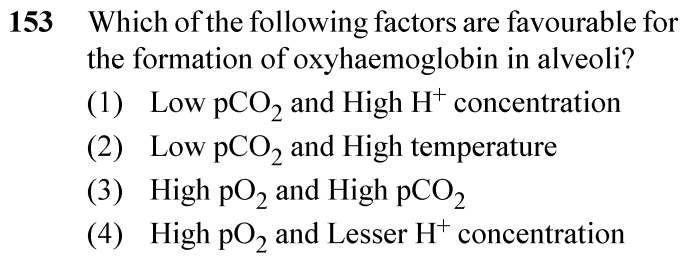
Option (4) : High pO2 and Lesser H+ concentration
📚 Breathing and Exchange of Gases Easy
📋 Given Parameters & Problem Setup
Site Alveoli of lungs
Target Physiological Process Formation of oxyhaemoglobin (HbO2 loading)
⚡

The 30-Second Exam Hall Shortcut: ⚡ Alveolar Oxygen Loading Conditions

⏱️ Save ~20 seconds

In alveoli: High pO₂, Low pCO₂, Lower H⁺ concentration (higher pH), and Lower temperature strictly favor oxyhaemoglobin formation!

1 Recall factors governing oxygen binding to haemoglobin in alveoli:
2 - pO₂: High
3 - pCO₂: Low
4 - H⁺ concentration: Low (Lesser)
5 - Temperature: Low
6 Option (4) states: "High pO₂ and Lesser H⁺ concentration", which is entirely correct!
7 Select Option (4) / D.
🛡️
Why You Can 100% Trust This Shortcut: NCERT Biology · Breathing and Exchange of Gases (Transport of Oxygen)
📐

Step-by-Step Rigorous Workflow & Mathematical Proof

Step 1

Examine Factors Affecting Oxygen Binding

Haemoglobin is a red coloured iron containing pigment present in RBCs. O2O_2 can bind with haemoglobin in a reversible manner to form oxyhaemoglobin. Binding of oxygen with haemoglobin is primarily related to partial pressure of O2O_2. Partial pressure of CO2CO_2, hydrogen ion concentration (H+H^+) and temperature are the other factors that interfere with this binding.

Step 2

Conditions in Alveoli vs Tissues

In the alveoli, where there is high pO2pO_2, low pCO2pCO_2, lesser H+H^+ concentration and lower temperature, the factors are all favourable for the formation of oxyhaemoglobin. In the tissues, where low pO2pO_2, high pCO2pCO_2, high H+H^+ concentration and higher temperature exist, the conditions are favourable for dissociation of oxygen from the oxyhaemoglobin.

Step 3

Match with Options

Option (4) directly and correctly captures "High pO₂ and Lesser H⁺ concentration".

⭐

360° Option Elimination Engine Key Feature

Diagnose every choice: Know exactly why the right option works and why distractors fail.

4-Option Deep Scan
1 (1)
✗ Incorrect
Verdict & Scientific Reason:

High H+ concentration promotes dissociation (Bohr effect), not formation.

⚠️
Student Fallacy (Why candidates pick this trap): High H+ concentration promotes dissociation (Bohr effect), not formation.
2 (2)
✗ Incorrect
Verdict & Scientific Reason:

High temperature shifts the oxygen dissociation curve to the right, favoring unloading, not loading.

⚠️
Student Fallacy (Why candidates pick this trap): High temperature shifts the oxygen dissociation curve to the right, favoring unloading, not loading.
3 (3)
✗ Incorrect
Verdict & Scientific Reason:

In alveoli, pCO2 is low, not high.

⚠️
Student Fallacy (Why candidates pick this trap): In alveoli, pCO2 is low, not high.
4 (4)
✓ 100% Correct
Verdict & Scientific Reason:

High pO₂ combined with lesser H⁺ concentration directly facilitates maximal oxyhaemoglobin association in alveoli.

💡
Why this is airtight: None.
⚠️

NTA Trap Alert: H+ vs pH Inversion

Confusing "lesser H+ concentration" with acidic conditions.

🛡️ How to avoid the -1 mark: Lesser H+ = higher pH = more alkaline environment in pulmonary capillaries, favoring oxygen binding.
📖

Core NEET Syllabus Standard

Biology Core Zoology · Breathing and Exchange of Gases Standard Benchmark
Core Scientific Principle Tested:

"In the alveoli, where there is high pO2, low pCO2, lesser H+ concentration and lower temperature, the factors are all favourable for the formation of oxyhaemoglobin."

Syllabus Focus: Factors Influencing Oxyhaemoglobin Formation in Alveoli
✓ Core NEET UG Syllabus Anchor Syllabus & Academic Standards ↗
NEET 2024 · Q155 Easy
Official NEET 2024 Question 155 - Breathing and Exchange of Gases
1
2
3 ✓ Key
4
💡 Verified Solution & 30-Second Hack
✓
Verified Against NTA Final Answer Key
Option (3) : A-II, B-IV, C-I, D-III
📚 Breathing and Exchange of Gases Easy
📋 Given Parameters & Problem Setup
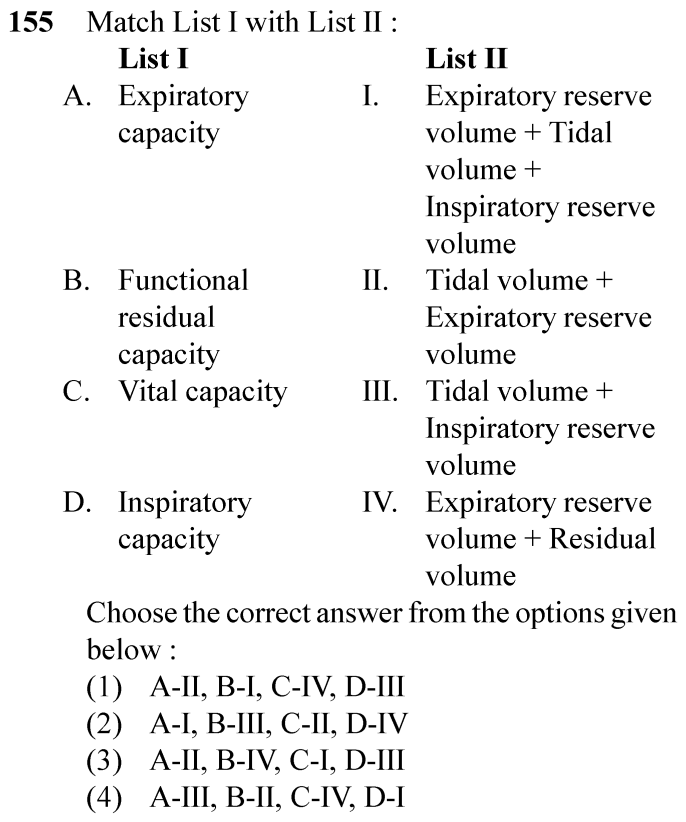
List I (Capacities) A: Expiratory capacity; B: Functional residual capacity; C: Vital capacity; D: Inspiratory capacity
List II (Component Sums) I: ERV + TV + IRV; II: TV + ERV; III: TV + IRV; IV: ERV + RV
⚡

The 30-Second Exam Hall Shortcut: ⚡ Respiratory Capacity Formulas

⏱️ Save ~25 seconds

EC = TV + ERV (II); FRC = ERV + RV (IV); VC = ERV + TV + IRV (I); IC = TV + IRV (III)! Result: A-II, B-IV, C-I, D-III!

1 A. Expiratory capacity (EC): Total volume of air a person can expire after normal inspiration: TV + ERV (II).
2 B. Functional residual capacity (FRC): Volume of air remaining in lungs after normal expiration: ERV + RV (IV).
3 C. Vital capacity (VC): Maximum volume of air a person can breathe in after forced expiration: ERV + TV + IRV (I).
4 D. Inspiratory capacity (IC): Total volume of air a person can inspire after normal expiration: TV + IRV (III).
5 Order: A-II, B-IV, C-I, D-III -> Option (3) / C.
🛡️
Why You Can 100% Trust This Shortcut: NCERT Biology · Breathing and Exchange of Gases (Respiratory Volumes and Capacities)
📐

Step-by-Step Rigorous Workflow & Mathematical Proof

Step 1

Define Inspiratory and Expiratory Capacities

Inspiratory Capacity (ICIC) is the total volume of air a person can inspire after a normal expiration, comprising Tidal Volume and Inspiratory Reserve Volume (IC=TV+IRVIC = TV + IRV) (D -> III). Expiratory Capacity (ECEC) is the total volume of air a person can expire after a normal inspiration, comprising Tidal Volume and Expiratory Reserve Volume (EC=TV+ERVEC = TV + ERV) (A -> II).

Step 2

Define FRC and Vital Capacity

Functional Residual Capacity (FRCFRC) is the volume of air that remains in the lungs after a normal expiration, including ERV+RVERV + RV (B -> IV). Vital Capacity (VCVC) is the maximum volume of air a person can breathe in after a forced expiration, encompassing ERV+TV+IRVERV + TV + IRV (C -> I).

Step 3

Match Combination

A-II, B-IV, C-I, D-III perfectly matches Option (3).

⭐

360° Option Elimination Engine Key Feature

Diagnose every choice: Know exactly why the right option works and why distractors fail.

4-Option Deep Scan
1 (1)
✗ Incorrect
Verdict & Scientific Reason:

Mismatches FRC with Vital capacity formula.

⚠️
Student Fallacy (Why candidates pick this trap): Mismatches FRC with Vital capacity formula.
2 (2)
✗ Incorrect
Verdict & Scientific Reason:

Mismatches EC with Vital capacity.

⚠️
Student Fallacy (Why candidates pick this trap): Mismatches EC with Vital capacity.
3 (3)
✓ 100% Correct
Verdict & Scientific Reason:

Accurately pairs each respiratory lung capacity with its precise algebraic formula.

💡
Why this is airtight: None.
4 (4)
✗ Incorrect
Verdict & Scientific Reason:

Mismatches EC with IC.

⚠️
Student Fallacy (Why candidates pick this trap): Mismatches EC with IC.
⚠️

NTA Trap Alert: FRC vs IC Confusion

Forgetting whether FRC includes residual volume (RV).

🛡️ How to avoid the -1 mark: Residual is in the name: Functional RESIDUAL Capacity = ERV + RV.
📖

Core NEET Syllabus Standard

Biology Core Zoology · Breathing and Exchange of Gases Standard Benchmark
Core Scientific Principle Tested:

"Inspiratory Capacity (IC) = TV + IRV; Expiratory Capacity (EC) = TV + ERV; Functional Residual Capacity (FRC) = ERV + RV; Vital Capacity (VC) = ERV + TV + IRV."

Syllabus Focus: Respiratory Capacities Formulations: EC, FRC, VC, and IC
✓ Core NEET UG Syllabus Anchor Syllabus & Academic Standards ↗
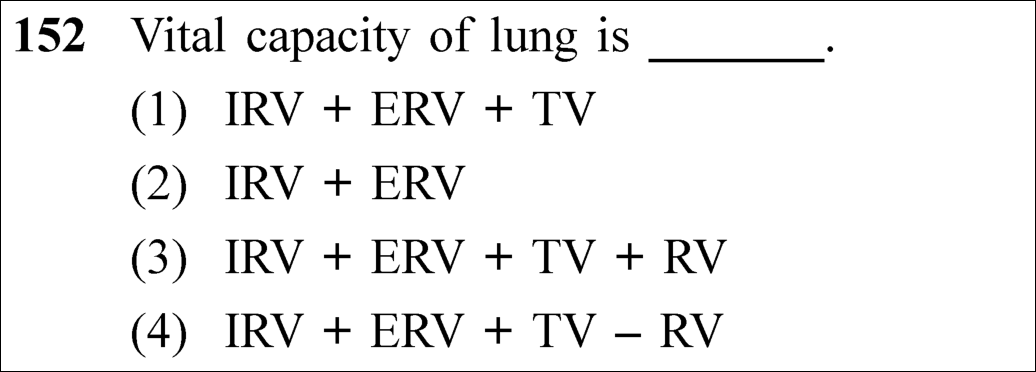
NEET 2023 · Q152 Easy
Official NEET 2023 Question 152 - Breathing and Exchange of Gases
1 IRV + ERV+TV ✓ Key
2 IRV + ERV
3 IRV+ ERV+TV+RV
4 IRV + ERV + TV -RV
💡 Verified Solution & 30-Second Hack
✓
Verified Against NTA Final Answer Key
Option (1) : IRV + ERV + TV
📚 Breathing and Exchange of Gases Easy
📋 Given Parameters & Problem Setup
Respiratory Capacity Vital Capacity of lungs (VC)
Spirometric Components Inspiratory Reserve Volume (IRV), Expiratory Reserve Volume (ERV), Tidal Volume (TV)
⚡

The 30-Second Exam Hall Shortcut: ⚡ Vital Capacity = All Mobilizable Air: IRV + ERV + TV

⏱️ Save ~20 seconds

Vital Capacity is the maximum volume of air a person can breathe out after a forced inspiration (or breathe in after a forced expiration). It includes all movable volumes (IRV + TV + ERV) and strictly excludes Residual Volume (RV)!

1 Total Lung Capacity (TLC) = IRV+ERV+TV+RVIRV + ERV + TV + RV.
2 Vital Capacity (VC) = TLC minus the non-expellable Residual Volume (RVRV).
3 Therefore: VC=IRV+ERV+TVVC = IRV + ERV + TV.
4 Match Option (1) IRV + ERV + TV.
🛡️
Why You Can 100% Trust This Shortcut: Canonical NCERT Human Physiology spirometric volume and capacity definitions.
📐

Step-by-Step Rigorous Workflow & Mathematical Proof

Step 1

Definition of Vital Capacity (VC)

Vital Capacity is defined as the maximum volume of air a person can exhale after a maximal forced inspiration, or the maximum volume of air a person can inhale after a maximal forced expiration:

Vital Capacity (VC)=ERV+TV+IRV(≈3500−4500 mL)\text{\textbf{Vital Capacity (VC)}} = \mathbf{ERV + TV + IRV} \quad (\approx 3500 - 4500\text{ mL})
Step 2

Verbatim NCERT Reference

NCERT defines Vital Capacity: "The maximum volume of air a person can breathe in after a forced expiration. This includes ERV, TV and IRV or the maximum volume of air a person can breathe out after a forced inspiration."

Step 3

Comparison with Other Capacities

Expiratory Capacity (EC=TV+ERVEC = TV + ERV); Inspiratory Capacity (IC=TV+IRVIC = TV + IRV); Functional Residual Capacity (FRC=ERV+RVFRC = ERV + RV); Total Lung Capacity (TLC=VC+RV=IRV+ERV+TV+RVTLC = VC + RV = IRV + ERV + TV + RV).

⭐

360° Option Elimination Engine Key Feature

Diagnose every choice: Know exactly why the right option works and why distractors fail.

4-Option Deep Scan
1 1
✓ 100% Correct
Verdict & Scientific Reason:

Exact mathematical formula and physiological definition of Vital Capacity (VC).

💡
Why this is airtight: None; textbook verbatim formula.
2 2
✗ Incorrect
Verdict & Scientific Reason:

Omits the Tidal Volume (TV, ~500 mL) which is an essential mobilizable component.

⚠️
Student Fallacy (Why candidates pick this trap): Forgetting that normal tidal breathing is part of vital capacity.
3 3
✗ Incorrect
Verdict & Scientific Reason:

This represents Total Lung Capacity (TLC), not Vital Capacity.

⚠️
Student Fallacy (Why candidates pick this trap): Confusing Total Lung Capacity with Vital Capacity.
4 4
✗ Incorrect
Verdict & Scientific Reason:

Nonsensical mathematical deduction; Residual Volume is not subtracted from mobilizable volumes.

⚠️
Student Fallacy (Why candidates pick this trap): Confusing TLC−RV=VCTLC - RV = VC with subtracting RV from VC.
⚠️

NTA Trap Alert: Vital Capacity vs. Total Lung Capacity Trap

Students frequently mix up VC with TLC. TLC includes the residual volume (air that can never be exhaled), while VC measures only the air that can be actively moved in and out.

🛡️ How to avoid the -1 mark: Remember: VC = Air you can breathe (no RV). TLC = ALL air in lungs (includes RV).
📖

Core NEET Syllabus Standard

NCERT Biology · Breathing and Exchange of Gases Standard Benchmark
Core Scientific Principle Tested:

"Vital Capacity (VC): The maximum volume of air a person can breathe in after a forced expiration. This includes ERV, TV and IRV."

Syllabus Focus: Respiratory Volumes and Capacities
✓ Core NEET UG Syllabus Anchor Syllabus & Academic Standards ↗
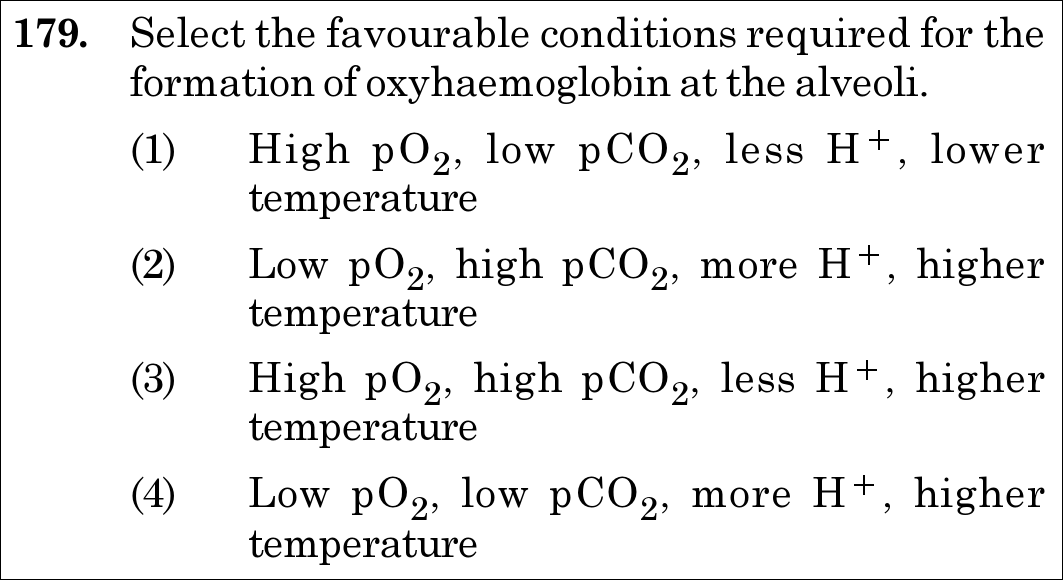
NEET 2021 · Q179 Easy
Official NEET 2021 Question 179 - Breathing and Exchange of Gases
1 High pO2, low pCO2, less H+, lower temperature ✓ Key
2 Low pO2, high pCO2, more H+, higher temperature
3 High pO2, high pCO2, less H+, higher temperature
4 Low pO2, low pCO2, more H+, higher temperature
💡 Verified Solution & 30-Second Hack
✓
Verified Against NTA Final Answer Key
Option (1) : High pO2, low pCO2, less H+, lower temperature
📚 Breathing and Exchange of Gases Easy
📋 Given Parameters & Problem Setup
Anatomical Site Pulmonary Alveoli
Biochemical Process Formation of Oxyhaemoglobin (Hb + 4O₂ ⇌ Hb(O₂)₄)
Question Objective Identify the favourable microenvironmental parameters
⚡

The 30-Second Exam Hall Shortcut: ⚡ "Alveolar Recipe for Oxyhaemoglobin: High O₂, Everything Else LOW!"

⏱️ Save ~25 seconds

At the alveoli, loading oxygen onto haemoglobin requires HIGH pO₂ and LOW levels of all competing allosteric effectors (LOW pCO₂, LOW H⁺/less acidity, and LOWER temperature). This shifts the curve to the LEFT! Mark Option (1).

1 Recall alveolar respiratory state: Inhaled air brings abundant oxygen and washes out CO₂.
2 Identify conditions for Hb-O2Hb\text{-}O_2 formation: High pO2pO_2, low pCO2pCO_2, lower [H+][H^+] (higher pH), and lower temperature.
3 Contrast with tissues (dissociation): Low pO2pO_2, high pCO2pCO_2, high H+H^+, higher temperature (Bohr effect, right shift).
4 Option (1) lists all four alveolar conditions perfectly.
🛡️
Why You Can 100% Trust This Shortcut: NCERT Biology · Breathing and Exchange of Gases (Transport of Gases: In the alveoli, where there is high pO2, low pCO2, lesser H+ concentration and lower temperature, the factors are all favourable for the formation of oxyhaemoglobin).
📐

Step-by-Step Rigorous Workflow & Mathematical Proof

Step 1

Haemoglobin Oxygenation Kinetics and Allosteric Modulation

Binding of oxygen to haemoglobin is a reversible, cooperative oxygenation process governed by the oxygen-haemoglobin dissociation curve. At the pulmonary alveoli: - High pO2pO_2 (~104 mm Hg): Provides the steep diffusion gradient driving conformational transition of deoxyhaemoglobin (T-state) into relaxed oxyhaemoglobin (R-state). - Low pCO2pCO_2 (~40 mm Hg): Minimizes carbamino-haemoglobin formation and prevents carbamylation of N-terminal amino groups. - Lesser H+H^+ concentration (Higher pH ~7.4): Prevents protonation of histidine residues that otherwise stabilize deoxyhaemoglobin (Haldane effect). - Lower Temperature: Exothermic binding of O2O_2 to haem is thermodynamically favoured at lower temperatures.

Alveoli (Left Shift)  ⟹  {↑pO2(∼104 mm Hg)↓pCO2(∼40 mm Hg)↓[H+](Higher pH)↓Temperature(Enhanced affinity)\text{Alveoli (Left Shift)} \implies \begin{cases} \mathbf{\uparrow pO_2} & (\sim 104\text{ mm Hg}) \\[3pt] \mathbf{\downarrow pCO_2} & (\sim 40\text{ mm Hg}) \\[3pt] \mathbf{\downarrow [H^+]} & (\text{Higher pH}) \\[3pt] \mathbf{\downarrow \text{Temperature}} & (\text{Enhanced affinity}) \end{cases}
Step 2

Contrast with Peripheral Tissue Microenvironment

In metabolically active systemic tissues, the reverse occurs: low pO2pO_2, high pCO2pCO_2, high H+H^+ (acidic lactic/carbonic acid), and elevated temperature facilitate the uncoupling and unloading of oxygen (Bohr effect, rightward shift).

⭐

360° Option Elimination Engine Key Feature

Diagnose every choice: Know exactly why the right option works and why distractors fail.

4-Option Deep Scan
1 1
✓ 100% Correct
Verdict & Scientific Reason:

Correct. Matches the verbatim NCERT microenvironmental parameters promoting oxyhaemoglobin association at alveoli.

💡
Why this is airtight: None. Candidate accurately remembers all four alveolar parameters.
2 2
✗ Incorrect
Verdict & Scientific Reason:

Incorrect. These are the exact conditions found in peripheral tissues promoting dissociation, not formation of oxyhaemoglobin.

⚠️
Student Fallacy (Why candidates pick this trap): Confusing tissue unloading conditions with alveolar loading conditions.
3 3
✗ Incorrect
Verdict & Scientific Reason:

Incorrect. High pCO2 and higher temperature both destabilize oxyhaemoglobin and shift the curve to the right.

⚠️
Student Fallacy (Why candidates pick this trap): Overlooking the negative allosteric effects of temperature and carbon dioxide.
4 4
✗ Incorrect
Verdict & Scientific Reason:

Incorrect. Low pO2 cannot drive oxyhaemoglobin formation.

⚠️
Student Fallacy (Why candidates pick this trap): Confusing all four physiological variables.
⚠️

NTA Trap Alert: Tissue vs Alveolar Condition Inversion Trap

NTA designs Option 2 as the exact mirror image (tissue conditions promoting dissociation). Students must check all 4 parameters: high pO2, low pCO2, low H+, low temp.

🛡️ How to avoid the -1 mark: Use the rule: "At the alveoli, only pO2 is high; the other three (pCO2, H+, temperature) are all low".
📖

Core NEET Syllabus Standard

NEET / NCERT Biology · Breathing and Exchange of Gases Standard Benchmark
Core Scientific Principle Tested:

"High pO2, low pCO2, lesser H+ concentration, and lower temperature favour oxyhaemoglobin formation in alveoli."

Syllabus Focus: Transport of Oxygen
✓ Core NEET UG Syllabus Anchor Syllabus & Academic Standards ↗
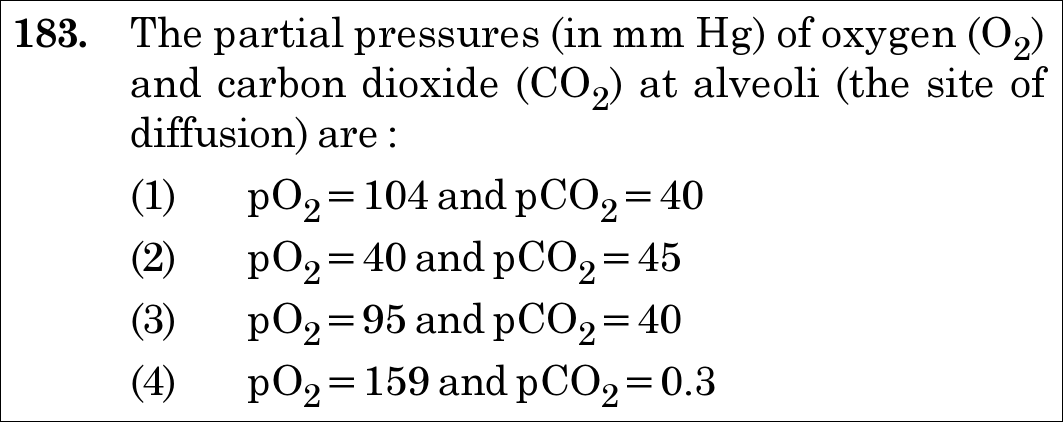
NEET 2021 · Q183 Easy
Official NEET 2021 Question 183 - Breathing and Exchange of Gases
1 pO2=104 and pCO2=40 ✓ Key
2 pO2=40 and pCO2=45
3 pO2=95 and pCO2=40
4 pO2=159 and pCO2=0.3
💡 Verified Solution & 30-Second Hack
✓
Verified Against NTA Final Answer Key
Option (1) : pO2=104 and pCO2=40
📚 Breathing and Exchange of Gases Easy
📋 Given Parameters & Problem Setup
Site of Diffusion Pulmonary Alveoli
Target Gases Oxygen (O₂) and Carbon Dioxide (CO₂)
Units mm Hg
Question Objective Identify exact standard partial pressures pO₂ and pCO₂
⚡

The 30-Second Exam Hall Shortcut: ⚡ "Alveolar Pressures: 104 and 40 mm Hg"

⏱️ Save ~20 seconds

In pulmonary alveoli, the partial pressure of oxygen is 104 mm Hg and carbon dioxide is 40 mm Hg. This creates the exact steep gradient needed to oxygenate deoxygenated venous blood (pO₂ = 40, pCO₂ = 45)! Mark Option (1) instantly.

1 Recall NCERT Table of Partial Pressures: - Atmosphere: pO2=159pO_2 = 159, pCO2=0.3pCO_2 = 0.3 - Alveoli: pO2=104pO_2 = 104, pCO2=40pCO_2 = 40 - Deoxygenated blood: pO2=40pO_2 = 40, pCO2=45pCO_2 = 45 - Oxygenated blood: pO2=95pO_2 = 95, pCO2=40pCO_2 = 40 - Tissues: pO2=40pO_2 = 40, pCO2=45pCO_2 = 45.
2 Identify Alveoli values: pO2=104 mm HgpO_2 = 104\text{ mm Hg} and pCO2=40 mm HgpCO_2 = 40\text{ mm Hg}.
3 Select Option (1).
🛡️
Why You Can 100% Trust This Shortcut: NCERT Biology · Breathing and Exchange of Gases (Exchange of Gases: Partial pressures of oxygen and carbon dioxide at alveoli are pO2 = 104 mm Hg and pCO2 = 40 mm Hg).
📐

Step-by-Step Rigorous Workflow & Mathematical Proof

Step 1

Partial Pressure Gradients Across Respiratory Compartments

Gas exchange across the alveolar-capillary respiratory membrane proceeds purely by simple passive diffusion governed by partial pressure gradients, gas solubility, and membrane thickness: - Atmospheric Air: pO2=159 mm HgpO_2 = 159\text{ mm Hg}, pCO2=0.3 mm HgpCO_2 = 0.3\text{ mm Hg}. - Alveoli: pO2=104 mm HgpO_2 = \mathbf{104\text{ mm Hg}}, pCO2=40 mm HgpCO_2 = \mathbf{40\text{ mm Hg}}. - Deoxygenated Blood (Pulmonary Artery): pO2=40 mm HgpO_2 = 40\text{ mm Hg}, pCO2=45 mm HgpCO_2 = 45\text{ mm Hg}. - Oxygenated Blood (Pulmonary Vein / Systemic Arteries): pO2=95 mm HgpO_2 = 95\text{ mm Hg}, pCO2=40 mm HgpCO_2 = 40\text{ mm Hg}. - Tissues: pO2=40 mm HgpO_2 = 40\text{ mm Hg}, pCO2=45 mm HgpCO_2 = 45\text{ mm Hg}.

Alveoli  ⟹  {pO2=104 mm HgpCO2=40 mm Hg\text{Alveoli} \implies \begin{cases} \mathbf{pO_2} & = 104\text{ mm Hg} \\[3pt] \mathbf{pCO_2} & = 40\text{ mm Hg} \end{cases}
Step 2

Analysis of Diffusion Direction

- For O2O_2: Gradient is from alveoli (104 mm Hg104\text{ mm Hg}) to deoxygenated capillary blood (40 mm Hg40\text{ mm Hg}), driving rapid influx of oxygen into blood. - For CO2CO_2: Gradient is from blood (45 mm Hg45\text{ mm Hg}) to alveoli (40 mm Hg40\text{ mm Hg}), driving excretion of carbon dioxide into alveolar air.

⭐

360° Option Elimination Engine Key Feature

Diagnose every choice: Know exactly why the right option works and why distractors fail.

4-Option Deep Scan
1 1
✓ 100% Correct
Verdict & Scientific Reason:

Correct. Perfectly matches canonical alveolar partial pressures.

💡
Why this is airtight: None. Candidate accurately remembers the standard gas values.
2 2
✗ Incorrect
Verdict & Scientific Reason:

Incorrect. These are the partial pressures of deoxygenated blood and tissues, not alveoli.

⚠️
Student Fallacy (Why candidates pick this trap): Confusing alveolar values with venous blood or tissue values.
3 3
✗ Incorrect
Verdict & Scientific Reason:

Incorrect. These are the partial pressures of oxygenated systemic arterial blood.

⚠️
Student Fallacy (Why candidates pick this trap): Confusing alveolar pO2 (104) with arterial blood pO2 (95) after physiological shunting.
4 4
✗ Incorrect
Verdict & Scientific Reason:

Incorrect. These are the partial pressures of dry ambient atmospheric air.

⚠️
Student Fallacy (Why candidates pick this trap): Confusing ambient atmospheric air with humidified alveolar gas mixture.
⚠️

NTA Trap Alert: Alveoli (104) vs Arterial Blood (95) vs Atmospheric (159) Trap

NTA includes all 4 standard compartments in the options: Option 1 is Alveoli (104/40), Option 2 is Venous/Tissue (40/45), Option 3 is Arterial blood (95/40), and Option 4 is Atmospheric air (159/0.3).

🛡️ How to avoid the -1 mark: Commit the numerical pair to memory: Alveoli = 104 and 40.
📖

Core NEET Syllabus Standard

NEET / NCERT Biology · Breathing and Exchange of Gases Standard Benchmark
Core Scientific Principle Tested:

"Partial pressures of O2 and CO2 at alveoli are 104 mm Hg and 40 mm Hg respectively."

Syllabus Focus: Exchange of Gases
✓ Core NEET UG Syllabus Anchor Syllabus & Academic Standards ↗
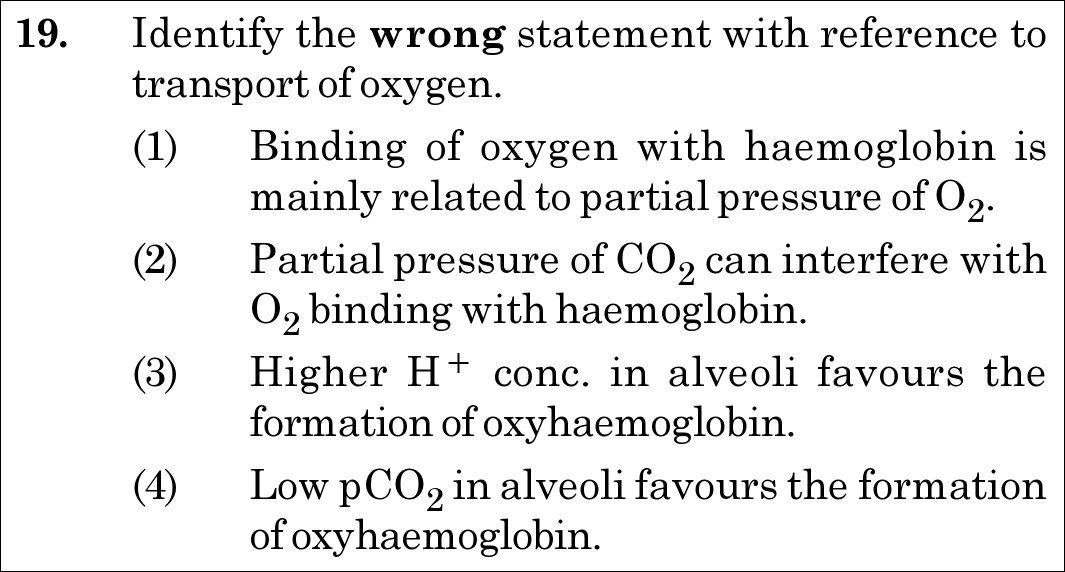
NEET 2020 · Q19 Easy
Official NEET 2020 Question 19 - Breathing and Exchange of Gases
1 Binding of oxygen with haemoglobin is mainly related to partial pressure of O2.
2 Partial pressure of CO2 can interfere with O2 binding with haemoglobin.
3 Higher H+ conc. in alveoli favours the formation of oxyhaemoglobin. ✓ Key
4 Low pCO2 in alveoli favours the formation of oxyhaemoglobin.
💡 Verified Solution & 30-Second Hack
✓
Verified Against NTA Final Answer Key
Option (3) : Higher H+ conc. in alveoli favours the formation of oxyhaemoglobin.
📚 Breathing and Exchange of Gases Easy
📋 Given Parameters & Problem Setup
Physiological Process Transport of Oxygen / Oxyhaemoglobin Dynamics
Microenvironment Pulmonary Alveoli vs Systemic Tissues
Question Objective Identify the WRONG / incorrect statement
⚡

The 30-Second Exam Hall Shortcut: ⚡ "Alveoli Must Have LESS H⁺ (Higher pH) to Form Oxyhaemoglobin!"

⏱️ Save ~20 seconds

At the alveoli, loading oxygen requires high pO₂, low pCO₂, LESS H⁺ concentration (alkaline pH), and lower temperature. Higher H⁺ (acidity) shifts the curve to the RIGHT and promotes DISSOCIATION (Bohr effect). Statement (3) claims higher H⁺ favours formation — which is completely WRONG! Select Option (3).

1 Recall alveolar conditions for oxyhaemoglobin formation: High pO2pO_2, low pCO2pCO_2, LESS H+H^+ conc. (high pH), and lower temperature.
2 Recall Bohr effect: Elevated [H+][H^+] (acidity) weakens oxygen binding and causes O₂ dissociation in tissues.
3 Analyze Statement (3): Claims "Higher H+ conc. in alveoli favours the formation" -> Blatantly false!
4 Option (3) is the wrong statement and therefore the correct answer.
🛡️
Why You Can 100% Trust This Shortcut: NCERT Biology · Breathing and Exchange of Gases (Transport of Gases: In the alveoli, where there is high pO2, low pCO2, lesser H+ concentration and lower temperature, the factors are all favourable for the formation of oxyhaemoglobin, whereas in the tissues, low pO2, high pCO2, high H+ concentration and higher temperature exist, the conditions are favourable for dissociation of oxygen from the oxyhaemoglobin).
📐

Step-by-Step Rigorous Workflow & Mathematical Proof

Step 1

Allosteric Regulation of Oxygen-Haemoglobin Binding

The reversible oxygenation of haemoglobin to form oxyhaemoglobin (Hb(O2)4Hb(O_2)_4) is governed by local allosteric modulators: - In Pulmonary Alveoli: Environmental conditions favor maximal oxygen saturation (leftward shift of dissociation curve): 1. High partial pressure of oxygen (pO2≈104 mm HgpO_2 \approx 104\text{ mm Hg}). 2. Low partial pressure of carbon dioxide (pCO2≈40 mm HgpCO_2 \approx 40\text{ mm Hg}). 3. Lesser H+H^+ concentration (higher, slightly alkaline pH ≈7.4\approx 7.4). 4. Lower body temperature. - In Systemic Tissues: Cellular respiration generates CO2CO_2 and lactic acid, creating: 1. Low pO2pO_2 (40 mm Hg40\text{ mm Hg}). 2. High pCO2pCO_2 (45 mm Hg45\text{ mm Hg}). 3. High H+H^+ concentration (acidosis). 4. Elevated temperature. - High [H+][H^+] protonates key histidine residues on haemoglobin subunits, stabilizing the low-affinity deoxygenated T-state (Bohr effect) and promoting oxygen dissociation, never formation.

Alveoli  ⟹  {↑pO2↓pCO2↓[H+](Lesser H+ Concentration)↓Temp  ⟹  Favour Oxyhaemoglobin Formation\text{Alveoli} \implies \begin{cases} \mathbf{\uparrow pO_2} & \\ \mathbf{\downarrow pCO_2} & \\ \mathbf{\downarrow [H^+]} & (\mathbf{Lesser\,H^+\,Concentration}) \\ \mathbf{\downarrow \text{Temp}} & \end{cases} \implies \mathbf{Favour\,Oxyhaemoglobin\,Formation}
Step 2

Statement Evaluation

Statement (3) asserts that "Higher H+ conc. in alveoli favours the formation of oxyhaemoglobin." This directly contradicts the Bohr effect and textbook facts; therefore, statement (3) is false and is the correct response.

⭐

360° Option Elimination Engine Key Feature

Diagnose every choice: Know exactly why the right option works and why distractors fail.

4-Option Deep Scan
1 A
✗ Incorrect
Verdict & Scientific Reason:

This is a true statement. pO2 is the primary determining factor governing cooperative oxygen binding.

⚠️
Student Fallacy (Why candidates pick this trap): Overlooking that pO2 is the principal driver of oxygen saturation.
2 B
✗ Incorrect
Verdict & Scientific Reason:

This is a true statement. Increased pCO2 decreases hemoglobin affinity for oxygen (Bohr effect).

⚠️
Student Fallacy (Why candidates pick this trap): Denying the competitive allosteric role of carbon dioxide.
3 C
✓ 100% Correct
Verdict & Scientific Reason:

Correct as the wrong statement. Lesser H+ concentration (not higher) in alveoli favours oxyhaemoglobin formation.

💡
Why this is airtight: None. Candidate accurately remembers that low H+ (high pH) is required at the alveoli.
4 D
✗ Incorrect
Verdict & Scientific Reason:

This is a true statement. Low pCO2 in alveoli shifts the curve to the left, promoting O2 loading.

⚠️
Student Fallacy (Why candidates pick this trap): Confusing alveolar pCO2 with tissue pCO2.
⚠️

NTA Trap Alert: H⁺ Concentration vs pH Reciprocal Trap

Remember that higher [H+][H^+] means *lower pH* (acidic, which unloads oxygen). Lower [H+][H^+] means *higher pH* (alkaline, which loads oxygen in the alveoli). The prompt uses "Higher H+ conc." which causes oxygen release, not binding.

🛡️ How to avoid the -1 mark: Remember: Alveoli = Less H⁺ (Basic); Tissues = More H⁺ (Acidic).
📖

Core NEET Syllabus Standard

NEET / NCERT Biology · Breathing and Exchange of Gases Standard Benchmark
Core Scientific Principle Tested:

"Lesser H+ concentration (higher pH) in alveoli favours oxyhaemoglobin formation."

Syllabus Focus: Transport of Oxygen
✓ Core NEET UG Syllabus Anchor Syllabus & Academic Standards ↗
NEET 2020 · Q24 Easy
Official NEET 2020 Question 24 - Breathing and Exchange of Gases
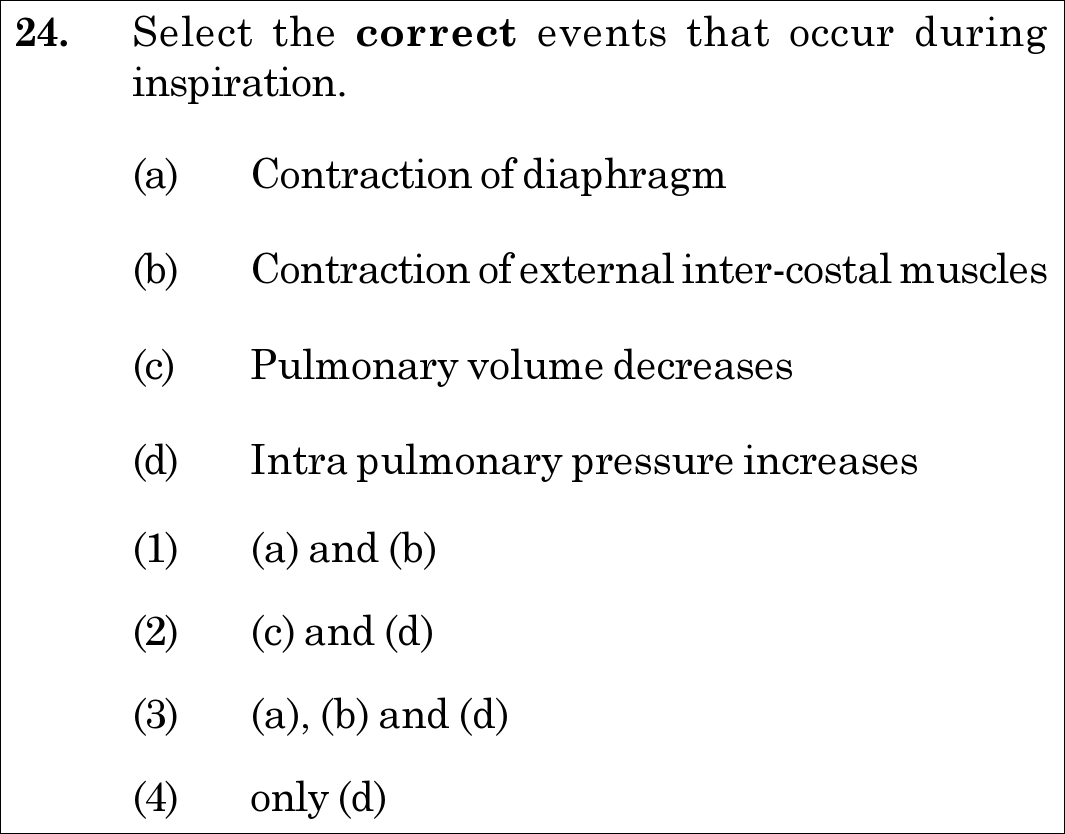
1 (a) and (b) ✓ Key
2 (c) and (d)
3 (a), (b) and (d)
4 only (d)
💡 Verified Solution & 30-Second Hack
✓
Verified Against NTA Final Answer Key
Option (1) : (a) and (b)
📚 Breathing and Exchange of Gases Easy
📋 Given Parameters & Problem Setup
Event (a) Contraction of diaphragm
Event (b) Contraction of external inter-costal muscles
Event (c) Pulmonary volume decreases
Event (d) Intra pulmonary pressure increases
Question Objective Select the correct events that occur during inspiration
⚡

The 30-Second Exam Hall Shortcut: ⚡ "Inspiration = Diaphragm & External Intercostals Contract (Volume Rises, Pressure Drops!)"

⏱️ Save ~20 seconds

Inspiration is active: Contraction of diaphragm flattens it (increases antero-posterior thoracic volume), while contraction of external intercostals lifts ribs/sternum (increases dorso-ventral volume). Pulmonary volume INCREASES (c is false) and intra-pulmonary pressure DECREASES below atmospheric (d is false). Only (a) and (b) occur! Select Option (1).

1 Check mechanics of Inspiration: - (a) Contraction of diaphragm: Pulls downward, increasing thoracic volume antero-posteriorly -> TRUE. - (b) Contraction of external intercostal muscles: Lifts ribs and sternum, increasing dorso-ventral thoracic volume -> TRUE. - (c) Pulmonary volume: INCREASES (does not decrease) -> FALSE. - (d) Intra-pulmonary pressure: DECREASES below atmospheric pressure (creates negative pressure) -> FALSE.
2 Events occurring during inspiration: (a) and (b) only.
3 Select Option (1).
🛡️
Why You Can 100% Trust This Shortcut: NCERT Biology · Breathing and Exchange of Gases (Mechanism of Breathing: Inspiration is initiated by the contraction of diaphragm which increases the volume of thoracic chamber in antero-posterior axis. The contraction of external inter-costal muscles lifts up the ribs and sternum causing an increase in volume in dorso-ventral axis. An overall increase in thoracic volume causes a similar increase in pulmonary volume, decreasing intra-pulmonary pressure below atmospheric pressure).
📐

Step-by-Step Rigorous Workflow & Mathematical Proof

Step 1

Boyle's Law and the Muscular Dynamics of Inspiration

Inspiration is an active neuromuscular process driven by atmospheric-to-alveolar pressure gradients: - (a) Contraction of Diaphragm: The dome-shaped phrenic-innervated muscular diaphragm contracts and flattens downward, increasing the volume of the thoracic cavity along the antero-posterior axis. - (b) Contraction of External Intercostal Muscles: Intercostal-innervated muscles pull the ribs upward and outward while pushing the sternum ventrally, increasing thoracic volume along the dorso-ventral axis. - Pulmonary Volume Increase: Because the pleura adhere tightly to the thoracic wall via pleural fluid surface tension, any expansion of thoracic volume drives an obligatory increase in pulmonary volume (negating statement (c)). - Intra-Pulmonary Pressure Decrease: According to Boyle’s Law (P∝1/VP \propto 1/V), an expansion in pulmonary volume causes intra-pulmonary pressure to drop below atmospheric pressure (negative pressure of approx. −1 mm Hg-1\text{ mm Hg} to −3 mm Hg-3\text{ mm Hg}), drawing ambient air into the bronchial tree (negating statement (d)).

Contraction of Diaphragm+External Intercostals  ⟹  ↑Pulmonary Volume↑Pulmonary Volume  ⟹  ↓Intra-Pulmonary Pressure<Patm  ⟹  Inflow of Air\begin{aligned} \text{Contraction of Diaphragm} + \text{External Intercostals} &\implies \mathbf{\uparrow Pulmonary\,Volume} \\[4pt] \uparrow Pulmonary\,Volume &\implies \mathbf{\downarrow Intra\text{-}Pulmonary\,Pressure} < P_{\text{atm}} \implies \text{Inflow of Air} \end{aligned}
Step 2

Option Alignment

Only events (a) and (b) occur during inspiration. Statements (c) and (d) describe events occurring during expiration.

⭐

360° Option Elimination Engine Key Feature

Diagnose every choice: Know exactly why the right option works and why distractors fail.

4-Option Deep Scan
1 A
✓ 100% Correct
Verdict & Scientific Reason:

Correct. Both diaphragm and external intercostal contraction actively expand the thoracic cavity during inspiration.

💡
Why this is airtight: None. Direct recall of respiratory mechanics.
2 B
✗ Incorrect
Verdict & Scientific Reason:

Incorrect. Volume decrease and pressure increase occur during expiration, not inspiration.

⚠️
Student Fallacy (Why candidates pick this trap): Confusing inspiration with expiration.
3 C
✗ Incorrect
Verdict & Scientific Reason:

Incorrect because intra-pulmonary pressure drops below atmospheric during inspiration; it does not increase.

⚠️
Student Fallacy (Why candidates pick this trap): Forgetting that air inflow requires negative (sub-atmospheric) pressure.
4 D
✗ Incorrect
Verdict & Scientific Reason:

Incorrect because statement (d) is false.

⚠️
Student Fallacy (Why candidates pick this trap): Complete inversion of pulmonary pressures.
⚠️

NTA Trap Alert: Inspiration vs Expiration Pressure Gradient Trap

Many candidates think that filling the lungs with air means "pressure increases". Air can ONLY rush in if the internal pressure is LOWER than atmospheric pressure. Boyle's law dictates: Volume up = Pressure down.

🛡️ How to avoid the -1 mark: Remember: Inflow needs suction -> Volume expands, Pressure drops below atmosphere.
📖

Core NEET Syllabus Standard

NEET / NCERT Biology · Breathing and Exchange of Gases Standard Benchmark
Core Scientific Principle Tested:

"Inspiration is caused by contraction of the diaphragm and external intercostal muscles, which expands pulmonary volume and decreases intra-pulmonary pressure."

Syllabus Focus: Mechanics of Breathing
✓ Core NEET UG Syllabus Anchor Syllabus & Academic Standards ↗

Solve 4 NEET Questions a Day — One per Subject

Cover all 1,140 official NEET questions in 285 days at your own pace. Progress is saved on your device. No login needed.