The 30-Second Exam Hall Shortcut: ⚡ Count Zero Crossings at r > 0
A radial node is a point where the wavefunction ψ_r crosses zero at finite distance r > 0!
Step-by-Step Rigorous Workflow & Mathematical Proof
Define Radial Nodes in Quantum Mechanical Wavefunctions
A radial node is a spherical surface around the nucleus at a finite distance r > 0 where the radial wavefunction ψ_r (and consequently the radial probability density ψ_r²) passes through zero.
- • Graphically, each radial node corresponds to the wavefunction curve crossing the r-axis (zero-line) at r > 0.
Analyze Each Plot in the Question
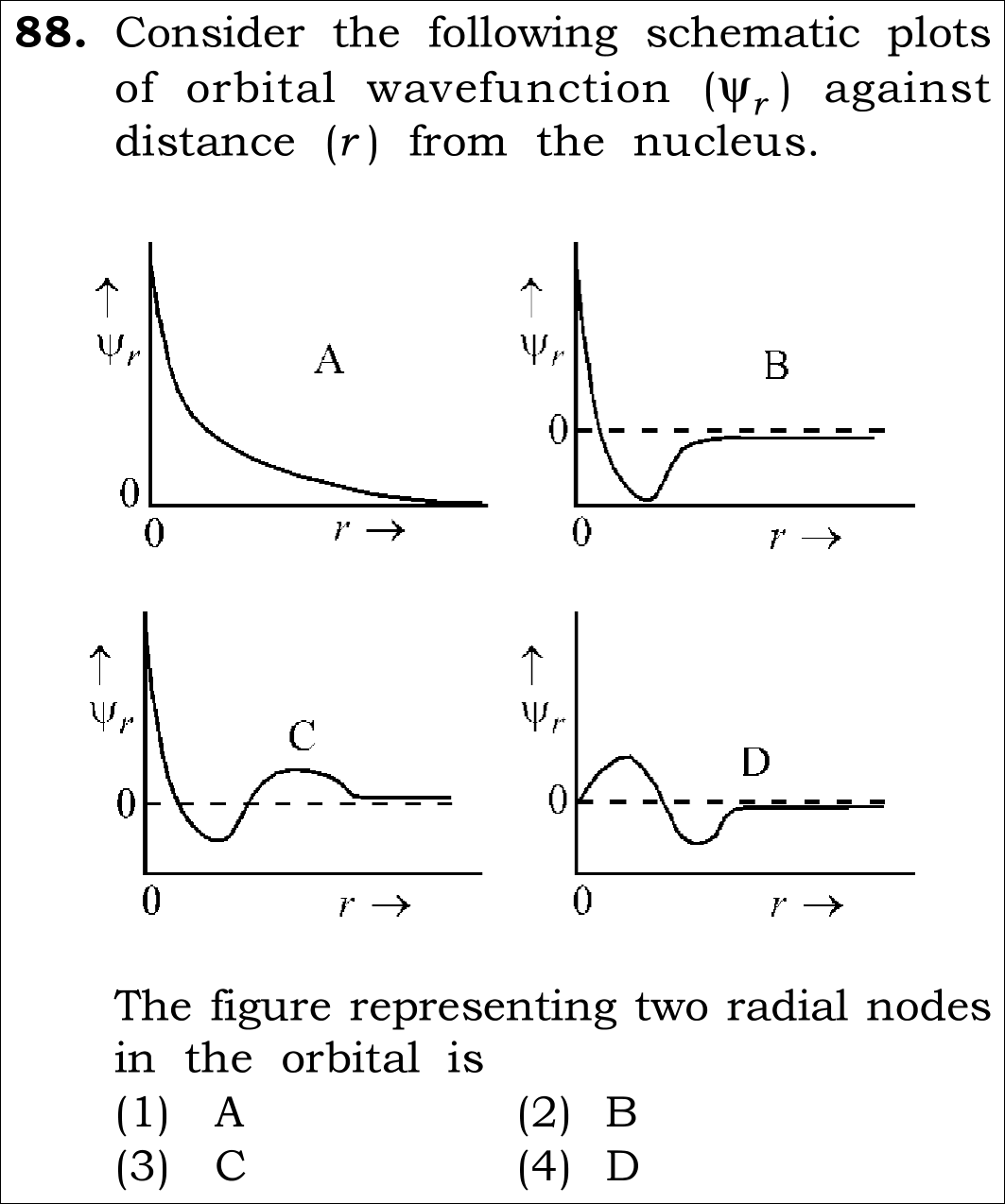
1. Plot A: ψ_r has a non-zero maximum at r = 0 and decays asymptotically to zero without ever cutting the zero line. Number of radial nodes = 0 (Represents 1s orbital). 2. Plot B: ψ_r starts positive at r = 0, crosses the zero axis once, dips into a negative minimum, and approaches zero asymptotically. Number of radial nodes = 1 (Represents 2s orbital). 3. Plot C: ψ_r starts positive at r = 0, crosses the zero axis first into negative values, turns around and crosses the zero axis a second time into positive values, and then approaches zero asymptotically. Number of radial nodes = 2 (Represents 3s orbital). 4. Plot D: ψ_r starts at 0 at r = 0 (since l > 0), rises to a positive peak, crosses the zero axis once into negative, and approaches zero. Number of radial nodes = 1 (Represents 3p or 4d orbital).
- • Plot C represents 2 radial nodes.
Conclusion
The figure representing two radial nodes is C.
- • Matches Option (3).
360° Option Elimination Engine Key Feature
Diagnose every choice: Know exactly why the right option works and why distractors fail.
Incorrect. Plot A has zero radial nodes (1s orbital).
Incorrect. Plot B has only one radial node (2s orbital).
Scientifically exact: Curve C crosses the zero axis at two distinct points, representing exactly two radial nodes (e.g. 3s orbital).
Incorrect. Plot D crosses zero only once at finite r (1 radial node for an orbital with l > 0).
NTA Trap Alert: Counting the Origin (r = 0) as a Radial Node
For p, d, and f orbitals, the wavefunction starts at zero at the nucleus (r = 0). Students mistakenly count r = 0 as a radial node. By quantum mechanical definition, radial nodes are strictly located at finite, non-zero distances (r > 0)!
Core NEET Syllabus Standard
"Radial nodes correspond to points where the radial wavefunction ψ_r changes sign (crosses zero)."