NEET 2026 Chemistry Question 88 Solution
Question
Consider the following schematic plots of orbital wavefunction (ψr) against distance (r) from the nucleus. The figure representing two radial nodes in the orbital is
Dynamic 180-question full-length simulator mixed dynamically from all 6 years for 2027 & 2026 aspirants.
Consider the following schematic plots of orbital wavefunction (ψr) against distance (r) from the nucleus. The figure representing two radial nodes in the orbital is
A radial node is a point where the wavefunction ψ_r crosses zero at finite distance r > 0!
A radial node is a spherical surface around the nucleus at a finite distance r > 0 where the radial wavefunction ψ_r (and consequently the radial probability density ψ_r²) passes through zero.
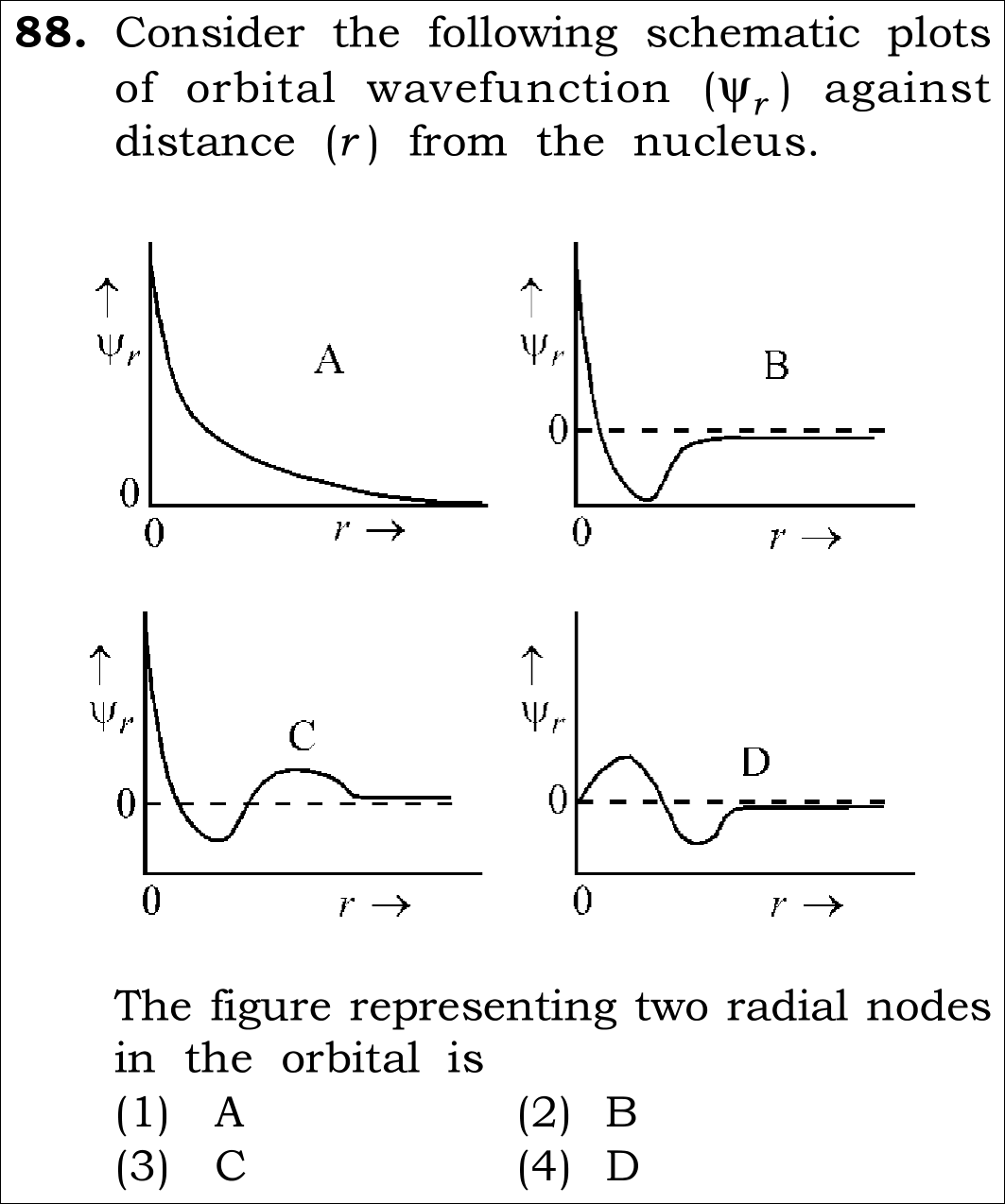
1. Plot A: ψ_r has a non-zero maximum at r = 0 and decays asymptotically to zero without ever cutting the zero line. Number of radial nodes = 0 (Represents 1s orbital). 2. Plot B: ψ_r starts positive at r = 0, crosses the zero axis once, dips into a negative minimum, and approaches zero asymptotically. Number of radial nodes = 1 (Represents 2s orbital). 3. Plot C: ψ_r starts positive at r = 0, crosses the zero axis first into negative values, turns around and crosses the zero axis a second time into positive values, and then approaches zero asymptotically. Number of radial nodes = 2 (Represents 3s orbital). 4. Plot D: ψ_r starts at 0 at r = 0 (since l > 0), rises to a positive peak, crosses the zero axis once into negative, and approaches zero. Number of radial nodes = 1 (Represents 3p or 4d orbital).
The figure representing two radial nodes is C.
Diagnose every choice: Know exactly why the right option works and why distractors fail.
Incorrect. Plot A has zero radial nodes (1s orbital).
Incorrect. Plot B has only one radial node (2s orbital).
Scientifically exact: Curve C crosses the zero axis at two distinct points, representing exactly two radial nodes (e.g. 3s orbital).
Incorrect. Plot D crosses zero only once at finite r (1 radial node for an orbital with l > 0).
For p, d, and f orbitals, the wavefunction starts at zero at the nucleus (r = 0). Students mistakenly count r = 0 as a radial node. By quantum mechanical definition, radial nodes are strictly located at finite, non-zero distances (r > 0)!
"Radial nodes correspond to points where the radial wavefunction ψ_r changes sign (crosses zero)."
Test your speed and accuracy in the authentic 180-minute timed NTA simulator.
Spotted a mistake in this solution? Report an error (support@mycompetitiveexams.com)
Cover all 1,140 official NEET questions in 285 days at your own pace. Progress is saved on your device. No login needed.