The 30-Second Exam Hall Shortcut: ⚡ The "No Interaction" Fallacy Detector
Liquids MUST have intermolecular interactions! In ideal solutions, interactions are EQUAL, not absent!
Step-by-Step Rigorous Workflow & Mathematical Proof
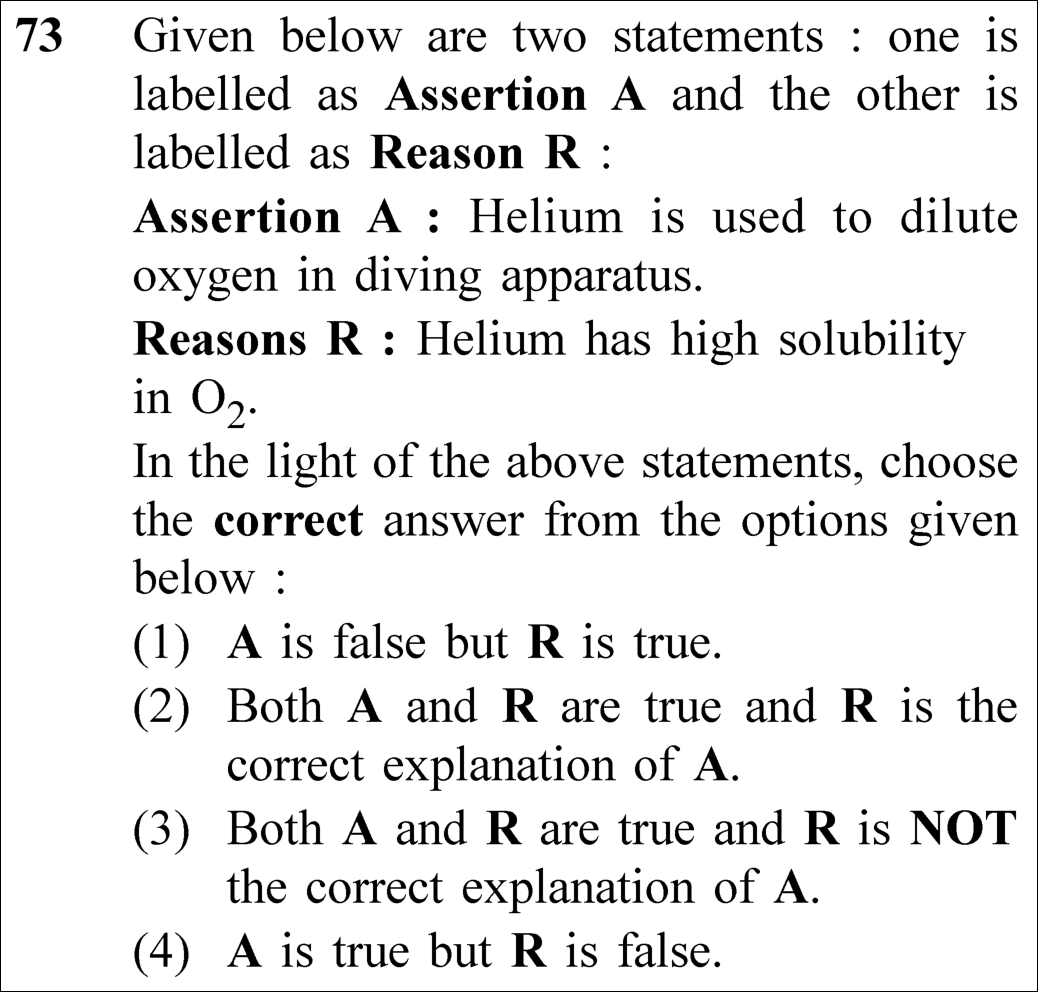
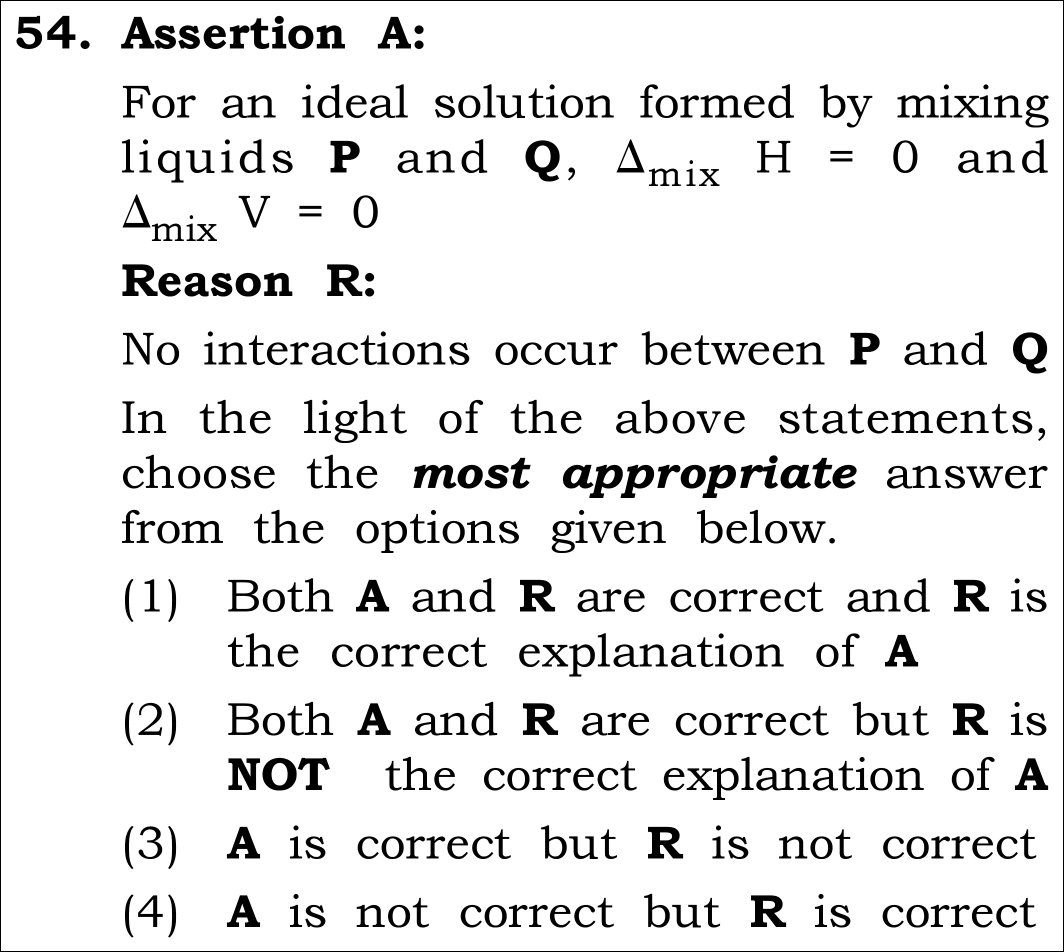
Evaluate Assertion A: Thermodynamic Criteria of Ideal Solutions
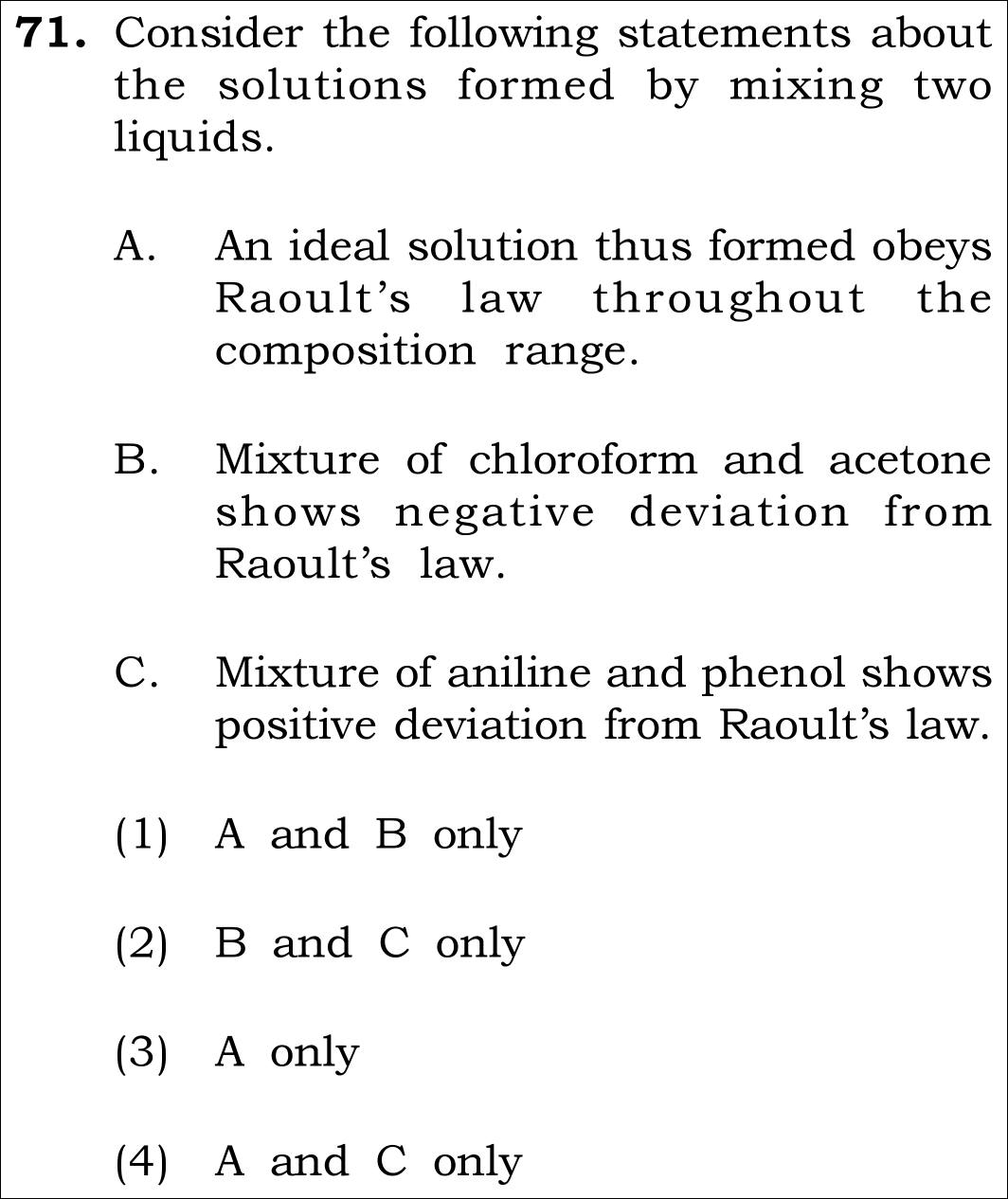
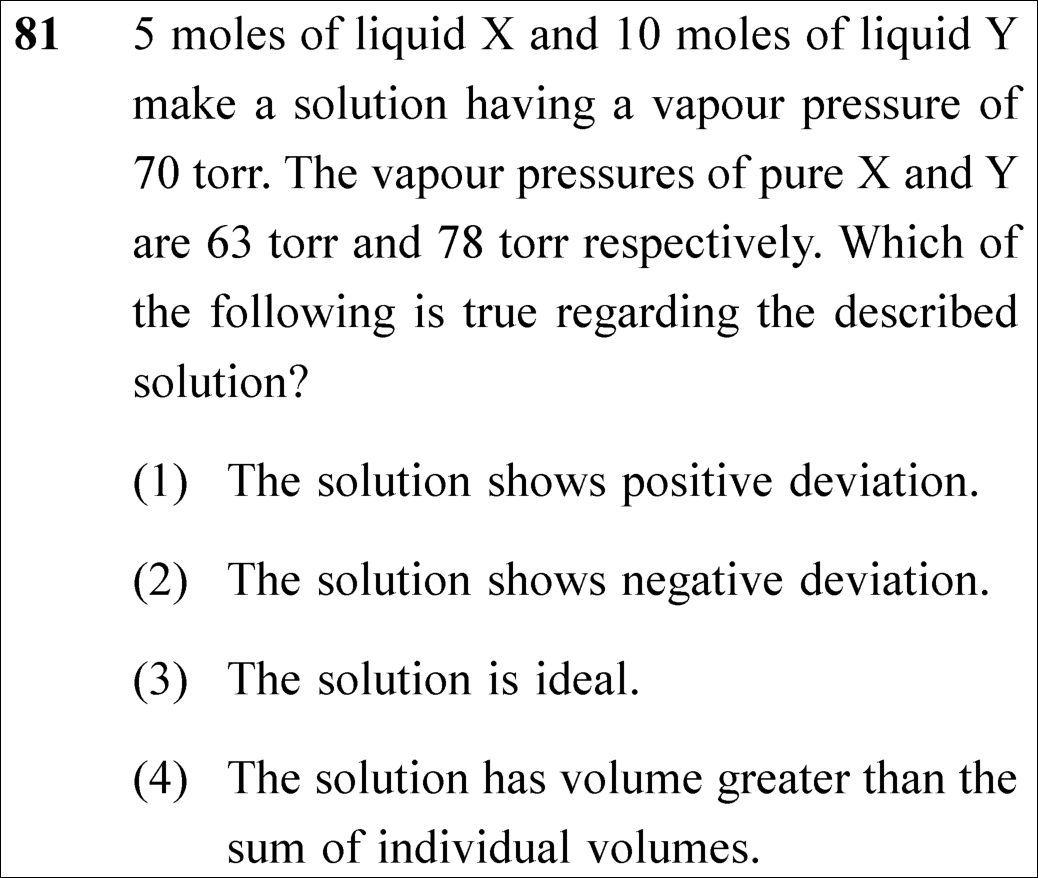
An ideal solution is defined as one that obeys Raoult’s law over the entire range of concentration. For such solutions: 1. Enthalpy of mixing is zero (Δ_mix H = 0), meaning no heat is absorbed or evolved. 2. Volume of mixing is zero (Δ_mix V = 0), meaning the total volume equals the sum of the individual volumes.
- • Assertion A is scientifically correct.
Evaluate Reason R: Nature of Intermolecular Forces
In liquid solutions, intermolecular cohesive forces (such as dipole-dipole, London dispersion, or van der Waals forces) are always present. An ideal solution does not mean "zero interaction". Rather, it means that the magnitude of solute-solvent (P-Q) intermolecular interactions is EQUAL to solute-solute (P-P) and solvent-solvent (Q-Q) interactions.
- • Because the bond-breaking energy of P-P and Q-Q equals the bond-making energy of P-Q, Δ_mix H = 0.
- • Reason R claims "No interactions occur", which is scientifically false.
Formulate the Final Answer
Since Assertion A is a correct factual statement and Reason R is scientifically false, the correct choice is: A is correct but R is not correct.
- • Matches Option (3).
360° Option Elimination Engine Key Feature
Diagnose every choice: Know exactly why the right option works and why distractors fail.
Incorrect. Reason R is false because liquids always possess intermolecular interactions.
Incorrect. R is false, not correct.
Scientifically rigorous. A correctly describes ideal thermodynamics, while R makes a fundamentally incorrect physical claim.
Incorrect. Assertion A is a textbook definition of an ideal solution.
NTA Trap Alert: Confusing Ideal Solution with Ideal Gas
Students frequently confuse kinetic molecular theory of ideal gases (where gas particles exert no attractive forces) with liquid solutions. In liquid solutions, forces are essential to hold the liquid state together!
Core NEET Syllabus Standard
"Ideal solutions form when intermolecular attractive forces between components are equal in magnitude."