📋 Given Parameters & Problem Setup
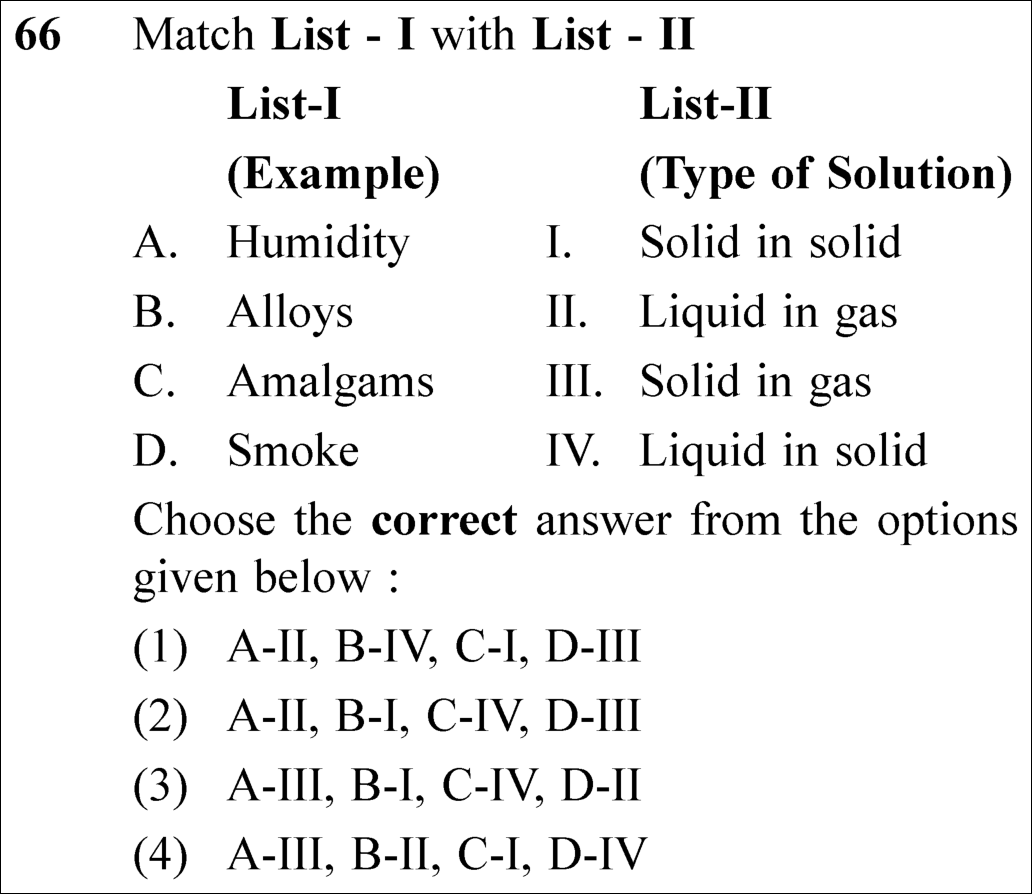
List I (Examples) A. Humidity, B. Alloys, C. Amalgams, D. Smoke
List II (Types of Solutions) I. Solid in solid, II. Liquid in gas, III. Solid in gas, IV. Liquid in solid
Humidity = water vapor (liquid) in air (gas) ⟹ Liquid in gas (A-II). Alloys (e.g. brass) = Solid in solid (B-I). Amalgams = mercury (liquid) in sodium (solid) ⟹ Liquid in solid (C-IV). Smoke = carbon particles (solid) in air (gas) ⟹ Solid in gas (D-III)!
1 A. Humidity: Water droplets/vapor suspended in air = Liquid solute in Gas solvent ⟹ A matches II.
2 Look at options: Options (1) and (2) start with A-II.
3 B. Alloys: Homogeneous mixture of metals (e.g. copper in gold) = Solid solute in Solid solvent ⟹ B matches I.
4 Now Option (1) has B-IV, while Option (2) has B-I. This confirms Option (2) immediately!
5 Verify C. Amalgams: Mercury (liquid) dissolved in sodium/metal (solid) = Liquid in solid ⟹ C matches IV.
6 Verify D. Smoke: Carbon soot particles (solid) suspended in atmosphere (gas) = Solid in gas ⟹ D matches III.
7 Select Option (2) in under 10 seconds!
🛡️ Why You Can 100% Trust This Shortcut: Types of Solutions and Physical States of Components (NCERT Chemistry · Solutions).
⚠️
Candidates know mercury is a liquid, but sometimes confuse whether the amalgam is "solid in liquid" or "liquid in solid". Because the metal (sodium or zinc) is the dominant solid matrix, amalgams are LIQUID IN SOLID!
🛡️ How to avoid the -1 mark: Remember: Mercury is dissolved INTO solid metal ⟹ Liquid in solid!
📖
NEET Chemistry Core Syllabus · Solutions Standard Benchmark
Core Scientific Principle Tested:
"Solutions are classified into 9 types according to the physical states of solute and solvent."
Syllabus Focus: Types of Solutions based on Physical States
Humidity is Liquid in Gas (II), Alloys are Solid in Solid (I), Amalgams are Liquid in Solid (IV), Smoke is Solid in Gas (III)!