MyCompetitiveExams Logo MyCompetitiveExams
Search 1,140+ Questions
Chapters, formulas, speed tricks
→
⚡ Brahmastra NEET 2027
720 MARKS

Dynamic 180-question full-length simulator mixed dynamically from all 6 years for 2027 & 2026 aspirants.

Launch Brahmastra 2027 Test →
Start Practice →
100% Free · No Login Required
Q.79 Chemistry ⭐ 360° Option Elimination Active
Vault ↗

NEET 2025 Chemistry Question 79 Solution

Topic: Solutions · Official NTA Booklet Code 45
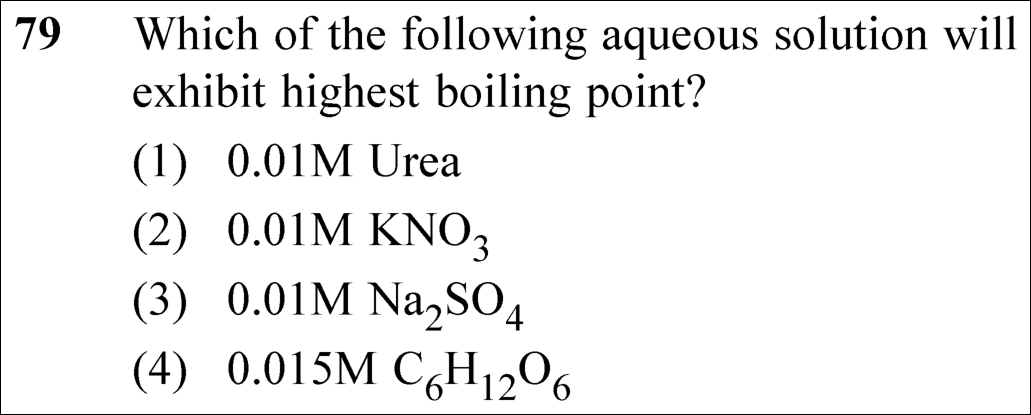
NEET 2025 Chemistry Question 79: Highest Boiling Point of Aqueous Solutions (Effective Molality / Osmolarity)

Question

Which of the following aqueous solution will exhibit highest boiling point?

✓
Verified Against NTA Final Answer Key
Option (3) : 0.01M Na₂SO₄
📚 Solutions Easy
📋 Given Parameters & Problem Setup
Solution (1) 0.01 M Urea (non-electrolyte, i = 1)
Solution (2) 0.01 M KNO₃ (binary electrolyte, i = 2)
Solution (3) 0.01 M Na₂SO₄ (ternary electrolyte, i = 3)
Solution (4) 0.015 M C₆H₁₂O₆ (Glucose, non-electrolyte, i = 1)
⚡

The 30-Second Exam Hall Shortcut: ⚡ i × M Maximizer Shortcut

⏱️ Save ~30 seconds

Boiling point elevation ΔT_b ∝ (i × M)! Urea = 1 × 0.01 = 0.01. KNO₃ = 2 × 0.01 = 0.02. Na₂SO₄ = 3 × 0.01 = 0.03. Glucose = 1 × 0.015 = 0.015! Na₂SO₄ has the LARGEST i × M (0.03) ⟹ HIGHEST BOILING POINT!

1 Elevation in boiling point formula: ΔT_b = i × K_b × m ≈ i × K_b × M for dilute aqueous solutions.
2 Higher ΔT_b means higher boiling point: T_b = T_b° + ΔT_b.
3 Calculate effective particle concentration (i × M) for each candidate:
4 Solution (1) Urea: i = 1 ⟹ i × M = 1 × 0.01 = 0.01 M.
5 Solution (2) KNO₃: Dissociates into K⁺ + NO₃⁻ (2 ions) ⟹ i = 2 ⟹ i × M = 2 × 0.01 = 0.02 M.
6 Solution (3) Na₂SO₄: Dissociates into 2 Na⁺ + SO₄²⁻ (3 ions) ⟹ i = 3 ⟹ i × M = 3 × 0.01 = 0.03 M.
7 Solution (4) Glucose (C₆H₁₂O₆): i = 1 ⟹ i × M = 1 × 0.015 = 0.015 M.
8 Compare values: 0.03 M (Na₂SO₄) > 0.02 M (KNO₃) > 0.015 M (Glucose) > 0.01 M (Urea).
9 Select Option (3) in under 10 seconds!
🛡️
Why You Can 100% Trust This Shortcut: Colligative Properties & van ’t Hoff Factor (NCERT Chemistry · Solutions: ΔT_b = i K_b m).
📐

Step-by-Step Rigorous Workflow & Mathematical Proof

Step 1

Colligative Principle Governing Boiling Point Elevation

The elevation in boiling point ΔT_b of an electrolyte solution depends on the total concentration of dissolved solute particles:

ΔTb=Tb−Tb∘=i⋅Kb⋅m\Delta T_b = T_b - T_b^\circ = i \cdot K_b \cdot m
  • • For dilute aqueous solutions, molality m is approximately equal to molarity M.
  • • The solution exhibiting the greatest elevation ΔT_b will have the highest boiling point T_b.
Step 2

Determine van ’t Hoff Factor (i) and Effective Concentration for Each Solute

Assuming complete dissociation for strong electrolytes:

i(Na2SO4)=2(Na+)+1(SO42−)=3i(\text{Na}_2\text{SO}_4) = 2(\text{Na}^+) + 1(\text{SO}_4^{2-}) = 3
  • • (1) Urea: Non-electrolyte ⟹ i = 1 ⟹ i × M = 0.01 M.
  • • (2) KNO₃: Dissociates into K⁺ + NO₃⁻ ⟹ i = 2 ⟹ i × M = 2 × 0.01 = 0.02 M.
  • • (3) Na₂SO₄: Dissociates into 2 Na⁺ + SO₄²⁻ ⟹ i = 3 ⟹ i × M = 3 × 0.01 = 0.03 M.
  • • (4) Glucose: Non-electrolyte ⟹ i = 1 ⟹ i × M = 1 × 0.015 = 0.015 M.
Step 3

Rank Boiling Points and Select Matching Option

Rank solutions by decreasing effective particle concentration:

0.03 M (Na2SO4)>0.02 M (KNO3)>0.015 M (Glucose)>0.01 M (Urea)0.03\text{ M (Na}_2\text{SO}_4) > 0.02\text{ M (KNO}_3) > 0.015\text{ M (Glucose)} > 0.01\text{ M (Urea)}
  • • 0.01 M Na₂SO₄ produces the greatest particle concentration and thus the highest boiling point.
  • • Matches Option (3) with complete precision.
⭐

360° Option Elimination Engine Key Feature

Diagnose every choice: Know exactly why the right option works and why distractors fail.

4-Option Deep Scan
1 A
✗ Incorrect
Verdict & Scientific Reason:

Incorrect. Produces the lowest boiling point (lowest i × M = 0.01 M).

⚠️
Student Fallacy (Why candidates pick this trap): Ignoring dissociation of ionic salts.
2 B
✗ Incorrect
Verdict & Scientific Reason:

Incorrect. Produces only 2 ions per formula unit (i × M = 0.02 M).

⚠️
Student Fallacy (Why candidates pick this trap): Failing to realize Na₂SO₄ produces 3 ions.
3 C
✓ 100% Correct
Verdict & Scientific Reason:

100% correct. Dissociates into 3 ions, yielding the maximum effective particle concentration (0.03 M).

💡
Why this is airtight: None; textbook application of colligative laws.
4 D
✗ Incorrect
Verdict & Scientific Reason:

Incorrect. Although molarity is 0.015 M, it does not ionize (i = 1), so 0.015 < 0.03 M.

⚠️
Student Fallacy (Why candidates pick this trap): Looking only at nominal molarity (0.015 > 0.01) without multiplying by i.
⚠️

NTA Trap Alert: Nominal Concentration vs Effective Concentration (Glucose Trap)

Students notice that glucose has the highest numerical concentration (0.015 M vs 0.01 M) and hastily pick Option (4). They forget to multiply by van ’t Hoff factor i! Na₂SO₄ gives 3 × 0.01 = 0.03 M, which is DOUBLE the glucose concentration!

🛡️ How to avoid the -1 mark: ALWAYS multiply molarity by van ’t Hoff factor: Effective Molality = i × M!
📖

Core NEET Syllabus Standard

NEET Chemistry Core Syllabus · Solutions Standard Benchmark
Core Scientific Principle Tested:

"ΔT_b = i K_b m; highest i × M gives highest boiling point."

Syllabus Focus: Colligative Properties & Abnormal Molar Mass (van ’t Hoff Factor)
✓ Core NEET UG Syllabus Anchor Syllabus & Academic Standards ↗
Multiply by ions: Na₂SO₄ has 3 ions ⟹ 3 × 0.01 = 0.03 M (Highest boiling point, Option 3)!

Ready to attempt under real exam pressure?

Test your speed and accuracy in the authentic 180-minute timed NTA simulator.

Launch NEET 2025 CBT Test →

Spotted a mistake in this solution? Report an error (support@mycompetitiveexams.com)

⚖️ Legal & Fair Dealing Notice: Sourced from publicly released NEET 2025 question papers and NEET answer keys for private study, research, and non-commercial educational practice under Fair Dealing (Section 52(1)(a) of the Indian Copyright Act, 1957). Not affiliated with or endorsed by NTA or NMC.

Solve 4 NEET Questions a Day — One per Subject

Cover all 1,140 official NEET questions in 285 days at your own pace. Progress is saved on your device. No login needed.