MyCompetitiveExams Logo MyCompetitiveExams
Search 1,140+ Questions
Chapters, formulas, speed tricks
→
⚡ Brahmastra NEET 2027
720 MARKS

Dynamic 180-question full-length simulator mixed dynamically from all 6 years for 2027 & 2026 aspirants.

Launch Brahmastra 2027 Test →
Start Practice →
100% Free · No Login Required
Q.93 Chemistry ⭐ 360° Option Elimination Active
Vault ↗

NEET 2021 Chemistry Question 93 Solution

Topic: Solutions · Official NTA Booklet Code M1
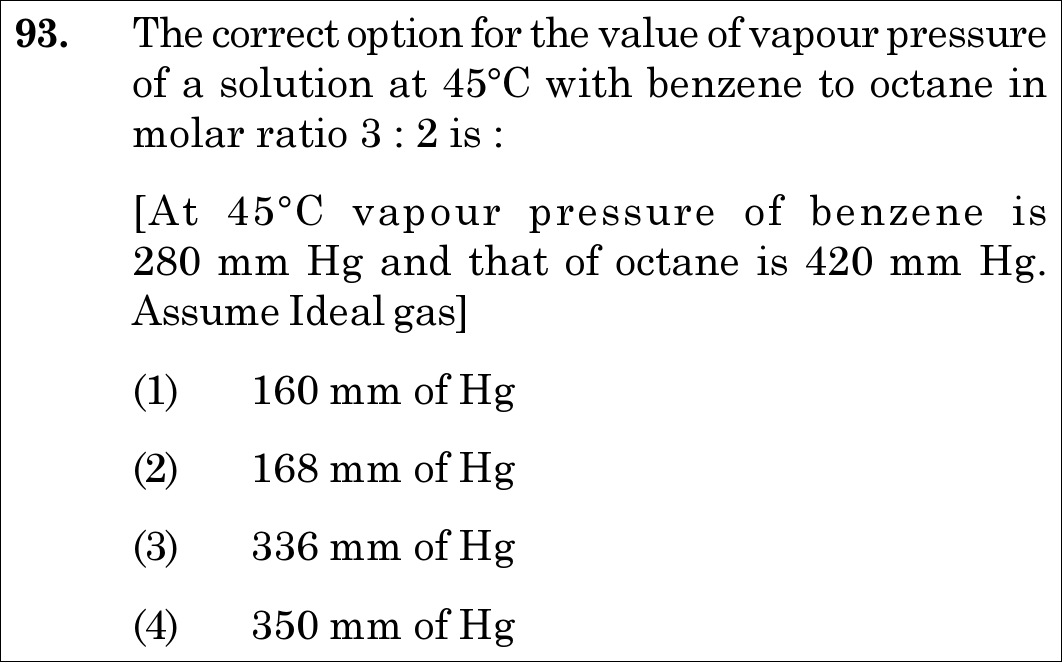
NEET 2021 Chemistry Question 93: Raoult's Law: Total Vapour Pressure of Ideal Binary Solution

Question

The correct option for the value of vapour pressure of a solution at 45°C with benzene to octane in molar ratio 3 : 2 is: [At 45°C vapour pressure of benzene is 280 mm Hg and that of octane is 420 mm Hg. Assume Ideal gas]

✓
Verified Against NTA Final Answer Key
Option (3) : 336 mm of Hg
📚 Solutions Easy
📋 Given Parameters & Problem Setup
Solution Temperature 45°C
Molar Ratio (Benzene : Octane) 3 : 2
P°(Benzene) 280 mm Hg
P°(Octane) 420 mm Hg
⚡

The 30-Second Exam Hall Shortcut: ⚡ Raoult's Law: Ptotal = P°B · χB + P°O · χO

⏱️ Save ~20 seconds

Mole fractions: χB=33+2=0.6\chi_B = \frac{3}{3+2} = 0.6 and χO=23+2=0.4\chi_O = \frac{2}{3+2} = 0.4. Total vapour pressure Ptotal=280(0.6)+420(0.4)=168+168=336 mm HgP_{\text{total}} = 280(0.6) + 420(0.4) = 168 + 168 = 336\text{ mm Hg}! Instant 15-second arithmetic matching Option (3)!

1 Calculate mole fractions from given molar ratio 3:23 : 2: - χbenzene=35=0.6\chi_{\text{benzene}} = \frac{3}{5} = 0.6 - χoctane=25=0.4\chi_{\text{octane}} = \frac{2}{5} = 0.4.
2 Apply Raoult's Law for ideal solution: Ptotal=PB∘χB+PO∘χOP_{\text{total}} = P_B^\circ \chi_B + P_O^\circ \chi_O.
3 Substitute: Ptotal=(280×0.6)+(420×0.4)P_{\text{total}} = (280 \times 0.6) + (420 \times 0.4).
4 Calculate partial pressures: PB=168 mm HgP_B = 168\text{ mm Hg}, PO=168 mm HgP_O = 168\text{ mm Hg}.
5 Sum: Ptotal=168+168=336 mm HgP_{\text{total}} = 168 + 168 = 336\text{ mm Hg}.
6 Match Option (3).
🛡️
Why You Can 100% Trust This Shortcut: Canonical Raoult's Law formulation for ideal volatile binary liquid mixtures.
📐

Step-by-Step Rigorous Workflow & Mathematical Proof

Step 1

Determining Component Mole Fractions

Let the number of moles of benzene (BB) be nB=3xn_B = 3x and octane (OO) be nO=2xn_O = 2x. The total moles in the solution are ntotal=3x+2x=5xn_{\text{total}} = 3x + 2x = 5x. - Mole fraction of benzene: χB=nBntotal=3x5x=35=0.6\chi_B = \frac{n_B}{n_{\text{total}}} = \frac{3x}{5x} = \frac{3}{5} = 0.6 - Mole fraction of octane: χO=nOntotal=2x5x=25=0.4\chi_O = \frac{n_O}{n_{\text{total}}} = \frac{2x}{5x} = \frac{2}{5} = 0.4

Step 2

Calculating Component Partial Pressures via Raoult's Law

For an ideal solution, the partial vapour pressure of each volatile component is equal to the vapour pressure of the pure component multiplied by its mole fraction in the liquid phase: - Partial pressure of benzene: PB=PB∘⋅χB=280 mm Hg×0.6=168 mm HgP_B = P_B^\circ \cdot \chi_B = 280\text{ mm Hg} \times 0.6 = 168\text{ mm Hg} - Partial pressure of octane: PO=PO∘⋅χO=420 mm Hg×0.4=168 mm HgP_O = P_O^\circ \cdot \chi_O = 420\text{ mm Hg} \times 0.4 = 168\text{ mm Hg}

Step 3

Computing Total Vapour Pressure

Applying Dalton's Law of Partial Pressures:

Ptotal=PB+PO=168 mm Hg+168 mm Hg=336 mm HgP_{\text{total}} = P_B + P_O = 168\text{ mm Hg} + 168\text{ mm Hg} = 336\text{ mm Hg}
⭐

360° Option Elimination Engine Key Feature

Diagnose every choice: Know exactly why the right option works and why distractors fail.

4-Option Deep Scan
1 1
✗ Incorrect
Verdict & Scientific Reason:

Arbitrary incorrect pressure.

⚠️
Student Fallacy (Why candidates pick this trap): Arithmetic miscalculation.
2 2
✗ Incorrect
Verdict & Scientific Reason:

This is the partial pressure of a single component (PBP_B or POP_O), NOT the total vapor pressure of the mixture.

⚠️
Student Fallacy (Why candidates pick this trap): Reporting partial pressure instead of total pressure.
3 3
✓ 100% Correct
Verdict & Scientific Reason:

Exact total vapour pressure calculated by Raoult's law (168+168=336 mm Hg168 + 168 = 336\text{ mm Hg}).

💡
Why this is airtight: None; flawless solution physical chemistry execution.
4 4
✗ Incorrect
Verdict & Scientific Reason:

Simple arithmetic average of pure vapour pressures: 280+4202=350 mm Hg\frac{280 + 420}{2} = 350\text{ mm Hg} (which assumes an equimolar 1:11:1 ratio instead of 3:23:2).

⚠️
Student Fallacy (Why candidates pick this trap): Assuming a 1:1 equimolar mixture.
⚠️

NTA Trap Alert: Partial Pressure vs. Total Pressure Trap (Option 2 vs. Option 3)

A student who computes PB=280×0.6=168 mm HgP_B = 280 \times 0.6 = 168\text{ mm Hg} might see 168 mm Hg168\text{ mm Hg} listed as Option (2) and immediately mark it. Remember that Option (2) represents ONLY the partial vapor pressure of benzene. The question asks for the TOTAL vapor pressure: Ptotal=PB+PO=168+168=336 mm HgP_{\text{total}} = P_B + P_O = 168 + 168 = 336\text{ mm Hg}.

🛡️ How to avoid the -1 mark: Always read the prompt carefully: "total pressure"   ⟹  Ptotal=PB+PO\implies P_{\text{total}} = P_B + P_O.
📖

Core NEET Syllabus Standard

NCERT Chemistry · Solutions Standard Benchmark
Core Scientific Principle Tested:

"According to Raoult's law, for a solution of volatile liquids, the total vapour pressure is the sum of the partial vapour pressures: P_total = P1° x1 + P2° x2."

Syllabus Focus: Vapour Pressure of Liquid-Liquid Solutions (Raoult's Law)
✓ Core NEET UG Syllabus Anchor Syllabus & Academic Standards ↗

Ready to attempt under real exam pressure?

Test your speed and accuracy in the authentic 200-minute timed NTA simulator.

Launch NEET 2021 CBT Test →

Spotted a mistake in this solution? Report an error (support@mycompetitiveexams.com)

⚖️ Legal & Fair Dealing Notice: Sourced from publicly released NEET 2021 question papers and NEET answer keys for private study, research, and non-commercial educational practice under Fair Dealing (Section 52(1)(a) of the Indian Copyright Act, 1957). Not affiliated with or endorsed by NTA or NMC.

Solve 4 NEET Questions a Day — One per Subject

Cover all 1,140 official NEET questions in 285 days at your own pace. Progress is saved on your device. No login needed.