📋 Given Parameters & Problem Setup
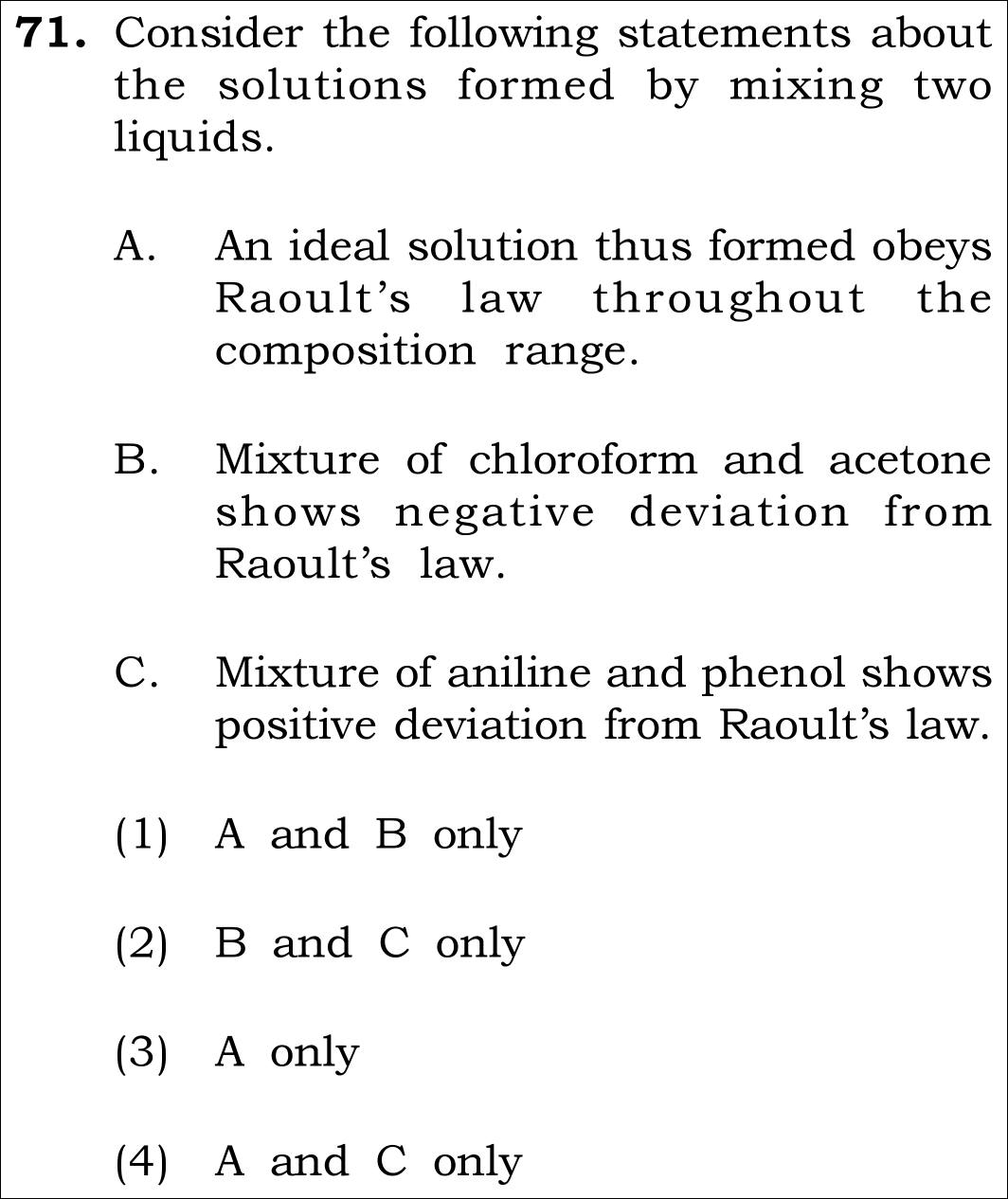
Statement A An ideal solution thus formed obeys Raoult's law throughout the composition range.
Statement B Mixture of chloroform and acetone shows negative deviation from Raoult's law.
Statement C Mixture of aniline and phenol shows positive deviation from Raoult's law.
NEW intermolecular H-bonds formed upon mixing = NEGATIVE deviation ALWAYS!
1 Statement A: An ideal solution obeys Raoult's law across all concentrations -> TRUE (canonical definition).
2 Statement B: Chloroform (Cl₃C-H) forms a strong hydrogen bond with Acetone (>C=O). Stronger A-B attraction = lower vapor pressure = NEGATIVE deviation -> TRUE.
3 Statement C: Phenol (Ph-O-H) and Aniline (Ph-NH₂) form strong intermolecular H-bonds between phenolic -OH and basic -NH₂. This ALSO causes NEGATIVE deviation, NOT positive deviation! -> FALSE.
4 Therefore, only Statements A and B are correct -> Option (1) immediately!
🛡️ Why You Can 100% Trust This Shortcut: NCERT Solutions textbook core examples: Both Chloroform + Acetone and Phenol + Aniline are classic textbook examples of NEGATIVE deviation.
⚠️
Students often know that Ethanol + Acetone shows positive deviation, and mistakenly think Phenol + Aniline does too. Phenol (acidic) and Aniline (basic) attract each other strongly, leading to NEGATIVE deviation!
🛡️ How to avoid the -1 mark: Acid + Base pairs (Phenol + Aniline, Chloroform + Acetone) ALWAYS show NEGATIVE deviation due to enhanced intermolecular attraction.
📖
NEET Chemistry Core Syllabus · Solutions Standard Benchmark
Core Scientific Principle Tested:
"Intermolecular attractions stronger than pure components (A-B > A-A, B-B) lead to negative deviation from Raoult's law."
Syllabus Focus: Ideal and non-ideal solutions, Raoult's law, positive and negative deviations
Chloroform & Acetone, Phenol & Aniline: Negative deviation all down the line!