MyCompetitiveExams Logo MyCompetitiveExams
Search 1,140+ Questions
Chapters, formulas, speed tricks
→
⚡ Brahmastra NEET 2027
720 MARKS

Dynamic 180-question full-length simulator mixed dynamically from all 6 years for 2027 & 2026 aspirants.

Launch Brahmastra 2027 Test →
Start Practice →
100% Free · No Login Required
🧪 Chemistry ⭐ High Weightage (~2–3 Qs/Year)

NEET Chemical Kinetics Previous Year Questions with Solutions

Complete repository of official NTA NEET questions for Chemical Kinetics from 2020 to 2026. Every question includes 30-second elimination tricks, step-by-step NCERT solutions, option-by-option traps, and official answer keys.

13 Questions 6 Exam Years (2026, 2025, 2024, 2023, 2021, 2020) 9 Easy · 4 Medium · 0 Challenging
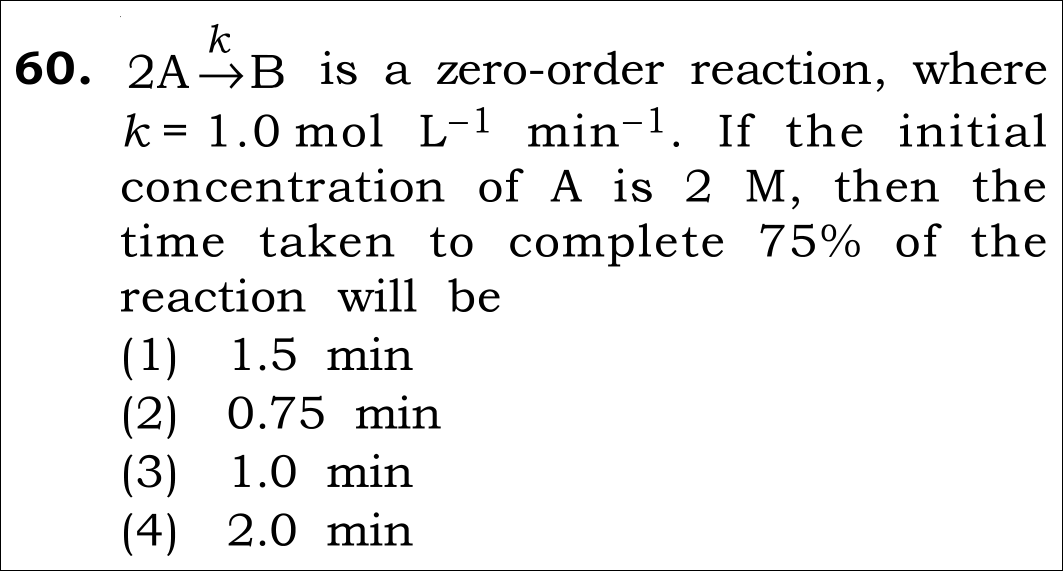
NEET 2026 · Q60 Medium
Official NEET 2026 Question 60 - Chemical Kinetics
1
2 ✓ Key
3
4
💡 Verified Solution & 30-Second Hack
✓
Verified Against NTA Final Answer Key
Option (2) : 0.75 min
📚 Chemical Kinetics Medium
📋 Given Parameters & Problem Setup
Reaction 2A → B (Zero-order reaction)
Rate Constant (k) 1.0 mol L⁻¹ min⁻¹
Initial Concentration [A]₀ 2.0 M
Target Completion Time taken to complete 75% of the reaction (t_75%)
⚡

The 30-Second Exam Hall Shortcut: ⚡ The Stoichiometric Factor in Differential Rates

⏱️ Save ~60 seconds

Watch the stoichiometric 2 in front of A! Rate = -(1/2) d[A]/dt = k ⇒ -d[A]/dt = 2k!

1 75% completion means 75% of [A]₀ has reacted: Amount consumed = 0.75 × 2.0 M = 1.5 M.
2 Differential rate equation: Rate = -(1/2) d[A]/dt = k ⇒ -d[A]/dt = 2k.
3 Integrated zero-order form: [A]₀ - [A]_t = 2 k t.
4 Substitute: 1.5 = 2 × (1.0) × t ⇒ t = 1.5 / 2 = 0.75 min!
5 Option (2) is nailed down in 15 seconds!
🛡️
Why You Can 100% Trust This Shortcut: By international and IUPAC kinetic convention, Rate of Reaction = -(1/a) d[A]/dt = k. For a = 2, disappearance of A proceeds at twice the rate of the reaction constant k.
📐

Step-by-Step Rigorous Workflow & Mathematical Proof

Step 1

Formulate the Rate Law with Stoichiometric Coefficient

For the chemical reaction 2A → B, the rate of reaction is defined with respect to the disappearance of reactant A divided by its stoichiometric coefficient: Rate = - (1/2) (d[A]/dt)

Rate=−12d[A]dt=k[A]0=k\text{Rate} = -\frac{1}{2}\frac{d[\text{A}]}{dt} = k [\text{A}]^0 = k
  • • Order = 0.
  • • Rate constant k = 1.0 mol L⁻¹ min⁻¹.
  • • -d[A]/dt = 2k.
Step 2

Integrate the Differential Rate Equation

Separate variables and integrate from time t = 0 to time t: - ∫_{[A]₀}^{[A]_t} d[A] = 2k ∫_0^t dt

[A]0−[A]t=2kt[\text{A}]_0 - [\text{A}]_t = 2kt
  • • Linear relationship between concentration consumed and time.
Step 3

Calculate the Time for 75% Completion

75% completion means 75% of the initial reactant has been consumed: [A]₀ - [A]_t = 0.75 × [A]₀ = 0.75 × 2.0 M = 1.5 M Substitute this into the integrated rate law: 1.5 M = 2 × (1.0 mol L⁻¹ min⁻¹) × t

t=1.52×1.0=1.52.0=0.75 mint = \frac{1.5}{2 \times 1.0} = \frac{1.5}{2.0} = 0.75\text{ min}
  • • Time required = 0.75 min.
  • • Matches Option (2).
⭐

360° Option Elimination Engine Key Feature

Diagnose every choice: Know exactly why the right option works and why distractors fail.

4-Option Deep Scan
1 A
✗ Incorrect
Verdict & Scientific Reason:

The classic trap! Forgetting the stoichiometric coefficient 2 of reactant A: t = 1.5 / 1.0 = 1.5 min.

⚠️
Student Fallacy (Why candidates pick this trap): Omitting the stoichiometric factor (1/2) in the rate expression.
2 B
✓ 100% Correct
Verdict & Scientific Reason:

Mathematically exact, incorporating the stoichiometric factor of 2 in 2A → B.

💡
Why this is airtight: None; rigorous kinetic derivation.
3 C
✗ Incorrect
Verdict & Scientific Reason:

Incorrect. Corresponds to 50% completion (half-life): t_50% = 1.0 / 2 = 0.5 min or miscalculated half-life.

⚠️
Student Fallacy (Why candidates pick this trap): Confusing 75% completion with other percentage conversions.
4 D
✗ Incorrect
Verdict & Scientific Reason:

Incorrect. Corresponds to 100% completion of A if the factor of 2 was omitted: t_100% = 2.0 / 1.0 = 2.0 min.

⚠️
Student Fallacy (Why candidates pick this trap): Calculating total reaction completion time without stoichiometric division.
⚠️

NTA Trap Alert: Neglecting the Stoichiometric Coefficient in Rate Expressions

The classic kinetic trap: students write [A]₀ - [A]_t = kt and compute 1.5 / 1.0 = 1.5 min (Option 1). When the equation has 2A, the rate of disappearance is 2k, cutting the time in half!

🛡️ How to avoid the -1 mark: Always write the general relation: [A]₀ - [A]_t = a·k·t, where a is the stoichiometric coefficient of reactant A.
📖

Core NEET Syllabus Standard

NEET Chemistry Core Syllabus · Chemical Kinetics Standard Benchmark
Core Scientific Principle Tested:

"The rate of disappearance of a reactant A with coefficient a is a times the rate constant k."
Syllabus Focus: Integrated rate law for zero-order reactions and effect of stoichiometry
✓ Core NEET UG Syllabus Anchor Syllabus & Academic Standards ↗
Two moles of A burn twice as fast: t = (Amount reacted) / (2k)!
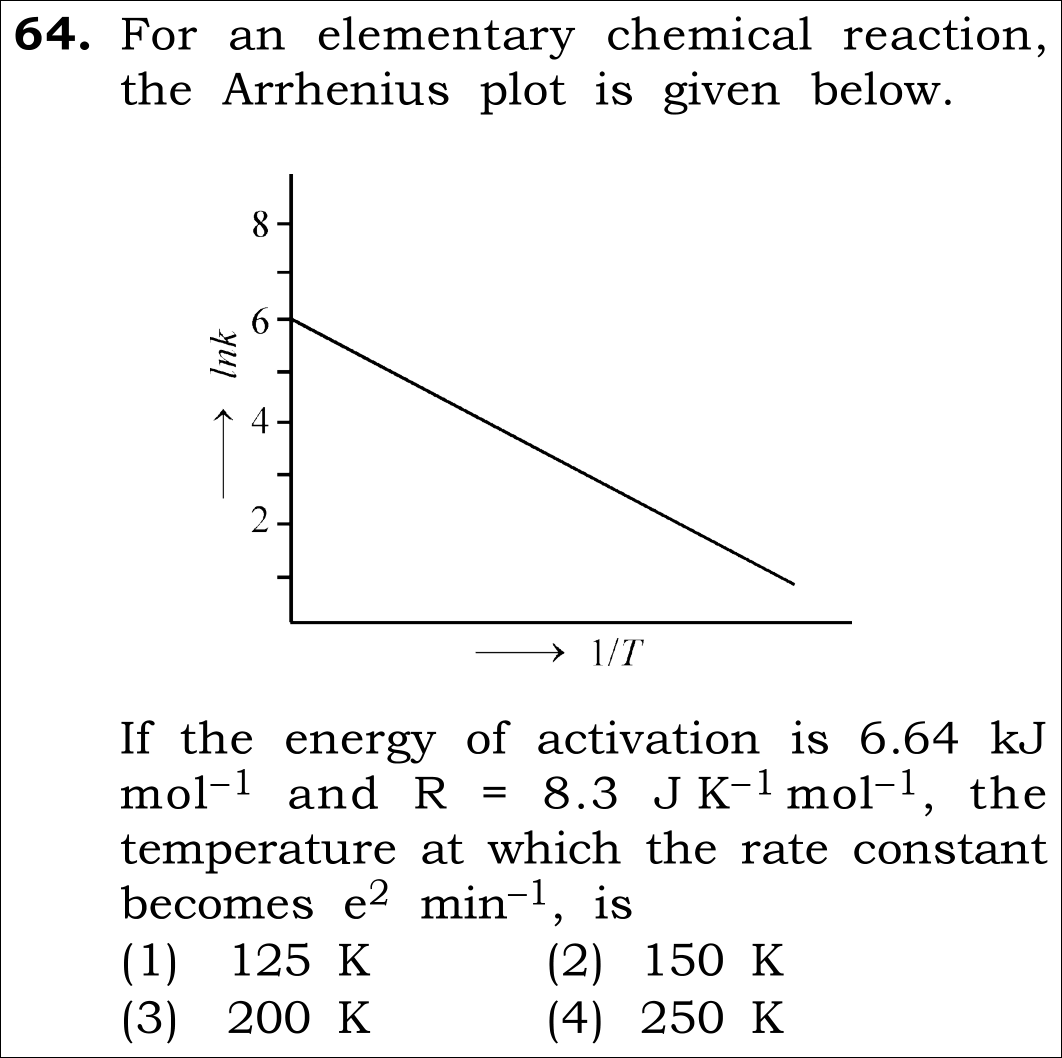
NEET 2026 · Q64 Medium
Official NEET 2026 Question 64 - Chemical Kinetics
1
2
3 ✓ Key
4
💡 Verified Solution & 30-Second Hack
✓
Verified Against NTA Final Answer Key
Option (3) : 200 K
📚 Chemical Kinetics Medium
📋 Given Parameters & Problem Setup
Arrhenius Plot ln k vs 1/T with y-intercept = 6
Activation Energy (E_a) 6.64 kJ mol⁻¹ = 6640 J mol⁻¹
Gas Constant (R) 8.3 J K⁻¹ mol⁻¹
Target Rate Constant (k) e² min⁻¹ (ln k = 2)
⚡

The 30-Second Exam Hall Shortcut: ⚡ The Arrhenius Straight Line Trick

⏱️ Save ~60 seconds

ln k = ln A - (E_a / RT). Intercept is ln A = 6 -> When ln k = 2, E_a / RT MUST equal 4!

1 From the graph, at 1/T = 0, y = ln A = 6.
2 Target: k = e² ⇒ ln k = ln(e²) = 2.
3 Substitute: 2 = 6 - (E_a / RT) ⇒ E_a / RT = 4.
4 Solve for T: T = E_a / (4R) = 6640 / (4 × 8.3) = 6640 / 33.2 = 200 K!
5 Option (3) is locked in 15 seconds!
🛡️
Why You Can 100% Trust This Shortcut: Direct mathematical deduction from the logarithmic Arrhenius equation ln k = ln A - E_a/(RT).
📐

Step-by-Step Rigorous Workflow & Mathematical Proof

Step 1

Formulate the Linear Arrhenius Equation

The Arrhenius equation describes how the rate constant depends on absolute temperature: k = A e^{-E_a / RT} Taking natural logarithm on both sides: ln k = ln A - (E_a / R)(1/T)

ln⁡k=ln⁡A−EaR(1T)\ln k = \ln A - \frac{E_a}{R}\left(\frac{1}{T}\right)
  • • y = mx + c with y = ln k, x = 1/T, slope m = -E_a/R, and intercept c = ln A.
  • • From the graph, the y-intercept is clearly 6 ⇒ ln A = 6.
Step 2

Evaluate the Target Condition

We need the temperature at which the rate constant becomes k = e² min⁻¹.

ln⁡k=ln⁡(e2)=2\ln k = \ln(e^2) = 2
  • • Substitute ln k = 2 and ln A = 6 into the linear equation:
  • • 2 = 6 - \frac{E_a}{RT} \implies \frac{E_a}{RT} = 4
Step 3

Calculate the Absolute Temperature T

Convert E_a to joules: E_a = 6.64 kJ mol⁻¹ = 6640 J mol⁻¹. Substitute R = 8.3 J K⁻¹ mol⁻¹.

T=Ea4R=6640 J mol−14×8.3 J K−1 mol−1=664033.2=200 KT = \frac{E_a}{4R} = \frac{6640\text{ J mol}^{-1}}{4 \times 8.3\text{ J K}^{-1}\text{ mol}^{-1}} = \frac{6640}{33.2} = 200\text{ K}
  • • Temperature = 200 K.
  • • Matches Option (3).
⭐

360° Option Elimination Engine Key Feature

Diagnose every choice: Know exactly why the right option works and why distractors fail.

4-Option Deep Scan
1 A
✗ Incorrect
Verdict & Scientific Reason:

Incorrect. Result of dividing by incorrect integer denominator.

⚠️
Student Fallacy (Why candidates pick this trap): Miscalculating the difference between 6 and 2.
2 B
✗ Incorrect
Verdict & Scientific Reason:

Incorrect. Arithmetic slip in division.

⚠️
Student Fallacy (Why candidates pick this trap): Estimating without working out 6640 / 33.2.
3 C
✓ 100% Correct
Verdict & Scientific Reason:

Exact mathematical solution: T = 6640 / 33.2 = 200 K.

💡
Why this is airtight: None; clean algebraic and graphical execution.
4 D
✗ Incorrect
Verdict & Scientific Reason:

Incorrect. Arises from using E_a / (RT) = 2 instead of 4.

⚠️
Student Fallacy (Why candidates pick this trap): Setting E_a / RT equal to ln k instead of (ln A - ln k).
⚠️

NTA Trap Alert: Forgetting to Convert kJ to J

Students frequently write 6.64 / (4 × 8.3) = 0.2 K because they forget to multiply 6.64 kJ by 1000 to match R in J/(mol K).

🛡️ How to avoid the -1 mark: Always match units: R is in Joules, so E_a MUST be converted from kJ to Joules (6640 J).
📖

Core NEET Syllabus Standard

NEET Chemistry Core Syllabus · Chemical Kinetics Standard Benchmark
Core Scientific Principle Tested:

"In a plot of ln k vs 1/T, the y-intercept is ln A and the slope is -E_a/R."

Syllabus Focus: Temperature dependence of rate of reaction - Arrhenius equation
✓ Core NEET UG Syllabus Anchor Syllabus & Academic Standards ↗
ln A is 6, ln k is 2, the drop is 4: T = 6640 / 33.2 = 200 K for sure!
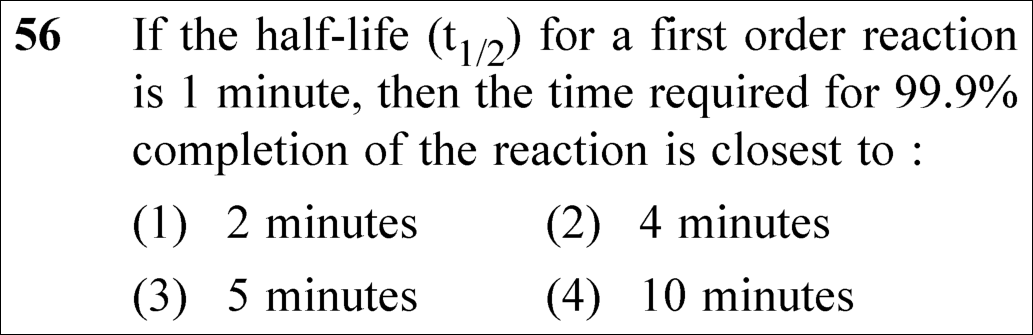
NEET 2025 · Q56 Easy
Official NEET 2025 Question 56 - Chemical Kinetics
1
2
3
4 ✓ Key
💡 Verified Solution & 30-Second Hack
✓
Verified Against NTA Final Answer Key
Option (4) : 10 minutes
📚 Chemical Kinetics Easy
📋 Given Parameters & Problem Setup
Order of Reaction First order
Half-Life (t_{1/2}) 1 minute
Completion Percentage 99.9%
⚡

The 30-Second Exam Hall Shortcut: ⚡ Canonical 10 × t_{1/2} Identity

⏱️ Save ~40 seconds

For any first order reaction, t_{99.9%} = 10 × t_{1/2}! Since t_{1/2} = 1 minute, t_{99.9%} = 10 × 1 min = 10 minutes!

1 Memorize canonical first-order milestone: t_{99.9%} ≈ 10 × t_{1/2}.
2 Mathematical reason: At 99.9% completion, remaining amount is 0.1% = 1/1000 = 10⁻³ of initial.
3 Since (1/2)¹⁰ = 1/1024 ≈ 1/1000, exactly 10 half-lives have elapsed.
4 Given t_{1/2} = 1 minute ⟹ t_{99.9%} = 10 × 1 = 10 minutes.
5 Select Option (4) in under 5 seconds!
🛡️
Why You Can 100% Trust This Shortcut: Rate Law & Integrated Rate Equations (NCERT Chemistry · Chemical Kinetics: t_1/2 = 0.693/k).
📐

Step-by-Step Rigorous Workflow & Mathematical Proof

Step 1

Formulate Integrated Rate Law for 99.9% Completion

For a first-order reaction with rate constant k, the time t required for reactant concentration to decrease from [R]₀ to [R]_t is:

t=2.303klog⁡10([R]0[R]t)t = \frac{2.303}{k} \log_{10}\left(\frac{[R]_0}{[R]_t}\right)
  • • For 99.9% completion, [R]_t = [R]₀ - 0.999 [R]₀ = 0.001 [R]₀ = 10⁻³ [R]₀.
  • • Therefore: [R]₀ / [R]_t = 1 / 10⁻³ = 10³ = 1000.
Step 2

Relate Rate Constant k to Half-Life

Substitute k = 2.303 log(2) / t_{1/2} = 0.693 / t_{1/2} into the integrated rate equation:

t99.9%=2.3030.693t1/2log⁡10(103)=2.303×30.693t1/2=6.9090.693t1/2≈9.97×t1/2≈10×t1/2t_{99.9\%} = \frac{2.303}{\frac{0.693}{t_{1/2}}} \log_{10}(10^3) = \frac{2.303 \times 3}{0.693} t_{1/2} = \frac{6.909}{0.693} t_{1/2} \approx 9.97 \times t_{1/2} \approx 10 \times t_{1/2}
  • • This is a fundamental theorem of first-order chemical kinetics.
Step 3

Calculate Time for Given Half-Life

Substitute t_{1/2} = 1 minute:

t99.9%=10×1 minute=10 minutest_{99.9\%} = 10 \times 1\text{ minute} = 10\text{ minutes}
  • • Matches Option (4) exactly.
⭐

360° Option Elimination Engine Key Feature

Diagnose every choice: Know exactly why the right option works and why distractors fail.

4-Option Deep Scan
1 A
✗ Incorrect
Verdict & Scientific Reason:

Incorrect. 2 half-lives corresponds to 75% completion ((1/2)² = 1/4 remaining).

⚠️
Student Fallacy (Why candidates pick this trap): Confusing 99.9% with 75%.
2 B
✗ Incorrect
Verdict & Scientific Reason:

Incorrect. 4 half-lives corresponds to 93.75% completion.

⚠️
Student Fallacy (Why candidates pick this trap): Guessing 4 half-lives.
3 C
✗ Incorrect
Verdict & Scientific Reason:

Incorrect. 5 half-lives corresponds to 96.875% completion.

⚠️
Student Fallacy (Why candidates pick this trap): Arithmetic slip.
4 D
✓ 100% Correct
Verdict & Scientific Reason:

100% correct. Canonical relation t_{99.9%} = 10 × t_{1/2} = 10 minutes.

💡
Why this is airtight: None; textbook kinetics mastery.
⚠️

NTA Trap Alert: Confusing 99% (t = 2 × t_{90%}) with 99.9%

t_{99%} ≈ 6.64 × t_{1/2}, whereas t_{99.9%} = 10 × t_{1/2}. Always count the nines: three nines (99.9%) means 10⁻³ remaining, which requires 10 half-lives (2¹⁰ = 1024)!

🛡️ How to avoid the -1 mark: Remember: 99.9% = 10 half-lives; 99% = 6.64 half-lives; 75% = 2 half-lives.
📖

Core NEET Syllabus Standard

NEET Chemistry Core Syllabus · Chemical Kinetics Standard Benchmark
Core Scientific Principle Tested:

"For a first order reaction, t_{99.9%} = 10 × t_{1/2}."

Syllabus Focus: Integrated Rate Equations & Half-Life of Reactions
✓ Core NEET UG Syllabus Anchor Syllabus & Academic Standards ↗
3 Nines (99.9%) ⟹ 10⁻³ left ⟹ 2¹⁰ ≈ 1000 ⟹ 10 Half-Lives = 10 minutes!
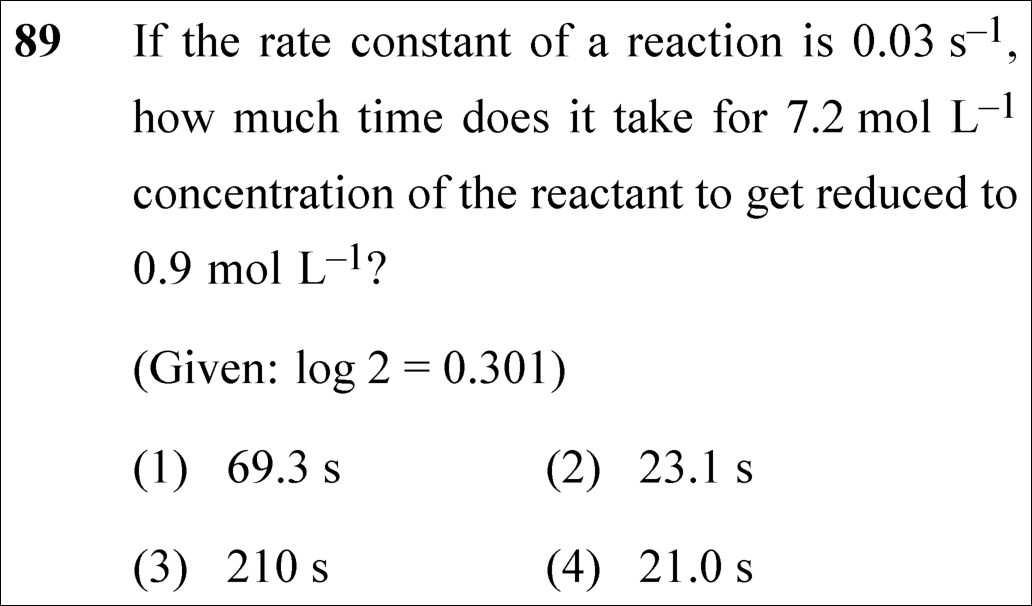
NEET 2025 · Q89 Easy
Official NEET 2025 Question 89 - Chemical Kinetics
1 ✓ Key
2
3
4
💡 Verified Solution & 30-Second Hack
✓
Verified Against NTA Final Answer Key
Option (1) : 69.3 s
📚 Chemical Kinetics Easy
📋 Given Parameters & Problem Setup
Rate Constant (k) 0.03 s⁻¹ (First order reaction, unit s⁻¹)
Initial Concentration ([R]₀) 7.2 mol L⁻¹
Final Concentration ([R]_t) 0.9 mol L⁻¹
Given Constant log 2 = 0.301
⚡

The 30-Second Exam Hall Shortcut: ⚡ Integer Half-Life Doubling Shortcut

⏱️ Save ~35 seconds

[R]₀ / [R]_t = 7.2 / 0.9 = 8 = 2³ ⟹ Exactly 3 HALF-LIVES! t_{1/2} = 0.693 / 0.03 = 23.1 s! Total time t = 3 × 23.1 s = 69.3 s!

1 Notice unit of k is s⁻¹ ⟹ Reaction is strictly First Order.
2 Compute ratio of initial to final concentration: [R]₀ / [R]_t = 7.2 / 0.9 = 8.
3 Express 8 as a power of 2: 8 = 2³ ⟹ exactly 3 half-lives have elapsed (n = 3).
4 Calculate half-life: t_{1/2} = 0.693 / k = 0.693 / 0.03 = 69.3 / 3 = 23.1 seconds.
5 Calculate total time: t = n × t_{1/2} = 3 × 23.1 s = 69.3 seconds.
6 Match Option (1) in under 10 seconds!
🛡️
Why You Can 100% Trust This Shortcut: First-Order Rate Law & Half-Life Dynamics (NCERT Chemistry · Chemical Kinetics: [A] = [A]₀ e^(-kt)).
📐

Step-by-Step Rigorous Workflow & Mathematical Proof

Step 1

Identify Reaction Order and State Integrated Rate Law

The rate constant k has units of s⁻¹, which uniquely characterizes a first-order chemical reaction:

t=2.303klog⁡10([R]0[R]t)t = \frac{2.303}{k} \log_{10}\left(\frac{[R]_0}{[R]_t}\right)
  • • Given [R]₀ = 7.2 mol L⁻¹ and [R]_t = 0.9 mol L⁻¹.
  • • Ratio [R]₀ / [R]_t = 7.2 / 0.9 = 8 = 2³.
Step 2

Calculate Time Using Logarithmic Formulation

Substitute the given value log 2 = 0.301 into the integrated rate law:

t=2.3030.03 s−1log⁡10(23)=2.303×3×0.3010.03=3×0.69320.03=3×23.106 s=69.32 st = \frac{2.303}{0.03\text{ s}^{-1}} \log_{10}(2^3) = \frac{2.303 \times 3 \times 0.301}{0.03} = \frac{3 \times 0.6932}{0.03} = 3 \times 23.106\text{ s} = 69.32\text{ s}
  • • Rounding to three significant digits yields 69.3 s.
Step 3

Alternative Verification via Half-Life Multiplier

Confirm via consecutive half-lives:

7.2→t1/23.6→t1/21.8→t1/20.9  ⟹  3 half-lives7.2 \xrightarrow{t_{1/2}} 3.6 \xrightarrow{t_{1/2}} 1.8 \xrightarrow{t_{1/2}} 0.9 \implies 3\text{ half-lives}
  • • t_{1/2} = 0.693 / 0.03 = 23.1 s.
  • • Total time = 3 × 23.1 s = 69.3 s.
  • • Matches Option (1) exactly.
⭐

360° Option Elimination Engine Key Feature

Diagnose every choice: Know exactly why the right option works and why distractors fail.

4-Option Deep Scan
1 A
✓ 100% Correct
Verdict & Scientific Reason:

100% correct. Exactly 3 half-lives: 3 × (0.693 / 0.03) = 69.3 s.

💡
Why this is airtight: None; flawless kinetics calculation.
2 B
✗ Incorrect
Verdict & Scientific Reason:

Incorrect. This is the duration of a single half-life (reduction from 7.2 to 3.6 mol L⁻¹).

⚠️
Student Fallacy (Why candidates pick this trap): Stopping after finding t_{1/2} without multiplying by 3.
3 C
✗ Incorrect
Verdict & Scientific Reason:

Incorrect. Order of magnitude error.

⚠️
Student Fallacy (Why candidates pick this trap): Dividing 7.2 - 0.9 by 0.03 directly (treating as zero-order reaction).
4 D
✗ Incorrect
Verdict & Scientific Reason:

Incorrect. Arithmetic slip in evaluating zero-order formula: (7.2 - 0.9) / 0.03 = 210, then dividing by 10.

⚠️
Student Fallacy (Why candidates pick this trap): Confusing zero order with first order kinetics.
⚠️

NTA Trap Alert: Stopping at a Single Half-Life (23.1 s Trap)

Option 2 (23.1 s) is exactly one half-life (0.693 / 0.03). Students who compute t_{1/2} and hastily spot 23.1 s in the options often select it before multiplying by the 3 half-lives needed to reach 0.9 mol/L!

🛡️ How to avoid the -1 mark: Trace the concentrations: 7.2 ⟶ 3.6 (1) ⟶ 1.8 (2) ⟶ 0.9 (3) ⟹ Multiply by 3!
📖

Core NEET Syllabus Standard

NEET Chemistry Core Syllabus · Chemical Kinetics Standard Benchmark
Core Scientific Principle Tested:

"t = (2.303 / k) log([R]₀ / [R]_t) = n × t_{1/2}."

Syllabus Focus: Integrated Rate Law for First Order Reactions
✓ Core NEET UG Syllabus Anchor Syllabus & Academic Standards ↗
7.2 / 0.9 = 8 = 2³ ⟹ 3 Half-Lives = 3 × 23.1 = 69.3 s (Option 1)!
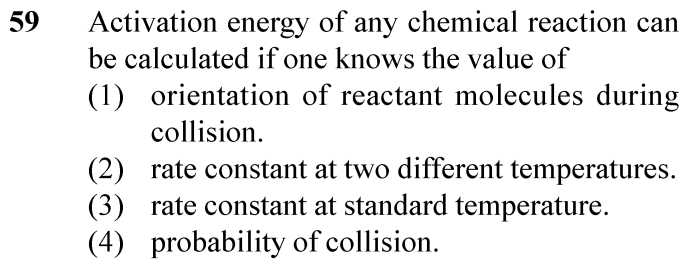
NEET 2024 · Q59 Easy
Official NEET 2024 Question 59 - Chemical Kinetics
1 orientation of reactant molecules during collision.
2 rate constant at two different temperatures. ✓ Key
3 rate constant at standard temperature.
4 probability of collision.
💡 Verified Solution & 30-Second Hack
✓
Verified Against NTA Final Answer Key
Option (2) : rate constant at two different temperatures.
📚 Chemical Kinetics Easy
📋 Given Parameters & Problem Setup
Target quantity Activation energy (E_a) of a chemical reaction
Governing equation Arrhenius equation: k = A e^(-E_a / RT)
⚡

The 30-Second Exam Hall Shortcut: ⚡ Two-Point Arrhenius Formula Rule

⏱️ Save ~30 seconds

ln(k2 / k1) = (E_a / R) · (1/T1 - 1/T2) -> Knowing rate constant at two temperatures gives E_a directly!

1 Recall the logarithmic two-temperature Arrhenius equation:
2 ln(k2 / k1) = (E_a / R) [ (T2 - T1) / (T1 · T2) ].
3 Gas constant R is a universal physical constant.
4 If rate constants k1 and k2 are determined at temperatures T1 and T2, E_a is the ONLY unknown variable.
5 Thus, E_a can be computed precisely from the rate constant at two different temperatures.
6 Option (2) in under 5 seconds!
🛡️
Why You Can 100% Trust This Shortcut: NCERT Chemistry · Chemical Kinetics (Temperature dependence of rate of a reaction and two-point Arrhenius calculation).
📐

Step-by-Step Rigorous Workflow & Mathematical Proof

Step 1

The Differential and Logarithmic Arrhenius Form

The Arrhenius equation describes how the rate constant k of a reaction depends exponentially on absolute temperature T and activation energy Ea:

k=Ae−EaRT  ⟹  ln⁡k=ln⁡A−EaRTk = A e^{-\frac{E_a}{RT}} \implies \ln k = \ln A - \frac{E_a}{RT}
Step 2

Two-Point Formulation Eliminating Pre-Exponential Factor A

Writing the equation at two distinct absolute temperatures T1 and T2 with rate constants k1 and k2:

ln⁡k1=ln⁡A−EaRT1,ln⁡k2=ln⁡A−EaRT2\ln k_1 = \ln A - \frac{E_a}{R T_1}, \quad \ln k_2 = \ln A - \frac{E_a}{R T_2}
Step 3

Subtraction and Direct Solution for Activation Energy

Subtracting the first equation from the second eliminates the unknown frequency factor A entirely:

ln⁡(k2k1)=EaR(1T1−1T2)=EaR(T2−T1T1T2)\ln\left(\frac{k_2}{k_1}\right) = \frac{E_a}{R} \left(\frac{1}{T_1} - \frac{1}{T_2}\right) = \frac{E_a}{R} \left(\frac{T_2 - T_1}{T_1 T_2}\right)
Step 4

Conclusion

Because R is known, experimental determination of the rate constant at two distinct temperatures permits exact calculation of Ea without prior knowledge of orientation factors or pre-exponential constant A.

Ea=R⋅T1T2T2−T1ln⁡(k2k1)E_a = \frac{R \cdot T_1 T_2}{T_2 - T_1} \ln\left(\frac{k_2}{k_1}\right)
⭐

360° Option Elimination Engine Key Feature

Diagnose every choice: Know exactly why the right option works and why distractors fail.

4-Option Deep Scan
1 (1)
✗ Incorrect
Verdict & Scientific Reason:

Relates to the steric probability factor P in collision theory, not the calculation of Ea.

⚠️
Student Fallacy (Why candidates pick this trap): Confusing the collision steric factor with activation energy.
2 (2)
✓ 100% Correct
Verdict & Scientific Reason:

Standard Arrhenius two-point method eliminates A and yields Ea directly.

💡
Why this is airtight: None.
3 (3)
✗ Incorrect
Verdict & Scientific Reason:

At a single temperature, Ea cannot be solved without knowing pre-exponential factor A.

⚠️
Student Fallacy (Why candidates pick this trap): Assuming single rate constant suffices without knowing A.
4 (4)
✗ Incorrect
Verdict & Scientific Reason:

Determines collision frequency Z, not the energetic barrier Ea.

⚠️
Student Fallacy (Why candidates pick this trap): Confusing collision rate with kinetic activation barrier.
⚠️

NTA Trap Alert: Attempting to Determine Ea from a Single Temperature

At a single temperature T, the equation k = A exp(-Ea/RT) has two unknowns: A and Ea. You must have two temperatures to eliminate A!

🛡️ How to avoid the -1 mark: Remember: 2 unknowns (A, Ea) require 2 data points (k1 at T1, k2 at T2).
📖

Core NEET Syllabus Standard

Chemistry Core Physical Chemistry · Chemical Kinetics Standard Benchmark
Core Scientific Principle Tested:

"Activation energy Ea is quantitatively determined by evaluating the rate constants at two different temperatures: ln(k2/k1) = (Ea/R)(1/T1 - 1/T2)."

Syllabus Focus: Temperature Dependence of Reaction Rates: Arrhenius Equation
✓ Core NEET UG Syllabus Anchor Syllabus & Academic Standards ↗
Two temperatures, two k’s in sight: Pre-exponential A drops out of the fight!
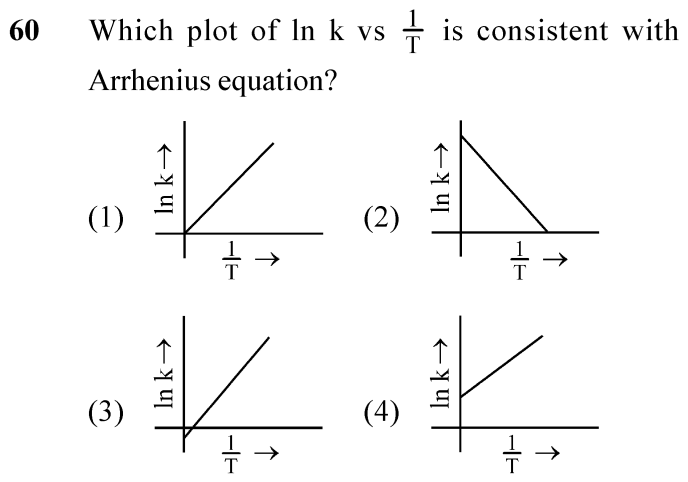
NEET 2024 · Q60 Easy
Official NEET 2024 Question 60 - Chemical Kinetics
1
2 ✓ Key
3
4
💡 Verified Solution & 30-Second Hack
✓
Verified Against NTA Final Answer Key
Option (2) : Plot (2): Straight line with negative slope and positive intercept
📚 Chemical Kinetics Easy
📋 Given Parameters & Problem Setup
Plotted function ln k on y-axis versus (1 / T) on x-axis
Theoretical basis Arrhenius equation: k = A e^(-E_a / RT)
⚡

The 30-Second Exam Hall Shortcut: ⚡ Arrhenius Slope Identification

⏱️ Save ~30 seconds

ln k = ln A - (E_a / R)(1/T) -> y = c + mx where slope m = -E_a/R is STRICTLY NEGATIVE -> Straight line sloping downward!

1 Linear form of Arrhenius equation: ln k = ln A - (E_a / R) · (1/T).
2 Match to standard straight line y = mx + c:
3 y = ln k, x = 1/T, Intercept c = ln A > 0, Slope m = -E_a / R < 0.
4 Because E_a > 0 and R > 0, the slope is negative: as 1/T increases (temperature cools), ln k decreases.
5 Plot (2) is the only plot showing a downward-sloping straight line with negative slope.
6 Option (2) in under 3 seconds!
🛡️
Why You Can 100% Trust This Shortcut: NCERT Chemistry · Chemical Kinetics (Arrhenius equation and determination of activation energy from graphical slope: Slope = -E_a / R).
📐

Step-by-Step Rigorous Workflow & Mathematical Proof

Step 1

Derivation of the Linear Equation

Taking the natural logarithm of both sides of the Arrhenius rate expression:

k=Ae−EaRT  ⟹  ln⁡k=ln⁡A−EaR(1T)k = A e^{-\frac{E_a}{RT}} \implies \ln k = \ln A - \frac{E_a}{R}\left(\frac{1}{T}\right)
Step 2

Comparison with Standard Linear Form y = mx + c

Aligning variables to identify graphical features: - Dependent variable: y = ln k - Independent variable: x = 1 / T - Slope: m = -Ea / R (strictly negative) - Y-intercept: c = ln A (positive finite value when extrapolated to 1/T = 0)

y=mx+c  ⟺  ln⁡k=(−EaR)⏟Slope <0(1T)+ln⁡A⏟Intercepty = mx + c \iff \ln k = \underbrace{\left(-\frac{E_a}{R}\right)}_{\text{Slope } < 0} \left(\frac{1}{T}\right) + \underbrace{\ln A}_{\text{Intercept}}
Step 3

Graphical Interpretation

As absolute temperature T increases, 1/T decreases, and the reaction rate constant k increases (ln k rises). Conversely, moving along the positive x-axis (increasing 1/T, meaning cooling), ln k falls linearly. The graph must therefore be a straight line sloping downward from left to right, exactly as illustrated in Plot (2).

d(ln⁡k)d(1/T)=−EaR=constant<0\frac{d(\ln k)}{d(1/T)} = -\frac{E_a}{R} = \text{constant} < 0
⭐

360° Option Elimination Engine Key Feature

Diagnose every choice: Know exactly why the right option works and why distractors fail.

4-Option Deep Scan
1 (1)
✗ Incorrect
Verdict & Scientific Reason:

Violates Arrhenius equation: positive slope implies reaction slows down upon heating.

⚠️
Student Fallacy (Why candidates pick this trap): Assuming rate constant is directly proportional to 1/T.
2 (2)
✓ 100% Correct
Verdict & Scientific Reason:

Matches Arrhenius slope m = -Ea/R < 0 and intercept c = ln A.

💡
Why this is airtight: None.
3 (3)
✗ Incorrect
Verdict & Scientific Reason:

Slope must be negative.

⚠️
Student Fallacy (Why candidates pick this trap): Flipping sign of Ea/R.
4 (4)
✗ Incorrect
Verdict & Scientific Reason:

Incorrect positive slope.

⚠️
Student Fallacy (Why candidates pick this trap): Plotting ln k versus T instead of 1/T.
⚠️

NTA Trap Alert: Confusing 1/T with Temperature T

Rate constant k increases with T (positive correlation), but 1/T is inversely related to T. Therefore, ln k decreases as 1/T increases!

🛡️ How to avoid the -1 mark: Higher 1/T means colder temperature, so the reaction is slower and ln k must be smaller.
📖

Core NEET Syllabus Standard

Chemistry Core Physical Chemistry · Chemical Kinetics Standard Benchmark
Core Scientific Principle Tested:

"The plot of ln k versus 1/T gives a straight line with slope = -Ea / R and intercept = ln A."

Syllabus Focus: Arrhenius Equation: Graphical Representation and Activation Energy
✓ Core NEET UG Syllabus Anchor Syllabus & Academic Standards ↗
As 1/T climbs, temperature goes low: The Arrhenius line must slope down below!
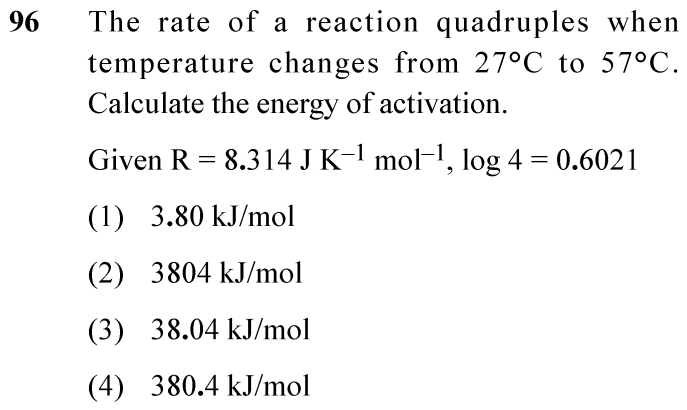
NEET 2024 · Q96 Medium
Official NEET 2024 Question 96 - Chemical Kinetics
1
2
3 ✓ Key
4
💡 Verified Solution & 30-Second Hack
✓
Verified Against NTA Final Answer Key
Option (3) : 38.04 kJ/mol
📚 Chemical Kinetics Medium
📋 Given Parameters & Problem Setup
Initial temperature (T1) 27°C = 300.15 K ≈ 300 K
Final temperature (T2) 57°C = 330.15 K ≈ 330 K
Rate factor (k2 / k1) 4 (quadruples)
Gas constant (R) 8.314 J K^-1 mol^-1
Given log 4 0.6021
⚡

The 30-Second Exam Hall Shortcut: ⚡ Arrhenius Two-Temperature Factor Shortcut

⏱️ Save ~45 seconds

log(k2/k1) = [E_a / (2.303 R)] · [ΔT / (T1 · T2)]. 0.6021 = [E_a / 19.147] · [30 / (300 × 330)]. E_a = 0.6021 × 19.147 × 3300 = 38040 J = 38.04 kJ/mol!

1 Arrhenius formula: log10(k2 / k1) = (E_a / 2.303 R) × [ (T2 - T1) / (T1 · T2) ].
2 Convert temperatures to Kelvin: T1 = 27 + 273 = 300 K; T2 = 57 + 273 = 330 K.
3 Temperature difference: ΔT = 330 - 300 = 30 K. Denominator product: T1 · T2 = 300 × 330 = 99,000.
4 Bracket factor: 30 / 99,000 = 1 / 3300.
5 Constant: 2.303 × R = 2.303 × 8.314 = 19.147 J K⁻¹ mol⁻¹.
6 Rearrange for E_a: E_a = log(4) × 19.147 × 3300 = 0.6021 × 19.147 × 3300 = 38,043 J/mol = 38.04 kJ/mol.
7 Option (3) in 25 seconds!
🛡️
Why You Can 100% Trust This Shortcut: NCERT Chemistry · Chemical Kinetics (Arrhenius equation and quantitative calculation of activation energy).
📐

Step-by-Step Rigorous Workflow & Mathematical Proof

Step 1

Two-Point Logarithmic Form of Arrhenius Equation

The relationship between rate constants k1, k2 at absolute temperatures T1, T2 is given by:

log⁡10(k2k1)=Ea2.303 R(T2−T1T1T2)\log_{10}\left(\frac{k_2}{k_1}\right) = \frac{E_a}{2.303\, R} \left(\frac{T_2 - T_1}{T_1 T_2}\right)
Step 2

Substitution of Given Physical Quantities

Given: - k2 / k1 = 4 ⟹ log10(4) = 0.6021 - T1 = 27°C = 300 K - T2 = 57°C = 330 K - R = 8.314 J K⁻¹ mol⁻¹ - 2.303 × R = 19.147 J K⁻¹ mol⁻¹

0.6021=Ea19.147(330−300300×330)=Ea19.147(3099000)=Ea19.147(13300)0.6021 = \frac{E_a}{19.147} \left(\frac{330 - 300}{300 \times 330}\right) = \frac{E_a}{19.147} \left(\frac{30}{99000}\right) = \frac{E_a}{19.147} \left(\frac{1}{3300}\right)
Step 3

Solving for Activation Energy (Ea)

Cross-multiplying to isolate Ea:

Ea=0.6021×19.147×3300=38043.6  J/molE_a = 0.6021 \times 19.147 \times 3300 = 38043.6\;\text{J/mol}
Step 4

Conversion to Kilojoules per Mole (kJ/mol)

Dividing by 1000 to convert Joules to Kilojoules:

Ea=38043.61000  kJ/mol=38.04  kJ/molE_a = \frac{38043.6}{1000}\;\text{kJ/mol} = 38.04\;\text{kJ/mol}
⭐

360° Option Elimination Engine Key Feature

Diagnose every choice: Know exactly why the right option works and why distractors fail.

4-Option Deep Scan
1 (1)
✗ Incorrect
Verdict & Scientific Reason:

Off by a factor of 10 due to decimal error.

⚠️
Student Fallacy (Why candidates pick this trap): Dividing by 10,000 instead of 1,000.
2 (2)
✗ Incorrect
Verdict & Scientific Reason:

Represents 38040 divided by 10 instead of 1000.

⚠️
Student Fallacy (Why candidates pick this trap): Units confusion.
3 (3)
✓ 100% Correct
Verdict & Scientific Reason:

Exact mathematical calculation: 38,044 J/mol = 38.04 kJ/mol.

💡
Why this is airtight: None.
4 (4)
✗ Incorrect
Verdict & Scientific Reason:

Off by a factor of 10.

⚠️
Student Fallacy (Why candidates pick this trap): Dividing by 100 instead of 1000.
⚠️

NTA Trap Alert: Power of 10 Decimal Shift Trap

The options all share the digits "3804" with varying powers of 10: 3.80, 38.04, 380.4, 3804. Watch the division: 30 / 99000 = 1 / 3300, and converting J to kJ divides by 1000!

🛡️ How to avoid the -1 mark: Always check: 0.6 × 19 ≈ 11.5; 11.5 × 3.3 ≈ 38 kJ/mol.
📖

Core NEET Syllabus Standard

Chemistry Core Physical Chemistry · Chemical Kinetics Standard Benchmark
Core Scientific Principle Tested:

"Activation energy is determined from the two-temperature Arrhenius equation: log(k2/k1) = Ea / (2.303 R) · [ΔT / (T1 T2)]."

Syllabus Focus: Temperature Dependence of Reaction Rates: Arrhenius Activation Energy
✓ Core NEET UG Syllabus Anchor Syllabus & Academic Standards ↗
Multiply point-six by nineteen and three-point-three: thirty-eight point zero-four is the key!
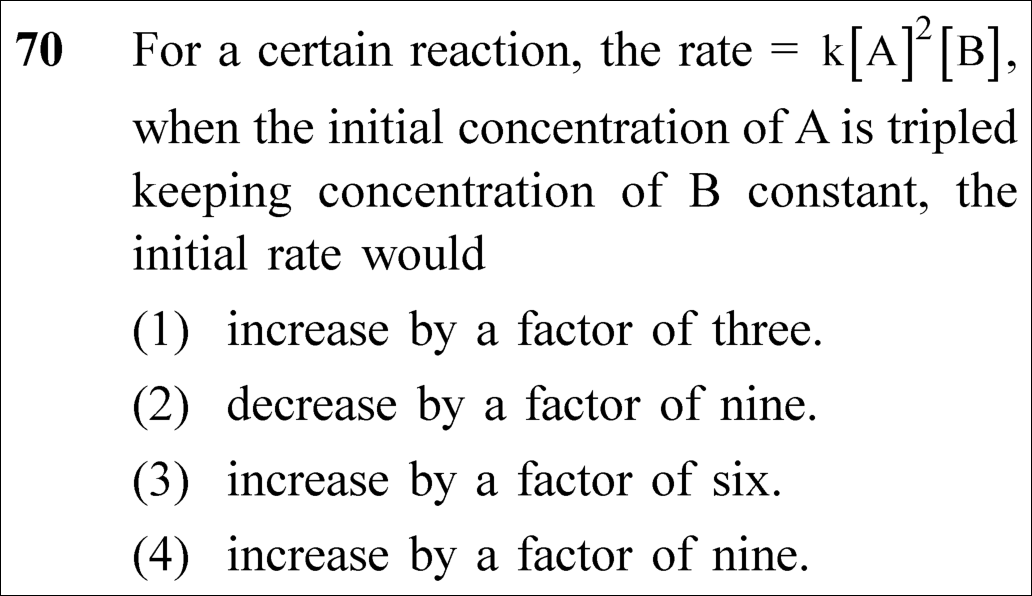
NEET 2023 · Q70 Easy
Official NEET 2023 Question 70 - Chemical Kinetics
1
2
3
4 ✓ Key
💡 Verified Solution & 30-Second Hack
✓
Verified Against NTA Final Answer Key
Option (4) : increase by a factor of nine.
📚 Chemical Kinetics Easy
📋 Given Parameters & Problem Setup
Differential rate law Rate = k [A]² [B]
Change in [A] [A]' = 3 [A] (tripled)
Change in [B] [B]' = [B] (held constant)
⚡

The 30-Second Exam Hall Shortcut: ⚡ Exponent Scaling Rule: Rate ∝ [A]² ⟹ 3² = 9

⏱️ Save ~25 seconds

The reaction is second-order with respect to A: Rate ∝ [A]². Tripling [A] multiplies the rate by 3² = 9! The initial rate increases by a factor of nine in 5 seconds!

1 Inspect the order with respect to reactant A from the rate law: Rate = k [A]² [B].
2 The exponent on [A] is 2 (second-order with respect to A).
3 When concentration [A] is multiplied by factor 3:
4 Rate' = k (3[A])² [B] = 3² × (k [A]² [B]) = 9 × Rate.
5 The rate increases by a factor of nine.
6 Lock Option (4) increase by a factor of nine immediately!
🛡️
Why You Can 100% Trust This Shortcut: Chemical Kinetics · Rate Law and Reaction Order (For an n-th order reactant, multiplying concentration by factor m scales the rate by mⁿ).
📐

Step-by-Step Rigorous Workflow & Mathematical Proof

Step 1

Initial Rate Formulation

According to the given rate law, the initial rate of reaction r₁ at initial reactant concentrations [A] and [B] is:

r1=k[A]2[B]r_1 = k [A]^2 [B]
Step 2

New Rate Formulation Under Modified Concentration

The initial concentration of A is tripled while [B] remains strictly constant:

[A]′=3[A],[B]′=[B][A]' = 3[A], \qquad [B]' = [B]
Step 3

Substitution into the Rate Law

Substituting the new concentrations into the rate equation gives the new initial rate r₂:

r2=k[A′]2[B′]=k(3[A])2[B]=k(9[A]2)[B]=9(k[A]2[B])r_2 = k [A']^2 [B'] = k (3[A])^2 [B] = k \left(9 [A]^2\right) [B] = 9 \left(k [A]^2 [B]\right)
Step 4

Comparison and Factor Evaluation

Comparing r₂ with r₁:

r2=9 r1  ⟹  The rate increases by a factor of 9r_2 = 9\, r_1 \implies \text{The rate increases by a factor of 9}
⭐

360° Option Elimination Engine Key Feature

Diagnose every choice: Know exactly why the right option works and why distractors fail.

4-Option Deep Scan
1 (1)
✗ Incorrect
Verdict & Scientific Reason:

Linear scaling: assumes first-order with respect to A instead of second-order.

⚠️
Student Fallacy (Why candidates pick this trap): Candidate treated the exponent on [A] as 1 rather than 2.
2 (2)
✗ Incorrect
Verdict & Scientific Reason:

Claims rate decreases despite increasing reactant concentration.

⚠️
Student Fallacy (Why candidates pick this trap): Candidate inverted the rate relationship.
3 (3)
✗ Incorrect
Verdict & Scientific Reason:

Multiplication slip: candidate computed 3 × 2 = 6 instead of 3² = 9.

⚠️
Student Fallacy (Why candidates pick this trap): Candidate multiplied concentration factor by exponent instead of raising to power.
4 (4)
✓ 100% Correct
Verdict & Scientific Reason:

Accurate: Second-order scaling yields 3² = 9 times the initial rate.

💡
Why this is airtight: None. Candidate correctly squared the tripling factor.
⚠️

NTA Trap Alert: Multiplying by the Exponent (3 × 2 = 6) Instead of Raising to Power (3² = 9)

Students who rush through kinetics frequently compute (3 × 2 = 6) and pick Option (3) "increase by a factor of six". The rate law is an exponential power relationship, NOT a linear multiplication!

🛡️ How to avoid the -1 mark: Remember: It is a POWER: (Factor)^Order = 3² = 9, never 3 × 2.
📖

Core NEET Syllabus Standard

National Eligibility cum Entrance Test (NEET UG) · Chemical Kinetics Standard Benchmark
Core Scientific Principle Tested:

"In rate law r = k[A]^x[B]^y, changing [A] by factor m changes rate by m^x."

Syllabus Focus: Rate Law and Order of Reaction
Preserved in Rationalized Curriculum Syllabus & Academic Standards ↗
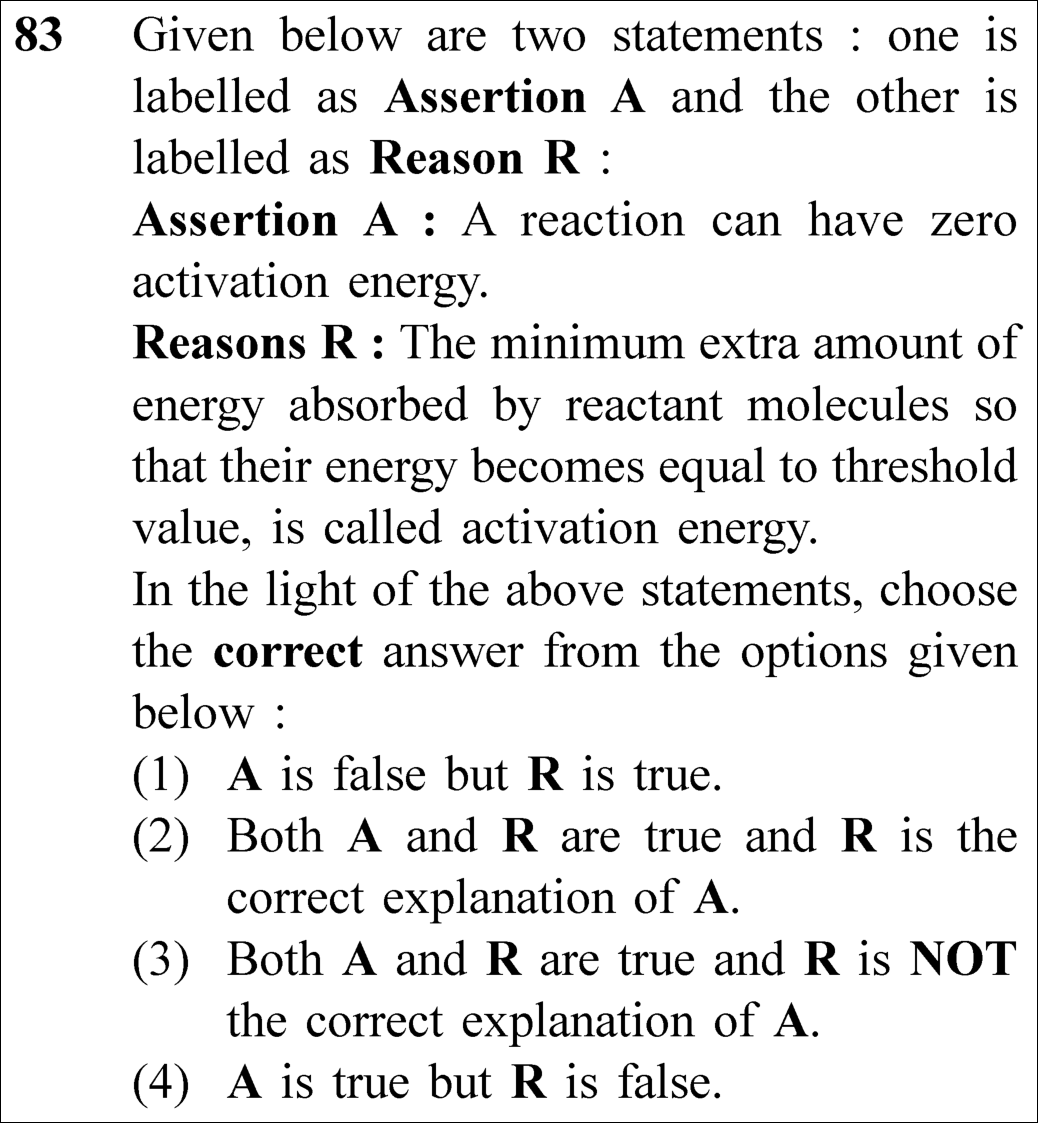
NEET 2023 · Q83 Medium
Official NEET 2023 Question 83 - Chemical Kinetics
1 A is false but R is true. ✓ Key
2 Both A and R are true and R is the correct explanation of A.
3 Both A and R are true and R is NOT the correct explanation of A.
4 A is true but R is false.
💡 Verified Solution & 30-Second Hack
✓
Verified Against NTA Final Answer Key
Option (1) : A is false but R is true.
📚 Chemical Kinetics Medium
📋 Given Parameters & Problem Setup
Assertion A A reaction can have zero activation energy.
Reason R The minimum extra amount of energy absorbed by reactant molecules so that their energy becomes equal to threshold value, is called activation energy.
⚡

The 30-Second Exam Hall Shortcut: ⚡ Chemical Kinetics Rule: Every Reaction Requires Finite Activation Energy (Ea > 0)

⏱️ Save ~25 seconds

Arrhenius equation k = A·e^(-Ea/RT) dictates that if Ea = 0, rate constant k = A, meaning rate is completely independent of temperature — which is impossible for chemical transformations involving bond reorganization. Hence Assertion is FALSE. Reason is the verbatim NCERT definition: Ea = E(threshold) - E(reactants) (TRUE). Lock Option (1)!

1 Evaluate Assertion A: Chemical reactions require energy to cross a transition state barrier; Ea cannot be zero in canonical curriculum. Assertion is FALSE.
2 Evaluate Reason R: "The minimum extra amount of energy absorbed by reactant molecules so that their energy becomes equal to threshold value, is called activation energy." This is the exact NCERT textbook definition (TRUE).
3 Match: A is false but R is true (Option 1).
🛡️
Why You Can 100% Trust This Shortcut: Official NTA Final Answer Key & NCERT Chemical Kinetics Collision Theory.
📐

Step-by-Step Rigorous Workflow & Mathematical Proof

Step 1

Analyze Assertion A Using Arrhenius Theory

According to the Arrhenius equation, if activation energy were zero (Ea = 0), the rate constant would equal the frequency factor A and become temperature-independent:

k=Ae−EaRT→Ea=0k=Ae0=Ak = A e^{-\frac{E_a}{RT}} \xrightarrow{E_a = 0} k = A e^0 = A
Step 2

Physical Feasibility of Zero Activation Energy

For any chemical reaction involving breaking of chemical bonds and formation of new bonds, a finite energy barrier must be crossed. Therefore, a chemical reaction cannot have zero activation energy. Assertion A is FALSE:

Ea>0(Mandatory energy barrier for chemical reactions)E_a > 0 \quad (\text{Mandatory energy barrier for chemical reactions})
Step 3

Analyze Reason R via Collision Theory

Activation energy (Ea) is formally defined as the minimum excess energy that reactant molecules must absorb to acquire threshold energy (E_threshold) required for effective collisions. Reason R is TRUE:

Ea=Ethreshold−EreactantsE_a = E_{\text{threshold}} - E_{\text{reactants}}
⭐

360° Option Elimination Engine Key Feature

Diagnose every choice: Know exactly why the right option works and why distractors fail.

4-Option Deep Scan
1 (1)
✓ 100% Correct
Verdict & Scientific Reason:

Accurate: Chemical reactions require a finite activation barrier (Ea > 0), whereas Reason correctly defines activation energy.

💡
Why this is airtight: None. Candidate recognized that chemical reactions cannot proceed with zero activation energy.
2 (2)
✗ Incorrect
Verdict & Scientific Reason:

Assertion A is false under standard Arrhenius kinetic theory.

⚠️
Student Fallacy (Why candidates pick this trap): Candidate confused fast radical recombination reactions with zero activation energy in textbook theory.
3 (3)
✗ Incorrect
Verdict & Scientific Reason:

Assertion A is scientifically false in the context of chemical kinetics curriculum.

⚠️
Student Fallacy (Why candidates pick this trap): Candidate incorrectly assumed Ea = 0 is a valid general chemical phenomenon.
4 (4)
✗ Incorrect
Verdict & Scientific Reason:

Completely inverts the validity of both statements; Reason R is the textbook definition.

⚠️
Student Fallacy (Why candidates pick this trap): Candidate rejected the classical definition of threshold energy.
⚠️

NTA Trap Alert: Confusing Free Radical Recombination with Zero Ea

Some students read advanced physical chemistry and recall that simple combination of free radicals has nearly zero activation barrier. However, NCERT and NTA strictly adhere to classical Arrhenius kinetics: all chemical reactions require activation energy to initiate.

🛡️ How to avoid the -1 mark: In NEET exams, always follow the NCERT guideline: chemical reactions require an activation barrier; Ea = 0 is considered false.
📖

Core NEET Syllabus Standard

National Eligibility cum Entrance Test (NEET UG) · Chemical Kinetics Standard Benchmark
Core Scientific Principle Tested:

"Activation energy represents the energy barrier that reactants must overcome to form products: Ea = E(threshold) - E(reactants)."

Syllabus Focus: Temperature Dependence of Rate of a Reaction – Arrhenius Equation
Preserved in Rationalized Curriculum Syllabus & Academic Standards ↗
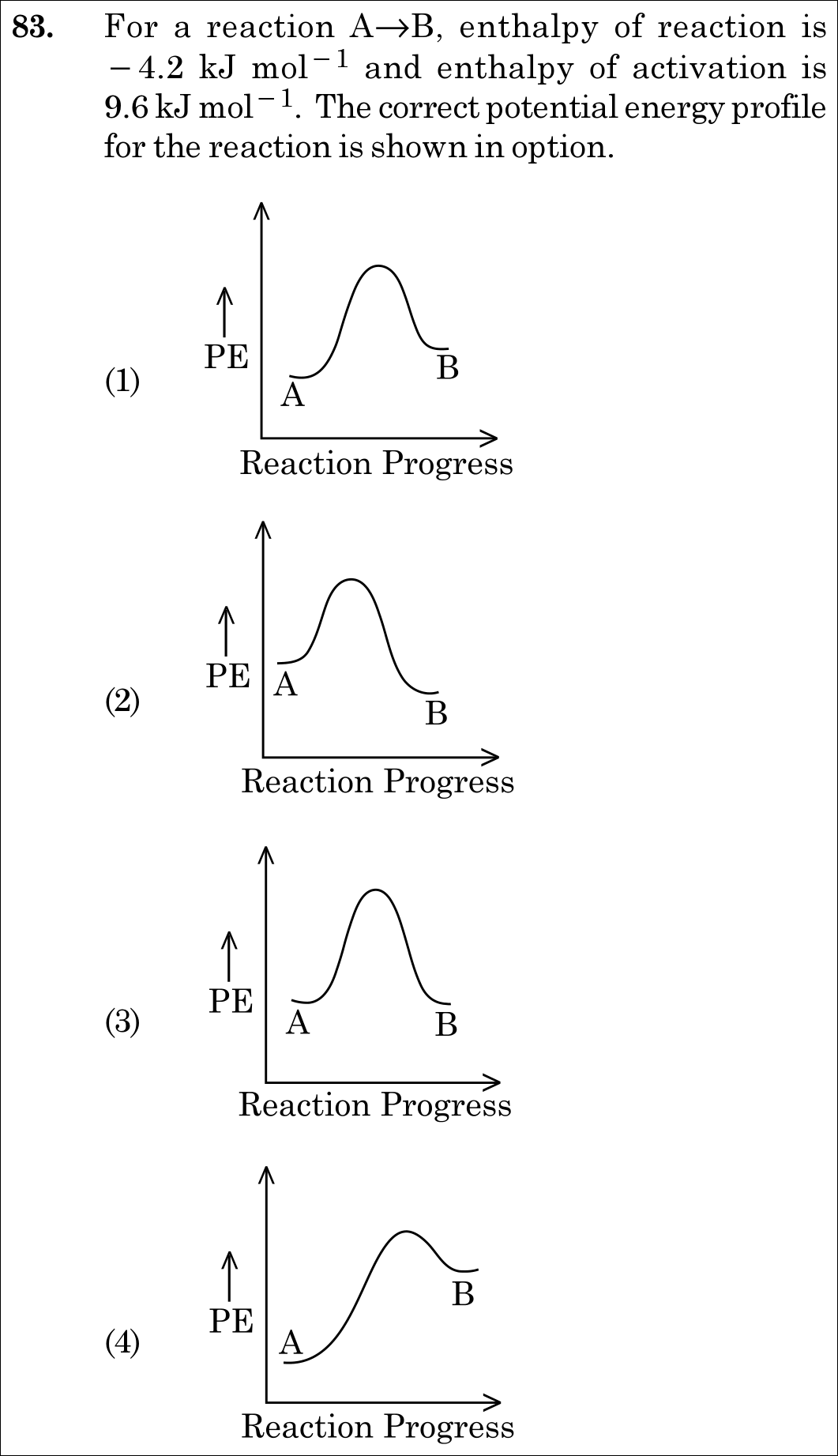
NEET 2021 · Q83 Easy
Official NEET 2021 Question 83 - Chemical Kinetics
1
2 ✓ Key
3
4
💡 Verified Solution & 30-Second Hack
✓
Verified Against NTA Final Answer Key
Option (2) : Graph (2)
📚 Chemical Kinetics Easy
📋 Given Parameters & Problem Setup
Reaction A -> B
Enthalpy of Reaction (ΔH) -4.2 kJ mol^-1 (< 0, exothermic)
Enthalpy of Activation (Ea) 9.6 kJ mol^-1
⚡

The 30-Second Exam Hall Shortcut: ⚡ ΔH < 0 = Exothermic   ⟹  \implies Products (B) Below Reactants (A)

⏱️ Save ~15 seconds

Enthalpy of reaction is ΔH=Hproducts−Hreactants=−4.2 kJ/mol<0\Delta H = H_{\text{products}} - H_{\text{reactants}} = -4.2\text{ kJ/mol} < 0. Negative ΔH\Delta H means the reaction is EXOTHERMIC, which requires products (B) to lie at a LOWER potential energy than reactants (A). In Graph (2), B is lower than A! Match Option (2)!

1 Check the sign of ΔH\Delta H: ΔH=−4.2 kJ mol−1<0  ⟹  \Delta H = -4.2\text{ kJ mol}^{-1} < 0 \implies Exothermic reaction.
2 For an exothermic reaction: Eproducts<EreactantsE_{\text{products}} < E_{\text{reactants}}, meaning point B must be below point A.
3 Inspect the graphs: - Graph (1): B is above A (Endothermic). - Graph (2): B is BELOW A (Exothermic). - Graph (3): B is at the same level as A (ΔH=0\Delta H = 0). - Graph (4): B is above A (Endothermic).
4 Match Graph (2).
5 Match Option (2).
🛡️
Why You Can 100% Trust This Shortcut: Canonical reaction energy coordinate profile from NCERT Chemical Kinetics.
📐

Step-by-Step Rigorous Workflow & Mathematical Proof

Step 1

Sign of Reaction Enthalpy and Thermochemical Classification

For the general transformation A⟶BA \longrightarrow B, the standard enthalpy of reaction is defined as the difference between the potential energy of the products and reactants: ΔH=HB−HA\Delta H = H_B - H_A Given ΔH=−4.2 kJ mol−1<0\Delta H = -4.2\text{ kJ mol}^{-1} < 0, heat is evolved to the surroundings, establishing that the process is exothermic.

Step 2

Relative Potential Energy of Reactants and Products

Because ΔH<0\Delta H < 0: HB−HA<0  ⟹  HB<HAH_B - H_A < 0 \implies H_B < H_A Thus, on the potential energy diagram against reaction coordinate, the baseline energy plateau for product BB must lie strictly below that of reactant AA.

Step 3

Role of Activation Energy

The forward activation enthalpy is Ea=9.6 kJ mol−1E_a = 9.6\text{ kJ mol}^{-1}. Reactant AA must surmount an energy barrier of height 9.6 kJ mol−19.6\text{ kJ mol}^{-1} to reach the activated transition state (A‡A^{\ddagger}) before descending to product BB. Graph (2) correctly depicts this energy barrier with the product plateau BB lower than AA.

⭐

360° Option Elimination Engine Key Feature

Diagnose every choice: Know exactly why the right option works and why distractors fail.

4-Option Deep Scan
1 1
✗ Incorrect
Verdict & Scientific Reason:

Product B lies at higher potential energy than A, representing an ENDOTHERMIC reaction (ΔH>0\Delta H > 0).

⚠️
Student Fallacy (Why candidates pick this trap): Confusing exothermic with endothermic profile.
2 2
✓ 100% Correct
Verdict & Scientific Reason:

Exact profile: potential energy barrier surmounted, with product B lying below reactant A (ΔH<0\Delta H < 0).

💡
Why this is airtight: None; rigorous thermochemical energy profile verification.
3 3
✗ Incorrect
Verdict & Scientific Reason:

Reactant A and product B are at identical energy levels, representing ΔH=0\Delta H = 0.

⚠️
Student Fallacy (Why candidates pick this trap): Assuming ΔH=0\Delta H = 0.
4 4
✗ Incorrect
Verdict & Scientific Reason:

Product B lies above reactant A (endothermic reaction profile).

⚠️
Student Fallacy (Why candidates pick this trap): Misreading the energy levels.
⚠️

NTA Trap Alert: Endothermic vs. Exothermic Visual Reading Trap

Students who focus on the activation energy peak (Ea=9.6 kJ/molE_a = 9.6\text{ kJ/mol}) sometimes forget to compare the final level of BB relative to AA. A negative ΔH\Delta H ALWAYS requires BB to be below AA.

🛡️ How to avoid the -1 mark: Exothermic (ΔH<0\Delta H < 0)   ⟹  B\implies B is LOWER than AA. Endothermic (ΔH>0\Delta H > 0)   ⟹  B\implies B is HIGHER than AA.
📖

Core NEET Syllabus Standard

NCERT Chemistry · Chemical Kinetics Standard Benchmark
Core Scientific Principle Tested:

"In an exothermic reaction, the potential energy of products is lower than that of reactants by ΔH\Delta H."

Syllabus Focus: Temperature Dependence of the Rate of a Reaction (Activation Energy and Reaction Profiles)
✓ Core NEET UG Syllabus Anchor Syllabus & Academic Standards ↗
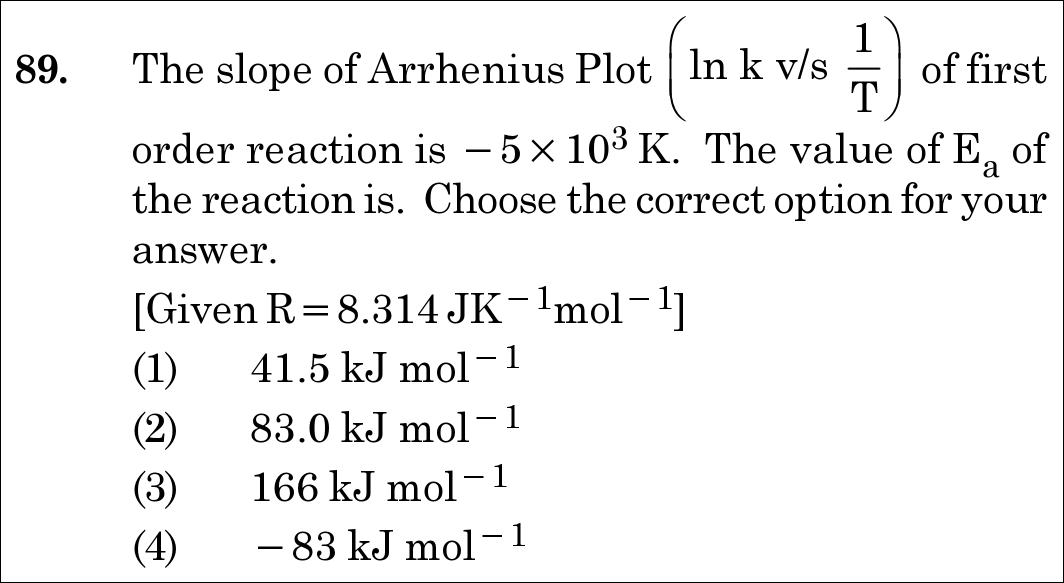
NEET 2021 · Q89 Easy
Official NEET 2021 Question 89 - Chemical Kinetics
1 ✓ Key
2
3
4
💡 Verified Solution & 30-Second Hack
✓
Verified Against NTA Final Answer Key
Option (1) : 41.5 kJ mol^-1
📚 Chemical Kinetics Easy
📋 Given Parameters & Problem Setup
Plot ln k vs 1/T
Slope -5 × 10^3 K
Gas Constant (R) 8.314 J K^-1 mol^-1
⚡

The 30-Second Exam Hall Shortcut: ⚡ Arrhenius Slope: Ea = -Slope × R

⏱️ Save ~20 seconds

For ln⁡k\ln k vs 1/T1/T, the slope is −EaR-\frac{E_a}{R}. Therefore, Ea=−Slope×R=−(−5×10³ K)×8.314 J K−1mol−1=41,570 J mol−1=41.57 kJ mol−1≈41.5 kJ mol−1E_a = -\text{Slope} \times R = -(-5 \times 10^3\text{ K}) \times 8.314\text{ J K}^{-1}\text{mol}^{-1} = 41,570\text{ J mol}^{-1} = 41.57\text{ kJ mol}^{-1} \approx 41.5\text{ kJ mol}^{-1}! Direct 10-second multiplication matching Option (1)!

1 Arrhenius equation in natural log: ln⁡k=ln⁡A−EaRT\ln k = \ln A - \frac{E_a}{RT}.
2 Plot of ln⁡k\ln k vs 1T\frac{1}{T} has slope m=−EaRm = -\frac{E_a}{R}.
3 Equate: −EaR=−5×10³ K  ⟹  Ea=5×103×8.314-\frac{E_a}{R} = -5 \times 10^3\text{ K} \implies E_a = 5 \times 10^3 \times 8.314.
4 Compute: Ea=41,570 J/mol=41.57 kJ/mol≈41.5 kJ/molE_a = 41,570\text{ J/mol} = 41.57\text{ kJ/mol} \approx 41.5\text{ kJ/mol}.
5 Match Option (1).
🛡️
Why You Can 100% Trust This Shortcut: Canonical Arrhenius equation temperature dependence from NCERT Chemical Kinetics.
📐

Step-by-Step Rigorous Workflow & Mathematical Proof

Step 1

Linear Form of Arrhenius Equation

The Arrhenius equation expresses the dependence of the rate constant kk on temperature TT: k=Ae−Ea/RTk = A e^{-E_a / RT} Taking the natural logarithm (ln⁡\ln) of both sides:

ln⁡k=ln⁡A−EaR(1T)\ln k = \ln A - \frac{E_a}{R} \left(\frac{1}{T}\right)
Step 2

Relating Slope to Activation Energy

Comparing this expression with the standard equation of a straight line y=c+mxy = c + mx, where y=ln⁡ky = \ln k and x=1Tx = \frac{1}{T}: - yy-intercept =ln⁡A= \ln A - Slope m=−EaR\text{Slope } m = -\frac{E_a}{R}

Step 3

Calculating Ea in kJ/mol

Given slope =−5×10³ K= -5 \times 10^3\text{ K} and R=8.314 J K−1mol−1R = 8.314\text{ J K}^{-1}\text{mol}^{-1}: −EaR=−5×10³ K  ⟹  Ea=(5×10³ K)×(8.314 J K−1mol−1)-\frac{E_a}{R} = -5 \times 10^3\text{ K} \implies E_a = (5 \times 10^3\text{ K}) \times (8.314\text{ J K}^{-1}\text{mol}^{-1})

Ea=41570 J mol−1=415701000 kJ mol−1=41.57 kJ mol−1≈41.5 kJ mol−1E_a = 41570\text{ J mol}^{-1} = \frac{41570}{1000}\text{ kJ mol}^{-1} = 41.57\text{ kJ mol}^{-1} \approx 41.5\text{ kJ mol}^{-1}
⭐

360° Option Elimination Engine Key Feature

Diagnose every choice: Know exactly why the right option works and why distractors fail.

4-Option Deep Scan
1 1
✓ 100% Correct
Verdict & Scientific Reason:

Exact activation energy: 5×103×8.314=41.57 kJ mol−1≈41.5 kJ mol−15 \times 10^3 \times 8.314 = 41.57\text{ kJ mol}^{-1} \approx 41.5\text{ kJ mol}^{-1}.

💡
Why this is airtight: None; precise kinetic derivation.
2 2
✗ Incorrect
Verdict & Scientific Reason:

Result of multiplying by a factor of 2 (2×41.5=832 \times 41.5 = 83).

⚠️
Student Fallacy (Why candidates pick this trap): Accidental doubling of slope or rate constant.
3 3
✗ Incorrect
Verdict & Scientific Reason:

Factor of 4 error.

⚠️
Student Fallacy (Why candidates pick this trap): Multiple multiplication mistakes.
4 4
✗ Incorrect
Verdict & Scientific Reason:

Negative value (activation energy is strictly positive) with doubling error.

⚠️
Student Fallacy (Why candidates pick this trap): Carrying negative sign to activation energy.
⚠️

NTA Trap Alert: ln k vs. log10 k Slope Formula Trap

If the plot were log⁡10k\log_{10} k vs 1/T1/T, the slope would be −Ea2.303R-\frac{E_a}{2.303 R}. The question explicitly specifies ln⁡k\ln k (natural log), so the slope is simply −EaR-\frac{E_a}{R}. Candidates who insert an unnecessary 2.3032.303 get erroneous values.

🛡️ How to avoid the -1 mark: ln⁡k\ln k vs 1/T  ⟹  1/T \implies Slope =−Ea/R= -E_a/R. log⁡10k\log_{10} k vs 1/T  ⟹  1/T \implies Slope =−Ea/(2.303R)= -E_a/(2.303 R).
📖

Core NEET Syllabus Standard

NCERT Chemistry · Chemical Kinetics Standard Benchmark
Core Scientific Principle Tested:

"A plot of ln k vs 1/T gives a straight line with slope equal to -Ea/R."

Syllabus Focus: Temperature Dependence of the Rate of a Reaction (Arrhenius Equation)
✓ Core NEET UG Syllabus Anchor Syllabus & Academic Standards ↗
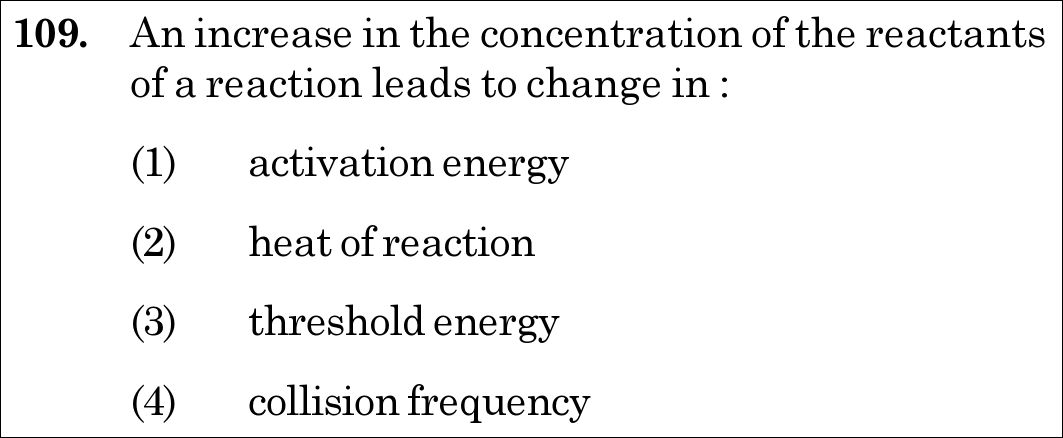
NEET 2020 · Q109 Easy
Official NEET 2020 Question 109 - Chemical Kinetics
1 activation energy
2 heat of reaction
3 threshold energy
4 collision frequency ✓ Key
💡 Verified Solution & 30-Second Hack
✓
Verified Against NTA Final Answer Key
Option (4) : collision frequency
📚 Chemical Kinetics Easy
📋 Given Parameters & Problem Setup
Manipulated Variable Increase in concentration of reactants
Candidate Reaction Properties Activation energy, heat of reaction, threshold energy, collision frequency
Question Objective Identify which parameter changes
⚡

The 30-Second Exam Hall Shortcut: ⚡ "More Molecules in Same Volume = MORE COLLISIONS PER SECOND (Collision Frequency)!"

⏱️ 20 seconds

Activation energy and threshold energy are intrinsic kinetic energy barriers characteristic of the reaction pathway (altered only by catalysts). Heat of reaction (ΔH\Delta H) is a state function dependent on temperature, independent of concentration. Increasing reactant concentration crowds more molecules per unit volume, directly increasing the COLLISION FREQUENCY (ZZ)! Mark Option (4) in 5 seconds.

1 Activation energy (Ea) depends only on nature of reaction and catalyst.
2 Threshold energy = Et = Ea + average initial energy, independent of concentration.
3 Heat of reaction (ΔH) is a standard molar thermodynamic property.
4 Collision frequency (Z) is the number of collisions per second per unit volume: Z ∝ [A][B].
5 Increasing reactant concentration directly increases collision frequency.
6 Select Option (4).
🛡️
Why You Can 100% Trust This Shortcut: NCERT Chemistry · Chemical Kinetics (Collision Theory of Chemical Reactions)
📐

Step-by-Step Rigorous Workflow & Mathematical Proof

Step 1

Define Collision Frequency

According to collision theory, the collision frequency (ZZ) is defined as the number of collisions per second per unit volume of the reacting mixture. For a bimolecular reaction A+B→ProductsA + B \to \text{Products}, the collision frequency is directly proportional to the product of molar concentrations: ZAB∝[A][B]Z_{AB} \propto [A][B].

Step 2

Impact of Increasing Reactant Concentration

When the concentration of reactants is increased, the number of reactant particles per unit volume increases. As a consequence, molecules collide more frequently with each other, leading to a direct increase in the collision frequency (ZZ).

Step 3

Evaluate Activation Energy and Threshold Energy

Activation energy (EaE_a) is the minimum extra energy required by reactant molecules to reach the activated transition state. It is an intrinsic feature of the reaction mechanism and is completely independent of reactant concentration (changed only by a catalyst).

Step 4

Evaluate Heat of Reaction

Heat of reaction (ΔrH\Delta_r H) is the difference in enthalpy between products and reactants per mole. It is a thermodynamic property determined by chemical bond energies, not affected by initial concentration.

⭐

360° Option Elimination Engine Key Feature

Diagnose every choice: Know exactly why the right option works and why distractors fail.

4-Option Deep Scan
1 A
✗ Incorrect
Verdict & Scientific Reason:

Incorrect; activation energy (EaE_a) is independent of concentration and can only be lowered by adding a catalyst.

⚠️
Student Fallacy (Why candidates pick this trap): Confusing reaction rate acceleration with lowering of activation energy.
2 B
✗ Incorrect
Verdict & Scientific Reason:

Incorrect; molar heat of reaction (ΔH\Delta H) is an intrinsic thermodynamic state function independent of reactant concentration.

⚠️
Student Fallacy (Why candidates pick this trap): Confusing total heat released in a beaker with molar heat of reaction.
3 C
✗ Incorrect
Verdict & Scientific Reason:

Incorrect; threshold energy is the total energy threshold needed for fruitful reaction, independent of particle concentration.

⚠️
Student Fallacy (Why candidates pick this trap): Believing higher concentration provides extra energy to individual molecules.
4 D
✓ 100% Correct
Verdict & Scientific Reason:

Factually and physically exact; crowding more molecules per unit volume directly raises the number of collisions per second (collision frequency).

💡
Why this is airtight: None; core kinetic collision theory statement.
⚠️

NTA Trap Alert: Rate of Reaction vs Kinetic Parameters

Increasing concentration increases the RATE because it increases COLLISION FREQUENCY (ZZ). It does NOT change EaE_a, kk, or ΔH\Delta H!

🛡️ How to avoid the -1 mark: Concentration affects: Collision Frequency & Rate. Catalyst affects: Activation Energy & Rate constant!
📖

Core NEET Syllabus Standard

Chemistry · Chemical Kinetics Standard Benchmark
Core Scientific Principle Tested:

""

Syllabus Focus: Collision Theory: Reactant Concentration Directly Increases Collision Frequency (Z)
✓ Core NEET UG Syllabus Anchor Syllabus & Academic Standards ↗
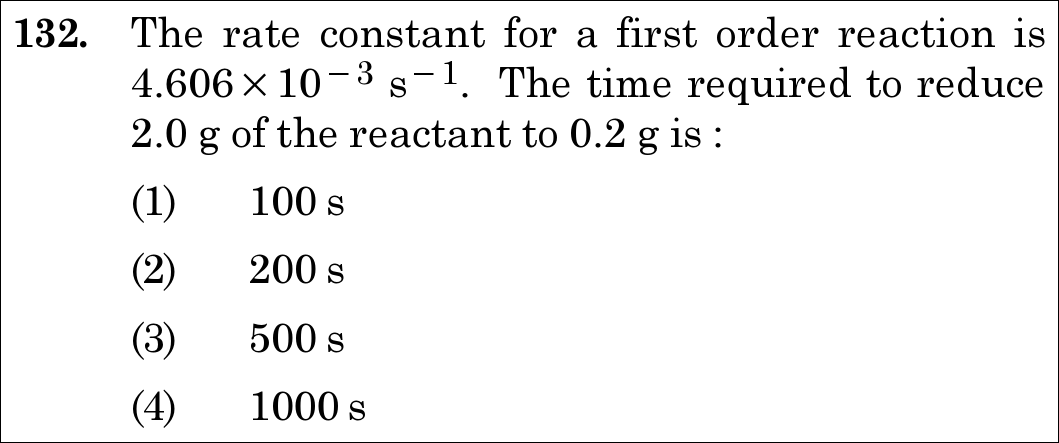
NEET 2020 · Q132 Easy
Official NEET 2020 Question 132 - Chemical Kinetics
1
2
3 ✓ Key
4
💡 Verified Solution & 30-Second Hack
✓
Verified Against NTA Final Answer Key
Option (3) : 500 s
📚 Chemical Kinetics Easy
📋 Given Parameters & Problem Setup
Reaction Order First order
Rate Constant (k) 4.606 × 10^-3 s^-1
Initial Amount [R]0 2.0 g
Remaining Amount [R] 0.2 g
Integrated Rate Formula t = (2.303 / k) × log([R]0 / [R])
⚡

The 30-Second Exam Hall Shortcut: ⚡ "Ratio [R]0/[R] = 2.0 / 0.2 = 10 -> log(10) = 1; t = 2.303 / (4.606 × 10^-3) = 500 s!"

⏱️ 25 seconds

The integrated rate equation for a first order reaction is t=2.303klog⁡([R]0[R])t = \frac{2.303}{k} \log\left(\frac{[R]_0}{[R]}\right). Here, the concentration ratio is 2.00.2=10\frac{2.0}{0.2} = 10, and log⁡(10)=1\log(10) = 1. Therefore, t=2.3034.606×10−3×1=12×10−3=10002=500 st = \frac{2.303}{4.606 \times 10^{-3}} \times 1 = \frac{1}{2 \times 10^{-3}} = \frac{1000}{2} = 500\text{ s}! Mark Option (3) in 10 seconds.

1 Formula: t = (2.303 / k) × log([R]0 / [R]).
2 Substitute concentrations: [R]0 = 2.0 g, [R] = 0.2 g.
3 Ratio: [R]0 / [R] = 2.0 / 0.2 = 10.
4 log(10) = 1.
5 Calculate: t = 2.303 / (4.606 × 10^-3) = 1 / (2 × 10^-3) = 500 s.
6 Select Option (3).
🛡️
Why You Can 100% Trust This Shortcut: NCERT Chemistry · Chemical Kinetics (Integrated Rate Equations: First Order Reactions)
📐

Step-by-Step Rigorous Workflow & Mathematical Proof

Step 1

State Integrated Rate Law for First Order Reaction

For a first order reaction R→ProductsR \to \text{Products}, the integrated rate equation in common logarithmic form is: k=2.303tlog⁡([R]0[R])  ⟹  t=2.303klog⁡([R]0[R])k = \frac{2.303}{t} \log\left(\frac{[R]_0}{[R]}\right) \implies t = \frac{2.303}{k} \log\left(\frac{[R]_0}{[R]}\right)

Step 2

Insert Given Quantities

Given: - Rate constant k=4.606×10⁻³ s−1k = 4.606 \times 10^{-3}\text{ s}^{-1} - Initial mass of reactant [R]0=2.0 g[R]_0 = 2.0\text{ g} - Final mass of reactant remaining [R]=0.2 g[R] = 0.2\text{ g} (Notice that for a given volume, the ratio of masses is identical to the ratio of molar concentrations).

Step 3

Evaluate the Logarithmic Term

[R]0[R]=2.00.2=10\frac{[R]_0}{[R]} = \frac{2.0}{0.2} = 10 log⁡(10)=1\log(10) = 1

Step 4

Calculate Time (t)

t=2.3034.606×10−3×1t = \frac{2.303}{4.606 \times 10^{-3}} \times 1 Notice that 4.606=2×2.3034.606 = 2 \times 2.303: t=12×10−3=10002=500 secondst = \frac{1}{2 \times 10^{-3}} = \frac{1000}{2} = 500\text{ seconds} This confirms Option (3).

⭐

360° Option Elimination Engine Key Feature

Diagnose every choice: Know exactly why the right option works and why distractors fail.

4-Option Deep Scan
1 A
✗ Incorrect
Verdict & Scientific Reason:

Incorrect; arithmetic error in dividing 1000 by 2.

⚠️
Student Fallacy (Why candidates pick this trap): Dividing by 10 instead of 2.
2 B
✗ Incorrect
Verdict & Scientific Reason:

Incorrect; inverts the factor of 2 or forgets to account for log⁡(10)\log(10).

⚠️
Student Fallacy (Why candidates pick this trap): Multiplying by 2 instead of dividing.
3 C
✓ 100% Correct
Verdict & Scientific Reason:

Factually and mathematically exact; t=2.3034.606×10−3=500 st = \frac{2.303}{4.606 \times 10^{-3}} = 500\text{ s}.

💡
Why this is airtight: None; clean cancellation of 2.303 into 4.606.
4 D
✗ Incorrect
Verdict & Scientific Reason:

Incorrect; neglects the factor of 2 (4.606/2.303=24.606 / 2.303 = 2) in the denominator.

⚠️
Student Fallacy (Why candidates pick this trap): Forgetting that 4.606 is double of 2.303.
⚠️

NTA Trap Alert: Numerical Cancellation Landmark

NTA intentionally uses k=4.606×10⁻³k = 4.606 \times 10^{-3} because 4.606/2.303=24.606 / 2.303 = 2 exactly! Do not waste time doing long division by hand.

🛡️ How to avoid the -1 mark: Spot the multiple: 2.303/4.606=1/22.303 / 4.606 = 1/2!
📖

Core NEET Syllabus Standard

Chemistry · Chemical Kinetics Standard Benchmark
Core Scientific Principle Tested:

""

Syllabus Focus: First Order Kinetics: Time Required for 90% Reactant Reduction
✓ Core NEET UG Syllabus Anchor Syllabus & Academic Standards ↗

Solve 4 NEET Questions a Day — One per Subject

Cover all 1,140 official NEET questions in 285 days at your own pace. Progress is saved on your device. No login needed.